Cite as: McLeay, H., O'Driscoll-Tole, K. and Jones K. (1998), Using imagery to solve spatial problems, Proceedings of the British Society for Research into Learning Mathematics, 18(3), 83-88.
BSRLM Geometry Working Group
Convenor: Keith Jones, University of Southampton, UK
Using Imagery to Solve Spatial Problems
A report based on the meeting at the University of Leeds, 14th November 1998 by
Heather McLeay, University of Wales Bangor Kim O'Driscoll-Tole, University of Strathclyde
Keith Jones, University of Southampton
This report focuses on the use of imagery to solve a range of spatial problems. The research projects reviewed in this report offer some insight into the range of strategies used by solvers of spatial problems and point to relationships between spatial and verbal skills.
Introduction
An important issue in the development of geometrical reasoning is how imagery is used when solving spatial problems (Jones and Bills 1998). Here, imagery is used in the way defined by Wheatley (1991): “constructing an image from pictures, words or thoughts; re-presenting the image as needed; transforming that image”. This report examines two areas of research which may shed some light on this question. The first area of research is concerned with the use of imagery when solving problems involving knots. The second area of research is looking at identifying spatial skills that underpin the 5-14 mathematics curriculum in Scotland. Both these research projects illustrate the range of strategies involved in solving spatial problems and point to relationships between spatial and verbal skills.
Using imagery to solve knot problems
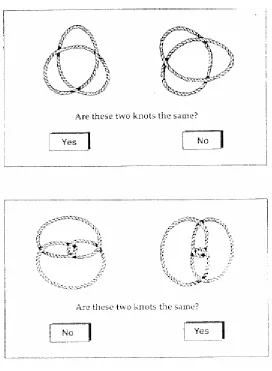
The first question the working group tackled was ‘how do we use imagery to solve knot problems?’ Members of the group were asked to try to solve mentally some comparison knot tasks which could involve deciding whether crossings in knot diagrams were the same or not (see Figure 1, overleaf). A strategy used by some people present was to see if the diagrams would ‘undo’.
A second challenge for the group was to see if they were able to follow a sequence of diagrams where a rope was moved sideways and rotated through 180 degrees (see Figure 2, overleaf). Some members of the working group had trouble with this task at first but ‘saw’ how it worked after a while.
A pilot study by McLeay and Piggins (1996) showed that different strategies might be used to solve this kind of knot problem. These strategies can be described in the following way
Rotation
Figure 1: Are these two knots the same?
Figure 2: Can you make the mirror image of the first knot?
Unravelling
Unravelling systematically to remove crossings. For unknots, solvers may notice ‘superfluous’ crossings and manipulate the image so as to remove crossings and eventually arrive at a simple loop.
Recognition of a knot or unknot by its global shape. Solvers learn to recognise the knot and identify it generically.
Matching crossings
Directly matching crossings according to their relative positions in each of the stimulus pair. Solvers may encode a verbal description or a perceptual organisation of information such as “The crossing at the ‘base’ has the rope on top as it goes down from right to left”.
Identifying sequences of crossings
Identifying sequences of crossings from the relative ordering of ‘under’ and ‘over’ elements in a configuration. Solvers may notice that the crossings in one figure have a sequence over, under, over, under, . . . , whereas the other of the pair has a different sequence.
In the working group, some discussion followed about what kinds of spatial ability we use in solving these problems - does it involve pictorial or verbal processing?
Further discussion ensued regarding the question ‘is there a link between being good at spatial problems and general problem-solving skills?’ This hypothesis, that imagery aids creative problem solving in unfamiliar problems, is supported in the psychology literature. Kaufmann (1985, page 58) states;
It may now be argued that the location of verbal and visual symbolic representation on the two dimensions of ‘level of processing’ and ‘type of processing’ may be seen to point in the same direction in relation to the novelty parameter in problem solving. Linguistic representation is the more appropriate and economical the higher the degree of task familiarity. With increasing situational novelty, the functional significance of visual imagery will increase.
Kaufmann (1985) further states that imagery has its most important function in the initial phase of the problem solving process.
Brown and Wheatley (1989) report that students who achieved above average scores on standard mathematics tests but who had low spatial ability were poor at problem solving. In a later paper Wheatley (1991, page 35) states;
… students with high spatial ability whose performance was average or below on standardized mathematics tests and in school mathematics class had an excellent grasp of mathematical ideas and were able to solve non-routine problems, often creatively.
manipulating mental models they may begin to use words as ‘pointers’ to important operations and to think without re-presenting the operations.
… familiar problems might be solved by referring to verbally encoded propositions or procedures, by-passing the spatial like thinking required to use the underlying mental model.
but he emphasises that:
… even though such thinking may appear strictly verbal, for it to be conceptually meaningful and powerful enough to encompass novel situations, it must be based - at some level - on operations with mental models. (Battista 1994, page 93)
On the question of generalisability and does working with knots generate general skills, the evidence has yet to be produced, but the fact that the solvers in Heather McLeay's experiments (1998 and work in progress) became proficient at the tasks suggests, at least, that the mental manipulation skills required are teachable.
Assessing spatial imagery
In this section we look at some recent and ongoing research examining what skills and strategies are displayed by pupils when attempting spatial tasks within the context of tessellations, nets, perspective, and symmetry.
A major component of the National Guidelines for Mathematics 5-14 in Scotland is Space, Position and Movement which requires pupils to demonstrate a considerable range of spatial skills and concepts. Research conducted in Scotland (at Primary Seven and Secondary Two) by O'Driscoll-Tole (1998) has explored a variety of spatial test items. In these tests, pupils were encouraged to draw, write down, or describe verbally the strategies and spatial imagery they had used when solving the tasks. O'Driscoll-Tole found that a range of successful and unsuccessful strategies were displayed by pupils when solving spatial tasks. There were several issues that emerged from the data that have implications for the effective teaching of spatial skills. These include the importance of visual vocabulary, the experience of working in three dimensions, and the development of accurate drawing skills.
For example, not only was a considerable variation in drawing skills found, but it appeared that these skills might be important factors in the successful completion of a task. Some pupils were not only able to verbalise but could illustrate pictorially the strategy they had used. This was particularly noticeable for the most spatially able pupils.
a shape they might not have access to the technical mathematical language to name a particular shape.
The confidence and ability to work in three dimensional space also seemed to distinguish some pupils from others, with performance deteriorating when working with three dimensions. For example, many pupils had difficulties making physical arrangements of three dimensional shapes in space. Some pupils were unable to measure all three dimensions of a solid, or arrangement of solids.
Examples of successful visual strategies included rotating images in the mind, visualising a net folded, and imagining looking at a shape from a new perspective.
Concluding comments
Spatial problems can involve linguistic aspects in their description. A verbal or written solution to a spatial problem may also be required in some circumstances. Yet the relationship between spatial and linguistic skills is complex. Clausen-May and Smith (1998 p1) point to the work of MacFarlane Smith who suggested that “rather being independent, spatial and linguistic abilities were to some extent opposed, with the consequence that the spatially gifted would be more likely than average to have poor linguistic abilities and vice versa”.
As Clements and Battista (1992 p446) observe, while the construction of images is certainly affected by existing cognitive structure, it would be “helpful to know more about how this actually occurs and whether it can be controlled”. They go on to suggest that, if we accept that images are based on actions, then:
• by what mechanism(s) are images derived from these actions?
• is the image of an object simply a replay of the sequence of actions involved in perceiving it?
• how are images generated in the absence of objects?
• what psychological mechanisms support the representation of an image?
Such questions may provide a suitable programme for research and will inform further work of the BSRLM geometry working group.
References
Battista, M. T. (1994), On Greeno’s environmental/model view of conceptual domains: a spatial/geometric perspective. Journal for Research in Mathematics Education, 25 (1), 86-94.
Clausen-May, T. and Smith, P. (Eds) (1998), Spatial Ability: a handbook for teachers. Slough: NFER.
Clements, D. H. and Battista, M. T. (1992), Geometry and Spatial Reasoning. In D. A. Grouws (Ed), Handbook of Research on Mathematics Teaching and Learning. New York: Macmillan.
Jones, K. and Bills, C. (1998), Visualisation, Imagery, and the Development of Geometrical Reasoning. Proceeding of the British Society for Research into Learning Mathematics, 18(1&2), 123-128.
Kaufmann, G. (1985), A Theory of Symbolic Representation in Problem Solving. Journal of Mental Imagery, 9(2), 51-70.
McLeay, H. and Piggins, D. (1996), The Mental Manipulation of 2-D Representations of Knots as Deformable Structures. Educational Studies in Mathematics, 30(4), 399-414.
McLeay, H. and Piggins, D. (1998), Mental Unknotting. Perceptual and Motor Skills, 86, 707-719.
O'Driscoll-Tole, K., (1998), Identifying Spatial Skills That Underpin The 5-14 Mathematics Curriculum in Scotland. Presentation to the 1998 conference of the Scottish Educational Research Association held at the University of Dundee. Wheatley, G. H. (1991), Enhancing Mathematics Learning Through Imagery.
Arithmetic Teacher, 39(1), 34-36.
BSRLM Geometry Working Group
The BSRLM geometry working group focuses on the teaching and learning of geometrical ideas in its widest sense. The aim of the group is to share perspectives on a range of research questions which could become the basis for further collaborative work. Suggestions of topics for discussion are always welcome. The group is open to all.
Contact: Keith Jones, University of Southampton, Research and Graduate School of Education, Highfield, Southampton, SO17 1BJ, UK.