Maximizing the SIMD Behavior in SPMD Engines
Cˇalin Bˆıra, Liviu Gugu, Mihaela Malit¸a, Gheorghe M. S¸tefan
Abstract—Almost all one-chip parallel architectures are un-able to reach a maximum degree of parallelism in performing real applications, mainly due to their weak or too costly support for interconnections between the computational cells. Minimizing or “hiding” the inter-cell communication, totally or partially, is the way we use to improve the degree of parallelism. Few typical algorithms – AES encryption, FFT, Batcher’s mergesort – are adapted for this purpose. Our approach is supported by a fine grain cellular structure – implemented as the Connex system – featured with enough big local data memory. A high level architectural description for the SPMD system Connex, and a simulator in SCHEME are used to write and evaluate our approach.
Index Terms—parallel computing, parallel algorithms, AES, FFT, Batcher’s sort.
I. INTRODUCTION
F
LYNN’S taxonomy makes the life difficult for now a days parallel machine designers. A really efficient architecture always falls in the interval between categories. It is the case for one of the most used parallel style of computation: SPMD (Single-Program-Multiple-Data). Some people consider it as a generalized SIMD, other people claim it is a subcategory of MIMD. In this paper, we consider the cellular systemConnex, designed as a generalized SIMD able to perform predicated SPMD executions. It is implemented as a linear array, of small and simple cells1.For the purpose of our approach we defined the functional high level architectural description Connex High Level Ar-chitecture (CHLA), described in SCHEME. CHLA allows different low level organizations, each having its own ISA. CHLA is also justified by a specific feature of the Connex approach: between the register level and the main memory level a large vector buffer is considered. Thus, the Connex architecture is an actual update of SWAR (SIMD Within A Register) architecture [4]. Let us call it SWAM – SIMD Within A Memory.
A many-cell organization is the premise for accelerating data intense computations, but such an organization does not guarantee the performance without a special care for how data is exchanged between cells in the array or between the array and the external memory. For example, a many-cell engine is able to solve very efficiently the problem of performing a big number of arithmetic operations requested by the FFT algorithm, but how the intermediary results
Manuscript received July 23, 2013.
Cˇalin Bˆıra is with the Politehnica University of Bucharest, Bucharest, Romania, e-amil:[email protected].
Liviu Gugu is with On Semiconductor, Bucharest, Romania, e-amil:
Mihaela Malit¸a is with theSaint Anselm College, Manchester, NH, USA, e-mail:[email protected].
Gheorghe M. S¸tefan is with the Politehnica University of Bucharest, Bucharest, Romania, e-amil:[email protected].
1A version, called ConnexArrayT M, designed and implemented in silicon for HDTV applications, is described in [8], [9].
are exchanged between cells, according to the “butterfly connections”, is a non-trivial problem.
[image:1.595.383.469.237.325.2]More generally, when SPMD is supported by an improved SIMD organization, efficiency is obtained only maximizing the pure SIMD execution. The goal of this paper is to provide simple tricks for hiding the costly inter-cell data exchange operations or inefficient predicated executions.
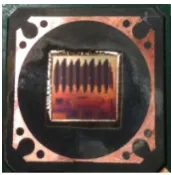
Fig. 1. BA1024 chip
The CHLA is developed and evaluated based on a previous actual implementations of the one chip parallel engine – the 1024-cellConnexsystem BA1024 (see Figure 1) – designed for HDTV applications [10] [8] [9] [6].
II. ConnexHIGHLEVELARCHITECTURE
The high level architectural view of the Connex p-cell system is expressed and simulated using a functional lan-guage (we selected a restricted version of SCHEME). The user’s image of the system consists of two arrays defining two distinct memory domains:
• Sdomain: an array of scalarsS=< s0, s1, . . . , sn−1>, theexternal memory
• V domain: an array of vectors as the internal vector bufferV =< v0, v1, . . . , vm−1, ix >, a two-dimension array containing m p-scalar horizontal vectors dis-tributed along the linear array of cells:
v0=< x00, . . . , x0p−1>
v1=< x10, . . . , x1p−1>
. . .
vm−1=< xm−1 0, . . . , xm−1p−1> and theindexvector ix=<0,1, ..., p−1>.
Each “column” in the array V,wi =< x0i, . . . , xm−1i >,
is avertical vectorof scalars associated to celli.
CHLA hides to the user the vector register level and the scalar register level operations. Three independent sub-architectures are defined in CHLA:
• data processing sub-architecture: functions defined on V andS returning values inV or S
• data transfersub-architecture: functions used to transfer data betweenV andS
A. Data processing sub-architecture
Data processing sub-architecture defines functions per-formed on vectors, scalars or specific scalar-vector combi-nations. The main functions are:
• (ResetActive): activates all the components of the
vectors involved in the operation that will be executed
• (Where x): keep active, from the active vector
com-ponents, only the vector components where the Boolean vector xreturns 1
• (ElseWhere): keep active only the vector
compo-nents where the Boolean vector x returned 0 in the previously executedWherefunction
• (EndWhere): restore the configuration of active
com-ponents before the execution of the previousWhere
• (Test x y): whereTest∈ {Lt, Gt, ...}, and
x and y are combinations of scalar and/or vector operands; returns a Boolean vector
• (SetVector x y): wherex is the vector’s address
inV, andyis the vector’s content
• (SetStream x y): where x is the start address in
S andyis the stream’s content
• (UnaryOp x): where UnaryOp ∈ {Inc, Dec,
Abs, ...}, andxis the scalar or vector operand
• (BinaryOp x y): where BinaryOp ∈ {Add,
Sub, Mult, ...}, and x, y are any combination
of scalar and/or vector operands
• (RedOp x): whereRedOp∈ {RedAdd, RedMax,
RedOr, ...} are the reduction operations, x is the
vector’s content, while RedOpreturns a scalar
• (Search x y): search the scalarxin the active cells
of the vector y; only the cells where the vector y has the valuexremain active
• (SearchCond x y): condition search the scalar x
in the vector y; the search operation is performed only in cells preceded by an active cell; only the cells where the match is accomplished remain activated
• (Insert x y): x is inserted in the active part of
vector yin the position of the first active position
• (Delete x): the first scalar from the active part of
the vectorxis deleted.
• . . .
B. Data transfer sub-architecture
The data transfer sub-architecture defines the transfer functions between the two memory domains, S andV. The main functions are:
• (StoreVector many vAddr sAddr): stores
many vectors from V, starting at the addressvAddr, inS starting with the address sAddr
• (LoadVector many vAddr sAddr): loads
many vectors in V, starting at the address vAddr, from S starting with the addresssAddr
• (StoreVectorStrided many vAddr sAddr
burst stride): performsStoreVectorin bursts
of sizeburststrided inS with stride stride
• (LoadVectorStrided many vAddr sAddr
burst stride): performs LoadVector in bursts
of sizeburststrided inS with stride stride • . . .
The previous functions are performed sharing with the other two sub-architectures the internal vector memory V. These functionscompete very littlewith the main user of the shared resource – the processing sub-architecture. Indeed, the function (LoadVector vAddr sAddr), for example, reads in one clock cycle an entire vector fromV and requires ttrans∈O(p)cycles for the whole transfer.
C. Inter-cell communication sub-architecture
The inter-cell communication sub-architecture supports data exchanges between vertical vectors in V. The main functions are:
• (ShiftOp x y): withShiftOp∈ {ShiftLeft,
ShiftRight, ...}, x is the vector address in V,
andyis the size of the shift operation; the operation is executed in time belonging toO(y)
• (Transpose x y): transpose the square matrices of
y ×y elements from V, stored in V starting at the addressx, inyvectors
• (Permute x y): permutes the vectorxaccording to
the vector of indexesy • . . .
These functions use more intense the shared resource V. A shift operation, for example, accesses two times the vector memoryV. For small shifts the share of the vector memory use could be important. In order to be able to optimize the execution, the access to the vector memoryV could be dynamically prioritized.
D. Parallel execution in the three sub-architectures
The previously defined sub-architectures request a special function which allow the parallel execution of up to three threads of program:data processing,data transfer, and inter-cell communication thread. The function ParallelEval
has two or three arguments, as follows:
(ParallelEval Prog1 Prog2) (ParallelEval Prog1 Prog2 Prog3)
where, for example, Prog1 is a data processing program
and Prog2 is a data transfer program, or an inter-cell
communication program.
The two or the three program threads interact by flags. The following functions are defined to use the flags:
(define (Set f)(define f true)) (define (Reset f)(define f false)) (define (Wait cond)(do()(cond)))
III. ALGORITHMS WITHMAXIMUMDEGREE OF PARALLELISM
The working hypothesis is that an efficiently implemented and transparently executed matrix transpose operation pro-vides the main tool to maximize the degree of parallel execution in our architecture. The appropriate use of the two dimensions of the vector memoryV allows us to avoid the main limitation of our architecture: the simplicity of the interconnections between cells. In-vector operations are inefficient when applied on horizontal vectors, while the same operations applied on vertical vectors are executed very efficient. Indeed, addingxij with xik is a very costly
timeO(|j−k|), while addingxji withxki is performed in
constant time because both operands are stored in the local memory of the same cell. The solution: a horizontal vector or sub-vector is transformed in a vertical vector or sub-vector by the transpose operation.
In this section three typical algorithms are investigated. The first one, AES encryption, uses the translation from horizontal vectors to vertical ones, performed through a transpose operation, only at the beginning and at the end of the process. The second function, FFT, calls the transpose in the middle of the process and at the end, while in the last example, Batcher’s sort, the transpose operation is performed tightly interleaved with the sorting operations.
The algorithms designed for the previous three functions are evaluated on programs tested on Connex Simulator[7] written in Dr.Racket, a version of the SCHEME language.
A. AES
The AES algorithm is performed on fix sized 128-bit blocks organized in 16 8-bit words. Each block is stored as a stream of 4 32-bit scalars in the external memory S. The algorithm on ap-cell engine is executed in three steps:
• load & transpose blockswhich means:
– pblocks of data to be encrypted are loaded from S memory domain into V memory domain as four successive vectors, each vector containingp/4
successive blocks
– on the loaded data perform(Transpose vAddr 4), so as thephorizontal sub-vectors,p/4in each vector, becomepvertical sub-vectors, one per cell and is performed by the function:
(define (LoadTrans vAddr sAddr) (LoadVector 4 vAddr sAddr) (Transpose vAddr 4)
)
• encrypt blocks, working in a pure SIMD mode, per-forms the AES encryption ofpblocks with a maximum degree of parallelism, because no inter-cell commu-nication is required; the function defined as (AES
sAddr), which computes sequentially AES on one
block from S starting at sAddr, will be performed in parallel as
(AES vAddr)
onpblocks inV starting fromvAddr • transpose & store blockswhich means:
– re-organize the result asphorizontal sub-vectors
– store back in the external memory the result as a stream of 4-element sub-vectors
performed by the function:
(define (TransStore vAddr sAddr) (Transpose vAddr 4)
(StoreVector 4 vAddr sAddr) )
The computation performed in the second step –encrypt blocks– is acceleratedptimes.
But, the first step –load blocks– and the last step –store blocks– add, because of the transpose operations, a certain overload. The overload is avoided making it transparent becauseload,storeandtransposeoperations do not belong to the processing sub-architecture, thus they can be performed in a sort of multi-threaded execution associated to two
distinct buffers organized in V. Let us define the vector buffer vb1 starting at the address vAddr1 in V, and the vector buffervb2starting at the addressvAddr2inV. We define also the addresses sAddr1, ... sAddr4, in S, where super-blocks ofpsuccessive blocks start. Two parallel executed routines – TRANS_AES and ENC_AES – can be now defined using two flags for synchronizing them. The two-thread program performing the AES encryption for4×p 128-bit blocks is the following:
(define (AES)
(Reset f1)(Reset f2)
(ParallelEval(TRAN_AES)(ENC_AES)) )
The two threads executed in parallel are defined as follows:
(define (TRAN_AES) |(define (ENC_AES) (LoadTrans vAddr1 sAddr1) | (Wait f1)
(Set f1) | (AES vAddr1)
(LoadTrans vAddr2 sAddr2) | (Reset f1) (Set f2)(Wait(not f1)) | (Wait f2) (TransStore vAddr1 sAddr1) | (AES vAddr2) (LoadTrans vAddr1 sAddr3) | (Reset f2) (Set f1)(Wait(not f2)) | (Wait f1) (TransStore vAddr2 sAddr2) | (AES vAddr1) (LoadTrans vAddr2 sAddr4) | (Reset f1) (Set f2)(Wait(not f1)) | (Wait f2) (TransStore vAddr1 sAddr3) | (AES vAddr2)
(Wait(not f2)) | (Reset f2)
(TransStore vAddr2 sAddr4) |) )
Because the sequence of operations
(LoadTrans vAddr sAddr)(Set f)
(Wait(not f))(TransStore vAddr sAddr)
is executed faster than the sequence of operations
(Wait f)(AES vAddr)(Reset f)
thetransfer & transposeoperations are transparent,
and the execution time is provided only by the execution of
the(AES vAddr)operations.
The case of the AES algorithm is a simple one, because the process of rearranging data in the vector memoryV is done in constant and short time. (In the next two examples more complex situations must be solved.) We conclude that, for this simple case, the parallel program works on vectors like a sequential program on scalars accessed from a local buffer.
Time, area and power performances for the AES encryp-tion: In order to compare CHLA architecture with a standard sequential architecture we will consider a Connex system implementation, with 64 16-bit cells each having 0.5 KB local static memory – Connex64 – which has the area and the power consumption of a Cortex A9 ARM core when both are synthesized to run in the same technology and at the same frequency.
The direct implementation of the AES algorithm on Cortex A9 provided 173 cycle/byte performance. Because, TRAN AES function works in less than1/4cycles than the function ENC AES, the overall execution time is the time for ENC AES function. It is measured to 2.1 cycle/byte on Connex64. Results the use of area & power is 173/2.1 =
B. FFT
Any parallel implementation for the FFT algorithm dis-tributes very efficiently the arithmetic operations over the computational cells, but is confronted with the “butterfly interconnections” between the cells. The difficulties are max-imal because of the inter-cell communication time, which is determined by the way the shift operations are executed.
Let us take, for example, a 16-cell engine and a 16-sample FFT. The 16 samples are distributed, one in each cell as the horizontal vector V1 =< x0, x1, . . . x15 >. In the first stage, each cell performs an addition/subtract between the local component of the vector,xiand the component received
from the cell i+ 8 or i−8. Then, in the last 8 cells the result is multiplied with the twiddle numberwi=real(wi)+
j ×im(wi). The second stage is similar, only the spatial
distance in the linear array of cells is smaller. In the third stage the data must move only 2 cells, while in the last stage, the numbers to be added/subtracted are located in adjacent cells. It is obvious that, for a big number of samples,n, the time is dominated by the data move in the array. Indeed, the time involved in performing the arithmetic operations is in O(log n)(with 75% degree of parallelism), while the time for inter-cell data movement is inO(n). FromO(n log n), for the sequential execution, we are now atO(n), obtaining an O(log n)acceleration withpcells. Maybe we can do more. We will continue to minimize the execution time and the degree of parallelism in two steps. First, the arithmetic computation is segregated from the data move, building a “compact” algorithmic section for data move (see also [5]), in order to obtain100%degree of parallelism, then computation and data move will be performed transparent to each other. 1) Segregating computation by data move: The limitation to be removed is due to the fact that we process horizontal vectors or vectors. If the horizontal vectors or sub-vectors can be translated into vertical sub-sub-vectors, then the problem should have a solution similar to the AES encryption. Unlike AES encryption, where the blocks are fix sized, the number of samples in FFT computation can have any size. Thus, for a small n an AES-like solution works, providing aptimes acceleration. But, unfortunately, a solution for bign must be provided also.
If one vertical sub-vector is not big enough to include all the n samples, more than one sub-vectors are used, organizing the samples in a two-dimension array of r rows and c columns. In the vector memory V in r vectors are loaded the samples for p/c FFTs, having for each FFT c vertical sub-vectors stored incsuccessive cells. The resulting algorithm has three stages:
• compute in parallel p r-sample FFTs, in the time for oner-sample FFT, with 100% degree of parallelism
• make2×(r/c)×p/c(Transpose vAddr c)
oper-ations, in the time for2×(r/c)(Transpose vAddr c)operations
• compute r/c×p c-sample FFTs, in the time for r/c c-sample FFTs, with 100% degree of parallelism.
Going back to our example of 16-sample FFT, instead of performing 1 FFT by distributing one vector of samples along the 16 cells of the parallel engine, we will compute, for example, 4 16-sample FFTs organizing the input data in r×c= 4×4arrays. The 4 sequences of samples are:
< a0, a1, . . . a15>
< b0, b1, . . . b15>
< c0, c1, . . . c15>
< d0, d1, . . . d15>
each loaded in the 16-cell engine, Connex16, as two-dimension4×4 arrays in the following 4 vectors:
V0=< a0, a1, a2, a3, b0, b1, . . . d0, d1d2, d3 >
V1=< a4, a5, a6, a7, b4, b5, . . . d4, d5d6, d7 >
V2=< a8, a9, a10, a11, b8, b9, . . . d8, d9d10, d11>
V3=< a12, a13, a14, a15, b12, b13, . . . d12, d13d14, d15> Let be:
x0 x1 x2 x3
x4 x5 x6 x7
x8 x9 x10 x11
x12 x13 x14 x15
the generic array used to describe the algorithm, where, the symbol xstands for a,b,c or d. Any operation applied to
x5, for example, applies simultaneously toa5,b5,c5andd5. The previous 3-stage algorithm for p/c (r×c)-sample FFTs, translates in three functions, as follows:
• (FFT1): compute 16 4-sample FFTs on the vertical
real vectors< a0, a4, a8, a12>, ...,< d3, d7, d11, d15> stored in v1, v2, v3, v4; this stage provides the result inv0, v1, v2, v3, for the real part, andv4,
v5, v6, v7, for the imaginary part
• (TRANSPFFT): the 44×4arrays stored inv0, v1,
v2, v3 (containing the real components) and the 4
4×4arrays stored in v4, v5, v6, v7(containing the imaginary components) are transposed
• (FFT2): continue by the 16 4-sample FFTs on the
vertical complex vectors stored inv0, ... v7. Thus, the program for computing 16-sample FFT is (see for details [7]):
(define(FFT16) (FFT1) (TRANSPFFT) (FFT2) )
The functions FFT1and FFT2 are executed with maxi-mum degree of parallelism using the engine with maximaxi-mum efficiency. On the other hand the function TRANSPFFT is defined using transpose operations (Transpose x y), which are performed, unfortunately, in O(y2) time, while the functionsFFT1andFFT2are performed in O(y log y). Therefore, there is a y0 so as for y > y0 the computation time ofFFTn, wheren=y2, is dominated by the execution time of the functionTRANSPFFT.
2) Performing transparently the computation and the data move: Because the Connex system is featured with a rela-tively large memory at the level of each cell, a double buffer approach will help to hide the transpose operations for a reasonable bign, while for bigger n > n0 the computation time will remain to be determined by the transpose time.
The computation is performed on two sets of vectors. Revisiting the previous example, besides the initial set of 8 vectorsVA = {v0, ... v7}, another set of 8 vectors,VB
= {v16, ... v23} is considered in order to interleave
two sets of FFTs. The algorithm will run as two threads synchronized with two flags:f1, f2. The functions work-ing on VAare suffixed withA, while the functions working onVBare suffixed withB. The two-thread program is:
(Reset f1)(Reset f2)
(ParallelEval(COMPUTE_FFT)(TRANPOSE_FFT)) )
where the two threads are defined as follows:
(define(COMPUTE_FFT) | (define(TRANPOSE_FFT) (FFT1A)(Set f1) | (Wait f1)(TRANSPFFTA) (FFT1B)(Set f2) | (Reset f1)
(Wait (not f1))(FFT2A)| (Wait f2)(TRANSPFFTB) (Wait (not f2))(FFT2B)| (Reset f2)
) | )
3) Time, area and power performances for FFT: Let be tT RAN SP the execution time for (TRANSPFFTA)
or (TRANSPFFTB), and tCOM P the execution time for
(FFT1A) or (FFT2A) or (FFT1B) or (FFT2B). As long as
tCOM P ≥tT RAN SP
the running time for computingp/c(r×c)-sample FFTs is: tF F T = 2×tCOM P
and theparallel acceleration is inO(p).
But, there is a n=n0 starting from whichtT RAN SP >
tCOM P, becausetT RAN SP ∈O(n), whiletCOM P ∈O(r×
log r), and the worst case, whenn0is minimal, is forr=c= √
n, becausetCOM P ∈O( √
n×log n). Then, the running time for computing p/√n n-sample FFTs is:
tF F T =tCOM P +tT RAN SP
and the parallel acceleration is in O(p× log n√n ), because n-sample FFTs are computed in parallel p/√n in time belonging to O(n) instead of O(n log n). We can keep us away from the worst case by increasing the value ofm (the size of the vector space), thus allowing big values for the ratio r/c.
The threshold value for n,n0, depends also on the actual execution time for the arithmetic functions performed in the cells. For small and simple cells the execution time for integer multiplication is around 10 cycles, for example. But, in this case the value forn0is higher and on the same silicon area more cells can be accommodated. The optimal value for an actual design will be established taking into account the parameters imposed by the application domain.
Because for computing FFT 32-bit computation is re-quested, a 32 32-bit cell engine, called Connex32, is used to evaluate the performance. It has the size and the power consumption of a Cortex A9 core. If n < n0, then a18.8x improvement in area and power use is obtained for FFT execution. The Connex32 engine does not have hardware multipliers in its cell. Therefore, the multiplication is per-formed in 10 cycles, resulting less than 32x improvement.
C. The Batcher sort
The Batcher sorter [1] has a twice recursive definition. Loading the sequence to be sorted,< x0, x1, . . . x15>, as a horizontal vector, the execution time will be dominated by the shift operations requested to gather, in the appropriate cells, the pairs to be sorted. As in the previous two examples, AES and FFT, the vertical dimension of the CHLA must be smartly involved.
1) Using transpose to rearrange data for pure SIMD computation: If the sequences of numbers to be sorted are short enough, then each cell will be loaded with one sequence and the sequential algorithm is applied in parallel on p sequences. But in real applications we must consider also the less friendly case when the length of the sequence is too big to be loaded in one cell. Therefore, the case of a two-dimension array loaded in more than one cell must be considered. Let us consider that each n length sequence is loaded as a r×c array, as r-length vertical vectors in c successive cells. Then, the first(log2r)(1 +log2r)/2 stages of the sorting algorithm are performed in a pure SIMD mode on p r-length sequences of numbers. For the next stages appropriate transpose operations must be performed, in order to rearrange each sequence of numbers in vertical sub-vectors allowing pure SIMD operations.
Let us consider again an example with a 16-cell engine processing the following 816-scalar sequences:
< a0, a1, . . . a15>
< b0, b1, . . . b15>
. . . < h0, h1, . . . h15>
each loaded in the 16-cell engine as a two-dimension8×2
arrays in the following 8 vectors: V0=< a0, a8, b0, b8, . . . h0, h8 >
V1=< a1, a9, b1, b9, . . . h1, h9 >
. . .
V7=< a7, a15, b7, b15, . . . h7, h15>
Thus, eight sequences are sorted in parallel. Let be
x0 x8
x1 x9
x2 x10
x3 x11
x4 x12
x5 x13
x6 x14
x7 x15
the generic sequence, organized as a8×2array, considered for explaining the algorithm. Such a data structure is loaded in each group of 2 cells starting withcell0, cell1and ending withcell14, cell15. The sub-sequencex0. . . x7belongs to the vertical vectorw0, the sub-sequencex8. . . x15belongs to the vertical vectorw1, and so on.
Forn= 16, the algorithm has 10 stages. The first 6 stages involve variables contained in the same vertical vectors. For the next stages, appropriate transpose operations will be performed. Thus, in each of the following stages the8×2
arrays are reconfigured by transpose operations, if needed, and the elementary sorting operations,S, are performed in each activated cells. The program is (see for details [7]):
(define(SORT)
(Sort1to6) ; stages 1 to 6 of sort
(Trans0to6) ; 4 2x2 transpose
(Sort7to9) ; stages 7 to 9 of sort
(Trans0to6) ; back to the initial form
(Sort10first) ; first sorts of stage 10
(Trans0) ; one 2x2 transpose
(Sort10last) ; last sort of stage 10
(Trans0) ; back to the initial form
)
weight of the transpose operation increases. Fortunately, for the same size, m, of the vector memoryV, the value for r is bigger than the value used in the FFT algorithm, because for performing the sorting operation no extra space is needed than the space used to load the sorted sequence.
Because for big c the weight of the transpose operation increases, we must provide a solution for hiding as much as possible the effect of the transpose operation.
2) Interleaving Sort with Trans: For interleaving
SortwithTrans, the working space inV is divided in two
sub-spaces,VAandVB, in order to accept two sets of streams to be sorted. The functions working onVAare suffixed with
A, while the functions working on VB are suffixed with B. One thread performs the function COMPUTE_SORT, while the other performs the function TRANSPOSE_SORT. The two threads are synchronized using the flags f1 and f2. The two functions are defined as follows:
(define(COMPUTE_SORT) |(define(TRANSPOSE_SORT) (Wait(not f1)) | (Wait f1)(Trans0to6A) (Sort1to6A)(Set f1) | (Reset f1)
(Wait(not f2)) | (Wait f2)(Trans0to6B) (Sort1to6B)(Set f2) | (Reset f2)
(Wait(not f1)) | (Wait f1)(Trans0to6A) (Sort7to9A)(Set f1) | (Reset f1)
(Wait(not f2)) | (Wait f2)(Trans0to6B) (Sort7to9B)(Set f2) | (Reset f2)
(Wait(not f1)) | (Wait f1)(Trans0A) (Sort10firstA)(Set f1)| (Reset f1)
(Wait(not f2)) | (Wait f2)(Trans0B) (Sort10firstB)(Set f2)| (Reset f2)
(Wait(not f1)) | (Wait f1)(Trans0A) (Sort10lastA)(Set f1) | (Reset f1)
(Wait(not f2)) | (Wait f2)(Trans0B) (Sort10lastB)(Set f2) | (Reset f2)
) |)
and the resulting program is:
(define (SORT2T); sort on two threads (Reset f1)(Reset f2)
(ParallelEval(COMPUTE_SORT)(TRANSPOSE_SORT))
3) Time, area and power performances for Batcher sort: The previously described algorithm for parallel sort of64/2
16-number sequences provides an acceleration of 84x on our Connex64compared with ARM’sCortex A9. But, in this case the computing time is provided almost exclusively by the run of the COMPUTE SORT thread. For bigger n and another ratio r/c, the weight of TRANSPOSE SORT is expected to increase. It is hard to predict how will evolve the play between SortandTrans for variousn=r×c. But, for the worst case, the(Trans v i)operations will dominate
the (Sort v w) operations. Then, our estimation is that
for an hypothetical limit case (when instead of (Sort v w) operations,(Trans v i) operations are counted) the acceleration is 70x. Therefore, a conservative estimate is a linear acceleration of sorting using the Connex technology.
IV. CONCLUDINGREMARKS
The three sub-architecturesof CHLA –data processing sub-architecture,data transfersub-architecture andinter-cell communication sub-architecture – provide a programming and execution environment well fitted for hiding the limits introduced by the simplest interconnection network used to organize our cellular engine.
An efficiently implemented transpose operation, which is executed transparently to the operations of the data
sub-architecture, allows the pure SIMD operations to dominate the execution time for many real applications.
The investigated algorithms– AES, FFT, Batcher’s sort – proved to be accelerated at least linearly in our architecture as long as there is enough space in theV domain.
Big sized local memoryin each cell is the first require-ment for designing a multi-buffer computation which allows to hide both, the data transfer between V domain and S domain, and the inter-cell communication inV domain.
SPMD is general, but SIMD is efficient. A SIMD organization able to perform predicated execution becomes a fairly efficient SPMD system, but, the degree of parallelism is damaged. In order to maintain the degree of parallelism as high as possible, the weight of pure SIMD operations are increased by the play, between horizontal and vertical vectors, based on a transparent transpose operation.
Playing with horizontal and vertical vectors by using transpose operation, could open a wide algorithmic research domain. Our SWAM architecture stimulates the transpose game in order to maximize the pure SIMD behavior.
Using a functional languagefor simulating and program-ming an engine working as accelerator is a good solution. Data intense computations have a pronounced functional as-pect which is efficiently expressed by a functional language, in our case the SCHEME programming language. In [6] we already have emphasized the advantages of defining parallel architectures by using Backus’s FP forms.
ACKNOWLEDGMENT
The authors got a lot of support from the main technical contributors to the development of the ConnexArrayT M
technology, the BA1024 chip, the associated language, and its first application: E. Altieri, F. Ho, B. Mˆıt¸u, M. Stoian, D. Thiebaut, T. Thomson, D. Tomescu.
REFERENCES
[1] Kenneth E. Batcher: “Sorting networks and their applications”, inProc. AFIPS Spring Joint Computer Conference, vol. 32, 1968.
[2] Eleanor Chu, Alan George: Inside the FFT Black Box: Serial and Parallel Fast Fourier Transform Algorithms. CRC Press, 2000. [3] James W. Cooley and John W. Tukey. “An algorithm for the machine
calculation of complex fourier series”. Mathematics of Computation, 19(90):297301, 1965.
[4] Randall J. Fisher, All J. Fisher, Henry G. Dietz: “Compiling For SIMD Within A Register” in 11th Annual Workshop on Languages and Compilers for Parallel Computing, 1998.
[5] Istvan Lorentz, Mihaela Malit¸a, Rˇazvan Andonie: “Fitting FFT onto an Energy Efficient Massively Parallel Architecture”, inThe Second Inter-national Forum on Next Generation Multicore/ Manycore Technologies, June, 2010.
[6] Mihaela Malit¸a, Gheorghe M. S¸tefan: ”Parallel RISC Architecture. A Functional Approach Based on Backus’s FP language”, inProceedings of the 2011 International Conference on Parallel and Distributed Processing Techniques and Applications, Las Vegas, 2011, pp 492-498. [7] Mihaela Malit¸a, Liviu Gugu, Cˇalin Bˆırˇa:Connex Simulator, posted at:
http://www.anselm.edu/internet/compsci/Faculty_ Staff/mmalita/HOMEPAGE/research.html
[8] Gheorghe S¸tefan, Anand Sheel, Bogdan Mˆıt¸u, Tom Thomson, Dan Tomescu: “The CA1024: A Fully Programmable System-On-Chip for Cost-Effective HDTV Media Processing”, inHot Chips: A Symposium on High Performance Chips, Memorial Auditorium, Stanford Univer-sity, August 20 to 22, 2006.
[9] Gheorghe S¸tefan: “One-Chip TeraArchitecture”, inProceedings of the 8th Applications and Principles of Information Science Conference, Okinawa, Japan on 11-12 January 2009. Posted at:
http://arh.pub.ro/gstefan/teraArchitecture.pdf
[10] Gheorghe S¸tefan: TheConnexProject, posted at: