DOI 10.1007/s11277-010-0003-y
Evaluation of Dynamic Channel and Power Assignment
for Cognitive Networks
Juan D. Deaton· Syed A. Ahmad ·Umesh Shukla · Ryan E. Irwin · Luiz A. DaSilva· Allen B. MacKenzie
Published online: 26 May 2010 © US Government 2010
Abstract In this paper, we develop a unifying optimization formulation to describe the Dynamic Channel and Power Assignment (DCPA) problem and an evaluation method for comparing DCPA algorithms. DCPA refers to the allocation of transmit power and frequency channels to links in a cognitive network so as to maximize the total number of feasible links while minimizing the aggregate transmit power. We apply our evaluation method to five
This work is partially supported by the Idaho National Laboratory (INL) Ph.D. Candidate Program and Virginia Tech Bradley Fellowship. Work supported by the INL is done under Battelle Energy Alliance, LLC under Contract No. DE-AC07-05ID14517 with the U.S. Department of Energy. The United States Government retains and the publisher, by accepting the article for publication, acknowledges that the United States Government retains a nonexclusive, paid-up, irrevocable, world-wide license to publish or reproduce the published form of this manuscript, or allow others to do so, for United States Government purposes. The views and conclusions contained in this document are those of the authors and should not be interpreted as representing the official policies, either expressed or implied, of the Department of Energy or the U.S. Government.
J. D. Deaton (
B
)·S. A. Ahmad·U. Shukla·R. E. Irwin·L. A. DaSilva·A. B. MacKenzie Virginia Polytechnic Institute & State University, Blacksburg, VA, USAe-mail: [email protected] S. A. Ahmad
e-mail: [email protected] U. Shukla
e-mail: [email protected] R. E. Irwin
e-mail: [email protected] A. B. MacKenzie e-mail: [email protected] J. D. Deaton
Idaho National Laboratory, Idaho Falls, ID, USA L. A. DaSilva
representative DPCA algorithms proposed in the literature. This comparison illustrates the tradeoffs between control modes (centralized versus distributed) and channel/power assign-ment techniques. We estimate the complexity of each algorithm. Through simulations, we evaluate the effectiveness of the algorithms in achieving feasible link allocations in the net-work, and their power efficiency. Our results indicate that, when few channels are available, the effectiveness of all algorithms is comparable and thus the one with smallest complexity should be selected. The Least Interfering Channel and Iterative Power Assignment algorithm does not require cross-link gain information, has the overall lowest run time, and achieves the highest feasibility ratio of all the distributed algorithms; however, this comes at a cost of higher average power per link.
Keywords Cognitive networks·Dynamic channel and power assignment· Mobile adhoc networks·Network density
1 Introduction
In a Cognitive Network (CN), radios adapt their operating parameters to achieve network-wide objectives such as connectivity and efficient resource utilization [7]. In Dynamic Spec-trum Access (DSA), a CN of specSpec-trum agile radios must efficiently utilize specSpec-trum resources throughout the network. Research on Dynamic Channel and Power Assignment (DCPA) seeks effective ways in which a CN of autonomous radios can assign an appropriate fre-quency channel and transmit power to improve connectivity and spectral efficiency given available spectrum. Many DCPA techniques have been proposed in the literature [1–5,8], and evaluating the tradeoffs among these techniques from the existing body of work is a difficult task. Each DCPA algorithm can be evaluated under different topologies, node den-sities, and metrics. The contribution of this paper is to propose a unifying framework with which to evaluate the performance of DCPA mechanisms and to apply this framework in the comparison of five DCPA algorithms that are representative of the existing literature.
In the next section, we provide a mathematical formulation of DCPA as an optimization problem and introduce notation adopted throughout the paper. Then, in Sect.3, we summarize each of the five algorithms, based on [1,2,4,5], and an additional algorithm proposed by us. In Sect.3we also present a complexity analysis for each algorithm. Section4describes the method and metrics for the performance evaluation of the five DCPA algorithms. Section5 presents the results of this evaluation: a comparative performance study under a common set of assumptions and conditions. Finally, we discuss our main conclusions in Sect.6, where we also provide thoughts on open issues for channel assignment.
2 System Model and Problem Formulation
We consider a CN of spectrum agile radios that seek to create a self-organized topology through frequency channel selection and power control. In our system model, we define a set
Cof frequency channels. Additionally, we define a setLof communications links, where a link comprises a transmitter and receiver. Links seek to communicate by using a frequency channel c∈C.
Given a set of communications links operating on a channel c,Lc, the Signal to Interference
γi =
Gi,iPi
No+j∈Lc,j=iGj,iPj
. (1)
Gj,i is the gain between the transmitter of link j and the receiver of link i . The variable Pi
denotes the power of the transmitting node of link i and Nothe thermal noise. The receiver
of each link requires a minimum SINRβfor the link to be feasible.
Given a set of transmitter–receiver pairs and corresponding feasibility constraints, the DCPA problem is to allocate limited resources (i.e., channels and transmit power) to these pairs to maximize the total number of feasible links and, for these links, to minimize the aggre-gate transmit power. Using this definition, we formulate a unifying optimization problem to describe the objective of the DCPA algorithms studied in this paper:
Maximize: M
i∈L
c∈C
lci −
i∈L
Pi, (2)
Subject to:
c∈C
lic≤1 ∀i∈L, (3)
Pi ≥licβ
⎛ ⎝ No
Gi,i
+
j∈L,j=i
Gj,i
Gi,i
Pjlcj
⎞
⎠ ∀i∈L,c∈C, (4)
0≤Pi≤Pmax ∀i ∈L. (5)
The optimization variable lci reflects the assignment of channel c to link i as described by:
lic=
1 if link i is assigned channel c∈C 0 otherwise.
M is a weighting factor that, when sufficiently large, prioritizes maximizing the number of feasible links over minimizing the total transmit power in the network. The constraint expressed in inequality (3) restricts a link to only one channel. Since we are minimizing transmit power, inequality (4) allows the transmit power to be set to zero if the link is not assigned a channel. Otherwise, the link is required to meet the minimum SINR requirement
β. Inequality (5) constrains the maximum transmitter power to Pmax.
3 Algorithms
3.1 Least Interfering Channel and Non-Iterative Power Assignment (LICNPA)
In LICNPA, link i is assigned the channel that has the lowest measured interference at the receiver and below a threshold parameter, Ith. If no channel is below Ith, the link is infeasible. If a link is assigned a channel, the transmitter begins with initial power Pref. If the SINR of the receiver is belowβ, the transmitter increases power in a one-step increment using the following equation:
Pi=min Pmax,Pref
Ith
Ii
β γi
, (6)
where Ii is the measured interference power at the receiver of link i . If the SINR of the
receiver of link i is still less thanβafter the power increase by Eq.6, the link is considered infeasible. According to [4], the objective of Eq.6is to prevent subsequent admitted links from increasing interference such that the SINR of active co-channel links will drop below
β. Additionally, this power control scheme never reduces transmit power, making the overall system performance sensitive to Pref.
In terms of complexity for LICNPA, links are admitted sequentially using a two-step operation for every link, O(L). First, LICNPA must determine the Least Interfering Channel (LIC) for channel assignment, O(C), and adjust power of the link, O(1). This results in a complexity of O(C L)for LICNPA. In summary, using the LIC requires less power for the SINR to remain aboveβ, thus minimizing the transmit power of each link and maximizing the number of feasible links.
3.2 Spatial Channel Separation and Iterative Power Assignment (SCSIPA)
Unlike the original proposal of [2], SCSIPA assumes frequency channels and distributed power control, as opposed to time slots and centralized power control. SCSIPA also assumes a common control channel in which nodes exchange location and channel assignment infor-mation with one another. Using the location and channel assignment inforinfor-mation, the trans-mitter node of link i determines which receivers are within distance di,i, where di,i is the
Euclidean distance between the transmitter and receiver of link i . The transmitter of link i then randomly selects a channel c not being used by the neighboring receivers within distance
di,i.
After the channel assignment for link i , the transmitter begins transmitting with initial power parameter Pref. All transmitters on channel c then iteratively adjust their transmit power according to:
Pi(k+1)=min
Pmax, β
γi
Pi(k)
, (7)
Fig. 1 Complexity derivation for LICIPA and SCSIPA
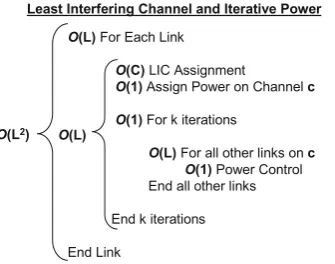
Our derivation of the complexity of the SCSIPA is shown in Fig.1. SCSIPA performs channel assignment and power control for each link, O(L). The link must discover the chan-nel assignment of the di,ineighbors by control messages from at most L links, O(L). The link
then determines and selects a channel not used by the di,ineighbors, O(C). After the initial
power is assigned to a link, transmit power levels are allowed to converge for, at most, L links, O(L). Since we assume L C, the dominant operation is determining neighbor channel information and allowing power levels to converge for both O(L). Since this procedure is performed for every link, the complexity is O(L2)for this decentralized algorithm.
3.3 Least Interfering Channel and Iterative Power Assignment (LICIPA)
LICIPA is an algorithm created by combining power control from SCSIPA and channel assignment from LICNPA. In LICIPA, a link is assigned to the LIC as long as the received power of the LIC is below Ith. If no channel has received interference power below Ith, the link is infeasible. If a link is assigned a channel, the transmitter begins with initial power Pref. After channel assignment, Eq.7is used by the links to iteratively adjust transmit power. If a link cannot maintain a SINR level ofβwithout the transmit power of the link exceeding Pmax, the link is infeasible and the transmit power of the link is set to zero. In this algorithm, each link is admitted sequentially. LICIPA uses the LIC and the transmit power of Eq.7for maximizing the number of feasible links and minimizing transmit power.
Figure1shows the complexity derivation for LICIPA. The complexity for this algorithm is similarly derived as for SCSIPA and LICNPA. Determining and assigning the LIC is O(C). Power control is then iterated for all other links on the channel, O(L). Since we assume that C<L, O(L)dominates in the inner loop and the algorithm has a complexity of O(L2).
3.4 Minimum Power Increase Assignment (MPIA)
MPIA is a centralized algorithm based on the Minimum Incremental Power Algorithm from [5]. In MPIA, global knowledge of cross-link gains is used to determine channel and power assignments. Using the cross-link gains, MPIA determines the feasibility of adding a new link into setLc, and if the new link is feasible, calculates the change in aggregate powerPc
that results from adding the new link into setLc[8]. The feasibility test and calculation of
Pcare performed for all setsLc. MPIA then assigns the new link to the setLcthat yields
the minimumPc. If the link is not assigned to anyLc, then its transmit power is set to zero,
[image:5.439.51.219.54.186.2]Fig. 2 Complexity derivation for MPIA and CGA
all links to meet the same minimum SINR requirement,β. Additionally, the order of link admittance is selected randomly. In summary, MPIA is a greedy assignment algorithm that seeks to maximize feasible link assignments using the minimum power increase onLc.
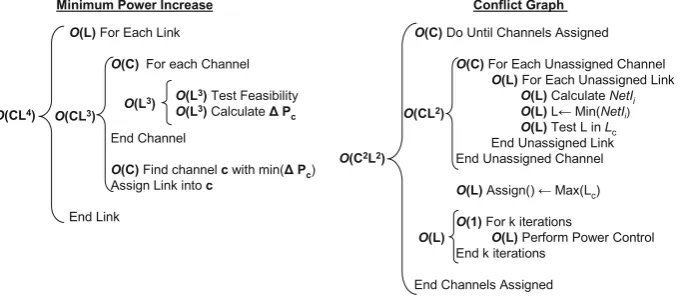
Our derivation of the complexity of MPIA is shown in Fig.2. Given|L| =L links and
|C| = C communications channels, MPIA must test every link O(L), in every channel,
O(C). Testing the feasibility of adding a new link toLcrequires calculating the eigenvalue
of a matrix whose dimensions are, at most, L×L. The dominant operation in the eigenvalue calculation is the determinant, which has complexity of O(L3)[6].P
crequires calculating
the inverse of a matrix whose dimensions are at most L×L. By Gauss-Jordan elimination, the calculation of the matrix inverse has a complexity of O(L3)[6]. Both calculations for feasibility andPc are estimated for the worst case as O(L3). O(L3)dominates in the
algorithm complexity, and combining the outer loops results in an algorithm complexity of O(C L4)for this centralized algorithm.
3.5 Conflict Graph Assignment (CGA)
CGA, based on [1], maximizes the number of feasible links through a greedy assignment algorithm using global knowledge of the cross-link gains in a weighted conflict graph. The algorithm begins by calculating the number of possible feasible links for each unassigned channel by attempting to place all links on each unassigned channel. After this calculation, CGA assigns the channel that supports the maximum number of feasible links. Power control is done subsequently to minimize total power consumption.
To calculate the number of feasible links for each unassigned channel, an adjacency matrix of weighted edges of the conflict graph is represented by:
G(i,j)=
Gi,j if i=j
0 if i= j. (8)
Using G, CGA calculates the potential network interference introduced by the transmitter of link i as NetIi =
jGi,j. The link that has the min(NetIi)is tested for feasibility inLc. To
test feasibility, eachγi is then calculated with Pi = Pmax in i ∈Lc. If the addition of the
new link intoLcwould not causeγito drop belowβfor any i ∈Lc, the link can be added into
setLc; otherwise, the link is not added. In either case, the link is discarded from G, and G is
links are attempted. The number of feasible links for each unassigned channel is calculated in the same manner. The channel that supports the maximum number of links, max|Lc|, is
then assignedLc. This routine continues until all channels are assigned. If it is not possible
to add a link into any channel, the link is infeasible.
While [1] does not use power control to minimize aggregate transmit power or reduce interference, it does suggest using the distributed power control mechanism in [3]. In CGA, upon completion of channel assignment, Eq.7is used to calculate the power of all links with initial power Pi =Pmax. Convergent power levels are then calculated for each link and assigned. In summary, CGA is a greedy assignment algorithm that uses the objective function in (2) by finding the maximum number of feasible links to each channel and minimizes the total transmit power by Eq.7.
Our derivation of the complexity of CGA is shown in Fig.2. CGA assigns links to a chan-nel in every iteration, O(C). For every unassigned channel, O(C), CGA, in the worst case, tests every link, O(L). For all links, the network interference, the minimum interferer, and the test for feasibility inLcare calculated, each with complexity O(L). Once the assignment
for a particular channel is completed, O(L), the power levels are calculated for all links in the channel, O(L). The channel assignment operations executed for every link have a dominant complexity of O(C L2). Since this process is repeated until all channels are assigned, the worst-case complexity of CGA is O(C2L2).
4 Evaluation Method and Metrics
The main goal of this work is to develop an evaluation method that can equitably compare distinct DCPA algorithms. To perform this comparison, the algorithms are given a set of L potential links in which they seek to fulfill the objective function defined in Eq.2. We consider links that have a maximum separation distance between the transmitter and receiver of dmax. Performance metrics are evaluated by varying the density of links, dmaxand then number of channels.
We evaluate algorithm performance by varying link density because we seek to under-stand how well each algorithm is able to manage interference through channel assignment and power control. By increasing link density, we increase the aggregate interference expe-rienced by each link. When density is low, the mean distance among potential interferers is larger than the intended transmitter-receiver distance. As the density increases, the dis-tance between a transmitter and its intended receiver will approach the mean disdis-tance among potential interferers. Therefore, increasing the density provides a means to increase potential aggregate interference for each link.
Additionally, the choice of dmaxplays a role in SINR being dominated by either noise or interference. If dmaxis small, the SINR of each link will be dominated by noise. Conversely, if dmaxis large, the SINR of each link will be dominated by interference. Additionally, if dmaxis sufficiently large and the density sufficiently low, links could be infeasible because of attenuation from path loss. Therefore, two different values of dmaxare used for this evaluation while varying the link density to explore these regions of interest.
For our algorithm evaluation, we choose two metrics that are directly related to our objec-tive function: feasibility ratio and average power per link. The feasibility ratio,κ, is the ratio of the number of feasible links|Lf|to the number of potential links|L|:
κ= |Lf|
Mobile nodes have limited battery life, and therefore power consumption is a concern for network longevity. We calculate the average power per link,χ, expressed as:
χ =
i∈Lf Pi
|Lf|
. (10)
5 Algorithm Evaluation
Our simulation environment, developed in MATLAB, considers L unidirectional links be-tween transmitter–receiver node pairs in a frequency channel-based network. Transmitters are isotropic with unity gain and limited to a transmit power of Pmax. Every link experiences path loss, independent Rayleigh fading, and a noise floor of No. The network is assumed
saturated, where each transmitter always has traffic to offer each receiver. Path loss is propor-tional to by di−,jα, where di,jis the distance between the transmitter of link i and the receiver
of link j andαis the path loss factor.
L links are randomly placed in a square simulation area under the constraint di,i ≤dmax.
C frequency channels are fixed, and each of the five algorithms discussed in Sect.3is
exe-cuted to solve the DCPA problem. New topologies are generated and the algorithms are executed again until 1,000 trials are completed. Upon completion, metrics are collected and the simulation area is reduced. New trials are executed in a smaller simulation area. The simulation begins with a minimum density Dmin=10−5links/m2and ends with a maximum density Dmax=10−1links/m2. In our simulation, we use parameter values ofβ= 10 dB, No
=−110 dBm, Pmax= 30 dBm,α=4, and L = 100 links.
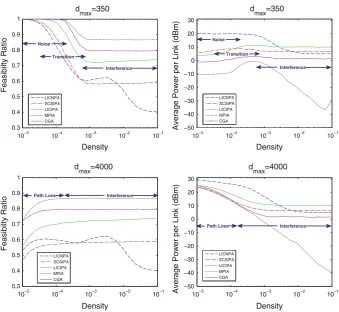
Our results show that the algorithms exhibit distinct regions of operation based on link density and the value dmax. Figure3shows the performance comparison of the feasibility ratio and average power per link for dmax= 350 (top plots) and dmax= 4000 (bottom plots), for all algorithms. In Figure3, the four regions of interest are labeled: noise dominant, transition, interference dominant, and path loss. The 90% confidence interval for the feasibility ratio is approximately±0.003 (left plots) and±2 dBm for average power per link (right plots).
The feasibility ratio plot with dmax= 350 (top left), identifies the noise dominant region as the region where the feasibility ratio is 1 for the algorithms. In this noise dominant region, shorter link lengths, relative to the simulation area, minimize the effects of co-channel inter-ference and produce a high feasibility ratio. Increasing link density moves algorithm per-formance into the transition region between the noise and interference dominant regions. In Fig.3(bottom left), the feasibility ratio declines when transitioning from the interference dominant region to the path loss region, because link density is low and dmaxis large.
10−5 10−4 10−3 10−2 10−1 0.3 0.4 0.5 0.6 0.7 0.8 0.9 1 Feasibilty Ratio Density d max=350 LICNPA SCSIPA LICIPA MPIA CGA
10−5 10−4 10−3 10−2 10−1
−50 −40 −30 −20 −10 0 10 20 30
Average Power per Link (dBm)
Density d max=350 LICNPA SCSIPA LICIPA MPIA CGA
10−5 10−4 10−3 10−2 10−1
0.3 0.4 0.5 0.6 0.7 0.8 0.9 1 Feasibilty Ratio Density d max=4000 LICNPA SCSIPA LICIPA MPIA CGA
10−5 10−4 10−3 10−2 10−1
−50 −40 −30 −20 −10 0 10 20 30
Average Power per Link (dBm)
Density d max=4000 LICNPA SCSIPA LICIPA MPIA CGA Transition Interference Noise Transition Interference Noise
Path Loss Interference
[image:9.439.50.390.52.364.2]Path Loss Interference
Fig. 3 Algorithm comparison using metrics feasibility ratio (left plots) and average power per link (right
plots) with L = 100, C = 40 and with dmax= 350 (top plots) and dmax= 4000 (bottom plots). Plots with dmax = 350 show a transition between a noise dominant and an interference dominant region. Plots with dmax= 4000 show a transition between path loss and interference dominant regions. MPIA exhibits best feasibility ratio and requires the lowest transmit power
The results for LICNPA show distinct characteristics when compared to the other algo-rithms. These characteristics, most pronounced in the interference dominant region, are caused by the power control mechanism employed by the algorithm. LICNPA uses the quan-tity Ith
Ii to adjust transmit power, which tends to excessively increase transmitter power and
co-channel interference. As a result, LICNPA has the lowest feasibility ratio in the noise dominant and transition regions (Fig.3, top left). In the interference dominant region, the quantity Ith
Ii will be closer to one, thus there is a reduction in relative transmit power and
0 20 40 60 80 100 0
0.1 0.2 0.3 0.4 0.5 0.6 0.7 0.8 0.9 1
Channels
Feasiblity Ratio (s) LICNPA SCSIPA
CGA
MPIA LICIPA
Fig. 4 Feasibility ratio as a function of the number of channels, with L=100, and fixed density 10−1links/m2
In terms of relative algorithm performance, MPIA achieves the best feasibility ratio per-formance and the overall lowest average power per link. While MPIA appears to have all the desirable features of a DCPA algorithm, it also has a unique disadvantage. In MPIA, the inverse of the cross-link gain matrix is used to calculatePc. In some cases, this matrix is
close to singular, resulting in an incorrect transmit power assignment. These near singular matrices occur when the link gain is much greater than the gain from co-channel interfering links, Gi,i Gj,i. An example of the effects of this matrix approaching singularity can be
seen by the “kink” shown in the Fig.3(top right). This “kink” is a result of incorrect power assignment, thus creating a wider confidence interval for average power per link.
Figure4shows, at a fixed density of 10−1 links/m2and dmax= 350, the feasibility ratio achieved by each algorithm as a function of the number of channels. In Fig.4, performance differences are small for C<20. For instance, LICIPA (a distributed algorithm) has almost identical performance as CGA (a centralized algorithm). When C >20, algorithms show larger differences in feasibility ratio. Also, in some of the curves, the addition of more chan-nels does not produce a linear improvement in feasibility ratio.
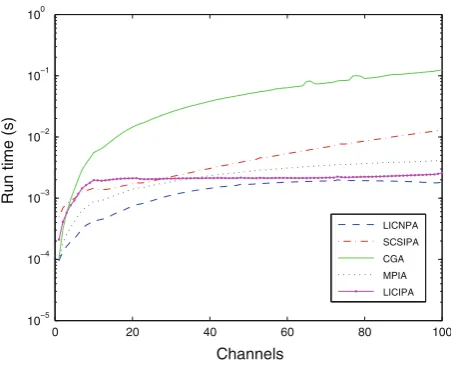
In addition to the complexity derivations in Sect.3, we also compare the algorithms accord-ing to average run time. Average algorithm run time metrics are shown in Fig.5for a link density of 10−1 links/m2, as a function of the number of channels. Three differences from our complexity analysis are apparent from Fig.5. First, we would expect MPIA to have the highest run time because its complexity is estimated as O(C L4). However, in general, the matrix used to test the feasibility and calculatePc has smaller dimensions than L×L.
Therefore, the complexity analysis is overly pessimistic when compared to the average. Two other differences involve the algorithms that use iterative power assignment: SCSI-PA and LICISCSI-PA. The worst-case complexity for SCSISCSI-PA is O(L2), because we assume that
LC. When C increases, the number of receivers in the neighborhood of di,i is likely to
0 20 40 60 80 100 10−5
10−4 10−3 10−2 10−1 100
Channels
Run time (s)
LICNPA
SCSIPA CGA
[image:11.439.107.333.54.237.2]MPIA LICIPA
Fig. 5 Average run time shown as a function of C
than LICIPA. LICIPA uses the LIC for assignment and is more likely to affect fewer links. As a result, the average run time for SCSIPA is greater than for LICIPA as C increases.
6 Conclusions and Future Work
Our results demonstrate that for most of the channel assignment algorithms analyzed, the fea-sibility ratio is constant when in the interference dominant region. Additionally, we showed that comparative performance is a function of the number of channels and the link density. With few channels, the performance of all algorithms is comparable. Therefore, when consid-ering network implementation with limited channel resources, the algorithm with the lowest complexity or run time should be selected.
The centralized algorithm MPIA has the overall best feasibility ratio and the lowest average power per link. Through assignment by the least change in transmit power, MPIA minimizes interference and increases the number of feasible links. However, implementation of this assignment faces the problem of near singular matrices. CGA showed comparable perfor-mance, with the disadvantage of a significantly longer run time. Additionally, in the case of the centralized algorithms, the requirement of knowledge of cross-link gains for any algo-rithm is problematic in the implementation of a real system. As a distributed alternative, LICIPA is a reasonable option.
While channel assignment has been a widely explored field, we believe some open issues remain. First, how should a network dynamically adapt based on changing conditions due to spectrum availability and desired quality of service? We believe this is important when considering the case of primary and secondary spectrum users. Second, how can a network maintain an optimal global topology through channel assignment when nodes only have access to local information? While some work has been done in combining aspects of rout-ing and channel assignment, we believe there is still opportunity for contribution in this area. Finally, what learning and self-organization techniques could a CN use to improve network performance and what would be the tradeoffs? Overall, we believe that the analysis of channel assignment is an important first step in understanding how to create CN.
Acknowledgements We would like to thank G. Kulkarni for providing us with his MATLAB code to develop the algorithm MPIA.
References
1. Chin, C.M., Sim, M.L., Olafsson, S. (2007). A dynamic channel assignment strategy via power control for ad-hoc network systems. In Vehicular Technology Conference, 2007 VTC2007-Spring IEEE 65th pp. 3006–3010. doi:10.1109/VETECS.2007.616.
2. ElBatt, T., & Ephremides, A. (2004). Joint scheduling and power control for wireless ad hoc net-works. IEEE Transactions on Wireless Communications, 3(1), 74–85.
3. Foschini, G., & Miljanic, Z. (1993). A simple distributed autonomous power control algorithm and itsconvergence. IEEE Transactions on Vehicular Technology, 42(4), 641–646.
4. Grace, D., Tozer, T., & Burr, A. (2000). Reducing call dropping in distributed dynamic channel assignment algorithms by incorporating power control in wireless ad hoc networks. IEEE Journal on Selected Areas in Communication, 18(11), 2417–2428.
5. Kulkarni, G., & Srivastava, M. (2002). A channel assignment scheme for FDMA based wireless ad hoc networks in Rayleigh fading environments. In 2002 IEEE 56th Vehicular Technology Conf. (VTC 2002-Fall), vol 2.
6. Skiena, S. (1998). The algorithm design manual. Berlin: Springer.
7. Thomas, R., Friend, D., DaSilva, L., & MacKenzie, A. (2006). Cognitive networks: Adaptation and learning to achieve end-to-end performance objectives. IEEE Communications Magazine, 44(12), 51–57. 8. Zander, J. (1992). Performance of optimum transmitter power control in cellular radiosystems. IEEE
Transactions on Vehicular Technology, 41(1), 57–62.
Author Biographies
Juan D. Deaton is currently employed as a Cellular Systems Engineer
Syed A. Ahmad completed his Bachelors in Computer Engineering
in 2005 from Lahore University of Management Sciences (LUMS), Pakistan. In 2007, he completed his Masters in Electrical Engineer-ing from West Virginia University, Morgantown. Since August 2007, he has been a Ph.D. student at Virginia Tech where the focus of his research is on how cross-layer adaptations impact the performance of cognitive networks. His research interests include wireless networks, adaptive rate schemes, spread spectrum communication and multiple antenna systems.
Umesh Shukla is pursuing his masters degree in Electrical &
Com-puter Engineering Department at Virginia Tech. Before coming to Vir-ginia Tech, he worked as a software developer in India for one year. He received his bachelors degree from National Institute of Technology, Allahabad, India. His primary research interest is in resource allocation techniques for wireless networks. He is a member of Wireless@VT re-search group.
Ryan E. Irwin has been a graduate student at Virginia Tech since the
Luiz A. DaSilva is currently on leave from Virginia Tech’s
Brad-ley Department of Electrical and Computer Engineering, where he has been a faculty member since 1998. He currently holds the Stokes Professorship in Telecommunications in the Department of Electronic and Electrical Engineering at Trinity College Dublin, in Ireland. Prof. DaSilva’s research focuses on distributed and adaptive resource man-agement in wireless networks, and in particular cognitive radio net-works and the application of game theory to wireless netnet-works. He is currently a principal investigator on research projects funded by the National Science Foundation, DARPA, and the European Commission under Framework Programme 7. Prof. DaSilva is a Senior Member of IEEE and a member of the ASEE and of ACM. In 2006, he was named a College of Engineering Faculty Fellow at Virginia Tech.
Allen B. MacKenzie has been an Assistant Professor in Virginia Tech