Original Article
Differential plasma microRNA expression
after remote ischemic conditioning in healthy
volunteers: identification by high-throughput sequencing
Bo Zuo1, Fuhua Wang1, Zhu Song1, Ning Wang1, Zhengpeng Li2, Guisong Wang1
1Department of Cardiology, Peking University Third Hospital and Key Laboratory of Cardiovascular Molecular
Biolo-gy and Regulatory Peptides, Ministry of Health, Beijing, China; 2Department of Gastroenterology, Peking University
Third Hospital, Beijing, China
Received January 9, 2017; Accepted February 10, 2017; Epub March 1, 2017; Published March 15, 2017
Abstract: Background: Remote ischemic conditioning (RIC), 3 to 4 cycles of transient episodes of ischemia/reperfu-sion on limbs, may protect against myocardial ischemia reperfuischemia/reperfu-sion injury markedly. MicroRNAs are important hu-moral factors, which may play a key role in RIC. However, no systematic studies on changes in the plasma miroRNA expression profile in RIC have been carried out. This study aimed to investigate the plasma miRNA profiles in five healthy subjects after RIC. Methods: High-throughput sequencing technique was applied to detect the expression profiles of plasma microRNAs in five healthy subjects after RIC. The results were validated by using qRT-PCR. The target genes of these differentially expressed miRNAs were analyzed by GO and KEGG pathway analysis. Finally, possible pathway of target genes in heart was detected in a rat model. Results: After the sequencing, 37 miRNAs were significantly differentially expressed after RIC (P<0.05). The GO and KEGG analysis showed that the Wnt, RNA transport, and endocytosis signaling pathways might be involved in the regulation of RIC. By using a rat model, we found that RIC could activate the phosphorylation of GSK-3β, the key molecule in the Wnt signaling pathway. Conclusion: RIC modifies the plasma microRNA expression profiles significantly. MicroRNAs might play important roles in the mechanism of cardioprotection conferred by RIC, providing a potential therapeutic target for the clinical treatment of myocardial ischemia/reperfusion injury in future.
Keywords: Remote Ischemic conditioning (RIC), microRNA expression, high-throughput sequencing technique, cardioprotection
Introduction
Early reperfusion to restore the myocardial blood supply is the most effective treatment method for myocardial infarction. However, reperfusion itself can cause ischemia reperfu-sion (IR) injury, which seriously affects the short- and long-term prognosis of patients [1]. Although the traditional ischemic precondition-ing or postconditionprecondition-ing can effectively alleviate the IR injury, it is still an invasive procedure and may cause adverse consequences, such as thrombosis and aggravated myocardial isch-emia [2]. Therefore, its clinical application is limited. Remote ischemic conditioning (RIC), i.e., 3 to 4 cycles of transient episodes of 5 min ischemia/5 min reperfusion on upper or lower limbs by using a non-invasive blood pressure
High-throughput microRNA sequencing and data analysis
Plasma RNAs of the five volunteers were extracted by using Trizol reagent according to the manufacturer’s protocol (Invitrogen) and sent to the BGI (The Beijing Genomics Institute) to construct small RNA library: Con Library (RNA from the plasma of control group) and RIC Library (RNA from the plasma of RIC group). Then the cDNA libraries were constructed and microRNAs were sequenced by using a next generation high-throughput sequencing tech-nique. Briefly, Illumina HiSeq 2000 instrument (BGI) was applied to obtain the raw sequencing data, then these data were mapped to human miRNAs database (miRBase 21), and differen-tially expressed miRNAs were screened out between RIC Library and Con Library. The tar -get genes of differentially expressed miRNAs were predicted and used to carry out GO (Gene Ontology) and KEGG (Kyoto Encyclopedia of Genes and Genomes) bioinformatics analysis [16].
Real-time quantitative PCR
The total RNAs were transcribed to cDNAs, then qRT-PCR assay was performed according to manufacturer’s instruction (Qiagen). The differential expressions of miRNA before and after RIC were compared the use of the 2-ΔΔCT method.
Establishment of myocardial IR and RIPostC in rat and TTC (2,3,5-Triphenyltetrazolium chloride) staining
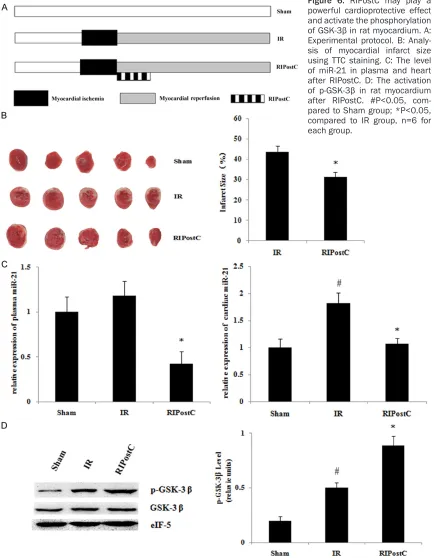
The study on animals was done in accordance to the Guide for the Care and Use of Laboratory Animals published by the US National Institutes of Health (NIH Publication no. 85-23, revised 1996). The protocol was approved by the Com-mittee on the Ethics of Animal Experiments of Peking University Third Hospital. Healthy adult male Sprague Dawley rats were anesthetized by intraperitoneal injection, and their chests were open at the third and fourth left intercos-tal space 0.5 cm away from the median sternal line along the intercostal. Vessel ligation was applied 2 cm below the origin of the left anteri-or descending canteri-oronary artery between the right margin of the left atrial appendage and the left margin of the pulmonary artery for 30 minutes. Then the ligature was removed, fol -RIC has gained attentions of researchers due
to its advantages of simplicity and noninvasive-ness. However, the mechanism of cardiopro- tection conferred by RIC remains unclear. According to the literature, RIC may induce changes in various peptide/protein factors in plasma, such as IL-10, nitrite and SDF-1 (stro -mal derived factor-1) [8-11], which could play key roles in the cardioprotective effect of RIC. Moreover, RIC has been reported to induce the modification of plasma proteome in healthy vol -unteers in 2013 [12]. MicroRNAs are important humoral regulatory factors, and miR-1, miR-21, and miR-144 have been shown to be of para-mount importance in RIC [13, 14]. However, no systematic studies on changes in the plasma miroRNA expression profile in RIC have been done. Further research on targeting microRNAs and their roles in RIC should be carried out to explain the mechanism of cardioprotection conferred by RIC and ultimately to guide clinical treatment. Therefore, the present work aimed to investigate the plasma miRNA profile in five healthy subjects after RIC by using a next gen-eration high-throughput sequencing technique. Materials and methods
RIC protocol
Overview of sequencing data
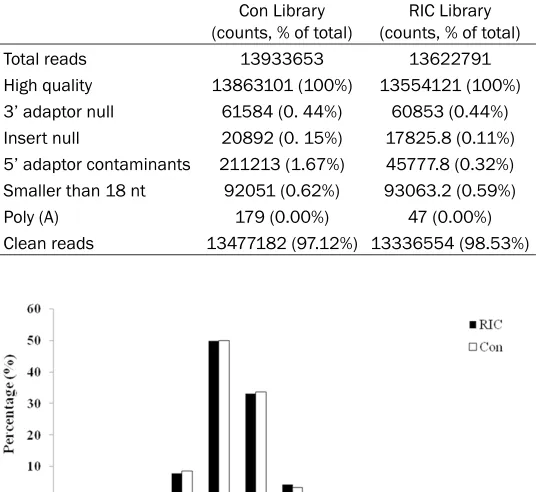
After the sequencing, no low quality sequences were found in both Con Library and RIC Library and other types of contaminant reads, such as 3’ adaptor null or insert null or 5’ adaptor con-taminants were removed from the original data. All the clean miRNA sequences for sequencing obtained after the removal of contaminant reads accounted for 97.12% in Con Library and 98.53% in RIC Library (Table 1). The data on the length distribution showed that the most frequently read length was 20-24 nt, the peak at 22 nt, indicating the high purity of the two libraries (Figure 1). Figure 2 presents the analy-sis results for common and specific sequences. The expressions of the common sequences were found to be relatively concentrated, indi-cating good overall consistency in the sequenc-ing of Con Library and RIC Library.
Differential microRNA expressions and qPCR
verification
239 miRNAs were detected in the plasma sam-ples from all subjects by high throughput lowed by reperfusion for 180 minutes. RIPostC
treatment (4 cycles of 5 min ischemia/5 min reperfusion of lower limb) was applied at the start of the reperfusion. The heart was removed after reperfusion and immediately stored at -20°C in a refrigerator for 20 minutes. About five slices of heart tissue, with a thickness of about 1 mm, were cut along the apex to the base with the use of a blade. The slices were placed in 1% TTC-PBS buffer and then incubat -ed in a thermostatic water bath at 37°C away from light for 20 mins. The heart tissue slices were then transferred into a 10% formalin solu-tion. Photographs were taken, and the infarct size was determined.
Western blot
[image:3.612.91.358.89.376.2]Proteins were denatured after boiling and load-ed on 10% SDS-PAGE. The separatload-ed proteins were transferred onto NC membrane, which was blocked with a 5% skim milk-TBST solution at 4°C overnight. The membrane was then washed, and primary antibody was added, fol-lowed by incubation at 4°C overnight. HRP-labeled secondary antibody was added after
Figure 1. Length distribution of all small RNAs obtained by sequencing. Con: Control.
the membrane was washed and incubated at room temperature for 1 hour. ECL luminescence reagents were applied to the membrane after washing; the film was then exposed, developed, and fixed. Semiquantitative analy -sis of the hybridization signal was carried out by using an image analysis system. Bands were nor-malized to the eukaryotic transla-tion initiatransla-tion factor 5 (eIF-5) expression.
Statistical analysis
Statistical analysis was done by using the SPSS version 20 soft-ware (SPSS Inc., Chicago, IL). The data were presented as mean ± standard error of the mean, and t
[image:3.612.91.360.99.345.2]test or one-way ANOVA with the Tukey post hoc test was used for comparison between groups. All the statistical tests were two-sid-ed, and a P value of less than 0.05 was considered indicative of a sta-tistically significant difference. Results
Table 1. Summary of reads from raw data to cleaned sequenc-es for small RNAs in Con and RIC librarisequenc-es
Con Library
(counts, % of total) (counts, % of total)RIC Library
Total reads 13933653 13622791
High quality 13863101 (100%) 13554121 (100%)
3’ adaptor null 61584 (0. 44%) 60853 (0.44%)
Insert null 20892 (0. 15%) 17825.8 (0.11%)
5’ adaptor contaminants 211213 (1.67%) 45777.8 (0.32%)
Smaller than 18 nt 92051 (0.62%) 93063.2 (0.59%)
Poly (A) 179 (0.00%) 47 (0.00%)
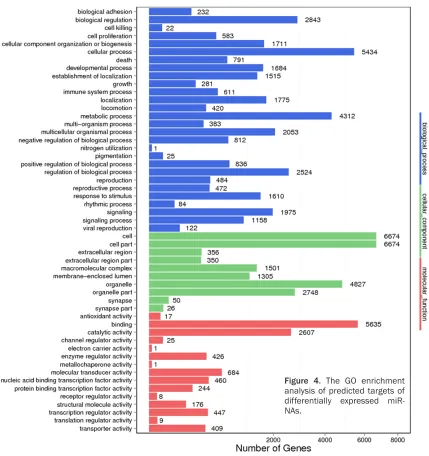
were mainly enriched in cell metabolism, cellu-lar process regulation and so on (Figure 4).
KEGG pathway enrichment analysis of miRNA candidate target genes
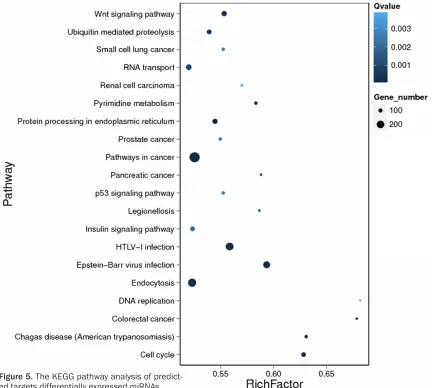
The KEGG pathway analysis was performed in terms of the target genes of these differen-sequencing in this study. Among these, 37
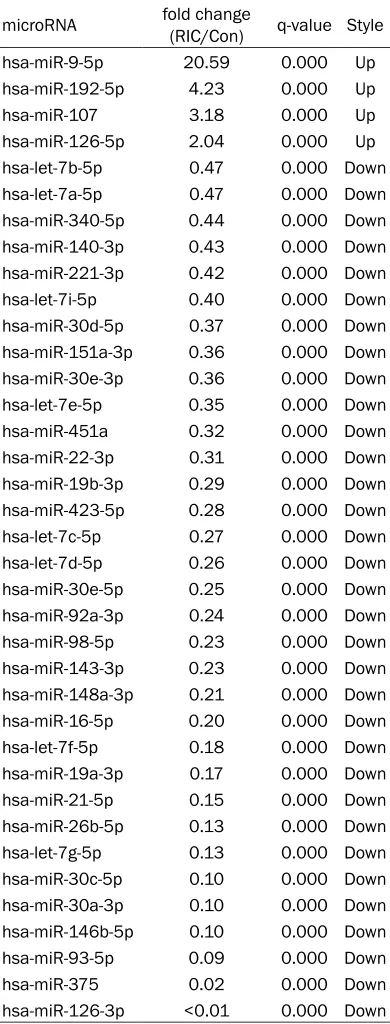
miR-NAs were significantly differentially expressed between the two libraries (P<0.05), which met the requirements of a fold-change log2 (RIC/ Con) >1 or a fold-change log2 (RIC/Con) <-1. Of the 37 miRNAs, 4 were up-regulated, 33 were down-regulated (Table 2). To verify the results of the sequencing data, the expressions of hsa-miR-21-5p, hsa-miR-26b-5p and hsa-miR-92a-3p were further detected by using qPCR. The expression patterns of these 3 miRNAs were consistent with those in the sequencing study, which confirmed the accuracy of sequencing results (Figure 3).
GO enrichment analysis on the target genes of differentially expressed miRNAs
[image:4.612.89.286.68.380.2]GO consists of three ontologies, including the biological process (P), molecular function (F), and cellular component (C). In this study, GO enrichment analysis was carried out in terms of the target genes of 37 differentially expressed miRNAs. The results showed that 28, 15, and 10 were significantly enriched in the P, F, and C ontology respectively. The predictive target genes of these differentially expressed miRNAs
Table 2. Differentially expressed plasma microRNAs after RIC treatment
microRNA fold change (RIC/Con) q-value Style
hsa-miR-9-5p 20.59 0.000 Up
hsa-miR-192-5p 4.23 0.000 Up
hsa-miR-107 3.18 0.000 Up
hsa-miR-126-5p 2.04 0.000 Up
hsa-let-7b-5p 0.47 0.000 Down
hsa-let-7a-5p 0.47 0.000 Down
hsa-miR-340-5p 0.44 0.000 Down
hsa-miR-140-3p 0.43 0.000 Down
hsa-miR-221-3p 0.42 0.000 Down
hsa-let-7i-5p 0.40 0.000 Down
hsa-miR-30d-5p 0.37 0.000 Down
hsa-miR-151a-3p 0.36 0.000 Down
hsa-miR-30e-3p 0.36 0.000 Down
hsa-let-7e-5p 0.35 0.000 Down
hsa-miR-451a 0.32 0.000 Down
hsa-miR-22-3p 0.31 0.000 Down
hsa-miR-19b-3p 0.29 0.000 Down
hsa-miR-423-5p 0.28 0.000 Down
hsa-let-7c-5p 0.27 0.000 Down
hsa-let-7d-5p 0.26 0.000 Down
hsa-miR-30e-5p 0.25 0.000 Down
hsa-miR-92a-3p 0.24 0.000 Down
hsa-miR-98-5p 0.23 0.000 Down
hsa-miR-143-3p 0.23 0.000 Down
hsa-miR-148a-3p 0.21 0.000 Down
hsa-miR-16-5p 0.20 0.000 Down
hsa-let-7f-5p 0.18 0.000 Down
hsa-miR-19a-3p 0.17 0.000 Down
hsa-miR-21-5p 0.15 0.000 Down
hsa-miR-26b-5p 0.13 0.000 Down
hsa-let-7g-5p 0.13 0.000 Down
hsa-miR-30c-5p 0.10 0.000 Down
hsa-miR-30a-3p 0.10 0.000 Down
hsa-miR-146b-5p 0.10 0.000 Down
hsa-miR-93-5p 0.09 0.000 Down
hsa-miR-375 0.02 0.000 Down
hsa-miR-126-3p <0.01 0.000 Down
Note: q-value: adjusted P value.
[image:4.612.326.521.97.609.2]Figure 3. Validation of plasma miRNA expression with qRT-PCR. Con: Control. *P<0.05, compared to Con group, n=8 for each group.
[image:5.612.92.521.271.727.2]p-GSK-3β in rat increased. This finding was consistent with our KEGG analysis (Figure 6). Discussion
In this study, the expression profile of plasma microRNA in five healthy subjects after RIC treatment was detected by the next generation high-throughput sequencing technique. 4 microRNAs were upregulated, and 33 were downregulated. The expressions of hsa-miR-21-5p, hsa-miR-26b-5p, and hsa-miR-92a-3p were verified through qRT-PCR. KEGG analysis showed that the Wnt, RNA transport, and en- docytosis signaling pathways may be involved. Finally, a rat model of myocardial IR was creat-ed, and the myocardial protective effect of RIC, as well as the changes in miR-21 expression in plasma and myocardium, was verified. The results also confirmed that RIC could activate tially expressed 37 miRNAs. The results
reve-aled that 20 metabolism pathways were en- riched in the predictive target genes of these miRNAs (adjusted P<0.05) (Figure 5), such as the Wnt signaling pathway, RNA transport sig-naling pathway, endocytosis, the insulin signal-ing pathway, cell metabolism, and cell cycle signaling pathway.
RIPostC may activate the phosphorylation of
GSK-3β in rat myocardium
[image:6.612.91.523.73.461.2]involved in this procedure, however, remains unclear thus far. The literature indicates that after the application of RIC, a protection signal is sent from the extremities to the heart, exert-ing a myocardial protective effect. There are three main pathways, namely, the humoral, the phosphorylation of GSK-3β, the key mole
-cule in the Wnt signaling pathway.
RIC is a promising technique with extensive clinical application because it is simple, nonin-vasive, safe, and effective. The mechanism
[image:7.612.91.525.75.633.2]NAs after RIC might be due to the increase of plasma RNase1 [24, 25].
GO and KEGG pathway analysis are powerful tools in functional genomics; they can effec-tively predict the functions of gene products and thus successfully explore the potential bio-informatics information. GO analysis showed that the target genes of the differentially expressed microRNAs were closely related to cell metabolism, cellular process, and cell pro-liferation. KEGG pathway analysis indicated that the target genes of the differentially expressed microRNAs were associated with signaling pathways, such as RNA transport and endocytosis. RIC may be related to the transfer process of the protection signal from remote limb tissues to the heart, and microRNAs, as important functional small molecules, play an important role in remote information transmis-sion. At present, the transport of microRNAs, especially mediated by exosome/microvesicle, is a hotspot in the study of trans-membrane transport. An exosome is a tiny vesicle less than 100 nm in diameter; a microvesicle is 100-1000 nm is diameter. They could mediate the trans-membrane information communica-tion via transferring small funccommunica-tional molecule, including microRNA between different cells [26, 27]. The results indicate that microRNAs may be active in the transport process of RIC, which is consistent with the hypothesis that the RIC myocardial protection signal can be trans-ported to the heart through the humoral path-way [28, 29].
KEGG analysis also showed that the target genes of the differentially expressed microR-NAs were related to the Wnt signaling pathway, a classic signal pathway that plays an impor-tant role in multiple physiologic processes, including cell proliferation, apoptosis, growth, differentiation, and metabolism. The Wnt sig -naling pathway may induce the intracellular accumulation of β-catenin, and GSK-3β can add a phosphate group to the amino terminal of β-catenin, thus exerting a regulatory effect. Several studies have shown that the Wnt/GSK-3β/β-catenin signaling pathway has an impor -tant effect in the regulation in myocardial IR injury. The activated Wnt/GSK-3β/β-catenin signaling pathway may inhibit the apoptosis of myocardial cells and significantly reduce myo -cardial IR injury, thus protecting the myocardi-neural, and immune pathways, among which
the humoral pathway is the most notable [17]. In a study on five healthy volunteers in 2013, Hibert et al. found that RIC could cause a marked change in plasma proteome; similar results were found in a rat model [18, 19], indi-cating that the humoral pathway might play a key role in RIC. The main mechanism of the humoral pathway involves a marked change in circulating factors, which may eventually induce a powerful protective effect on the heart after RIC treatment of limbs [20]. The effect of RIC seems to extend beyond the above-mentioned pathways. RIPC has been reported to possibly modify the gene expression in mouse myocar-dium and human neutrophils [21, 22]. MicroRNAs have been shown to play a key role in gene expression. Besides, circulating microR-NAs have been widely recognized to be poten-tial markers for clinical diagnosis and to play important roles in the development of disease [23]. Thus, changes in microRNA expression and the role of microRNAs in RIC should be emphasized.
-References
[1] Yellon DM, Hausenloy DJ. Myocardial reperfu-sion injury. N Engl J Med 2007; 357: 1121-35. [2] Hausenloy DJ, Yellon DM. Ischaemic condition-ing and reperfusion injury. Nat Rev Cardiol 2016; 13: 193-209.
[3] Heusch G, Botker HE, Przyklenk K, Redington A, Yellon D. Remote ischemic conditioning. J Am Coll Cardiol 2015; 65: 177-95.
[4] Przyklenk K. Reduction of myocardial infarct size with ischemic “conditioning”: physiologic and technical considerations. Anesth Analg 2013; 117: 891-901.
[5] Zuo B, Wang F, Song Z, Xu M, Wang G. Using remote ischemic conditioning to reduce acute kidney injury in patients undergoing percuta-neous coronary intervention: a meta-analysis. Curr Med Res Opin 2015; 31: 1677-85. [6] Przyklenk K, Bauer B, Ovize M, Kloner RA,
Whittaker P. Regional ischemic ‘precondition-ing’ protects remote virgin myocardium from subsequent sustained coronary occlusion. Cir-culation 1993; 87: 893-9.
[7] Kerendi F, Kin H, Halkos ME, Jiang R, Zatta AJ, Zhao ZQ, Guyton RA, Vinten-Johansen J. Re-mote postconditioning. Brief renal ischemia and reperfusion applied before coronary ar- tery reperfusion reduces myocardial infarct size via endogenous activation of adenosine receptors. Basic Res Cardiol 2005; 100: 404-12.
[8] Davidson SM, Selvaraj P, He D, Boi-Doku C, Yellon RL, Vicencio JM, Yellon DM. Remote ischaemic preconditioning involves signalling through the SDF-1alpha/CXCR4 signalling axis. Basic Res Cardiol 2013; 108: 377. [9] Cai ZP, Parajuli N, Zheng X, Becker L. Remote
ischemic preconditioning confers late protec-tion against myocardial ischemia-reperfusion injury in mice by upregulating interleukin-10. Basic Res Cardiol 2012; 107: 277.
[10] Rassaf T, Totzeck M, Hendgen-Cotta UB, Shiva S, Heusch G, Kelm M. Circulating nitrite con-tributes to cardioprotection by remote isch-emic preconditioning. Circ Res 2014; 114: 1601-10.
[11] Lim SY, Yellon DM, Hausenloy DJ. The neural and humoral pathways in remote limb isch-emic preconditioning. Basic Res Cardiol 2010; 105: 651-5.
[12] Hepponstall M, Ignjatovic V, Binos S, Monagle P, Jones B, Cheung MH, d’Udekem Y, Konstan-tinov IE. Remote ischemic preconditioning (RIPC) modifies plasma proteome in humans. PLoS One 2012; 7: e48284.
[13] Duan X, Ji B, Wang X, Liu J, Zheng Z, Long C, Tang Y, Hu S. Expression of microRNA-1 and microRNA-21 in different protocols of ischemic um [30-32]. Our omics analysis showed that
the target genes of differentially expressed microRNAs were closely related to the Wnt sig-naling pathway. The microRNAs in the expres -sion profiles, such as miR-21, could regulate the phosphorylation of GSK-3β. We further con -structed an IR rat model and carried out RIC treatment. The results showed an obvious phosphorylation of GSK-3β. Thus, the Wnt/ GSK-3β/β-catenin signaling pathway may have an important regulatory effect on the myocar-dial protection of RIC.
The present study has some limitations. First, the sample size for the high-throughput dete- ction was relatively small. Second, the objects of RIC were healthy subjects; in future research, patients with myocardial infarction will be re- cruited to determine the expressions of microR-NAs. Finally, further data analysis is required, and more data have to be collected and orga-nized. The focus of future research is to investi -gate the regulation effect and molecular mech-anism of differentially expressed microRNAs in the myocardial protection of RIC.
By applying next generation high-throughput sequencing, this study found that 37 microR-NAs were differentially expressed in plasma in five healthy subjects after remote ischemic conditioning. Further, the target genes of these miRNAs may be closely related to the RNA transport, endocytosis, and Wnt signaling pathways. MicroRNAs may play an important regulatory role in the mechanism of myocardial protection of RIC, providing a potential thera-peutic target for the clinical treatment of myo-cardial IR injury in the future.
Acknowledgements
This work was partly supported by the Nati-onal Natural Science Foundation of China (81170179).
Disclosure of conflict of interest
None.
[23] Lorenzen JM. Vascular and circulating microR-NAs in renal ischaemia-reperfusion injury. J Physiol 2015; 593: 1777-84.
[24] Cabrera-Fuentes HA, Ruiz-Meana M, Simseky-ilmaz S, Kostin S, Inserte J, Saffarzadeh M, Galuska SP, Vijayan V, Barba I, Barreto G, Fischer S, Lochnit G, Ilinskaya ON, Baumgart-Vogt E, Böning A, Lecour S, Hausenloy DJ, Liehn EA, Garcia-Dorado D, Schlüter KD, Pre-issner KT. RNase1 prevents the damaging in-terplay between extracellular RNA and tumour necrosis factor-alpha in cardiac ischaemia/re-perfusion injury. Thromb Haemost 2014; 112: 1110-9.
[25] Cabrera-Fuentes HA, Niemann B, Grieshaber P, Wollbrueck M, Gehron J, Preissner KT, Böning A. RNase1 as a potential mediator of remote ischaemic preconditioning for cardioprotec-tiondagger. Eur J Cardiothorac Surg 2015; 48: 732-7; discussion 7.
[26] Das S, Halushka MK. Extracellular vesicle mi-croRNA transfer in cardiovascular disease. Cardiovasc Pathol 2015; 24: 199-206.
[27] Barile L, Moccetti T, Marban E, Vassalli G. Roles of exosomes in cardioprotection. Eur Heart J 2016; [Epub ahead of print].
[28] Colombo M, Raposo G, Thery C. Biogenesis, secretion, and intercellular interactions of exosomes and other extracellular vesicles. Annu Rev Cell Dev Biol 2014; 30: 255-89. [29] Record M, Carayon K, Poirot M, Silvente-Poirot
S. Exosomes as new vesicular lipid transport-ers involved in cell-cell communication and various pathophysiologies. Biochim Biophys Acta 2014; 1841: 108-20.
[30] Peng Y, Zhang X, Feng X, Fan X, Jin Z. The crosstalk between microRNAs and the Wnt/ beta-catenin signaling pathway in cancer. On-cotarget 2016; [Epub ahead of print].
[31] Miura T, Tanno M. Mitochondria and GSK-3be-ta in cardioprotection against ischemia/reper-fusion injury. Cardiovasc Drugs Ther 2010; 24: 255-63.
[32] Miura T, Miki T. GSK-3beta, a therapeutic tar-get for cardiomyocyte protection. Circ J 2009; 73: 1184-92.
conditioning in an isolated rat heart model. Cardiology 2012; 122: 36-43.
[14] Li J, Rohailla S, Gelber N, Rutka J, Sabah N, Gladstone RA, Wei C, Hu P, Kharbanda RK, Redington AN. MicroRNA-144 is a circulating effector of remote ischemic preconditioning. Basic Res Cardiol 2014; 109: 423.
[15] Bøtker HE, Kharbanda R, Schmidt MR, Bøttch-er M, Kaltoft AK, TBøttch-erkelsen CJ, Munk K, AndBøttch-er- Ander-sen NH, HanAnder-sen TM, Trautner S, LasAnder-sen JF, Christiansen EH, Krusell LR, Kristensen SD, Thuesen L, Nielsen SS, Rehling M, Sørensen HT, Redington AN, Nielsen TT. Remote isch-aemic conditioning before hospital admission, as a complement to angioplasty, and effect on myocardial salvage in patients with acute myo-cardial infarction: a randomised trial. Lancet 2010; 375: 727-34.
[16] Tonge DP, Gant TW. What is normal? Next gen-eration sequencing-driven analysis of the hu-man circulating miRNAOme. BMC Mol Biol 2016; 17: 4.
[17] Xiong J, Liao X, Xue FS, Yuan YJ, Wang Q, Liu JH. Remote ischemia conditioning-an endoge-nous cardioprotective strategy from outside the heart. Chin Med J (Engl) 2011; 124: 2209-15.
[18] Hibert P, Prunier-Mirebeau D, Beseme O, Chwastyniak M, Tamareille S, Pinet F, Prunier F. Modifications in rat plasma proteome after remote ischemic preconditioning (RIPC) stimulus: identification by a SELDI-TOF-MS ap-proach. PLoS One 2014; 9: e85669.
[19] Hibert P, Prunier-Mirebeau D, Beseme O, Chwastyniak M, Tamareille S, Lamon D, Furber A, Pinet F, Prunier F. Apolipoprotein a-I is a po-tential mediator of remote ischemic precondi-tioning. PLoS One 2013; 8: e77211.
[20] Sivaraman V, Pickard JM, Hausenloy DJ. Re-mote ischaemic conditioning: cardiac protec-tion from afar. Anaesthesia 2015; 70: 732-48. [21] Konstantinov IE, Arab S, Kharbanda RK, Li J,
Cheung MM, Cherepanov V, Downey GP, Liu PP, Cukerman E, Coles JG, Redington AN. The re-mote ischemic preconditioning stimulus modi-fies inflammatory gene expression in humans. Physiol Genomics 2004; 19: 143-50.