New Technology in the Human Services
Contents
Papers Quality Improvement through the use of Home Care Information Systems The Looking After Children Computer System Factors Implicated in the Integration of Clinical Information Systems into Human Service Agencies
Practice & Policy Reports Dutch Branch Mirror for Generic Social Work
Controversial issues Does Electronic Monitoring (EM) Contribute to Community Based Penalties for Offenders?
C o n t e n t s Up Front Papers
2 Quality Improvement through the use of Home Care
Information Systems - GIRST as an example Eric Verkaar
10 The Looking After Children Computer System;
Developing Social Work Sensitive Databases Andrew Kerslake
15 Factors Implicated in the Integration of Clinical Information Systems Into Human Service Agencies: A Concept Map
Riki Savaya, & Mark Waysman
Practice and Policy Reports
23 Dutch Branch Mirror for Generic Social Work. Jos Potting
Controversial Issues
27 Does Electronic Monitoring (EM) Contribute to Community Based Penalties for Offenders? Dick Whitfield and Ruud Bociens
Reviews
34 Human Services in the Age of New Technology;
Harmonising Social Work and Computerisation reviewed by Judith Holt
35 Creative Computing In Health and Social Care reviewed by Peter Sharkey
36 Dreams and Realities
reviewed by Harmen Grehel
38 Human Services and Information Technology, an
International Perspective reviewed by Ignace Snellen
39 Information Management in Social Services
reviewed by Jan Steyaert
New Technology in the Human Services is a quarterly journal
devoted to the dissemination of information about the application of information and information technology in the human services.
New Technology in the Human Services holds copyright on all
articles and texts published in this journal. Apart from standard referencing in other publications, no part of this journal may be reproduced in any way without prior agreement from the editors.
New Technology in the Human Services takes no responsibility for
the contents of the contributions. The opinions expressed are those of the authors, and not necessarily those of the editors or publishers.
New Technology in the Human Services is edited by Jan Steyaert
and Ann Wilkinson. You can contact them at the addresses given below. The editorial board also includes Harmen Grehel and Jackie
Rajferty. Consulting editors are Stuart Toole and Bryan Glastonbury, both former editors of this journal. The editorial
advisory network consists of the following:
Gail Auslander, Hebrew University, Jerusalem, Israel
Colin Barnes, Social Service Department, Coventry, United
Kingdom
Nick Gould, University of Bath, United Kingdon
Don Mahey, Centrecare St John, Canada
Robert MacFadden, University of Toronto, Canada
David Phillips, University of Sheffield, United Kingdom
Ignace Snellen, Erasmus Universiteit, Rotterdam, the Netherlands
Laraine Stewart, CCETSW, United Kingdom
New Technology in the Human Services is published by Causa (the Netherlands) and CHST (UK). You can contact the editors and publishers at these addresses:
Tel: Fax; Email; W W W :
Causa
Faculty of Health Care and Social Work Postbus 347
5600 AH Eindhoven The Netherlands +31-40-2605940 +31-40-2435274 [email protected] http://www.fz.hse.nl/causa/
CHST
Department of Social Work Studies University of Southampton Southampton S 0 1 7 IBJ UK
+44-1703-593536 +44-1703-592779 [email protected] http://www.soton.ac.uk/~chst
Subscription to the journal
To subscribe to the journal New Technology in the Human Services, contact CHST at the above address. The subscription rates for the current volume are as follows:
United Kingdom Europe Outside Europe
Individuals 12 UK pounds 15 UK pounds 25 US dollars
Institutions with 20 UK pounds
CCETSW courses
Institutions & libraries 40 UK pounds 45 UK pounds 70 US dollars
Submissions to the journal
We welcome papers, articles and reviews from both academics and practitioners. Please read the guidelines for contributors on the back inside cover and do not hesitate to contact either of the editors.
Up Front
This editorial piece is written shortly after the fourth Husita conference 'Dreams and Realities'. Early reports indicate that people are feeling renewed energy to follow some of the dreams. Our reviewers were out and about at the conference and we have asked presenters who made a particular impact at the conference to submit papers for later issues. During the conference in Finland negotiations were conducted to agree the venue for the next Husita conference. It is exciting to see this awarded to Hungary and we look forward to meeting more of our readers in Budapest, Hungary in August 1999. Watch future issues for announcements.
Although my co-editor Jan Steyaert was able to attend Husita-4 I had to content myself with glimpses of the conference via the Husita list. The last minute introduction of a few networked machines in the conference foyer showed interesting possibilities for people to participate from a distance. It would be good to see future conferences creating an opportunity for those who are unable to travel to link in and make a contribution.
The web page for the conference was a first for Husita. Now we need to use the Internet's ever expanding facilities to include a wider audience. Speaking from the view of a non-participant on this occasion and observing comments on the list I would like to see, at minimum, rapporteurs providing very brief summaries of each session to be distributed on the web. These might be illustrated by photographs taken at the sessions or perhaps even short video clips.
Introducing Vol 9 No 2
We did not seek to create a theme for this issue but it is interesting to find that the same themes are emerging from a diverse group of papers and reports from the Netherlands, Israel and UK.
Verkaar describes the development of, and attempts to implement, a workload management system for health and home care workers. GIRST is an information and registration system for home care with four separate modules: intake and assessment, work planning, time-tabling and evaluation. It, like the program described in Kerslake's paper which follows, is a PC based system developed outside commercial software houses by subject specialists. The issues of
implementation which both Verkaar and Kerslake raise, although not identical, match in some respects. Human service system developers need to find a way of working along side mainstream software houses to integrate new practice developments and make them acceptable to
managers and practitioners. %
0 LIBRARY I
Kerslake describes another practice support system developed in the UK to take the Department of Health 'Looking after Children' materials and turn them into a computer based system. The SSRADU Looking after Children Computer System (LACCS) has undergone extensive trialing with agencies and SSRADU and the Department of Health hope that it will be adopted throughout the UK.
Those involved in the process of testing and trialing would be advised to consider the next article which sets out research into the integration of clinical information systems into human service agencies. Savaya and Waysman outline a research project to discover why clinical information systems are underused in agencies. This is interesting both for the research design and the issues they identify as important for successful implementation.
Our practice report from Jos Potting is on a system for collecting service information. This is an attempt to go beyond collecting figures and to address the issues of effectiveness and efficiency for social work agencies in the Netherlands.
We continue our series of controversial issues with a debate on the use of electronic monitoring as a community sentence for offenders. Dick Whitfield argues against and Ruud Boelens takes the positive view. What do you think? Finally in this very full issue we carry five reviews of new books. Judith Holt looks at Human Services in the Age of New Technology; Harmonising Social Work and
Computerisation by Phillips and Herman. Peter Sharkey read Creative Computing In Health and Social Care an edited volume by Fred Yates. The next two were published to coincide with Husita and were launched there. Jan Steyaert, David Colombi and Jackie Rafferty have expanded and updated their book on Human Services and Information Technology to give it an international perspective. Bryan Glastonbury edited 17 papers presented at the Husita Conference to reflect the theme Dreams and Realities. Harmen Grebel and Ignace Snellen tell us what they think. Finally Jan Steyaert looks at Information Management in Social Services, a conference volume by Kerslake and Gould.
In the next issue
Volume 9 Number 3 will be a special issue on Coding and Classification and we have a selection of papers in review. We will be suspending the practice report and controversial issue to allow us to publish a larger range of papers.
Papers
Quality Improvement through the use of Home Care Information Systems - GIRST as
an example
Dr Eric AM J Verkaar, Netherlands Institute of Care and Welfare INIZW
Dr Eric Verkaar works for the Home Care and Prevention section of the Netherlands Institute of Care and Welfare in Utrecht. His work focuses on managerial issues concerning the integration of home nursing and family care and he is the manager of the GIRST project described in this article.
Contact him at:
3501 DD Utrecht The Netherlands
JO 2^06^77 Fax: +31 30 2319641 Email: [email protected]
Introduction
There is a trend in developing information systems in social work and health care, to support those who actually deliver help, care or cure. In the past more emphasis was placed on administrative support while developing information systems, now the focus has moved to supporting the actual process of helping, caring and curing.
The main purpose of these 'care-supporting' or 'help-supporting' information systems ought to be the quality improvement of the care providing process. By diagnosing, monitoring and evaluating clients and by generating and adequately using 'real'information which is essential for the process of providing care, care supporting information systems can help to improve the quality of actual care or helping processes.
In this paper an example will be given of such a newly developed help or care-supporting system. The system concerned is GIRST, designed to support helpers, nurses and their managers in the field of Dutch home care. This article will describe how such a system can lead to better quality of care. At the HUSITA 3 conference in Maastricht (1993), we presented the blue-prints of GIRST (Verkaar, 1996). This article looks back at the three years which followed and discusses development and implementation of the application.
Girst
GIRST is an information and registration system for home care which allows information needed by the care process to be stored and retrieved. It is composed of four modules, covering all aspects of the care work process from start to finish. The four modules are; intake/assessment, planning, work in progress and evaluation.
• The planning module is an instrument to assign specific tasks to specific helpers. By using an electronic planning board, the original care advice (tasks and required skills) is converted into a real plan. There can be a difference between what was regarded as appropriate or necessary and what is planned.
• The care registration or work in progress module is an instrument to make work lists for clients and helpers. Also workers or helpers can register tasks which are carried out. These can be printed out, or the Apple Newton prototype will provide helpers with a complete electronic file of the week's clients.
• The care evaluation module is concerned with
answering questions about the quality and effectiveness of care provision, whether the care was appropriate and whether clients received the help they had in mind. This module shows graphs on changes, registered over time and asks questions about client satisfaction and professional judgements about the quality and quantity of the delivered care.
GIRST
Mediation module
-client presentation -intake interview -complexity scale -skill assessment -care advice
Planning module
-job delegation -planning
W o r k in progress module
-work-lists for helpers -work-lists for clients -care registration
Evaluation module
-historical presentation of changes -client satisfaction scale
-registration of professional judgement, concerning quality and quantity
Figure 1 Girst modules
GIRST is a Windows 3.1. based system. It is a Visual Basic application, working with an Access database. There is also a complementaiy prototype for use on an Apple Newton Message pad (for pure registration tasks). This Newton
prototype contains two parts: a Newton bookmaker application and a Notion application. Currently the system is stand alone, but a Network version will be available for actual buyers of the system. The contemporary
functionality is individual client oriented, but work is in progress on group analysis functionality. The system is based on nursing theory (Oram etc.), but GIRST integrates nursing problems with domestic (help) needs. Further elaboration for using the instrument in residential nursing homes for elderly and handicapped people is being done. GIRST does not integrate purely administrative
functionality, like billing etc. Because it's Windows and because it supports ODBC, a connection with other more administrative oriented applications is possible.
GIRST was developed by the Netherlands Institute of Care and Welfare (NIZW). NIZW is a non-profit organisation for research and development in the field of care and welfare. Girst is exploited for the Netherlands by a small private company, GINO.
Information systems and quality assurance
Information systems offer huge possibilities for improving the quality of care or helping processes. The main
professional advantages of an information system are the standardisation and the accessibility of information.
Professionalism is actually a process of standardisation. Mintzberg (1979) refers to this process as pigeonholing. A professional, such as a doctor or a nurse, explores a problem by checking pigeon holes with information. It is a process of continuously testing and checking hypotheses. Is it this...? No it is not... Is it that...? No it is not, so maybe it is that ? The better equipped with more and better structured information holes, the more successful a professional worker can be. So in order to help a
professional to do his or her work better, an organisation provides its professionals with adequate (not too much, not too little) information about a client and about the possible interventions. Professional training or education is a way of providing professionals with adequate information and to teach them to structure and apply this information in specific ways.
quality of the process of helping and caring in delivering home care services.
It is recognised that not every helping or caring practice has a professional basis with established consensus about how to do the job right and how to use information properly. Therefore an information system should allow some variation in the information workers can store and retrieve from such a system and in the way workers handle the information in this system. GIRST also allows some variation in the ways a home-care professional uses information in his or her job.
Professional workers need information about clients to do their work properly; quite often this information is not very accessible. Dossiers are only made as unique files, there are hardly any copies. If there are any copies, these are always outdated. Dossiers or files are also commonly available in only one office location. So in the case of more than one person providing help to one client, sometimes in several locations or in the client's home, there is a problem. Information systems can make client data more accessible: faster, in more places and more accurately. Besides this, information security can be improved, by means of passwords or several templates for different authorisations: your authorisation allows you to see only the information you need.
In this article I will describe the way GIRST improves accessibility of information for professionals and their clients, in home-care practices
A better intake and diagnosis
The organisation of intake and diagnosisIn the Netherlands, home care organisations are divided into local or regional home help services
(gezinsverzorging) and district nursing organisations (wijkverpleging). There is a trend towards integration and merging of these organisations. If home help and district nursing organisations do not merge, they do tend to co-operate more than before. There is a tendency to construct one local entry for potential clients. The national
government in the Netherlands has recently decided that a help demand for home care should be judged and delegated by a regional institute (Nota indicatiestelling, 1996). This means that a client will be diagnosed by this institute and after a balanced judgement, is delegated to a specific organisation: a home help or district nursing organisation, or to an elderly home or nursing home. It is possible that the diagnosis of relatively simple demands for help, is delegated to the home care organisations themselves. These regional institutes for intake and diagnosis, should be operational on 1st January 1997.
Until now, the diagnosis of a (potential) client has been made by the home-care organisations themselves. A client asks for help and a district nurse or a team manager from the home help agency visits this client and makes a simple diagnosis. On the basis of this diagnosis, a care plan is made. In the case of a complex situation, co-operation with other organisations and professionals is sought. The district nurses can use an extensive set of paper forms, called WAS forms for this diagnosis and application, while home help agencies can use a rather simple LIER form. It is common practice in the Netherlands, not to use these standard forms, but to use a set of forms, which are developed by the organisation or the professional themselves.
In search of a theoretical framework
The main problem in diagnosing a client in the field of home care, is the fact that home-helpers and district nurses have different views on clients. Nurses tend to look at clients as individuals with somatic problems, while home-helpers often look at the client as part of a
household system. In GIRST a synthesis of both views is made, while using a theoretical framework which focuses on deficiencies (van Amelsvoort and Slingerland, 1993). This framework is more or less similar to the one used in the WHO ICIDH classification (International
Classification of Impairments, Disabilities and Handicaps, WHO 1993) and has also strong resemblance to Orem's theories on nursing practices (1985).
GIRST's framework employs a health care model whose central premise is that health is the equilibrium of
physical, psychological and social well-being, and not just the absence of disease or want. In general, people strive to be as healthy as possible. To achieve this, they deliberately undertake activities in physical, psychological, social, societal and domestic areas, the so-called 'vital functions'. When health is disturbed, this can lead to deficiencies and limitations in other areas of life. Deficiencies in one's ability to look after oneself can affect not only what one can do but also what one feels or wants. Whether a deficiency or limitation can be removed or reduced depends on the ability of that person to look after
themselves, on the ability of the family to compensate, on the domestic settings and on the help that professionals can offer. So a disturbance in one's health can lead to one or more deficiencies in one's ability to take care of oneself If these deficiencies can no longer be
GIRST's 22 area's of deficiencies
Individual
1. moving around
2. changing position
3. bodily control
4. personal hygiene
5. dressing and undressing
6. eating
7. excreting
8. breathing
9. life rhythm (rest and activity)
10. s e n s e perceptions
11. sexuality
12. psychological functioning
13. social functioning
14. societal functioning
15. nursing activities
16. medical tasks
17. paramedical tasks
Domestic
18. preparing meals
19. care of clothes and s h o e s
20. cleaning activities
21. organization and management of the h o m e
22. o t h e r maintenance activities
Fig 2 Girst's 22 areas's of deficiencies
This theoretical framework governs the structure of GIRST. First of all, the intake worker finds out from the client whether there are deficiencies in physical
functioning and whether these are complete, partial or incipient. The intake worker then determines whether this is a deficiency of knowledge, skill or motivation; whether the deficiency is current; and whether there is also a shortage of compensating capacity within and outside the home. This inventory forms the GIRST's core data. On the basis of these established deficiencies, the help
requirements and their provision are determined.
The intake worker is able to make an extremely detailed inventory of the client's deficiencies and the compensating capacity of his or her social environment. This inventory is drawn up at the so called 'activity level', which
distinguishes between a manageable 22 areas of human activities. These come in two main categories, individual and domestic. Here GIRST differs from the ICIDH because of the fact that more domestic deficiencies are distinguished. GIRST also offers more elaborate categories in individual deficiencies.
Because GIRST is based upon the theoretical framework, mentioned above, GIRST offers a specific structure to diagnose potential home care clients. GIRST integrates home care services and district nursing activities. The GIRST information system differs from paper information systems in the sense that much more information in a more standard format, is more easily and quickly
accessible. In other words: without these new information techniques, a diagnosis such as can be made in GIRST, is not possible.
A standardised care-plan
After a diagnosis has been made and deficiencies found, a care-plan with standardised categories can be made. For every client a plan can be made about what can be done in relation to a specific deficit: to observe, to inform, to instruct, to motivate, to assist with, or to take over activities. All these activities are related to standardised goals. Combined the deficiency, goals and helping activities, form a care plan. This care plan is part of the complete dossier, which also contains information about personal particulars, the household settings, information about illnesses, other professional help, etc. Every professional who helps a specific client, receives a
complete care plan and dossier for this client, including the information for the other helpers. Every helper or nurse also knows exactly what is done by others and when.
Between tasks and qualifications: a model for
skill-assessment decision support
Once it is clear what a client's problems are in terms of deficits, goals are set and helping activities are prescribed, the question is, who is to deliver this help or care? The helping tasks should be carried out by a qualified
professional. Who is qualified to carry out which tasks? In GIRST a tool is used to support the decision of allocating tasks to specific professionals, based on a Dutch
[image:7.596.23.260.50.582.2]can even make a combination without using the
professional given within the range. This matching model, is not a prescription, but advice.
Figure 3 is a screen showing how in GIRST specific tasks can be matched with Dutch home care job qualifications/ skill levels.
Skill lemk Frnqwoo 4 uliRtton
Cowplenlr
CBeikt ON compleatv Dutaiukn
w n wv
w* complea^
ow complcxiiv
our« Bor
Isr isr Icf sr. lisr jwjv
Wound care
Shnvwpwio • TI-^O p" r S. L& 5L
r ,r
ShoiWfrj
s m i w ^ a « i u
1 * 1 * 1
Figure 3 Girst's skill-assessment screen
A separation of intake, planning and actual
caring: between necessity and reality
An information system offers possibilities to integrate information, but also to separate specific information and information processing procedures. GIRST contains a procedural separation of the process of intake and
diagnosing (producing advice, what is necessary) from the process of planning care (what to do when) and from registering what is actually done (reality). An information system can be of great support in separating these phases: while evaluating, each decision can be traced exactly and transport of information between phases and actors can be optimised.
By means of separating these information items, home care workers are given assistance in evaluating the differences between what help was regarded as necessary and what help was actually given. This means a quality judgement for every individual client. A judgement, which until now is hardly ever given, because the necessary information is not available, or is stored in different places. This information system also asks for the relevant information, separates this information during the helping process, but integrates this information in an appropriate way, at the moment of evaluation.
Individual evaluation as an element of quality
assessment
Individual client evaluation is one of the crucial elements of GIRST. This evaluation is pre-structured and contains the following elements: changes in complexity over time; changes in deficiencies; changes in volume; changes in skill levels and client satisfaction. By means of graphical overviews, monthly changes can be shown. On the basis of these overviews of changes a professional, or a team, can evaluate a client's help. In the last screen of this module, pre-defined actions can be taken: change volume; change skill level; change frequency; send through to other institutions or end the care process. By means of offering such a pre-structured evaluation procedure, evaluating clients can become a standard procedure, which takes up little time.
Dossiers and lists for professionals and clients
GIRST contains a lot of client-related data. Every professional who helps a specific client needs these data. In GIRST it is possible to print out complete intake dossiers and work lists for every helper. These work lists contain all clients of the week, including all tasks which should be accomplished at specific moments. If a worker has their intake dossiers and their work lists, they have a complete documentation for a whole week. It is possible to export these intake dossiers and work list to small hand held computers. So a worker has the actual information at hand in the hand held computer.
In the Netherlands home care organisations are experimenting with information for clients. In these experiments, home care clients receive information on paper, about who is helping when and which tasks are being accomplished. Because this kind of information needs to be accurate, it is time consuming to accomplish this task. Therefore in many experiments, clients receive overall information only at the start of the helping period, with monthly or three monthly updates. GIRST however makes it possible to print out a weekly list for every client, with information about who is visiting when and about what help is provided during these visits.
An information system like GIRST enables one to make print outs, or electronic data exports in almost any format at any time, for professionals, their managers and clients. In GIRST some standard formats are made available. This way communication with regard to a client, concerning the help this client receives, is made a lot easier than before.
Privacy, Access and Confidentiality
and confidentiality are very important for a client. In the Netherlands there are legal regulations for privacy and confidentiality but also for the client's rights to see their own dossier. But these legal regulations are relatively open and can lead to very different interpretations.
A home care organisation should distribute client related data to the professionals who actually work for and with a client. Most professionals need a complete view of a client's situation and not only information on the specific part they actually deal with. Professionals should be obliged not to pass this private client information to anyone else but their co-workers who serve the same client. Sometimes this information can be shared with colleagues for supervision or collegial advice. The
organisations for home care professionals (nurses, helpers) should develop and write down professional ethical codes on this issue.
If client related information is automated or printed on paper, it can be accessed rather easily by people, who are sometimes not qualified to see it. So a home care
organisation should make safety regulations for both computerised information and paper. In the case of paper records, regulations for locking files, rooms and even suitcases should be made. Computerised data should be protected by safety plans with authorisations, passwords etc. The Dutch law further prohibits this health related client data being made public or sold to other interested parties. Only group data which is made anonymous can be made public or available for research and policy making purposes.
The issue of a client's rights to see their dossier, is something else which should be mentioned here. In the Netherlands, it's common practice that clients hardly know what is in their files. A client has a legal right to access the dossier, with the exception of some purely professional annotations. But even if a client asks to see their own dossier, many organisations are not very willing to allow this. Usually many dossiers are rather incomplete and hardly understandable. Therefore GIRST's option to print out a standard dossier and a weekly list for a client, is a huge progression. But it makes an organisation vulnerable. The dossier and the weekly schedule state what should be done and when. If it is not done in reality, this fact gives a client evidence to complain. An organisation should give a client as much information as possible about the help they are receiving. Only when there are strong reasons not to do so, for instance when a client is no longer mentally able to understand their situation, can this rule be abandoned. But then the information should be given to family or neighbours who are the primary caretakers of this client.
Flexibility
There is hardly any kind of work, where standardisation is so generally accepted, that a professional has no need for their own way of using information. GIRST is also designed to allow a lot of flexibility in the way it is used. First, flexibility is possible in the way a professional navigates through the system. There is no standard way of navigating. One can choose a personnel order to fill in, or to retrieve information. Of course, when information is not stored, it cannot be retrieved. There is also no obligation to fill in a client's record completely. So if only a little information is needed, only a little is stored. Where co-operation with others is necessary, there should be an agreement, about what parts of GIRST are used and what parts are unnecessary.
Every professional has the need to make personal non-structured remarks. GIRST allows the worker to make a text comment anywhere in the record. This text information is stored separately and can be retrieved at any place in GIRST by using a simple text searching tool. It is also possible to search for dates, if a specific remark has a date attached, or search for the specific screen. GIRST adds this information to your remark automatically.
GIRST uses a specific, rather detailed framework to enter a client's deficiencies. Not every organisation or
professional thinks this kind of detail is necessary. Details can be specified for some problems and not for others. GIRST can deal with these wishes. It is possible to use detailed recording or categories, in the same file. GIRST offers a little support in deciding who has to accomplish which tasks. The user is not forced to follow the system's advice, but is free to deviate from it any way she or he wishes. This way professionals can always put their professional judgement above mathematics or other system rules.
The flexibility which is described here, is of course a compromise between a maximum of professional standardisation and a maximum of personal freedom. The more freedom users have, the more a system like this will be accepted by individual helpers. But a minimum of standardisation is necessary to make an information system work and this contributes to the quality of helping or delivering care.
What is not accomplished yet?
advantages. Because of the large investments needed for such an operation, GIRST will be built as a network application, as soon as home care organisations ask for it. Because GIRST is not a network system yet, NIZW has no experience with the distribution of client data in different formats, for different users.
Part of GIRST is a prototype for Apple Newton hand-held computers. Unfortunately, this part of GIRST can only be called a prototype, because of its elaborate and difficult transport of data between these hand-held computers and a PC. As soon as a home care organisation shows a serious interest in this part of GIRST, a more solid application for these Newton hand helds will be built.
GIRST is not an instrument to measure a client's condition in an academic way. GIRST contains no valid and reliable scores about a client's situation. So Empirical Clinical Practice (ECP), like van Yperen (1996) and Hudson (1996) promote, is not possible yet. GIRST has not been built for this purpose. A valid and reliable measuring scale is less elaborate and contains less (but different)
information than a professional needs to deliver care. Nevertheless to make the use of reliable and valid scores possible for ECP and academic research, NIZW is now working on implementing such scales in GIRST.
Problems in implementing GIRST
GIRST is developed by the Netherlands Institute of Care and Welfare, with the help of three home care
organisations. Nevertheless, the demand for such an information system was more latent than explicit. The three developing partners did not commit themselves to use GIRST, after development. These organisations, as well as others, are still considering the use of GIRST. Their problems in implementing GIRST lie in the following conditions:
• GIRST is a rather elaborate information system. Hardware is expensive and a lot of training is required. Existing organisational procedures would have to be reshaped on the basis of GIRST. Implementing GIRST also has many consequences for a home care
organisation. Deciding to buy such a system, therefore takes a lot of time.
• GIRST is not an administrative information system with functionality like accounting and billing. Every home care organisation uses administrative systems, which should be connected with GIRST. The commercial developers of these systems did not want to co-operate with NIZW for this purpose. Only if an organisation orders and pays for such a co-operation, are commercial developers willing to co-operate. An additional problem is, that the three largest commercial firms in this field.
have problems in delivering their new systems.
Organisations put off the decision whether or not to use GIRST and wait for the delivery of the new generation of administrative systems.
• GIRST is not a management information system yet. Managers who make decisions on buying information systems, are not very happy with systems which only support the work of their professionals. Managers do not want individuals client data, they want aggregated data from groups of clients. So only those managers who can see the importance of assisting their helping or care-delivering professionals, are considering buying GIRST.
To solve these problems NIZW has tried to co-operate with developers of commercial (administrative) home care information systems. A design for data exchange with three major systems has been made by NIZW. Now that home care organisations appear to be delighted with GIRST's qualities, the willingness to co-operate is growing. One commercial developer has agreed to make a standard data exchange, if a single client asks for it. A second developer already has been asked to do so and cost studies for such an interface are now being made. A third, large developer, simply keeps refusing any form of co-operation. For the benefit of managers of home care organisations, NIZW will publish a design for GIRST management information, later this year. Although there are hardly any technical problems in making analysis on group data from GIRST (because GIRST is an ACCESS database which supports ODBC) there are some
conceptual problems. GIRST contains a lot of detailed client data in which managers are hardly interested. Which managers really want to know how many clients cannot wash their hair? Managers are interested in more general information. So the design for management information NIZW is working on, describes how GIRST data can be grouped meaningful and can be analysed usefully. NIZW hopes that this will stimulate the use of GIRST by Dutch home care organisations.
Lessons to be learned, conclusions
To round off this paper, I will try to formulate a few lessons, which can be drawn from the developing of GIRST. These lessons reflect on the problems we encountered in our efforts to develop a new information system which supports the improvement of quality of care, rather than administrative processes.
system can improve the quahty of care. But whether home-care practices in the Netherlands will really use such an instrument, is not clear yet. So a better commitment concerning the guarantee of use, before starting such a project, would be preferable. This on the other hand is a rather problematic and perhaps impossible option: what organisation is crazy enough to oblige itself to use an information system before it has even been designed? And because of the fact that NIZW was perfectly free to develop a system according to its own quality standards and without obliging commitments, quality reducing compromises did not have to be made. So GIRST has become a quality improving care supporting information system in a rather pure form.
GIRST's implementation success depends heavily on the willingness of commercial software developers to connect their application to GIRST. This is a complex co-operation problem. By these firms, NIZW is seen as a competitor, while NIZW only wants to fill-in gaps which are left open in this market. Until now, commercial developers did not see any potential in developing a care supporting
information system.
Establishing good relationships with these third parties is also an essential part of a successful development project. This co-operation implies that commercial information system developers accept the expertise of a research and development institute like NIZW. It is also necessary for them to co-operate on a non-exclusive basis, with such an organisation, to improve the quality of their products or to design new products together, these conditions are not very familiar to commercial developers of information systems, at least not in the Netherlands. A better
understanding of this problem could perhaps have lead to better implementation results.
A major miscalculation in this project was the idea that personal computers would find their way into home care organisations, on a large scale. Until now this assumption proved to be quite wrong. Home-care organisations in the Netherlands are very slow with regard to technical innovation in this field. Not because of a lack of money (a lot of money is spent on large mainframe and mini-computers), but because of a lack of strategic thinking on technological innovation. Home care organisations have little technical knowledge themselves, they hire experts from large system developing firms. These firms have displayed little interest in promoting PC applications, because of their vast interests in the mainframe and mini-computer market. It wasn't until the change in these application building firms towards the development and support of PC based applications, that home care organisations have tended to follow this trend and start buying PC s and networks. A more conservative trend analysis, regarding this development, could have tempered
our expectations about the possible market prospects for GIRST, in an early stage of this project.
Quality improvement in health care and social work is a hot issue in the Netherlands. Many articles and text books on this subject are published annually. In only a few of these publications, the relation between information systems and quality improvement is stressed. Even if the authors of these publications understand the importance of information systems, they rarely elaborate on this issue. This article is an attempt to clarify this relation between information systems and quality improvement, by means of an example. It is my personal hope that in the coming years, more and more information systems can improve the quality of helping and caring processes. Perhaps this article can be a small contribution to so huge an effort.
References
Amelsvoort F van, Verkaar E and Slingerland P, (1993), Op kwaliteit aangesproken, NIZW, Utrecht, 1993. Hudson W, (1996), Professional practice for the 21st century, professional implications. In: J. Steyaert (Ed.), Information technology and human services, more than computers?, pp 169-184, NIZW/Causa, Utrecht, the Netherlands.
Nota Indicatiestelling in de zorg, (1996), Tweede Kamer, 1995-1995, 24 608, nr. 1, SOU, Den Haag, the
Netherlands.
Mintzberg H, (1979), The structuring of organisations. Prentice Hall, Englewood Cliffs, N.J.
Orem D E, (1985), Nursing : concepts of practice. New York McGraw-Hill,
Slingerland P, and van Amelsvoort F, (1993). Thuiszorg bemiddeld, NIZW, Utrecht, The Netherlands.
Verkaar E, (1995), leder voor zich, samenwerking bij de ontwikkeling van informatiesystemen noodzakelijk, Gezondheidszorg en Management, De Tijdstroom, Utrecht, The Netherlands.
Verkaar E, (1996), The development of a computerised information system for integrated home care in the Netherlands in: J. Rafferty, J. Steyaert & D. Colombi (Eds.), Human Services in the Information Age, The Haworth Press, New York, 1996, pp. 273-287
WHO, (1993), International Classification of Impairment, Disabilities and Handicaps, Geneva.
The Looking After Children Computer System: Developing Social Work Sensitive
Databases
Andrew Kerslake, SSRADU
Andrew Kerslake is the Director of the Social Services Research &
Development Unit (SSRADU) a Centre of the University of Bath.
Contact him at:
The University of Bath The New Church Henry Street Bath
BAl IJR.
fm:.- +44 722J
Email: [email protected]
Children Looked After in State Care
In England and Wales the local authority has a duty to care for and accommodate children in need under two clear legislative sets of circumstances. First, it should provide accommodation for children in need within their area where any of the following apply;
• there is no person with parental responsibility for the child concerned; or
• the child is lost or has been abandoned; or
• the person who has been caring for the child is prevented from providing suitable care or accommodation for the child. (Children Act 1989 s 20).
Secondly, where a court has made a Care Order, following significant harm to a child, then the local authority has a duty to receive the child concerned into their care and look after them. These duties give the state 'parental responsibility' (although such responsibilities are not removed from the child's natural parents). In addition, the local authority has a duty to accommodate and maintain the child, to safeguard and promote their welfare and to provide services equal to those which are available to children living with their families. The purpose of this is to ensure that children who are in care are not deprived of services available to other children. (Children Act 1989 s 22).
However, whilst the duty towards children implicit within the legislation looks well intentioned the outcomes of state intervention are not always so beneficial. As a recent press article in the UK commented:
"What we know is this. Children in care, in open units such as Sunny Oak, cost the state £1,000 per child per week. It's money well spent if it allows them to go on and live independently in society. But success is rare. On any one day children in care are 80 times more likely to be excluded from school than children who aren't in care; 75% of kids leaving care have no
educational qualifications: half are unemployed after one year; one third of homeless young people have been in care; and 23% of the adult prison population have a care background'. (Cohen, 1996, p26)
In addition to the major problems described above children looked after by the state can often suffer a number of other more minor disadvantages. For example, vital health care events such as immunisations, dental and medical checks, that parents undertake as routine, may have been missed. (Patterns and Outcomes in Child Placement, 1991, p8).
towards being more outcome centred, in all health and social welfare interventions. Consequently, the
Department of Health set up in 1987 a Working Party on Child Care Outcomes which commissioned a set of paper based recording materials designed to offer detailed assessment and action records for any child looked after by a local authority.
The Looking After Children materials
The materials, developed initially by the Dartington Social Research Unit, divided into a series of age ranges, e.g.,
10-14 years, and dimensions or aspects of a child's care (these dimensions are; health, education, identity, family and social relationships, social presentation, emotional and behavioural development and self care skills). Within each of the dimensions there were then questions for the social worker to cover with the parent and/or the child, (see Parker, Ward, Jackson, Aldgate and Wedge, 1991)
The content of the records, to be used at six monthly intervals, were based around 'a number of aims that a reasonable parent might be expected to hold for any child' (Corrick, Jones and Ward, 1995, p5) and would obviously vary according to age. Special adaptations to the record were made to take account of children who may have a disability. As part of the development of the records they were also subject to a piloting process both with children in state care and with a sample of children looked after at home with their parents who were not subject to state intervention.
In addition to the assessment and action records a further set of recording devices were also developed based around the legislative requirement for placement planning and review. Finally, an Essential Information Record (EIR) was devised bringing together the key data relating to any one individual child. The overall project was funded by the Department of Health and supported by an extensive promotional and training campaign for local authority Social Services Departments (SSDs) in England and Wales. To date some 70 local authorities have started to use the approach with eventually around 80-90% of all SSD's being anticipated to use the system.
It may be felt that such a system of state monitoring is too intrusive into the lives of children and their families. However, much of the information collected is only based on actions which any parent would undertake for, or with, their child, e.g., monitoring educational performance. It is information which may already have been stored in children's files, but in such a haphazard way that it would neither have been secure or amenable to analysis. Finally, as the authors of the records point out;
'The rationale for allowing the state to intervene in the private sphere of family life has always been that
either children, adults or the wider society will benefit by the intrusion. A hundred years ago, the benefits of providing separate care for deprived and
disadvantaged children were thought to be self evident. It has since become increasingly apparent that unless outcomes in child care can be adequately measured, we have no means of justifying the actions of social workers, which may have far reaching and permanent consequences for individuals'. (Parker, Ward, Jackson, Aldgate and Wedge, 1991, p i 3 6 )
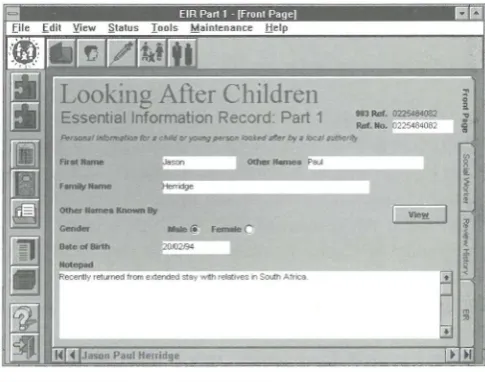
E I R P a r t 1 - [ F r o n t P a g e !
F i l e t d i t V i e w b t a t u s Lools M a i n t e n a n c e H e l p
Looking After Children
Essential Information Record: Part 1
P&tscMl infama^n On a chSfet or yourtg pwscn AeW after Ay a focaf
Ottier N«me* Known By Date of Birth Hot«p»d
Recently returned from extended stay wan relatives in South Africa
M l 41 J a s o n P a u l H e n i d g e
Fig 1 Front Screen of LACCS
The Looking After Children Computer System
(LACCS)
The idea of computerising some or all of these records was present from an early stage and given the amount of material that could potentially be recorded on any one child, computer storage was viewed as somewhat of a necessity. Accordingly in 1992 the Social Services Research and Development Unit (SSRADU) at the University of Bath was commissioned to produce a feasibility study to explore what material might lend itself to a computerised package and how such a program might be developed.
[image:13.596.288.531.224.415.2]EIR Part 2 - (Placement H i s t o r y ]
I File Edit V i e w Status T o o l s M a i n t e n a n c e Help
iU
a
4» Pte—o record aW pt«cemeiit« «lnc« ffrvl looked aAer away from home: SB) I Run 9M tf <ltd<Uon |
p«t«8egart iMoEnAd " ^5^3)94
MJ J±
TFIM
Fig 2 Essential Information Record
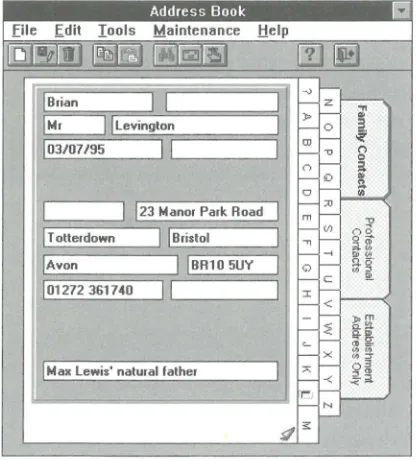
The system was designed to be a direct repUcation of the EIR form with the capacity to printout an identical paper based copy of the record. However, the system did have a number of efficiency benefits such as a common address book for schools, residential units, foster parents, etc., which could be shared by all the system users, thereby eliminating double entry of data. The computer program was also designed to be capable of generating for any one local authority the annual data return to central
government on children looked after by the SSD. On completion of the initial development phase a piloting process was commenced which allowed local authorities to review the software for a time limited period together with some training and a telephone based 'help line' support. Some 60 local authorities availed themselves of this offer.
A d d r e s s B o o k
F i l e Edit T o o l s M a i n k n a n c e H e l p
iDi&imi i%imi \mmw
I L e v i n g t o n
0 3 / 0 7 / 9 5
23 Manor Park R o a d
T o t t e r d o w n Bristol
A v o n BR10 5UY
01272 3G1740
Max Lewis' natural father
I
§
a s
I I
11
3
!
1 1
Fig 3 Address Book
The development of the LACCS system was funded by the Department of Health with the intention that once
developed continued support of the system should be taken over by local authorities via a licensing
arrangement. Such a development is significant in that it is the first major database for social services to be directly funded by central government. Coterminous with these initiatives and also following on from the development of both the paper based and computer based systems a number of other projects have arisen concerning the management of child care information. These include an internal review by the Department of Health of the function of child care returns to central government, a minimum data set for all child care recording, a possible extension of the recording system to other children with which SSD's come into contact and a set of data standards for exchange of information from one computer system to another.
SSDA- (903 Return) File Edit T o o l s M a i n t e n a n c e H e l p
Mem 1 Local Authorfty
Hem 2 CNkfe IdenUfier [1225484030 I
Mem 3 Sex (Fnter 4 In bo* W rnWrn, 2 if femWe) L _ l
Kern 4 Date of Birth
Kern 1A Area Offke (Optional)
'I ua/
Rem* 6 Date chiM started to be bM^ed after _
B.«m 903 ValidaUon I Irnnfi Dote
Commenced iH7 Reason pWmCode Legi^ Inns ffeason gWAAmr jfiwfcf- — Ik*
'' ' Y l ^ j Epteode Ceased g g
p.
30*584 21 01^284127
p.
01^284127
Fig 4 903 Return
Background to the Development of the Computer
System
[image:14.596.27.269.54.236.2] [image:14.596.298.555.316.512.2] [image:14.596.23.231.504.734.2]Overall a child's individual record may be stored using a variety of mediums, including paper based notes and forms, word processed documents and computers, the latter varying from sophisticated networked systems through to little more than computerised card indexes. Each local authority may utilise any or all of these mediums often having a number of systems recording different aspects of a child's care, e.g., a client index, a system concerning fostering, a database designed to record information to compile the annual statistical return to government.
Consequently, a desired outcome of the overall Looking After Children Records system was to standardise both the content and method of recording across the country as well as to improve the quality and consistency of individual records. The computer program was seen as playing a role in achieving this.
Issues of Implementation
Despite the logic surrounding the development of LACCS such work has not been greeted with universal approval. The reasons why this might be so form part of a wider debate concerning the role and development of computeris-ation by social work agencies in England and Wales.
First, computerisation in SSD's has largely been influenced by administrative staff inputting data, information technology staff managing the system and managers using the results. Use of computers by social workers is still limited. In part this is a 'chicken and egg' discussion, i.e., is it that software has not been developed specifically targeted at a social work audience or is it that social workers have not demanded the use of computers? Consequently any software developed, like LACCS, encounters problems in a shortage of hardware being available for the audience at which it is directed. Whilst funding was available to provide computing resources for care in the community this has not been the case for child care. As Glastonbury comments, 'In short, IT may be highly valued by managers and administrators, and have some limited use in professional practice, but it is also an unproven 'Johnny-come-lately', neither well understood nor wholly suited to the caring context'.
Secondly, although the proposed recipients of results from software have been managers the databases currently in use have still been seen as producing only limited benefits for that group. This in turn has also been encouraged by SSD's generally not being information driven
organisations, (see Kerslake 1996). Therefore, there is a general climate of opinion that databases are there to be endured rather than benefited from.
Thirdly within most SSD's the computer development that has taken place does not readily fit locally networked, Windows based databases. Consequently such a system has often been opposed by computer staff who see the use of LACCS as deviating from the corporate IT strategy that has been developed. Little work has been achieved in linking different database systems or in the use of 'client-server architecture'.
Finally, the design of the LACCS software potentially creates problems, its structure not being served by a large database such as Oracle and yet it is still far more complex than, for example, word processing templates which could also be used for form completion.
Conclusion
The aims for the Looking After Children Computer System were to develop a Windows based database, that could easily be used by social work staff, that were a direct replication of the paper based records and that offered easy monitoring of children looked after by SSD's.
Whilst those aims have been achieved gaining its implementation by such agencies may prove a far from easy task, as the issues presented above display. If successful implementation of LACCS is to be achieved then a number of actions will need to take place:
• Computer systems in SSD's need to move beyond serving primarily a data warehousing function. More attention needs to be paid to how systems present information in a format that lends itself to monitoring and analysis.
• Information Management strategies also need to take account of how generalist functions, such as an index of all clients, can be matched with the specialist requirements that may be present in child care or child protection.
• More attention needs to be given by all software developers as to how effective implementation strategies can be achieved. This calls for establishing common ground between IT staff, managers and social work practitioners.
so elongated that the hardware may well be incompatible with the latest software before widespread
implementation of any modem system can occur. For such an investment to be both justified and used also requires systems that address the concerns of the staff who input data. This may well mean greater linkage between databases and office systems such as word processors so that front line staff can see the benefits of information being entered in one system being replicated by other forms and documents that contain identical information. It also means offering computer based reports and analysis which help the kind of decisions social workers are required to take on a daily basis rather than just providing the longer term perspective required for managerial decision making.
If outcomes for children looked after by the local authority are to be improved then computerisation is the only way in which such outcomes can be observed and measured individually or collectively. LACCS is potentially one step along that route. However, if effective implementation of such a system is to be achieved then SSD IT strategies need to be much more practice and policy orientated.
References:
The Children Act 1989, London, HMSO.
Cohen, 'Lock up Your Daughters'; The Independent Magazine, 25/5/96, The Independent, London
Department of Health, (1991), 'Patterns and Outcomes in Child Placement' \ HMSO
Parker R, Ward H, lackson S, Aldgate I, Wedge P, (Eds.) (1991), 'Looking After Children: Assessing Outcomes in Child Care', HMSO.
Corrick H, Jones D, Ward H, (1995), 'Management and Implementation Guide for Looking After Children HMSO.
Glastonbury B, (1995), 'Risk, Information Technology and Social Care' in New Technology in the Human Services Vol. 8 No 3.
Kerslake A, (1996), 'Information Management: Beyond Information Technology' in Information Management in Social Services, Avebury.
Conference: Information Management in Social Services (IMISS)
2nd National Conference
In March 1995, the Social Services Research and Development Unit (SSRADU), University of Bath, organised the first National Conference on Information Management in Social Services(IMISS). IMISS aims to bring together senior SSD and voluntary sector managers, representatives from the Department of Health, IT experts, academics and all those who see effective information collection and delivery as essential to managing SSD's in the 21st Century.
Venue: The Guildhall, Bath, U K
Date: 31st October - 1st November 1996.
For advance information please contact Jo Coldman, Conference Organiser :
Tel: +44 1225 484088 Fax: +44 1225 330313
Factors Implicated in the Integration of Clinical Information Systems Into Human
Service Agencies: A Concept Map
Dr Riki Savaya, & Dr Mark Waysman,
Abstract
Recent advances in computer technology have facilitated the development of computerised clinical information systems (CIS) to answer growing demands for accountability and quality assurance in the fields of mental health, social welfare and education. These systems aid and support ongoing monitoring and
evaluation of professional practice. Although agencies invest considerable resources in computer hardware, software and staff training, these systems tend to be under-utilised and generally fail to live up to their vast potential. This study identifies, via the concept mapping procedure, 98 variables that form eleven clusters of factors contributing to acceptance and utilisation of clinical
information systems in human service organisations. These findings suggest that successful integration of clinical information systems into a human service agency is a difficult outcome to achieve, that requires a long-term commitment to monitoring and intervention in a large number of areas. Practical and theoretical implications are discussed.
Riki Savaya works at the Boh Shapell School of Social Work, Tel Aviv University, Israel and Mark Waysman works at the Center for Evaluation of Human Services Rishon Lezion, Israel. This paper was based on a paper presented at the International
Conference on Evaluation of Social Work Practice, Huddersfield, England, 5-7th September 1995.
Contact them at:
Bob Shapell School of Social Work Tel Aviv University
Ramat Aviv Tel Aviv, Israel
TgA- +972 j 64097^0 /w." +972.) 6^09752
Email: [email protected]
Introduction
The aim of this study was to identify, classify and map the factors that influence the utilisation of clinical information systems. These systems are differentiated from management information systems, by their focus on practice-oriented data relevant to clinical decision-making, rather than (or in addition to) administrative factors. Thus, whereas management information systems primarily track effort, such as, number of clients in treatment, number of intakes, and/or number of treatment sessions (cf. Fein, 1975), clinical information systems monitor treatment processes and outcomes (e.g. changes over time in client problems; quality and integrity of interventions applied) in order to evaluate effectiveness (Briar & Blythe, 1985). They also generally provide outputs in the form of graphic and text summary reports, on both the individual case and the agency level. While clinical information systems may also serve managerial functions, they are geared first and foremost to support and guide clinical decision making (Cwikel & Cnaan, 1991; Fischer, 1993; Gambrill & Butterfield, 1988; Mutschler & Hasenfeld, 1986; Mutschler & Jayaratne, 1993).
The demand for monitoring and evaluation of interventions is associated with the empirically-based practice movement, which has grown in the past two decades in response to two main pressures. Results of early studies in psychology and in social work began to question the effectiveness of professional practice, while at the same time, social and economic changes led to a reduction in public funding of social programs and to demands by funding agencies for greater accountability of agencies regarding the services that they provide and the degree to which they achieve their objectives. As Reid (1994) has specified, empirically-based practice has three main facets: use of research methods in practice to facilitate
The use of computerised information systems to support work according to principles of empirically-based practice is the most recent stage in an ongoing process of
professional evolution that was preceded by two prior approaches (Fischer, 1993). Historically, emphasis was initially placed on practice evaluation via experimental research designs that involve control groups and before/after measurements (MacDonald, Sheldon, & Gillespie, 1992; Reid, 1979; Sheldon, 1986). The
implementation of these procedures required considerable research skills and a great investment of time and effort. More importantly, findings were reported using
terminology that was alien to most practitioners (Meyer, 1992). Not surprisingly, this approach was of little value to individual practitioners or agencies interested in the ongoing evaluation of their own practice.
As a response to these limitations, the past decade has seen a rising emphasis on single case designs, which provide tools to enable individual practitioners to monitor and evaluate the outcomes of their practice (Fischer, 1993; Reid, 1993; Thyer & Thyer, 1992; Thyer, 1992). These designs, too, have proven to be of limited usefulness, however, and are rarely applied outside academic settings, for two main reasons;
i) the large amount of time, effort and skill required to design and implement a different and unique assessment for each client; and
ii) th