Abstract—In this study, an effective computational intelligence-based method is proposed to design mutagenic primer for PCR-RFLP (polymerase chain reaction-restriction fragment length polymorphism). It is a rapid and economical biotechnological method for SNP (single nucleotide polymorphism) genotyping. A novel application of REHUNT for restriction enzymes search based on REBASE is introduced into the method. Mutagenic matrix is used to increase the efficiency of getting available restriction enzymes for target SNPs. Furthermore, the accurate thermodynamic melting temperature calculation is applied to the method. We have in silico test the method use 25 target SNPs with mismatch PCR-RFLP. It is helpful for design mutagenic primers and to get available restriction enzymes for SNPs in PCR-RFLP experiments.
Index Terms—Computational intelligence, mutagenic primer, PCR-RFLP, SNP, restriction enzyme.
I. INTRODUCTION
NPs (single nucleotide polymorphisms) are the most widespread genetic variants and continuously considered as genetic markers in the human species. PCR-RFLP (polymerase chain reaction-restriction fragment length polymorphism) is a rapid and economical biotechnology for SNP genotyping [1, 2]. However, many SNPs get invalid restriction enzymes to recognize them and can not be genotyped by PCR-RFLP which is known as mismatch PCR-RFLP. Fortunately, a mutagenic primer design can solve this problem [3].
In related studies, Cheng et al. in 2013 use genetic algorithm (GA) with fixed and adaptive stopping criteria to design PCR-RFLP primers [4]. Furthermore, they also estimate appropriate parameters for GA in PCR-RFLP primer design [5]. In 2016, Cheng et al. proposed a novel method to improve the GA [6]. However, these methods are not suitable for mismatch PCR-RFLP. Several systems provide the information of mutagenic primers and restriction enzymes including SNP Cutter [7], V-MitoSNP [8], and Prim-SNPing [9]. However, SNP Cutter is limited to the older database. Many SNP IDs is unavailable and only a few restriction enzymes are available. V-MitoSNP only provides
Manuscript received November 4, 2016; revised January 16, 2017. This work is partly supported by the Ministry of Science and Technology (MOST) in Taiwan under grant MOST105-2221-E-324-026. Asterisk indicates
corresponding author.
Y.-H. Cheng is with the Department of Information and Communication Engineering, Chaoyang University of Technology, Taichung, Taiwan (e-mail: [email protected]).
C.-M. Lai is with the Department of Vehicle Engineering, National Taipei University of Technology, Taipei, Taiwan (e-mail: [email protected]).
information for human mitochondrial SNPs (mtSNPs). Prim-SNPing is limited by its inefficiency method strategy to provide invalid primers. That makes mutagenic primers and available restriction enzymes are difficult to obtain for PCR-RFLP experiments.
In 2012, a GA-based method was first proposed for mismatch PCR-RFLP [3]. The melting temperature is calculated by 2AT+4CG rule, i.e., Wallace’s formula [10] is used to design mutagenic primers. However, many researchers consider it is still inaccurate method, even through many literatures referred the primer design using the Wallace’s formula [11-13]. The thermodynamic ‘Nearest Neighbor’ (NN) model proposed by SantaLucia [14] is thought accurate method for melting temperature estimation. There are many software and tools use the SantaLucia’s formula for melting temperature calculation, such as Primer3 [15], MethPrimer [16], BatchPrimer3 [17], QuantPrime [18], and Primer-BLAST [19].
In this study, we present an effective computational intelligence-based method which apply learning concepts [20-22] for mutagenic primer design. Available restriction enzymes are found based on a novel package REHUNT to recognize target SNPs by altering nucleotides [23, 24]. Multiple primer constraints are provided to be accorded to the experiential PCR-RFLP experiments, including primer length, length difference, melting temperature, melting temperature difference, GC proportion, GC clamp, cross-dimer, self-dimer, hairpin structure, specificity and PCR product size [7, 25-27]. The in silico test result for 25 target SNPs with mismatch PCR-RFLP have been shown in paper. The method is a helpful method for provide available restriction enzymes and design mutagenic primer for target SNPs to successfully perform PCR-RFLP experiments.
II. MATERIALS AND METHODS
A. Mutagenic primer design
The mutagenic primer design is to find out available restriction enzymes which can identify the target SNP in sequence and provide a feasible primer pair for PCR-RFLP assay. To let TD be the template DNA sequence which contains ‘A’, ‘T’, ‘C’, and ‘G’ and only one target SNP. The target SNP can be the dNTP format ([dNTP1/dNTP2]) or the composite IUPAC code (‘M’, ‘R’, ‘W’, ‘S’, ‘Y’, ‘K’, ‘V’, ‘H’, ‘D’, ‘B’ or ‘N’). In this study, deletion/insertion polymorphism (DIP or Indel) and multi-nucleotide polymorphisms (MNP) is not considered. TD is presented as
An Effective Computational Intelligence-Based
Method for Mutagenic Primer Design
Yu-Huei Cheng
*,
Member, IAENG
, and Ching-Ming Lai
follows:
} !
|
{B iistheindexof DNA sequence, B target SNP
TD i i (1)
In this study, we define Pf, Pr, and Fm, are forward primer, reverse primer, and mutagenic position, respectively. For Pf, it must contain the target SNP and a mutagenic base which is on the Fm position. Furthermore, a recognition sequence of available restriction enzymes at least must cover the target SNP and the mutagenic base to identify the target SNP. Pr is a complementary and reverse subsequence retrieved from TD.
Pf and Pr together are called a primer pair which is the design aim for PCR-RFLP assay. In order to apply the method to perform mutagenic primer design, we encode learner vector Lv = (Fm, Fl, Pl, Rl, Σ) to indicate the solution of this issue. In the Lv, Fm is mutagenic position as the above-mentioned and its range is between Fm_min and Fm_max. Fl is forward primer length; Pl is the PCR product length; Rl is reverse primer length; Σ is a mutagenic nucleotide which has a integer 0, 1, 2 or 3 to indicate ‘A’, ‘T’, ‘C’ or ‘G’, respectively.
B. Mutagenic matrix
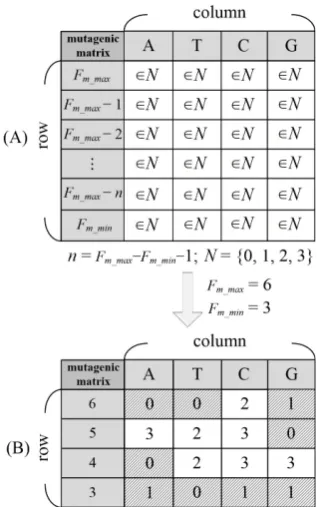
Restriction enzymes search work is tedious and time-consuming, especially in iterative computation method. In order to increase the efficacy and decrease the computational complexity, the mutagenic matrix (Fig. 1) is employed in the method. Pre-computation is performed for all hypothetical mutagenic nucleotide to provide available information for the identification of a target SNP. There are [(Fm_max-Fm_min+1) × 4] elements are included in the mutagenic matrix. The mutagenic position between (SNP- Fm_max+1)and (SNP-Fm_min+1) is presented in row fields; the mutated nucleotides of ‘A’, ‘T’, ‘C’ and ‘G’ is presented in column fields. The element values of 0, 1, 2 and 3 which indicate different conditions for the availability of restriction enzymes. The value 0 shows both the sense and anti-sense strand have available restriction enzymes. The value 1 shows either the sense or anti-sense strand has available restriction enzymes. The value 2 shows neither the sense nor anti-sense strand has available restriction enzymes. The value 3 shows no mutagenic base is designed and no any available restriction enzymes.
C. REHUNT for restriction enzymes hunting
In this study, REHUNT (Restriction Enzymes HUNTing) (https://sites.google.com/site/yhcheng1981/rehunt) is employed to hunt available restriction enzymes from REBASE. It is a reliable and open source API (Application Programming Interface) implemented in JAVA to provide many useful methods for biological sequence analysis around restriction enzymes. All recognition sequences of restriction enzymes in REBASE are examined for the target SNP. The information for the availability of restriction enzymes is stored in mutagenic matrix.
D. Primer constraints
The success rate of PCR amplification is partly determined by PCR primer constraints. Primer constraints involve primer length, primer length difference, primer melting temperature (Tm), primer Tm difference, GC proportion, GC clamp, dimer cross-dimer, self-dimer, hairpin structure, specificity and PCR product size [7, 25-27]. In this study, we give primer length is between 16 and 28 nt. The primer length difference is not more than 3 nt. The primer Tm is between 45 oC and 62 oC, and the primer T
m difference is not exceed 5oC. The GC proportion is between 40% and 60%. Furthermore, we also estimate the GC clamp to ensure a tight localized hybridization bond. Dimers and hairpins are also avoided appearing in primers. Finally, primers are designed with specificity and the PCR product size is greater than 100 nt.
E. Thermodynamic melting temperature calculation method Thermodynamic melting temperature calculation method is considered is accurate for primer design. In this study, SantaLucia’s formula (Eq. 2) is applied to mutagenic primer design.
15 . 273 )) 4 / ln( ) (
(
1000 ) (
)
(
T SAN
C R ction salt_corre S
predicted H
P
Tm (2)
where H(predicted) is the enthalpy; S(salt_correction) is the entropy correction; R is the gas constant (1.987 cal/Kmol), and CT is the DNA concentration.
F. The computational intelligence-based method
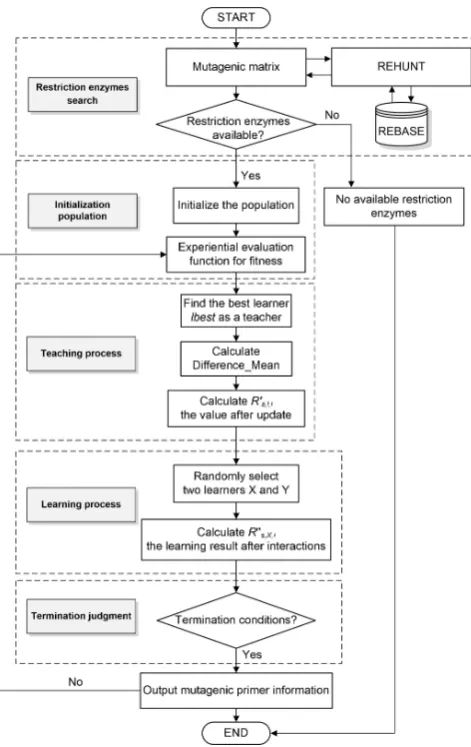
In this study, five steps are used for mutagenic primer design (the flowchart is shown as Fig. 2). These steps are respective 1) restriction enzymes search; 2) initialization population; 3) teaching process; 4) learning process, and 5) termination judgment. The following clearly describes the
Fig. 1. (A) Mutagenic matrix. (B) Instance for mutagenic matrix with Fm_max
[image:2.595.348.507.52.306.2]steps.
1) Restriction enzymes search
The above-mentioned REHUNT and mutagenic matrix is firstly used to estimate available restriction enzymes. We must know mutagenic primers whether available for the target SNP. The mutagenic matrix involves the element values of 0 or 1 is available, and the mutagenic matrix involves the element values of 2 or 3 is not available. If mutagenic matrix has no any available restriction enzymes, to perform mutagenic primer design will be meaningless.
2) Initialization population
Learner vector Lv = (Fm, Fl, Pl, Rl, Σ) is generated randomly with dozens or hundreds for providing an initial solutions, we called it a population. Population will be updated iteratively. The initial population is evaluated by an experiential evaluation function (Eq. 2) for their fitness of every learner vector. We give the evaluation value the smaller the better.
) ( 100 ) ( 60 ) ( 50 )) ( ) ( ) ( ) ( ( 10 )) ( ) ( ) ( ( 3 ) ( v v v v v v diff v v clamp v proportion v diff v L RFLP L product L y specificit L hairpin L dimer L Tm L Tm L GC L GC L Len L Evaluation (2) where Lendiff(Lv) checks the length difference between the forward primer and the reverse primer; GCproportion(Lv) checks the proportion of nucleotide ‘C’ and ‘G’ in the forward primer and the reverse primer; GCclamp(Lv) checks the nucleotide ‘G’
or ‘C’ which appears at the primer 3’ terminal end; Tm(Lv) checks the melting temperature for the forward primer and the reverse primer; Tmdiff(Lv) checks the Tm difference between the forward primer and the reverse primer; dimer(Lv) checks cross-dimer and self-dimer for primers; hairpin(Lv) checks for primer self-annealing; specificity(Lv) checks the primer specificity; product(Lv) checks the digested allelic fragments can be distinguished by electrophoresis; RFLP(Lv) checks the availability for RFLP.
3) Teaching process
In the teaching process, the best learner lbest is firstly found out as a teacher. To consider s is a particular subject, and there are m number of subjects (i.e., s = 1, 2, …, m); l is a particular learner, and there are n number of learners (i.e., l = 1, 2, …, n). At an iteration i, Ms,iis represented as the mean result of the learners in a particular subject s; Rs,l,i is represented as the learning result of l in a particular subject s; Rs,lbest,i is represented as the learning result of lbest in a particular subject s; Rtotal-l,i is represented as the total learning result of l in all subjects; Rtotal-lbest,i is represented as the total learning result of lbest in all subjects. Diff_Means,l,i (Eq. 3) is represented as the difference between the existing mean learning result of l in a particular subject s and the corresponding learning result of the lbest in a particular subject s.
) (
_Means,l,i ri Rs,lbest,i TFMs,i
Diff (3)
where TF (Eq. 4) is the teaching factor to determine the value of mean to be changed, and ri is the random number in the range [0, 1].
}] 1 2 ){ 1 , 0 ( 1 [
round rand
TF (4)
In the teaching process, Rs,l,i is updated by Eq. 5, and finally
R's,l,i the value after update is gained and provided for next process. i l s i l s i l
s R Diff Mean
R',, ,, _ ,, (5)
4) Learner process
Two learners X and Y are randomly selected from the population. The selected learners X and Y have their learning result R'total-X,i and R'total-Y,i, which are respective the updated values of Rtotal-X,i and Rtotal-Y,i. R''s,X,i is the learning result after interactions, it can be calculated by Eq. 6.
i Y total i X total i X s i Y s i Y total i X total i Y s i X s i i X s i X s R R if R R R R if R R k k r R R , , , , , , , , , , , , , , , , , , , (6)
5) Termination judgment
[image:3.595.49.285.49.423.2]Two criteria are used in the method, one is the learning result of the best learner lbest is reached to 0; the other is preset maximum number of iterations is reached. In this study, we use the preset maximum number of iterations is met to estimate the computational time.
G. Parameter settings and environment
There are two main parameters set in this method. One is the number of iterations and the other is the population size. The number of iterations is set to 1000, and the number of learners is set to 50. In environment, a server computer of Intel(R) Xeon(R) CPU E3-1200 v2 @ 3.1 GHz x 2, and 4GB of RAM under Microsoft Windows 7 professional SP1 32 bits is used to perform mutagenic primer design.
H. Test dataset
SNPs screened from SLC6A4 gene associated with autism spectrum disorders [28], psychosis [29], and bipolarity [30] is used as test dataset. There are twenty five true SNPs are found with mismatch PCR-RFLP.
III. RESULTS
A. In silico estimation
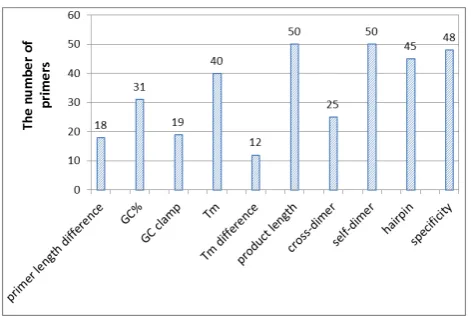
Twenty five true SNPs with mismatch PCR-RFLP were in silico tested by the proposed method. The test result get 25 primer pairs and total number is fifty primers. There are 18 primers conformed to the constraint of primer length difference; there are 31 primers conformed to the constraint of the GC%; there are 19 primers conformed to the constraint of the GC clamp; there are 40 primers conformed to the constraint of the Tm; there are 12 primers conformed to the constraint of the Tm difference; there are 50 primers conformed to the constraint of the product length; there are 25 primers conformed to the constraint of the cross-dimer; there are 50 primers conformed to the constraint of the self-dimer; there are 45 primers conformed to the constraint of the hairpin, and finally, there are 48 primers conformed to the constraint of the specificity. The result is shown in Fig. 3.
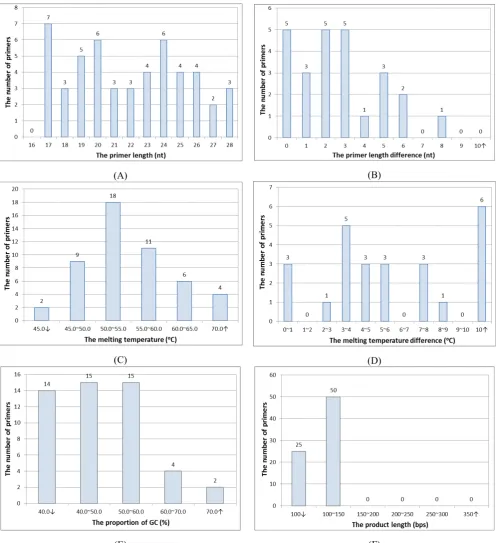
The distributions of the primer constraints for the 25 true SNPs with mismatch PCR-RFLP in mutagenic primer design are shown in Fig. 4. Primer length in 17 nt, 20 nt and 24 nt are larger than 5 primers. All primer lengths are designed fall into 16 nt to 28 nt. Primer length difference in 0 nt, 2 nt and 3nt has 5 primer pair; in 1 nt has 3 primer pair, and the others are designed larger than 3 nt. Tm smaller than 45 oC has 2 primers; larger than 70 oC has 4 primers, and the others are designed fall into the preset Tm range. Tm difference exceeds 5 oC has 13 primers, and the others are designed fall into the preset Tm range. GC% smaller than 40% has 14 primers; between 60% and 70% has 4 primers; larger than 70% has 2 primer, and the others are designed fall into the preset GC% range. The PCR product length smaller than 100 bps has 25 primer pairs, and the others are designed fall into the preset PCR product length range. The average fitness in the method is 112.04, and the average computation time in the method is 309.59 ms.
B. The advantages of the proposed method
In PCR-RFLP experiments, restriction enzymes are the pivotal information for further perform successful PCR-RFLP. However, available restriction enzymes for target SNP is difficult to obtain by manually search. This method uses the REHUNT to search available restriction enzymes for the target SNP. Therefore, the researchers can effectively get available restriction enzymes. Furthermore, mutagenic matrix is
introduced into the method to give time-saving work for available restriction enzymes in throughout all REBASE and mutagenic points. That makes the method get available restriction enzymes based on mutagenic point rapidly and robustly. In the computational intelligence-based method, solutions are gradually converged into one better solution based on primer constraints by iterations. Consequently, it can get preferable mutagenic primers. The accurate thermodynamic melting temperature is applied to the method also helps the PCR-RFLP experiments performed well.
C. Less algorithm-specific parameter settings
The computational intelligence-based method uses only two general parameters, i.e., the number of iterations and the population size. We consider the algorithm-specific parameters are always the concerned topic for solving the problem. It is thus more suitable for beginners for mutagenic primer design.
IV. CONCLUSION
[image:4.595.309.545.49.208.2]In this study, the computational intelligence-based method combines REHUNT, mutagenic matrix, and accurate thermodynamic melting temperature calculation to provide effectively intelligent computation to give available restriction enzymes and mutagenic primer design. It is a reliable and rapidly method to offer available restriction enzymes for target SNP and design feasible mutagenic primers for mismatch PCR-RFLP experiments. We have given in silico estimation for the method use 25 SNPs with mismatch PCR-RFLP. It indeed is helpful for design mutagenic primers and to get available restriction enzymes for target SNPs in PCR-RFLP experiments.
REFERENCES
[1] R. Zhang, Z. Zhu, H. Zhu, T. Nguyen, F. Yao, K. Xia, D. Liang, and C. Liu, "SNP Cutter: a comprehensive tool for SNP PCR-RFLP assay design," Nucleic Acids Res, vol. 33, pp. W489-92, Jul 1 2005.
[2] M. Ota, H. Fukushima, J. K. Kulski, and H. Inoko, "Single nucleotide polymorphism detection by polymerase chain reaction-restriction fragment length polymorphism," Nat Protoc, vol. 2, pp. 2857-64, 2007.
[3] C. H. Yang, Y. H. Cheng, and L. Y. Chuang, "Mutagenic primer design for mismatch PCR-RFLP SNP genotyping using a genetic
algorithm," IEEE/ACM Trans Comput Biol Bioinform, vol. 9, pp. 837-45, May-Jun 2012.
[4] Y.-H. Cheng, L.-Y. Chuang, and C.-H. Yang, "Single Nucleotide Polymorphisms Polymerase Chain Reaction-Restriction Fragment Length Polymorphism Primer Design Using Genetic Algorithm with Fixed and Adaptive Stopping Criteria," Journal
of Advanced Mathematics and Applications, vol. 2, pp. 172-181,
2013.
[5] L.-Y. Chuang, Y.-H. Cheng, C.-H. Yang, and C.-H. Yang, "Associate PCR-RFLP assay design with SNPs based on genetic algorithm in appropriate parameters estimation," IEEE
Transactions on NanoBioscience, vol. 12, pp. 119-127, 2013.
[6] Y.-H. Cheng, C.-N. Kuo, and C.-M. Lai, "Effective Natural PCR-RFLP Primer Design for SNP Genotyping Using
(A) (B)
(C) (D)
[image:5.595.50.549.51.595.2](E) (F)
Teaching-Learning-Based Optimization with Elite Strategy,"
IEEE Transactions on NanoBioscience, 2016.
[7] S. Rozen and H. Skaletsky, "Primer3 on the WWW for general users and for biologist programmers," Methods in Molecular
Biology, vol. 132, pp. 365-386, 2000.
[8] L. Y. Chuang, C. H. Yang, Y. H. Cheng, D. L. Gu, P. L. Chang, K. H. Tsui, and H. W. Chang, "V-MitoSNP: visualization of human mitochondrial SNPs," BMC Bioinformatics, vol. 7, p. 379, 2006. [9] H. W. Chang, L. Y. Chuang, Y. H. Cheng, Y. C. Hung, C. H. Wen, D. L. Gu, and C. H. Yang, "Prim-SNPing: a primer designer for cost-effective SNP genotyping," Biotechniques, vol. 46, pp. 421-31, May 2009.
[10] R. B. Wallace, J. Shaffer, R. F. Murphy, J. Bonner, T. Hirose, and
K. Itakura, "Hybridization of synthetic
oligodeoxyribonucleotides to phi chi 174 DNA: the effect of single base pair mismatch," Nucleic Acids Res, vol. 6, pp. 3543-57, Aug 10 1979.
[11] C. W. Dieffenbach, T. M. Lowe, and G. S. Dveksler, "General concepts for PCR primer design," PCR Methods Appl, vol. 3, pp. S30-7, Dec 1993.
[12] K. A. Abd-Elsalam, "Bioinformatic tools and guideline for PCR primer design," african Journal of biotechnology, vol. 2, pp. 91-95, 2003.
[13] L. Y. Chuang, Y. H. Cheng, and C. H. Yang, "Specific primer design for the polymerase chain reaction," Biotechnol Lett, vol. 35, pp. 1541-9, Oct 2013.
[14] J. SantaLucia, Jr., "A unified view of polymer, dumbbell, and oligonucleotide DNA nearest-neighbor thermodynamics," Proc
Natl Acad Sci U S A, vol. 95, pp. 1460-5, Feb 17 1998.
[15] A. Untergasser, I. Cutcutache, T. Koressaar, J. Ye, B. C. Faircloth, M. Remm, and S. G. Rozen, "Primer3--new capabilities and interfaces," Nucleic Acids Res, vol. 40, p. e115, Aug 2012. [16] L. C. Li and R. Dahiya, "MethPrimer: designing primers for
methylation PCRs," Bioinformatics, vol. 18, pp. 1427-31, Nov 2002.
[17] F. M. You, N. Huo, Y. Q. Gu, M. C. Luo, Y. Ma, D. Hane, G. R. Lazo, J. Dvorak, and O. D. Anderson, "BatchPrimer3: a high throughput web application for PCR and sequencing primer design," BMC Bioinformatics, vol. 9, p. 253, 2008.
[18] S. Arvidsson, M. Kwasniewski, D. M. Riano-Pachon, and B. Mueller-Roeber, "QuantPrime--a flexible tool for reliable high-throughput primer design for quantitative PCR," BMC
Bioinformatics, vol. 9, p. 465, 2008.
[19] J. Ye, G. Coulouris, I. Zaretskaya, I. Cutcutache, S. Rozen, and T. L. Madden, "Primer-BLAST: a tool to design target-specific primers for polymerase chain reaction," BMC Bioinformatics, vol. 13, p. 134, 2012.
[20] Y.-H. Cheng, "Computational intelligence-based polymerase chain reaction primer selection based on a novel teaching-learning-based optimisation," IET Nanobiotechnology, vol. 8, pp. 238-246, 2014.
[21] Y.-H. Cheng, "Estimation of Teaching-Learning-Based Optimization Primer Design Using Regression Analysis for Different Melting Temperature Calculations," IEEE
Transactions on NanoBioscience, vol. 14, pp. 3-12, 2015.
[22] Y.-H. Cheng, "A novel teaching-learning-based optimization for improved mutagenic primer design in mismatch PCR-RFLP SNP genotyping," IEEE/ACM Transactions on Computational
Biology and Bioinformatics, vol. 13, pp. 86-98, 2016.
[23] A. Haliassos, J. C. Chomel, S. Grandjouan, J. Kruh, J. C. Kaplan, and A. Kitzis, "Detection of minority point mutations by modified PCR technique: a new approach for a sensitive diagnosis of tumor-progression markers," Nucleic Acids Res, vol. 17, pp. 8093-9, Oct 25 1989.
[24] A. Haliassos, J. C. Chomel, L. Tesson, M. Baudis, J. Kruh, J. C. Kaplan, and A. Kitzis, "Modification of enzymatically amplified DNA for the detection of point mutations," Nucleic Acids Res, vol. 17, p. 3606, May 11 1989.
[25] M. J. McPherson, G. R. Taylor, and P. Quirke, PCR, a practical
approach: Oxford University Press, USA, 1991.
[26] J. Sambrook and D. W. Russell, "Molecular cloning: a laboratory manual," Cold Spring Harbor Laboratory Press, vol. 2, pp. 8.1-8.126, 2001.
[27] C. H. Yang, Y. H. Cheng, L. Y. Chuang, and H. W. Chang, "Specific PCR product primer design using memetic algorithm,"
Biotechnol Prog, vol. 25, pp. 745-53, May-Jun 2009.
[28] T. Sakurai, J. Reichert, E. J. Hoffman, G. Cai, H. B. Jones, M. Faham, and J. D. Buxbaum, "A large-scale screen for coding
variants in SERT/SLC6A4 in autism spectrum disorders," Autism
Res, vol. 1, pp. 251-7, Aug 2008.
[29] T. E. Goldberg, R. Kotov, A. T. Lee, P. K. Gregersen, T. Lencz, E. Bromet, and A. K. Malhotra, "The serotonin transporter gene and disease modification in psychosis: Evidence for systematic differences in allelic directionality at the 5-HTTLPR locus,"
Schizophr Res, vol. 111, pp. 103-8, Jun 2009.