Future developments in cyber risk
assessment for the internet of things
Radanliev, Petar and De Roure, David and Nicolescu,
Razvan and Huth, Michael and Mantilla Montalvo, Rafael
and Cannady, Stacy and Burnap, Peter
Oxford e-Research Centre, Department of Engineering Sciences,
University of Oxford„ Imperial College London, Cisco Research
Centre, Research Triangle Park, USA, School of Computer Science
and Informatics, Cardiff University, United Kingdom
September 2018
Online at
https://mpra.ub.uni-muenchen.de/92567/
FUTURE DEVELOPMENTS IN CYBER RISK
ASSESSMENT FOR THE INTERNET OF THINGS
Petar Radanliev*, David Charles De Roure*, Razvan Nicolescu, Michael Huth §, Rafael Mantilla Montalvo†, Stacy Cannady†, Peter Burnapª
*Oxford e-Research Centre, Department of Engineering Sciences, University of Oxford, UK, [email protected]; [email protected]; , § Imperial College London, UK, [email protected], [email protected]; †Cisco Research Centre, Research
Triangle Park, USA, [email protected]; [email protected]; ª School of Computer Science and Informatics, Cardiff University, [email protected]
Funding sources:
This work was supported by the UK EPSRC with project [grant number EP/N02334X/1 and
EP/N023013/1] and by the Cisco Research Centre [grant number 2017-169701 (3696)].
Abstract
This article is focused on the economic impact assessment of Internet of Things (IoT) and its
associated cyber risks vectors. We report the results of an empirical study that correlates
cyber risk impact assessment approaches with academic literature and IoT risks vertices. We
adapt the Cyber Value at Risk model and the MicroMort for cyber risk assessment of IoT
risks vertices. From the findings, we build a new impact assessment model for the IoT cyber
risk. We therefore advance the efforts of integrating cyber risk impact assessment standards
and offer a better understanding of economics impact assessment of cyber risk.
Keywords: IoT Cyber Risk; IoT risk analysis; IoT cyber insurance; IoT MicroMort; Cyber
1
Introduction
The IoT term was created in 1999 (Ashton 2011) and the first IoT principles were published
shortly after in the book ‘When Things Start to Think’ (Gershenfeld 1999). According to
Gartner’s IT Hype Cycle, the IoT market adoption should take 5-10 years, as of 2012 (Gubbi
et al. 2013). The increased adoption of the IoT represents multiple categories of
cyber-physical systems (Orojloo and Azgomi 2017), integrating technologies related to smart grids,
smart homes, intelligent transportation, manufacturing and supply chain and smart cities, to
name a few. Such new technologies come with new types of risks that existing risk
assessment/management methods are not designed to anticipate or predict. Safeguarding an
IoT deployment, while simultaneously harnessing its economic value, requires systematic
consideration of multiple risk factors. Cyber-attacks are increasing in frequency, and the and
increasingly target IoT devices (for example the Mirai botnet). The severity of future attacks
could be much greater than what has been observed to date.
A critical question for government policy and for private sector business strategies for IoT
connected products, platforms and services is the sufficiency of cyber security to minimise
cyber risk that accompanies IoT deployments. This answer must be partially addressed by
economic analysis, such as cost and frequency analysis of cyber-attacks (P. Radanliev, De
Roure, Cannady, et al. 2018). Such analysis would complement the process of building
frameworks and methodologies for mitigating the economic impact of cyber risk of
commercial use of deployments of IoT connected products and services (P. Radanliev, De
Roure, Nurse, et al. 2018).
The research methodology in this article proposes adopting the Cyber Value at Risk (CyVaR)
and the MicroMort (MM), and evaluating other cyber risk assessment approaches, to build a
new model for calculating the economic impact of IoT cyber risk. There is a limited research
related to cyber risks from different IoT verticals. The economic impact of IoT related cyber
risks in present time are assessed by applying methodologies established before the
development of IoT verticals (ex. automated, digital, social machines, cyber-physical and
coupled systems). Present day critical infrastructure systems are far more complex, creating
new risks for failures. Further, risk in an IoT deployment might extend to many entities. An
interruption in services delivered by a smart grid or smart city would impact many
businesses, agencies and individuals. For example, failure in MY IoT deployment might cost
millions due to interrupted services. This creates the rationale that a new impact model and
assessment methodology are needed that would anticipate economic impact of cyber risks
and benefits from the IoT ecosystem. This research would build upon existing cyber risk
models (e.g. VaR, Cyber VaR). The research aim is to develop a robust economic model to
estimate the economic impact in IoT verticals (ex. communications network, or critical
infrastructure).
2
Literature review
The literature review is probing the essence of impact measurements and sources of
probabilistic data of cyber risk impact assessment methods. Taxonomic classification is
applied for identifying and grouping impact measurement units into an intuitive scheme and
to categorise IoT cyber risk vertices.
2.1
Cyber risk impact assessment
The IoT security enables a trustworthy IoT (Yan, Zhang, and Vasilakos 2014; Sicari et al.
2013) with minimal human intervention (Ashraf and Habaebi 2015). Such autonomous IoT,
requires a risk-based adaptive assessment framework (J. R. C. Nurse et al. 2018) for risk
analysis (Abie and Balasingham 2012; Balasingham et al. 2012). Risk-based adaptive
implement planned actions, ability to maintain focus on risk mitigation, and ability to reduce
risk exposure (Abie and Balasingham 2012). Since cyber risk is constantly changing, the risk
has not been clearly quantified through historical measures (DiMase et al. 2015). The
common figure stated is a loss of $1 trillion to cybercrime, but estimates range from: 300bn
and $1tn (Biener, Eling, and Wirfs 2014), $400bn to over $575bn (DiMase et al. 2015), or
$400bn to over $2tn (Shackelford 2016). The difference in these figures shows that the
numbers are rough estimates at best, and the real economic impact of cyber risk remains
unknown (Shackelford 2016). The main difficulties in calculating the economic impact of
cyber risk are the lack of suitable data and the lack of universal standardised framework to
assess cyber risk (Koch and Rodosek 2016). Adding to these, there is the need to quantify
accumulated risk on a shared technology platform (such as cloud computing) and the digital
supply chain (Ruan 2017).
2.2
Economic Impact from the Internet of Things
The world is experiencing the fourth industrial revolution (Rajkumar et al. 2010; Wahlster et
al. 2013; Jazdi 2014), where the IoT real-time enabled platforms (Marwedel and Engel 2016)
represents the foundation for digital industry (Wahlster et al. 2013; Carruthers 2016). Digital
industry would be supported with more intelligent, resilient and interconnected
manufacturing equipment (Lee, Bagheri, and Kao 2015; Leitão, Colombo, and Karnouskos
2016; Marwedel and Engel 2016). The integration of artificial intelligence and machine
learning (Francalanza, Borg, and Constantinescu 2017), the cloud (Babiceanu and Seker
2016) and IoT has created systems of machines capable of interacting with humans
(Carruthers 2016; Marwedel and Engel 2016). The application of behavioural economics into
these systems of machines (Leonard 2008) already enables market speculation on human
consumer purchasing behaviour. We can expect to see autonomous machines adopting to
predetermine human behaviour (Carruthers 2016).
Technologies that would enable the integration of IoT in the digital industry include software
defined networks (Kirkpatrick 2013) and software defined storage (Ouyang et al. 2014). The
IoT and industrial integration are built upon cloud hosting (Carruthers 2016), automation
(Leitão, Colombo, and Karnouskos 2016), robots and artificial intelligence (Khalid et al.
2018), machine learning (Kambatla et al. 2014) and mesh networks (Wark et al. 2007). The
IoT creates security and risk management vulnerabilities from integrating less secured or
unsecured systems, triggering liability for breaches or damages (Carruthers 2016).
IoT is essential for future economic competitiveness, but technological innovations are
necessary for harnessing the economic value (Leitão, Colombo, and Karnouskos 2016;
Biennier and Favrel 2005; Nicolescu et al. 2018b). Maximising the economic impact of IoT
requires energy-aware buildings and cities (Rajkumar et al. 2010; Marwedel and Engel 2016),
with preventive maintenance and self-correcting systems (Rajkumar et al. 2010; Leitão,
Colombo, and Karnouskos 2016). On the other hand, the electric power grid represents one of
the largest complex interconnected networks (Leitão, Colombo, and Karnouskos 2016), and
under stressed conditions, even a single failure can trigger complex cascading effects,
creating wide-spread failure and blackouts (Rajkumar et al. 2010). Distributed energy
resource technologies such as wind power, create additional stress and vulnerabilities
(Rajkumar et al. 2010; Leitão, Colombo, and Karnouskos 2016; Marwedel and Engel 2016).
In terms of data ownership, data privacy and Economic lifespan of digital assets, it has
already been established that digital assets can outlive humans (Ruffle et al. 2014), triggering
the question of data ownership after end of data owners’ life. Some studies have simplified
the topic with the assumption of a limited economic lifespans for all classes of digital assets
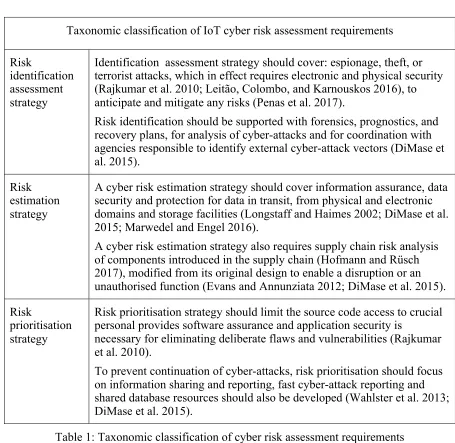
assessment requirements in Table 1. The categorisation follows recommendations from
earlier literature (J. Nurse, Creese, and De Roure 2017) and separates IoT cyber risk
assessment requirements into (1) risk identification assessment strategy, (2) risk estimation
strategy, and (3) risk prioritisation strategy.
Taxonomic classification of IoT cyber risk assessment requirements
Risk
identification assessment strategy
Identification assessment strategy should cover: espionage, theft, or terrorist attacks, which in effect requires electronic and physical security (Rajkumar et al. 2010; Leitão, Colombo, and Karnouskos 2016), to anticipate and mitigate any risks (Penas et al. 2017).
Risk identification should be supported with forensics, prognostics, and recovery plans, for analysis of cyber-attacks and for coordination with agencies responsible to identify external cyber-attack vectors (DiMase et al. 2015).
Risk estimation strategy
A cyber risk estimation strategy should cover information assurance, data security and protection for data in transit, from physical and electronic domains and storage facilities (Longstaff and Haimes 2002; DiMase et al. 2015; Marwedel and Engel 2016).
A cyber risk estimation strategy also requires supply chain risk analysis of components introduced in the supply chain (Hofmann and Rüsch 2017), modified from its original design to enable a disruption or an unauthorised function (Evans and Annunziata 2012; DiMase et al. 2015).
Risk
prioritisation strategy
Risk prioritisation strategy should limit the source code access to crucial personal provides software assurance and application security is
necessary for eliminating deliberate flaws and vulnerabilities (Rajkumar et al. 2010).
[image:7.595.68.523.170.613.2]To prevent continuation of cyber-attacks, risk prioritisation should focus on information sharing and reporting, fast cyber-attack reporting and shared database resources should also be developed (Wahlster et al. 2013; DiMase et al. 2015).
Table 1: Taxonomic classification of cyber risk assessment requirements
The IoT creates new types of cyber risk which are not anticipated or considered in existing
cyber risk assessment standards (J. Nurse, Creese, and De Roure 2017). To adapt the current
cyber security models, firstly the specific IoT cyber risk vertices are identified in Table 1. By
risk vertices, we refer to IoT attack vectors from particular approach used, to exploit IoT
cyber risk impact assessment model, because IoT technologies have already been integrated
into traditional computer networks. Integrating IoT technology in the communications
networks of critical infrastructure implies major ethical aspects that humans should be able to
sense and understand, while benefiting of maximum possible levels of trust and privacy. This
concern is represented by the needs that different IoT risk vertices have to be integrated in
reliable cyber security frameworks; such would prevent abuse from malicious interventions,
including those originated by organised crime, terror organisations or state-sponsored
aggressors. Analysis of the complete economic impact of data compromise would empower
the communications network providers to create clear, rigorous, industry-accepted
mechanisms to measure, control, analyse, distribute and manage critical data needed to
develop, deploy and operate cost-effective cyber security for critical infrastructure.
3
Research methodology
This section outlines the research methodology applied in the research. The methodology
starts with a literature review to create a taxonomical categorisation of impact assessment
classes. Then the complexities of designing a new impact assessment model are discussed
through SWOT analysis of the existing frameworks, methods and models. Finally, a new
quantitative model is developed, by adopting the Cyber Value-at-Risk (CyVaR) and
MicroMort (MM) for impact assessment of IoT cyber risk.
The CyVaR model has been promoted for standardisation of language, models and methods
(World Economic Forum 2015). This model attempts to understand the economic impact of
cyber risk for individual organisations (Koch and Rodosek 2016). Building upon the CyVaR,
a unifying economic framework proposed measurement units for cyber risk (Ruan 2017).
Other cyber value analysis methods have advanced to calculate the cost of different
cyber-attack types (Roumani et al. 2016), but the same problem with lack of data to validate the
(Koch and Rodosek 2016) that is based on data assumptions. The weakness in this approach
is that economic impact is calculated on organisations’ ‘stand-alone’ cyber risk, because data
assumptions can only be made on individual cases. However, Business impact for the same
risk can vary widely between companies based on the specific circumstances of each
company. Furthermore, that approach ignores the correlation effect of organisations sharing
infrastructure and information, and by default, sharing cyber risk exposure. Cyber risk exists
in multiple physical, information, cognitive, and social domains, (software, hardware,
firmware, adjacent systems, energy supplies, supply chains) and the economic impact is
related to these closely interconnected systems. This close interconnection of disparate
systems increases the probability of ‘cascading impacts’ (DiMase et al. 2015). This article
applied multidisciplinary methodologies, along with established risk measurement methods
e.g. MicroMort (MM) to define individual risk units and Value-at-Risk (VaR) for measuring
market cyber risk
4
Strengths, weaknesses, opportunities and threats (SWOT) analysis of Cyber
Risk Frameworks, methods, systems and models
Earlier literature suggested methods based on Return on Investment (ROI) and Net Present
Value (NPV), have been proposed to assess the information security investment, that include
broad set of criteria, including ‘economics of privacy’ (Anderson and Moore 2006), ‘optimal
amount to invest’ (Gordon and Loeb 2002), ‘risk averseness’ (Rodewald and Gus 2005), but
these methods are not validated with real data. In addition, cyber risk covers more elements
than information security financial cost, and a method is needed that would integrate cyber
risk directly with economics (Ruan 2017). Because the motivation for cyber risk can be
different than purely financial (ex. espionage), and yet still creating economic impact.
Therefore, the impact should be calculated in terms of average and in the most severe
To make such calculations with a reasonable precision of the impact assessment, different
modelling approaches need to be integrated in a new and more reliable impact assessment
model. Such integration is important, because the diversity of approaches for impact
assessment, complicates the process of performing cyber risk assessment for the insurance
companies. This diversity, found in different frameworks, methods, systems and models, is
evaluated with strengths, weaknesses, opportunities and threats (SWOT) analysis in Table 2.
The SWOT analysis of the reviewed frameworks, methods, systems and models is
summarised in the Table 2.
The strengths
•OCTAVE has developed a standardised questionnaire that can be applied to investigate and categorise recovery impact areas.
•TARA is a predictive framework that enables targeting of the most crucial exposures, as opposed to promoting the defence of all possible vulnerabilities.
•CVSS is relatively easy to use and translate results. Moreover, it is based on input and feedback from various sources and can be used to translate simple qualitative input into a numerical score reflecting severity and characteristics of a vulnerability.
•Exostar System enables enterprises to assess, measure, and mitigate risk in real-time across multi-tier partner and supplier networks and determines the gaps between cybersecurity posture and regulatory compliance.
•CMMI combines set of best practices in the disciplines of systems analysis and design, software engineering and management. CMMI can simultaneously address multiple as opposed to stand alone improvements. This enables improvement in the entire enterprise risk and the full product development life cycle risk.
•The NIST framework is valuable in assessing cyber risk, but more valuable in managing cyber risks. NIST is also the most advanced framework in terms of disaster and recovery planning.
•FAIR model promotes a quantitative, risk based, acceptable level of loss exposure.
•ISO promotes standardisation of cyber risk and reflects international experience and knowledge. ISO provides standards for cyber risk and disaster recovery.
•RiskLense presents a quantitative assessment with Monte Carlo simulations.
•CyVaR presents a method to quantitatively assess risk with Monte Carlo simulations.
The
weaknesses
•OCTAVE fails to provide a quantification method for calculating the required level of recovery.
•CVSS contains scoring range between 0.0 to 10.0, but is based on a 3-level system and because the score is derived from a limited number of variables, it creates dissimilar vulnerabilities receiving similar score.
•Exostar System does not assess enterprises own cyber risk exposure. Instead, it helps enterprises to manage risk by understanding the strengths and vulnerabilities of their supply chain partners.
•CMMI does not explain how to implement improvements, but only indicates where improvements are needed. The improvements are not methodological processes and the actual processes an enterprise chooses depend on multiple factors. The CMMI may simply not map the processes in a specific enterprise.
•NIST framework is documented, not an automated tool and does not contain an impact assessment model for quantifying cyber risk.
•FAIR framework promotes standardisation of quantitative models, but is difficult to use and is not as documented as other frameworks, e.g. OCTAVE. The greatest shortcoming is the lack of access to current information about the methodology and examples of how the methodology is applied.
•ISO is based on voluntary shared knowledge and is consensus based. International standardisation requires a level of compulsory compliance. •RiskLense contains a lack of details on the algorithm supporting its risk
assessment.
•CyVaR has the potential issue of a lack of the required risk data to perform adequate and comprehensive assessments.
The
opportunities
•OCTAVE is aimed at companies with limited resources, it is free and can be used as the foundation risk-assessment component or process for other risk methodologies.
•TARA is a methodology that can be implemented as a complementary method, in combination with other risk assessment processes.
•CVSS currently has a 3-level scoring system, and as such the biggest opportunity is to integrate more levels in the calculator to represent cyber risk with greater precision. Since the numbers are based on experts’ opinion and do not represent an ultimate precision, the calculator represents a guiding point. As such, colour coded system with more risk categories could be easier to understand than a number. Numbers may also provide a fake sense of precision, while the numbers in the calculator are not based on established mathematical or statistical probabilistic data.
•Exostar System could evolve into a system that assesses enterprises own cyber risk exposure, while enabling the assessment of cyber risk from supply chain partners.
•CMMI is related to ISO 9001. The ISO 9001 specifies a minimal acceptable quality level, while CMMI specifies continuous process improvement. Biggest opportunity is to adapt CMMI with continuous updates from ISO 9001 and other standards.
•FAIR is complementary to existing risk frameworks and applies knowledge from existing quantitative models. This represents an opportunity for developing a standardisation reference architecture.
•ISO could evolve into an international standardisation of cyber risk/security frameworks, models and methodologies.
•RiskLense could evolve into the first standardised quantitative model for cyber risk assessment. More academic research is required on this model to define and disclose the algorithm. This would increase the acceptance of this model, as academic research would enable the model to be verified and validated.
•CyVaR needs to be adapted and modified to include units of measurement for IoT cyber risk vectors.
The threats •OCTAVE method is complex and takes time to understand. This is the main weakness as it is a qualitative method that does not provide mathematical or financial modelling.
•TARA focuses on reducing cost by covering only the exposures that are most likely to occur. Considering that not all exposures are covered, greater focus should be on recovery planning. TARA promotes and facilitates system recovery, but does not address the level of cyber risk impact. •CVSS converting qualitative data into a quantitative result, with relatively
low level mathematical approximation, could create a false level of security.
•Exostar System uses third-party sources to provide insights in the cyber health and viability of supply chain partners. The validity of the data depends on the third-party sources and if this cyber data is incomplete or compromised, the insights would also be compromised.
•CMMI measures are easy to recognise but difficult to develop. For instance, CMMI does not provide guidance on how to implement improvements, it simply indicates where improvements are required. •NIST as a documented model, depends on many documents being
continuously updated. Unless it evolves into a more automated process, the framework would need constantly to be reviewed and updated as new technology and laws emerge.
•FAIR depends on a computational engine for calculating risk and a model for analysing complex risk scenarios RiskLens (RiskLens 2017). RiskLens (RiskLens 2017) is a commercial product and the software comes at a cost. Standardisation of commercial products could create disadvantages for small enterprises that lack resources of large enterprises. Small enterprises may choose free models such as OCTAVE.
•ISO contains members from 161 countries and 778 technical committees and subcommittees. This presents a major challenge in coordination and integration of specific standards.
•RiskLense, without the academic peer-review rigour and industry expert review, represents a model that is very difficult to verify and validate. Without such validation, the results would be questionable.
•CyVaR is a fairly complicated approach and unless simplified, in a software format, similar to the CVSS, it could be difficult to implement as a standard model for cyber impact risk assessment.
The SWOT analysis in Table 2 explains multiple issues in building one quantitative model
that would rule all of the complexities of cyber risk assessment. Existing cyber risk
frameworks and methodologies are constrained by a number of limitations. For instance,
cyber risk assessment frameworks are based on security control domains and assess security
posture, but are not effective in assessing high risk loss scenarios developed around critical
digital assets (Ruan 2017). Furthermore, cyber risk assessment methodologies have created
an inconsistency in measuring cyber risk, because of the absence of a common point of
reference (Ruan 2017).
There are additional complexities not discussed in the SWOT analysis in Table 2, because
they are almost impossible to quantify. For example, in information assets such as intellectual
property of digital information, the future value is lost regardless of early detection (Koch
and Rodosek 2016). Therefore, the economic value of digital assets has to reflect their
economic functions first before their value can be properly assigned (Ruan 2017). In addition,
analysing the economic impact of cyber risk is also complicated because of the impact on
brand reputation, the cost of downtime, legal liability, cost of intellectual property loss, and
many other variables. Merely the media coverage of cyber risk has created such significant
economic impact that managing risk has become ‘imperative’ (Biener, Eling, and Wirfs
2014). The following section, proposes a design of a holistic model for calculating the
economic impact of IoT cyber risks.
5
The model
We need a reliable model for costing cybercrime (Armin et al. 2015) and the first step in
developing a costing model for IoT cyber risk, is to determine the cybercrime units of
costings. To determine the risk of cybercrime, we refer to established methods for calculating
risk.
R = {si, pi, xi }, i = 1, 2, ... , N,
R – risk; s – the description of a scenario (undesirable event); p – the probability of a
scenario; x – the measure of consequences or damage caused by a scenario; N – the number
of possible scenarios that may cause damage to a system.
To build a model for calculating the impact of IoT cyber risk, we need to combine established
risk models (Ruan 2017), such as MicroMort (MM) and Value-at-Risk (VaR) for measuring
market risk and adapt a new cyber risk units for IoT MicroMort (IoTMM) and IoT
MicroMort2 (IoTMM2) as the value of reducing the risk by a given IoTMM.
The economic functions of IoT assets requires an International IoT Asset Classification
(IIoTAC). The term is chosen to be compliant with the proposed International Digital Asset
Classification (IDAC) (Ruan 2017).
IoT digital assets can be categorised as: (1) IoT core value assets (IoTCA), where digital
assets which are directly part of goods or services that T profits from; (1a) IoT digitised
assets (IoTDA), where goods and services digitised from traditional goods and services; (1b)
IoT assets born digital, representing things and services that are intrinsically digital; and (2)
IoT operational assets (IoTOA), representing assets that support the creation, consumption
and distribution of IoT goods and service.
Thing’s (T) IoT composition can be described by the ratio of its core value assets to
operational assets: CA:OA={ci,pi}:{oj,qj} i=1,2,...,Nc, j=1,2,....,No where
IoTCA – T’s core value assets; IoTOA – T’s operational assets; c – a type of asset listed in
IDAC which is of core value to T; p – T’s core digital asset c; o – a type of asset listed in
IDAC which is of operational value to T; q – T’s operational asset o; Nc – the number of
core value assets in T; No – the number of operational assets in T.
By using the same formula, T’s DA (digitised assets) to AD (assets born digital) ratio can
traditional goods have a high OA:CA ratio, while software has a high CA:OA ratio and a
high AD:DA ratio. Other valuation parameters are: Intrinsic value of IoT digital asset can be
determined through fundamental analysis without reference to its market value. Market value
of IoT digital asset is the price at which the digital valuable would trade in a competitive
market. Subjective value of IoT digital asset is determined by the importance the T places on
it.
Following these valuation parameters, the value of (1a) IoT assets is directly converted from
their physical equivalents. The value of (1b) IoT assets requires their own valuation analyses.
(2) IoT assets can be valued with Business Impact Analysis (BIA). According to this formula
of the existing economic theory of value to digital asset, the T’s total digital value can be
calculated as:
where:
V – total digital value of T; cv – value of core value asset c of T; ov – value of operational
asset o of T; Nc – the number of core value assets in T; No – the number of operational
assets in T.
This valuation requires Key IoT Cyber Risk Factors (KIoTCRF) correlated with a T’s risk
profile. Established Key Cyber Risk Factors (KCRF) risk categorisations (Ruan 2017) can be
adopted to IoT, where: Technological factors are related to the usage of technology.
Non-technological factors are related to: people, process, socio- economic, geo-political factors.
Inherent factors are related to T’s nature of business, industry, core operations, goods and
services. Control factors represent T’s control effectiveness against cyber loss. Therefore, the
T’s residual cyber risk can be calculated as: Residual cyber risk = inherent risk ÷ control
effectiveness. This valuation allows for MM to be applied to define cyber risk units for class
million probability of its digital death, where the value of 1 IoTMMD is the amount of money
T is willing to pay to reduce 1 IoTMMD for its class D assets.
Since IoT residual risk IoTMM is not statistically available, when it becomes statistically
available for various types of IoT assets, it could be aggregated with asset values to generate
a cyber VaR curve, representing T’s residual cyber risk:
To compute the cyber VaR curve, historical simulation and Monte Carlo simulation can be
used, where VaR is Value-at-Risk for all IoT digital assets of T; T’s digital asset inventory D
= {D1, D2, ..., Dn}; the value of each asset V = {V1, V2, ..., Vn}; and fDi is the amount of
residual risk Di is exposed to, measured in IoTMMD is. Monte Carlo can generate a large
number of paths using repeated random sampling to produce a probability distribution. In this
scenario, the risk measure IoTMM2 can be defined as a 12-month IoTMM2 VaR representing
the loss limit T can afford from cyber incidents. Where IoTMM2 is the cost T is willing to
pay to reduce its IoTMM2 by 1% for the same loss limit. The VaR can be calculated for 12
months to represents cyber risk exposure over one financial year, required for budget
planning in ERM frameworks.
The proposed valuation depends on advanced data analytics, capable to support a trajectory
of exponential growth. We have the advantage of storing and processing large datasets, hence
the main obstacle is not the lack of capabilities to compute datasets, but to break down
non-technological barriers and establish a wide range of data points in the proposed categories. It
may take years or decades to validate the economic impact of IoT cyber risk, because of the
time required for data collection. However, it is important to set the categories in order for the
6
Applying the proposed model for IoT MicroMort calculations
To test, validate and verify the findings of the new model, (a) the IoTMM for 2017 is
calculated; and (b) for 2020 is forecasted, from the following data. There are estimated 378
Million Devices Potentially Vulnerable to Hacking in 2017 out of 8.4 billion connected
things (Lipman Paul 2017). These numbers emerged from the BullGuard's IoT Scanner,
where 310,000 users scanned their network for vulnerabilities and 4.5 percent (nearly 14,000
devices), were reported as ‘could be easily hacked’. This data is combined with Garner report
that 8.4 billion connected things will be in use worldwide in 2017 (Meulen 2017). To forecast
the IoTMM for 2020, the forecasted data is used from the same report showing that the
number of IoT connected devices will reach 20.4 billion by 2020, with more than 900 million
potentially vulnerable devices by 2020.
Therefore, (a) the IoTMM for 2017 is calculated as 0.045
and (b) the IoTMM for 2020 is calculated as 0.044
The next step is to calculate the enterprises ‘willingness to pay’ to reduce 1 IoTMM. This is
representative of the cost sum for an enterprise to accept a one-in-a-million IoTMM, or the
cost sum that enterprise might be willing to pay to avoid a one-in-a-million chance of
IoTMM. For the purposes of testing this model, we could apply a nominal Value of a
Statistical Life (VSL) or the Value for Preventing a Fatality (VPF) to evaluate the
cost-effectiveness of expenditure on cyber security. The IoT security spending is estimated to
increase to $840.5 million in 2020 (Savage 2017). This would IoT market value of 1 IoTMM
in 2020 as $840.5. However, it is important to understand what does the value of 1 IoTMM
represent in this scenario. We can explain this with an example, e.g. each T in a sample of
100,000 T’s willingness to pay for a reduction in their individual IoT risk of 1 in 100,000, or
0.001%, over the next year. Since this reduction in risk would mean that we would expect
Supposing that the answer was $840.5, then the total dollar amount that the group would be
willing to pay to save one statistical life in a year would be $840.5 per T × 100,000 T’s, or
$84,050,000 million. This is a very generic estimate that cannot be used by governments as
guidance point for creating standards and governance. Calculating the IoTMM for 8.4 billion
connected things would result with a number far greater than the estimated IoT security
spending of $840.5 million in 2020. Unfortunately, we have no data as to how the experts
estimated the IoT security spending, and the utility functions in such estimates are often not
linear. Therefore, the economic value of 1 IoTMM does not represent a precise calculation of
the value and risk. It represents more of a guidance point to show that as more IoT devices
become connected, their cyber security is not competitively priced, which increases the risk,
and we need to be aware that we have no precise calculation of the IoT cyber risk, or cyber
risk in general.
Enterprises can obtain a valuation more precise to their T’s by assessing the previously
described valuation formula where T’s digital asset inventory D = {D1, D2, ..., Dn};
combined with the value of each asset V = {V1, V2, ..., Vn}; and fDi is the amount of
residual risk Di is exposed to, measured in IoTMMD is. Resulting with the calculation of the
value of 1 IoTMMD in 2020 as the amount of money T is willing to pay to reduce 1
IoTMMD for its class D assets, valued with:
7
Analysis of results
The figures we are applying are just to verify the new model. Since there is no International
IoT Asset Classification (IIoTAC) and no established Key IoT Cyber Risk Factors
establishment of IIoTAC and KIoTCRF, the new model could be applied to calculate more
precise ‘willingness to pay’ that T is willing to pay to reduce 1 IoTMMD.
We need to mention that the local linearity of the utility curve means that the MicroMort is
useful for small incremental risks and rewards, not necessarily for large risks. Therefore, the
IoTMM is not an ideal measure to calculate the IoT risk. Instead, IoTMM is better placed to
measure for a given T willingness to pay to reduce 1 IoTMMD for its class D assets.
Finally, we need to discuss the lack of IoT data. For example, the latest forecast from Gartner
Inc. says worldwide information security spending will reach $86.4 billion (USD) in 2017
and $93 billion in 2018. That forecast doesn’t cover the IoT, ICS (Industrial Control Systems)
and IIoT (Industrial Internet of Things) security (Morgan 2017). Given the lack of data on
IoT cyber risk, cyber loss, or profits from different IoT vectors, it is extremely difficult to
conduct IoT cyber risk analysis and argue on the soundness of the analysis. Since the cyber
insurance is in its infancy, insurance companies have not mastered the valuation of cyber risk
in general. For example, Target was insured for $100 millions of cyber risk in 2017, and
suffered over $450 millions of loss, with estimated to total at $1 billion by the end of 2017
(Skroupa 2017). This example clearly states that cyber insurance needs a lot more data to
calculate, correlated and transfer risk with an acceptable degree of certainty. While general
cyber risk cannot be calculated, the emergence of IoT has created new IoT risk verticals that
are not at all defined in the cyber insurance policies.
8
Discussion
The research problem investigated in this article was the present lack of standardised
methodology that would measure the cost and probabilities of cyber-attacks in specific IoT
related verticals (ex. connected spaces or commercial and industrial IoT equipment) and the
economic impact (IoT product, service or platform related) of such cyber risk. As a result of
data to construct actuarial tables. Despite the development of models related to the impact of
cyber risk, there is a lack of such models related to specific IoT verticals. Hence, banks and
insurers are unable to price IoT cyber risk with the same precision as in traditional insurance
lines. Even more concerning, the current macroeconomic costs estimates of cyber-attacks
related to IoT products, services and platforms are entirely speculative. The approach by
‘early adopters’ that IoT products are ‘secure by default’ is misleading. Even governments
advocate security standards ex. standards like ISA 99, or C2M2 (U.S. Department of Energy
2015; U.S. Department of Energy 2014) that accept that the truth on the ground is that IoT
devices are unable to secure themselves, so the logical placement of security capability is in
the communications network.
The findings from this research lead to the conclusion that there many challenges in
understanding the types and nature of cyber risk and their dependencies/interactions in this
new space. This article informs on how one may assess economic impact with mathematical
formalisms. The mathematical formalisms in the article are focused on IoT risk assessment
CyVaR approach that would change the future, not explain the past with historical analysis.
9
Conclusion
The multiple complexities explained in the study, in terms of calculating the economic impact
of IoT cyber risk, lead to the conclusion that impact can only be assessed with (1) new risk
metrics, and (2) a new valuation method specific for the new risk metrics, combined with (3)
new regulatory framework and standardisation IoT data bases with (4) new risk vectors as
defined in the form of International IoT Asset Classification (IIoTAC) and Key IoT Cyber
Risk Factors (KIoTCRF).
This article presents new risk metrics, by adapting established methods for calculating risks
and uncertainties, and identifies some specific grand challenges for calculating the economic
approaches and incorporated existing standards into a new model for calculating the
economic impact of IoT cyber risk. The new risk metrics enable measuring the IoT risk,
while the risk model enables establishing an acceptable IoT risk level. The adapted CyVaR
determines the maximum loss sensitivity and enables adjusting the acceptable IoT risk level,
by calculating the risk metrics from new operating conditions.
The new model provides an overall understanding of the design, development, and evolution
of IoT cyber risks. The model integrates theories of IoT, control of physical systems, and the
interaction between the physical and the digital worlds. (Nicolescu et al. 2018a; P. Radanliev,
De Roure, Nurse, et al. 2018; Petar Radanliev, De Roure, Nurse, Montalvo, and Burnap
2019a; Petar Radanliev et al. 2019; Petar Radanliev et al. 2019; Petar Radanliev, De Roure,
Nurse, Montalvo, Burnap, et al. 2019; P. Radanliev et al. 2019; Petar Radanliev, De Roure,
Nurse, Montalvo, and Burnap 2019b; Petar Radanliev et al. 2019; J. R. C. Nurse et al. 2018;
Petar Radanliev 2014; Nicolescu et al. 2018b; Petar Radanliev 2015; Taylor, P., Allpress, S.,
Carr, M., Lupu, E., Norton, J., Smith et al. 2018; Petar Radanliev et al. 2019; Petar
Radanliev, Rowlands, and Thomas 2014; Petar Radanliev et al. 2019; Petar Radanliev et al.
2019; Petar Radanliev, De Roure, Maple, et al. 2019)
10
References
Abie, Habtamu, and Ilangko Balasingham. 2012. “Risk-Based Adaptive Security for Smart
IoT in EHealth.” SeTTIT 2012, September 24-26, Oslo, Norway.
https://pdfs.semanticscholar.org/c39d/04c6f3b84c77ad379d0358bfbe7148ad4fd2.pdf.
Anderson, Ross, and Tyler Moore. 2006. “The Economics of Information Security.” Science
AAAS 314 (5799): 610–13. http://science.sciencemag.org/content/314/5799/610.full.
Armin, Jart, Bryn Thompson, Davide Ariu, Giorgio Giacinto, Fabio Roli, and Piotr Kijewski.
International Conference on Availability, Reliability and Security, 701–10. IEEE.
doi:10.1109/ARES.2015.56.
Ashraf, Qazi Mamoon, and Mohamed Hadi Habaebi. 2015. “Autonomic Schemes for Threat
Mitigation in Internet of Things.” Journal of Network and Computer Applications 49
(March). Academic Press: 112–27. doi:10.1016/J.JNCA.2014.11.011.
Ashton, Kevin. 2011. “In the Real World, Things Matter More than Ideas.” RFID Journal 22
(7). http://www.rfidjournal.com/articles/pdf?4986.
Babiceanu, Radu F, and Remzi Seker. 2016. “Big Data and Virtualization for Manufacturing
Cyber-Physical Systems: A Survey of the Current Status and Future Outlook.”
Computers in Industry 81: 128–37. doi:https://doi.org/10.1016/j.compind.2016.02.004.
Balasingham, Ilangko, J. (Junʼichi) Suzuki, Tao Gu, Social-Informatics Institute for
Computer Sciences, SIGCHI (Group : U.S.), and ACM Digital Library. 2012.
Proceedings of the 7th International Conference on Body Area Networks : 24-26
September 2012, Oslo, Norway : Bodynets 2012. Proceedings of the 7th International
Conference on Body Area Networks. ICST (Institute for Computer Sciences,
Social-Informatics and Telecommunications Engineering).
https://dl.acm.org/citation.cfm?id=2442752.
Biener, Christian, Martin Eling, and Jan Hendrik Wirfs. 2014. “Insurability of Cyber Risk 1.”
The Geneva Association.
https://www.genevaassociation.org/media/891047/ga2014-if14-biener_elingwirfs.pdf.
Biennier, Frédérique, and Joël Favrel. 2005. “Collaborative Business and Data Privacy:
Toward a Cyber-Control?” Computers in Industry 56 (4): 361–70.
Carruthers, Kate. 2016. “Internet of Things and Beyond: Cyber-Physical Systems - IEEE
Internet of Things.” IEEE Internet of Things.
http://iot.ieee.org/newsletter/may-2016/internet-of-things-and-beyond-cyber-physical-systems.html.
DiMase, Daniel, Zachary A Collier, Kenneth Heffner, and Igor Linkov. 2015. “Systems
Engineering Framework for Cyber Physical Security and Resilience.” Environment
Systems and Decisions 35 (2): 291–300. doi:10.1007/s10669-015-9540-y.
Evans, Peter C, and Marco Annunziata. 2012. “Industrial Internet: Pushing the Boundaries of
Minds and Machines.” General Electric.
https://www.ge.com/docs/chapters/Industrial_Internet.pdf.
Francalanza, E, J Borg, and C Constantinescu. 2017. “A Knowledge-Based Tool for
Designing Cyber Physical Production Systems.” Computers in Industry 84: 39–58.
doi:https://doi.org/10.1016/j.compind.2016.08.001.
Gershenfeld, Neil A. 1999. When Things Start to Think. New York, NY, USA: Henry Holt.
https://books.google.com/books?hl=en&lr=&id=J8GLAwAAQBAJ&oi=fnd&pg=PP2&
dq=When+Things+Start+to+Think&ots=8HHfEEuYYh&sig=vSgqQS_0PtX0cH_E_d0
uDVTYlCI#v=onepage&q=When Things Start to Think&f=false.
Gordon, Lawrence A., and Martin P. Loeb. 2002. “The Economics of Information Security
Investment.” ACM Transactions on Information and System Security 5 (4). ACM: 438–
57. doi:10.1145/581271.581274.
Gubbi, Jayavardhana, Rajkumar Buyya, Slaven Marusic, and Marimuthu Palaniswami. 2013.
“Internet of Things (IoT): A Vision, Architectural Elements, and Future Directions.”
Future Generation Computer Systems 29 (7): 1645–60.
Hofmann, Erik, and Marco Rüsch. 2017. “Industry 4.0 and the Current Status as Well as
Future Prospects on Logistics.” Computers in Industry 89: 23–34.
doi:10.1016/j.compind.2017.04.002.
Jazdi, N. 2014. “Cyber Physical Systems in the Context of Industry 4.0.” In 2014 IEEE
International Conference on Automation, Quality and Testing, Robotics, 1–4. IEEE.
doi:10.1109/AQTR.2014.6857843.
Kambatla, Karthik, Giorgos Kollias, Vipin Kumar, and Ananth Grama. 2014. “Trends in Big
Data Analytics.” J. Parallel Distrib. Comput 74: 2561–73.
doi:10.1016/j.jpdc.2014.01.003.
Khalid, Azfar, Pierre Kirisci, Zeashan Hameed Khan, Zied Ghrairi, Klaus-Dieter Thoben, and
Jürgen Pannek. 2018. “Security Framework for Industrial Collaborative Robotic
Cyber-Physical Systems.” Computers in Industry 97: 132–45.
doi:https://doi.org/10.1016/j.compind.2018.02.009.
Kirkpatrick, Keith. 2013. “Software-Defined Networking.” Communications of the ACM 56
(9). ACM: 16. doi:10.1145/2500468.2500473.
Koch, Robert, and Gabi Rodosek. 2016. Proceedings of the 15th European Conference on
Cyber Warfare and Security : ECCWS 2016 : Hosted by Universität Der Bundeswehr,
Munich, Germany 7-8 July 2016.
https://books.google.co.uk/books?hl=en&lr=&id=ijaeDAAAQBAJ&oi=fnd&pg=PA145
&dq=economic+impact+of+cyber+risk&ots=50mTo8TVSV&sig=sD4V76yG5tG6IZIgl
mnGz3L1qqw&redir_esc=y#v=onepage&q=economic impact of cyber risk&f=false.
Lee, Jay, Behrad Bagheri, and Hung-An Kao. 2015. “A Cyber-Physical Systems Architecture
doi:10.1016/j.mfglet.2014.12.001.
Leitão, Paulo, Armando Walter Colombo, and Stamatis Karnouskos. 2016. “Industrial
Automation Based on Cyber-Physical Systems Technologies: Prototype
Implementations and Challenges.” Computers in Industry 81: 11–25.
doi:10.1016/j.compind.2015.08.004.
Leonard, Thomas C. 2008. “Richard H. Thaler, Cass R. Sunstein, Nudge: Improving
Decisions about Health, Wealth, and Happiness.” Constitutional Political Economy 19
(4): 356–60. doi:10.1007/s10602-008-9056-2.
Lewis, David, and Darren Brigder. 2004. “Market Researchers Make Increasing Use of Brain
Imaging.” Advances in Clinical Neuroscience and Rehabilitation 5 (3): 36–37.
http://www.acnr.co.uk/pdfs/volume5issue3/v5i3specfeat.pdf.
Lipman Paul. 2017. “New Reaper IoT Botnet Leaves 378 Million IoT Devices Potentially
Vulnerable to Hacking.”
https://www.prnewswire.com/news-releases/new-reaper-iot-
botnet-leaves-378-million-iot-devices-potentially-vulnerable-to-hacking-300542019.html.
Longstaff, T.A., and Y.Y. Haimes. 2002. “A Holistic Roadmap for Survivable Infrastructure
Systems.” IEEE Transactions on Systems, Man, and Cybernetics - Part A: Systems and
Humans 32 (2): 260–68. doi:10.1109/TSMCA.2002.1021113.
Marwedel, Peter, and Michael Engel. 2016. “Cyber-Physical Systems: Opportunities,
Challenges and (Some) Solutions.” In , 1–30. Springer International Publishing.
doi:10.1007/978-3-319-26869-9_1.
Meulen, van der Rob. 2017. “Gartner Says 8.4 Billion Connected "Things" Will
https://www.gartner.com/newsroom/id/3598917.
Morgan, Steve. 2017. “Gartner: Worldwide Information Security Spending to Hit $93B in
2018.”
https://www.csoonline.com/article/3219165/it-careers/gartner-worldwide-information-security-spending-to-hit-93b-in-2018.html.
Nicolescu, Razvan, Michael Huth, Petar Radanliev, and David De Roure. 2018a. “State of
The Art in IoT - Beyond Economic Value.” London.
https://iotuk.org.uk/wp-content/uploads/2018/08/State-of-the-Art-in-IoT-–-Beyond-Economic-Value2.pdf.
———. 2018b. “Mapping the Values of IoT.” Journal of Information Technology, March.
Palgrave Macmillan UK, 1–16. doi:10.1057/s41265-018-0054-1.
Nurse, J.R.C., P. Radanliev, S. Creese, and D. De Roure. 2018. “Realities of Risk: ‘If You
Can’t Understand It, You Can’t Properly Assess It!’: The Reality of Assessing Security
Risks in Internet of Things Systems.” In Living in the Internet of Things: Cybersecurity
of the IoT - 2018, 1–9. 28 - 29 March 2018 | IET London: Savoy Place: The Institution
of Engineering and Technology. doi:10.1049/cp.2018.0001.
Nurse, J, Sadie Creese, and David De Roure. 2017. “Security Risk Assessment in Internet of
Things Systems.” IT Professional 19 (5): 20–26. doi:10.1109/MITP.2017.3680959.
Orojloo, Hamed, and Mohammad Abdollahi Azgomi. 2017. “A Game-Theoretic Approach to
Model and Quantify the Security of Cyber-Physical Systems.” Computers in Industry
88: 44–57. doi:https://doi.org/10.1016/j.compind.2017.03.007.
Ouyang, Jian, Shiding Lin, Song Jiang, Zhenyu Hou, Yong Wang, Yuanzheng Wang, Jian
Ouyang, et al. 2014. “SDF: Software-Defined Flash for Web-Scale Internet Storage
Systems.” In Proceedings of the 19th International Conference on Architectural Support
York, New York, USA: ACM Press. doi:10.1145/2541940.2541959.
Penas, Olivia, Régis Plateaux, Stanislao Patalano, and Moncef Hammadi. 2017. “Multi-Scale
Approach from Mechatronic to Cyber-Physical Systems for the Design of
Manufacturing Systems.” Computers in Industry 86: 52–69.
doi:https://doi.org/10.1016/j.compind.2016.12.001.
Radanliev, P., C.D. De Roure, .R.C. Nurse, R. Nicolescu, M. Huth, C Cannady, R.M.
Montalvo, et al. 2018. “Integration of Cyber Security Frameworks, Models and
Approaches for Building Design Principles for the Internet-of-Things in Industry 4.0.”
In Living in the Internet of Things: Cybersecurity of the IoT - 2018, 2018:41 (6 pp.)-41
(6 pp.). London: IET. doi:10.1049/cp.2018.0041.
Radanliev, P., D. De Roure, S. Cannady, R.M. Montalvo, R. Nicolescu, and M. Huth. 2018.
“Economic Impact of IoT Cyber Risk - Analysing Past and Present to Predict the Future
Developments in IoT Risk Analysis and IoT Cyber Insurance.” In Living in the Internet
of Things: Cybersecurity of the IoT - 2018, 2018:3 (9 pp.)-3 (9 pp.). London: Institution
of Engineering and Technology. doi:10.1049/cp.2018.0003.
Radanliev, P., D. De Roure, R. Nicolescu, and M. Huth. 2019. “A Reference Architecture for
Integrating the Industrial Internet of Things in the Industry 4.0.” Working Paper.
Oxford.
Radanliev, Petar. 2014. “A Conceptual Framework for Supply Chain Systems Architecture
and Integration Design Based on Practice and Theory in the North Wales Slate Mining
Industry.” British Library. doi:ISNI: 0000 0004 5352 6866.
———. 2015. “Architectures for Green-Field Supply Chain Integration.” Journal of Supply
https://www.csupom.com/uploads/1/1/4/8/114895679/2015n5p5.pdf.
Radanliev, Petar, David Charles De Roure, Jason R.C. Nurse, Pete Burnap, Eirini Anthi,
Uchenna Ani, Omar Santos, and Rafael Mantilla Montalvo. 2019. “Definition of Cyber
Strategy Transformation Roadmap for Standardisation of IoT Risk Impact Assessment
with a Goal-Oriented Approach and the Internet of Things Micro Mart.” Working Paper.
Oxford.
Radanliev, Petar, David Charles De Roure, Jason R.C. Nurse, Rafael Mantilla Montalvo, and
Pete Burnap. 2019a. “Standardisation of Cyber Risk Impact Assessment for the Internet
of Things (IoT).” Working Paper.
———. 2019b. “The Industrial Internet-of-Things in the Industry 4.0 Supply Chains of Small
and Medium Sized Enterprises.” Working Paper. Oxford.
Radanliev, Petar, David Charles De Roure, Jason R.C. Nurse, Rafael Mantilla Montalvo, Pete
Burnap, David Charles De Roure, Jason R.C. Nurse, Rafael Mantilla Montalvo, and
Stacy Cannady. 2019. “Design Principles for Cyber Risk Impact Assessment from
Internet of Things (IoT).” Working Paper. Oxford.
Radanliev, Petar, David De Roure, Carsten Maple, Razvan Nicolescu, Jason Nurse, and
Uchenna Anie. 2019. “Cyber Risk in IoT Systems.” Journal of Cyber Policy, 1–27.
doi:10.13140/RG.2.2.29652.86404.
Radanliev, Petar, David De Roure, Jason Nurse, Peter Burnap, and Rafael Mantilla Montalvo.
2019. “Methodology for Designing Decision Support Supply Chain Systems for
Visualising and Mitigating Cyber Risk from IoT Technologies.” Working Paper.
Oxford.
Cannady, and Rafael Mantilla Montalvo. 2019. “Cyber Risk Impact Assessment –
Discussion on Assessing the Risk from the IoT to the Digital Economy.” Oxford.
———. 2019. “New Developments in Cyber Physical Systems, the Internet of Things and
the Digital Economy – Discussion on Future Developments in the Industrial Internet of
Things and Industry 4.0.” Oxford.
Radanliev, Petar, David C. De Roure, Jason R.C. Nurse, Rafael Mantilla Montalvo, and Peter
Burnap. 2019. “Supply Chain Design for the Industrial Internet of Things and the
Industry 4.0.” Oxford.
Radanliev, Petar, David Charles De Roure, Jason R.C. Nurse, Pete Burnap, Eirini Anthi,
Uchenna Ani, La’Treall Maddox, Omar Santos, and Rafael Mantilla Montalvo. 2019.
“Cyber Risk from IoT Technologies in the Supply Chain – Discussion on Supply Chains
Decision Support System for the Digital Economy.” Oxford.
Radanliev, Petar, Hefin Rowlands, and Andrew Thomas. 2014. “Supply Chain Paradox:
Green-Field Architecture for Sustainable Strategy Formulation.” In Cardiff: Sustainable
Design and Manufacturing 2014, Part 2, International Conference, edited by R. Setchi,
R.J. Howlett, M Naim, and H. Seinz, 839–50. Cardiff: Future Technology Press.
Rajkumar, Ragunathan, Insup Lee, Lui Sha, and John Stankovic. 2010. “Cyber-Physical
Systems: The Next Computing Revolution.” In Proceedings of the 47th Design
Automation Conference on - DAC ’10, 731. New York, New York, USA: ACM Press.
doi:10.1145/1837274.1837461.
RiskLens. 2017. “Risk Analytics Platform | FAIR Platform Management.”
https://www.risklens.com/platform.
Risk Tolerance.” In Proceedings of the 2nd Annual Conference on Information Security
Curriculum Development - InfoSecCD ’05, 139. New York, New York, USA: ACM
Press. doi:10.1145/1107622.1107654.
Roumani, Mehrnaz Akbari, Chun Che Fung, Shri Rai, and Hong Xie. 2016. “Value Analysis
of Cyber Security Based on Attack Types.” ITMSOC Transactions on Innovation &
Business Engineering 01: 34–39. http://www.itmsoc.org.
Ruan, Keyun. 2017. “Introducing Cybernomics: A Unifying Economic Framework for
Measuring Cyber Risk.” Computers & Security 65: 77–89.
doi:10.1016/j.cose.2016.10.009.
Ruffle, S.J., G. Bowman, F. Caccioli, A.W. Coburn, S. Kelly, B. Leslie, and D Ralph. 2014.
“Stress Test Scenario: Sybil Logic Bomb Cyber Catastrophe.” Cambridge Risk
Framework Series; Centre for Risk Studies, University of Cambridge.
https://www.jbs.cam.ac.uk/fileadmin/user_upload/research/centres/risk/downloads/ccrs_
cyber_catastrophe_scenario_october_2014.pdf.
Rutter, Tamsin. 2015. “The Rise of Nudge – the Unit Helping Politicians to Fathom Human
Behavior.” The Guardian 7 (23): 2015.
https://www.theguardian.com/public-leaders-network/2015/jul/23/rise-nudge-unit-politicians-human-behaviour.
Savage, Ken. 2017. “IoT Devices Are Hacking Your Data & Stealing Your Privacy -
Infographic.”
https://www.pwnieexpress.com/blog/iot-devices-attack-vector-infographic.
Shackelford, Scott J. 2016. “Protecting Intellectual Property and Privacy in the Digital Age:
The Use of National Cybersecurity Strategies to Mitigate Cyber Risk.” Chapman Law
http://heinonline.org/HOL/Page?handle=hein.journals/chlr19&id=469&div=26&collecti
on=journals.
Sicari, Sabrina, Stephen Hailes, Damla Turgut, Sanaa Sharafeddine, and Uday B. Desai.
2013. “Security, Privacy and Trust Management in the Internet of Things Era – SePriT.”
Ad Hoc Networks 11 (8). Elsevier: 2623–24. doi:10.1016/J.ADHOC.2013.06.006.
Skroupa, Christopher. 2017. “The Cost Of Cyber Breach - How Much Your Company Should
Budget.” Forbes, April 19.
https://www.forbes.com/sites/christopherskroupa/2017/04/19/the-cost-of-cyber-breach-how-much-your-company-should-budget/#ad618d6ce746.
Taylor, P., Allpress, S., Carr, M., Lupu, E., Norton, J., Smith, L., H. Blackstock, J., Boyes,
H., Hudson-Smith, A., Brass, I., Chizari, D. Cooper, R., Coulton, P., Craggs, B.,Davies,
N., De Roure, B. Elsden, M., Huth, M., Lindley, J., Maple, C., Mittelstadt, A. Nicolescu,
R., Nurse, J., Procter, R., Radanliev, P., Rashid, R. Sgandurra, D., Skatova, A., Taddeo,
M., Tanczer, L., Vieira-Steiner, Thompson Watson, J.D.M., Wachter, S., Wakenshaw,
S., Carvalho, G., and P.S. R.J., Westbury. 2018. “Internet of Things Realising the
Potential of a Trusted Smart World.” London. www.raeng.org.uk/internetofthings.
U.S. Department of Energy. 2014. “Cybersecurity Capability Maturity Model (C2M2) |
Department of Energy.” Washington, DC.
https://energy.gov/oe/services/cybersecurity/cybersecurity-capability-maturity-model-c2m2-program/cybersecurity.
———. 2015. “Energy Sector Cybersecurity Framework Implementation Guidance.”
https://energy.gov/sites/prod/files/2015/01/f19/Energy Sector Cybersecurity Framework
Wahlster, Wolfgang, Johannes Helbig, Ariane Hellinger, M A Veronika Stumpf, Joaquín
Blasco, Helen Galloway, and Heilmeyerundsernau Gestaltung. 2013.
“Recommendations for Implementing the Strategic Initiative INDUSTRIE 4.0.” Federal
Ministry of Educationand Research.
http://www.acatech.de/fileadmin/user_upload/Baumstruktur_nach_Website/Acatech/roo
t/de/Material_fuer_Sonderseiten/Industrie_4.0/Final_report__Industrie_4.0_accessible.p
df.
Wark, Tim, Peter Corke, Pavan Sikka, Lasse Klingbeil, Ying Guo, Chris Crossman, Phil
Valencia, Dave Swain, and Greg Bishop-Hurley. 2007. “Transforming Agriculture
through Pervasive Wireless Sensor Networks.” IEEE Pervasive Computing 6 (2): 50–57.
doi:10.1109/MPRV.2007.47.
World Economic Forum. 2015. “Partnering for Cyber Resilience Towards the Quantification
of Cyber Threats.” Geneva.
http://www3.weforum.org/docs/WEFUSA_QuantificationofCyberThreats_Report2015.p
df.
Yan, Zheng, Peng Zhang, and Athanasios V. Vasilakos. 2014. “A Survey on Trust
Management for Internet of Things.” Journal of Network and Computer Applications 42