Proceedings of the 4th Workshop on Representation Learning for NLP (RepL4NLP-2019), pages 169–180 169
Fine-Grained Entity Typing in Hyperbolic Space
Federico L´opez* Benjamin Heinzerling *Research Training Group AIPHES Heidelberg Institute for Theoretical Studies
Michael Strube
Abstract
How can we represent hierarchical informa-tion present in large type inventories for en-tity typing? We study the ability of hyperbolic embeddings to capture hierarchical relations between mentions in context and their target types in a shared vector space. We evaluate on two datasets and investigate two different techniques for creating a large hierarchical en-tity type inventory: from an expert-generated ontology and by automatically mining type co-occurrences. We find that the hyperbolic model yields improvements over its Euclidean counterpart in some, but not all cases. Our analysis suggests that the adequacy of this ge-ometry depends on thegranularityof the type inventory and the way hierarchical relations are inferred.1
1 Introduction
Entity typing classifies textual mentions of enti-ties according to their semantic class. The task has progressed from finding company names (Rau,
1991), to recognizing coarse classes (person, lo-cation,organization, andother, Tjong Kim Sang and De Meulder, 2003), to fine-grained invento-ries of about one hundred types, with finer-grained types proving beneficial in applications such as relation extraction (Yaghoobzadeh et al., 2017) and question answering (Yavuz et al.,2016). The trend towards larger inventories has culminated in
ultra-fineandopenentity typing with thousands of classes (Choi et al.,2018;Zhou et al.,2018).
However, large type inventories pose a chal-lenge for the common approach of casting en-tity typing as a multi-label classification task ( Yo-gatama et al.,2015;Shimaoka et al.,2016), since exploiting inter-type correlations becomes more
1Code available at: https://github.com/ nlpAThits/figet-hyperbolic-space
Sentence Annotation ...when the
presidentsaid...
politician, president ...during the
negotiation,he...
politician, diplomat ...after the last
meeting,she...
politician, president ...thepresident
argued...
[image:1.595.317.487.222.312.2]politician, president
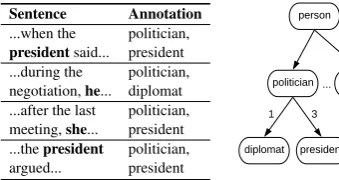
Figure 1: Examples of annotations and hierarchical type inventory with co-occurrence frequencies.
difficult as the number of types increases. A nat-ural solution for dealing with a large number of types is to organize them in hierarchy ranging from general,coarse types such as “person” near the top, to more specific,finetypes such as “politi-cian” in the middle, to even more specific, ultra-fineentity types such as “diplomat” at the bottom (see Figure 1). By virtue of such a hierarchy, a model learning about diplomats will be able to transfer this knowledge to related entities such as politicians.
Prior work integrated hierarchical entity type in-formation by formulating a hierarchy-aware loss (Ren et al.,2016;Murty et al.,2018;Xu and Bar-bosa, 2018) or by representing words and types in a joint Euclidean embedding space (Shimaoka et al.,2017; Abhishek et al., 2017). Noting that it is impossible to embed arbitrary hierarchies in Euclidean space,Nickel and Kiela(2017) propose hyperbolic space as an alternative and show that hyperbolic embeddings accurately encode hierar-chical information. Intuitively (and as explained in more detail in Section 2), this is because dis-tances in hyperbolic space grow exponentially as one moves away from the origin, just like the num-ber of elements in a hierarchy grows exponentially with its depth.
be-(a) Euclidean Space. (b) Hyperbolic Space.
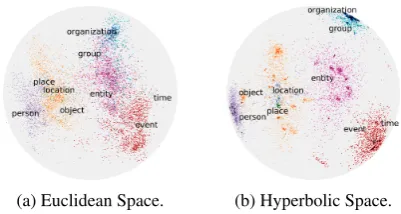
Figure 2: Type inventory of the Ultra-Fine dataset aligned to the WordNet noun hierarchy and projected on two dimensions in different spaces.
lieve this is due to two difficulties: First, incorpo-rating hyperbolic embeddings into a neural model is non-trivial since training involves optimization in hyperbolic space. Second, it is often not clear what the best hierarchy for the task at hand is.
In this work, we address both of these issues. Using ultra-fine grained entity typing (Choi et al.,
2018) as a test bed, we first show how to incor-porate hyperbolic embeddings into a neural model (Section3). Then, we examine the impact of the hierarchy, comparing hyperbolic embeddings of an expert-generated ontology to those of a large, automatically-generated one (Section 4). As our experiments on two different datasets show (Sec-tion 5), hyperbolic embeddings improve entity typing in some but not all cases, suggesting that their usefulness depends both on the type inven-tory and its hierarchy. In summary, we make the following contributions:
1. We develop a fine-grained entity typing model that embeds both entity types and en-tity mentions in hyperbolic space.
2. We compare two different entity type hierar-chies, one created by experts (WordNet) and one generated automatically, and find that their adequacy depends on the dataset. 3. We study the impact of replacing the
Eu-clidean geometry with its hyperbolic counter-part in an entity typing model, finding that the improvements of the hyperbolic model are noticeable onultra-finetypes.
2 Background: Poincar´e Embeddings
Hyperbolic geometry studies non-Euclidean spaces with constant negative curvature. Two-dimensional hyperbolic space can be modelled as the open unit disk, the so-calledPoincar´e disk, in which the unit circle represents infinity, i.e., as a
point approaches infinity in hyperbolic space, its norm approaches one in the Poincar´e disk model. In the generaln-dimensional case, the disk model becomes the Poincar´e ball (Chamberlain et al.,
2017) Bn = {x ∈
Rn | kxk < 1}, wherek · k
denotes the Euclidean norm. In the Poincar´e model the distance between two pointsu, v∈ Bn is given by:
dH(u,v) = arcosh(1 + 2 ku−vk
2
(1− kuk2)(1− kvk2)) (1)
If we consider the origin O and two points, x and y, moving towards the outside of the disk, i.e. kxk,kyk → 1, the distance dH(x, y) tends to dH(x, O) +dH(O, y). That is, the path be-tweenx andy is converges to a path through the origin. This behaviour can be seen as the contin-uous analogue to a (discrete) tree-like hierarchical structure, where the shortest path between two sib-ling nodes goes through their common ancestor.
As an alternative intuition, note that the hyper-bolic distance between points grows exponentially as points move away from the center. This mirrors the exponential growth of the number of nodes in trees with increasing depths, thus making hyper-bolic space a natural fit for representing trees and hence hierarchies (Krioukov et al., 2010; Nickel and Kiela,2017).
By embedding hierarchies in the Poincar´e ball so that items near the top of the hierarchy are placed near the origin and lower items near infinity (intuitively, embedding the “vertical” structure), and so that items sharing a parent in the hierar-chy are close to each other (embedding the “hori-zontal” structure), we obtain Poincar´e embeddings (Nickel and Kiela, 2017). More formally, this means that embedding norm represents depth in the hierarchy, and distance between embeddings the similarity of the respective items.
(a) Projection layers. (b) Incorporation of hierarchical information.
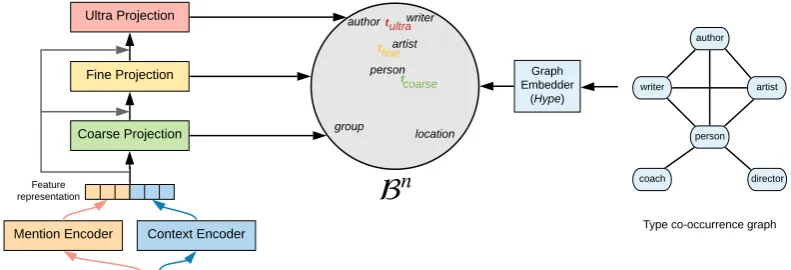
Figure 3: Overview of the proposed model to predict types of a mention within its context.
3 Entity Typing in Hyperbolic Space
3.1 Task Definition
The task we consider is, given a context sentence ccontaining an entity mentionm, predict the cor-rect type labelstmthat describemfrom a type in-ventoryT, which includes more than 10,000 types (Choi et al.,2018). The mentionmcan be a named entity, a nominal, or a pronoun. The ground-truth type set tm may contain multiple types, making the task a multi-label classification problem.
3.2 Objective
We aim to analyze the effects of hyperbolic and Euclidean spaces when modeling hierarchical in-formation present in the type inventory, for the task of fine-grained entity typing. Since hyper-bolic geometry is naturally equipped to model hi-erarchical structures, we hypothesize that this en-hanced representation will result in superior per-formance. With the goal of examining the rela-tion between the metric space and the hierarchy, we propose a regression model. We learn a func-tion that maps feature representafunc-tions of a menfunc-tion and its context onto a vector space such that the in-stances are embedded closer to their target types.
The ground-truth type set contains a varying number of types per instance. In our regression setup, however, we aim to predict a fixed amount of labels for all the instances. This imposes strong upper bounds to the performance of our proposed model. Nonetheless, as the strict accuracy of state-of-the-art methods for the Ultra-Fine dataset is be-low 40% (Choi et al.,2018;Xiong et al.,2019), the evaluation we perform is still informative in qual-itative terms, and enables us to gain better
intu-itions with regard to embedding hierarchical struc-tures in different metric spaces.
3.3 Method
Given the encoded feature representations of a mentionm and its contextc, noted as e(m, c) ∈ Rn
0
our goal is to learn a mapping function f :
Rn
0
→ Sn, where Sn is the target vector space. We intend to approximate embeddings of the type labels tm, previously projected into the space. Subsequently, we perform a search of the nearest type embeddings of the embedded representation in order to assign the categorical label correspond-ing to the mention within that context. Figure 3
presents an overview of the model.
The label distribution on the dataset is diverse and fine-grained. Each instances is annotated with three levels of granularity, namelycoarse,fineand
ultra-fine, and on the development and test set there are, on average, five labels per item. This poses a challenging problem for learning and pre-dicting with only one projection. As a solution, we propose three different projection functions, fcoarse, ff ine, and fultra, each one of them fine-tuned to predict labels of a specific granularity.
region of the space. Nevertheless, we use shortcut connections so that top layers can have access to the encoder layer representation.
3.4 Mention and Context Representations
To encode the contextccontaining the mentionm, we apply the encoder schema ofChoi et al.(2018) based onShimaoka et al. (2016). We replace the location embedding of the original encoder with a word position embeddingpi to reflect relative dis-tances between thei-th word and the entity men-tion. This modification induces a bias on the atten-tion layer to focus less on the menatten-tion and more on the context. Finally we apply a standard Bi-LSTM and a self-attentive encoder (McCann et al.,2017) on top to get the context representationC ∈Rdc.
For the mention representation we derive fea-tures from a character-level CNN, concatenate them with the Glove word embeddings ( Penning-ton et al.,2014) of the mention, and combine them with a similar self-attentive encoder. The mention representation is denoted asM ∈ Rdm. The final
representation is achieved by the concatenation of mention and context[M;C]∈Rdm+dc.
3.5 Projecting into the Ball
To learn a projection function that embeds our feature representation in the target space, we ap-ply a variation of the re-parameterization tech-nique introduced inDhingra et al.(2018). The re-parameterization involves computing a direction vectorrand a norm magnitudeλfrome(m, c)as follows:
r=ϕdir(e(m, c)), r = r
krk,
λ=ϕnorm(e(m, c)), λ=σ(λ), (2)
where ϕdir : Rn
0
→ Rn, ϕnorm : Rn
0 → R
can be arbitrary functions, whose parameters will be optimized during training, and σ is the sig-moid function that ensures the resulting normλ∈
(0,1). The re-parameterized embedding is defined asv=λr, which lies inSn.
By making use of this simple technique, the embeddings are guaranteed to lie in the Poincar´e ball. This avoids the need to correct the gradient or the utilization of Riemannian-SGD (Bonnabel,
2011). Instead, it allows the use of any opti-mization method in deep learning, such as Adam (Kingma and Ba,2014).
We parameterize the direction function ϕdir :
Rdm+dc →Rnas a multi-layer perceptron (MLP)
with a single hidden layer, using rectified linear units (ReLU) as nonlinearity, and dropout. We do not apply the ReLU function after the output layer in order to allow negative values as components of the direction vector. For the norm magnitude functionϕnorm : Rdm+dc → Rwe use a single
linear layer.
3.6 Optimization of the Model
We aim to find projection functionsfi that embed the instance representations closer to the respec-tive target types, in a given vector spaceSn. As target spaceSnwe use the Poincar´e BallBn and compare it with the Euclidean unit ballRn. Both Bn and
Rn are metric spaces, therefore they are
equipped with a distance function, namely the hy-perbolic distance dH defined in Equation 1, and the Euclidean distancedE respectively, which we intend to minimize. Moreover, since the Poincar´e Model is a conformal model of the hyperbolic space, i.e. the angles between Euclidean and hy-perbolic vectors are equal, the cosine distancedcos
can be used, as well.
We propose to minimize a combination of the distance defined by each metric space and the co-sine distance to approximate the embeddings. Al-though formally this is not a distance metric since it does not satisfy the Cauchy-Schwarz inequality, it provides a very strong signal to approximate the target embeddings accounting for the main con-cepts modeled in the representation: relatedness, captured via the distance and orientation in the space, andgenerality, via the norm of the embed-dings.
To mitigate the instability in the derivative of the hyperbolic distance2 we follow the approach proposed in Sala et al. (2018) and minimize the square of the distance, which does have a continu-ous derivative inBn. Thus, in the Poincar´e Model we minimize the distance for two pointsu, v∈ Bn defined as:
dB(u, v) =α(dH(u, v))2+βdcos(u, v) (3)
Whereas in the Euclidean space, forx, y∈ Rn we minimize:
dR(x, y) =αdE(x, y) +βdcos(x, y) (4)
The hyperparametersαandβare added to com-pensate the bounded image of the cosine distance function in[0,1].
2limy
Split Coarse Fine Ultra-fine Train 2,416,593 4,146,143 3,997,318 Dev 1,918 1,289 7,594 Test 1,904 1,318 7,511
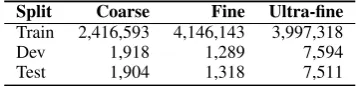
Table 1: Type instances in the dataset grouped by split and granularity.
4 Hierarchical Type Inventories
In this section, we investigate two methods for de-riving a hierarchical structure for a given type in-ventory. First, we introduce the datasets on which we perform our study since we exploit some of their characteristics to construct a hierarchy.
4.1 Data
We focus our analysis on the the Ultra-Fine en-tity typing dataset introduced inChoi et al.(2018). Its design goals were to increase the diversity and coverage entity type annotations. It con-tains 10,331 target types defined as free-form noun phrases and divided in three levels of granularity:
coarse, fine and ultra-fine. The data consist of 6,000 crowdsourced examples and approximately 6M training samples in the open-source version3, automatically extracted with distant supervision, by entity linking and nominal head word extrac-tion. Our evaluation is done on the original crowd-sourced dev/test splits.
To gain a better understanding of the proposed model under different geometries, we also exper-iment on the OntoNotes dataset (Gillick et al.,
2014) as it is a standard benchmark for entity typ-ing.
4.2 Deriving the Hierarchies
The two methods we analyze to derive a hierarchi-cal structure from the type inventory are the fol-lowing.
Knowledge base alignment: Hierarchical infor-mation can be provided explicitly, by aligning the type labels to a knowledge base schema. In this case the types follow the tree-like structure of the ontology curated by experts. On the Ultra-Fine dataset, the type vocabularyT (i.e. noun phrases) is extracted from WordNet (Miller,1992). Nouns in WordNet are organized into a deep hierarchy, defined by hypernym or “IS A” relationships. By aligning the type labels to the hypernym structure existing in WordNet, we obtain a type hierarchy. In this case, all paths lead to the root typeentity.
3Choi et al.(2018) uses the licensed Gigaword to build
part of the dataset resulting in about 25.2M training samples.
In the OntoNotes dataset the annotations follow a pre-established, much smaller, hierarchical taxon-omy based on “IS A” relations, as well.
Type co-occurrences: Although in practical sce-narios hierarchical information may not always be available, the distribution of types has an implicit hierarchy that can be inferred automatically. If we model the ground-truth labels as nodes of a graph, its adjacency matrix can be drawn and weighted by considering the co-occurrences on each instance. That is, ift1andt2are annotated as true types for
a training instance, we add an edge between both types. To weigh the edge we explore two vari-ants: the frequency of observed instances where this co-relation holds, and the pointwise mutual information (pmi), as a measure of the associa-tion between the two types4. By mining type co-occurrences present in the dataset as an affinity score, the hierarchy can be inferred. This method alleviates the need for a type inventory explicitly aligned to an ontology or pre-defined label corre-lations.
To embed the target type representations into the different metric spaces we make use of the li-braryHype5(Nickel and Kiela,2018). This library allows us to embed graphs into low-dimensional continuous spaces with different metrics, such as hyperbolic or Euclidean, ensuring that related ob-jects are closer to each other in the space. The learned embeddings capture notions of both sim-ilarity, through the relative distance among each other, and hierarchy, through the distance to the origin, i.e. the norm. The projection of the hierar-chy derived from WordNet is depicted in Figure2. 5 Experiments
We perform experiments on the Ultra-Fine (Choi et al.,2018) and OntoNotes (Gillick et al.,2014) datasets to evaluate which kind of hierarchical in-formation is better suited for entity typing, and un-der which geometry the hierarchy can be better ex-ploited.
5.1 Setup
For evaluation we run experiments on the Ultra-Fine dataset with our model projecting onto the hyperbolic space, and compare to the same set-ting in Euclidean space. The type embeddings are
4
We adaptpmiin order to satisfy the condition of non-negativity.
5https://github.com/facebookresearch/
Model Space Coarse Fine Ultra-fine
Coarse
+ Ultra Variation MaF1 MiF1 MaF1 MiF1 MaF1 MiF1 MaF1 MiF1 MaF1 MiF1
MULTITASK - 60.6 58.0 37.8 34.7 13.6 11.7 - - -
-WORDNET Hyper 45.9 44.3 22.5 21.5 7.0 6.7 41.8 37.2 -4.1 -7.1
Euclid 56.1 54.2 26.6 25.3 7.2 6.5 56.6 48.5 0.6 -5.7 WORDNET
+FREQ
Hyper 54.6 52.8 18.4 18.0 11.3 10.8 46.5 40.6 -8.0 -12.2 Euclid 56.7 54.9 27.3 26.0 12.1 11.5 55.8 49.1 -0.9 -5.8
FREQ Hyper 56.5 54.6 26.8 25.7 16.0 15.2 59.7 53.5 3.2 -1.1
Euclid 56.1 54.2 25.8 24.4 12.1 11.4 60.0 53.0 3.9 -1.3
PMI Hyper 54.7 53.0 26.9 25.8 16.0 15.4 57.5 51.8 2.8 -1.2
Euclid 56.5 54.6 26.9 25.6 12.2 11.5 59.7 53.0 3.2 -1.5
(a) Results on the same three granularities analyzed byChoi et al.(2018). (b) Comparison to previouscoarse
[image:6.595.88.517.64.210.2]results.
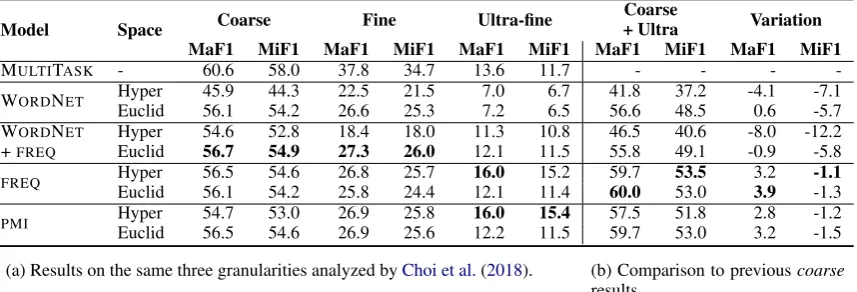
Table 2: Results on the test set for different hierarchies and spaces. The best results of our models are marked in bold. On (b) we report the comparison of adding the closestcoarselabel to theultra-fineprediction, with respect to thecoarseresults on (a).
created based on the following hierarchical struc-tures derived from the dataset: the type vocabulary aligned to the WordNet hierarchy (WORDNET), type co-occurrence frequency (FREQ), pointwise mutual information among types (PMI), and fi-nally, the combination of WordNet’s transitive closure of each type with the co-occurrence fre-quency graph (WORDNET+FREQ).
We compare our model to the multi-task model of Choi et al. (2018) trained on the open-source version of their dataset (MULTITASK). The fi-nal type predictions consist of the closest neigh-bor from thecoarse andfineprojections, and the three closest neighbors from theultra-fine projec-tion. We report Loose Macro-averaged and Loose Micro-averaged F1 metrics computed from the precision/recall scores over the same three gran-ularities established byChoi et al.(2018). For all models we optimize Macro-averaged F1 oncoarse
types on the validation set, and evaluate on the test set. All experiments project onto a target space of 10 dimensions. The complete set of hyperparame-ters is detailed in the Appendix.
6 Results and Discussion
6.1 Comparison of the Hierarchies
Results on the test set are reported in Table 2. From comparing the different strategies to derive the hierarchies, we can see thatFREQandPMI sub-stantially outperform MULTITASK on the ultra-fine granularity (17.5% and 29.8% relative im-provement in Macro F1 and Micro F1, respec-tively, with the hyperbolic model). Both hierar-chies show a substantially better performance over the WORDNET hierarchy on this granularity as
well (MaF116.0and MiF115.4forPMIvs7.0and
6.7for WORDNETon the Hyperbolic model), in-dicating that these structures, created solely from the dataset statistics, better reflect the type distri-bution in the annotations. OnFREQandPMI, types that frequently co-occur on the training set are lo-cated closer to each other, improving the predic-tion based on nearest neighbor.
All the hierarchies show very low performance onfinewhen compared to the MULTITASKmodel. This exhibits a weakness of our regression setup. On the test set there are 1,998 instances but only 1,318finelabels as ground truth (see Table1). By forcing a prediction on the fine level for all in-stances, precision decreases notably. More details in Section6.3.
The combined hierarchy WORDNET + FREQ achieves marginal improvements on coarse and
fine granularities, while it degrades the perfor-mance onultra-finewhen compared toFREQ.
a) Example Rin, Kohaku and Sesshomaru Rin befriends Kohaku, the demonslayer Sango’s younger brother, while Kohaku acts as her guard when Naraku is using her for bait to lure Sesshomaru intobattle.
Annotation event, conflict, war, fight, battle, struggle, dispute, group action
Prediction FREQ:event, conflict, war, fight, battle;
WORDNET:event, conflict,difference, engagement, assault
b) Example The UN mission in Afghanistandispatched its own investigation, expressing concern about reports of civilian casualties and calling for them to be properly cared for.
Annotation organization, team, mission
Prediction FREQ:organization, team, mission, activity, operation; WORDNET: group, institution, branch, delegation, corporation
c) Example Brazilian President Luiz Inacio Lula da Silva and Turkish Prime Minister Recep Tayyip Erdo-gan talked about designing a strategy different from sanctions ata meetingMonday, Amorim said.
Annotation event, meeting, conference, gathering, summit
[image:7.595.98.501.63.235.2]Prediction FREQ:event, meeting, conference, film, campaign; WORDNET: entity,meeting, gathering, structure, court
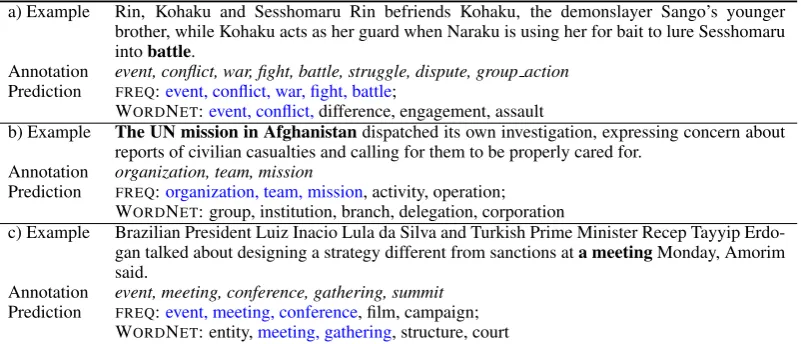
Table 3: Qualitative analysis of instances taken from the development set. The predictions are generated with the hyperbolic models ofFREQand WORDNET. Correct predictions are marked in blue color.
ultra-finetypes are better.
6.2 Comparison of the Spaces
When comparing performances with respect to the metric spaces, the hyperbolic models forPMIand FREQ outperform all other models on ultra-fine
granularity. Compared to its Euclidean counter-part,PMIbrings considerable improvements (16.0
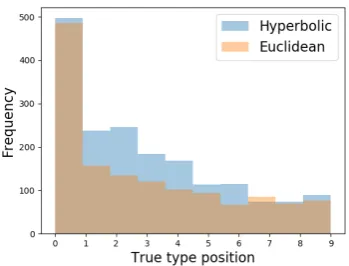
vs12.2and15.4vs11.5for Macro and Micro F1 respectively). This can be explained by the expo-nential growth of this space towards the bound-ary of the ball, combined with a representation that reflects the type co-occurrences in the dataset. Figure4shows a histogram of the distribution of ground-truth types as closest neighbors to the pre-diction.
On both Euclidean and hyperbolic models, the type embeddings forcoarseandfinelabels are lo-cated closer to the origin of the space. In this re-gion, the spaces show a much more similar behav-ior in terms of the distance calculation, and this similarity is reflected on the results as well.
The low performance of the hyperbolic model of WORDNEToncoarse can be explained by the fact that entity is the root node of the hierarchy, therefore it is located closer to the center of the space. Elements placed in the vicinity of the origin have a norm closer to zero, thus their distance to other types tends to be shorter (does not grow ex-ponentially). This often misleads the model into assign entity as the coarse. See Table3c for an example.
This issue is alleviated on WORDNET+ FREQ. Nevertheless, it appears again when using the
ultra-fineprediction to infer thecoarselabel. The
drop in performance can be seen in Table 2b: Macro F1 decreases by8.0and Micro F1 by12.2.
6.3 Error analysis
We perform an error analysis on samples from the development set and predictions from two of our proposed hyperbolic models. We show three ex-amples in Table 3. Overall we can see that pre-dictions are reasonable, suggesting synonyms or related words.
In the proposed regression setup, we predict a fixed amount of labels per instance. This schema has drawbacks as shown in example a), where all predicted types by the FREQ model are correct though we can not predict more, and b), where we predict more related types that are not part of the annotations.
In examples b) and c) we see how the FREQ model predicts thecoarse type correctly whereas the model that uses the WordNet hierarchy pre-dictsgroup andentity since these labels are con-sidered more general (organization IS A group) thus located closer to the origin of the space.
Model Dev Test P R F1 P R F1 ATTNER 53.7 15.0 23.5 54.2 15.2 23.7
FREQ 24.8 25.9 25.4 25.6 26.8 26.2
[image:8.595.75.287.63.116.2]MULTI 48.1 23.2 31.3 47.1 24.2 32.0
Table 4: Combined performance over the three granu-larities. Results are extracted fromChoi et al.(2018).
Model Sp Coarse Fine Ultra Ma Mi Ma Mi Ma Mi
ONTO Hy 83.0 81.9 24.0 23.9 2.0 2.0
Eu 82.2 82.2 28.8 28.7 2.4 2.4
FREQ Hy 81.7 81.8 27.1 27.1 4.2 4.2
[image:8.595.73.290.166.231.2]Eu 81.7 81.7 30.6 30.6 3.8 3.8
Table 5: Macro and micro F1 results on OntoNotes.
6.4 Analysis Case: OntoNotes
To better understand the effects of the hierarchy and the metric spaces we also perform an evalua-tion on OntoNotes (Gillick et al.,2014). We com-pare the original hierarchy of the dataset (ONTO), and one derived from the type co-occurrence fre-quency extracted from the data augmented by
Choi et al. (2018) with this type inventory. The results for the three granularities are presented in Table5.
The FREQ model on the hyperbolic geome-try achieves the best performance for the ultra-finegranularity, in accordance with the results on the Ultra-Fine dataset. In this case the improve-ments of the frequency-based hierarchy are not so remarkable when compared to the ONTO model given that the type inventory is much smaller, and the annotations follow a hierarchy where there is only one possible path for every label to itscoarse
type.
[image:8.595.87.262.584.717.2]The low results on theultra-finegranularity are
Figure 4: Histogram of ground-truth type neighbor po-sitions forultra-finepredictions in Hyperbolic and Eu-clidean spaces on the test set.
due to the reduced multiplicity of the annotated types (See Table8). Most instances have only one or two types, setting very restrictive upper bounds for this setup.
7 Related Work
Type inventories for the task of fine-grained entity typing (Ling and Weld,2012;Gillick et al.,2014;
Yosef et al., 2012) have grown in size and com-plexity (Del Corro et al.,2015;Murty et al.,2017;
Choi et al.,2018). Systems have tried to incorpo-rate hierarchical information on the type distribu-tion in different manners. Shimaoka et al.(2017) encode the hierarchy through a sparse matrix. Xu and Barbosa (2018) model the relations through a hierarchy-aware loss function. Ma et al. (2016) andAbhishek et al.(2017) learn embeddings for labels and feature representations into a joint space in order to facilitate information sharing among them. Our work resembles Xiong et al. (2019) since they derive hierarchical information in an unrestricted fashion, through type co-occurrence statistics from the dataset. These models operate under Euclidean assumptions. Instead, we impose a hyperbolic geometry to enrich the hierarchical information.
Hyperbolic spaces have been applied mostly on complex and social networks modeling (Krioukov et al.,2010;Verbeek and Suri,2016). In the field of Natural Language Processing, they have been employed to learn embeddings for Question An-swering (Tay et al., 2018), in Neural Machine Translation (Gulcehre et al.,2019), and to model language (Leimeister and Wilson, 2018; Tifrea et al., 2019). We build upon the work of Nickel and Kiela (2017) on modeling hierarchical link structure of symbolic data and adapt it with the pa-rameterization method proposed byDhingra et al.
(2018) to cope with feature representations of text.
8 Conclusions
on very fine-grained labels when the hierarchy re-flects the annotated type distribution.
Acknowledgments
We would like to thank the anonymous review-ers for their valuable comments and suggestions, and we also thank Ana Marasovi´c, Mareike Pfeil, Todor Mihaylov and Mark-Christoph M¨uller for their helpful discussions. This work has been supported by the German Research Foundation (DFG) as part of the Research Training Group Adaptive Preparation of Information from Hetero-geneous Sources (AIPHES) under grant No. GRK 1994/1 and the Klaus Tschira Foundation, Heidel-berg, Germany.
References
Abhishek Abhishek, Ashish Anand, and Amit Awekar. 2017. Fine-grained entity type classification by jointly learning representations and label embed-dings. InProceedings of the 15th Conference of the European Chapter of the Association for Computa-tional Linguistics: Volume 1, Long Papers, pages 797–807, Valencia, Spain. Association for Compu-tational Linguistics.
Silvre Bonnabel. 2011. Stochastic gradient descent on riemannian manifolds. IEEE Transactions on Auto-matic Control, 58.
Benjamin Paul Chamberlain, James Clough, and Marc Peter Deisenroth. 2017. Neural embeddings of graphs in hyperbolic space.CoRR, abs/1705.10359.
Eunsol Choi, Omer Levy, Yejin Choi, and Luke Zettle-moyer. 2018. Ultra-fine entity typing. In Proceed-ings of the 56th Annual Meeting of the Association for Computational Linguistics (Volume 1: Long Pa-pers), pages 87–96, Melbourne, Australia. Associa-tion for ComputaAssocia-tional Linguistics.
Luciano Del Corro, Abdalghani Abujabal, Rainer Gemulla, and Gerhard Weikum. 2015. Finet: Context-aware fine-grained named entity typing. In
Proceedings of the 2015 Conference on Empirical Methods in Natural Language Processing, pages 868–878, Lisbon, Portugal. Association for Compu-tational Linguistics.
Bhuwan Dhingra, Christopher Shallue, Mohammad Norouzi, Andrew Dai, and George Dahl. 2018. Em-bedding text in hyperbolic spaces. InProceedings of the Twelfth Workshop on Graph-Based Methods for Natural Language Processing (TextGraphs-12), pages 59–69, New Orleans, Louisiana, USA. Asso-ciation for Computational Linguistics.
Dan Gillick, Nevena Lazic, Kuzman Ganchev, Jesse Kirchner, and David Huynh. 2014. Context-Dependent Fine-Grained Entity Type Tagging.
ArXiv e-prints.
Caglar Gulcehre, Misha Denil, Mateusz Malinowski, Ali Razavi, Razvan Pascanu, Karl Moritz Hermann, Peter Battaglia, Victor Bapst, David Raposo, Adam Santoro, and Nando de Freitas. 2019. Hyperbolic attention networks. InInternational Conference on Learning Representations.
Diederik P. Kingma and Jimmy Ba. 2014. Adam: A method for stochastic optimization. Interna-tional Conference on Learning Representations, abs/1412.6980.
Dmitri Krioukov, Fragkiskos Papadopoulos, Maksim Kitsak, Amin Vahdat, and Marin Bogu. 2010. Hy-perbolic geometry of complex networks. Physi-cal review. E, StatistiPhysi-cal, nonlinear, and soft matter physics, 82:036106.
Matthias Leimeister and Benjamin J. Wilson. 2018. Skip-gram word embeddings in hyperbolic space.
CoRR, abs/1809.01498.
Xiao Ling and Daniel S. Weld. 2012. Fine-grained entity recognition. In Proceedings of the Twenty-Sixth AAAI Conference on Artificial Intelligence, AAAI’12, pages 94–100. AAAI Press.
Yukun Ma, Erik Cambria, and SA GAO. 2016. La-bel embedding for zero-shot fine-grained named en-tity typing. In Proceedings of COLING 2016, the 26th International Conference on Computational Linguistics: Technical Papers, pages 171–180, Os-aka, Japan.
Bryan McCann, James Bradbury, Caiming Xiong, and Richard Socher. 2017. Learned in translation: Con-textualized word vectors. InAdvances in Neural In-formation Processing Systems, pages 6297–6308.
George A. Miller. 1992. Wordnet: A lexical database for english. InSpeech and Natural Language: Pro-ceedings of a Workshop Held at Harriman, New York, February 23-26, 1992.
Shikhar Murty, Patrick Verga, Luke Vilnis, and Andrew McCallum. 2017. Finer grained entity typing with typenet. In31st Conference on Neural Information Processing Systems (NIPS 2017), Long Beach, CA, USA.
Maximilian Nickel and Douwe Kiela. 2017. Poincar´e embeddings for learning hierarchical representa-tions. In I. Guyon, U. V. Luxburg, S. Bengio, H. Wallach, R. Fergus, S. Vishwanathan, and R. Gar-nett, editors, Advances in Neural Information Pro-cessing Systems 30, pages 6341–6350. Curran As-sociates, Inc.
Maximillian Nickel and Douwe Kiela. 2018. Learn-ing continuous hierarchies in the Lorentz model of hyperbolic geometry. InProceedings of the 35th In-ternational Conference on Machine Learning, vol-ume 80 of Proceedings of Machine Learning Re-search, pages 3779–3788, Stockholmsmssan, Stock-holm Sweden. PMLR.
Jeffrey Pennington, Richard Socher, and Christopher Manning. 2014. Glove: Global vectors for word representation. In Proceedings of the 2014 Con-ference on Empirical Methods in Natural Language Processing (EMNLP), pages 1532–1543, Doha, Qatar. Association for Computational Linguistics.
Lisa F Rau. 1991. Extracting company names from text. In Artificial Intelligence Applications, 1991. Proceedings., Seventh IEEE Conference on, vol-ume 1, pages 29–32. IEEE.
Xiang Ren, Wenqi He, Meng Qu, Clare R. Voss, Heng Ji, and Jiawei Han. 2016. Label noise reduction in entity typing by heterogeneous partial-label embed-ding. In Proceedings of the 22Nd ACM SIGKDD International Conference on Knowledge Discovery and Data Mining, KDD ’16, pages 1825–1834, New York, NY, USA. ACM.
Frederic Sala, Chris De Sa, Albert Gu, and Christo-pher Re. 2018. Representation tradeoffs for hyper-bolic embeddings. In Proceedings of the 35th In-ternational Conference on Machine Learning, vol-ume 80 of Proceedings of Machine Learning Re-search, pages 4460–4469, Stockholmsmssan, Stock-holm Sweden. PMLR.
Victor Sanh, Thomas Wolf, and Sebastian Ruder. 2019. A hierarchical multi-task approach for learning em-beddings from semantic tasks. In AAAI, volume abs/1811.06031.
Sonse Shimaoka, Pontus Stenetorp, Kentaro Inui, and Sebastian Riedel. 2016. An attentive neural ar-chitecture for fine-grained entity type classification. In Proceedings of the 5th Workshop on Automated Knowledge Base Construction, pages 69–74, San Diego, CA. Association for Computational Linguis-tics.
Sonse Shimaoka, Pontus Stenetorp, Kentaro Inui, and Sebastian Riedel. 2017. Neural architectures for fine-grained entity type classification. In Proceed-ings of the 15th Conference of the European Chap-ter of the Association for Computational Linguistics: Volume 1, Long Papers, pages 1271–1280, Valencia, Spain. Association for Computational Linguistics.
Yi Tay, Luu Anh Tuan, and Siu Cheung Hui. 2018. Hyperbolic representation learning for fast and ef-ficient neural question answering. InProceedings of the Eleventh ACM International Conference on Web Search and Data Mining, WSDM ’18, pages 583– 591, New York, NY, USA. ACM.
Alexandru Tifrea, Gary Becigneul, and Octavian-Eugen Ganea. 2019. Poincare glove: Hyperbolic word embeddings. InInternational Conference on Learning Representations.
Erik F. Tjong Kim Sang and Fien De Meulder. 2003. Introduction to the CoNLL-2003 shared task: Language-independent named entity recognition. In
Proceedings of the Seventh Conference on Natural Language Learning at HLT-NAACL 2003 - Volume 4, CONLL ’03, pages 142–147, Stroudsburg, PA, USA. Association for Computational Linguistics.
Kevin Verbeek and Subhash Suri. 2016. Metric embed-ding, hyperbolic space, and social networks. Com-putational Geometry, 59:1 – 12.
Wenhan Xiong, Jiawei Wu, Deren Lei, Mo Yu, Shiyu Chang, Xiaoxiao Guo, and William Yang Wang. 2019. Imposing label-relational inductive bias for extremely fine-grained entity typing. In Proceed-ings of NAACL-HLT 2019.
Peng Xu and Denilson Barbosa. 2018. Neural fine-grained entity type classification with hierarchy-aware loss. InProceedings of the 2018 Conference of the North American Chapter of the Association for Computational Linguistics: Human Language Technologies, Volume 1 (Long Papers), pages 16– 25, New Orleans, Louisiana. Association for Com-putational Linguistics.
Yadollah Yaghoobzadeh, Heike Adel, and Hinrich Sch¨utze. 2017. Noise mitigation for neural entity typing and relation extraction. In Proceedings of the 15th Conference of the European Chapter of the Association for Computational Linguistics: Volume 1, Long Papers, pages 1183–1194, Valencia, Spain. Association for Computational Linguistics.
Semih Yavuz, Izzeddin Gur, Yu Su, Mudhakar Srivatsa, and Xifeng Yan. 2016. Improving semantic pars-ing via answer type inference. In Proceedings of the 2016 Conference on Empirical Methods in Nat-ural Language Processing, pages 149–159, Austin, Texas. Association for Computational Linguistics.
Dani Yogatama, Daniel Gillick, and Nevena Lazic. 2015. Embedding methods for fine grained entity type classification. InProceedings of the 53rd An-nual Meeting of the Association for Computational Linguistics and the 7th International Joint Confer-ence on Natural Language Processing (Volume 2: Short Papers), pages 291–296, Beijing, China. As-sociation for Computational Linguistics.
HYENA: Hierarchical type classification for entity names. InProceedings of COLING 2012: Posters, pages 1361–1370, Mumbai, India.
A Appendix
A.1 Hyperparameters
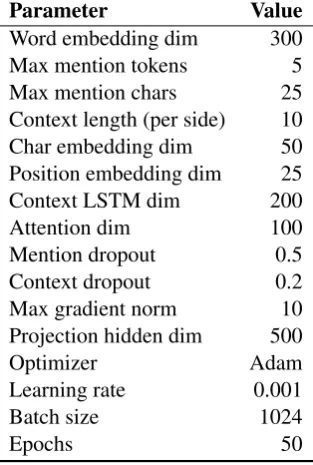
Both hyperbolic and Euclidean models were trained with the following hyperparameters.
Parameter Value
Word embedding dim 300 Max mention tokens 5 Max mention chars 25 Context length (per side) 10 Char embedding dim 50 Position embedding dim 25 Context LSTM dim 200
Attention dim 100
Mention dropout 0.5 Context dropout 0.2 Max gradient norm 10 Projection hidden dim 500
Optimizer Adam
Learning rate 0.001
Batch size 1024
[image:12.595.103.260.143.376.2]Epochs 50
Table 6: Model hyperparameters.
A.2 Dataset statistics
Split Samples Coarse Fine Ultra-fine Train 6,240,105 2,148,669 2,664,933 3,368,607
Dev 1,998 1,612 947 1,860
Test 1,998 1,598 964 1,864
Table 7: Amount of samples with at least one la-bel of the granularity organized by split on Ultra-Fine Dataset.
[image:12.595.71.296.446.489.2]Split Samples Coarse Fine Ultra Train 793,487 828,840 735,162 301,006 Dev 2,202 2,337 869 76 Test 8,963 9,455 3,521 417