13
Texar: A Modularized, Versatile, and Extensible Toolbox
for Text Generation
Zhiting Hu*, Zichao Yang, Haoran Shi, Bowen Tan, Tiancheng Zhao, Junxian He, Xiaodan Liang, Wentao Wang, Xingjiang Yu, Di Wang, Lianhui Qin,
Xuezhe Ma, Hector Liu, Devendra Singh, Wangrong Zhu, Eric P. Xing
[email protected]*, Carnegie Mellon University, Petuum Inc.
Abstract
We introduce Texar, an open-source toolkit aiming to support the broad set of text generation tasks. Different from many existing toolkits that are specialized for specific applications (e.g., neural machine translation), Texar is designed to be highly flexible and versatile. This is achieved by abstracting the common patterns under-lying the diverse tasks and methodolo-gies, creating a library of highly reusable modules and functionalities, and enabling arbitrary model architectures and vari-ous algorithmic paradigms. The features make Texar particularly suitable for tech-nique sharing and generalization across different text generation applications. The toolkit emphasizes heavily on extensibil-ity and modularized system design, so that components can be freely plugged in or swapped out. We conduct extensive exper-iments and case studies to demonstrate the use and advantage of the toolkit.
1 Introduction
Text generation spans a broad set of natural lan-guage processing tasks that aim at generating nat-ural language from input data or machine rep-resentations. Such tasks include machine transla-tion (Bahdanau et al., 2014;Brown et al.,1990), dialog systems (Williams and Young, 2007; Ser-ban et al., 2016), text summarization (Hovy and Lin,1998;See et al.,2017), article writing ( Wise-man et al.,2017), text paraphrasing and manipula-tion (Madnani and Dorr,2010;Hu et al.,2017a), image captioning (Vinyals et al., 2015b; Karpa-thy and Fei-Fei, 2015), and more. Recent years have seen rapid progress of this active area in both academia and industry, especially with the
adop-tion of modern deep learning approaches in many of the tasks. On the other hand, considerable re-search efforts are still needed to improve relevant techniques and enable real-world practical appli-cations.
The variety of text generation tasks share many common properties and goals, e.g., to generate well-formed, grammatical and readable text, and to realize in the generation the desired information inferred from inputs. To this end, a few key mod-els and algorithms are increasingly widely-used to empower the different applications, such as neural encoder-decoders (Sutskever et al., 2014), atten-tions (Bahdanau et al.,2014;Luong et al.,2015b), memory networks (Sukhbaatar et al.,2015), adver-sarial methods (Goodfellow et al.,2014;Hu et al.,
2017b; Lamb et al., 2016), reinforcement learn-ing (Ranzato et al.,2015;Bahdanau et al.,2016), as well as some optimization techniques, data pre-processing and result post-pre-processing procedures, evaluations, etc.
It is therefore highly desirable to have an open-source platform that unifies the development of the diverse yet closely-related applications, backed with clean and consistent implementations of the core algorithms. Such a unified platform enables reuse of common components and functionali-ties, standardizes design, implementation, and ex-perimentation, fosters reproducible research, and importantly, encourages technique sharing among different text generation tasks, so that an algorith-mic advance originally developed for a specific task can quickly be evaluated and potentially gen-eralized to many other tasks.
Though a few remarkable open-source toolkits have been developed, they have been largely de-signed for one or few specific tasks, especially neural machine translation (Britz et al., 2017;
pa-per introduces Texar, a general-purpose text gen-eration toolkit that aims to support most of the popular applications in the field, by providing re-searchers and practitioners a unified and flexible framework for building their models. Texar is built upon TensorFlow1, a popular deep learning plat-form. Texar emphasizes on three key properties, namely, versatility, modularity, and extensibility.
• Versatility: Texar contains a wide range of features and functionalities for 1) arbi-trary model architectures as a combination of encoders, decoders, discriminators, mem-ories, and many other modules; and 2) dif-ferent modeling and learning paradigms such as sequence-to-sequence, probabilistic mod-els, adversarial methods, and reinforcement learning. Based on these, both workhorse and cutting-edge solutions to the broad spectrum of text generation tasks are either already in-cluded or can be easily constructed.
• Modularity: Texar is designed to be highly modularized, by decoupling solutions to di-verse tasks into a set of highly reusable mod-ules. Users can construct their model at a high conceptual level just like assembling LEGO bricks. It is convenient to plug in or swap out modules, configure rich options of each mod-ule, or even switch between distinct model-ing paradigms. For example, switchmodel-ing be-tween maximum likelihood learning and re-inforcement learning involves only minimal code changes. Modularity makes Texar use-ful for fast prototyping, parameter tuning, and model experimentation.
• Extensibility: The toolkit provides interfaces of multiple functionality levels, ranging from simple Python-like configuration files to full library APIs. Users of different needs and ex-pertise are free to choose different interfaces for appropriate programmability and internal accessibility. The library APIs are fully com-patible with the native TensorFlow interfaces, which allows a seamless integration of user-customized modules, and enables the toolkit to take advantage of the vibrant open-source community by easily importing any external components as needed.
1https://www.tensorflow.org
Furthermore, Texar puts much emphasis on well-structured high-quality code of uniform de-sign patterns and consistent styles, along with clean documentations and rich tutorial examples.
In the following, we provide details of the toolkit structure and design. To demonstrate the use of the toolkit and its advantages, we perform extensive experiments and cases studies, including generalizing the state-of-the-art machine transla-tion model to multiple text generatransla-tion tasks, in-vestigating different algorithms for language mod-eling, and implementing composite neural archi-tectures beyond conventional encoder-decoder for text style transfer. All are easily realized with the versatile toolkit.
Texar is under Apache license 2.0, and will be released very soon. Please check out http: //www.cs.cmu.edu/˜zhitinghfor the re-lease progress.
2 Structure and Design
In this section, we first provide an overview of the toolkit on its design principles and overall struc-tures. We then present the detailed structure of Texar with running examples to demonstrate the key properties of the toolkit (sec2.2-2.4).
Figure1shows the stack of main modules and functionalities in Texar. Building upon the lower level deep learning platform (TensorFlow), Texar provides a comprehensive set of building blocks for model construction, training, evaluation, and prediction. Texar is designed with the goals of ver-satility, modularity, and extensibility in mind. In the following, we first present the design princi-ples that lead to the goals (sec 2.1), and describe the detailed structure of Texar with running exam-ples to demonstrate the properties of the toolkit (sec2.2-2.4).
2.1 The Design of Texar
The broad variation of the many text generation tasks and the fast-growing new models and algo-rithms have posed unique challenges to design-ing a versatile toolkit. We tackle the challenges through proper decomposition of the whole exper-imentation pipeline, extensive sets of modules to assemble freely, and user interfaces of varying ab-stract levels.
Applications
Model templates + Config files
Evaluation
Models Data
Encoder
Prediction Training
Library APIs
Architectures Losses
Decoder Classifier Memory
...
MLE Adv Reward RegMonoText ParallelText
Dialog Numerical
Trainer
Optimizer RL Agent
[image:3.595.94.502.62.227.2]lr decay/ grad clip
...
Figure 1: The stack of main modules and functionalities in Texar.
E D
A
𝑥 𝑦 E D
Prior
𝑥 𝑧 𝑦 E D
M
𝑥 𝑦
C
E D
𝑥 𝑧 𝑦
E D
𝑥 𝑦
C 0/1
E1
E2
E3
D1
D2
D3
𝑦1
𝑦2
𝑦3
𝑥1
𝑥2
𝑥3
𝑥 E
D1
D2
C
𝑦1
𝑦2
0/1
(a) (b) (c) (d)
(e) (f) (g)
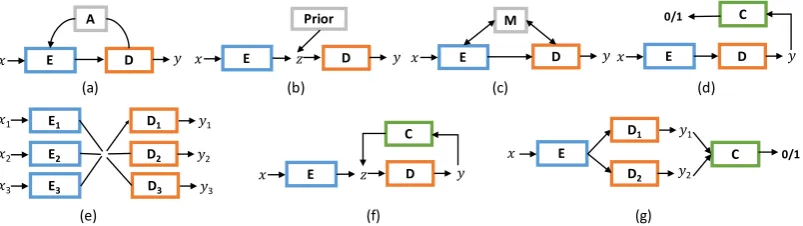
Figure 2: Example various model architectures in recent text generation literatures.Edenotes encoder,
Ddenotes decoder,Cdenotes classifier (i.e., binary discriminator).(a)The canonical encoder-decoder, sometimes with attentionsA(Sutskever et al.,2014;Bahdanau et al.,2014;Luong et al.,2015b;Vaswani et al.,2017), or copy mechanisms (Gu et al., 2016;Vinyals et al., 2015a;Gulcehre et al., 2016); (b)
Variational encoder-decoder (Bowman et al.,2015;Yang et al.,2017);(c)Encoder-decoder augmented with external memory (Sukhbaatar et al.,2015;Bordes et al.,2016);(d)Adversarial model using a binary discriminatorC, with or without reinforcement learning (Liang et al.,2017;Zhang et al.,2017;Yu et al.,
2017);(e)Multi-task learning with multiple encoders and/or decoders (Luong et al.,2015a;Firat et al.,
2016);(f)Augmenting with cyclic loss (Hu et al.,2017a;Goyal et al.,2017);(g)Learning to align with adversary, either on samplesyor hidden states (Lamb et al.,2016;Lample et al.,2017;Shen et al.,2017).
learned with the following abstract procedure:
maxθL(fθ, D) (1)
where (1)fθ is the model that defines the model
architecture and the intrinsic inference procedure; (2)Dis the data; (3) Lis the losses to optimize; and (4) max denotes the optimization and learn-ing procedure. Note that the above can have mul-tiple losses imposed on different parts of compo-nents and parameters (e.g., generative adversarial networks (Goodfellow et al., 2014)). Texar is de-signed to properly decouple the four elements, and allow free combinations of them through uniform interfaces. Such design has underlay the strong modularity of the toolkit.
In particular, the decomposition of model ar-chitecture and inference (i.e., fθ) from losses
[image:3.595.98.500.258.371.2]Decoder
BasicRNNDecoder AttentionRNNDecoder
TransformerDecoder BahdananAttn LuongAttn MonotonicAttn
Encoder
UnidirectionalRNNEncoder BidirectionalRNNEncoder
TransformerEncoder HierarchicalRNNEncoder ConvEncoder
Classifier/ Discriminator
RNNClassifier ConvClassifier HierarchicalClassifier
Data
MonoText PairedText
...
MultiAligned Dialog
Loss
MLE Loss
Adversarial Loss Cross-entropy KLD
Binary adversarial loss
…
Agent
Policy Gradient Agent Q-learning Agent Actor-critic Agent
Numerical
Connector
MLPTransformer Stochastic
...
ReparameterizedStochastic Concat
Forward
…
Optimization
Optimizer
Learning Rate Decay
…
Adam/SGD/…
Piecewise/Exp/…
Model architecture
[image:4.595.76.521.64.274.2]Model loss Trainer Data
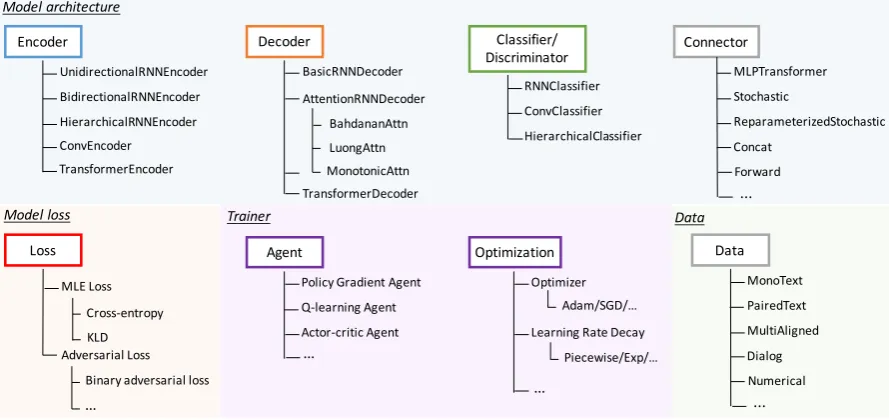
Figure 3: The catalog of a subset of modules for model construction and learning. Other modules, such as memory network modules, and those for evaluation and prediction, are omitted due to space limitations. More new modules are continuously added to the library.
With unified abstractions, the decoder and the learning algorithms need not know the implemen-tation details of each other. This also enables con-venient switch between different learning algo-rithms for the same model, by simply changing the inference scheme and connecting to the new learning module, without adapting the model ar-chitecture (see sec2.3for the example).
Modules Readily to Assemble The fast evolu-tion of modeling and learning methodologies in the research field has led to sophisticated models that go beyond the canonical (attentive) sequence-to-sequence alike paradigms and introduce many new composite architectures. Figure2summarizes several model architectures recently used in the lit-erature for different tasks. To versatilely support all these diverse approaches, we break down the complex models and extract a set of frequently-used modules (e.g., encoders, decoders,
classifiers, etc). Figure3shows the catelog
of a subset of modules. Crucially, Texar allows free concatenation between these modules in or-der to assemble arbitrary model architectures. Such concatenation can be done by directly in-terfacing two modules, or through an interme-diate connector module that provides gen-eral, highly-usable functionalities of shape trans-formation, reparameterization (e.g., (Kingma and Welling, 2013;Jang et al.,2016)), sampling, and others.
User Interfaces It is critical for the toolkit to be flexible enough to allow construction of the sim-ple or advanced models, while at the same time providing proper abstractions to relieve users from overly concerning about low-level implementa-tions. To this end, Texar provides two types of user interfaces with different abstract levels: 1) Python-style configuration files that instantiate pre-defined model templates, and 2) a set of intuitive library APIs called in Python code. The former is simple, clean, straightforwardly understandable for non-expert users, and is widely adopted by other toolk-its (Britz et al., 2017;Neubig et al., 2018;Klein et al.,2017), while the latter allows maximal flexi-bility, full access to internal states, and essentially unlimited customizability. Examples are provided in the following section.
2.2 Assemble Arbitrary Model Architectures
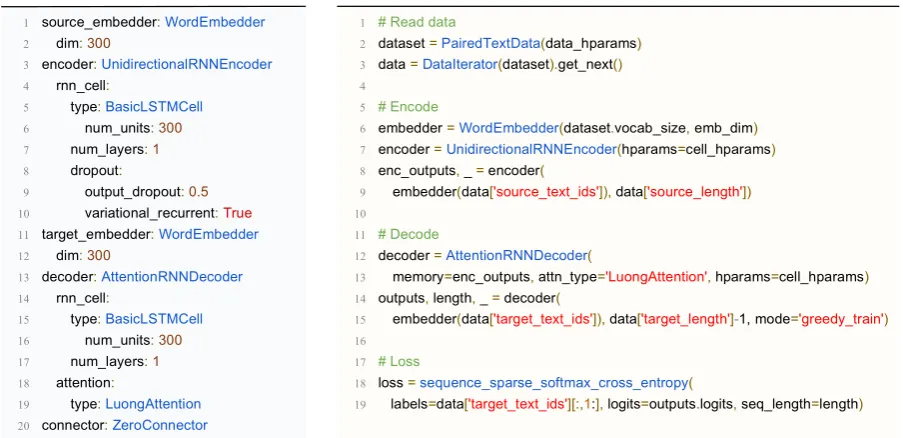
Figure4shows an example of specifying an atten-tive sequence-to-sequence model through either the YAML configuration file (left panel), or sim-ple Python code (right panel), respectively.
1 # Read data
2 dataset =PairedTextData(data_hparams)
3 data =DataIterator(dataset).get_next()
4
5 # Encode
6 embedder =WordEmbedder(dataset.vocab_size, emb_dim)
7 encoder = UnidirectionalRNNEncoder(hparams=cell_hparams)
8 enc_outputs, _ = encoder(
9 embedder(data['source_text_ids']), data['source_length'])
10
11 # Decode
12 decoder =AttentionRNNDecoder(
13 memory=enc_outputs, attn_type='LuongAttention', hparams=cell_hparams)
14 outputs, length, _ = decoder(
15 embedder(data['target_text_ids']), data['target_length']-1, mode='greedy_train')
16 17 # Loss
18 loss =sequence_sparse_softmax_cross_entropy(
19 labels=data['target_text_ids'][:,1:], logits=outputs.logits, seq_length=length)
1 source_embedder:WordEmbedder
2 dim:300
3 encoder:UnidirectionalRNNEncoder
4 rnn_cell:
5 type:BasicLSTMCell
6 num_units:300
7 num_layers:1
8 dropout:
9 output_dropout:0.5
10 variational_recurrent:True
11 target_embedder:WordEmbedder
12 dim:300
13 decoder:AttentionRNNDecoder
14 rnn_cell:
15 type:BasicLSTMCell
16 num_units:300
17 num_layers:1
18 attention:
19 type:LuongAttention
[image:5.595.74.526.62.281.2]20 connector:ZeroConnector
Figure 4: Two ways of specifying an attentive sequence-to-sequence model.Left:Snippet of an example YAML configuration file of the sequence-to-sequence model template. Only those hyperparameters that the user concerns are specified explicitly in the particular file, while the remaining many hyperparameters can be omitted and will take default values.Right:Python code assembling the sequence-to-sequence model, using the Texar library APIs. Modules are created as Python objects, and then can be called as functions to perform the main logic (e.g., decoding) of the module. (Other code such as optimization is omitted.)
names as children in the configuration hier-archy. Note that most of the hyperparameters have sensible default values, and users only have to specify a small subset of them. Hy-perparameters taking default values can be omitted in the configuration file.
• The library APIs offer high-level function calls. Users are enabled to efficiently build desired pipelines at a high conceptual level, without worrying too much about the low-level implementations. Power users are also given the option to access the full internal states for native programming and low-level manipulations.
2.3 Plug-in and Swap-out Modules
Texar builds a shared abstraction of the broad set of text generation tasks, and creates highly reusable modules. It is thus very convenient to switch between different application contexts, or change from one modeling paradigm to another, by simply plugging in/swapping out a single or few modules, or even merely changing a configu-ration parameter, while keeping other parts of the modeling and training pipeline agnostic.
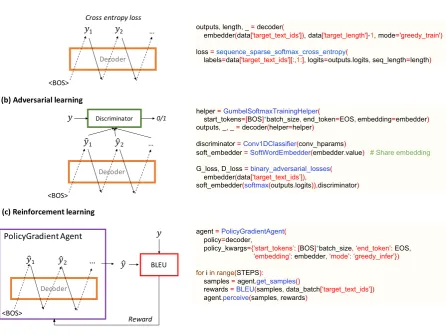
Figure 5 illustrates an example of switching between three major learning paradigms of an RNN decoder, i.e., maximum-likelihood based su-pervised learning, adversarial learning, and rein-forcement learning, using the library APIs. Local modification of only few lines of code is enough to achieve such change. In particular, the same decoder is called with different decoding modes (e.g.,greed trainandgreedy infer), and discriminator or reinforcement learning agent is added when needed, with simple API calls.
The convenient module replacement can be valuable for fast exploration of different algo-rithms for a specific task, or quick experimentation of an algorithm’s generalization on different tasks.
2.4 Customize with Extensible Interfaces
With the aim of supporting the rapidly advancing research area of text generation, Texar emphasizes heavily on extensibility, and allows easy addition of customized or external modules through various interfaces, without editing the Texar codebase.
Discriminator
Decoder
𝑦1 𝑦2 …
Decoder
𝑦" BLEU
PolicyGradient Agent 𝑦
Reward
<BOS>
<BOS>
Decoder …
<BOS>
𝑦 0/1
𝑦"1 𝑦"2 …
𝑦"1 𝑦"2 Cross entropy loss
outputs,length,_ =decoder(
embedder(data['target_text_ids']),data['target_length']-1,mode='greedy_train')
loss =sequence_sparse_softmax_cross_entropy(
labels=data['target_text_ids'][:,1:],logits=outputs.logits,seq_length=length)
helper = GumbelSoftmaxTrainingHelper(
start_tokens=[BOS]*batch_size,end_token=EOS,embedding=embedder)
outputs,_,_ =decoder(helper=helper)
discriminator =Conv1DClassifier(conv_hparams)
soft_embedder=SoftWordEmbedder(embedder.value) # Share embedding
G_loss,D_loss=binary_adversarial_losses(
embedder(data[‘target_text_ids’]),
soft_embedder(softmax(outputs.logits)),discriminator)
agent =PolicyGradientAgent(
policy=decoder,
policy_kwargs={‘start_tokens’: [BOS]*batch_size, ‘end_token’:EOS, ‘embedding’:embedder, ‘mode’: ‘greedy_infer’})
foriin range(STEPS):
samples =agent.get_samples()
rewards =BLEU(samples,data_batch[‘target_text_ids’])
agent.perceive(samples,rewards)
(a) Maximum likelihood learning
(b) Adversarial learning
[image:6.595.78.525.76.411.2](c) Reinforcement learning
Figure 5: Switching between the different learning paradigms of a decoder involves only modification of Line.14-19 in the right panel of Figure4. In particular, the same decoder is called with different decoding modes (schemes), and the discriminator or reinforcement learning agent is added when needed, with simple API calls.Left:The module structure of each of the paradigms;Right:The respective code. For the adversarial learning in (b), the continuous Gumbel-softmax approximation (Jang et al.,2016) (with
GumbelSoftmaxTrainingHelper) to the generated sample is used to enable gradient propagation
from the discriminator to the decoder.
the sequence-to-sequence model encoder, one can simply change Lines.5-6 in the left panel of Fig-ure4to the following:
1 2 3 4
5 type: path.to.MyCell
6 num_units: 300
7 some_new_arg: 123
8 …
as long as the MyCell class is accessible by Python, and its interface is compatible to other parts of the model.
Incorporating customized modules with Texar library APIs is even more flexible and straightfor-ward. As the library APIs are designed to be co-herent with the native TensorFlow programming interfaces, any externally-defined modules can be seamlessly combined with Texar components to
build arbitrary complex models and pipelines.
3 Experiments
Task:VAE language modeling
Dataset Metrics VAE-LSTM VAE-Transformer
Yahoo (Yang et al.,2017) Test PPL 68.31 61.26 Test NLL 337.36 328.67
[image:7.595.307.539.231.316.2]PTB (Bowman et al.,2015) Test PPL 105.27 102.46 Test NLL 102.06 101.46
Table 1: Comparison of Transformer decoder and LSTM RNN decoder on VAE language model-ing (Bowman et al.,2015). Test set perplexity (PPL) and sentence-level negative log likelihood (NLL) are evaluated (The lower the better).
3.1 One Technique on Many Tasks: Transformer
Transformer (Vaswani et al., 2017) is a recently developed model that achieves state-of-the-art per-formance on machine translation. Different from the widely-used attentive sequence-to-sequence models (Bahdanau et al., 2014), Transformer in-troduces a new self-attention technique in which each generated token attends to all previously gen-erated tokens. It would be interesting to see how the technique generalizes to other text generation tasks beyond machine translation. We deploy the self-attention Transformer decoder on two tasks, namely, variational autoencoder (VAE) based lan-guage modeling (Bowman et al., 2015) and con-versation generation (Serban et al.,2016).
The first task is to use the VAE model (Kingma and Welling,2013) for language modeling. LSTM RNN has been widely-used in VAE for decoding sentences. We follow the experimental setting in previous work (Bowman et al.,2015;Yang et al.,
2017), and test two models, one with the LSTM RNN decoder, and the other with the Transformer decoder. All other configurations (including the encoders) are the same in the two models. Chang-ing the decoder in the whole experiment pipeline is easily achieved on Texar, thanks to the modu-larized design. Both the LSTM decoder and the Transformer decoder have around 6.3M free pa-rameters to learn. Table 1 shows the results. We see that the VAE with Transformer decoder con-sistently improves over the VAE with conventional LSTM decoder.
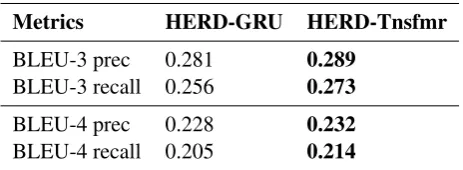
The second task is to generate response given a conversation history. We use the popu-lar hierarchical recurrent encoder-decoder model (HRED) (Serban et al., 2016) as the base model, which treats a conversation as a transduction task. The conversation history is seen as the source se-quence and is modeled with a hierarchical
en-Task:Conversation generation
Metrics HERD-GRU HERD-Tnsfmr
BLEU-3 prec 0.281 0.289
BLEU-3 recall 0.256 0.273
BLEU-4 prec 0.228 0.232
BLEU-4 recall 0.205 0.214
Table 2: Comparison of Transformer decoder and GRU RNN decoder on conversation generation within the HERD model (Bowman et al., 2015). The Switchboard data (Zhao et al.,2017) is used.
coder. Each utterance in the dialog history is first encoded with a first-level RNN. The result-ing hidden states of the sequence of utterance are then encoded with a second-level RNN. We follow the experimental setting in (Zhao et al.,
2017). In particular, the first-level RNN is set to be bidirectional and the second-level is uni-directional. Such configuration is easily imple-mented by setting the hyperparameters of the TexarHierarchicalRNNEncoder. Similar to the above task, we compare two models, one with an GRU RNN decoder as in the original work, and the other with an Transformer decoder. Table 2
shows the results. Again, we see that the Trans-former model generalizes well to the conversation generation setting, and consistently outperforms the GRU RNN counterpart.
3.2 One Task with Many Techniques: Language Modeling
differ-Models Test PPL
[image:8.595.84.279.170.226.2]LSTM RNN with MLE (Zaremba et al.,2014) 74.23 LSTM RNN with seqGAN (Yu et al.,2017) 74.12 Memory Network LM (Sukhbaatar et al.,2015) 94.82
Table 3: Comparison of the three models on the task of language modeling, using the PTB dataset (Zaremba et al.,2014).
Models Accuracy BLEU
Shen et al.(2017) 79.5 12.4
Shen et al.(2017) on Texar 82.5 13.0
Hu et al.(2017a) on Texar 88.6 38.0
Table 4: Text style transfer on the Yelp data (Shen et al., 2017). The first row is the original open-source implementation by the author (Shen et al.,
2017). The subsequent two rows are Texar imple-mentations of the two work.
ent from the VAE language modeling task above, due to different data partition strategies conven-tionally adopted in respective research lines.
We compare three models as shown in Table3. The LSTM RNN trained with the maximum like-lihood estimation (MLE) (Zaremba et al., 2014) is the most widely used model for language mod-eling, due to its simplicity and prominent perfor-mance. We use the exact same architecture as gen-erator and setup a (seq)GAN (Yu et al.,2017) sys-tem to train the language model with adversarial learning. (The generator is pre-trained with MLE.) From Table3we see that adversarial learning does not improve the perplexity. This is partly because of the high variance of the policy gradient in seq-GAN learning. Besides, test set perplexity is not a perfect metric for evaluating language model-ing, though it is the most widely-used metrics in the field. We further evaluate a memory network-based language model (Sukhbaatar et al., 2015) which has the same number of free parameters (11M) with the LSTM RNN model. The test set perplexity is significantly higher than the LSTM RNNs, which is not unreasonable because LSTM RNN models are well studied for language mod-eling and a number of optimal modmod-eling and opti-mization choices are already known.
3.3 Text Style Transfer
To further demonstrate the versatility of Texar for composing complicated model architectures, we next choose the the newly emerging task of text style transfer (Hu et al.,2017a;Shen et al.,2017).
The task aims to manipulate the text of an input sentence to change from one style to another (e.g., from positive sentiment to negative), given only non-parallel training data of each style. The crite-ria is that the resulting sentence accurately entails the target style, while preserving the content and other properties well.
We use Texar to implement the models from both (Hu et al., 2017a) and (Shen et al., 2017), whose model architectures fall in the category (f) and (g) in Figure 2, respectively. Experimen-tal settings mostly follow those in (Shen et al.,
2017). Following previous setting, we use a pre-trained sentiment classifier to evaluate the trans-ferred style accuracy. For evaluating how well the generated sentence preserves the original content, we measure the BLEU score between the gen-erated sentence and the respective original one (The higher the better). Note that we do not mean to perform exhaustive evaluations of the meth-ods, but instead aim to demonstrate the flexibil-ity of the toolkit for implementing different com-posite model architectures beyond conventional encoder-decoder. Table 4 shows the results. Our re-implementation of (Shen et al.,2017) recovers and slightly surpasses the original results, while the implementation of (Hu et al.,2017a) provides the best performance in terms of the two metrics.
4 Related Work
Text generation is a broad research area with rapid advancement. Figure 2 summarizes some popu-lar and emerging models used in the diverse con-texts of the field. There are some existing toolk-its that focus on tasks of neural machine trans-lation and alike, such as Google Seq2seq (Britz et al., 2017) and Tensor2Tensor (Vaswani et al.,
2018) on TensorFlow, OpenNMT (Klein et al.,
2017) on (Py)Torch, XNMT (Neubig et al.,2018) on DyNet, and Nematus (Sennrich et al., 2017) on Theano, and MarianNMT (Junczys-Dowmunt et al.,2018) on C++. ParlAI (Miller et al.,2017) is a software platform specialized for dialog re-search. Differing from these task-specific toolk-its, Texar aims to cover as many text generation tasks as possible. The goal of versatility poses unique challenges to the design. We combat the challenges through proper pipeline decomposi-tion, ready-to-assemble modules, and user inter-faces of varying abstract levels.
appli-cations (AllenAI;Pytorch;DMLC). With the fo-cus on text generation, we provide a more com-prehensive and readily-usable modules and func-tionalities to relevant tasks, enable users to ef-ficiently build their pipelines at a high concep-tual level without worrying too much on low-level details. Some platforms exist for specific types of algorithms, such as OpenAI Gym (Brockman et al.,2016), DeepMind Control Suite (Tassa et al.,
2018), and ELF (Tian et al., 2017) for reinforce-ment learning in game environreinforce-ments. Texar has drawn inspirations from these toolkits when de-signing relevant specific algorithm supports.
5 Conclusion and Future Work
This paper has introduced Texar, a text generation toolkit that is designed to be versatile to support the broad set of applications and algorithms, to be modularized to enable easy replacement of any components, and to be extensible to allow seam-less integration of any external modules. Features and functionalities will continue be added to the toolkit, including distributed model training, ser-vice deployment, more model building blocks, and more applications related to text generation or be-yond. We invite researchers and practitioners to join and enrich the toolkit, and in the end help push forward the text generation research and applica-tions together.
References
AllenAI. AllenNLP. Website: http://allennlp.org.
Dzmitry Bahdanau, Philemon Brakel, Kelvin Xu, Anirudh Goyal, Ryan Lowe, Joelle Pineau, Aaron Courville, and Yoshua Bengio. 2016. An actor-critic algorithm for se-quence prediction. arXiv preprint arXiv:1607.07086.
Dzmitry Bahdanau, Kyunghyun Cho, and Yoshua Bengio. 2014. Neural machine translation by jointly learning to align and translate.arXiv preprint arXiv:1409.0473.
Antoine Bordes, Y-Lan Boureau, and Jason Weston. 2016. Learning end-to-end goal-oriented dialog. arXiv preprint arXiv:1605.07683.
Samuel R Bowman, Luke Vilnis, Oriol Vinyals, Andrew M Dai, Rafal Jozefowicz, and Samy Bengio. 2015. Gener-ating sentences from a continuous space. arXiv preprint arXiv:1511.06349.
Denny Britz, Anna Goldie, Thang Luong, and Quoc Le. 2017. Massive exploration of neural machine translation archi-tectures.arXiv preprint arXiv:1703.03906.
Greg Brockman, Vicki Cheung, Ludwig Pettersson, Jonas Schneider, John Schulman, Jie Tang, and Wojciech Zaremba. 2016. Openai gym. arXiv preprint arXiv:1606.01540.
Peter F Brown, John Cocke, Stephen A Della Pietra, Vin-cent J Della Pietra, Fredrick Jelinek, John D Lafferty, Robert L Mercer, and Paul S Roossin. 1990. A statistical approach to machine translation. Computational linguis-tics, 16(2):79–85.
DMLC.GluonNLP.
Orhan Firat, Kyunghyun Cho, and Yoshua Bengio. 2016. Multi-way, multilingual neural machine translation with a shared attention mechanism. arXiv preprint arXiv:1601.01073.
Ian Goodfellow, Jean Pouget-Abadie, Mehdi Mirza, Bing Xu, David Warde-Farley, Sherjil Ozair, Aaron Courville, and Yoshua Bengio. 2014. Generative adversarial nets. In
Advances in neural information processing systems, pages 2672–2680.
Anirudh Goyal Alias Parth Goyal, Alessandro Sordoni, Marc-Alexandre Cˆot´e, Nan Ke, and Yoshua Bengio. 2017. Z-forcing: Training stochastic recurrent networks. In Ad-vances in Neural Information Processing Systems, pages 6716–6726.
Jiatao Gu, Zhengdong Lu, Hang Li, and Victor OK Li. 2016. Incorporating copying mechanism in sequence-to-sequence learning.arXiv preprint arXiv:1603.06393.
Caglar Gulcehre, Sungjin Ahn, Ramesh Nallapati, Bowen Zhou, and Yoshua Bengio. 2016. Pointing the unknown words.arXiv preprint arXiv:1603.08148.
Eduard Hovy and Chin-Yew Lin. 1998. Automated text sum-marization and the summarist system. InProceedings of a workshop on held at Baltimore, Maryland: October 13-15, 1998, pages 197–214. Association for Computational Linguistics.
Zhiting Hu, Zichao Yang, Xiaodan Liang, Ruslan Salakhut-dinov, and Eric P Xing. 2017a. Toward controlled gen-eration of text. InInternational Conference on Machine Learning.
Zhiting Hu, Zichao Yang, Ruslan Salakhutdinov, and Eric P Xing. 2017b. On unifying deep generative models.arXiv preprint arXiv:1706.00550.
Eric Jang, Shixiang Gu, and Ben Poole. 2016. Categorical reparameterization with gumbel-softmax. arXiv preprint arXiv:1611.01144.
Marcin Junczys-Dowmunt, Roman Grundkiewicz, Tomasz Dwojak, Hieu Hoang, Kenneth Heafield, Tom Necker-mann, Frank Seide, Ulrich GerNecker-mann, Alham Fikri Aji, Nikolay Bogoychev, Andr F. T. Martins, and Alexandra Birch. 2018. Marian: Fast neural machine translation in c++. arXiv preprint arXiv:1804.00344.
Andrej Karpathy and Li Fei-Fei. 2015. Deep visual-semantic alignments for generating image descriptions. In Proceed-ings of the IEEE conference on computer vision and pat-tern recognition, pages 3128–3137.
Diederik P Kingma and Max Welling. 2013. Auto-encoding variational bayes.arXiv preprint arXiv:1312.6114.
Alex M Lamb, Anirudh Goyal Alias Parth Goyal, Ying Zhang, Saizheng Zhang, Aaron C Courville, and Yoshua Bengio. 2016. Professor forcing: A new algorithm for training recurrent networks. InAdvances In Neural In-formation Processing Systems, pages 4601–4609.
Guillaume Lample, Ludovic Denoyer, and Marc’Aurelio Ranzato. 2017. Unsupervised machine translation using monolingual corpora only. arXiv preprint arXiv:1711.00043.
Xiaodan Liang, Zhiting Hu, Hao Zhang, Chuang Gan, and Eric P Xing. 2017. Recurrent topic-transition gan for vi-sual paragraph generation. CoRR, abs/1703.07022, 2.
Minh-Thang Luong, Quoc V Le, Ilya Sutskever, Oriol Vinyals, and Lukasz Kaiser. 2015a. Multi-task sequence to sequence learning.arXiv preprint arXiv:1511.06114.
Minh-Thang Luong, Hieu Pham, and Christopher D Man-ning. 2015b. Effective approaches to attention-based neu-ral machine translation. arXiv preprint arXiv:1508.04025.
Nitin Madnani and Bonnie J Dorr. 2010. Generating phrasal and sentential paraphrases: A survey of data-driven meth-ods.Computational Linguistics, 36(3):341–387.
Tom´aˇs Mikolov, Martin Karafi´at, Luk´aˇs Burget, Jan ˇ
Cernock`y, and Sanjeev Khudanpur. 2010. Recurrent neu-ral network based language model. In Eleventh Annual Conference of the International Speech Communication Association.
Alexander H Miller, Will Feng, Adam Fisch, Jiasen Lu, Dhruv Batra, Antoine Bordes, Devi Parikh, and Jason We-ston. 2017. Parlai: A dialog research software platform.
arXiv preprint arXiv:1705.06476.
Graham Neubig, Matthias Sperber, Xinyi Wang, Matthieu Fe-lix, Austin Matthews, Sarguna Padmanabhan, Ye Qi, De-vendra Singh Sachan, Philip Arthur, Pierre Godard, et al. 2018. Xnmt: The extensible neural machine translation toolkit. arXiv preprint arXiv:1803.00188.
Pytorch.QuickNLP.
Marc’Aurelio Ranzato, Sumit Chopra, Michael Auli, and Wojciech Zaremba. 2015. Sequence level train-ing with recurrent neural networks. arXiv preprint arXiv:1511.06732.
Abigail See, Peter J Liu, and Christopher D Manning. 2017. Get to the point: Summarization with pointer-generator networks.arXiv preprint arXiv:1704.04368.
Rico Sennrich, Orhan Firat, Kyunghyun Cho, Alexandra Birch, Barry Haddow, Julian Hitschler, Marcin Junczys-Dowmunt, Samuel L¨aubli, Antonio Valerio Miceli Barone, Jozef Mokry, et al. 2017. Nematus: a toolkit for neural machine translation. arXiv preprint arXiv:1703.04357.
Iulian Vlad Serban, Alessandro Sordoni, Yoshua Bengio, Aaron C Courville, and Joelle Pineau. 2016. Building end-to-end dialogue systems using generative hierarchical neural network models.
Tianxiao Shen, Tao Lei, Regina Barzilay, and Tommi Jaakkola. 2017. Style transfer from non-parallel text by cross-alignment. InAdvances in Neural Information Pro-cessing Systems, pages 6833–6844.
Sainbayar Sukhbaatar, Jason Weston, Rob Fergus, et al. 2015. End-to-end memory networks. InAdvances in neural in-formation processing systems, pages 2440–2448.
Ilya Sutskever, Oriol Vinyals, and Quoc V Le. 2014. Se-quence to seSe-quence learning with neural networks. In
Advances in neural information processing systems, pages 3104–3112.
Yuval Tassa, Yotam Doron, Alistair Muldal, Tom Erez, Yazhe Li, Diego de Las Casas, David Budden, Abbas Abdol-maleki, Josh Merel, Andrew Lefrancq, et al. 2018. Deep-mind control suite.arXiv preprint arXiv:1801.00690.
Yuandong Tian, Qucheng Gong, Wenling Shang, Yuxin Wu, and C Lawrence Zitnick. 2017. Elf: An extensive, lightweight and flexible research platform for real-time strategy games. InAdvances in Neural Information Pro-cessing Systems, pages 2656–2666.
Ashish Vaswani, Samy Bengio, Eugene Brevdo, Francois Chollet, Aidan N Gomez, Stephan Gouws, Llion Jones, Łukasz Kaiser, Nal Kalchbrenner, Niki Parmar, et al. 2018. Tensor2tensor for neural machine translation.
arXiv preprint arXiv:1803.07416.
Ashish Vaswani, Noam Shazeer, Niki Parmar, Jakob Uszkor-eit, Llion Jones, Aidan N Gomez, Łukasz Kaiser, and Illia Polosukhin. 2017. Attention is all you need. InAdvances in Neural Information Processing Systems, pages 6000– 6010.
Oriol Vinyals, Meire Fortunato, and Navdeep Jaitly. 2015a. Pointer networks. InAdvances in Neural Information Pro-cessing Systems, pages 2692–2700.
Oriol Vinyals, Alexander Toshev, Samy Bengio, and Dumitru Erhan. 2015b. Show and tell: A neural image caption generator. InComputer Vision and Pattern Recognition (CVPR), 2015 IEEE Conference on, pages 3156–3164. IEEE.
Jason D Williams and Steve Young. 2007. Partially observ-able markov decision processes for spoken dialog systems.
Computer Speech & Language, 21(2):393–422.
Sam Wiseman, Stuart M Shieber, and Alexander M Rush. 2017. Challenges in data-to-document generation. arXiv preprint arXiv:1707.08052.
Zichao Yang, Zhiting Hu, Ruslan Salakhutdinov, and Tay-lor Berg-Kirkpatrick. 2017. Improved variational autoen-coders for text modeling using dilated convolutions.arXiv preprint arXiv:1702.08139.
Lantao Yu, Weinan Zhang, Jun Wang, and Yong Yu. 2017. Seqgan: Sequence generative adversarial nets with policy gradient. InAAAI, pages 2852–2858.
Wojciech Zaremba, Ilya Sutskever, and Oriol Vinyals. 2014. Recurrent neural network regularization. arXiv preprint arXiv:1409.2329.
Yizhe Zhang, Zhe Gan, Kai Fan, Zhi Chen, Ricardo Henao, Dinghan Shen, and Lawrence Carin. 2017. Adversar-ial feature matching for text generation. arXiv preprint arXiv:1706.03850.