76
Coding Structures and Actions with the COSTA
Scheme in Medical Conversations
Nan Wang†‡], Yan Song♠, Fei Xia‡ †
University of California-Los Angeles, CA, USA ‡University of Washington, WA, USA
]Hunan University, Hunan, China
♠Tencent AI Lab
Abstract
This paper describes the COSTA scheme for coding structures and actions in con-versation. Informed by Conversation Analysis, the scheme introduces an in-novative method for marking multi-layer structural organization of conversation and a structure-informed taxonomy of actions. In addition, we create a corpus of nat-urally occurring medical conversations, containing 318 video-recorded and man-ually transcribed pediatric consultations. Based on the annotated corpus, we investi-gate 1) treatment decision-making process in medical conversations, and 2) effects of physician-caregiver communication be-haviors on antibiotic over-prescribing. Al-though the COSTA annotation scheme is developed based on data from the task-specific domain of pediatric consultations, it can be easily extended to apply to more general domains and other languages.
1 Introduction
Conversational understanding has been inves-tigated for long by various fields of study such as philosophy of language (Austin, 1962;
Searle, 1969, 1985; Wittgensein, 1953), sociol-ogy (Sch¨utz,1967;Sacks,1992;Garfinkel,1967;
Goffman,1983), and artificial intelligence (Grosz and Sidner,1986;Core and Allen,1997;Perrault. and Allen,1980;Pollack,1986) .
Conversational structures are at the heart of the inquiry. Drawing from the philosophical and so-ciological views of conversational understanding (Sch¨utz, 1967;Wittgensein,1953;Weber,1991), Conversation Analysis (CA) was developed to study the systematic organization of conversation and answer the question: ‘How is conversation
made possible?’(Heritage,1984;Schegloff,2007;
Sacks et al., 1974). In artificial intelligence, re-searchers also explored various theories and prac-tices in analyzing conversation structures, based on which intelligent dialog systems can be de-veloped to assist human with various types of tasks (Core and Allen,1997;Carletta et al.,1997;
Grosz and Sidner, 1986; Jurafsky et al., 1997;
Stolcke et al., 2000; Mayfield et al., 2014). In medicine, research shows that a thorough un-derstanding of physician-patient communication structure is important for delivering quality health care and achieving optimal health outcomes ( Her-itage and Maynard,2006;Zolnierek and Dimatteo,
2009;Stivers,2007).
Despite the enormous contribution that existing research has made to advance our knowledge in conversational structures and understanding, limi-tations exist and opportunities stand for future re-search. For CA, although the theory and practices of analyzing conversational structures and actions exist, there has not been any synthesized scheme to analyze the hierarchical structure of complete conversations; nor is there any corpus in which such information is annotated. In artificial intel-ligence, although existing studies recognized the role of structures and actions in conversation un-derstanding and developed annotation schemes to code such information, most of them has only implemented structural annotations at a shallow layer. Moreover, due to a lack of appropriate lan-guage resources and tools, research on medical communication in clinical setting remains limited.
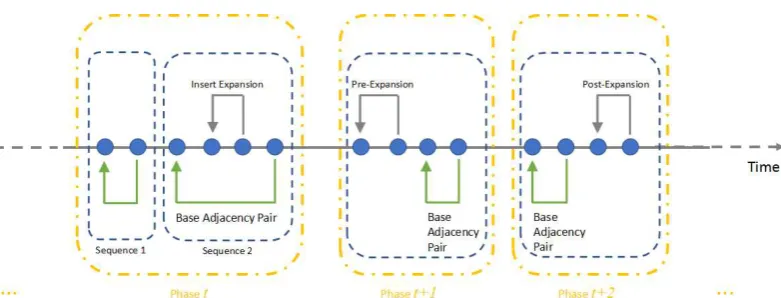
Figure 1: A schematic representation of hierarchical structure of conversation. Blue nodes are turns following a chronological order (the horizontal axis). The arrows link two turns in an adjacency pair. Base adjacency pairs are marked by green arrows; adjacency pairs in sequence expansions are marked by gray arrows. Sequences are marked by blue boxes, and phases are marked by yellow boxes.
2 Conversation Analysis
The COSTA scheme is informed by the socio-logical theory of conversation analysis (CA). Al-though CA resembles discourse structure theories such as Rhetorical Structure Theory (RST) (Mann and Thompson,1988) and that of Penn Discourse Tree Bank (PDTB) (Prasad et al.,2008) in a sense that utterances are considered as structurally or-ganized, what distinguishes CA is that its theory is based on dialogic text rather than monological text (e.g., news articles, academic articles, etc.). Conversation is viewed as organized with ‘inter-action’ orders (Weber, 1991); by contrast, mono-logical text does not take into account recipients’ reactions in its immediate context. This means that these two types of discourse are distinctively dif-ferent and might need to be analyzed with difdif-ferent structural frameworks.
Using naturally occurring conversational data, CA aims to investigate the methods and resources that participants systematically use and rely on to produce intelligible actions and make sense of each other (Heritage,1984).
Two of the major dimensions of CA involve se-quence organization and action formation. Se-quence organization addresses questions such as how successive turns are formed up to be ‘coher-ent’ with the prior turn, and relatedly, how the overall composition of a conversation gets struc-tured, what those structures are, and how the placement in the overall structure informs the con-struction and understanding of the talk (Schegloff,
2007). Action formationrefers to the problem as to how the resources of language, the body, the en-vironment of the interaction, and position in the interaction are fashioned into conformations
de-signed to be and recognizable by the recipient as particular action (Schegloff,2007).
2.1 Conversational Structures
In CA, structural organization of conversation can be conventionally analyzed at three layers ( Sche-gloff,2007).
(1)Turn: Turns are segmented at each change of speakership. A turn is analyzed in terms of how it is designed to implement some social actions (e.g., a question, a proposal, etc. (Drew,2014)).
(2) Sequence organization: Sequence organiza-tion examines how successive turns are formed up to be ‘coherent’ with the prior turn to ac-complish some courses of social actions (e.g., question-answer, proposal-acceptance, greeting-greeting, etc. (Schegloff, 2007)). Relatedly, ad-jacency pairsare the most basic unit of sequence organization (Schegloff, 2007). The idea is that social actions are produced to either initiate a pos-sible sequence of action or to respond to an al-ready initiated action (Stivers, 2014). By initiat-ing a sequence of actions, social actors impose a normative obligation on co-interactants to provide a type-fitted response at the first possible oppor-tunity (Stivers, 2014; Sacks, 1992). Yet, an ad-jacency pair may, but need not, be expanded, with one or multiple forms of sequenceexpansions(i.e., pre-, insert, and post-expansion) (Schegloff,2007;
Stivers,2014). Therefore, a cluster of turns in con-versation can be analyzed as to whether they form up a coherent sequence with one base adjacency pair and its expansions.
TID APP SL PS PR Speech Text Action Outcome
58 1-B 0 P4 D 感冒 了.
(He’s) got a cold.
59 2-B 58 M 嗯.
Ok.
60 1-B 0 P5 D 吃点药吧? B2
Take some oral medicine, ok?
61 1 60 M 啊? C0
Huh?
62 2 61 D 先吃点药, 好吧?
Take some oral medicine first, ok?
63 2-B 60 M 哦, 好.
Oh, ok.
64 3-B 60 D 嗯.
Ok.
65 1-B 0 P5 M 开 点 青霉素 给 我们 好吧?
Could you prescribe us some Penicillin? A1
66 2-B 65 D 嗯, 行 .
[image:3.595.120.481.60.256.2]Ok. Alright. D1
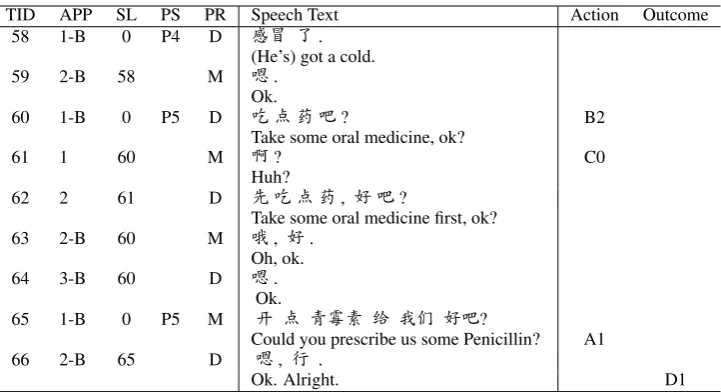
Table 1: An example of annotated excerpt. TID: Turn ID; PR: Participant Role (M: Mother, D: Doctor); APP: Adjacency Pair Part; SL: Sequence Link; PS: Phase; Action: Conversational Action; Outcome: Prescribing Outcome. Note: Prescribing outcome is annotated at the last turn of a conversation. D1 is included in this table for illustration purpose.
activities, and the social activities can be viewed as involving multiple, normatively ordered se-quences of actions (Sacks,1992;Robinson,2014;
Sacks and Schegloff,1973). For example, the so-cial activity of telling a trouble to a friend usu-ally involves approaching, arriving at, delivering, working up, and exiting from the trouble ( Jeffer-son,1988); the activity of dealing with acute med-ical concerns involves presenting, gathering infor-mation about, diagnosing and treating the concern in the American primary care settings (Robinson,
2003,2014).
Based on the CA theory, we synthesize and for-malize the CA analytical practices by developing an annotation scheme of conversational structures which has the following four layers:
(1) Turn: A conversation is segmented at each change of speakership. A turn consists of all its construction units before the speakership changes.
(2) Adjacency Pair: Turns are analyzed as to whether they form up adjacency pairs. An adja-cency pair has two parts - a first pair part (FPP) initiates an action, and a second pair part (SPP) responds to a FPP action. For instance, FPP could be a request and SPP is a response to the request.
(3) Sequence of Actions: Turns are also analyzed as to whether they form up a sequence of actions. A sequence is composed of a base adjacency pair and zero or more expansions.
(4) Phase: At a highest level, a conversation may consist of several ordered phases. For instance, a medical conversation may include phases for
his-tory taking, diagnosis, treatment, etc. A phase consists of one or more sequences of actions.
This hierarchical structural organization of con-versation is illustrated in Figure 1. In this fig-ure, blue nodes are turns in a conversation in a chronological oder. Yellow boxes represent phases in a conversation; blue boxes represent sequences. Within a sequence, an arrow links two turns in an adjacency pairs - green arrows represent base ad-jacency pairs, whereas gray arrows represent that the adjacency pairs are expansions of a base adja-cency pair.
These concepts can be further illustrated with the examples in Table1. Table1is a short excerpt of a medical conversation in which the physician and the mother are engaged in an activity of deal-ing with the patient’s acute respiratory tract infec-tion symptoms.
Phase:The excerpt contains two phases in a med-ical conversation: Turns 58-59 belong to a diag-nosis phase, in which a diagdiag-nosis of the patient’s condition is provided and received; Turns 60-66 are part of a treatment phase, in which a treatment recommendation is offered and accepted. Note that a phase can contain multiple sequences. For example, there are two sequences in Turns 60-66, in which two treatment recommendations are of-fered and received (Turns 60-63 and 64-66, re-spectively).
60-64, contains two adjacency pairs: Turns 60-63-64 is the base adjacency pair;1 Turns 61-62 is an insert expansion of the bases pair, as the mother and the physicians deal with repairing a hearing problem with the physician’s turn (Schegloff et al.,
1977).
Adjacency pair and Turn: Each Chinese line in Table1is a turn, and they form multiple adjacency pairs. For instance, Turn 65-66 forms an adja-cency pair, where the mother initiates a request for a Penicillin prescription in Turn 65 and the physi-cian grants it in Turn 66, thereby fulfilling the ex-pectation set up by the request.
2.2 Conversational Actions
Definition of action has long been of considerable interest to many fields. In CA, the central sense of action is the ascription and assignment of ‘a main job’ that the turn is doing (i.e., what the response must deal with in order to count as an adequate next turn; whether the turn fits to the overall con-textual environment or not) (Levinson,2014).
The structural placement of a turn thus is essen-tial for action recognition and ascription in conver-sations. First, action ascription is informed by the sequential position of a turn in a local adjacency pair (e.g., question-answer, offer-acceptance). A first pair part (FPP), by projecting a matched ond pair part (SPP), maps an action onto the sec-ond. Thus, the same utterance might be under-stood as different actions by virtue of its location. For example, Turn 58‘He’s got a cold.’ in Table
1 is understood as delivering a diagnosis, rather than providing an account, because of its sequen-tial context as being an initiating action in the di-agnosis phase, rather than an answer responding to a question (e.g.,‘Why is him not here today?’). In sum, CA views the positioning of an utterance in the ongoing conversation as fundamental to the understanding of its meaning as performing some actions. Social actors rely on their shared knowl-edge or commensense about the sequential con-text to make sense of each other. This structure-informed theory about conversational actions thus distinguishes CA from other approaches such as Speech Act Theory, which exclusively focuses on the surface composition of an utterance.
In this study, we use this structure-informed
tax-1While an adjacency pair typically contains two turns,
there are exceptions such as the one here, where Turn 64 is a sequence closing third turn (see Section 3.2).
Item Number
[image:4.595.308.525.59.134.2]Total Number of Visits 318 Total Number of Hospitals 5 Total Number of Physicians 9 Total Number of Patients 318 Average length of a visit 4.9 minutes Total length of the recordings 26 hours
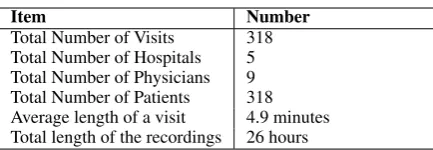
Table 2: Statistics of the raw data. Total number of patients are calculated by those accompanied by caregivers.
onomy of action to identify the conversational ac-tions that are hypothesized to affect the prescrib-ing decision outcome of the medical visits. This will be explained in Section3.3.
3 Corpus Construction and Annotation Scheme
How do we annotate structures and actions in con-versation? In this section, we describe the corpus that we constructed for the study and the annota-tion procedure of the COSTA scheme.
3.1 Video-recording and Transcription
We created a corpus containing 318 medi-cal conversations between pediatricians and pa-tients/caregivers, collected from five hospitals in China in 2013.
Raw Data: The raw data are video-recordings of the medical conversations. Due to its pediatric setting, the conversations were mostly between physicians and patients’ caregivers. We call each conversation (i.e., a recording of a complete medi-cal visit) avisit. Table2shows raw data statistics.
Transcribing: The video-recordings were tran-scribed to capture both what was said and how it was said in the conversation. The conversa-tion was segmented into turns at each speakership change in two passes. The first pass transcribed the verbatim words of a turn; the second pass tran-scribed speech production features (e.g., intona-tions, overlapping, etc.), as well as non-verbal ac-tivities (e.g., nodding, coughing, etc.). Example of the transcript is in the Speech Text column in Table 1. Details of the transcribing symbols are described in (Jefferson,2004).
Five undergraduate students and one graduate student transcribed the data. Each conversation was transcribed by two annotators and verified by a third. The inter-annotator agreement was 91%.2
2The character error rate was 8.9% when one transcript
Ethical Consideration: Research procedures were reviewed and approved by the UCLA IRB (Ref: IRB#13-000748). All identifiable informa-tion were removed.
3.2 Structure Annotations
To annotate structures in conversation, we create five attributes: Turn ID (TID), Participant Role (PR), Adjacency Pair Part (APP), Sequential Link (SL), and Phase (PS). The first four are at the turn level, and the last one is at the sequence level.
TID (Turn ID) is a sequential number automati-cally assigned to a turn, indicating the temporal position of the turn in a conversation.
PR (Participant Role) marks the speakership of a turn, using labels from a pre-defined label set (which is task-specific). For example, in Table
1, Label D stands for Doctor, and M stands for Mother. The PR label is particularly informative when there are more than two participants.
APP(Adjacency pair part) marks the position of a turn in an adjacency pair and it normally has one of the two values:
• 1marks an initiating action (FPP). • 2marks a responding action (SPP).
This can be illustrated in Table1, lines 58-59. In addition to 1 and 2, APP can have other values:
• 0 marks a turn occupied by a noticeable si-lence or some non-verbal activities.
• 3 marks a turn as ‘sequence closing third (SCT)’. SCT is in fact a minimal form of post-expansion of an adjacency pair, indicat-ing that no further talk is projected beyond this turn. However, it is ritually used and viewed as part of the base adjacency pair, making it a three-part exception of the adja-cency pair (Schegloff,2007). For example, in Table1(lines 60–64), a treatment recommen-dation is delivered at line 60 and accepted at line 63. This sequence can be considered as completed with the second pair part turn fulfills the expectation of the first pair part. Following this, the physician produces an ac-knowledgment token’ok’at line 64, indicat-ing no further talk projected related to the se-quence. This turn is thus marked as 3 in the APP attribute.
Although a sequence is ideally composed of a two-part adjacency pair (the minimal form), it can
be and is usually expanded, and thereby consist of one base adjacency pair and one or more expan-sions.
To distinguish a base adjacency pair from its ex-pansions, we attach labelBto the APP value of the turns in the base adjacency pair, such as the pair formed by Turns 58-59.
Given that an adjacency pair can be expanded with other turns (e.g., by an insert expansion) and some adjacency pairs can be incomplete (e.g., a question is not answered), APP labels alone will not be sufficient to indicate which turns form an adjacency pair and which adjacency pairs form a sequence. TheSLattribute is created to solve this problem.
SL(Sequential link) is a pointer to another turn in the same sequence, indicating the dependency-like relation between two turns. The SL values are set according to the following rules:
• Rule 1: In an adjacency pair, the non-FPP (e.g., SPP and SCT) always points to its cor-responding FPP. That is, the SL value of an non-FPP turn of an adjacency pair is the TID of its corresponding FPP.
• Rule 2(a): The base adjacency pair in a se-quence is like the root of a dependency struc-ture; therefore, the SL of the FPP of the base adjacency pair is set to 0.
• Rule 2(b): If a sequence includes any forms of expansion, the expansion pair ’depends’ on the base pair; therefore, the SL value of the FPP of an expansion pair is the TID of the FPP of the base adjacency pair.
To illustrate an example of a sequence with an insert sequence, we can look at Turns 60–64 in Ta-ble1. At Turn 60, the physician initiates a recom-mendation, which sets up an expectation for the mother’s acceptance. However, the mother dis-plays a hearing problem before she finally accepts it at Turn 63. In this sequence, Turns 60 and 63 are FPP and SPP of the base adjacency pair, respec-tively; Turns 61 and 62 are FPP and SPP of an insert expansion of the base adjacency pair. The SL values of Turns 62-64, 60, and 61 are set ac-cording to Rule 1, 2(a), and 2(b), respectively.
it is very similar to the dependency structure for a sentence: the SL attribute is just like the depen-dency arc, indicating the dependepen-dency of the non-FPP turns on non-FPP turns and that of the non-FPP of an expansion pair on the FPP of the base adjacency pair. While we are not using dependency type on the arc, the type can be easily inferred from the APP attribute including label -B.
PS(Phase) indicates the nature of sequence (i.e., what phase a sequence belongs to) in a conversa-tion, and it is marked at the first turn in a sequence. The labels for PS are task-specific and the ones that we used for this corpus are: P0: Consulta-tion opening,P1: Problem presentation,P2: His-tory taking,P3: Physical examination, P4: Diag-nosis, P5: Treatment, P6: Addressing additional concerns,P7: Consultation closing.
In Table1, Turn 58 is the start of a sequence of actions for delivering diagnosis, thus its PS label is P4. Similarly, Turn 60 and Turn 65 are the start of two action sequences of physician’s treatment recommendations, thus their PS labels are both P5. Note that phases can go back and forth. Therefore, a P7 label can precede a P6 Label.
In sum, PS marks the natures of and bound-aries of sequences; SL marks the relations of turns within a sequence (similar to a dependency tree); and APP indicates the role of a turn within an ad-jacency pair.
Based on the CA theory, this multi-layer struc-ture annotation scheme is not only salient in indi-cating a turn’s position in a conversation, but also important for determining the type of action that a turn undertakes (Stivers,2014;Schegloff,2007;
Sacks, 1992). The hierarchical structural infor-mation thus forms a fine-grained contextual con-straint for the way of a turn in conversation can be understood. Therefore, by incorporating our shared knowledge or commonsense about the con-text of a turn in conversation, the COSTA annota-tion scheme is capable of dealing with problems such as comprehending indirect speech actions, as it no long relies on the surface composition of a turn to classify its action type.
As this is preliminary work, we used code-recode procedure to test the agreement of the structural and action annotations. The overall agreement achieved 94.43% among the APP, SL, and PS attributes3.
3Since PR is assigned during the transcribing process and
3.3 Task-specific Annotations
Besides examining conversational structures, we also examine the decision-making process of an-tibiotic treatment in the specific clinical context of pediatric consultations. This task is motivated by the fact that antibiotic over-prescribing and bacte-rial resistance is a big global public health crises today, and the problem is particularly severe in China in the pediatric settings (Li et al., 2012;
Laxminarayan et al.,2013).
Several kinds of physician-patient/caregiver conversational actions are annotated, as well as prescribing outcome of the visits. For example, the task-specific annotations are marked on the last two columns of Table1, and explained below:
Caregivers’ advocacy for antibiotics (A) is marked in the turn where a caregiver advocates for antibiotic treatment in the medical visits. This at-tribute has four possible values, indicating a vary-ing degree of overtness of the advocatvary-ing actions:
• A1:Explicit request for antibiotics (e.g.,Can you prescribe me some antibiotics?)
• A2: Statement of desire for antibiotics (e.g., Her mother wants to put her on antibiotics.) • A3: Inquiry about antibiotics (e.g., Does he
need antibiotics?)
• A4: Evaluation of treatment effectiveness (e.g.,Antibiotics always work well for her.)
Physicians’ treatment recommendation (B) is used for a turn where physician makes a treatment recommendation. This attribute has three possi-ble values, indicating a varying degree of physi-cian authoritarian style in delivering the treatment recommendation.
• B1: Pronouncement (e.g., She has to take some antibiotics now.)
• B2:Proposal (e.g.,How about we put her on antibiotics?)
• B3:Offer (e.g.,If you’d like, I can prescribe you some antibiotics.)
Response to treatment recommendationor Re-sponse to antibiotic advocacy (C) is used for a turn if it contains a response to either an antibiotic treatment advocacy (A) or a treatment recommen-dation (B). Such a turn normally appears immedi-ately after a turn with an A or B action. Two pos-sible values are: C1: Acceptance and C0: Non-acceptance4.
TID is assigned automatically after the transcribing process, they were excluded from the test.
Item Total Avg.
Characters 468,162 1472.2
Words 270,042 849.2
Turns 39,216 123.3
Non-verbal turns 5,815 18.3
Adjacency pairs 20,123 63.3
[image:7.595.321.525.59.236.2]Sequences 9114 28.7
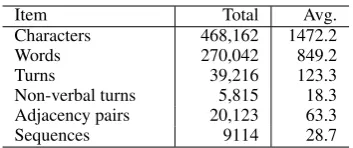
Table 3: Statistics of the annotated corpus. Total number of visit is 318. Avg. refers to that average number is calculated per visit.
Prescribing Outcome (D)marks whether antibi-otics are prescribed in a visit. This label is anno-tated at the end of the conversation as a derived result. It has two possible values: D1: Antibiotic treatment andD0:Non-antibiotic treatment .
The overall code-recode agreement of the task-specific annotations achieved 97% among the four types of behavior5.
4 Results
In this section, we first present basic statistics of our corpus; next, we report our findings on 1) the process of treatment decision-making in med-ical consultation, and 2) the association between physician-patient/caregiver conversational behav-iors and antibiotic prescribing outcome in medical consultations.
4.1 Corpus Statistics
In total, our corpus contains 318 manually tran-scribed conversations, among which 187 are acute visits and 131 are follow-up visits. Table3 sum-marizes the statistics of the corpus. The cor-pus contains nearly 40K turns with 470K Chi-nese characters, which is considerably large in terms of manually annotated natural human con-versations. The Chinese sentences are then auto-matically word segmented with an in-house CRF model. On average, each visit has three partici-pants (physician might talk to more than one care-giver), and the turns in a visit form 63 adjacency pairs, which in turn form 29 action sequences.
4.2 Treatment Decision-making Process
To investigate the process of treatment decision-making in medical consultation, we focus on the interactive process in which a physician’s treat-ment recommendation is accepted. We found that a physician’s treatment recommendation is
5See Chilisa and Preece(2005) for details of the
[image:7.595.93.270.60.134.2]code-recode strategy. The overall code-code-recode agreement was cal-culated based on the average of the four task-specific labels
Figure 2: Average number of action sequences and average number of turns in a sequence in medical consultation phases. P0: OpeningP1: Problem presentationP2: History taking P3: Physical examsP4: DiagnosisP5: TreatmentP6: Ad-dressing additional concernsP7: Closing.
not always immediately accepted in the next turn; rather, it can be resisted or rejected by a patient or caregiver. In doing so, the patient or caregiver has the opportunity to negotiate for a treatment that is in line with their own wants. As a result, this could lead to rather expanded treatment rec-ommendation action sequence shapes.
After examining our corpus, we found that physicians’ treatment recommendations are re-sisted by caregivers 41% of the time. On aver-age, a treatment recommendation action sequence takes 6.63 turns for its completion. In comparison, other actions in a medical consultation are usually less expanded. A history-taking action sequence takes 4.70 turns, and a problem presentation action sequence takes 3.95 turns to complete on average. In our corpus, the average number of turns of an action sequence is the greatest in treatment phase (P5) throughout all phases in medical consulta-tion. Figure 2 shows the distribution of the av-erage number of turns for an action sequence and average number of actions in each phase of medi-cal consultations. The long sequence suggests that the treatment phase is where communication prob-lems (understanding or accepting physician’s rec-ommendations) are most likely to occur.
4.3 Association between Conversational Behaviors and Antibiotic Prescribing
advo-Advocating Action Type # of Visits % of Visits
A1 Requests 10 5.3
A2 Statements 14 7.5
A3 Inquiries 50 26.7
A4 Evaluations 26 13.9
[image:8.595.76.288.60.127.2]Total 100 54.0
Table 4: Frequency and distribution of caregiver advocacy for antibiotics. # of Visit refers to number of visits in which advocacy is observed. % of Visit refers to proportion of visits in which advocacy is observed out of 187 visits.
cating actions that Chinese caregivers use to ad-vocate for antibiotics. Table5shows the distribu-tion of antibiotics prescribing outcomes by occur-rence of caregivers’ advocacy for antibiotics. The result reveals that caregiver advocacy for antibi-otic treatment is significantly associated with an-tibiotic prescribing outcome. What is more trou-bling about this finding is that while caregiver ad-vocacy for antibiotic treatment occurred in 54% of the acute visits in our corpus, similar kind of care-giver advocacy for antibiotics were observed only 9% of the time in the similar setting of American pediatric consultations (Stivers,2002).
In addition, we found that physicians tend to use less authoritarian styles of treatment recommenda-tions (i.e., B2 and B3 combined) than more author-itarian ones (i.e., B1). Table6shows distribution of the three types of treatment recommendation actions in the Chinese pediatric context. More-over, in response to caregivers’ advocacy for an-tibiotic treatment, physicians more frequently re-sist it than grant it, as shown in Table 7. These findings indicate that physicians play a less domi-nant role in antibiotic over-prescribing in the med-ical visits; in contrast, caregivers have a significant influence on the prescribing outcomes.
Multivariate logistic regression results reveal that caregiver advocacy for antibiotic treatment significantly increases the likelihoods of antibi-otic prescribing in a visit – caregivers’ advocacy was associated with 9.23 times increased likeli-hoods of antibiotic prescription (Odds Ratio (OR) = 9.23, 95% Confidence Interval(CI): 3.30-33.08); whereas physician’s response to caregivers’ advo-cacy has a significant effect on the prescribing out-come – physicians’ resistance to caregivers’ advo-cacy reduced the likelihoods of antibiotic prescrip-tions by 77% (OR=0.23, 95%CI: 0.06-0.68), con-trolling for the socio-demographic variables in our model.
Prescriptions V.w.A. V.w/o.A. Total % Antibiotics 72 39 111 59.4 Non-antibiotics 28 48 76 40.6 Total # of Visits 100 87 187 100.0
[image:8.595.308.525.61.118.2]% 53.5 46.5 100.0
Table 5: Frequency and distribution of prescribing outcomes by occurrence of advocacy in number of visits. V.w.A.:visits with advocacy; V.w/o.A.:visits without advocacy. The right-most column shows the percentage of antibiotic prescriptions out of a total of 187 visits. The bottom row shows the per-centage of visits in which caregiver advocacy is observed out of the 187 visits.
5 Discussion
Conversational structures have been recognized as critical for conversational understanding in both sociology and artificial intelligence. Although past research has made enormous contributions to this important inquiry, no annotation scheme ex-ists, with which the hierarchical structural orga-nizations of conversation can be captured. Moti-vated by this gap, we developed the COSTA and created a corpus annotated with this scheme.
5.1 Related Theories and Schemes
Informed by Conversation Analysis (CA), the theoretical framework of the COSTA annotation scheme is largely in line with the existing dis-course structure theories and annotation schemes. Although the existing theories have recognized that utterances in conversation have higher-level forms of hierarchical structures (Grosz and Sid-ner, 1986;Carletta et al., 1997), most have only implemented annotations of conversational struc-tures at turn level and between a pair of turns (e.g., by distinguishing Forward Communicative Function and Backward Communicative Function (Core and Allen,1997;Jurafsky et al.,1997)).
Action Type # of Visits % B1 (Pronouncements) 61 41.5
B2 (Proposals) 65 44.2
B3 (Offers) 21 14.3
[image:9.595.96.269.61.116.2]Total 147 100
Table 6: Frequency and distribution of physicians’ treatment recommendations, by three recommendation actions. Per-centage of action is out of a total of 147 visits, in which physi-cians rather than caregivers initiated treatment discussions.
Response to Advocacy Visit % C0 (Non-acceptance) 65 65.0
C1 (Acceptance) 35 35.0
Total 100 100
Table 7: Frequency and distribution of physicians‘ response to caregiver advocacy for antibiotics. Percentage is out of a total of 100 visits where caregiver advocacy is observed.
at a turn, and 2) depends on the multi-layer struc-tural annotations of a turn for action taxonomy. It thus offers great flexibilities in annotating indirect actions.
5.2 Applications to Different Domains
The COSTA annotation scheme can be used for both general domains and for task-specific do-mains. While the values for TID, APP, and SL are likely to remain the same for different domains, the values for PR and PS and additional attributes such as A-D labels as described in Section 3.3
are task-specific. In addition,, because the CA theory about conversational structures and actions applies to both ordinary conversation and task-specific conversation, we believe that the same scheme with slight customization (e.g., using a different label set for PS) can accommodate analy-sis of conversational structures and actions in other task-specific service settings such as airliner hot-lines, 911 call centers, etc. Furthermore, since so-cial norms underlying conversations do not tend to vary significantly across cultures, the COSTA scheme can be applied to languages other than Chinese.
5.3 Applications of the Corpus
Although research in medicine has long been concerned with effective communication between physicians and patients, related language re-sources are still lacking. Our corpus is one of the first to have multi-layer structure annotations of complete natural conversations, in the task-specific setting of physician-patients/caregivers medical consultations.
The findings regarding structural shape of a
typ-ical medtyp-ical consultation and the process through which a treatment decision is made can be applied to research and practices in medicine and beyond. For example, communication effectiveness can be improved by focusing on phases that are identified as critical in medical consultations (e.g., treatment phase in which sequences are most expanded). In addition, intervention programs can be developed to reduce antibiotic over-prescribing by training physicians to resist caregivers’ pressure more ef-fectively. Moreover, the rich information of the corpus can be valuable for building intelligent di-alogue system for applications in clinical setting (Campillos et al.,2016).
6 Conclusion
In this paper, we propose a general scheme for an-notating multi-layer conversational structures and actions and use that scheme to build a corpus of medical conversations in Chinese pediatric set-tings. First, our work extends the theory and prac-tice of the sociological field of conversation analy-sis (CA) by creating an annotation scheme for cod-ing conversational structures and actions. Second, we create a corpus of naturally occurring conver-sations between physicians and caregivers. The corpus can be used not only for research of gen-eral purposes such as conversational understand-ing, modeling human social behavior of cooper-ation and coordincooper-ation, but also for more specific purposes such as identifying risk factors for antibi-otic prescribing. Third, we demonstrate that con-versational behavior indeed affects medical deci-sions. We hope our findings can be used to train physicians for effective communication.
For future work, we want to test the usefulness of the scheme in other domains. In addition, we plan to extend COSTA to mark turn construction unit (TCU)6. We plan to release the dataset once it is completed.
References
John L. Austin. 1962. How to Do Things with Words. William James Lectures. Oxford University Press.
Leonardo Campillos, Dhouha Bouamor, Eric Bilinski, Anne-Laure Ligozat, Pierre Zweigenbaum, and
So-6
[image:9.595.103.259.173.215.2]phie Rosset. 2016. Integrating a dialogue system into a virtual patient consultation.
Jean Carletta, Amy Isard, Stepen Isard, C. Jacquelin Kowtko, Gwyneth Doherty-Sneddon, and Anne H. Anderson. 1997. The Reliability of a Dialogue Structure Coding Scheme. Computational Linguis-tics23(1):13–31.
Bagele Chilisa and Julia Preece. 2005. Research meth-ods for adult educators in Africa. UNESCO Insti-tute for Education; Pearson Education, Hamburg, Germany; Cape Town, South Africa.
Mark Core and James Allen. 1997. Coding Dialogs with the DAMSL Annotation Scheme. In Proceed-ings of AAAI Fall Symposium on Communicative Ac-tion in Humans and Machines.
Paul Drew. 2014. Turn Design. In J. Sidnell and Tanya Stivers, editors, The Handbook of Conversa-tion Analysis, John Wiley & Sons, West Sussex, UK, pages 131–149.
Harold Garfinkel. 1967.Studies in Ethnomethodology. Prentice-Hall Inc.
Erving Goffman. 1983. The interaction order: Amer-ican sociological association, 1982 presidential ad-dress. American Sociological Review48(1):1–17.
Barbara Grosz and Candace Sidner. 1986. Attention, Intentions, and the Structure of discourse. Compu-tational Linguistics12(3):175–204.
John Heritage. 1984. A Change-of-State Token and Aspects of its Sequential Placement. In J. Maxwell Atkinson, , and John Heritage, editors, Structures of social action: Studies in Conversation Analy-sis, Cambridge University Press, Cambridge, U.K., chapter 13, pages 299–345.
John Heritage and Douglas W. Maynard. 2006. Com-munication in Medical Care: Interaction between Primary Care Physicians and Patients. Cambridge University Press, Cambridge.
Julia Hoxha, Praveen Chandar, Zhe He, James Cimino, David Hanauer, and Chunhua Weng. 2016. DREAM: Classification Scheme for Dialog Acts in Clinical Research Query Mediation. Journal of Biomedical Informatics59:89–101.
Gail Jefferson. 1988. On the sequential organization of trouble-talk in ordinary conversation. Social Prob-lems35(4):418–441.
Gail Jefferson. 2004. Glossary of transcript symbols with an introduction. In Gene H. Lerner, editor, Conversation Analysis: Studies from the First Gen-eration, John Benjamins, Amsterdam / Philadelphia, chapter 2, pages 13–31.
Daniel Jurafsky, Elizabeth Shriberg, and Debra Bi-asca. 1997. Switchboard SWBD-DAMSL Shallow-Discourse-Function Annotation Coders Manual, Draft 13. Technical report, University of Colorado, Boulder.
R. Laxminarayan, A. Duse, C. Wattal, AK. Zaidi, HF. Wertheim, V. Sumpradit, E. Vlieghe, GL. Hara, IM. Gould, H. Goossens, C. Greko, AD. So, M.Bigdeli, G. Tomson, W. Woodhouse, E. Ombaka, AQ. Per-alta, FN. Qamar, F. Mir, S. Kariuki, ZA. Bhutta, A. Coates, R. Bergstrom, GD. Wright, ED. Brown, and O. Cars. 2013. Global antibiotic consumption 2000 to 2010: an analysis of national pharmaceutical sales data. Lancet Infectious Diseases13(12):1057– 1098.
Stephen Levinson. 2014. Action Formation and Action Ascription. In J. Sidnell and Tanya Stivers, editors, The Handbook of Conversation Analysis, John Wi-ley & Sons, West Sussex, UK, pages 103–130.
Yongbin Li, Jing Xu, Fang Wang, Bin Wang, Liqun Liu, Wanli Hou, Hong Fan, Yeqing Tong, Juan Zhang, and Zuxun Lu. 2012. Overprescribing in china, driven by financial incentives, results in very high use of antibiotics, injections, and corticos-teroids. Health Affairs (Project Hope)31(5):1075– 1082.
William C. Mann and Sandra A. Thompson. 1988. Rhetorical Structure Theory: toward a Functional Theory of Text Organization. Text: Interdisciplinary Journal for the Study of Discourse8(3):243–281.
Elijah Mayfield, M Barton Laws, Ira B. Wilson, and Carolyn Penstein Ros’e. 2014. Automating anno-tation of information-giving for analysis of clinical conversation. Journal of American Medical Infor-matics Association21(e1):e122–e128.
Raymond C. Perrault. and James Allen. 1980. A Plan-based Analysis of Indirect Speech Acts. Computa-tional Linguistics6(3):167–182.
Martha Elizabeth Pollack. 1986. Inferring Do-main Plans in Question–answering. Ph.D. thesis, Philadelphia, PA, USA. UMI order no. GAX86– 14850.
Rashmi Prasad, Nikhil Dinesh, Alan Lee, Livio Robaldo Aravind Joshi Eleni Miltsakaki, and Bonnie Webber. 2008. The Penn Discourse Treebank 2.0. In Proceedings of the 6th Inter-national Conference on Language Resources and Evaluation (LREC).
Jeffery D. Robinson. 2003. An interactional structure of medical activities during acute visits and its im-plications for patient’s participation. Health Com-munication15(1):27–57.
Jeffery D. Robinson. 2014. Overall Structural Organi-zation. In J. Sidnell and Tanya Stivers, editors,The Handbook of Conversation Analysis, John Wiley & Sons, West Sussex, UK, pages 257–280.
Harvey Sacks. 1992. Lectures on Conversation, vol-ume 1 & 2. Basil Blackwell.
Harvey Sacks, Emanuel A. Schegloff, and Gail Jeffer-son. 1974. A Simplest Systematics for the Organi-zation of Turn-taking for Conversation. Language 50(4, Part 1):696–735.
Emanuel A. Schegloff. 2007. Sequence Organization in Interaction: Volume 1: A Primer in Conversation Analysis. Cambridge University Press.
Emanuel A. Schegloff, Gail Jefferson, and Harvey Sacks. 1977. The Preference for Self-Correction in the Organization of Repair in Conversation. Lan-guage53(2):361–382.
Alfred Sch¨utz. 1967. Phenomenonology of the Social World. Northwestern University Press.
John R. Searle. 1969. Speech Acts: An Essay in the Philosophy of Language. Cambridge University Press.
John R. Searle. 1985. Expression and Meaning: Stud-ies in the Theory of Speech Acts. Cambridge Uni-versity Press.
Tanya Stivers. 2002. Participating in decisions about treatment: Overt parent pressure for antibiotic med-ication in pediatric encounters. Social Science & Medicine54(7):1111–1130.
Tanya Stivers. 2007. Prescribing under pressure: Parent-physician conversations and antibiotics. Ox-ford University Press, London.
Tanya Stivers. 2014. Sequence Organization. In J. Sid-nell and Tanya Stivers, editors, The Handbook of Conversation Analysis, John Wiley & Sons, West Sussex, UK, pages 191–209.
Andreas Stolcke, Klaus Ries, Noah Coccaro, Eliz-abeth Shriberg, Rebecca Bates, Daniel Jurafsky, Paul Taylor, Rachel Martin, Carol Van Ess-Dykema, and Marie Meteer. 2000. Dialogue Act Mod-eling for Automatic Tagging and Recognition of Conversational Speech. Computational Linguistics 26(3):339–373.
Max Weber. 1991. The Nature of Social Action. In W. G. Runiciman Weber, editor,Selections in Trans-lation, Cambridge.
Ludwig Wittgensein. 1953. Philosophical Investiga-tions. Oxford University Press.