3083
Multilingual Unsupervised NMT using Shared Encoder and
Language-Specific Decoders
Sukanta Sen, Kamal Kumar Gupta, Asif Ekbal, Pushpak Bhattacharyya Department of Computer Science and Engineering
Indian Institute of Technology Patna Patna, India
{sukanta.pcs15,kamal.pcs17,asif,pb}@iitp.ac.in
Abstract
In this paper, we propose a multilingual un-supervised NMT scheme which jointly trains multiple languages with a shared encoder and multiple decoders. Our approach is based on denoising autoencoding of each language and back-translating between English and multi-ple non-English languages. This results in a universal encoder which can encode any lan-guage participating in training into an inter-lingual representation, and language-specific decoders. Our experiments using only mono-lingual corpora show that multimono-lingual unsu-pervised model performs better than the sepa-rately trained bilingual models achieving im-provement of up to 1.48 BLEU points on WMT test sets. We also observe that even if we do not train the network for all possible translation directions, the network is still able to translate in a many-to-many fashion lever-aging encoder’s ability to generate interlingual representation.
1 Introduction
Neural machine translation (NMT) (Kalchbrenner and Blunsom, 2013; Cho et al., 2014; Sutskever et al., 2014; Bahdanau et al., 2015) has be-come a dominant paradigm for machine transla-tion achieving state-of-the-art results on publicly available benchmark datasets. An effective NMT system requires supervision of a huge amount of high-quality parallel data which is not easily avail-able for many language pairs. In absence of such huge amount of parallel data, NMT systems tend to perform poorly (Koehn and Knowles, 2017). However, NMT without using any parallel data such as bilingual translations, bilingual dictionary or comparable translations, has recently become reality and opened up exciting opportunities for future research (Lample et al.,2018;Artetxe et al.,
2018;Yang et al.,2018). It completely eliminates the need of any kind of parallel data and depends
heavily on cross-lingual embeddings and iterative back-translations (Sennrich et al.,2016) between the source and target language using monolingual corpora. On the architectural point of view, the approaches combine one encoder and one ( Lam-ple et al., 2018) or two (Artetxe et al., 2018) de-coders. In supervised NMT settings, combining multiple languages to jointly train an NMT system has been found to be successful in improving the performance (Dong et al.,2015;Firat et al.,2016;
Johnson et al., 2017). However, to the best of our knowledge, this is the very first attempt which aims at combining multiple languages in an unsu-pervised NMT training.
To translate between many languages using bilingual version of unsupervised NMT, we re-quire an encoder and one (Lample et al.,2018) or two (Artetxe et al.,2018) decoders for each pair of languages. However, we may not need separate decoders depending on the source language. We can train source-independent, target-specific de-coders, wherein each decoder will take an interme-diate representation of a source sentence obtained from the shared encoder to translate into their cor-responding language. Also, to translate in many-to-many direction for n languages using bilin-gual unsupervised NMT (Artetxe et al.,2018), we may neednautoencodings andn∗(n−1) back-translations in each iteration during training.
En-glish as the anchor language and map three non-English languages’ embeddings into the non-English embedding space. We train the network to denoise all the four languages and back-translate between English and non-English languages. We evaluate on newstest13andnewstest14using BLEU ( Pap-ineni et al., 2002) score. We find that the mul-tilingual model outperforms the bilingual models by up to 1.48 BLEU points. We also find that the network learns to translate between the non-English (French, German and Spanish) language pairs as well even though it does not explicitly see these pairs during training. To translate between a non-English language pair, no modification to the network is required at inference time. We also evaluate the performance of the non-English lan-guage pairs and achieve a maximum BLEU score of 13.92.
The key contributions of our current work are as follows: (i) we propose a strategy to train multi-lingual unsupervised NMT for one source to many targets and many targets to one source translations; (ii) we empirically show that jointly training mul-tiple languages improves separately trained bilin-gual models; and (iii) we also show that with-out training the network for many-to-many trans-lations, the network can translate between all the languages participating in the training.
2 Related Work
Training multiple languages using a single net-work is a well known approach in NMT. All the previous works in this line were carried out by us-ing parallel data only. Dong et al. (2015) intro-duced one-to-many translation using a single en-coder for the source language and a deen-coder for each target language. Firat et al.(2016) proposed multi-way multilingual NMT using multiple en-coders and deen-coders with a single shared attention mechanism. Johnson et al.(2017) came up with a simpler but effective approach that needed only a single encoder and a single decoder, in which all the parallel data were merged into a single corpus after appending some special tokens at the begin-ning of each sentence. Our multilingual unsuper-vised translation approach is inspired by Artetxe et al. (2018). We use single encoder which is shared by all languages and a decoder for each lan-guage.
3 Background
In this section, we briefly describe the basic unsupervised NMT model as proposed inArtetxe et al. (2018). The architecture has one shared encoder and two language specific decoders, and uses following two strategies to train the NMT system in an unsupervised manner:
Denoising Autoencoding: The shared encoder
takes a noisy (noise through random swaps between two adjacent words) sentence in a given language, initialized with cross-lingual embeddings, encodes into an intermediate rep-resentations, and the decoder of that specific language reconstructs the original sentence from that intermediate representations.
Back-translation: Training strategy with denois-ing involves one language at a time, thus it is noth-ing more than a copynoth-ing task. In order to per-form actual translation without violating the con-straint of using nothing but monolingual corpora, back-translation approach is adapted to generate synthetic parallel sentences. At first, for a given sentence in one language, authors (Artetxe et al.,
2018) use the system in inference mode to trans-late it in another language using greedy decoding. Then, the system is trained to predict the original sentence from this synthetic sentence.
4 Proposed Approach
Our proposed approach comprises mainly two steps: in the first step, we map multiple languages into a shared latent space through cross-lingual embedding mapping, and in the second step, using the shared representation we train NMT using only monolingual corpora with the help of a shared en-coder and language-specific deen-coders through de-noising and back-translation.
4.1 Cross-lingual Embedding
to prevent the discriminator from doing so by mak-ingW X andY as similar as possible. UsingW, a small bilingual dictionary of frequent words is learned. A new translation matrix W that trans-lates betweenX andY space is induced by solv-ing the Orthogonal Procrustes problem:
W∗=argminW||W X−Y||F =U VT (1) s.t W WT =I, UΣVT =SV D(Y XT) (2)
This step can be iterated multiple times by us-ing newW to extract new translation pairs. New translation pairs between the two languages are produced using cross-domain similarity local scal-ing (CSLS) (Conneau et al.,2018).
4.2 Multilingual Embeddings
In general, for n languages, we choose one lan-guageL1 as anchor to map othern−1languages
into its embedding space. To do so, we first train monolingual word embeddings for each ofn lan-guages. Then one by one, we map each ofn−1
languages’ embedding into embedding space of L1. In our experiments, we consider 4 languages,
namely English, French, Spanish and German. We create three cross-lingual embeddings for French, Spanish, and German by keeping English embed-ding fixed.
4.3 Multilingual NMT Training
NMT systems are ideally trained to predict a tar-get sentence given a source sentence. However, in case of unsupervised version of NMT training, we only have monolingual corpora. In absence of a true source-target pair, we depend on synthetic source-target pair having a authentic monolingual sentence at the target side and synthetic equivalent of target at the source side.
Our proposed multilingual unsupervised NMT training strategy is inspired by a recent work of
Artetxe et al.(2018), which has mainly two steps, viz. (i) denoising autoencoding of the sentences of source and target; and (ii) back-translation between source and target. For n languages L1, L2, ..., Ln, in each iteration, we perform
de-noising ofnlanguages, back-translation fromL1
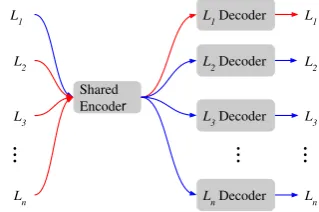
to the othern−1languages, and back-translation of n −1 languages to L1. Figure 1 shows the
block-diagrammatic representation. In our experi-mental setting, we have 4 languages andL1is
En-glish. In denoising autoencoding step, sentences in one language are corrupted by some random
shuffle of words and the decoder is trained to pre-dict the original sentences. In back-translation step, to train the system for a source-to-target direction, first a target sentence is translated to a source sentence using the system in inference mode (using the shared encoder and the source language decoder) to generate pseudo source-target parallel sentence and then this pseudo paral-lel sentence is used to train the network for source-to-target direction. Similarly for a target-to-source training, the process is analogous to the above ap-proach.
L1 Decoder
L2 Decoder
L n Decoder
Shared Encoder
L1
L2
L n
L3 Decoder L3
...
...
L1
L2
L3
L n
[image:3.595.333.493.245.351.2]...
Figure 1: Block diagrammatic view of the proposed network. The shared encoder and decoders of each lan-guage are 2-layered bidirectional GRUs. In each it-eration of the training: 1. we denoise all languages (L1,L2,L3, ...,Ln); 2. back-translate from eachLi to L1 as shown using red arrows; 3. back-translate
fromL1to eachLias shown using blue arrows, where i∈ {2,3, ..., n}.
5 Datasets and Experimental Setup
5.1 Datasets
We use monolingual English, French, and Ger-man news corpora from WMT 20141(Bojar et al., 2014) and Spanish from WMT 20132(Bojar et al.,
2013) for the experiments. The number of to-kens for English, German, French and Spanish are 495.5, 622.6, 224.3 and 122.9 millions, respec-tively. For English-{French, German}, we use newstest2013andnewstest2014, and for English-Spanish, we usenewstest2013. We do not use any parallel data to train, or development set to tune a model. We tokenize and truecase the data using Moses tokenizer3and truecaser scripts.
1
http://www.statmt.org/wmt14/translation-task.html 2
http://www.statmt.org/wmt13/translation-task.html 3
5.2 Experimental Setup
Monolingual embeddings are trained using fast-Text4 using the skip-gram model with vector di-mension of 300. For other hyperparameters, we keep default values of fastText (Bojanowski et al.,
2017). After getting monolingual embedding for each language, we map every non-English em-bedding into the emem-bedding space of English us-ing the cross-lus-ingual embeddus-ing mappus-ing code MUSE5 byConneau et al.(2018). For mapping, we use no bilingual data. We implement the pro-posed multilingual NMT architecture using Py-Torch6, and is based on the implementation of
Artetxe et al. (2018). The encoder and decoders are 2-layered bidirectional gated recurrent units (Cho et al., 2014). We keep the maximum sen-tence length to 50 tokens. For training, we keep embedding dimension of 300 and hidden dimen-sion of 600, vocabulary size 50K, learning rate 0.0002 with Adam optimizer (Kingma and Ba,
2015). As we do not use any development set, we run all the models (bilingual as well as multilin-gual) for 200k iterations keeping batch size of 50 sentences, and take the final models for evaluation.
6 Results and Analysis
We train bilingual models for English↔{French, German, Spanish} as the baselines following
Artetxe et al.(2018). We present the BLEU score for each translation direction using bilingual and multilingual models in Table1. From Table1, we observe that proposed multilingual model outper-forms the separately trained bilingual models for all translation directions on both test sets with a maximum improvement of 1.48 BLEU points for for Spanish to English on newstest2013. As the parameters are shared at only encoder side and a separate decoder is used for each target language, multilingual training provides an improved perfor-mance for all the language pairs without loosing their own linguistic characteristics.
Though, for one translation direction (En→Fr), the improvement on newstest2014 is only 0.12 BLEU points. The proposed method is still use-ful as our method shows consistent improvements over all the baseline models. In supervised multi-lingual NMT, specifically for one-to-many transla-tion directransla-tions, this consistency is absent in some
4
https://github.com/facebookresearch/fastText 5
https://github.com/facebookresearch/MUSE 6https://pytorch.org
existing works (Dong et al., 2015; Firat et al.,
2016; Johnson et al., 2017). However, in this work, we find that using shared encoder with fixed cross-lingual embedding improves performance in all the translation directions. Though, it may not be fair to compare this unsupervised approach with the supervised ones, but this suggests that su-pervised multilingual NMT can be improved with cross-lingual embeddings. We leave it for future work.
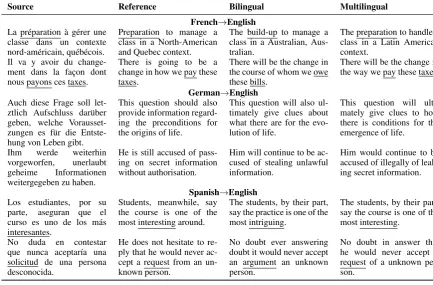
We also study the outputs produced by the dif-ferent models. We find that multilingual mod-els are better than bilingual modmod-els at lexical se-lection. For example, French wordspréparation andpayons are translated asbuild-upandoweby bilingual model. However, the correct translations preparationandpayare generated by the multilin-gual model. For more examples and the quality of outputs, refer to Table3in Appendix A.
newstest2013 newstest2014
System Base Multi N Base Multi N
Fr→En 13.81 14.47 +0.66 14.98 15.76 +0.78 Es→En 13.97 15.45 +1.48 - - -En→Fr 13.28 13.71 +0.43 14.57 14.69 +0.12 En→Es 14.01 14.82 +0.81 - - -De→En 11.30 11.94 +0.64 10.48 11.21 +0.73 En→De 7.24 8.09 +0.85 6.24 6.77 +0.53
Table 1: BLEU scores on newstest2013 and
new-stest2014.Nshows improvements over bilingual
mod-els. Spanish (Es) is not part of thenewstest2014 test set.Base: Baseline.Multi: Multingual
6.1 Translation between Unseen Language
Pairs
In Table 2, we show the results of the language pairs never seen explicitly during training. Dur-ing trainDur-ing, we only back-translate between En-glish and non-EnEn-glish (Spanish, French, German) languages, but the network learns to translate be-tween the non-English language pairs as well. For example, to translate from Spanish to French, we encode a Spanish sentence and the encoded out-put of the encoder is decoded by the French de-coder. For evaluation, we use the newstest20137 test set for Spanish-French, Spanish-German, and French-German language pairs. From Table 2, we see translations between French and Spanish achieve very encouraging BLEU scores of 13.87 and 13.92, and pairs involving German achieve
moderate BLEU score of up to 7.40 considering the fact that the network is not trained for these pairs. For sample outputs, refer to Table4in Ap-pendix A.
→ Es Fr De
Es - 13.92 4.78
Fr 13.87 - 4.59
De 7.40 6.78
-Table 2: BLEU scores of translation between non-English languages on newstest2013. Consider rows are source and columns are target. The network is not trained for these language pairs and still it is possible to translate between these pairs by using the shared en-coder and language specific deen-coders.
6.2 Interlingual Representations
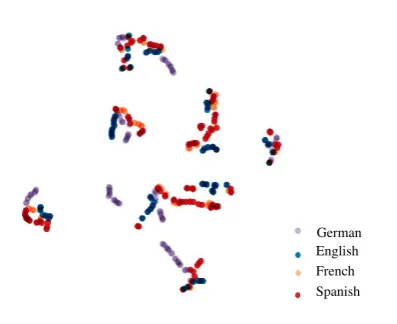
Though the network is not trained for many-to-many translation direction, it is still able to trans-late in all directions. In multilingual training, the encoder is shared by all the languages while each language has a separate decoder. The hidden vec-tors generated by the shared encoder is consumed by a language-specific decoder to generate the translation in that specific language. The network learns to translate between the non-English lan-guages as well, though the network is not trained to do so. It may happen that the encoder gener-ates an interlingual representation from which a language-specific decoder is able to generate the translation. To see if the encoded representations share any pattern, we project them using t-SNE8 (Maaten and Hinton,2008) for some sentences in all the four languages. From the projection as shown in Figure 6.2, we see that there are well-formed clusters, each representing a sentence in four languages. It means that for a sentence, the shared encoder generates approximately the same hidden contexts for all the four languages.
7 Conclusion
In this paper, we propose a multilingual unsuper-vised NMT framework to jointly train multiple languages using a shared encoder and language-specific decoders. Our approach is based on de-noising autoencoding of all languages and back-translating between English and non-English lan-guages. Our approach shows consistent improve-ment over the baselines in all the translation
di-8https://projector.tensorflow.org
English
[image:5.595.314.513.64.226.2]Spanish French German
Figure 2: t-SNE projection of hidden vectors obtained from the shared encoder for some sentences in four guages. Each cluster indicates one sentence in four lan-guages. Dots are the words in a sentence. Color repre-sents the languages.
rections with a maximum improvement of 1.48 BLEU points. We also observe that the network learns to translate between unseen language pairs. This is due to the ability of the shared encoder in our proposed network to generate language-independent representation. In future, we would like to explore other languages with diverse lin-guistic characteristics.
Acknowledgments
The authors would like to thank the anonymous reviewers for their thoughtful comments. Asif Ekbal gratefully acknowledges the Young Faculty Research Fellowship (YFRF) Award supported by the Visvesvaraya PhD scheme for Electronics and IT, Ministry of Electronics and Information Tech-nology (MeitY), Government of India, and im-plemented by Digital India Corporation (formerly Media Lab Asia).
References
Mikel Artetxe, Gorka Labaka, Eneko Agirre, and Kyunghyun Cho. 2018. Unsupervised Neural Ma-chine Translation. InProceedings of the 6th Inter-national Conference on Learning Representations
(ICLR 2018).
Dzmitry Bahdanau, Kyunghyun Cho, and Yoshua Ben-gio. 2015. Neural Machine Translation by Jointly Learning to Align and Translate. InProceedings of the 3rd International Conference on Learning
Rep-resentation (ICLR 2015).
[image:5.595.117.250.127.187.2]Tomas Mikolov. 2017. Enriching Word Vectors with Subword Information. Transactions of the
Associa-tion for ComputaAssocia-tional Linguistics (TACL), 5:135–
146.
Ondˇrej Bojar, Christian Buck, Chris Callison-Burch, Christian Federmann, Barry Haddow, Philipp Koehn, Christof Monz, Matt Post, Radu Soricut, and Lucia Specia. 2013. Findings of the 2013 Work-shop on Statistical Machine Translation. In Pro-ceedings of the Eighth Workshop on Statistical
Ma-chine Translation (WMT 2013), pages 1–44.
Ondˇrej Bojar, Christian Buck, Christian Federmann, Barry Haddow, Philipp Koehn, Johannes Leveling, Christof Monz, Pavel Pecina, Matt Post, Herve Saint-Amand, et al. 2014. Findings of the 2014 Workshop on Statistical Machine Translation. In Proceedings of the ninth workshop on statistical
ma-chine translation (WMT 2014), pages 12–58.
Kyunghyun Cho, Bart Van Merriënboer, Dzmitry Bah-danau, and Yoshua Bengio. 2014. On the Properties of Neural Machine Translation: Encoder-decoder Approaches. In Proceedings of SSST-8, Eighth Workshop on Syntax, Semantics and Structure in
Statistical Translation, pages 103–111.
Alexis Conneau, Guillaume Lample, Marc’Aurelio Ranzato, Ludovic Denoyer, and Hervé Jégou. 2018. Word Translation Without Parallel Data. In Pro-ceedings of the 6th International Conference on
Learning Representations (ICLR 2018).
Daxiang Dong, Hua Wu, Wei He, Dianhai Yu, and Haifeng Wang. 2015. Multi-Task Learning for Mul-tiple Language Translation. In Proceedings of the 53rd Annual Meeting of the Association for Compu-tational Linguistics and the 7th International Joint Conference on Natural Language Processing
(ACL-IJCNLP 2015) (Volume 1: Long Papers), pages
1723–1732.
Orhan Firat, Kyunghyun Cho, and Yoshua Bengio. 2016. Multi-Way, Multilingual Neural Machine Translation with a Shared Attention Mechanism. In Proceedings of the 2016 Conference of the North American Chapter of the Association for Computa-tional Linguistics: Human Language Technologies
(NAACL-HLT 2016), pages 866–875.
Yaroslav Ganin, Evgeniya Ustinova, Hana Ajakan, Pascal Germain, Hugo Larochelle, François Lavi-olette, Mario Marchand, and Victor Lempitsky. 2016. Domain-Adversarial Training of Neural Net-works. The Journal of Machine Learning Research, 17(1):2096–2030.
Melvin Johnson, Mike Schuster, Quoc V. Le, Maxim Krikun, Yonghui Wu, Zhifeng Chen, Nikhil Thorat, Fernanda Viégas, Martin Wattenberg, Greg Corrado, Macduff Hughes, and Jeffrey Dean. 2017. Google’s Multilingual Neural Machine Translation System: Enabling Zero-Shot Translation. Transactions of the
Association for Computational Linguistics (TACL),
5:339–351.
Nal Kalchbrenner and Phil Blunsom. 2013. Recurrent Continuous Translation Models. InProceedings of the 2013 Conference on Empirical Methods in
Nat-ural Language Processing (EMNLP 2013), pages
1700–1709.
Diederik P Kingma and Jimmy Ba. 2015. Adam: A Method for Stochastic Optimization. In Proceed-ings of the 3rd International Conference on
Learn-ing Representation (ICLR 2015).
Philipp Koehn and Rebecca Knowles. 2017. Six Chal-lenges for Neural Machine Translation. In Pro-ceedings of the First Workshop on Neural Machine
Translation, pages 28–39.
Guillaume Lample, Alexis Conneau, Ludovic Denoyer, and Marc’Aurelio Ranzato. 2018. Unsupervised Machine Translation using Monolingual Corpora Only. InProceedings of the 6th International
Con-ference on Learning Representations (ICLR 2018).
Laurens van der Maaten and Geoffrey Hinton. 2008. Visualizing Data using t-SNE. Journal of machine
learning research, 9(Nov):2579–2605.
Tomas Mikolov, Quoc V Le, and Ilya Sutskever. 2013. Exploiting Similarities among Languages for Ma-chine Translation. arXiv preprint arXiv:1309.4168.
Kishore Papineni, Salim Roukos, Todd Ward, and Wei-Jing Zhu. 2002. BLEU: a Method for Automatic Evaluation of Machine Translation. InProceedings of the 40th annual meeting on association for
com-putational linguistics (ACL 2002), pages 311–318.
Rico Sennrich, Barry Haddow, and Alexandra Birch. 2016. Improving Neural Machine Translation Mod-els with Monolingual Data. In Proceedings of the 54th Annual Meeting of the Association for Com-putational Linguistics (ACL 2016) (Volume 1: Long
Papers), pages 86–96.
Ilya Sutskever, Oriol Vinyals, and Quoc V Le. 2014. Sequence to Sequence Learning with Neural Net-works. In Proceedings of Advances in neural
in-formation processing systems (NIPS 2014), pages
3104–3112.
Zhen Yang, Wei Chen, Feng Wang, and Bo Xu. 2018. Unsupervised Neural Machine Translation with Weight Sharing. InProceedings of the 56th An-nual Meeting of the Association for Computational
Linguistics (ACL 2018), pages 46–55.
A Sample Outputs
Source Reference Bilingual Multilingual
French→English
La préparation à gérer une classe dans un contexte nord-américain, québécois.
Preparation to manage a class in a North-American and Quebec context.
The build-up to manage a class in a Australian, Aus-tralian.
The preparation to handle a class in a Latin American context.
Il va y avoir du change-ment dans la façon dont nous payons ces taxes.
There is going to be a change in how we pay these taxes.
There will be the change in the course of whom we owe these bills.
There will be the change in the way we pay these taxes.
German→English
Auch diese Frage soll let-ztlich Aufschluss darüber geben, welche Vorausset-zungen es für die Entste-hung von Leben gibt.
This question should also provide information regard-ing the preconditions for the origins of life.
This question will also ul-timately give clues about what there are for the evo-lution of life.
This question will ulti-mately give clues to how there is conditions for the emergence of life.
Ihm werde weiterhin vorgeworfen, unerlaubt geheime Informationen weitergegeben zu haben.
He is still accused of pass-ing on secret information without authorisation.
Him will continue to be ac-cused of stealing unlawful information.
Him would continue to be accused of illegally of leak-ing secret information.
Spanish→English
Los estudiantes, por su parte, aseguran que el curso es uno de los más interesantes.
Students, meanwhile, say the course is one of the most interesting around.
The students, by their part, say the practice is one of the most intriguing.
The students, by their part, say the course is one of the most interesting.
No duda en contestar que nunca aceptaría una solicitud de una persona desconocida.
He does not hesitate to re-ply that he would never ac-cept a request from an un-known person.
No doubt ever answering doubt it would never accept an argument an unknown person.
[image:7.595.75.509.95.380.2]No doubt in answer that he would never accept a request of a unknown per-son.
Table 3: Sample outputs for bilingual and multilingual models on newstest2013 test set. We observe that the multilingual model is better at lexical selection. Underlined words are some examples of our observation.
Source Reference Multilingual
French→Spanish
Les dirigeants républicains justifièrent leur politique par la nécessité de lutter contre la fraude électorale.
Los dirigentes republicanos justifi-caron su política por la necesidad de luchar contra el fraude electoral.
Los dirigentes republicanos <OOV> su política por la necesidad de luchar contra la fraude electoral.
French→German
Chacun sait que son livre fait partie de cet édifice.
Jeder weiß , dass sein Buch Teil dieses Gebäudes ist.
Jeder weiß , dass sein Buch Teil seines Gebäudes machte.
German→Spanish
Seine Zahlen auf Ebene der interna-tionalen Turniere sind beeindruckend.
Sus números a nivel de torneos inter-nacionales son impresionantes.
Sus cifras sobre el nivel de torneos in-ternacionales son impresionantes.
German→French
Diese Einschränkungen sind nicht ohne Folgen.
Ces restrictions ne sont pas sans con-séquence.
Ces restrictions ne sont pas sans con-séquences.
Spanish→German
Tomemos por caso la elección directa del presidente , que ha sido un logro de la presión pública.
Nehmen Sie nur einmal die direkte Wahl des Präsidenten, die ein Verdi-enst des öffentlichen Drucks war.
Nehmen Sie über die direkte Wahl des Präsidenten, hat dies ein Erfolg ein der öffentlichen Druck.
Spanish→French
Las inversiones en la materia superan los 1.5 billones de dólares.
Les investissements dans ce domaine dépassent les 1,5 milliards de dollars.
Les investissements dans la matière dépassent les 1,5 milliards de dollars.