Fine-Grained Temporal Relation Extraction
Siddharth Vashishtha
University of Rochester Johns Hopkins UniversityBenjamin Van Durme University of RochesterAaron Steven White
Abstract
We present a novel semantic framework for modeling temporal relations and event dura-tions that maps pairs of events to real-valued scales. We use this framework to construct the largest temporal relations dataset to date, covering the entirety of the Universal Depen-dencies English Web Treebank. We use this dataset to train models for jointly predicting fine-grained temporal relations and event du-rations. We report strong results on our data and show the efficacy of a transfer-learning ap-proach for predicting categorical relations.
1 Introduction
Natural languages provide a myriad of formal and lexical devices for conveying the temporal struc-ture of complex events—e.g. tense, aspect, auxil-iaries, adverbials, coordinators, subordinators, etc. Yet, these devices are generally insufficient for de-termining the fine-grained temporal structure of such events. Consider the narrative in(1).
(1) At 3pm, a boybrokehis neighbor’s window. He was running away, when the neighbor
rushed outtoconfronthim. His parents were
calledbut couldn’t arrive for two hours be-cause theywere still at work.
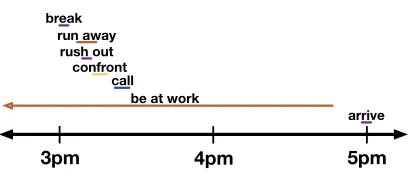
Most native English speakers would have little dif-ficulty drawing a timeline for these events, likely producing something like that in Figure 1. But how do we know that the breaking, the run-ning away, the confrontation, and the calling were short, while the parents being at work was not? And why should the first four be in sequence, with the last containing the others?
The answers to these questions likely involve a complex interplay between linguistic information, on the one hand, and common sense knowledge about events and their relationships, on the other
run away
arrive rush out
confront call
be at work break
5pm
[image:1.595.308.513.230.318.2]3pm 4pm
Figure 1: A typical timeline for the narrative in(1). (Minsky,1975;Schank and Abelson,1975; Lam-port,1978;Allen and Hayes,1985; Hobbs et al.,
1987;Hwang and Schubert,1994). But it remains a question how best to capture this interaction.
A promising line of attack lies in the task of temporal relation extraction. Prior work in this domain has approached this task as a classification problem, labeling pairs of event-referring expressions—e.g. broke or be at work in(1)—and time-referring expressions—e.g. 3pm or two hours—with categorical temporal rela-tions (Pustejovsky et al., 2003; Styler IV et al.,
2014;Minard et al.,2016). The downside of this approach is that time-referring expressions must be relied upon to express duration information. But as (1) highlights, nearly all temporal dura-tion informadura-tion can be left implicit without hin-dering comprehension, meaning these approaches only explicitly encode duration information when that information is linguistically realized.
com-plex events as described by entire documents. We first discuss prior work on temporal rela-tion extracrela-tion (§2) and then present our frame-work and data collection methodology (§3). The resulting dataset—Universal Decompositional Se-mantics Time (UDS-T)—is the largest temporal relation dataset to date, covering all of the Univer-sal Dependencies (Silveira et al.,2014;De Marn-effe et al.,2014;Nivre et al.,2015) English Web Treebank (Bies et al.,2012). We use this dataset to train a variety of neural models (§4) to jointly pre-dict event durations and fine-grained (real-valued) temporal relations (§5), yielding not only strong results on our dataset, but also competitive perfor-mance on TimeML-based datasets (§6).1
2 Background
We review prior work on temporal relations frame-works and temporal relation extraction systems.
Corpora Most large temporal relation datasets use the TimeML standard (Pustejovsky et al.,
2003;Styler IV et al.,2014;Minard et al.,2016). TimeBank is one of the earliest large corpora built using this standard, aimed at capturing ‘salient’ temporal relations between events (Pustejovsky et al.,2003). The TempEval competitions build on TimeBank by covering relations between all the events and times in a sentence.
Inter-sentential relations, which are necessary for document-level reasoning, have not been a fo-cus of the TempEval tasks, though at least one sub-task does address them (Verhagen et al.,2007,
2010; UzZaman et al., 2013, and see Chambers et al. 2014). Part of this likely has to do with the sparsity inherent in the TempEval event-graphs. This sparsity has been addressed with corpora such as the TimeBank-Dense, where annotators la-bel all local-edges irrespective of ambiguity ( Cas-sidy et al.,2014). TimeBank-Dense does not cap-ture the complete graph over event and time rela-tions, instead attempting to achieve completeness by capturing all relations both within a sentence and between neighboring sentences. We take in-spiration from this work for our own framework.
This line of work has been further improved on by frameworks such as Richer Event De-scription (RED), which uses a multi-stage an-notation pipeline where various event-event phe-nomena, including temporal relations and
sub-1Data and code are available athttp://decomp.io/.
event relations are annotated together in the same datasets (O’Gorman et al.,2016). Similarly,Hong et al. (2016) build a cross-document event cor-pus which covers fine-grained event-event rela-tions and roles with more number of event types and sub-types (see alsoFokkens et al.,2013).
Models Early systems for temporal relation ex-traction use hand-tagged features modeled with multinomial logistic regression and support vector machines (Mani et al.,2006; Bethard,2013; Lin et al.,2015). Other approaches use combined rule-based and learning-rule-based approaches (D’Souza and Ng, 2013) and sieve-based architectures— e.g. CAEVO (Chambers et al., 2014) and CATENA (Mirza and Tonelli, 2016). Recently,
Ning et al. (2017) use a structured learning ap-proach and show significant improvements on both TempEval-3 (UzZaman et al., 2013) and TimeBank-Dense (Cassidy et al., 2014). Ning et al. (2018) show further improvements on TimeBank-Dense by jointly modeling causal and temporal relations using Constrained Conditional Models and formulating the problem as an Interger Linear Programming problem.
Neural network-based approaches have used both recurrent (Tourille et al., 2017; Cheng and Miyao, 2017; Leeuwenberg and Moens, 2018) and convolutional architectures (Dligach et al.,
2017). Such models have furthermore been used to construct document timelines from a set of predicted temporal relations (Leeuwenberg and Moens,2018). Such use of pairwise annotations can result in inconsistent temporal graphs, and ef-forts have been made to avert this issue by employ-ing temporal reasonemploy-ing (Chambers and Jurafsky,
2008;Yoshikawa et al.,2009;Denis and Muller,
2011;Do et al.,2012;Laokulrat et al.,2016;Ning et al.,2017;Leeuwenberg and Moens,2017).
Other work has aimed at modeling event du-rations from text (Pan et al., 2007; Gusev et al.,
2011;Williams and Katz,2012), though this work does not tie duration to temporal relations (see also
Filatova and Hovy, 2001). Our approach com-bines duration and temporal relation information within a unified framework, discussed below. 3 Data Collection
We collect the Universal Decompositional Seman-tics Time (UDS-T) dataset, which is annotated on top of the Universal Dependencies (Silveira et al.,
Dataset #Events #Event-Event Relations
TimeBank 7,935 3,481
TempEval 2010 5,688 3,308 TempEval 2013 11,145 5,272 TimeBank-Dense 1,729 8,130 Hong et al.(2016) 863 25,610
[image:3.595.90.286.83.170.2]UDS-T 32,302 70,368
Table 1: Number of total events, and event-event tem-poral relations captured in various corpora
English Web Treebank (Bies et al., 2012) (UD-EWT). The main advantages of UD-EWT over other similar corpora are: (i) it covers text from a variety of genres; (ii) it contains gold standard Universal Dependency parses; and (iii) it is com-patible with various other semantic annotations which use the same predicate extraction standard (White et al.,2016;Zhang et al.,2017;Rudinger et al., 2018;Govindarajan et al., 2019). Table1
compares the size of UDS-T against other tempo-ral relations datasets.
Protocol design Annotators are given two con-tiguous sentences from a document with two high-lighted event-referring expressions (predicates). They are then asked (i) to provide relative time-lines on a bounded scale for the pair of events re-ferred to by the highlighted predicates; and (ii) to give the likely duration of the event referred to by the predicate from the following list: instan-taneous, seconds, minutes, hours, days, weeks, months, years, decades, centuries, forever. In ad-dition, annotators were asked to give a confidence ratings for their relation annotation and each of their two duration annotation on the same five-point scale -not at all confident(0),not very con-fident (1),somewhat confident(2),very confident (3),totally confident(4).
An example of the annotation instrument is shown in Figure 2. Henceforth, we refer to the situation referred to by the predicate that comes first in linear order (feedin Figure2) ase1and the
situation referred to by the predicate that comes second in linear order (sickin Figure2) ase2. Annotators We recruited 765 annotators from Amazon Mechanical Turk to annotate predicate pairs in groups of five. Each predicate pair con-tained in the UD-EWT train set was annotated by a single annotator, and each in the UD-EWT de-velopment and test sets was annotated by three.
Predicate extraction We extract predicates from UD-EWT using PredPatt (White et al.,2016;
Figure 2: An annotated example from our protocol
Zhang et al.,2017), which identifies 33,935 pred-icates from 16,622 sentences. We concatenate all pairs of adjacent sentences in the documents con-tained in UD-EWT, allowing us to capture inter-sentential temporal relations. Considering all pos-sible pairs of predicates in adjacent sentences is in-feasible, so we use a heuristic to capture the most interesting pairs. (See AppendixAfor details.)
1 A
B
C
0
0.12 0.48 0.48 0.66
e1 e2
0.02 0.38 0.38 0.56
e1 e2
0.30 0.48 0.48
0.57
e1 e2
0 1
0 0.66
0.66 1
[image:3.595.307.513.83.199.2]e1 e2
Figure 3: Normalization of slider values
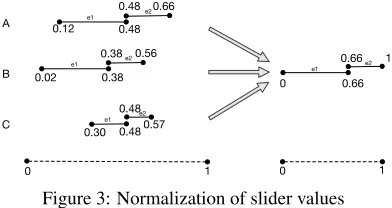
Normalization We normalize the slider re-sponses for each event pair by subtracting the min-imum slider value from all values, then dividing all such shifted values by the maximum value (af-ter shifting). This ensures that the earliest begin-ning point for every event pair lies at 0 and that the right-most end-point lies at 1 while preserving the ratio between the durations implied by the sliders. Figure3illustrates this procedure for three hypo-thetical annotators annotating the same two events
e1ande2. Assuming that the duration classes for e1ore2do not differ across annotators, the relative
chronology of the events is the same in each case. This preservation of relative chronology, over ab-solute slider position, is important because, for the purposes of determining temporal relation, the ab-solute positions that annotators give are meaning-less, and we do not want our models to be forced to fit to such irrelevant information.
[image:3.595.313.509.345.449.2]0.00 0.05 0.10 0.15 0.20 0.25
instant
secondsminuteshoursda ys
weeksmonthsyears decadescentur
ies fore
ver
Relative Frequenc
y
Split
[image:4.595.307.507.75.274.2]dev train
Figure 4: Distribution of event durations. correlation between the normalized slider posi-tions for each pair of annotators that annotated the same group of five predicate pairs in the develop-ment set.2 The development set is annotated by
724 annotators. Rank correlation is a useful mea-sure because it tells us how much different anno-tators agree of the relative position of each slider. The average rank correlation between annotators was 0.665 (95% CI=[0.661, 0.669]).
For the duration responses, we compute the ab-solute difference in duration rank between the du-ration responses for each pair of annotators that annotated the same group of five predicate pairs in the development set. On average, annotators dis-agree by 2.24 scale points (95% CI=[2.21, 2.25]), though there is heavy positive skew ( 1 = 1.16,
95% CI=[1.15, 1.18])—evidenced by the fact that the modal rank difference is 1 (25.3% of the re-sponse pairs), with rank difference 0 as the next most likely (24.6%) and rank difference 2 as a dis-tant third (15.4%).
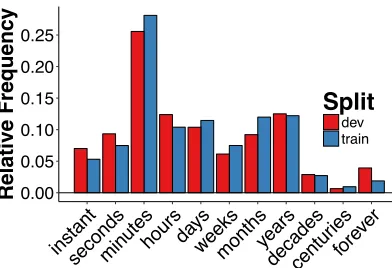
Summary statistics Figure 4 shows the distri-bution of duration responses in the training and de-velopment sets. There is a relatively high density of events lasting minutes, with a relatively even distribution across durations of years or less and few events lastingdecadesor more.
The raw slider positions themselves are some-what difficult to directly interpret. To improve in-terpretability, we rotate the slider position space to construct four new dimensions: (i) PRIORITY, which is positive when e1 starts and/or ends
ear-lier thane2and negative otherwise; (ii)CONTAIN
-MENT,which is most positive when e1 contains
more ofe2; (iii)EQUALITY, which is largest when
2Our protocol design also allows us to detect some bad
annotations internal to the annotation itself, as opposed to comparing one annotator’s annotation of an item to another. See AppendixBfor further details on our deployment of such annotation-internal validation techniques.
Figure 5: Distribution of event relations. both e1 and e2 have the same temporal extents
and smallest when they are most unequal; and (iv) SHIFT, which moves the events forward or back-ward in time. We construct these dimensions by solving forRin
R
2 6 6 4
1 1 1 1 1 1 1 1 1 1 1 1 1 1 1 1 3 7 7
5= 2S 1
where S 2 [0,1]N⇥4 contains the slider
posi-tions for ourN datapoints in the following order:
beg(e1), end(e1), beg(e2), end(e2).
Figure5shows the embedding of the event pairs on the first three of these dimensions ofR. The tri-angular pattern near the top and bottom of the plot arises because strict priority—i.e. extreme positiv-ity or negativpositiv-ity on they-axis—precludes any
tem-poral overlap between the two events, and as we move toward the center of the plot, different prior-ity relations mix with different overlap relations— e.g. the upper-middle left corresponds to event pairs where most of e1 comes toward the
begin-ning ofe2, while the upper middle right of the plot
corresponds to event pairs where most ofe2comes
toward the end ofe1.
4 Model
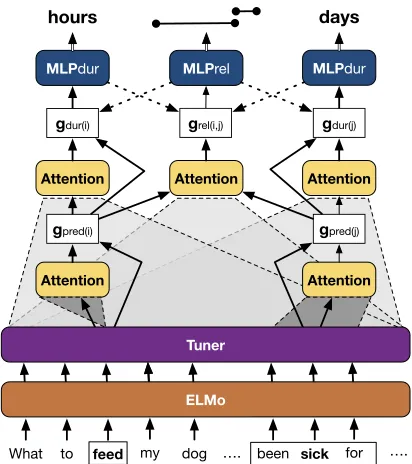
For each pair of events referred to in a sentence, we aim to jointly predict the relative timelines of those events as well as their durations. We then use a separate model to induce document timelines from the relative timelines.
[image:4.595.88.284.82.216.2]What to feed my dog …. been sick for ….
What to feed my dog …. been sick for ….
What to feed my dog …. been sick for ….
ELMo
Attention Attention
Attention
Attention Attention
gpred(i) gpred(j)
MLPrel
MLPdur MLPdur
gdur(i) grel(i,j) gdur(j)
hours days
[image:5.595.84.290.83.315.2]Tuner
Figure 6: Network diagram for model. Dashed arrows are only included in some models.
duration model, and a relation model. These com-ponents use multiple layers ofdot product atten-tion(Luong et al.,2015) on top of an embedding
H 2 RN⇥D for a sentence s = [w1, . . . , w N]
tuned on the threeM-dimensional contextual
em-beddings produced by ELMo (Peters et al.,2018) for that sentence, concatenated together.
H= tanh (ELMo(s)WTUNE+bTUNE)
where D is the dimension for the tuned
embed-dings,WTUNE2R3M⇥D, andbTUNE2RN⇥D. Event model We define the model’s represen-tation for the event referred to by predicate k as
gpredk 2 RD, where D is the embedding size.
We build this representation using a variant of dot-product attention, based on the predicate root.
aSPANpredk= tanh ASPANPREDhROOT(predk)+b
SPAN PRED
↵predk= softmax HSPAN(predk)a
SPAN
predk gpredk= [hROOT(predk);↵predkHSPAN(predk)]
whereASPANPRED 2 RD⇥D,bSPAN
PRED 2RD;hROOT(predk) is the hidden representation of thekth predicate’s
root; andHSPAN(predk) is obtained by stacking the hidden representations of the entire predicate.
As an example, the predicate been sick for now in Figure 2 has sick as its root, and thus we would take the hidden representation for sick as hROOT(predk). Similarly, HSPAN(predk) would be equal to taking the hidden-state representations
ofbeen sick for nowand stacking them together. Then, if the model learns that tense information is important, it may weightbeenusing attention.
Duration model The temporal duration rep-resentationgdurk for the event referred to by the
kthpredicate is defined similarly to the event
rep-resentation, but instead of stacking the predicate’s span, we stack the hidden representations of the entire sentenceH.
adurSENTk = tanh ASENTDURgpredk+b
SENT DUR
↵durk= softmax(Ha
SENT
durk) gdurk= [gpredk;↵durkH]
whereASENT
DUR 2RD⇥size(gpredk)andbSENTDUR 2RD.
We consider two models of the categorical du-rations: a softmax model and a binomial model. The main difference is that the binomial model enforces that the probabilities pdurk over the 11 duration values be concave in the duration rank, whereas the softmax model has no such constraint. We employ a cross-entropy loss for both models.
Ldur(dk;p) = logpdk
In the softmax model, we pass the duration rep-resentationgdurk for predicatek through a multi-layer perceptron (MLP) with a single hidden multi-layer of ReLU activations, to yield probabilities pdurk over the 11 durations.
vdurk = ReLU(W(1)DURgdurk+b(1)DUR)
p= softmax(W(2)DURvdurk+b(2)DUR)
In the binomial distribution model, we again pass the duration representation through a MLP with a single hidden layer of ReLU activations, but in this case, we yield only a single value⇡durk. With
vdurkas defined above:
⇡= ⇣w(2)DURvdurk+b
(2) DUR
⌘
pc=
✓n
c
◆
⇡n(1 ⇡)(n c)
wherec 2 {0,1,2, ...,10}represents the ranked durations – instant (0), seconds (1), minutes (2), ..., centuries (9), forever (10) – andnis the
maxi-mum class rank (10).
aSENTrelij = tanh ASENTREL [gpredi;gpredj] +b
SENT REL
↵relij = softmax⇣HarelSENTij ⌘
grelij = [gpredi;gpredj;↵relijH]
whereASENT
REL 2RD⇥2size(gpredk)andbSENTREL 2RD.
The main idea behind our temporal model is to map events and states directly to a timeline, which we represent via a reference interval [0,1]. For
situationk, we aim to predict the beginning point
bkand end-point ek bkofk.
We predict these values by passing grelij through an MLP with one hidden layer of ReLU activations and four real-valued outputs [ ˆi,ˆi,ˆj,ˆj], representing the estimated relative
beginning points (ˆi,ˆj) and durations (ˆi,ˆj) for events i and j. We then calculate the predicted
slider valuesˆsij= [ˆbi,eˆi,ˆbj,ˆej]
h ˆ
bk,ˆek
i
=h ⇣ˆk
⌘
, ⇣ˆk+ ˆk
⌘i
The predicted valuesˆsijare then normalized in the
same fashion as the true slider values prior to being entered into the loss. We constrain this normalized ˆ
sij using four L1 losses.
Lrel(sij; ˆsij) = (bi bj) (ˆbi ˆbj) +
(ei bj) (ˆei ˆbj) +
(ej bi) (ˆej ˆbi) +
|(ei ej) (ˆei ˆej)|
The final loss function is thenL=Ldur+ 2Lrel. Duration-relation connections We also ex-periment with four architectures wherein the du-ration and relation models are connected to each other in the Dur!Rel or Dur Rel directions.
In the Dur ! Rel architectures, we modify
grelij in two ways: (i) additionally concatenating the ith and jth predicate’s duration probabilities
from the binomial distribution model, and (ii) not using the relation representation model at all.
grelij = [gpredi;gpredj;↵relijH;pi;pj] grelij = [pi;pj]
In the Dur Rel architectures, we use two mod-ifications: (i) we modify gdurk by concatenating the ˆbk and eˆk from the relation model, and (ii) we do not use the duration representation model
at all, instead use the predicted relative duration ˆ
ek ˆbkobtained from the relation model, passing
it through the binomial distribution model.
gdurk= [gpredk;↵durkH; ˆbk; ˆek]
⇡durk= ˆek ˆbk
Document timelines We induce the hidden doc-ument timelines for the docdoc-uments in the UDS-T development set using relative timelines from (i) actual pairwise slider annotations; or (ii) slider values predicted by the best performing model on UDS-T development set. To do this, we assume a hidden timelineT 2 Rnd⇥2
+ , wherend is the
to-tal number of predicates in that document, the two dimensions represent the beginning point and the duration of the predicates. We connect these la-tent timelines to the relative timelines, by anchor-ing the beginnanchor-ing points of all predicates such that there is always a predicate with 0 as the beginning point in a document and defining auxiliar variables ⌧ijandˆsijfor each eventsiandj.
⌧ij = [ti1, ti1+ti2, tj1, tj1+tj2]
ˆ
sij =
⌧ij min(⌧ij)
max(⌧ij min(⌧ij))
We learnTfor each document under the relation
lossLrel(sij,ˆsij). We further constrainTto
pre-dict the categorical durations using the binomial distribution model on the durationstk2implied by
T, assuming⇡k = (clog(tk2)).
5 Experiments
We implement all models inpytorch 1.0. For all experiments, we use mini-batch gradient de-scent with batch-size 64 to train the embedding tuner (reducing ELMo to a dimension of 256), at-tention, and MLP parameters. Both the relation and duration MLP have a single hidden layer with 128 nodes and a dropout probability of 0.5 (see AppendixDfor further details).
To predict TimeML relations in TempE-val3 (TE3;UzZaman et al.,2013, Task C-relation only) and TimeBank-Dense (TD; Cassidy et al.,
Model Duration Relation
Duration Relation Connection ⇢ rank diff. R1 Absolute⇢ Relative⇢ R1
softmax X - 32.63 1.86 8.59 77.91 68.00 2.82
binomial X - 37.75 1.75 13.73 77.87 67.68 2.35
- X Dur Rel 22.65 3.08 -51.68 71.65 66.59 -6.09
binomial - Dur!Rel 36.52 1.76 13.17 77.58 66.36 0.85 binomial X Dur!Rel 38.38 1.75 13.85 77.82 67.73 2.58
binomial X Dur Rel 38.12 1.75 13.68 78.12 68.22 2.96
Table 2: Results on test data based on different model representations;⇢denotes the Spearman-correlation coef-ficient; rank-diff is the duration rank difference. The model highlighted in blue performs best on durations and is also close to the top performing model for relations on the development set. The numbers highlighted inboldare the best-performing numbers on the test data in the respective columns.
kernel to train on the training sets of these datasets using the feature vector obtained from our model.3
Following recent work using continuous la-bels in event factuality prediction (Lee et al.,
2015; Stanovsky et al., 2017; Rudinger et al.,
2018;White et al.,2018) and genericity prediction (Govindarajan et al.,2019), we report three met-rics for the duration prediction: Spearman correla-tion (⇢), mean rank difference (rank diff), and
pro-portion rank difference explained (R1). We report three metrics for the relation prediction: Spearman correlation between the normalized values of ac-tual beginning and end points and the predicted ones (absolute ⇢), the Spearman correlation
be-tween the actual and predicted values inLrel
(rela-tive⇢), and the proportion of MAE explained (R1).
R1= 1 MAEmodel MAEbaseline
where MAEbaselineis always guessing the median.
6 Results
Table 2shows the results of different model ar-chitectures on the UDS-T test set, and Table 4
shows the results of our transfer-learning approach on test set of TimeBank-Dense (TD-test).
UDS-T results Most of our models are able to predict the relative position of the beginning and ending of events very well (high relation ⇢) and the relative duration of events somewhat well (rel-atively low duration ⇢), but they have a lot more
trouble predicting relation exactly and relatively less trouble predicting duration exactly.
3For training on TE3, we use TimeBank (TB;Pustejovsky
et al.,2003) + AQUAINT (AQ;Graff) datasets provided in the TE3 workshop (UzZaman et al.,2013). For training on TD, we use TD-train and TD-dev.
Duration model The binomial distribution model outperforms the softmax model for dura-tion predicdura-tion by a large margin, though it has basically no effect on the accuracy of the relation model, with the binomial and softmax models per-forming comparably. This suggests that enforcing concavity in duration rank on the duration proba-bilities helps the model better predict durations.
Connections Connecting the duration and re-lation model does not improve performance in general. In fact, when the durations are directly predicted from the temporal relation model—i.e. without using the duration representation model— the model’s performance drops by a large margin, with the Spearman correlation down by roughly 15 percentage points. This indicates that constrain-ing the relations model to predict the durations is not enough and that the duration representation is needed to predict durations well. On the other hand, predicting temporal relations directly from the duration probability distribution—i.e. without using the relation representation model—results in a similar score as that of the top-performing model. This indicates that the duration representa-tion is able to capture most of the relarepresenta-tion charac-teristics of the sentence. Using both duration rep-resentation and relation reprep-resentation separately (model highlighted in blue) results in the best per-formance overall on the UDS-T development set.
Duration
Word Attention Rank Freq soldiers 0.911 1.28 69
months 0.844 1.38 264
Nothing 0.777 5.07 114
minutes 0.768 1.33 81
astronauts 0.756 1.37 81
hour 0.749 1.41 84
Palestinians 0.735 1.72 288
month 0.721 2.03 186
cartoonists 0.714 1.35 63
years 0.708 1.94 588
days 0.635 1.39 84
thoughts 0.592 2.90 60
us 0.557 2.09 483
week 0.531 2.23 558
advocates 0.517 2.30 105
Relation
Word Attention Rank Freq
occupied 0.685 1.33 54
massive 0.522 2.71 66
social 0.510 1.68 57
general 0.410 3.52 168
few 0.394 3.07 474
mathematical 0.393 7.66 132
are 0.387 3.47 4415
comes 0.339 2.39 51
or 0.326 3.50 3137
and 0.307 4.86 17615
emerge 0.305 2.67 54
filed 0.303 7.14 66
s 0.298 4.03 1152
were 0.282 3.49 1308
[image:8.595.114.485.86.313.2]gets 0.239 7.36 228
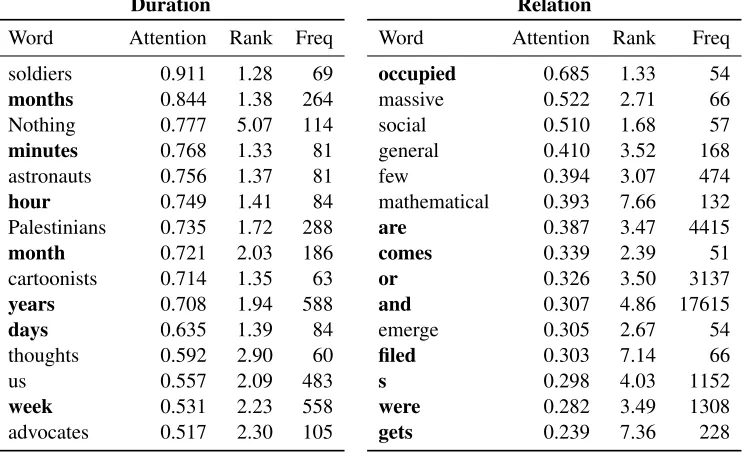
Table 3: Mean attention weight, mean attention rank, and frequency for 15 words in the development set with the highest mean duration-attention (left) and relation-attention (right) weights. For duration, the words highlighted in bold directly correspond to some duration class. For relation, the words in bold are either conjunctions or words containing tense information.
only E-E relations and achieve a score of 0.498.4
Our system beats the TD F1-micro scores of all other systems reported in Table 4. As a refer-ence, the top performing system on TE3-PT (Ning et al., 2017) reports an F1 score of 0.672 over all relations, but is not directly comparable to our system as we only evaluate on event-event rela-tions. These results indicate that our model is able to achieve competitive performance on other stan-dard temporal classification problems.
Systems Evaluation Data F1 (E-E)
CAEVO TD-test 0.494
CATENA TD-test 0.519
Cheng and Miyao(2017) TD-test 0.529
[image:8.595.88.287.506.574.2]This work TD-test 0.566
Table 4: F1-micro scores of event-event relations in TD-test based on our transfer learning experiment. 7 Model Analysis and Timelines
We investigate two aspects of the best-performing model on the development set (highlighted in Ta-ble 2): (i) what our duration and relation rep-resentations attend to; and (ii) how well docu-ment timelines constructed from the model’s
pre-4We do not report thetemporal awareness scores (F1)
of other systems on TE3-PT, since they report their metrics on all relations, including timex-timex, and event-timex re-lations, and thus they are not directly comparable. For TD, only those systems are reported that report F1-micro scores.
dictions match those constructed from the annota-tions. (See AppendixFfor further analyses.)
Attention The advantage of using an attention mechanism is that we can often interpret what lin-guistic information the model is using by analyz-ing the attention weights. We extract these at-tention weights for both the duration representa-tion and the relarepresenta-tion representarepresenta-tion from our best model on the development set.
Duration We find that words that denote some time period—e.g. month(s),minutes,hour, years, days, week—are among the words with highest mean attention weight in the duration model, with seven of the top 15 words directly denoting one of the duration classes (Table 3). This is exactly what one might expect this model to rely heavily on, since time expressions are likely highly informative for making predictions about duration. It also may suggest that we do not need to directly encode relations between event-referring and time-referring expressions in our framework—as do annotation standards like TimeML—since our models may discover them.
by that predicate. To investigate this possibil-ity, we compute a multinomial regression predict-ing the attention weights ↵s for each sentence s
from theK morphological features of each word
in that sentence Fs 2 {0,1}length(s)⇥K, which
are extracted from the UD-EWT features column and binarized. To do this, we optimize coeffi-cientscinargcminPsD(↵sksoftmax(Fsc)),
where D is the KL divergence. We find that
the five most strongly weighted positive features in c are all features of nouns—NUMBER=plur, CASE=acc,PRONTYPE=prs,NUMBER=sing,GEN -DER=masc—suggesting that good portion of du-ration information can be gleaned from the ar-guments of a predicate. This may be because nominal information can be useful in determin-ing whether the clause is about particular events or generic events (Govindarajan et al.,2019).
Relation A majority of the words with high-est mean attention weight in the relation model are either coordinators—such as or and and—or bearers of tense information—i.e. lexical verbs and auxiliaries. The first makes sense because, in context, coordinators can carry information about temporal sequencing (see Wilson and Sperber,
1998, i.a.). The second makes sense in that infor-mation about the tense of predicates being com-pared likely helps the model determine relative or-dering of the events they refer to.
Similar to duration attention analysis, for rela-tion attenrela-tion, we find that the five most strongly weighted positive features in c are all fea-tures of verbs or auxiliaries—PERSON=1, PER -SON=3,TENSE=pres,TENSE=past,MOOD=ind— suggesting that a majority of the information rel-evant to relation can be gleaned from the tense-bearing units in a clause.
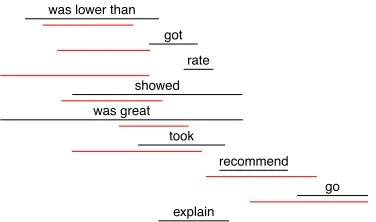
Document timelines We apply the document timeline model described in §4 to both the an-notations on the development set and the best-performing model’s predictions to obtain timelines for all documents in the development set. Figure
7shows an example, comparing the two resulting document timelines.
For these two timelines, we compare the in-duced beginning points and durations, obtaining a mean Spearman correlation of 0.28 for beginning points and -0.097 for durations. This suggests that the model agrees to some extent with the annota-tions about the beginning points of events in most documents but is struggling to find the correct
du-was lower than
got
rate
showed
was great
took
recommend
go
[image:9.595.318.506.85.196.2]explain
Figure 7: Learned timeline for the following docu-ment based on actual (black) and predicted (red) an-notations:“A+. I would rate Fran pcs an A + because the price was lower than everyone else , i got my com-puter back the next day , and the professionalism he showed was great . He took the time to explain things to me about my computer , i would recommend you go to him. David”
ration spans. One possible reason for poor pre-diction of durations could be the lack of a direct source of duration information. The model cur-rently tries to identify the duration based only on the slider values, which leads to poor performance as already seen in one of the Dur Rel model.
8 Conclusion
We presented a novel semantic framework for modeling fine-grained temporal relations and event durations that maps pairs of events to real-valued scales for the purpose of constructing document-level event timelines. We used this framework to construct the largest temporal rela-tions dataset to date – UDS-T – covering the en-tirety of the UD-EWT. We used this dataset to train models for jointly predicting fine-grained tempo-ral relations and event durations, reporting strong results on our data and showing the efficacy of a transfer-learning approach for predicting standard, categorical TimeML relations.
Acknowledgments
References
James F Allen. 1983. Maintaining knowledge about temporal intervals. Communications of the ACM, 26(11):832–843.
James F Allen and Patrick J Hayes. 1985. A common-sense theory of time. InProceedings of the 9th Inter-national Joint Conference on Artificial Intelligence-Volume 1, pages 528–531. Morgan Kaufmann Pub-lishers Inc.
Steven Bethard. 2013. Cleartk-timeml: A minimalist approach to tempeval 2013. InSecond Joint Con-ference on Lexical and Computational Semantics (* SEM), Volume 2: Proceedings of the Seventh In-ternational Workshop on Semantic Evaluation (Se-mEval 2013), volume 2, pages 10–14.
Ann Bies, Justin Mott, Colin Warner, and Seth Kulick. 2012. English web treebank. Linguistic Data Con-sortium, Philadelphia, PA.
Taylor Cassidy, Bill McDowell, Nathanael Chambers, and Steven Bethard. 2014. An annotation frame-work for dense event ordering. InProceedings of the 52nd Annual Meeting of the Association for Compu-tational Linguistics (Volume 2: Short Papers), vol-ume 2, pages 501–506.
Nathanael Chambers, Taylor Cassidy, Bill McDowell, and Steven Bethard. 2014. Dense event ordering with a multi-pass architecture. Transactions of the Association for Computational Linguistics, 2:273– 284.
Nathanael Chambers and Dan Jurafsky. 2008. Jointly combining implicit constraints improves temporal ordering. InProceedings of the Conference on Em-pirical Methods in Natural Language Processing, pages 698–706. Association for Computational Lin-guistics.
Fei Cheng and Yusuke Miyao. 2017. Classifying tem-poral relations by bidirectional lstm over depen-dency paths. In Proceedings of the 55th Annual Meeting of the Association for Computational Lin-guistics (Volume 2: Short Papers), volume 2, pages 1–6.
Marie-Catherine De Marneffe, Timothy Dozat, Na-talia Silveira, Katri Haverinen, Filip Ginter, Joakim Nivre, and Christopher D. Manning. 2014. Uni-versal Stanford dependencies: A cross-linguistic ty-pology. InProceedings of the Ninth International Conference on Language Resources and Evaluation (LREC-2014), volume 14, pages 4585–4592.
Pascal Denis and Philippe Muller. 2011. Predicting globally-coherent temporal structures from texts via endpoint inference and graph decomposition. In
IJCAI-11-International Joint Conference on Artifi-cial Intelligence.
Dmitriy Dligach, Timothy Miller, Chen Lin, Steven Bethard, and Guergana Savova. 2017. Neural tem-poral relation extraction. InProceedings of the 15th Conference of the European Chapter of the Associa-tion for ComputaAssocia-tional Linguistics: Volume 2, Short Papers, volume 2, pages 746–751.
Quang Xuan Do, Wei Lu, and Dan Roth. 2012. Joint inference for event timeline construction. In Pro-ceedings of the 2012 Joint Conference on Empirical Methods in Natural Language Processing and Com-putational Natural Language Learning, pages 677– 687. Association for Computational Linguistics. Jennifer D’Souza and Vincent Ng. 2013. Classifying
temporal relations with rich linguistic knowledge. InProceedings of the 2013 Conference of the North American Chapter of the Association for Computa-tional Linguistics: Human Language Technologies, pages 918–927.
Elena Filatova and Eduard Hovy. 2001. Assigning time-stamps to event-clauses. In Proceedings of the Workshop on Temporal and Spatial Informa-tion Processing-Volume 13, page 13. Association for Computational Linguistics.
Antske Fokkens, Marieke van Erp, Piek Vossen, Sara Tonelli, Willem Robert van Hage, Luciano Ser-afini, Rachele Sprugnoli, and Jesper Hoeksema. 2013. GAF: A grounded annotation framework for events. InWorkshop on Events: Definition, Detec-tion, Coreference, and Representation, pages 11–20. Venkata Subrahmanyan Govindarajan, Benjamin Van Durme, and Aaron Steven White. 2019. Decomposing generalization: Models of generic, habitual, and episodic statements. arXiv preprint arXiv:1901.11429.
David Graff. The aquaint corpus of English news text:[content copyright] Portionsc 1998-2000 New York Times, Inc.,c 1998-2000 Associated Press, Inc.,c 1996-2000 Xinhua News Service. Linguis-tic Data Consortium.
Andrey Gusev, Nathanael Chambers, Pranav Khaitan, Divye Khilnani, Steven Bethard, and Dan Juraf-sky. 2011. Using query patterns to learn the dura-tion of events. In Proceedings of the Ninth Inter-national Conference on Computational Semantics, pages 145–154. Association for Computational Lin-guistics.
Jerry R Hobbs, William Croft, Todd Davies, Douglas Edwards, and Kenneth Laws. 1987. Commonsense metaphysics and lexical semantics. Computational Linguistics, 13(3-4):241–250.
Harold Hotelling. 1936. Relations between two sets of variates.Biometrika, 28(3/4):321–377.
Chung Hee Hwang and Lenhart K Schubert. 1994. In-terpreting tense, aspect and time adverbials: A com-positional, unified approach. In Temporal Logic, pages 238–264. Springer.
Leslie Lamport. 1978. Time, clocks, and the ordering of events in a distributed system. Communications of the ACM, 21(7):558–565.
Natsuda Laokulrat, Makoto Miwa, and Yoshimasa Tsu-ruoka. 2016. Stacking approach to temporal relation classification with temporal inference. Information and Media Technologies, 11:53–78.
Kenton Lee, Yoav Artzi, Yejin Choi, and Luke Zettle-moyer. 2015. Event detection and factuality assess-ment with non-expert supervision. InProceedings of the 2015 Conference on Empirical Methods in Natural Language Processing, pages 1643–1648. Artuur Leeuwenberg and Marie-Francine Moens.
2018. Temporal information extraction by predict-ing relative time-lines. InProceedings of the 2018 Conference on Empirical Methods in Natural Lan-guage Processing, pages 1237–1246.
Tuur Leeuwenberg and Marie-Francine Moens. 2017. Structured learning for temporal relation extraction from clinical records. In Proceedings of the 15th Conference of the European Chapter of the Asso-ciation for Computational Linguistics, pages 1150– 1158.
Chen Lin, Dmitriy Dligach, Timothy A Miller, Steven Bethard, and Guergana K Savova. 2015. Multi-layered temporal modeling for the clinical domain.
Journal of the American Medical Informatics Asso-ciation, 23(2):387–395.
Minh-Thang Luong, Hieu Pham, and Christopher D Manning. 2015. Effective approaches to attention-based neural machine translation. arXiv preprint arXiv:1508.04025.
Inderjeet Mani, Marc Verhagen, Ben Wellner, Chong Min Lee, and James Pustejovsky. 2006. Ma-chine learning of temporal relations. InProceedings of the 21st International Conference on Compu-tational Linguistics and the 44th annual meeting of the Association for Computational Linguistics, pages 753–760. Association for Computational Linguistics.
Christopher Manning, Mihai Surdeanu, John Bauer, Jenny Finkel, Steven Bethard, and David McClosky. 2014. The stanford corenlp natural language pro-cessing toolkit. In Proceedings of 52nd Annual Meeting of the Association for Computational Lin-guistics: System Demonstrations, pages 55–60. Anne-Lyse Myriam Minard, Manuela Speranza, Ruben
Urizar, Begona Altuna, Marieke van Erp, Anneleen Schoen, and Chantal van Son. 2016. Meantime,
the newsreader multilingual event and time corpus. In Proceedings of the Tenth International Confer-ence on Language Resources and Evaluation (LREC 2016). European Language Resources Association (ELRA).
Marvin Minsky. 1975. A framework for representing knowledge. The Psychology of Computer Vision. Paramita Mirza and Sara Tonelli. 2016. Catena: Causal
and temporal relation extraction from natural lan-guage texts. In Proceedings of COLING 2016, the 26th International Conference on Computational Linguistics: Technical Papers, pages 64–75. Qiang Ning, Zhili Feng, and Dan Roth. 2017. A
struc-tured learning approach to temporal relation extrac-tion. InProceedings of the 2017 Conference on Em-pirical Methods in Natural Language Processing, pages 1027–1037.
Qiang Ning, Zhili Feng, Hao Wu, and Dan Roth. 2018. Joint reasoning for temporal and causal relations. In
Proceedings of the 56th Annual Meeting of the As-sociation for Computational Linguistics (Volume 1: Long Papers), volume 1, pages 2278–2288. Joakim Nivre, Zeljko Agic, Maria Jesus Aranzabe,
Masayuki Asahara, Aitziber Atutxa, Miguel Balles-teros, John Bauer, Kepa Bengoetxea, Riyaz Ah-mad Bhat, Cristina Bosco, Sam Bowman, Giuseppe G. A. Celano, Miriam Connor, Marie-Catherine de Marneffe, Arantza Diaz de Ilarraza, Kaja Do-brovoljc, Timothy Dozat, Toma Erjavec, Richrd Farkas, Jennifer Foster, Daniel Galbraith, Filip Gin-ter, Iakes Goenaga, Koldo Gojenola, Yoav Gold-berg, Berta Gonzales, Bruno Guillaume, Jan Haji, Dag Haug, Radu Ion, Elena Irimia, Anders Jo-hannsen, Hiroshi Kanayama, Jenna Kanerva, Si-mon Krek, Veronika Laippala, Alessandro Lenci, Nikola Ljubei, Teresa Lynn, Christopher Man-ning, Ctlina Mrnduc, David Mareek, Hctor Mart-nez Alonso, Jan Maek, Yuji Matsumoto, Ryan Mc-Donald, Anna Missil, Verginica Mititelu, Yusuke Miyao, Simonetta Montemagni, Shunsuke Mori, Hanna Nurmi, Petya Osenova, Lilja vrelid, Elena Pascual, Marco Passarotti, Cenel-Augusto Perez, Slav Petrov, Jussi Piitulainen, Barbara Plank, Mar-tin Popel, Prokopis Prokopidis, Sampo Pyysalo, Lo-ganathan Ramasamy, Rudolf Rosa, Shadi Saleh, Se-bastian Schuster, Wolfgang Seeker, Mojgan Ser-aji, Natalia Silveira, Maria Simi, Radu Simionescu, Katalin Simk, Kiril Simov, Aaron Smith, Jan tpnek, Alane Suhr, Zsolt Sznt, Takaaki Tanaka, Reut Tsar-faty, Sumire Uematsu, Larraitz Uria, Viktor Varga, Veronika Vincze, Zdenk abokrtsk, Daniel Zeman, and Hanzhi Zhu. 2015. Universal Dependencies 1.2.
http://universaldependencies.github.io/docs/. Tim O’Gorman, Kristin Wright-Bettner, and Martha
Feng Pan, Rutu Mulkar-Mehta, and Jerry R Hobbs. 2007. Modeling and learning vague event dura-tions for temporal reasoning. InProceedings of the 22nd National Conference on Artificial Intelligence-Volume 2, pages 1659–1662. AAAI Press.
Fabian Pedregosa, Gal Varoquaux, Alexandre Gram-fort, Vincent Michel, Bertrand Thirion, Olivier Grisel, Mathieu Blondel, Peter Prettenhofer, Ron Weiss, Vincent Dubourg, Jake Vanderplas, Alexan-dre Passos, David Cournapeau, Matthieu Brucher, Matthieu Perrot, and Edouard Duchesnay. 2011. Scikit-learn: Machine Learning in Python. Journal of Machine Learning Research, 12:2825–2830. Matthew E Peters, Mark Neumann, Mohit Iyyer, Matt
Gardner, Christopher Clark, Kenton Lee, and Luke Zettlemoyer. 2018. Deep contextualized word rep-resentations.arXiv preprint arXiv:1802.05365. James Pustejovsky, Patrick Hanks, Roser Sauri,
An-drew See, Robert Gaizauskas, Andrea Setzer, Dragomir Radev, Beth Sundheim, David Day, Lisa Ferro, et al. 2003. The timebank corpus. InCorpus linguistics, volume 2003, page 40. Lancaster, UK. Rachel Rudinger, Aaron Steven White, and Benjamin
Van Durme. 2018. Neural models of factuality.
arXiv preprint arXiv:1804.02472.
Roger C Schank and Robert P Abelson. 1975. Scripts, plans, and knowledge. In Proceedings of the 4th International Joint Conference on Artificial Intelligence-Volume 1, pages 151–157. Morgan Kaufmann Publishers Inc.
Natalia Silveira, Timothy Dozat, Marie-Catherine De Marneffe, Samuel R Bowman, Miriam Connor, John Bauer, and Christopher D Manning. 2014. A gold standard dependency corpus for english. In
Proceedings of the Ninth International Conference on Language Resources and Evaluation (LREC-2014), pages 2897–2904.
Gabriel Stanovsky, Judith Eckle-Kohler, Yevgeniy Puzikov, Ido Dagan, and Iryna Gurevych. 2017. In-tegrating deep linguistic features in factuality pre-diction over unified datasets. InProceedings of the 55th Annual Meeting of the Association for Compu-tational Linguistics (Volume 2: Short Papers), vol-ume 2, pages 352–357.
William F Styler IV, Steven Bethard, Sean Finan, Martha Palmer, Sameer Pradhan, Piet C de Groen, Brad Erickson, Timothy Miller, Chen Lin, Guergana Savova, et al. 2014. Temporal annotation in the clin-ical domain. Transactions of the Association for Computational Linguistics, 2:143.
Julien Tourille, Olivier Ferret, Aurelie Neveol, and Xavier Tannier. 2017. Neural architecture for tem-poral relation extraction: A bi-lstm approach for de-tecting narrative containers. InProceedings of the 55th Annual Meeting of the Association for Compu-tational Linguistics (Volume 2: Short Papers), vol-ume 2, pages 224–230.
Naushad UzZaman, Hector Llorens, Leon Derczyn-ski, James Allen, Marc Verhagen, and James Puste-jovsky. 2013. Semeval-2013 task 1: Tempeval-3: Evaluating time expressions, events, and temporal relations. In Second Joint Conference on Lexical and Computational Semantics (* SEM), Volume 2: Proceedings of the Seventh International Workshop on Semantic Evaluation (SemEval 2013), volume 2, pages 1–9.
Marc Verhagen, Robert Gaizauskas, Frank Schilder, Mark Hepple, Graham Katz, and James Pustejovsky. 2007. Semeval-2007 task 15: Tempeval temporal relation identification. In Proceedings of the 4th International Workshop on Semantic Evaluations, pages 75–80. Association for Computational Lin-guistics.
Marc Verhagen, Roser Sauri, Tommaso Caselli, and James Pustejovsky. 2010. Semeval-2010 task 13: Tempeval-2. In Proceedings of the 5th Interna-tional Workshop on Semantic Evaluation, pages 57– 62. Association for Computational Linguistics.
Aaron Steven White, Drew Reisinger, Keisuke Sak-aguchi, Tim Vieira, Sheng Zhang, Rachel Rudinger, Kyle Rawlins, and Benjamin Van Durme. 2016. Universal decompositional semantics on universal dependencies. InProceedings of the 2016 Confer-ence on Empirical Methods in Natural Language Processing, pages 1713–1723, Austin, TX. Associ-ation for ComputAssoci-ational Linguistics.
Aaron Steven White, Rachel Rudinger, Kyle Rawl-ins, and Benjamin Van Durme. 2018. Lexicosyn-tactic inference in neural models. arXiv preprint arXiv:1808.06232.
Jennifer Williams and Graham Katz. 2012. Extracting and modeling durations for habits and events from twitter. In Proceedings of the 50th Annual Meet-ing of the Association for Computational LMeet-inguis- Linguis-tics: Short Papers-Volume 2, pages 223–227. Asso-ciation for Computational Linguistics.
Deirdre Wilson and Dan Sperber. 1998. Pragmatics and time.Pragmatics and Beyond New Series, pages 1–22.
Katsumasa Yoshikawa, Sebastian Riedel, Masayuki Asahara, and Yuji Matsumoto. 2009. Jointly identi-fying temporal relations with markov logic. In Pro-ceedings of the Joint Conference of the 47th Annual Meeting of the ACL and the 4th International Joint Conference on Natural Language Processing of the AFNLP: Volume 1-Volume 1, pages 405–413. Asso-ciation for Computational Linguistics.
A Data Collection
We concatenate two adjacent sentences to form a combined sentence which allows us to capture inter-sentential temporal relations. Considering all possible pairs of events in the combined sentence results into an exploding number of event-event comparisons. Therefore, to reduce the total num-ber of comparisons, we find thepivot-predicateof the antecedent of the combined sentence as fol-lows - find the root predicate of the antecedent and if it governs a CCOMP, CSUBJ, or XCOMP, fol-low that dependency to the next predicate until a predicate is found that doesn’t govern a CCOMP,
CSUBJ, orXCOMP. We then take all pairs of the antecedent predicates and pair every predicate of the consequent only with thepivot-predicate. This results into N
2 +Mpredicates instead of N+M
2
[image:13.595.310.511.85.219.2]per sentence, where N and M are the number of predicates in the antecedent and consequent re-spectively. This heuristic allows us to find a pred-icate that loosely denotes the topic being talked about in the sentence. Figure8shows an example of finding the pivot predicate.
Figure 8: Our heuristic finds fly as (the root of) the pivot predicate inHas anyone considered that perhaps George Bush just wanted to fly jets?
B Rejecting Annotations
We design multiple checks to detect potentially bad annotations during our data collection. A sin-gle assignment contains 5 annotations (predicate-pairs). Once an annotation is flagged by any of these checks, we may accept or reject the assign-ment based on our subjective opinion about the particular case. Annotations are flagged based on the following conditions:
B.1 Time completion
Our pilot studies indicate a median time of roughly 4 minutes to complete a single assignment (5 an-notations). We automatically reject any
assign-Figure 9: An example illustrating an inconsistency be-tween the annotated slider positions and the durations
ment which is completed under a minute as we believe that it is not plausible to finish the assign-ment within a minute. We find that such annota-tions mostly had default values annotated.
B.2 Same slider values
If all the beginning points and end-points in an as-signment have the same values, we automatically reject those assignments.
B.3 Same duration values
Sometimes we encounter cases where all duration values in an assignment are annotated to have the same value. This scenario , although unlikely, could genuinely be an instance of correct anno-tation. Hence we manually check for these cases and reject only if the annotations look dubious in nature based on our subjective opinion.
B.4 Inconsistency between the slider positions and durations
Our protocol design allows us to detect poten-tially bad annotations by detecting inconsistency between the slider positions (beginning and end-points) and the duration values of events in an an-notated sentence. The annotator in Figure 9 as-signs slider values for e1 (think) as [7,60] i.e. a
time-span of 53 and assigns its duration as min-utes. But at the same time, the slider values fore2
(do) are annotated as [50,60] i.e. a time-span of 10, even though its duration is assigned asyears. This is an inconsistency ase2has a smaller
[image:13.595.108.285.393.522.2]C Inter-annotator agreement
Annotators were asked to approximate the relative duration of the two events that they were annotat-ing usannotat-ing the distance between the sliders. This means that an annotation is coherent insofar as the ratio of distances between the slider responses for each event matches the ratio of the categorical du-ration responses. We rejected annotations wherein there was gross mismatch between the categori-cal responses and the slider responses — i.e. one event is annotated as having a longer duration but is given a shorter slider response — but because this does not guarantee that the exact ratios are preserved, we assess that here using a canonical correlation analysis (CCA; Hotelling 1936) be-tween the categorical duration responses and the slider responses.
Duration Relation
dur(e1) dur(e2) beg(e1) end(e1) beg(e2) end(e2)
CC2
CC1 0.5
0.0
[image:14.595.87.287.315.378.2]−0.5
Figure 10: Scores from canonical correlation analysis comparing categorical duration annotations and slider relation annotations.
Figure10shows the CCA scores. We find that the first canonical correlation, which captures the ratios between unequal events, is 0.765; and the second, which captures the ratios between roughly unequal events, is 0.427. This preservation of the ratios is quite impressive in light of the fact that our slider scales are bounded; though we hoped for at least a non-linear relationship between the categorical durations and the slider distances, we did not expect such a strong linear relationship. D Confidence Ratings
Annotators use the confidence scale in different ways. Some always respond with totally confi-dentwhereas others use all five options. To cater to these differences, we normalize the confidence ratings for each event-pair using a standard ordi-nal scale normalization technique known as ridit scoring. In ridit scoring ordinal labels are mapped to (0, 1) using the empirical cumulative distribu-tion funcdistribu-tion of the ratings given by each annota-tor. Ridit scoring re-weights the importance of a scale label based on the frequency of its usage.
We weight both Ldur, and Lrel by the
ridit-scored confidence ratings of event durations and
event relations, respectively. E Processing TempEval3 and
TimeBank-Dense
Since we require spans of predicates for our model, we pprocess TB+AQ and TD by re-moving all xml tags from the sentences and then we pass it through Stanford CoreNLP 3.9.2
(Manning et al., 2014) to get the corresponding conllu format. Roots and spans of predicates are then extracted using PredPatt. To train the SVM classifier, we usesklearn 0.20.0;Pedregosa et al. 2011. We run a hyperparameter grid-search over 4-fold CV with C: (0.1, 1, 10), and gamma: (0.001, 0.01, 0.1, 1). The best performance on cross-validation (C=1 and gamma=0.001) is then evaluated on the test set of TE3 i.e. TE3-Platinum (TE3-PT), and TD-test. For our purposes, the identityandsimultaneousrelations in TB+AQ are equivalent when comparing event-event relations. Hence, they are collapsed into one single relation. F Further analysis