Proceedings of the 55th Annual Meeting of the Association for Computational Linguistics, pages 1634–1644 Vancouver, Canada, July 30 - August 4, 2017. c2017 Association for Computational Linguistics Proceedings of the 55th Annual Meeting of the Association for Computational Linguistics, pages 1634–1644
Vancouver, Canada, July 30 - August 4, 2017. c2017 Association for Computational Linguistics
Interactive Learning of Grounded Verb Semantics towards
Human-Robot Communication
Lanbo She and Joyce Y. Chai
Department of Computer Science and Engineering Michigan State University
East Lansing, Michigan 48824, USA
{shelanbo, jchai}@cse.msu.edu
Abstract
To enable human-robot communication and collaboration, previous works repre-sent grounded verb semantics as the poten-tial change of state to the physical world caused by these verbs. Grounded verb semantics are acquired mainly based on the parallel data of the use of a verb phrase and its corresponding sequences of primitive actions demonstrated by hu-mans. The rich interaction between teach-ers and students that is considered impor-tant in learning new skills has not yet been explored. To address this limitation, this paper presents a new interactive learning approach that allows robots to proactively engage in interaction with human partners by asking good questions to learn mod-els for grounded verb semantics. The pro-posed approach uses reinforcement learn-ing to allow the robot to acquire an op-timal policy for its question-asking be-haviors by maximizing the long-term re-ward. Our empirical results have shown that the interactive learning approach leads to more reliable models for grounded verb semantics, especially in the noisy environ-ment which is full of uncertainties. Com-pared to previous work, the models ac-quired from interactive learning result in a 48% to 145% performance gain when ap-plied in new situations.
1 Introduction
In communication with cognitive robots, one of the challenges is that robots do not have sufficient linguistic or world knowledge as humans do. For example, if a human asks a robot to boil the wa-terbut the robot has no knowledge what this verb
phrase means and how this verb phrase relates to its own actuator, the robot will not be able to exe-cute this command. Thus it is important for robots to continuously learn the meanings of new verbs and how the verbs are grounded to its underlying action representations from its human partners.
To support learning of grounded verb seman-tics, previous works (She et al.,2014;Misra et al., 2015; She and Chai, 2016) rely on multiple in-stances of human demonstrations of correspond-ing actions. From these demonstrations, robots capture the state change of the environment caused by the actions and represent verb semantics as the desired goal state. One advantage of such state-based representation is that, when robots en-counter the same verbs/commands in a new situa-tion, the desired goal state will trigger the action planner to automatically plan a sequence of prim-itive actions to execute the command.
While the state-based verb semantics provides an important link to connect verbs to the robot’s actuator, previous works also present several limi-tations. First of all, previous approaches were de-veloped under the assumption of perfect percep-tion of the environment (She et al., 2014; Misra et al.,2015;She and Chai,2016). However, this assumption does not hold in real-world situated interaction. The robot’s representation of the envi-ronment is often incomplete and error-prone due to its limited sensing capabilities. Thus it is not clear whether previous approaches can scale up to handle noisy and incomplete environment.
Second, most previous works rely on multi-ple demonstration exammulti-ples to acquire grounded verb models. Each demonstration is simply a sequence of primitive actions associated with a verb. No other type of interaction between humans and robots is explored. Previous cognitive stud-ies (Bransford et al., 2000) on how people learn have shown that social interaction (e.g.,
sation with teachers) can enhance student learn-ing experience and improve learnlearn-ing outcomes. For robotic learning, previous work (Cakmak and Thomaz,2012) has also demonstrated the neces-sity of question answering in the learning process. Thus, in our view, interactive learning beyond demonstration of primitive actions should play a vital role in the robot’s acquisition of more reliable models of grounded verb semantics. This is es-pecially important because the robot’s perception of the world is noisy and incomplete, human lan-guage can be ambiguous, and the robot may lack the relevant linguistic or world knowledge during the learning process.
To address these limitations, we have developed a new interactive learning approach where robots actively engage with humans to acquire models of grounded verb semantics. Our approach ex-plores the space of interactive question answering between humans and robots during the learning process. In particular, motivated by previous work on robot learning (Cakmak and Thomaz, 2012), we designed a set of questions that are pertinent to verb semantic representations. We further ap-plied reinforcement learning to learn an optimal policy that guides the robot in deciding when to ask what questions. Our empirical results have shown that this interactive learning process leads to more reliable representations of grounded verb semantics, which contribute to significantly better action performance in new situations. When the environment is noisy and uncertain (as in a realis-tic situation), the models acquired from interactive learning result in a performance gain between 48% and 145% when applied in new situations. Our re-sults further demonstrate that the interaction pol-icy acquired from reinforcement learning leads to the most efficient interaction and the most reliable verb models.
2 Related Work
To enable human-robot communication and col-laboration, recent years have seen an increasing amount of works which aim to learn semantics of language that are grounded to agents’ percep-tion (Gorniak and Roy,2007;Tellex et al.,2014; Kim and Mooney, 2012;Matuszek et al., 2012a; Liu et al., 2014; Liu and Chai, 2015;Thomason et al., 2015, 2016; Yang et al., 2016;Gao et al., 2016) and action (Matuszek et al., 2012b; Artzi and Zettlemoyer, 2013; She et al., 2014; Misra
et al., 2014,2015;She and Chai,2016). Specif-ically for verb semantics, recent works explored the connection between verbs and action plan-ning (She et al., 2014; Misra et al., 2014, 2015; She and Chai, 2016), for example, by represent-ing grounded verbs semantics as the desired goal state of the physical world that is a result of the corresponding actions. Such representations are learned based on example actions demonstrated by humans. Once acquired, these representations will allow agents to interpret verbs/commands is-sued by humans in new situations and apply action planning to execute actions. Given its clear advan-tage in connecting verbs with actions, our work also applies the state-based representation for verb semantics. However, we have developed a new ap-proach which goes beyond learning from demon-strated examples by exploring how rich interaction between humans and agents can be used to acquire models for grounded verb semantics.
This approach was motivated by previous cog-nitive studies (Bransford et al.,2000) on how peo-ple learn as well as recent findings on robot skill learning (Cakmak and Thomaz, 2012). One of the principles for human learning is that “learning is enhanced through socially supported interac-tions”. Studies have shown that social interaction with teachers and peers (e.g., substantive conver-sation) can enhance student learning experience and improve learning outcomes. In recent work on interactive robot learning of new skills ( Cak-mak and Thomaz, 2012), researchers identified three types of questions that can be used by a hu-man/robot student to enhance learning outcomes: 1)demonstration query (i.e., asking for a full or partial demonstration of the task), 2) label query
(i.e., asking whether an execution is correct), and 3)feature query(i.e., asking for a specific feature or aspect of the task). Inspired by these previous findings, our work explores interactive learning to acquire grounded verb semantics. In particular, we aim to address when to ask what questions during interaction to improve learning.
3 Acquisition of Grounded Verb Semantics
Figure 1: An example of acquiring state-based representation for verb semantics based on an initial environment Ei, and a language commandLi, the primitive action sequence −A→i demonstrated by the human, and the final environmentEi0that results from the execution of−A→iinEi.
3.1 State-based Representation
As shown in Figure 1, the verb semantics (e.g.,
boil(x)) is represented by the goal state (e.g.,
Status(x, T empHigh)) which is the result of the
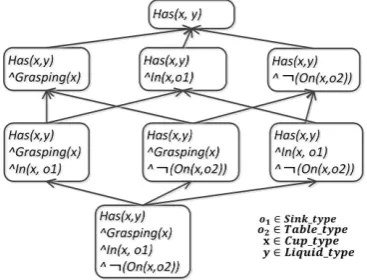
demonstrated primitive actions. Given the verb phraseboil the water(i.e.,Li), the human teaches the robot how to accomplish the corresponding ac-tion based on a sequence of primitive acac-tions−A→i. By comparing the final environment Ei0 with the initial environment Ei, the robot is able to iden-tify the state change of the environment, which be-comes a hypothesis of goal state to represent verb semantics. Compared to procedure-based repre-sentations, the state-based representation supports automated planning at the execution time. It is environment-independent and more generalizable. In (She and Chai, 2016), instead of one hypoth-esis, it maintains a specific-to-general hypothesis space as shown in Figure2to capture all goal hy-potheses of a particular verb frame. Specifically, it assumes that one verb frame may lead to differ-ent outcomes under differdiffer-ent environmdiffer-ents, where each possible outcome is represented by one node in the hierarchical graph and each node is a con-junction of multiple atomic fluents. 1
Given a language command (i.e., a verb phrase), a robot will engage in the following processes:
• Execution.In this process, the robot will se-lect a hypothesis from the space of hypothe-ses that is most relevant to the current situa-tion and use the corresponding goal state to plan for actions to execute.
• Learning. When the robot fails to select
a hypothesis or fails to execute the action, it will ask the human for a demonstration. 1In this work, we assume the set of atomic fluents rep-resenting environment state are given and do not address the question of whether these predicates are adequate to represent a domain.
Figure 2: An example hypothesis space for the verb framef ill(x, y).
Based on the demonstrated actions, the robot will learn a new representation (i.e., new nodes) and update the hypothesis space.
3.2 Noisy Environment
Figure 3: An example probabilistic sensing result.
Previous works represent the environmentEi as a conjunction of grounded state fluents. Each flu-ent consists of a predicate and one or more argu-ments (i.e., objects in the physical world, or ob-ject status), representing one aspect of the per-ceived environment. An example of a fluent is
“Has(Kettle1, W AT ER)” meaning object Kettle1
has some water inside, where Has is the
predi-cate, andKettle1andW AT ERare arguments. The set of fluents include the status of the robot (e.g.,
Grasping(Kettle1)), the status of different objects
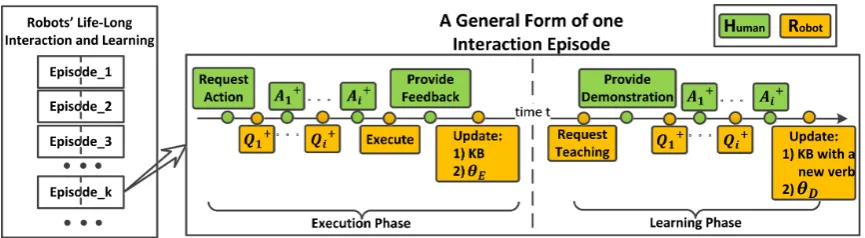
[image:3.595.324.508.214.354.2]envi-Figure 4: A general framework of robot interactive learning. KB stands for knowledge base,θE stands for Interaction Strategy for Execution, andθD stands for Interaction Strategy for Learning.
Only demonstration(She and Chai,2016) Interactive learning (this work)
Execution Example Execution Example
H1: Boil the water. H1: Boil the water.
R1: (select a hypothesis and execute the action accordingly) R1: I see a silver object on the table, is that a pot? H2: (provide true/false feedback on whether the execution is H2: Yes.
correct) R2: Should I leave the pot on the stove after boil? H3: Yes.
R3: Ok. (select a hypothesis to execute) H4: Thank you.
Learning Example Learning Example
H3: Boil the water. H5: Boil the water.
R3: I don’t know how to boil, could you show me an example? R5: I don’t know how to boil, could you show me an example? H4: (human shows the robot how to achieve the corresponding
action through a sequence of primitive actions) H6: Ok. (heat pad) demonstrate the task, at the end put the pot on a R4: (indicate the acceptance and induce a hypothesis to rep- R6: So after boiling something, should I put it on a heat pad? resent verb semantics) H7: No, you don’t have to.
[image:4.595.83.516.61.180.2]R7: I see. (induce goal state hypothesis)
Table 1: Examples to show differences between learning through demonstrations as in the previous works (She and Chai,2016) and the proposed learning from interaction.
ronment has a perfect, deterministic representa-tion, as shown in Figure1. This is clearly not the case in the realistic physical world.
In reality, given limitations of sensor capabili-ties, the environment representation is often par-tial, error prone, and full of uncertainties. Figure3 shows an example of a more realistic representa-tion where each fluent comes with a confidence between 0 and 1 to indicate how likely that par-ticular fluent can be detected in the current envi-ronment. Thus, it is unclear whether the previous work is able to handle representations with uncer-tainties. Our interactive learning approach aims to address these uncertainties through interactive question answering with human partners.
4 Interactive Learning
4.1 Framework of Interactive Learning
Figure4 shows a general framework for interac-tive learning of action verbs. It aims to support a life-long learning cycle for robots, where the robot can continuously (1) engage in collaboration and
communication with humans based on its exist-ing knowledge; (2) acquire new verbs by learn-ing from humans and experienclearn-ing the change of the world (i.e., grounded verb semantics as in this work); and (3) learn how to interact (i.e., update interaction policies). The lifelong learning cycle is composed by a sequence of interactive learn-ing episodes (Episode 1, 2...) where each episode consists of either an execution phase or a learning phase or both.
The execution phase starts with a human request for action (e.g.,boil the water). According to its interaction policy, the robotic agent may choose to ask one or more questions (i.e.,Q+i ) and wait for
human answers (i.e., A+i ), or select a hypothesis
from its existing knowledge base to execute the command (i.e., Execute). With the human feed-back of the execution, the robot can update its in-teraction policy and existing knowledge.
[image:4.595.72.520.229.407.2]the robotic agent can either choose to update its knowledge if it feels confident, or it can choose to ask the human one or more questions before up-dating its knowledge.
4.2 Examples of Interactive Learning
Table1illustrates the differences between the pre-vious approach that acquires verb models based solely on demonstrations and our current work that acquires models based on interactive learning. As shown in Table1, under thedemonstrationsetting, humans only provide a demonstration of primitive actions and there’s no interactive question answer-ing. In theinteractive learningsetting, the robot can proactively choose to ask questions regard-ing the uncertainties either about the environment (e.g., R1), the goal (e.g., R2), or the demonstra-tions (e.g., R6). Our hypothesis is that rich inter-actions based on question answering will allow the robot to learn more reliable models for grounded verb semantics, especially in a noisy environment. Then the question is how to manage such inter-action: when to ask and what questions to ask to most efficiently acquire reliable models and apply them in execution. Next we describe the appli-cation of reinforcement learning to manage inter-active question answering for both the execution phase and the learning phase.
4.3 Formulation of Interactive Learning
Markov Decision Process (MDP) and its closely related Reinforcement Learning (RL) have been applied to sequential decision-making problems in dynamic domains with uncertainties, e.g., dialogue/interaction management (Singh et al., 2002; Paek and Pieraccini, 2008; Williams and Zweig, 2016), mapping language commands to actions (Branavan et al., 2009), interactive robot learning (Knox and Stone,2011), and interactive information retrieval (Li et al.,2017). In this work, we formulate the choice of when to ask what ques-tions during interaction as a sequential decision-making problem and apply reinforcement learning to acquire an optimal policy to manage interaction. Specifically, each of the execution and learning phases is governed by one policy (i.e.,θE andθD), which is updated by the reinforcement learning al-gorithm. The use of RL intends to obtain opti-mal policies that can lead to the highest long-term reward by balancing the cost of interaction (e.g., the length of interaction and difficulties of ques-tions) and the quality of the acquired models. The
reinforcement formulation for both the execution phase and the learning phase are described below.
State For the execution phase, each statese ∈
SE is a five tuple: se = <l, e, KB, Grd, Goal>.
l is a language command, including a verb and multiple noun phrases extracted by the Stan-ford parser. For example, the command “ Mi-crowave the ramen” is represented as l = microwave(ramen). The environment e is a
probabilistic representation of the currently per-ceived physical world, consisting of a set of grounded fluents and the confidence of perceiv-ing each fluent (an example is shown in Figure3).
KB stands for the existing knowledge of verb models. Grdaccounts for the agent’s current
be-lief of object grounding: the probability of each noun in thelbeing grounded to different objects.
Goalrepresents the agent’s belief of different goal
state hypotheses of the current command. Within one interaction episode, command l and
knowl-edge KB will stay the same, whilee, Grd, and Goal may change accordingly due to interactive
question answering and robot actions. In the ex-ecution phase,GrdandGoal are initialized with
existing knowledge of learned verb models. For the learning phase, a statesd ∈ SD is a four tu-ple: sd = <l, estart, eend, Grd>. estartandeend stands for the environment before the demonstra-tion and after the demonstrademonstra-tion.
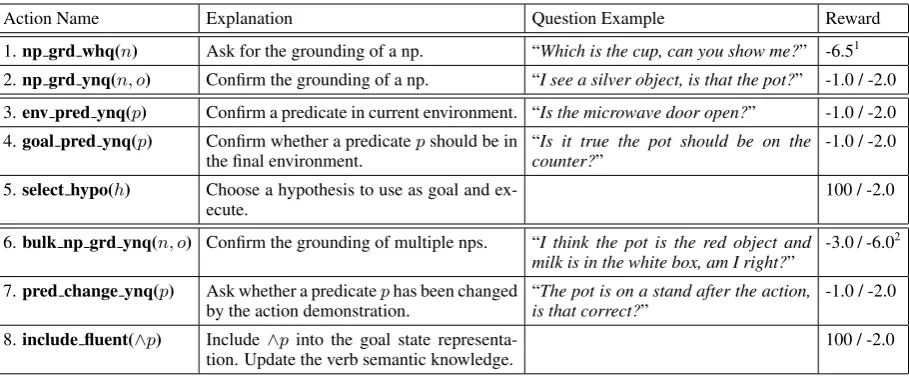
Action Motivated by previous studies on how humans ask questions while learning new skills (Cakmak and Thomaz, 2012), the agent’s question set includes two categories: yes/no ques-tions and wh- quesques-tions. These quesques-tions are designed to address ambiguities in noun phrase grounding, uncertain environment sensing, and goal states. They are domain independent in nature. For example, one of the questions is np grd ynq(n, o). It is a yes/no question asking
whether the noun phrase n refers to an object o
(e.g., “I see a silver object, is that the pot?”). Other questions are env pred ynq(p) (i.e., whether
a fluentp is present in the environment; e.g., “Is the microwave door open?”) and goal pred ynq(p)
(i.e., whether a predicate pshould be part of the
hy-Action Name Explanation Question Example Reward 1.np grd whq(n) Ask for the grounding of a np. “Which is the cup, can you show me?” -6.51 2.np grd ynq(n, o) Confirm the grounding of a np. “I see a silver object, is that the pot?” -1.0 / -2.0 3.env pred ynq(p) Confirm a predicate in current environment. “Is the microwave door open?” -1.0 / -2.0 4.goal pred ynq(p) Confirm whether a predicatepshould be in
the final environment. “counter?Is it true the pot should be on the” -1.0 / -2.0 5.select hypo(h) Choose a hypothesis to use as goal and
ex-ecute. 100 / -2.0
6.bulk np grd ynq(n, o) Confirm the grounding of multiple nps. “I think the pot is the red object and
milk is in the white box, am I right?” -3.0 / -6.0 2
7.pred change ynq(p) Ask whether a predicatephas been changed
by the action demonstration. “is that correct?The pot is on a stand after the action,” -1.0 / -2.0 8.include fluent(∧p) Include ∧pinto the goal state
[image:6.595.74.529.61.249.2]representa-tion. Update the verb semantic knowledge. 100 / -2.0 Table 2: The action space for reinforcement learning, wheren stands for a noun phrase, oa physical object,pa fluent representation of the current state of the world,ha goal hypothesis. Action 1 and 2 are
shared by both the execution and learning phases. Action 3, 4, 5 are for the execution phase, and 6, 7, 8 are only used for the learning phase. -1.0/-2.0 are typically used for yes/no questions. When the human answers the question with a “yes”, the reward is -1.0, otherwise it’s -2.0.
pothesis that best describes the current situation. For the learning phase, the include fluent(∧p)
ac-tion forms a goal hypothesis by conjoining a set of fluentsps where eachpshould have high
probabil-ity of being part of the goal.
Transition The transition function takes action
ain states, and gives the next states0 according to human feedback. Note that the commandldoes
not change during interaction. But the agent’s be-lief of environmente, object groundingGrd, and goal hypothesesGoalis changed according to the
questions and human answers. For example, sup-pose the agent asks whether noun phrasenrefers to the objecto, if the human confirms it, the
prob-ability ofnbeing grounded toobecomes 1.0,
oth-erwise it will become 0.0.
Reward Finding a good reward function is a hard problem in reinforcement learning. Our cur-rent approach has followed the general practice in the spoken dialogue community (Schatzmann et al., 2006; Fang et al., 2014; Su et al., 2016). The immediate robot questions are assigned small costs to favor shorter and more efficient interac-tion. Furthermore, motivated by how humans ask
1According to the study in (Cakmak and Thomaz,2012), the frequency of y/n questions used by humans is about 6.5 times the frequency of open questions (wh question), which motivates our assignment of -6.5 to wh questions.
2bulk np grd ynq asks multiple object grounding all at once. This is harder to answer than asking for a single np. Therefore, its cost is assigned three times of the other yes/no questions.
Algorithm 1: Policy learning. The execution and learning phases share the same learning process, but with different states, actionaspaces, and feature vectorsφ. Theeendis only available to the learning phase.
Input :e,l(,eend); Feature functionφ;
Old policyθ(i.e., a weight vector)
Verb Goal States HypothesesH; Initialize : statesinitialized withe,l(,eend);
first actiona∼P(a|s;θ)withgreedy
1 whilesis not terminaldo
2 Take actiona, receive rewardr;
3 s0=T(s, a);
4 Choosea0∼P(a0|s0;θ)withgreedy;
δ←r+γ·θT·φ(s0, a0)−θT·φ(s, a);
5 θ←θ+δ·η·φ(s, a);
6 end
7 ifs terminates with positive feedbackthen 8 UpdateH;
9 end
Output : UpdatedHandθ.
questions (Cakmak and Thomaz, 2012), yes/no questions are easier for a human to answer than the open questions (e.g., wh-questions) and thus are given smaller costs. A large positive reward is given at the end of interaction when the task is completed successfully. Detailed reward assign-ment for different actions are shown in Table2.
cu-Features shared by both phases Ifais a np grd whq(n).
The entropy of candidate groundings ofn. Ifnhas more than 4 grounding candidates. Ifais a np grd ynq(n, o).
The probability ofngrounded too.
Additional Features specific for the Execution phase Ifais a select hypo(h) action.
The probability of hypohnot satisfied in current
envi-ronment.
Similarity between thens used by commandland the
commands from previous experiences.
Additional Features specific for the Learning phase Ifais a pred change ynq(p).
The probability ofpbeen changed by demo.
Table 3: Example features used by the two phases.
astands for action. Other notations are the same
as used in Table2. The“If” features are binary, and the other features are real-valued.
mulative reward of taking action a in a state s).
This value function is approximated by a linear functionQ(s, a) = θ|·φ(s, a), whereφ(s, a)is
a feature vector andθis a weight updated during
training. Details of the algorithm is shown in Al-gorithm1. During testing, the agent can take an actionathat maximizes theQvalue at a states.
Feature Example features used by the two phases are listed in Table 3. These features in-tend to capture different dimensions of informa-tion such as specific types of quesinforma-tions, how well noun phrases are grounded to the environment, un-certainties of the environment, and consistencies between a hypothesis and the current environment.
5 Evaluation
5.1 Experiment Setup
Dataset. To evaluate our approach, we utilized the benchmark made available by (Misra et al., 2015). Individual language commands and corre-sponding action sequences are extracted similarly as (She and Chai, 2016). This dataset includes common tasks in the kitchen and living room do-mains, where each data instance comes with a lan-guage command (e.g., “boil the water”, “throw the beer into the trashcan”) and the correspond-ing sequence of primitive actions. In total, there are 979 instances, including 75 different verbs and 215 different noun phrases. The length of primi-tive action sequences range from 1 to 51 with an average of 4.82 (+/-4.8). We divided the dataset into three groups: (1) 200 data instances were used by reinforcement learning to acquire optimal
inter-action policies; (2) 600 data instances were used by different approaches (i.e., previous approaches and our interactive learning approach) to acquire grounded verb semantics models; and (3) 179 data instances were used as testing data to evaluate the learned verb models. The performance on apply-ing the learned models to execute actions for the testing data is reported.
To learn interaction policies, a simulated human model is created from the dataset (Schatzmann et al., 2006) to continuously interact with the robot learner3. This simulated user can answer
the robot’s different types of questions and make decisions on whether the robot’s execution is correct. During policy learning, one data instance can be used multiple times. At each time, the in-teraction sequence is different due toexploitation and explorationin RL in selecting the next action. The RL discount factorγ is set to 0.99, thein
-greedy is 0.1, and the learning rate is 0.01.
Noisy Environment Representation. The origi-nal data provided by (Misra et al.,2015) is based on the assumption that environment sensing is per-fect and deterministic. To enable incomplete and noisy environment representation, for each fluent (e.g., grasping(Cup3), near(robot1, Cup3)) in
the original data, we independently sampled a con-fidence value to simulate the likelihood that a par-ticular fluent can be detected correctly from the environment. We applied the following four dif-ferent variations in sampling the confidence val-ues, which correspond to different levels of sensor reliability.
(1) PerfectEnvrepresents the most reliable sensor. If a fluent is true in the original data, its sampled confidence is 1, and 0 otherwise.
(2) NormStd3represents a relatively reliable sen-sor. For each fluent in the original environment, a confidence is sampled according to a normal dis-tribution N(1,0.32) with an interval [0,1]. This
distribution has a large probability of sampling a number larger than 0.5, meaning the correspond-ing fluent is still more likely to be true.
(3) NormStd5 represents a less reliable sensor. The sampling distribution is N(1,0.52), which
has a larger probability of generating a number smaller than 0.5 compared toNormStd3.
(4) UniEnvrepresents an unreliable sensor. Each number is sampled with a uniform distribution be-tween 0 and 1. This means the sensor works ran-domly. A fluent has a equal change to be true or false no matter what the true environment is.
Evaluation Metrics. We used the same evalua-tion metrics as in the previous works (Misra et al., 2015;She and Chai,2016) to evaluate the perfor-mance of applying the learned models to testing instances on action planning.
• IED: Instruction Editing Distance. This is a
number between 0 and 1 measuring the sim-ilarity between the predicted action sequence and the ground-truth action sequence. IED
equals 1 if the two sequences are exactly the same.
• SJI: State Jaccard Index. This is a
num-ber between 0 and 1 measuring the similarity between the predicted and the ground-truth state changes.SJIequals 1 if action planning leads to exactly the same state change as in the ground-truth.
Configurations.To understand the role of interac-tive learning in model acquisition and action plan-ning, we first compared the interactive learning ap-proach with the previous leading apap-proach (pre-sented asShe16). To further evaluate the interac-tion policies acquired by reinforcement learning, we also compared the learned policy (i.e., RLPol-icy) with the following two baseline policies:
• RandomPolicywhich randomly selects ques-tions to ask during interaction.
• ManualPolicy which continuously asks for yes/no confirmations (i.e., object grounding questions (GroundQ), environment
ques-tions (EnvQ), goal prediction questions
(GoalQ)) until there’s no more questions
be-fore making a decision on model acquisition or action execution.
5.2 Results
5.2.1 The Effect of Interactive Learning
Table4shows the performance comparison on the testing data between the previous approachShe16
and our interactive learning approach based on en-vironment representations with different levels of noise. The verb models acquired by interactive learning perform better consistently across all four
She16 RL policy % improvement IED SJI IED SJI IED SJI PerfectEnv 0.430 0.426 0.453 0.468 5.3%∗ 9.9%∗
NormStd3 0.284 0.273 0.420 0.431 47.9%∗ 57.9%∗
NormStd5 0.172 0.168 0.392 0.411 127.9%∗ 144.6%∗
[image:8.595.308.515.248.406.2]UniEnv 0.168 0.163 0.332 0.347 97.6%∗ 112.9%∗
Table 4: Performance comparison betweenShe16
and our interactive learning based on environment representations with different levels of noise. All the improvements (marked *) are statistically sig-nificant (p <0.01).
0 100 200 300 400 500 600
Number of data used to acquire verb models in learning phase 0.00
0.05 0.10 0.15 0.20 0.25 0.30 0.35 0.40 0.45
Performance in action planning (SJI)
RL policy Manual policy Random policy She16
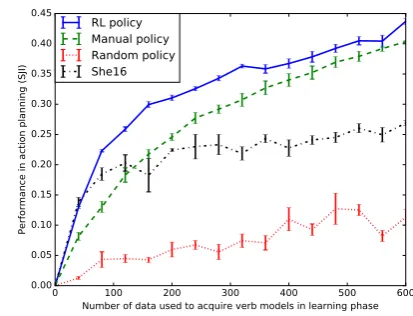
Figure 5: Performance (SJI) comparison by
ap-plying models acquired based on different interac-tion policies to the testing data.
environment conditions. When the environment becomes noisy (i.e., NormStd3, NormStd5, and
UniEnv), the performance ofShe16that only relies on demonstrations decreases significantly. While the interactive learning improves the performance under the perfect environment condition, its effect in noisy environment is more remarkable. It leads to a significant performance gain between 48% and 145%. These results validate our hypothe-sis that interactive question answering can help to alleviate the problem of uncertainties in environ-ment representation and goal prediction.
Man-Average number of questions Performance
Learning Phase Execution Phase
GroundQ EnvQ TotalQ GroundQ EnvQ GoalQ TotalQ IED SJI
RLPolicy 2.130∗ 2.615∗ 4.746∗ 0.383∗ 0.650∗ 2.626 3.665∗ 0.420 0.430∗ +/-0.231 +/-0.317 +/-0.307 +/-0.137 +/-0.366 +/-0.331 +/-0.469 +/-0.015 +/-0.018 ManualPolicy 2.495 5.338 7.833 1.236 3.202 2.353 6.792 0.406 0.404
+/-0.025 +/-0.008 +/-0.025 +/-0.002 +/-0.012 +/-0.023 +/-0.025 +/-0.002 +/-0.004 RandomPolicy 0.545 0.368 0.913 0.678 0.081 0.151 0.909 0.114 0.113
[image:9.595.80.521.62.176.2]+/-0.016 +/-0.033 +/-0.040 +/-0.055 +/-0.030 +/-0.024 +/-0.018 +/-0.025 +/-0.029 Table 5: Comparison between different policies including the average number (and standard deviation) of different types of questions asked during the execution phase and the learning phase respectively, and the performance on action planning for the testing data. The results are based on the noisy environment sampled by NormStd3. * indicates statistically significant difference (p < 0.05) comparing RLPolicy
withManualPolicy.
ualPolicy results in much longer interaction (i.e., more questions) than the RL acquired policy.
5.2.2 Comparison of Interaction Policies
Table5compares the performance of different in-teraction policies. It shows the average number of questions asked under different policies. It is not surprising theRandomPolicyhas the worst perfor-mance. For theManualPolicy, its performance is similar to theRLPolicy. However, the average in-teraction length of ManualPolicy is 6.792, which is much longer than theRLPolicy(which is 3.127). These results further demonstrate that the policy learned from RL enables efficient interactions and the acquisition of more reliable verb models.
6 Conclusion
Robots live in a noisy environment. Due to the limitations in their external sensors, their repre-sentations of the shared environment can be er-ror prone and full of uncertainties. As shown in previous work (Mour˜ao et al.,2012), learning ac-tion models from the noisy and incomplete obser-vation of the world is extremely challenging. The same problem applies to the acquisition of verb se-mantics that are grounded to the perceived world. To address this problem, this paper presents an interactive learning approach which aims to han-dle uncertainties of the environment as well as in-completeness and conflicts in state representation by asking human partners intelligent questions. The interaction strategies are learned through re-inforcement learning. Our empirical results have shown a significant improvement in model acqui-sition and action prediction. When applying the learned models in new situations, the models
ac-quired through interactive learning leads to over 140% performance gain in noisy environment.
The current investigation also has several lim-itations. As in previous works, we assume the world can be described by a closed set of predi-cates. This causes significant simplification for the physical world. One of the important questions to address in the future is how to learn new predicates through interaction with humans. Another limita-tion is that the current utility funclimita-tion is learned based on a set of pre-identified features. Future work can explore deep neural network to alleviate feature engineering.
As cognitive robots start to enter our daily lives, data-driven approaches to learning may not be possible in new situations. Human partners who work side-by-side with these cognitive robots are great resources that the robots can directly learn from. Recent years have seen an increasing amount of work on task learning from human part-ners (Saunders et al.,2006;Chernova and Veloso, 2008; Cantrell et al., 2012; Mohan et al., 2013; Asada et al., 2009; Mohseni-Kabir et al., 2015; Nejati et al., 2006;Liu et al., 2016). Our future work will incorporate interactive learning of verb semantics with task learning to enable autonomy that can learn by communicating with humans.
Acknowledgments
References
Yoav Artzi and Luke Zettlemoyer. 2013. Weakly su-pervised learning of semantic parsers for mapping instructions to actions. Transactions of the Associa-tion for ComputaAssocia-tional LinguisticsVolume1(1):49– 62.
Minoru Asada, Koh Hosoda, Yasuo Kuniyoshi, Hiroshi Ishiguro, Toshio Inui, Yuichiro Yoshikawa, Masaki Ogino, and Chisato Yoshida. 2009. Cognitive devel-opmental robotics: A survey. IEEE Transactions on Autonomous Mental Development1(1):12–34. S. R. K. Branavan, Harr Chen, Luke S. Zettlemoyer,
and Regina Barzilay. 2009. Reinforcement learn-ing for mapplearn-ing instructions to actions. In Pro-ceedings of the Joint Conference of the 47th Annual Meeting of the ACL and the 4th International Joint Conference on Natural Language Processing of the AFNLP: Volume 1 - Volume 1. Association for Com-putational Linguistics, Stroudsburg, PA, USA, ACL ’09, pages 82–90.
John D. Bransford, Ann L. Brown, and Rodney R. Cocking. 2000. How People Learn: Brain, Mind, Experience, and School: Expanded Edition. Na-tional Academy Press., Washington, DC.
Maya Cakmak and Andrea L. Thomaz. 2012. De-signing robot learners that ask good questions. In Proceedings of the 7th Annual ACM/IEEE Inter-national Conference on Human-Robot Interaction. ACM, New York, NY, USA, HRI ’12, pages 17–24.
R. Cantrell, K. Talamadupula, P. Schermerhorn, J. Ben-ton, S. Kambhampati, and M. Scheutz. 2012. Tell me when and why to do it! run-time planner model updates via natural language instruction. In Proceedings of the 7th Annual ACM/IEEE Inter-national Conference on Human-Robot Interaction. ACM, New York, NY, USA, HRI ’12, pages 471– 478.
Sonia Chernova and Manuela Veloso. 2008. Teach-ing multi-robot coordination usTeach-ing demonstration of communication and state sharing. In Proceed-ings of the 7th international joint conference on Autonomous agents and multiagent systems-Volume 3. International Foundation for Autonomous Agents and Multiagent Systems, pages 1183–1186.
Rui Fang, Malcolm Doering, and Joyce Y. Chai. 2014. Collaborative models for referring expression gen-eration in situated dialogue. In Proceedings of the 28th AAAI Conference on Artificial Intelligence. AAAI Press, AAAI’14, pages 1544–1550.
Qiaozi Gao, Malcolm Doering, Shaohua Yang, and Joyce Y. Chai. 2016. Physical causality of action verbs in grounded language understanding. InACL (1). The Association for Computer Linguistics.
P. Gorniak and D. Roy. 2007. Situated language under-standing as filtering perceived affordances. In Cog-nitive Science, volume 31(2), pages 197–231.
Joohyun Kim and Raymond J. Mooney. 2012. Un-supervised pcfg induction for grounded language learning with highly ambiguous supervision. In Pro-ceedings of the Conference on Empirical Methods in Natural Language Processing and Natural Lan-guage Learning (EMNLP-CoNLL ’12). Jeju Island, Korea, pages 433–444.
W. Bradley Knox and Peter Stone. 2011. Under-standing human teaching modalities in reinforce-ment learning environreinforce-ments: A preliminary report. InIJCAI 2011 Workshop on Agents Learning Inter-actively from Human Teachers (ALIHT).
Jiwei Li, Alexander H. Miller, Sumit Chopra, Marc’Aurelio Ranzato, and Jason Weston. 2017. Learning through dialogue interactions. InICLR. Changsong Liu and Joyce Y. Chai. 2015. Learning to
mediate perceptual differences in situated human-robot dialogue. InProceedings of the Twenty-Ninth AAAI Conference on Artificial Intelligence. AAAI Press, AAAI’15, pages 2288–2294.
Changsong Liu, Lanbo She, Rui Fang, and Joyce Y. Chai. 2014. Probabilistic labeling for efficient ref-erential grounding based on collaborative discourse. In Proceedings of the 52nd Annual Meeting of the Association for Computational Linguistics. Associ-ation for ComputAssoci-ational Linguistics, pages 13–18. Changsong Liu, Shaohua Yang, Sari Saba-Sadiya,
Nis-hant Shukla, Yunzhong He, Song-chun Zhu, and Joyce Y. Chai. 2016. Jointly learning grounded task structures from language instruction and visual demonstration. In Proceedings of the 2016 Con-ference on Empirical Methods in Natural Language Processing. Association for Computational Linguis-tics, Austin, Texas, pages 1482–1492.
Cynthia Matuszek, Nicholas Fitzgerald, Luke Zettle-moyer, Liefeng Bo, and Dieter Fox. 2012a. A joint model of language and perception for grounded attribute learning. In John Langford and Joelle Pineau, editors, Proceedings of the 29th Interna-tional Conference on Machine Learning (ICML-12). ACM, New York, NY, USA, pages 1671–1678. Cynthia Matuszek, Evan Herbst, Luke S. Zettlemoyer,
and Dieter Fox. 2012b. Learning to parse nat-ural language commands to a robot control sys-tem. In Jaydev P. Desai, Gregory Dudek, Oussama Khatib, and Vijay Kumar, editors, ISER. Springer, volume 88 ofSpringer Tracts in Advanced Robotics, pages 403–415.
Dipendra K Misra, Jaeyong Sung, Kevin Lee, and Ashutosh Saxena. 2014. Tell me dave: Context-sensitive grounding of natural language to manipula-tion instrucmanipula-tions. Proceedings of Robotics: Science and Systems (RSS), Berkeley, USA.
7th International Joint Conference on Natural Lan-guage Processing (Volume 1: Long Papers). Associ-ation for ComputAssoci-ational Linguistics, Beijing, China, pages 992–1002.
Shiwali Mohan, James Kirk, and John Laird. 2013. A computational model for situated task learning with interactive instruction. In Proceedings of ICCM 2013 - 12th International Conference on Cognitive Modeling.
Anahita Mohseni-Kabir, Charles Rich, Sonia Cher-nova, Candace L. Sidner, and Daniel Miller. 2015. Interactive hierarchical task learning from a single demonstration. InProceedings of the Tenth Annual ACM/IEEE International Conference on Human-Robot Interaction. ACM, HRI ’15, pages 205–212.
Kira Mour˜ao, Luke S. Zettlemoyer, Ronald P. A. Pet-rick, and Mark Steedman. 2012. Learning STRIPS operators from noisy and incomplete observations. InProceedings of the Twenty-Eighth Conference on Uncertainty in Artificial Intelligence. Catalina Is-land, CA, USA, pages 614–623.
Negin Nejati, Pat Langley, and Tolga Konik. 2006. Learning hierarchical task networks by observation. InProceedings of the 23rd international conference on Machine learning. ACM, pages 665–672.
Tim Paek and Roberto Pieraccini. 2008. Automating spoken dialogue management design using machine learning: An industry perspective. Speech Commu-nication50(8-9):716–729.
Joe Saunders, Chrystopher L Nehaniv, and Kerstin Dautenhahn. 2006. Teaching robots by moulding behavior and scaffolding the environment. In Pro-ceedings of the 1st ACM SIGCHI/SIGART confer-ence on Human-robot interaction. ACM, pages 118– 125.
Jost Schatzmann, Karl Weilhammer, Matt Stuttle, and Steve Young. 2006. A survey of statistical user sim-ulation techniques for reinforcement-learning of di-alogue management strategies. Knowl. Eng. Rev. 21(2):97–126.
Lanbo She and Joyce Y. Chai. 2016. Incremental ac-quisition of verb hypothesis space towards physical world interaction. In Proceedings of the 54th An-nual Meeting of the Association for Computational Linguistics, ACL 2016, August 7-12, 2016, Berlin, Germany, Volume 1: Long Papers.
Lanbo She, Shaohua Yang, Yu Cheng, Yunyi Jia, Joyce Y. Chai, and Ning Xi. 2014. Back to the blocks world: Learning new actions through situ-ated human-robot dialogue. In Proceedings of the SIGDIAL 2014 Conference, The 15th Annual Meet-ing of the Special Interest Group on Discourse and Dialogue, 18-20 June 2014, Philadelphia, PA, USA. pages 89–97.
Satinder Singh, Diane Litman, Michael Kearns, and Marilyn Walker. 2002. Optimizing dialogue man-agement with reinforcement learning: Experiments with the njfun system. Journal of Artificial Intelli-gence Research16:105–133.
Pei-Hao Su, Milica Gasic, Nikola Mrkˇsi´c, Lina M. Ro-jas Barahona, Stefan Ultes, David Vandyke, Tsung-Hsien Wen, and Steve Young. 2016. On-line active reward learning for policy optimisation in spoken di-alogue systems. InProceedings of the 54th Annual Meeting of the Association for Computational Lin-guistics (Volume 1: Long Papers). Association for Computational Linguistics, Berlin, Germany, pages 2431–2441.
Richard S. Sutton and Andrew G. Barto. 1998. In-troduction to Reinforcement Learning. MIT Press, Cambridge, MA, USA, 1st edition.
Stefanie Tellex, Pratiksha Thaker, Joshua Joseph, and Nicholas Roy. 2014. Learning perceptually grounded word meanings from unaligned parallel data.Machine Learning94(2):151–167.
Jesse Thomason, Jivko Sinapov, Maxwell Svetlik, Pe-ter Stone, and Raymond J. Mooney. 2016. Learning multi-modal grounded linguistic semantics by play-ing ”i spy”. InProceedings of the 25th International Joint Conference on Artificial Intelligence (IJCAI-16). New York City, pages 3477–3483.
Jesse Thomason, Shiqi Zhang, Raymond Mooney, and Peter Stone. 2015. Learning to interpret natural lan-guage commands through human-robot dialog. In Proceedings of the 24th International Joint Confer-ence on Artificial IntelligConfer-ence (IJCAI). pages 1923– 1929.
Jason D Williams and Geoffrey Zweig. 2016. End-to-end lstm-based dialog control optimized with su-pervised and reinforcement learning. arXiv preprint arXiv:1606.01269.