2017, Volume 4, e3527 ISSN Online: 2333-9721 ISSN Print: 2333-9705
DOI: 10.4236/oalib.1103527 Nov. 10, 2017 1 Open Access Library Journal
Impact of Different Methods of Soil Sampling
and DNA Extraction on the Identification of Soil
Bacterial Abundance under Elevated CO
2
Fengxia Li
1,2, Saman Bowatte
1, Paul C. D. Newton
1, Dongwen Luo
11Agresearch Grasslands, Palmerston North, New Zealand
2Agriculture Resource and Environment Institute of Ningxia Academy of Agriculture and Forestry Science, Yinchuan, China
Abstract
Elevated atmospheric CO2 (eCO2) is anticipated to have marked effects on soil
microbial populations. While there is experimental evidence to support this view there are also studies where changes in microbial populations, such as the abundance of bacteria, are suggested but cannot be statistically estab-lished. We conducted this study to identify whether the sampling and sample treatment methods used could influence the results obtained using bacterial abundance as the variable of interest. We tested three different sampling me-thods and two different DNA extraction kits. The first because microbes are distributed heterogeneously in soil so the sampling procedure might be ex-pected to influence the accuracy and precision of the population estimate and the second because the quantity and quality of DNA extracted influences the microbial analyses that can be performed and can introduce bias. Samples were taken from a long-running FACE experiment on grassland from under plants of Agrostis capillaris. We found that bacterial abundance was consis-tently lower under eCO2 but we were only able to establish a statistical
differ-ence where a more intense sampling regime was used and bulking of the soil sample was avoided. A reduction in bacterial abundance is a consistent out-come in eCO2 field experiments but the only other occasion where this
reduc-tion has been found to be significant was also where individual soil cores were analysed rather than the samples being bulked. We conclude that while there is extra work and cost attached to more detailed sampling this approach is highly desirable if we are to make robust conclusions about the impacts of eCO2 on soil microbes.
Subject Areas
Agricultural Science, Soil Science How to cite this paper: Li, F.X., Bowatte,
S., Newton, P.C.D. and Luo, D.W. (2017) Impact of Different Methods of Soil Sampling and DNA Extraction on the Identification of Soil Bacterial Abundance under Elevated CO2. Open Access Library
Journal, 4: e3527.
https://doi.org/10.4236/oalib.1103527
Received: March 15, 2017 Accepted: November 7, 2017 Published: November 10, 2017
Copyright © 2017 by authors and Open Access Library Inc.
This work is licensed under the Creative Commons Attribution International License (CC BY 4.0).
http://creativecommons.org/licenses/by/4.0/
DOI: 10.4236/oalib.1103527 2 Open Access Library Journal
Keywords
DNA Extraction Kit, DNA Yield, DNA Quality, Gene Abundance, Bacterial 16S rRNA, Free Air Carbon Dioxide Enrichment
1. Introduction
There is strong experimental evidence that soil properties are altered by elevated concentrations of atmospheric CO2 (eCO2) [1] [2] [3]. These changes have
impor-tant consequences for agricultural production through issues such as fertiliser use
[4] [5] and the nutritional composition of crops [6], for the function of natural ecosystems including biodiversity and for future concentrations of atmospheric CO2 as soils may act a source or sink for carbon (C) [7] [8]. Changes in soil
proper-ties are primarily a consequence of the activiproper-ties of soil microbes [9] [10] (Schimel and Bennett 2004; Van Der Heijden et al. 2008) which are themselves responding to changes in their environment and resources resulting from plant responses to eCO2
[11] [12] [13] [14] [15]. A full understanding of the likely direction of change in soil properties and the mechanism causing these changes therefore requires an under-standing of microbial population size and activity under eCO2 [16] [14].
Measuring microbial populations is difficult. Two factors that are particularly challenging are a) ensuring that the soil sampling methodology provides an ac-curate estimation of the population given that microbes are frequently distri-buted heterogeneously in soil [17] [18] [19]; and b) ensuring that the method chosen for DNA extraction is appropriate as the choice of method potentially in-fluences the precision and accuracy of the data and thus the statistical inferences that can be drawn about the microbial populations [20] [21] [18] [19]. Table 1
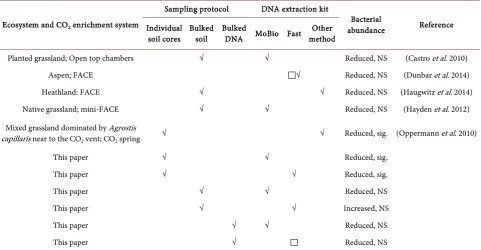
shows examples where ‘differences’ have been observed in bacterial abundance under eCO2 but these effects have not been statistically significant. Additionally
there are costs in both time and materials that may differ between sampling me-thods and have a bearing on the choice of protocol.
In this paper we compare methods for quantifying bacterial populations in a pasture exposed to eCO2 in a long-running Free Air Carbon Dioxide Enrichment
(FACE) experiment on grassland [22]. We took soil samples from under a specific grass species—Agrostis capillaris L.; soil samples from this species have previously been shown to differ in their nitrification potential depending on the atmospheric CO2 concentration so we expected associated changes in bacterial population
ab-undance [11]. We tested three sampling approaches and two methods of DNA ex-traction commonly used in eCO2 experiments [23] [24] [25] [26] [27].
2. Materials and Methods
2.1. New Zealand Free Air Carbon Dioxide Enrichment
Experiment (NZFACE)
DOI: 10.4236/oalib.1103527 3 Open Access Library Journal Table 1. Soil sampling protocol and DNA extraction kit used in field experiments with elevated CO2 and the impact of eCO2 on
bacterial abundance measured as copy number of the 16S rRNA gene and showing whether the result was significant (sig.) or non-significant (NS).
Ecosystem and CO2 enrichment system
Sampling protocol DNA extraction kit
Bacterial
abundance Reference Individual
soil cores Bulked soil Bulked DNA MoBio Fast method Other
Planted grassland; Open top chambers √ √ Reduced, NS (Castro et al. 2010) Aspen; FACE √ Reduced, NS (Dunbar et al. 2014)
Heathland: FACE √ √ Reduced, NS (Haugwitz et al. 2014) Native grassland; mini-FACE √ √ Reduced, NS (Hayden et al. 2012) Mixed grassland dominated by Agrostis
capillaris near to the CO2 vent; CO2 spring √ √ Reduced, sig. (Oppermann et al. 2010)
This paper √ √ Reduced, sig.
This paper √ √ Reduced, sig.
This paper √ √ Reduced, NS
This paper √ √ Increased, NS
This paper √ √ Reduced, NS
This paper √ Reduced, NS
Bulls (40˚14'S, 173˚16'E) in the North Island of New Zealand. The average an-nual temperature at the site is 12.9˚C and average total anan-nual rainfall 870 mm. The experiment consists of six rings of 12 m in diameter with three of these left at ambient CO2 (aCO2) and three enriched with CO2 during the photoperiod,
with enrichment continuous throughout the year. From October 1997 until De-cember 2011 the enrichment was to 475 ppm. The CO2 enrichment was
sus-pended in December 2011 until July 2013 to conduct technical maintenance and then resumed with a target concentration of 500 ppm. From 1997 to 2011 the rings were grazed periodically by adult sheep under a protocol described in Newton et al (2014) [28]; thereafter (from 2013 onwards) the rings were cut with a mower and the clippings removed from the site. In October 2012 an irrigation system was installed and all the rings were irrigated to maintain pasture growth during periods of water deficit (usually December-February).
The pasture is a permanent grassland—uncultivated for at least 50 years— containing a mixture of C3 and C4 grasses, forbs and legumes [29] [28]. C3
grasses are the most abundant group with Agrostis capillaris (browntop), a grass typically found in low-fertility situations [30], one of the dominant species under both ambient CO2 (aCO2) and eCO2 [31].
DOI: 10.4236/oalib.1103527 4 Open Access Library Journal
Details of soil properties and changes over time can be found in [2].
2.2. Soil Sampling
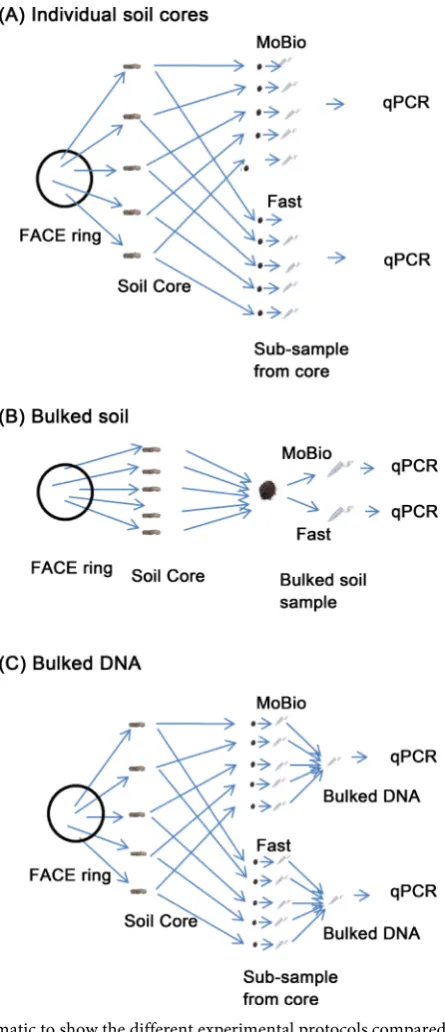
[image:4.595.264.487.200.717.2]In January 2014 soil samples were collected for this experiment. Patches of browntop were identified and soil was sampled from these sites. Soil cores were taken to a depth of 75 mm using a 25 mm diameter steel soil corer. There were five browntop patches in each ring and a core was taken from each patch. Three experimental protocols were then used: first (Figure 1(A)) DNA was extracted
DOI: 10.4236/oalib.1103527 5 Open Access Library Journal
from each of the five cores sampled per ring and qPCR completed on all the samples; second (Figure 1(B)), the five soil cores from each ring were bulked and DNA extracted from this single sample per ring; third (Figure 1(C)) as for the first protocol (A) but the DNA was bulked after extraction giving a single sample per ring for qPCR. Note that in each case n = 3 for the CO2 treatment but
there were five qPCR samples per ring for method A) and one qPCR sample for (B) and (C). Importantly, the three approaches used the same soil cores thus al-lowing a direct comparison of the protocols and extraction kits. The soil samples were stored at −20˚C until DNA extraction. A sub-sample of soil was used to measure soil moisture by oven-drying at 105˚C for 24 h.
2.3. DNA Extraction from the Soil and DNA Quality
and Quantity Assessment
Two DNA extraction kits were evaluated in this study, the FastDNA Spin kit for soil (MP Biomedicals, Solon, OH, USA) (hereafter described as the Fast kit) and the MoBio PowerSoil DNA isolation kit (MO BIO, Carlsbad, CA, USA) (hereaf-ter described as the MoBio kit). All operations were conducted according to the manufactures instructions. DNA was extracted from 0.5 g fresh soil (approx-imately 0.3 g dry soil) for the Fast kit and 0.25 g fresh soil (approx(approx-imately 0.15 g dry soil) for the MoBio kit. The quantity and quality of extracted DNA was as-sessed on the basis of absorbance at 260 and 280 nm using the NanoDrop ND-1000 (NanoDrop, Wilmington, DE, USA). An A260/A280 ratio of 1.8 - 2.0 is indicative of high purity [33] [34]. All extracted DNA was stored at −20˚C un-til required for further analysis.
2.4. Real-Time PCR Analysis
The abundance of the 16S rRNA gene of bacteria was quantified in triplicate by real-time PCR using a LightCyclerTM 480П (Roche, Vienna, Austria). The real time PCR reaction mixture contained 10 µl 10 × SYBR Green iCycler iQ mixture (Roche Applied Science, Germany), 0.2 µl each of the primers Bacteria 968F; AACGCGAAGAACCTTAC and Bacteria 1378R; CGGTGTGTACAAGGCCCG GAACG [35] [36], 5µl diluted soil DNA (1 ng/µl) and 4.6 µl ultra-pure water in a total of 20 µl reaction volume. Standard curves were obtained using serial dilu-tions of a known amount of plasmid DNA containing a fragment of the respec-tive genes. The thermal cycle conditions were 95˚C 10 s, 58˚C 10 s, 72˚C 10 s, 45 cycles. Copy numbers of all gene targets were normalized based on grams of dry soil.
2.5. Statistical Analysis
The effects of atmospheric CO2, sampling protocol and DNA extraction kits
DOI: 10.4236/oalib.1103527 6 Open Access Library Journal
quality (A260/A280 ratio) were tested using the data from individual soil cores. The effect of elevated atmospheric CO2, and sampling protocol on bacterial 16S rRNA gene abundance were conducted separately for the two DNA extraction kits. The mixed effects model used had the CO2 ring nested within block as a
random effect while atmospheric CO2 concentration, sampling protocol and
their interaction were considered as fixed effects. Mean separation was per-formed using Fisher’s LSD test.
3. Results
3.1. The Effect of Different Sampling Extraction Kits on DNA Yield
under Elevated CO
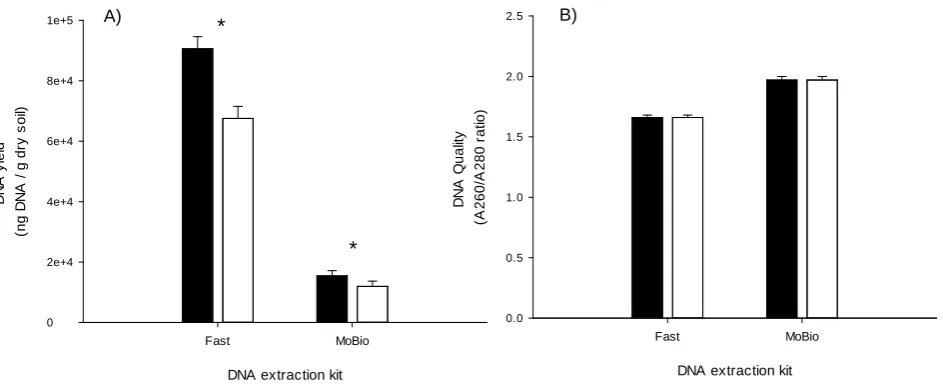
2The DNA yield from the MoBio kit was significantly lower than that from the Fast kit (P < 0.001) (Figure 2(A)). The DNA yield from both kits was signifi-cantly lower in the eCO2 soil and the percentage reduction was similar (22% for
MoBio and 25% for Fast kit) (Figure 2(A)). The DNA extracted from aCO2 and
eCO2 soils was of the same quality (CO2 P = 0.357) but the MoBio kit extracted
significantly (P < 0.001) higher quality DNA than the Fast kit irrespective of the CO2 treatment (Figure 2(B)).
3.2. The Effect of Different Extraction Kits on Bacterial
Abundance under Elevated CO
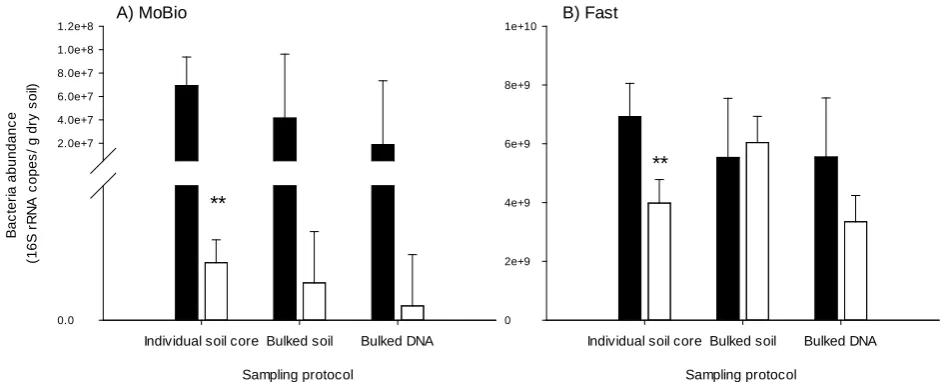
2 [image:6.595.66.538.488.680.2]Comparing the values between Figure 3(A) and Figure 3(B) (note the different scales) shows bacterial abundance measured as 16S rRNA copy number was much lower measured from the DNA extracted from the MoBio kit compared to the DNA from the Fast kit. There was no significant effect (P = 0.722) of the ex-perimental protocol on bacterial abundance measured from the DNA of the MoBio kit (Figure 3(A)); by contrast, a significant difference between the sam-
Figure 2. The (A) yield and (B) quality of DNA extracted from soil samples taken under Agrostis capillaris plants growing under ambient (filled bars) or elevated (open bars) atmospheric CO2 using two DNA extraction kits and soil sampling method (A) from
Figure 1. * denotes significant difference between CO2 treatments using Fisher’s LSD test at the P ≤ 0.05 level.
DNA extraction kit
Fast MoBio DNA y ie ld (ng D N A / g d ry s o il) 0 2e+4 4e+4 6e+4 8e+4 1e+5
*
DNA extraction kit
DOI: 10.4236/oalib.1103527 7 Open Access Library Journal Figure 3. The abundance of bacteria in soil sampled under plants growing at ambient (closed bar) or elevated (open bars) atmos-pheric CO2 measured as copy numbers of the 16S rRNA gene and identified using three experimental protocols and two DNA
extraction kits: (A) MoBio kit, (B) Fast kit. ** denotes significant difference between CO2 treatments using Fisher’s LSD test at the
P ≤ 0.01 level.
pling method was evident when using the Fast kit (P < 0.001) (Figure 3(B)). The DNA from both kits showed soil bacterial abundance at eCO2 was marginally
lower (P = 0.100 MoBio and 0.084 Fast) compared to aCO2. However, only the
individual soil core method was able to detect this difference at a significant level as calculated using Fisher’s LSD at the P ≤ 0.01 level (Figure 3).
4. Discussion
4.1. Effect of Different Methods of Soil Sampling and DNA
Extraction on the Identification of Quantity and Quality
under Elevated CO
2The DNA extraction rates convert to about 7 µg DNA g dry soil-1 for the Fast kit and 2 µg DNA g dry soil-1 for the MoBio kit. These values are higher than those reported byJossi et al. (2006) [16] in another grassland under elevated CO2
where the average values for two perennial grasses were 6.0 and 8.1 µg DNA g fresh soil-1. The amount of DNA extracted was significantly greater using the Fast kit and this kit extracted a significantly greater amount from the aCO2
compared to the eCO2 soil. The greater amount of DNA extracted by the Fast kit
is consistent with much higher 16s rRNA gene copy numbers using this kit. Sim-ilar to our studyVishnivetskaya et al (2014) [38] extracted more DNA using the Fast kit than the MoBio kit from permafrost soils in the Arctic; although in their study both the Fast and MoBio kits extracted high quality DNA (see Table 1 of Vishnivetskaya et al (2014) for comparison of the kits) [38]. The DNA extracted by the MoBio kit in our study was of a higher quality than that extracted using the Fast kit. The quantity and quality of the soil DNA extracted are important for downstream techniques to analyse microbial community structure [39]. Feinstein et al (2009) found that incomplete DNA extraction from soil resulted
A) MoBio B) Fast
Sampling protocol
Individual soil core Bulked soil Bulked DNA
B ac ter ia a b un d an c e (16 S r R N A c o p es / g d ry s o il) 0.0 2.0e+7 4.0e+7 6.0e+7 8.0e+7 1.0e+8 1.2e+8 ** Sampling protocol
Individual soil core Bulked soil Bulked DNA
DOI: 10.4236/oalib.1103527 8 Open Access Library Journal
in biased estimates of ribosomal copy number and bacterial community compo-sition [40]. The quality of DNA characterised by A260/280 ratio is important as it indicates co-extraction of impurities such as humic substances with DNA that can inhibit the activity of polymerase chain reaction [41].
4.2. Effect of Different Methods of Soil Sampling and DNA
Extraction on the Bacterial Abundance and Cost
of the 16S rRNA Gene under Elevated CO
2We found that bacterial abundance measured as copy number of the 16S rRNA gene and showing whether the result was significant or non-significant was more impacted by the soil sampling approach than the DNA extraction kit (Table 1). The soil sampling approach most widely used in CO2 studies is the bulked soil
method providing a single soil sample per FACE ring or OTC; examples where bacterial abundance has been measured are given in Table 1 and there are fur-ther examples where the object was to study bacterial community structure and diversity [42] [16]. The results for bacterial abundance in eCO2 field experiments
shows a consistent reduction in abundance with eCO2; the only exception in the
experiments listed being a slight and non-significant response in one set of measurements in this paper (Figure 3(B)). However, despite the consistent re-sponse across experiments there were only three examples where the bacterial abundance was significantly different between aCO2 and eCO2 and this was
when individual soil cores were studies rather than a bulked sample (Table 1). Using the individual core method meant that in our case 30 samples were re-quired to be analysed compared to 6 for the bulk sampled method. The ap-proximate total cost for single gene abundance (DNA extraction and qPCR) for 30 samples was 5 fold higher than for 6 bulked samples but similar for the two kits. There was also 3 fold increase in technical time required for the individual soil core approach compared to the bulked soil sample approach. Although the cost of analysis of individual soil core approach can be reduced by 1.5 fold by extracting DNA from individual cores and then bulking the DNA for qPCR (method C) in Figure 1) the statistical analysis indicated that this method re-sulted in high variability and ultimately a non-significant difference between treatments although the same trend was observed as with individual soil core method.
5. Conclusions
Three different sampling methods and two different DNA extraction kits tested. The first because microbes are distributed heterogeneously in soil so the sam-pling procedure might be expected to influence the accuracy and precision of the population estimate and the second because the quantity and quality of DNA extracted influences the microbial analyses that can be performed and can in-troduce bias. We found that bacterial abundance was consistently lower under eCO2 but we were only able to establish a statistical difference where a more
DOI: 10.4236/oalib.1103527 9 Open Access Library Journal
reduction in bacterial abundance is a consistent outcome in eCO2 field
experi-ments but the only other occasion where this reduction has been found to be significant was also where individual soil cores were analysed rather than the samples being bulked. We conclude that while there is extra work and cost at-tached to more detailed sampling this approach is highly desirable if we are to make robust conclusions about the impacts of eCO2 on soil microbes.
Our study demonstrated that increasing number of replicates per CO2
treat-ment improves the precision of microbial population estimates and that the ex-tra effort and cost is likely to be a justifiable investment. This aspect of experi-mentation has not received attention in CO2 experiments in the past and our
re-sults highlights that the choice of soil sampling protocol and DNA extraction method needs to be considered carefully if microbial responses to eCO2 are to be
characterised accurately.
Acknowledgements
Research costs were provided by AgResearch. The China Scholarship Council provided a Research Fellowship to Fengxia Li. The authors are grateful to Phil Theobald and Shona Brock for technical assistance.
References
[1] De Graaff, M.-A., Van Groenigen, K.-J., Six, J., Hungate, B. and Van Kessel, C. (2006) Interactions between Plant Growth and Soil Nutrient Cycling under Elevated CO2: A Meta-Analysis. Global Change Biology, 12, 2077-2091.
https://doi.org/10.1111/j.1365-2486.2006.01240.x
[2] Ross, D.J., Newton, P.C.D., Tate, K.R. and Luo, D. (2013) Impact of a Low Level of CO2 Enrichment on Soil Carbon and Nitrogen Pools and Mineralization Rates over
Ten Years in a Seasonally Dry, Grazed Pasture. Soil Biology and Biochemistry, 58, 265-274. https://doi.org/10.1016/j.soilbio.2012.12.011
[3] Sillen, W.M.A. and Dieleman, W.I.J. (2012) Effects of Elevated CO2 and N
Fertiliza-tion on Plant and Soil Carbon Pools of Managed Grasslands: A Meta-Analysis. Bio-geosciences, 9, 2247-2258.
[4] Bloom, J.A., Burger, M., Kimball, B.A. and Pinter Jr., P. (2014) Nitrate Assimilation Is Inhibited by Elevated CO2 in Field-Grown Wheat. Nature Climate Change, 4,
477-480. https://doi.org/10.1038/nclimate2183
[5] Gentile, R., Dodd, M., Lieffering, M., Brock, S.C., Theobald, P.W. and Newton, P.C.D. (2012) Effects of Long-Term Exposure to Enriched CO2 on the
Nu-trient-Supplying Capacity of a Grassland Soil. Biology and Fertility of Soils, 48, 357-362. https://doi.org/10.1007/s00374-011-0616-7
[6] Myers, S.S., et al. (2014) Increasing CO2 Threatens Human Nutrition. Nature, 510,
139-142. https://doi.org/10.1038/nature13179
[7] Reich, P.B. (2009) Elevated CO2 Reduces Losses of Plant Diversity Caused by
nitro-gen Deposition. Science, 326, 1399-1402. https://doi.org/10.1126/science.1178820
DOI: 10.4236/oalib.1103527 10 Open Access Library Journal
[9] Schimel, J.P. and Bennett, J. (2004) Nitrogen Mineralization: Challenges of a Changing Paradigm. Ecology, 85, 591-602.
[10] Van Der Heijden, M.G.A., Bardgett, R.D. and Van Straalen, N.M. (2008) The Un-seen Majority: Soil Microbes as Drivers of Plant Diversity and Productivity in Ter-restrial Ecosystems. Ecology Letters, 11, 296-310.
https://doi.org/10.1111/j.1461-0248.2007.01139.x
[11] Bowatte, S., Newton, P.C.D., Hill, A.M., Theobald, P., Luo, D., Hovenden, M. and Osanai, Y. (2013) Offspring of Plants Exposed to Elevated or Ambient CO2 Differ in
Their Impacts on Soil Nitrification in a Common Garden Experiment. Soil Biology and Biochemistry, 62, 134-136.
[12] Díaz, S., Grime, J.P., Harris, J. and McPherson, E. (1993) Evidence of a Feedback Mechanism Limiting Plant Response to Elevated Carbon Dioxide. Nature, 364, 616-617. https://doi.org/10.1038/364616a0
[13] Hu, S., Tu, C., Chen, X. and Gruver, J.B. (2006) Progressive N Limitation of Plant Response to Elevated CO2: A Microbiological Perspective. Plant and Soil, 289,
47-58. https://doi.org/10.1007/s11104-006-9093-4
[14] Singh, B.K., Bardgett, R.D., Smith, P. and Reay, D.S. (2010) Microorganisms and Climate Change: Terrestrial Feedbacks and Mitigation Options. Nature Reviews Microbiology, 8, 779-790. https://doi.org/10.1038/nrmicro2439
[15] Zak, D.R., Pregitzer, K.S., King, J.S. and Holmes, W.E. (2000) Elevated Atmospheric CO2, Fine Roots and the Response of Soil Microorganisms: A Review and
Hypothe-sis. New Phytologist, 147, 201-222.
https://doi.org/10.1046/j.1469-8137.2000.00687.x
[16] Jossi, M., Fromin, N., Tarnawski, S., Kohler, F., Gillet, F., Aragno, M. and Hamelin, J. (2006) How Elevated pCO2 Modifies Total and Metabolically Active Bacterial Communities in the Rhizosphere of Two Perennial Grasses Grown under Field Conditions. FEMS Microbiology Ecology, 55, 339-350.
https://doi.org/10.1111/j.1574-6941.2005.00040.x
[17] Baker, K.L., Langenheder, S., Nicol, G.W., Ricketts, D., Killham, K., Campbell, C.D. and Prosser, J.I. (2009) Environmental and Spatial Characterisation of Bacterial Community Composition in Soil to Inform Sampling Strategies. Soil Biology and Biochemistry, 41, 2292-2298.
[18] Kirk, J.L., Beaudette, L.A., Hart, M., Moutoglis, P., Klironomos, J.N., Lee, H. and Trevors, J.T. (2004) Methods of Studying Soil Microbial Diversity. Journal of Mi-crobiological Methods, 58, 169-188.
[19] Lombard, N., Prestat, E., van Elsas, J.D. and Simonet, P. (2011) Soil-Specific Limita-tions for Access and Analysis of Soil Microbial Communities by Metagenomics.
FEMS Microbiology Ecology, 78, 31-49. https://doi.org/10.1111/j.1574-6941.2011.01140.x
[20] Carrigg, C., Rice, O., Kavanagh, S., Collins, G. and O’Flaherty, V. (2007) DNA Ex-traction Method Affects Microbial Community Profiles from Soils and Sediment.
Applied Microbiology and Biotechnology, 77, 955-964. https://doi.org/10.1007/s00253-007-1219-y
[21] Leite, D.C.A., Balieiro, F.C., Pires, C.A., Madari, B.E., Rosado, A.S., Coutinho, H.L.C. and Peixoto, R.S. (2014) Comparison of DNA Extraction Protocols for Mi-crobial Communities from Soil Treated with Biochar. Brazilian Journal of Microbi-ology, 45, 175-183. https://doi.org/10.1590/S1517-83822014000100023
DOI: 10.4236/oalib.1103527 11 Open Access Library Journal
In: Nosberger, J., Long, S.P., Norby, R.J., Stitt, M., Hendrey, G.R. and Blum, H., Eds., Managed Ecosystems and CO2: Case Studies, Processes, and Perspectives. Ecological Studies: Analysis and Synthesis, Vol. 187, Springer-Verlag, Berlin, 157-171. https://doi.org/10.1007/3-540-31237-4_9
[23] Castro, H.F., Classen, A.T., Austin, E.E., Norby, R.J. and Schadt, C.W. (2010) Soil Microbial Community Responses to Multiple Experimental Climate Change Driv-ers. Applied and Environmental Microbiology, 76, 999-1007.
https://doi.org/10.1128/AEM.02874-09
[24] Dunbar, J., Gallegos-Graves, L.V., Steven, B., Mueller, R., Hesse, C., Zak, D.R. and Kuske, C.R. (2014) Surface Soil Fungal and Bacterial Communities in Aspen Stands Are Resilient to Eleven Years of Elevated CO2 and O3. Soil Biology and
Biochemi-stry, 76, 227-234.
[25] Haugwitz, M., Bergmark, L., Priemé, A., Christensen, S., Beier, C. and Michelsen, A. (2014) Soil Microorganisms Respond to Five Years of Climate Change Manipula-tions and Elevated Atmospheric CO2 in a Temperate Heath Ecosystem. Plant and
Soil, 374, 211-222. https://doi.org/10.1007/s11104-013-1855-1
[26] Hayden, H.L., et al. (2012) Changes in the Microbial Community Structure of Bac-teria, Archaea and Fungi in Response to Elevated CO2 and Warming in an
Austral-ian Native Grassland Soil. Environmental Microbiology, 14, 3081-3096. https://doi.org/10.1111/j.1462-2920.2012.02855.x
[27] Oppermann, B.I., et al. (2010) Soil Microbial Community Changes as a Result of Long-Term Exposure to a Natural CO2 Vent. Geochimica et Cosmochimica Acta,
74, 2697-2716.
[28] Newton, P.C.D., et al. (2014) Selective Grazing Modifies Previously Anticipated Responses of Plant Community Composition to Elevated CO2 in Temperate
Grass-land. Global Change Biology, 20, 158-169. https://doi.org/10.1111/gcb.12301
[29] Edwards, G., Clark, H. and Newton, P.C.D. (2001) The Effects of Elevated CO2 on
Seed Production and Seedling Recruitment in a Sheep-Grazed Pasture. Oecologia, 127, 383-394. https://doi.org/10.1007/s004420000602
[30] Harris, W. and Brougham, R.W. (1968) Some Factors Affecting Change in Botanical Composition in a Ryegrass-White Clover Pasture under Continuous Grazing. New Zealand Journal of Agricultural Research, 11, 15-38.
https://doi.org/10.1080/00288233.1968.10431631
[31] Allard, V., Newton, P.C.D., Lieffering, M., Clark, H., Matthew, C., Soussana, J.F. and Gray, Y.S. (2003) Nitrogen Cycling in Grazed Pastures at Elevated CO2: N
Re-turns by Ruminants. Global Change Biology, 9, 1731-1742. https://doi.org/10.1111/j.1365-2486.2003.00711.x
[32] Cornforth, I.S. and Sinclair, A.G. (1984) Fertiliser and Lime Recommendations for Pastures and Crops in New Zealand. 2nd Revised Edition, Ministry of Agriculture and Fisheries, Wellington.
[33] Pirondini, A., Bonas, U., Maestri, E., Visioli, G., Marmiroli, M. and Marmiroli, N. (2010) Yield and Amplificability of Different DNA Extraction Procedures for Tra-ceability in the Dairy Food Chain. Food Control, 21, 663-668.
[34] Quigley, L., O’Sullivan, O., Beresford, T.P., Paul Ross, R., Fitzgerald, G.F. and Cot-ter, P.D. (2012) A Comparison of Methods Used to Extract Bacterial DNA from Raw Milk and Raw Milk Cheese. Journal of Applied Microbiology, 113, 96-105. https://doi.org/10.1111/j.1365-2672.2012.05294.x
DOI: 10.4236/oalib.1103527 12 Open Access Library Journal
rRNA and Gel-Electrophoretic Separation in Denaturing Gradients. Applied and Environmental Microbiology, 63, 3233-3241.
[36] Yates, M.D., et al. (2012) Convergent Development of Anodic Bacterial Communi-ties in Microbial Fuel Cells. ISME Journal, 6, 2002-2013.
https://doi.org/10.1038/ismej.2012.42
[37] Pinheiro, J., Bates, D., DebRoy, S. and Sarkar, D. (2013) nlme: Linear and Nonlinear Mixed Effects Models. R Package Version 3.1-109. R Foundation for Statistical Computing.
[38] Vishnivetskaya, T.A., et al. (2014) Commercial DNA Extraction Kits Impact Ob-served Microbial Community Composition in Permafrost Samples. FEMS Microbi-ology EcMicrobi-ology, 87, 217-230. https://doi.org/10.1111/1574-6941.12219
[39] Hazen, T.C., Rocha, A.M. and Techtmann, S.M. (2013) Advances in Monitoring Environmental Microbes. Current Opinion in Biotechnology, 24, 526-533.
[40] Feinstein, L.M., Woo, J.S. and Blackwood, C.B. (2009) Assessment of Bias Asso-ciated with Incomplete Extraction of Microbial DNA from Soil. Applied and Envi-ronmental Microbiology, 75, 5428-5433. https://doi.org/10.1128/AEM.00120-09
[41] Fortin, N., Beaumier, D., Lee, K. and Greer, C.W. (2004) Soil Washing Improves the Recovery of Total Community DNA from Polluted and High Organic Content Se-diments. Journal of Microbiological Methods, 56, 181-191.
[42] Ge, Y., Chen, C., Xu, Z., Oren, R. and He, J.Z. (2010) The Spatial Factor, Rather than Elevated CO2, Controls the Soil Bacterial Community in a Temperate Forest
Ecosystem. Applied and Environmental Microbiology, 76, 7429-7436. https://doi.org/10.1128/AEM.00831-10
Submit or recommend next manuscript to OALib Journal and we will pro-vide best service for you:
Publication frequency: Monthly
9 subject areas of science, technology and medicine
Fair and rigorous peer-review system Fast publication process
Article promotion in various social networking sites (LinkedIn, Facebook, Twitter, etc.)
Maximum dissemination of your research work
Submit Your Paper Online: Click Here to Submit