5137
Relating Simple Sentence Representations in Deep Neural Networks and
the Brain
Sharmistha Jat1∗ Hao Tang2 Partha Talukdar1 Tom Mitchell2
1Indian Institute of Science, Bangalore
2School of Computer Science, Carnegie Mellon University
{sharmisthaj,ppt}@iisc.ac.in
[email protected], [email protected]
Abstract
What is the relationship between sentence rep-resentations learned by deep recurrent mod-els against those encoded by the brain? Is there any correspondence between hidden lay-ers of these recurrent models and brain re-gions when processing sentences? Can these deep models be used to synthesize brain data which can then be utilized in other extrin-sic tasks? We investigate these questions us-ing sentences with simple syntax and seman-tics (e.g., The bone was eaten by the dog.). We consider multiple neural network archi-tectures, including recently proposed ELMo and BERT. We use magnetoencephalography (MEG) brain recording data collected from hu-man subjects when they were reading these simple sentences.
Overall, we find that BERT’s activations cor-relate the best with MEG brain data. We also find that the deep network representation can be used to generate brain data from new sen-tences to augment existing brain data. To the best of our knowledge, this is the first work showing that the MEG brain recording when reading a word in a sentence can be used to distinguish earlier words in the sentence. Our exploration is also the first to use deep neural network representations to generate synthetic brain data and to show that it helps in improv-ing subsequent stimuli decodimprov-ing task accuracy.
1 Introduction
Deep learning methods for natural language pro-cessing have been very successful in a variety of Natural Language Processing (NLP) tasks. How-ever, the representation of language learned by such methods is still opaque. The human brain is an excellent language processing engine, and the brain representation of language is of course very effective. Even though both brain and deep
∗
This research was carried out during a research intern-ship at the Carnegie Mellon University.
learning methods are representing language, the relationships among these representations are not thoroughly studied.Wehbe et al.(2014b) andHale et al.(2018) studied this question in some limited capacity. Wehbe et al. (2014b) studied the pro-cessing of a story context at a word level during language model computation. Hale et al. (2018) studied the syntactic composition in RNNG model (Dyer et al., 2016) with human encephalography (EEG) data.
We extend this line of research by investigating the following three questions: (1) what is the rela-tionship between sentence representations learned by deep learning networks and those encoded by the brain; (2) is there any correspondence between hidden layer activations in these deep models and brain regions; and (3) is it possible for deep re-current models to synthesize brain data so that they can effectively be used for brain data aug-mentation. In order to evaluate these questions, we focus on representations of simple sentences. We employ various deep network architectures, including recently proposed ELMo (Peters et al.,
2018) and BERT (Devlin et al., 2019) networks. We use MagnetoEncephaloGraphy (MEG) brain recording data of simple sentences as the target reference. We then correlate the representations learned by these various networks with the MEG recordings. Overall, we observe that BERT rep-resentations are the most predictive of MEG data. We also observe that the deep network models are effective at synthesizing brain data which are use-ful in overcoming data sparsity in stimuli decoding tasks involving brain data.
In summary, in this paper we make the follow-ing contributions.
ar-eas.
• We demonstrate that deep networks are capa-ble of predicting change in brain activity due to differences in previously processed words in the sentence.
• We demonstrate effectiveness of using deep networks to synthesize brain data for down-stream data augmentation.
We have made our code and data1 publicly available to support further research in this area.
2 Datasets
In this section, we describe the MEG dataset and Simple Sentence Corpus used in the paper.
2.1 MEG Dataset
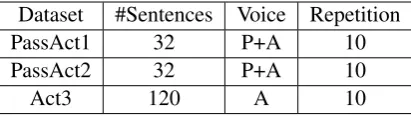
Magnetoencephalography (MEG) is a non-invasive functional brain imaging technique which records magnetic fields produced by electrical currents in the brain. Sensors in the MEG helmet allow for recording of magnetic fluctuations caused by changes in neural activity of the brain. For the experiments in this paper, we used three different MEG datasets collected when subjects were shown simple sentences as stimulus. These datasets are summarized in Table1, please see (Rafidi, 2014) for more details. Additional dataset details are mentioned in appendix section
A.1. In the MEG helmet, 306 sensors were distributed over 102 locations and sampled at 1kHz. Native English speaking subjects were asked to read simple sentences. Each word within a sentence was presented for 300ms with 200ms subsequent rest. To reduce noise in the brain recordings, we represent a word’s brain activity by averaging 10 sentence repetitions (Sudre et al.,
2012). Comprehension questions followed 10% of sentences, to ensure semantic engagement. MEG data was acquired using a 306 channel Elekta Neuromag device. Preprocessing included spatial filtering using temporal signal space separation (tSSS), low-pass filtering 150Hz with notch filters at 60 and 120Hz, and downsampling to 500Hz (Wehbe et al.,2014b). Artifacts from tSSS-filtered same-day empty room measurements, ocular and cardiac artifacts were removed via Signal Space Projection (SSP).
1https://github.com/SharmisthaJat/
ACL2019-SimpleSentenceRepr-DNN-Brain
Dataset #Sentences Voice Repetition PassAct1 32 P+A 10 PassAct2 32 P+A 10
[image:2.595.308.514.62.120.2]Act3 120 A 10
Table 1: MEG datasets used in this paper. Column ‘Voice’ refers to the sentence voice, ‘P’ is for passive sentences and ‘A’ is for active. Repetition is the number of times the human subject saw a sentence. For our experiments, we average MEG data corresponding to multiple repetitions of a single sentence.
2.2 Simple Sentence Corpus
In this paper, we aim to understand simple sen-tence processing in deep neural networks (DNN) and the brain. In order to train DNNs to repre-sent simple repre-sentences, we need a sizeable corpus of simple sentences. While the MEG datasets de-scribed in Section 2.1 contain a few simple sen-tences, that set is too small to train DNNs ef-fectively. In order to address this, we created a new Simple Sentence Corpus (SSC), consisting of a mix of simple active and passive sentences of the form “the woman encouraged the girl” and
“the woman was encouraged by the boy”, respec-tively. The SSC dataset consists of 256,145 sen-tences constructed using the following two sets.
• Wikipedia: We processed the 2009 Wikipedia dataset to get sentences matching the following patterns.
“the [noun+] was [verb+] by the [noun+]” “the [noun+] [verb+] the [noun+]”
If the last word in the pattern matched is not noun, then we retain the additional dependent clause in the sentence. We were able to extract 117,690 active, and 8210 passive sentences from wikipedia.
• NELL triples: In order to ensure broader cov-erage of Subject-Verb-Object (SVO) triples in our sentence corpus, we used the NELL SVO triples2(Talukdar et al.,2012). We sub-sample SVO triples based on their frequency (threshold = 6), a frequent verb list, and Free-base to get meaningful sentences. Any triple with subject or object or verb not in Freebase is discarded from the triple set.
– Active sentence: Convert the verb to its past tense and concatenate the triple
us-2NELL SVO triples: http://rtw.ml.cmu.edu/
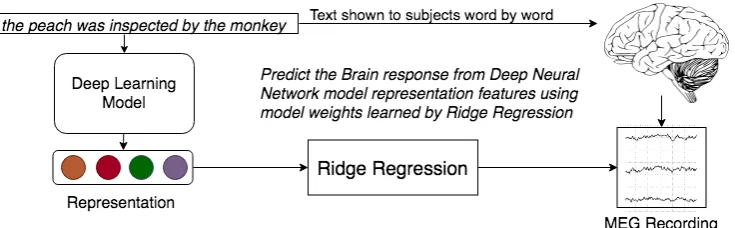
Figure 1: Encoding model for MEG data. 306 channel 500ms MEG signal for a single word was compressed to
306×5by averaging100ms data into a single column. This MEG brain recording data is then encoded from text representation vector to brain activity using ridge regression. The evaluation is done using 5 fold cross-validation. Please see Section4for more details.
ing the following pattern: “the [subject] [verb-past-tense] the [object]”.
– Passive sentence: Concatenate the triple using pattern: “the [object] was [verb-past-tense] by the [subject]”
We generate 86,452 active and 43,793 pas-sive sentences in total from the NELL triples.
We train our deep neural network models with 90% of sentences in this dataset and test on the remaining 10%. We used the spaCy (Honnibal and Montani,2017) library to predict POS tags for words in this dataset.
3 Methods
We test correlations between brain activity and deep learning model activations (LeCun et al.,
2015) for a given sentence using a classification task, similar to previous works (Mitchell et al.,
2008; Wehbe et al., 2014a,b). If we are able to predict brain activity from the neural network ac-tivation, then we hypothesize that there exists a relationship between the process captured by the neural network layer and the brain. The schematic of our encoding approach is shown in Figure1.
We investigate various deep neural network models using context sensitivity tests to evalu-ate their performance in predicting brain activ-ity. Working with these models and their respec-tive training assumptions help us in understand-ing which assumption contributes to the correla-tions with the brain activity data. We process the sentences incrementally for each model to prevent information from future words from affecting the current representation, in line with how informa-tion is processed by the brain. For example, in the
sentence“the dog ate the biscuit”, the representa-tion of the word“ate”is calculated by processing sentence segment“the dog ate”and taking the last representation in each layer as the context for the word“ate”. The following embedding models are used to represent sentences.
• Random Embedding Model: In this model, we represent each word in a context by a randomly generated 300-dimensional vector. Each dimension is uniformly sampled be-tween [0,1]. The results from this model help us establish the random baseline.
• GloVe Additive Embedding Model: This model represents a word context as the aver-age of the current word’s GloVe embedding (Pennington et al., 2014) and the previous word context. The first word in a sentence is initialized with its GloVe embedding as con-text.
• Simple Bi-directional LSTM Language Model: We build a language model follow-ing (Inan et al., 2016). Given a sequence of words w1. . . wt, we predict the next word wt+1 using a two layer bidirectional-LSTM
model (Hochreiter and Schmidhuber,1997). The model is trained on the simple language corpus data as described in Section2.1with a cross-entropy loss. We evaluate our model on 10% held out text data. The perplexity for the Bi-directional Language model is 9.97 on test data (the low perplexity value is due to the simple train and test dataset).
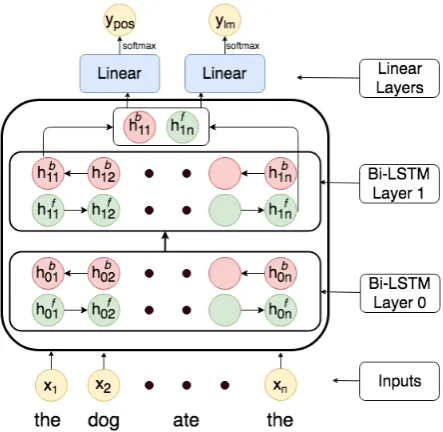
multitask model is a simple two layer bidi-rectional LSTM model with separate linear layers predicting each of the tasks given the output of the last LSTM layer (Figure2). The model is trained on the simple sentence cor-pus data as described in Section 2.1 with a cross-entropy loss. The model’s accuracy is 96.9% on the POS-tag prediction task and has perplexity of 9.09 on the 10% test data. The high accuracy and low perplexity are due to the simple nature of our language dataset.
• ELMO (Peters et al., 2018): ELMo is a recent state-of-the-art deep contextualized word representation method which models a word’s features as internal states of a deep bidirectional language model (biLM) pre-trained on a large text corpus. The contex-tualized word vectors are able to capture in-teresting word characteristics like polysemy. ELMO has been shown to improve perfor-mance across multiple tasks, such sentiment analysis and question answering.
• BERT (Devlin et al., 2019): BERT uses a novel technique called Masked Language Model (MLM). MLM randomly masks some tokens inputs and then predicts them. Unlike previous models, this technique can use both left and right context to predict the masked token. The training also predicts the next sentence. The embedding in this model con-sists of 3 components: token embedding, sen-tence embedding and transformer positional embedding. Due to the presence of sentence embeddings, we observe an interesting per-formance of the embedding layer in our ex-periments.
4 Experiments and Results
[image:4.595.308.530.62.278.2]With human brain as the reference language pro-cessing engine, we investigate the relationship between deep neural network representation and brain activity recorded while processing the same sentence. For this task, we perform experiments at both the macro and micro sentence context level. The macro-context experiments evaluate the overall performance of deep neural networks in predicting brain data for input words (all words, nouns, verbs etc.). The micro-context experi-ments, by contrast, focus on evaluating the perfor-mance of deep neural network representations in
Figure 2: Architecture diagram for the simple multi-task model. The second LSTM layer’s output is pro-cessed by 2 linear layers each producing the next-word and the POS-tag prediction. We process each sentence incrementally to get the prediction for word at the nth position, this helps in removing forward bias from fu-ture words and therefore is consistent with the infor-mation our brain receives when processing the same sentence. Our Simple Bi-directional LSTM language model also has a similar architecture with just one out-put linear layer for next word prediction.
detecting minor changes in sentence context prior to the token being processed.
Regression task: Similar to previous research (Mitchell et al., 2008; Wehbe et al., 2014b), we use a classification task to align model representa-tions with brain data. MEG data (Section2.1) is used for these experiments. The task classifies be-tween a candidate word and the true word a subject is reading at the time of brain activity recording. The classifier uses an intermediate regression step to predict the MEG activity from deep neural net-work representation for the true and the candidate word. The classifier then chooses the word with least Euclidean distance between the predicted and the true brain activity. A correct classification sug-gests that the deep neural network representation captures important information to differentiate be-tween brain activity at words in different contexts. Detailed steps of this process are described as fol-lows.
and trained on the MEG data as described by ( We-hbe et al.,2014b) (Section 2.3.2). We average the signal from every sensor (total 306) over 100ms non-overlapping windows, yielding a306×5sized MEG data for each word. To train the regression model, we take the training portion of the data in each fold, (X, Y), in the tuple (xi, yi), xi is
the layer representation for an input word iin a neural network model, and yi is the correspond-ing MEG recordcorrespond-ing of size 1530 (flattened 306*5). The Ridge regression model (f) (Pedregosa et al.,
2011) is learned with generalized cross-validation to selectλparameter (Golub et al.,1979). Ridge regression model’s α parameter is selected from range[0.1, . . . ,100,1000]. The trained regression model is used to estimate MEG activity from the stimulus features, i.e.,yˆi=f(xi).
Regression testing: The trained regression model is used to predictyˆifor each word stimulus
(xi) in the test fold during cross-validation. We
perform a pair-wise test for the classification ac-curacy (Acc) (Mitchell et al.,2008). The chance accuracy of this measure is 0.5. We use Euclidean distance (Edist) as given in (1) for the measure.
Acc =
1,if Edist(f(xi), yi) +Edist(f(xj), yj) ≤Edist(f(xi), yj) +Edist(f(xj), yi)
0, otherwise
(1)
4.1 Macro-context Experiments
The macro-context experiments aggregate classi-fication performance of each model’s layer on the entire stimuli set. We also evaluate on smaller sets such as only the nouns, verbs, passive sentence words, active sentence words, etc. The macro ex-periments help us to compare all the models on a large stimuli set. In summary, we observe the following: (1) the intermediate layers of state-of-the-art deep neural network models are most pre-dictive of brain activity (Jain and Huth(2018) also observe this on a 3 layer LSTM language model), (2) in-context representations are better at predict-ing brain activity than out-of-context representa-tions (embeddings), and (3) Temporal lobe is pre-dicted with highest accuracy from deep neural net-work representations.
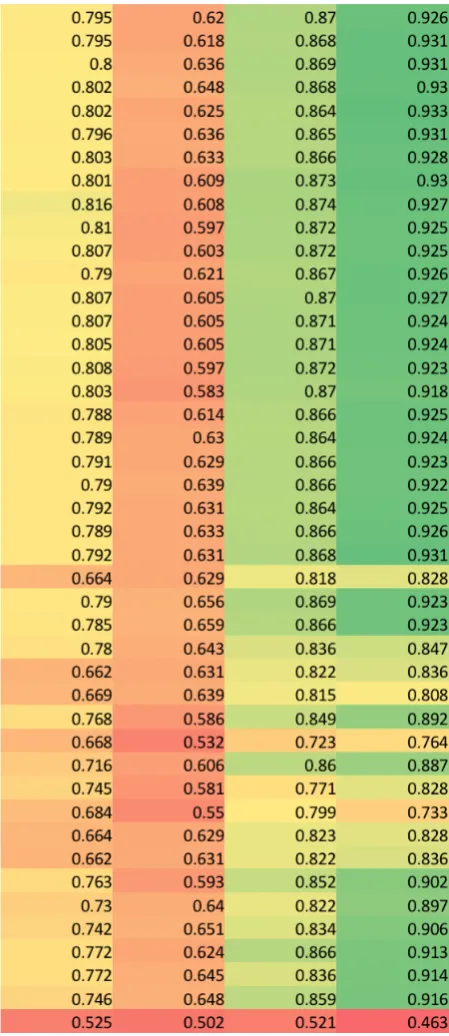
Detailed Observations: The results of pair-wise classification tests for various models are pre-sented in Figure3. All the results reported in this section are for PassAct1 dataset. From the figure,
we observe that BERT and ELMo outperform the simple models in predicting brain activity data. In the neural network language models, the middle layers perform better at predicting brain activity than the shallower or deeper layers. This could be due to the fact that the shallower layers repre-sent low-level features and the deeper layers rep-resent more task-oriented features. We tested this hypothesis by examining the performance scores at each lobe of the brain. For each area, we tested the left and right hemispheres independently and compared these performances with the bilateral frontal lobe as well as the activity across all re-gions. In particular, we examined the primary vi-sual areas (left and right occipital lobe), speech and language processing areas (left temporal) and verbal memory (right temporal), sensory percep-tion (left parietal) and integrapercep-tion (right parietal), language related movements (left frontal) and non-verbal functioning (right frontal). The frontal lobe was tested bilaterally as it is associated with higher level processing such as problem solving, lan-guage processing, memory, judgement, and social behavior.
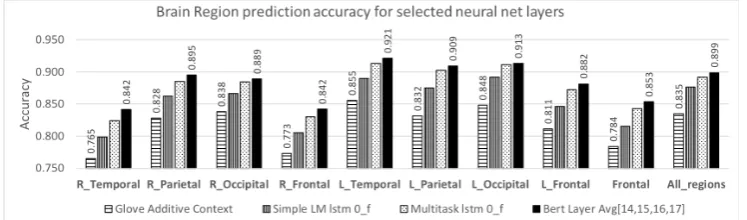
From our results, we observe that lower layers such as BERT layer 5 have very high accuracy for right occipital and left occipital lobe associated with low-level visual processing task. In contrast, higher layers such as linear layers in the Multitask Model and in Language Model have the highest accuracy in the left temporal region of the brain. Figure 4 shows the pairwise classification accu-racy for a given brain region for best layers from each model. The accuracy is highest in left tem-poral region, responsible for syntactic and seman-tic processing of language. These results establish correspondences between representations learned by deep neural methods and those in the brain. Further experiments are needed to improve our un-derstanding of this relationship.
Figure 3: Pairwise classification accuracy of brain activity data predicted from various model layer representations. We average 4 consecutive layers of BERT into one value. We find that BERT and ELMO model layers perform the best. The middle layers of most models and BERT, in particular, are good at predicting brain activity. Read ‘ f’ as forward layer and ‘Emb’ as the embedding layer.
Figure 4: Pairwise accuracy of various brain regions from some selected deep neural network model layers. The left part of the brain which is considered central to language understanding is predicted with higher accuracy, especially left temporal region (L = left, R = right).
deep neural networks, as active sentences are dom-inant in the training data of most of the pre-trained models. We also observe that for passive sen-tences, our simple multitask model (trained using about 250K active and passive sentences) has a lower performance gap between active and pas-sive sentence as compared to ELMO and BERT models. This may be due to a more balanced ac-tive and passive sentence used to train the multi-task model. Noun stimuli are predicted with the highest accuracy of 0.81, while the accuracy for verbs is 0.65. Both Multitask and ELMo mod-els dominate verb prediction results, while BERT lags in this category. Further experiments should be done to compare the ability of Transformer (Vaswani et al., 2017) versus Recurrent Neural Network based models to represent verbs.
4.2 Micro-context Experiments
In these micro-context experiments, we evaluate if our models are able to retain information from words in the sentence prior to the word being
pro-cessed. For such context sensitivity tests, we only use the first repetition of the sentence shown to hu-man subjects. This helps to ensure that the sen-tence has not been memorized by the subjects, which might affect the context sensitivity tests.
Training: The micro-context experiment setup is illustrated in Figure 5. To train the regres-sion model, each training instance corresponding to a word has the form (xi, yi), where xi is the layer representation for an input wordiin a neu-ral network model, and yi is the corresponding
MEG brain recording data of size 1530 (flattened
306×5). During testing, we restrict the pairwise tests to word pairs (xi, xj) which satisfy some
con-ditions. For example in noun context sensitivity test, the pair of words should be such that, they appear in a sentence with the same words except the noun. We describe these candidate word test pairs, in detail, in the following sections.
[image:6.595.113.487.287.397.2]Figure 5: Experimental setup for micro-context tests. Given two sentences with similar words except one in the past (underlined), the test evaluates if the deep neural network model representation contains sufficient information to tell the two words apart. Please see Section4.2for more details.
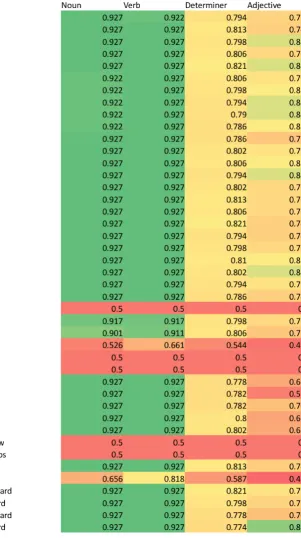
are identical except for one word (underlined items). We vary the non-identical word type (noun, verb, adjective, determiner) among the two sentences to test the contribution of each of these word types to the context representation further in sentence. This test helps us understand what parts of the context are retained or forgotten by the neu-ral network model representation. Detailed results of each test are included in the appendix section (Figure 10). Please note that the part of BERT word embedding is the sentence embedding, there-fore the BERT embedding performs better than 0.5, unlike other embeddings.
4.2.1 Noun sensitivity
“The dog atethe” vs. “The girl atethe”
For the PassAct1 dataset, we observe that sim-ple GloVe additive model (classification accuracy = 0.52) loses information about the noun while it is retained by most layers of other models like BERT (accuracy = 0.92), ELMo (accuracy = 0.91). Higher level layers, such as linear layer for POS-tag prediction (accuracy = 0.65), also perform poorly. This seems obvious due to the task it solves which focuses on POS-tag property at the word ‘the’ rather than the previous context. In summary, we observe that the language model context preserves noun information well.
4.2.2 Verb sensitivity
“The dog sawthe” vs. “The dog atethe”
For the PassAct1 dataset, we observe that simi-lar to noun sensitivity, most language model layers (accuracy = 0.92), except for simple GloVe Ad-ditive model, preserve the verb memory. By de-sign, the GloVe Additive model retains little con-text from the past words, and therefore the result verifies the experiment setup.
4.2.3 First determiner sensitivity
“Adog” vs. “Thedog”
For the PassAct2 dataset, we observe that de-terminer information is retained well by most lay-ers. However, the shallow layers retain informa-tion better than the deeper layers. For example, BERT layer 3 (accuracy = 0.82), Multitask lstm 0 backward (accuracy = 0.82), BERT Layer 18/19 (accuracy 0.78). Since the earlier layers have a higher correlation with shallow feature processing, the determiner information may be useful for the early features in neural network representation.
4.2.4 Adjective sensitivity
“The happychild” vs. “Thechild”
For the Act3 dataset, we observe that middle layers of most models (BERT, Multitask) retain the adjective information well. However, sur-prisingly simple multitask model (lstm 1 forward layer accuracy = 0.89) retains adjective informa-tion better than BERT model (layer 7 accuracy = 0.84). This could be due to the importance of ad-jective in context for POS tag prediction. This result encourages the design of language models with diverse cost functions based on the kind of sentence context information that needs to be pre-served in the final task.
4.2.5 Visualisation
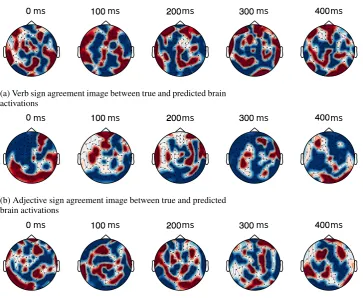
activity (y0) and the true brain activity (y) are then compared to form an agreement activity (y00), re-sulting in a zero value for all locations where the sign predicted was incorrect. We average these agreement activities (y00) for all test examples in a cross-validation fold to form a single activity im-age (Y00). Figure8showsY00for the word ‘the’ in noun-sensitivity tests Section4.2.1(additional re-sults are in the appendix section). We observe that our model prediction direction agrees with brain prediction direction in most of the brain regions. This shows that our neural network layer represen-tation can preserve information from earlier words in the sentence.
4.3 Semi-supervised training using synthesized brain activity
In this section, we consider the question of whether previously trained linear regression model (X1), which predicts brain activity for a given sentence, can be used to produce useful synthetic brain data (i.e., sentence-brain activity pairs). Constraints like high cost of MEG record-ing and physical limits on an individual subject during data collection, favor such synthetic data generation. We evaluate effectiveness of this syn-thetically generated brain data for data augmenta-tion in the stimulus predicaugmenta-tion task (Mitchell et al.,
2008). Specifically, we train a decoding model (X2) to predict brain activity during a stimulus reading based on GloVe vectors for nouns. We consider two approaches. In the first approach, the same brain activity data as in previous sections was used. In the second approach, the real brain activity data is augmented with the synthetic ac-tivities generated by the regression model (X1).
In our experiment, we generate new sentences using the same vocabulary as the original sen-tences in the PassAct1 dataset. Details of the original 32 sentences (Section A.1.1) along with the 160 generated sentences (Section A.1.2) are given in the appendix section. We process the 160 generated sentences with BERT layer 18 to get word stimulus features in context. The en-coding model (X1) was trained using the PassAct1 dataset. Please note that BERT layer 18 was cho-sen based on the high accuracy results on macro-context tests, therefore the layer aligned well with the whole brain activity. The choice of represen-tation (deep neural network layer) to encode brain activity should be done carefully, as each
represen-tation may be good at encoding different parts of brain. A good criteria for representation selection requires further research.
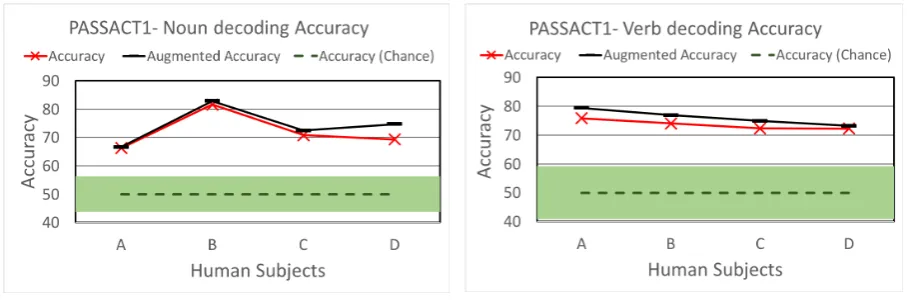
To demonstrate the efficacy of the synthetic dataset, we present the accuracy in predicting noun (or verb) stimuli from observed MEG activ-ity with and without the additional synthetic MEG data. With linear ridge regression model (X2), a GloVe (Pennington et al.,2014) feature to brain-activity prediction models were trained to predict the MEG activity when a word is observed . To test the model performance, we calculate the accuracy of the predicted brain activity given the true brain activity during a word processing (Equation 1). All the experiments use 4-fold cross-validation. Figure7shows the increase in the noun/verb pre-diction accuracy with additional synthetically gen-erated data. The statistical significance is calcu-lated over 400 random label permutation tests.
To summarize, these results show the utility of using previously trained regressor model to pro-duce synthetic training data to improve accuracy on additional tasks. Given the high cost of col-lecting MEG recordings from human subjects and their individual capacity to complete the task, this data augmentation approach may provide an effec-tive alternaeffec-tive in many settings.
5 Related Work
Usage of machine learning models in neuro-science has been gaining popularity. Methods in this field use features of words and con-texts to predict brain activity using various tech-niques (Agrawal et al.,2014). Previous research have used functional magnetic resonance imaging (FMRI) (Glover,2011) and Magnetoencephalog-raphy (MEG) (Hmlinen et al., 1993) to record brain activity. Prefrontal cortex in rhesus monkeys was studied inMante et al.(2013). They showed that an appropriately trained recurrent neural net-work model reproduces key physiological obser-vations and suggests a new mechanism of input selection and integration. Barak (2017) argues that RNNs with reverse engineering can provide a framework for modeling in neuroscience, po-tentially serving as a powerful hypothesis gener-ation tool. Prior research byMitchell et al.(2008),
Wehbe et al.(2014b),Jain and Huth(2018),Hale et al.(2018),Pereira et al.(2018), andSun et al.
re-Figure 6: Average sign agreement activity for noun sensitivity stimuli ‘the’. The red and blue colored areas are the +ive and -ive signed brain region agreement respectively, while the white colored region displays brain regions with prediction error. We observe that in most regions of the brain, the predicted and true activity agree on the activity sign, thereby providing evidence that deep learning representations can capture useful information about language processing consistent with the brain recording.
[image:9.595.143.459.65.132.2](a) Noun prediction results (b) Verb prediction results
Figure 7: Accuracy with and without synthetically generated MEG brain data on two stimuli prediction tasks: (a) Nouns (left) and (b) Verbs (right). We trained two models – one using true MEG brain recording and the other using both true and synthetically generated MEG brain data (Augmented data model). We observe that the augmented data model results in accuracy improvement on both tasks, on average2.1%per subject for noun prediction and 2.4%for verb. Accuracy (chance) is the random permutation test accuracy, with the green shaded area representing standard deviation. Please see Section4.3for details.
sponse to naturalistic language. We follow these prior research in our analysis work and extend the results by doing a fine-grained analysis of the sen-tence context. Additionally, we also use deep neu-ral network representations to generate synthetic brain data for extrinsic experiments.
6 Conclusion
In this paper, we study the relationship between sentence representations learned by deep neural network models and those encoded by the brain. We encode simple sentences using multiple deep networks, such as ELMo, BERT, etc. We make use of MEG brain imaging data as reference. Rep-resentations learned by BERT are the most effec-tive in predicting brain activity. In particular, most models are able to predict activity in the left tem-poral region of the brain with high accuracy. This brain region is also known to be responsible for processing syntax and semantics for language un-derstanding. To the best of our knowledge, this
is the first work showing that the MEG data, when reading a word in a sentence, can be used to dis-tinguish earlier words in the sentence. Encouraged by these findings, we use deep networks to gen-erate synthetic brain data to show that it helps in improving accuracy in a subsequent stimulus de-coding task. Such data augmentation approach is very promising as actual brain data collection in large quantities from human subjects is an expen-sive and labor-intenexpen-sive process. We are hopeful that the ideas explored in the paper will promote further research in understanding relationships be-tween representations learned by deep models and the brain during language processing tasks.
7 Acknowledgments
[image:9.595.72.526.215.368.2]References
Pulkit Agrawal, Dustin Stansbury, Jitendra Malik, and Jack L. Gallant. 2014. Pixels to voxels: Modeling visual representation in the human brain. CoRR, abs/1407.5104.
Omri Barak. 2017. Recurrent neural networks as versa-tile tools of neuroscience research.Current Opinion in Neurobiology, 46:1 – 6. Computational Neuro-science.
Jacob Devlin, Ming-Wei Chang, Kenton Lee, and Kristina Toutanova. 2019. BERT: pre-training of deep bidirectional transformers for language under-standing. InProc. of NAACL.
Chris Dyer, Adhiguna Kuncoro, Miguel Ballesteros, and Noah A. Smith. 2016. Recurrent neural network grammars. InProc. of NAACL.
Gary H Glover. 2011. Overview of functional magnetic resonance imaging. Neurosurgery clinics of North America, 22(2):133–vii.
Gene H. Golub, Michael Heath, and Grace Wahba. 1979. Generalized cross-validation as a method for choosing a good ridge parameter. Technometrics, 21(2):215–223.
John Hale, Chris Dyer, Adhiguna Kuncoro, and Jonathan Brennan. 2018. Finding syntax in human encephalography with beam search. In Proceed-ings of the 56th Annual Meeting of the Association for Computational Linguistics (Volume 1: Long Pa-pers), pages 2727–2736. Association for Computa-tional Linguistics.
Sepp Hochreiter and J¨urgen Schmidhuber. 1997. Long short-term memory. Neural Comput., 9(8):1735– 1780.
Matthew Honnibal and Ines Montani. 2017. spacy 2: Natural language understanding with bloom embed-dings, convolutional neural networks and incremen-tal parsing. To appear.
Matti Hmlinen, Riitta Hari, Risto Ilmoniemi, Jukka Knuutila, and Olli V. Lounasmaa. 1993. Magne-toencephalography: Theory, instrumentation, and applications to noninvasive studies of the working human brain. Rev. Mod. Phys., 65:413–.
Hakan Inan, Khashayar Khosravi, and Richard Socher. 2016. Tying word vectors and word classifiers: A loss framework for language modeling. CoRR, abs/1611.01462.
Shailee Jain and Alexander Huth. 2018. Incorporating context into language encoding models for fmri. In S. Bengio, H. Wallach, H. Larochelle, K. Grauman, N. Cesa-Bianchi, and R. Garnett, editors,Advances in Neural Information Processing Systems 31, pages 6628–6637. Curran Associates, Inc.
Yann LeCun, Yoshua Bengio, and Geoffrey Hinton. 2015.Deep learning.Nature, 521:436.
Valerio Mante, David Sussillo, Krishna V. Shenoy, and William T. Newsome. 2013. Context-dependent computation by recurrent dynamics in prefrontal cortex. Nature, 503:78 EP –.
Tom M. Mitchell, Svetlana V. Shinkareva, Andrew Carlson, Kai-Min Chang, Vicente L. Malave, Robert A. Mason, and Marcel Adam Just. 2008. Predicting human brain activity associated with the meanings of nouns.Science, 320(5880):1191–1195.
F. Pedregosa, G. Varoquaux, A. Gramfort, V. Michel, B. Thirion, O. Grisel, M. Blondel, P. Pretten-hofer, R. Weiss, V. Dubourg, J. Vanderplas, A. Pas-sos, D. Cournapeau, M. Brucher, M. Perrot, and E. Duchesnay. 2011. Scikit-learn: Machine Learn-ing in Python . Journal of Machine Learning Re-search, 12:2825–2830.
Jeffrey Pennington, Richard Socher, and Christopher D Manning. 2014. Glove: Global vectors for word representation. InEMNLP, volume 14, pages 1532– 1543.
Francisco Pereira, Bin Lou, Brianna Pritchett, Samuel Ritter, Samuel J. Gershman, Nancy Kanwisher, Matthew Botvinick, and Evelina Fedorenko. 2018. Toward a universal decoder of linguistic meaning from brain activation. Nature Communications, 9(1):963.
Matthew E. Peters, Mark Neumann, Mohit Iyyer, Matt Gardner, Christopher Clark, Kenton Lee, and Luke Zettlemoyer. 2018. Deep contextualized word rep-resentations. InProc. of NAACL.
Nicole Rafidi. 2014. The role of syntax in semantic processing: A study of active and passive sentences. [Online; accessed 2-March-2019].
Gustavo Sudre, Dean Pomerleau, Mark Palatucci, Leila Wehbe, Alona Fyshe, Riitta Salmelin, and Tom Mitchell. 2012. Tracking neural coding of percep-tual and semantic features of concrete nouns. Neu-roImage, 62:451–63.
Jingyuan Sun, Shaonan Wang, Jiajun Zhang, and Chengqing Zong. 2019. Towards sentence-level brain decoding with distributed representations. AAAI Press.
Partha Pratim Talukdar, Derry Wijaya, and Tom Mitchell. 2012. Acquiring temporal constraints be-tween relations. InProceedings of the 21st ACM In-ternational Conference on Information and Knowl-edge Management, CIKM ’12, pages 992–1001, New York, NY, USA. ACM.
Leila Wehbe, Brian Murphy, Partha Talukdar, Alona Fyshe, Aaditya Ramdas, and Tom Mitchell. 2014a. Simultaneously uncovering the patterns of brain re-gions involved in different story reading subpro-cesses.PloS one, 9:e112575.
A Appendices
A.1 Dataset details
Following are the sentences used in the paper for experiments described in Section4. We list down the sentences in PassAct1 dataset and the gener-ated sentences in the sections Section A.1.1 and Section A.1.2 respectively. The two datasets are disjoint in terms of the sentences they contain, but are built using the same vocabulary. Datasets Pas-sAct2 dataset and Act3 dataset are detailed in sub-sectionsA.1.3andA.1.4respectively.
A.1.1 PassAct1 dataset sentences
the boy was liked by the girl the girl was watched by the man the man was despised by the woman the woman was encouraged by the boy the girl was liked by the woman the man was despised by the boy the girl was liked by the boy the boy was watched by the woman the man was encouraged by the girl the woman was despised by the man the woman was watched by the boy the girl was encouraged by the woman the man was despised by the girl the boy was liked by the man the boy was watched by the girl the woman was encouraged by the man the man despised the woman
the girl encouraged the man the man liked the boy the girl despised the man the woman encouraged the girl the boy watched the woman the man watched the girl the girl liked the boy
the woman despised the man the boy encouraged the woman the woman liked the girl the boy despised the man the man encouraged the woman the girl watched the boy the woman watched the boy the boy liked the girl
A.1.2 PassAct1 dataset artificially generated sentences
the girl was despised by the man the man despised the girl
the man was liked by the girl the girl was liked by the man the girl liked the man the man liked the girl
the girl was encouraged by the man the man encouraged the girl the man was watched by the girl the girl watched the man
the boy was despised by the man the man despised the boy the man was liked by the boy the boy liked the man
the man was encouraged by the boy the boy was encouraged by the man the boy encouraged the man the man encouraged the boy the man was watched by the boy the boy was watched by the man the boy watched the man the man watched the boy
the man was despised by the women the women was despised by the man the women despised the man the man despised the women the man was liked by the women the women was liked by the man the women liked the man the man liked the women
the man was encouraged by the women the women was encouraged by the man the women encouraged the man the man encouraged the women the man was watched by the women the women was watched by the man the women watched the man the man watched the women the girl was despised by the man the man despised the girl the girl was liked by the man the man was liked by the girl the man liked the girl the girl liked the man
the girl was encouraged by the man the man encouraged the girl the man was watched by the girl the girl watched the man the girl was despised by the boy the boy was despised by the girl the boy despised the girl the girl despised the boy
the boy was encouraged by the girl the boy encouraged the girl the girl encouraged the boy the girl was watched by the boy the boy watched the girl
the girl was despised by the women the women was despised by the girl the women despised the girl the girl despised the women the girl was liked by the women the women was liked by the girl the women liked the girl the girl liked the women
the girl was encouraged by the women the women was encouraged by the girl the women encouraged the girl the girl encouraged the women the girl was watched by the women the women was watched by the girl the women watched the girl the girl watched the women the boy was despised by the man the man despised the boy the man was liked by the boy the boy liked the man
the boy was encouraged by the man the man was encouraged by the boy the man encouraged the boy the boy encouraged the man the boy was watched by the man the man was watched by the boy the man watched the boy the boy watched the man the boy was despised by the girl the girl was despised by the boy the girl despised the boy the boy despised the girl
the boy was encouraged by the girl the girl was encouraged by the boy the girl encouraged the boy the boy encouraged the girl the girl was watched by the boy the boy watched the girl
the boy was despised by the women the women was despised by the boy the women despised the boy the boy despised the women the boy was liked by the women the women was liked by the boy the women liked the boy the boy liked the women
the boy was encouraged by the women the women was encouraged by the boy the women encouraged the boy the boy encouraged the women the boy was watched by the women the women was watched by the boy the women watched the boy the boy watched the women
the women was despised by the man the man was despised by the women the man despised the women the women despised the man the women was liked by the man the man was liked by the women the man liked the women the women liked the man
the women was encouraged by the man the man was encouraged by the women the man encouraged the women the women encouraged the man the women was watched by the man the man was watched by the women the man watched the women the women watched the man the women was despised by the girl the girl was despised by the women the girl despised the women the women despised the girl the women was liked by the girl the girl was liked by the women the girl liked the women the women liked the girl
the women was encouraged by the girl the girl was encouraged by the women the girl encouraged the women the women encouraged the girl the women was watched by the girl the girl was watched by the women the girl watched the women the women watched the girl
the women was despised by the boy the boy was despised by the women the boy despised the women the women despised the boy the women was liked by the boy the boy was liked by the women the boy liked the women the women liked the boy
the women encouraged the boy the women was watched by the boy the boy was watched by the women the boy watched the women the women watched the boy
A.1.3 PassAct2 dataset sentences
the monkey inspected the peach a monkey touched a school
the school was inspected by the student a peach was touched by a student the peach was inspected by the monkey a school was touched by a monkey a doctor inspected a door
the doctor touched the hammer the student found a door a student kicked the hammer the student inspected the school a student touched a peach a monkey found the hammer the monkey kicked a door a dog inspected a hammer the dog touched the door a dog found the peach the dog kicked a school the doctor found a school a doctor kicked the peach a school was kicked by the dog the peach was found by a dog the door was touched by the dog a hammer was inspected by a dog the peach was kicked by a doctor a school was found by the doctor the hammer was touched by the doctor a door was inspected by a doctor the hammer was kicked by a student a door was found by the student the hammer was found by a monkey a door was kicked by the monkey
A.1.4 Act3 dataset sentences
the teacher broke the small camera the student planned the protest the student walked along the long hall the summer was hot
the storm destroyed the theater the storm ended during the morning the duck flew
the duck lived at the lake
the activist dropped the new cellphone
the editor carried the magazine to the meeting the boy threw the baseball over the fence the bicycle blocked the green door the boat crossed the small lake the boy held the football the bird landed on the bridge the bird was red
the reporter wrote about the trial the red plane flew through the cloud the red pencil was on the desk the reporter met the angry doctor
the reporter interviewed the politician during the debate
the tired lawyer visited the island the tired jury left the court the artist found the red ball
the artist hiked along the mountain the angry lawyer left the office the army built the small hospital the army marched past the school the artist drew the river
the actor gave the football to the team the angry activist broke the chair the cellphone was black
the company delivered the computer the priest approached the lonely family the patient put the medicine in the cabinet the pilot was friendly
the policeman arrested the angry driver the policeman read the newspaper the politician celebrated at the hotel the trial ended in spring
the tree grew in the park
the tourist hiked through the forest the activist marched at the trial the tourist ate bread on vacation the vacation was peaceful
the dusty feather landed on the highway the accident destroyed the empty lab the horse kicked the fence
the happy girl played in the forest the guard slept near the door the guard opened the window the glass was cold
the green car crossed the bridge the voter read about the election the wealthy farmer fed the horse
the wealthy family celebrated at the party the window was dusty
the man saw the fish in the river the man saw the dead mouse
the man read the newspaper in church
the lonely patient listened to the loud television the girl dropped the shiny dime
the couple laughed at dinner the council read the agreement the couple planned the vacation the fish lived in the river the flood damaged the hospital the big horse drank from the lake the corn grew in spring
the woman bought medicine at the store the woman helped the sick tourist the woman took the flower from the field the worker fixed the door at the church the businessman slept on the expensive bed the businessman lost the computer at the airport the businessman laughed in the theater
the chicken was expensive at the restaurant the lawyer drank coffee
the judge met the mayor
the judge stayed at the hotel during the vacation the jury listened to the famous businessman the hurricane damaged the boat
the journalist interviewed the judge the dog ate the egg
the doctor helped the injured policeman the diplomat bought the aggressive dog the council feared the protest
the park was empty in winter the parent watched the sick child the cloud blocked the sun the coffee was hot
the commander ate chicken at dinner the commander negotiated with the council the commander opened the heavy door the old judge saw the dark cloud the young engineer worked in the office the farmer liked soccer
the mob approached the embassy the mob damaged the hotel
the minister spoke to the injured patient the minister visited the prison
the minister found cash at the airport the minister lost the spiritual magazine the mouse ran into the forest
the parent took the cellphone
the soldier delivered the medicine during the flood the soldier arrested the injured activist
the small boy feared the storm
the egg was blue
the editor gave cash to the driver the editor damaged the bicycle the expensive camera was in the lab the engineer built the computer
the family survived the powerful hurricane the child held the soft feather
the clever scientist worked at the lab
(a) Verb sign agreement image between true and predicted brain activations
(b) Adjective sign agreement image between true and predicted brain activations
[image:16.595.72.436.215.513.2](c) Determiner sign agreement image between true and pre-dicted brain activations