263
Probabilistic Embedding of Knowledge Graphs with
Box Lattice Measures
Luke Vilnis⇤ Xiang Li⇤ Shikhar Murty Andrew McCallum College of Information and Computer Sciences
University of Massachusetts Amherst
{luke,xiangl,smurty,mccallum}@cs.umass.edu
Abstract
Embedding methods which enforce a par-tial order or lattice structure over the con-cept space, such as Order Embeddings (OE) (Vendrov et al., 2016), are a nat-ural way to model transitive relational data (e.g. entailment graphs). However, OE learns a deterministic knowledge base, limiting expressiveness of queries and the ability to use uncertainty for both predic-tion and learning (e.g. learning from ex-pectations). Probabilistic extensions of OE (Lai and Hockenmaier, 2017) have provided the ability to somewhat calibrate thesedenotational probabilities while re-taining the consistency and inductive bias of ordered models, but lack the ability to model the negative correlations found in real-world knowledge. In this work we show that a broad class of models that as-sign probability measures to OE can never capture negative correlation, which moti-vates our construction of a novelbox lat-tice and accompanying probability mea-sure to capture anticorrelation and even disjoint concepts, while still providing the benefits of probabilistic modeling, such as the ability to perform rich joint and ditional queries over arbitrary sets of con-cepts, and both learning from and predict-ing calibrated uncertainty. We show im-provements over previous approaches in modeling the Flickr and WordNet entail-ment graphs, and investigate the power of the model.
*Equal contribution.
1 Introduction
Structured embeddings based on regions, densi-ties, and orderings have gained popularity in re-cent years for their inductive bias towards the essential asymmetries inherent in problems such as image captioning (Vendrov et al., 2016), lexi-cal and textual entailment (Erk,2009;Vilnis and McCallum, 2015; Lai and Hockenmaier, 2017; Athiwaratkun and Wilson,2018), and knowledge graph completion and reasoning (He et al.,2015; Nickel and Kiela,2017;Li et al.,2017).
prob-abilities, but in terms of asymmetric comparison functions such as the originally proposed KL di-vergence and the recently proposed thresholded divergences(Athiwaratkun and Wilson,2018).
Probabilistic models are especially compelling for modeling ontologies, entailment graphs, and knowledge graphs. Their desirable properties include an ability to remain consistent in the presence of noisy data, suitability towards semi-supervised training using the expectations and un-certain labels present in these large-scale applica-tions, the naturality of representing the inherent uncertainty of knowledge they store, and the abil-ity to answer complex queries involving more than 2 variables. Note that the final one requires a true joint probabilistic model with a tractable inference procedure, not something provided by e.g. matrix factorization.
We take the dual approach to density-based embeddings and model uncertainty about rela-tionships and attributes as explicitly probabilistic, while basing the probability on a latent space of geometric objects that obey natural structural bi-ases for modeling transitive, asymmetric relations. The most similar work are the probabilistic order embeddings (POE) of Lai (Lai and Hockenmaier, 2017), which apply a probability measure to each order embedding’s forward cone (the set of points greater than the embedding in each dimension), assigning a finite and normalized volume to the unbounded space. However, POE suffers severe limitations as a probabilistic model, including an inability to model negative correlations between concepts, which motivates the construction of our box lattice model.
Our model represents objects, concepts, and events as high-dimensional products-of-intervals (hyperrectanglesorboxes), with an event’s unary probability coming from the box volume and joint probabilities coming from overlaps. This contrasts with POE’s approach of defining events as the for-ward cones of vectors, extending to infinity, in-tegrated under a probability measure that assigns them finite volume.
One desirable property of a structured represen-tation for ordered data, originally noted in ( Ven-drov et al., 2016) is a “slackness” shared by OE, POE, and our model: when the model predicts an “edge” or lack thereof (i.e. P(a|b) = 0 or1, or a zero constraint violation in the case of OE), being exposed to that fact again will not update
the model. Moreover, there are large degrees of freedom in parameter space that exhibit this slack-ness, giving the model the ability to embed com-plex structure with 0 loss when compared to mod-els based on symmetric inner products or distances between embeddings, e.g. bilinear GLMs (Collins et al., 2002), Trans-E (Bordes et al., 2013), and other embedding models which must always be pushing and pulling parameters towards and away from each other.
Our experiments demonstrate the power of our approach to probabilistic ordering-biased rela-tional modeling. First, we investigate an instruc-tive 2-dimensional toy dataset that both demon-strates the way the model self organizes its box event space, and enables sensible answers to queries involving arbitrary numbers of variables, despite being trained on only pairwise data. We achieve a new state of the art in denotational prob-ability modeling on the Flickr entailment dataset (Lai and Hockenmaier, 2017), and a matching state-of-the-art on WordNet hypernymy (Vendrov et al., 2016; Miller, 1995) with the concurrent work on thresholded Gaussian embedding of Athi-waratkun and Wilson (2018), achieving our best results by training on additional co-occurrence ex-pectations aggregated from leaf types.
We find that the strong empirical performance of probabilistic ordering models, and our box lat-tice model in particular, and their endowment of new forms of training and querying, make them a promising avenue for future research in represent-ing structured knowledge.
2 Related Work
In addition to the related work in structured em-beddings mentioned in the introduction, our focus on directed, transitive relational modeling and on-tology induction shares much with the rich field of directed graphical models and causal model-ing (Pearl, 1988), as well as learning the struc-ture of those models (Heckerman et al., 1995). Work in undirected structure learning such the Graphical Lasso (Friedman et al., 2008) is also relevant due to our desire to learn from pairwise joint/conditional probabilities and moment matri-ces, which are closely related in the setting of dis-crete variables.
2014), although this work is often restricted to-wards tree-shaped ontologies, which allow effi-cient inference by Chu-Liu-Edmonds’ algorithm (Chu and Liu,1995), while we focus on arbitrary DAGs.
As our model is based on populating a latent “event space” into boxes (products of intervals), it is especially reminiscent of the Mondrian pro-cess (Roy and Teh,2009). However, the Mondrian process partitions the space as a high dimensional tree (a non-parametric kd-tree), while our model allows the arbitrary box placement required for DAG structure, and is much more tractable in high dimensions compared to the Mondrian’s Bayesian non-parametric inference.
Embedding applications to relational learning constitute a huge field to which it is impossible to do justice, but one general difference between our approaches is that e.g. a matrix factorization model treats the embeddings as objects to score re-lation links with, as opposed to POE or our model in which embeddings represent subsets of proba-bilistic event space which are directly integrated. They are full probabilistic models of the joint set of variables, rather than embedding-based approx-imations of only low-order joint and conditional probabilities. That is, any set of our parame-ters can answer any arbitrary probabilistic ques-tion (possibly requiring intractable computaques-tion), rather than being fixed to modeling only certain subsets of the joint.
Embedding-based learning’s large advantage over the combinatorial structure learning pre-sented by classical PGM approaches is its applica-bility to large-scale probaapplica-bility distributions con-taining hundreds of thousands of events or more, as in both our WordNet and Flickr experiments.
3 Background
3.1 Partial Orders and Lattices
A non-strictpartial ordered set (poset) is a setP
equipped with a binary relation such that for all
a, b, c2P,
• a a(reflexivity)
• a b aimpliesa=b(antisymmetry)
• a b cimpliesa c(transitivity)
This is simply a generalization of a totally ordered set that allows some elements to be incomparable,
and is a good model for the kind of acyclic directed graph data found in knowledge bases.
A lattice is a poset where any subset has a a unique least upper and greatest lower bound, which will be true of all posets (lattices) consid-ered in this paper. The least upper bound of two elementsa, b2Pis called thejoin, denoteda_b,
and the greatest lower bound is called the meet, denoteda^b.
Additionally, in abounded latticewe have two extra elements, called top, denoted > and
bot-tom, denoted ?, which are respectively the least upper bound and greatest lower bound of the en-tire space. Using the extended real number line (adding points at infinity), all lattices considered in this paper are bounded lattices.
3.2 Order Embeddings (OE)
Vendrov et al.(2016) introduced a method for em-bedding partially ordered sets and a task, partial order completion, an abstract term for things like hypernym or entailment prediction (learning tran-sitive relations). The goal is to learn a mapping from the partially-ordered data domain to some other partially-ordered space that will enable gen-eralization.
Definition 1. Vendrov et al.(2016)
A functionf : (X, X) ! (Y, Y) is an
order-embeddingif for allu, v2X
u X v () f(u) Y f(v)
They choose Y to be a vector space, and the
order Y to be based on thereverse product order
onRn
+, which specifies
x y () 8i2{1..n}, xi yi
so an embedding is below another in the hierarchy if all of the coordinates are larger, and 0 provides a top element.
Although Vendrov et al. (2016) do not explic-itly discuss it, their model does not just capture partial orderings, but is a standard construction of a vector (Hilbert) lattice, in which the opera-tions of meet and join can be defined as taking the pointwise maximum and minimum of two vectors, respectively (Zaanen, 1997). This observation is also used in (Li et al.,2017) to generate extra con-straints for training order embeddings.
cone extending out from the vector towards infin-ity. All concepts “entailed” by a given concept must lie in this cone.
This ordering is optimized from examples of or-dered elements and negative samples via a max-margin loss.
3.3 Probabilistic Order Embeddings (POE)
Lai and Hockenmaier(2017) built on the “region” idea to derive a probabilistic formulation (which we will refer to as POE) to model entailment prob-abilities in a consistent, hierarchical way.
Noting that all of OE’s regions obviously have the same infinite area under the standard (Lebesgue) measure ofRn
+, they propose a
abilistic interpretation where the Bernoulli prob-ability of each concepta or joint set of concepts
{a, b}with corresponding vectors{x, y}is given by its volume under the exponential measure:
p(a) = exp( X
i
xi) = Z
z x
exp( kzk1)dz
p(a, b) =p(x^y) = exp( kmax(xi, yi)k1)
since the meet of two vectors is simply the in-tersection of their area cones, and replacing sums with`1norms for brevity since all coordinates are
positive. While having the intuition of measuring the areas of cones, this also automatically gives a valid probability distribution over concepts since this is just the product likelihood under a coordi-natewise exponential distribution.
However, they note a deficiency of their model — it can only model positive (Pearson) correla-tions between concepts (Bernoulli variables).
Consider two Bernoulli variables a and b,
whose probabilities correspond to the areas of cones x and y. Recall the Bernoulli covariance
formula (we will deal with covariances instead of correlations when convenient, since they always have the same sign):
cov(a, b) =p(a, b) p(a)p(b) =
exp( kmax(xi, yi)k1) exp( kxi+yik1)
Since the sum of two positive vectors can only be greater than the sum of their pointwise max-imum, this quantity will always be nonnegative. This has real consequences for probabilistic mod-eling in KBs: conditioning on more concepts will only make probabilities higher (or unchanged), e.g.p(dog|plant) p(dog).
3.4 Probabilistic Asymmetric Transitive Relations
Probabilistic models have pleasing consistency properties for modeling asymmetric transitive re-lations, in particular compared to density-based embeddings — a pairwise conditional probability table can almost always (in the technical sense) be asymmetrized to produce a DAG by simply taking an edge if P(a|b) > P(b|a). A matrix of pair-wise Gaussian KL divergences cannot be consis-tently asymmetrized in this manner. These claims are proven in Appendix C. While a high P(a|b) does not always indicate an edge in an ontology due to confounding variables, existing graphical model structure learning methods can be used to further prune on the base graph without adding a cycle, such as Graphical Lasso or simple thresh-olding (Fattahi and Sojoudi,2017).
4 Method
We develop a probabilistic model for lattices based on hypercube embeddings that can model both positive and negative correlations. Before describ-ing this, we first motivate our choice to abandon OE/POE type cone-based models for this purpose.
4.1 Correlations from Cone Measures
Claim. For a pair of Bernoulli variablesp(a)and
p(b), cov(a, b) 0 if the Bernoulli probabili-ties come from the volume of a cone as measured under any product (coordinate-wise) probability measurep(x) = Qni pi(xi) onRn, whereFi, the
associated CDF forpi, is monotone increasing.
Proof. For any product measure we have
Z
z x
p(z)dz =
n Y
i Z
xizi
pi(zi)dzi= n Y
i
1 Fi(xi)
This is just the area of the unique box correspond-ing toQni[Fi(xi),1]2 [0,1]n, under the uniform
measure. This box is unique as a monotone in-creasing univariate CDF is bijective with(0,1)— cones in Rn can be invertibly mapped to boxes
of equivalent measure inside the unit hypercube [0,1]n. These boxes have only half their degrees
of freedom, as they have the form [Fi(xi),1]per
dimension, (intuitively, they have one end ”stuck at infinity” since the cone integrates to infinity.
variables a and b, and letting Fi(xi) = ui and
Fi(yi) = vi, their intersection in the unit
hyper-cube isQn
i[max(ui, vi),1].
Pairing terms in the right-hand product, we have
p(a, b) p(a)p(b) =
n Y
i
(1 max(ui, vi)) n Y
i
(1 ui)(1 vi) 0
since the right contains all the terms of the left and can only grow smaller. This argument is easily modified to the case of the nonnegative orthant, mutatis mutandis.
An open question for future work is what non-product measures this claim also applies to. Note that some non-product measures, such as multi-variate Gaussian, can be transformed into product measures easily (whitening) and the above proof would still apply. It seems probable that some measures, nonlinearly entangled across dimen-sions, could encode negative correlations in cone volumes. However, it is not generally tractable to integrate high-dimensional cones under arbitrary non-product measures.
4.2 Box Lattices
The above proof gives us intuition about the pos-sible form of a better representation. Cones can be mapped into boxes within the unit hypercube while preserving their measure, and the lack of negative correlation seems to come from the fact that they always have an overly-large intersection due to “pinning” the maximum in each dimension to 1. To remedy this, we propose to learn repre-sentations in the space of all boxes (axis-aligned hyperrectangles), gaining back an extra degree of freedom. These representations can be learned with a suitable probability measure inRn, the
non-negative orthantRn
+, or directly in the unit
hyper-cube with the uniform measure, which we elect. We associate each concept with 2 vectors, the minimum and maximum value of the box at each dimension. Practically for numerical reasons these are stored as a minimum, a positive offset plus an ✏term to prevent boxes from becoming too small and underflowing.
Let us define our box embeddings as a pair of vectors in [0,1]n, (xm, xM), representing the
maximum and minimum at each coordinate.
Then we can define a partial ordering by inclu-sion of boxes, and a lattice structure as
x^y=? ifxandydisjoint, else
x^y=Y
i
[max(xm,i, ym,i),min(xM,i, yM,i)]
x_y=Y
i
[min(xm,i, ym,i),max(xM,i, yM,i)]
where the meet is the intersecting box, or bottom (the empty set) where no intersection exists, and join is the smallest enclosing box. This lattice, considered on its own terms as a non-probabilistic object, is strictly more general than the order em-bedding lattice in any dimension, which is proven in AppendixB.
However, the finite sizes of all the lattice el-ements lead to a natural probabilistic interpre-tation under the uniform measure. Joint and marginal probabilities are given by the volume of the (intersection) box. For conceptawith
associ-ated box(xm, xM), probability is simplyp(a) = Qn
i(xM,i xm,i) (under the uniform measure).
p(?) is of course zero since no probability mass is assigned to the empty set.
It remains to show that this representation can represent both positive and negative correlations.
Claim. For a pair of Bernoulli variablesp(a)and
p(b), corr(a, b)can take on any value in[ 1,1]if the probabilities come from the volume of associ-ated boxes in[0,1]n.
Proof. Boxes can clearly model disjointness (ex-actly 1 correlation if the total volume of the boxes equals 1). Two identical boxes give their concepts exactly correlation 1. The area of the meet is continuous with respect to translations of intersecting boxes, and all other terms in correla-tion stay constant, so by continuity of the corre-lation function our model can achieve all possible correlations for a pair of variables.
This proof can be extended to boxes inRnwith
product measures by the previous reduction.
negated variables in Appendix A. Also, note that in a knowledge graph often true complements are not required — for examplemortalandimmortal are not actually complements, because the concept coloris neither.
Additionally, requiring the total probability mass covered by boxes to equal 1, or exactly matching marginal box probabilities while model-ing all correlations is a difficult box-packmodel-ing-type problem and not generally possible. Modeling limitations aside, the union of boxes having mass
< 1can be seen as an open-world assumption on our KB (not all points in space have corresponding concepts, yet).
4.3 Learning
While inference (calculation of pairwise joint, unary marginal, and pairwise conditional proba-bilities) is quite straightforward by taking inter-sections of boxes and computing volumes (and their ratios), learning does not appear easy at first glance. While the (sub)gradient of the joint prob-ability is well defined when boxes intersect, it is non-differentiable otherwise. Instead we optimize a lower bound.
Clearlyp(a_b) p(a[b), with equality only whena=b, so this can give us a lower bound:
p(a^b) =p(a) +p(b) p(a[b)
p(a) +p(b) p(a_b)
Where probabilities are always given by the vol-ume of the associated box. This lower bound al-ways exists and is differentiable, even when the joint is not. It is guaranteed to be nonpositive ex-cept whenaandbintersect, in which case the true
joint likelihood should be used.
While a negative bound on a probability is odd, inspecting the bound we see that its gradient will push the enclosing box to be smaller, while in-creasing areas of the individual boxes, until they intersect, which is a sensible learning strategy.
Since we are working with small probabilities it is advisable to negate this term and maximize the negative logarithm:
log(p(a_b) p(a) p(b))
This still has an unbounded gradient as the lower bound approaches 0, so it is also useful to add a constant within the logarithm function to avoid nu-merical problems.
Since the likelihood of the full data is usu-ally intractable to compute as a conjunction of many negations, we optimize binary conditional and unary marginal terms separately by maximum likelihood.
In this work, we parametrize the boxes as (min, = max min), with Euclidean pro-jections after gradient steps to keep our parame-ters in the unit hypercube and maintain the mini-mum/delta constraints.
Now that we have the ability to compute prob-abilities and (surrogate) gradients for arbitrary marginals in the model, and by extension condi-tionals, we will see specific examples in the ex-periments.
5 Experiments
5.1 Warmup: 2D Embedding of a Toy Lattice
We begin by investigating properties of our model in modeling a small toy problem, consisting of a small hand constructed ontology over 19 con-cepts, aggregated from atomic synthetic examples first into a probabilistic lattice (e.g. some rabbits are brown, some are white), and then a full CPD. We model it using only 2 dimensions to enable visualization of the way the model self-organizes its “event space”, training the model by mini-mize weighted cross-entropy with both the unary marginals and pairwise conditional probabilities. We also conduct a parallel experiment with POE as embedded in the unit cube, where each repre-sentation is constrained to touch the faces x = 1, y = 1. In Figure 2, we show the represen-tation of lattice structures by POE and the box lattice model as compared to the abstract proba-bilistic lattice used to construct the data, shown in Figure1, and compare the conditional probabili-ties produced by our model to the ground truth, demonstrating the richer capacity of the box model in capturing strong positive and negative correla-tions. In Table1, we perform a series of multivari-able conditional queries and demonstrate intuitive results on high-order queries containing up to 4 variables, despite the model being trained on only 2-way information.
5.2 WordNet
837,888-(a) Original lattice (b) Ground truth CPD
Figure 1: Representation of the toy probabilistic lattice used in Section 5.1. Darker color corresponds to more unary marginal probability. The associated CPD is obtained by a weighted aggregation of leaf elements.
(a) POE lattice (b) Box lattice
(c) POE CPD (d) Box CPD
[image:7.595.93.517.314.715.2]P(grizzly bear|... ) P(cactus|... ) P(plant|... )
P(grizzly bear) 0.12 P(cactus) 0.10 P(plant) 0.20
omnivore 0.29 green 0.16 green 0.37
white 0.00 plant 0.39 snake 0.00
brown 0.30 american, green 0.19 carnivore 0.00
omnivore, white 0.00 plant, green, american 0.40 cactus 0.78
[image:8.595.110.490.61.158.2]omnivore, brown 0.38 american, carnivore 0.00 american, cactus 0.85
Table 1: Multi-way queries: conditional probabilities adjust when adding additional evidence or contra-diction. In constrast, POE can only raise or preserve probability when conditioning.
term1 term2
craftsman.n.02 shark.n.03
homogenized milk.n.01 apple juice.n.01 tongue depresser.n.01 paintbrush.n.01 deerstalker.n.01 bathing cap.n.01
[image:8.595.80.279.213.296.2]skywriting.n.01 transcript.n.01
Table 2: Negatively correlated variables produced by the model.
Method Test Accuracy %
transitive 88.2
word2gauss 86.6
OE 90.6
Li et al.(2017) 91.3
DOE (KL) 92.3
POE 91.6
POE (100 dim) 91.7
Box 92.2
Box + CPD 92.3
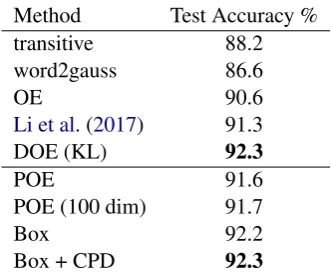
Table 3: Classification accuracy on WordNet test set.
edge transitive closure of the WordNet hypernym hierarchy as positive training examples for the development set, 4,000 for the test set, and us-ing the rest as trainus-ing data. Negative trainus-ing examples are created by randomly corrupting a train/development/test edge(u, v)by replacing ei-theruorvwith a randomly chosen negative node.
We use their specific train/dev/test split, while Athiwaratkun and Wilson (2018) use a different train/dev split with the same test set (personal communication) to examine the effect of different negative sampling techniques. We cite their best performing model, called DOE (KL).
Since our model is probabilistic, we would like a sensible value forP(n), wherenis a node. We
assign these marginal probabilities by looking at
the number of descendants in the hierarchy un-der a node, and normalizing over all nodes, taking
P(n) = |descendants(n)|nodes| |.
Furthermore, we use the graph structure (only of the subset of edges in the training set to avoid leaking data) to augment the data with ap-proximate conditional probabilities P(x|y). For each leaf, we consider all of its ancestors as pairwise co-occurences, then aggregate and di-vide by the number of leaves to get an approx-imate joint probability distribution, P(x, y) =
|x, y co-occur in ancestor set|
|leaves| . With this and the unary
marginals, we can create a conditional probabil-ity table, which we prune based on the difference ofP(x|y)andP(y|x)and add cross entropy with these conditional “soft edges” to the training data. We refer to experiments using this additional data as Box + CPD in Table3.
[image:8.595.98.264.348.485.2]aggregating up the WordNet lattice, would further strengthen this effect.
[image:9.595.77.295.138.271.2]5.3 Flickr Entailment Graph
Figure 3: R between model and gold probabilities.
P(x|y)
Full test data KL Pearson R
POE 0.031 0.949
POE* 0.031 0.949
Box 0.020 0.967
Unseen pairs
POE 0.048 0.920
POE* 0.046 0.925
Box 0.025 0.957
Unseen words
POE 0.127 0.696
POE* 0.084 0.854
Box 0.050 0.900
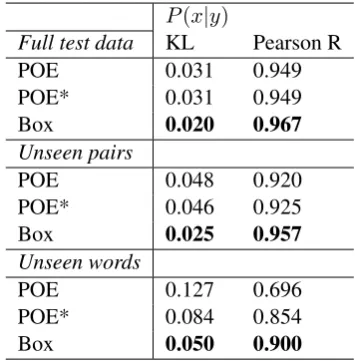
Table 4: KL and Pearson correlation between model and gold probability.
We conduct experiments on the large-scale Flickr entailment dataset of 45 million image cap-tion pairs. We use the exactly same train/dev/test from Lai and Hockenmaier (2017). We use a slightly different unseen word pairs and unseen words test data, obtained from the author. We include their published results and also use their published code, marked⇤, for comparison.
For these experiments, we relax our boxes from the unit hypercube to the nonnegative or-thant and obtain probabilities under the exponen-tial measure, p(x) = exp( x). We enforce the nonnegativity constraints by clipping the LSTM-generated embedding (Hochreiter and Schmidhu-ber, 1997) for the box minimum with a ReLU,
and parametrize our embeddings using a soft-plus activation to prevent dead units. As in Lai and Hockenmaier(2017), we use 512 hidden units in our LSTM to compose sentence vectors. We then apply two single-layer feed-forward networks with 512 units applied to the final LSTM state to produce the embeddings.
As we can see from Table4, we note large im-provements in KL and Pearson correlation to the ground truth entailment probabilities. In further analysis, Figure3demonstrates that while the box model outperforms POE in nearly every regime, the highest gains come from the comparatively dif-ficult to calibrate small entailment probabilities, indicating the greater capability of our model to produce fine-grained distinctions.
6 Conclusion and Future Work
We have only scratched the surface of possible applications. An exciting direction is the in-corporation of multi-relational data for general knowledge representation and inference. Sec-ondly, more complex representations, such as 2n-dimensional products of 2-dimensional
con-vex polyhedra, would offer greater flexibility in tiling event space. Improved inference of the la-tent boxes, either through better optimization or through Bayesian approaches is another natural extension. Our greatest interest is in the applica-tion of this powerful new tool to the many areas where other structured embeddings have shown promise.
7 Acknowledgments
We thank Alice Lai for making the code from her original paper public, and for providing the additional unseen pairs and unseen words data. We also thank Haw-Shiuan Chang, Laurent Dinh, and Ben Poole for helpful discussions. We also thank the anonymous reviewers for their construc-tive feedback.
[image:9.595.91.269.330.511.2]References
Ben Athiwaratkun and Andrew Gordon Wilson. 2018.
On modeling hierarchical data via probabilistic or-der embeddings. In International Conference on Learning Representations.
Mohit Bansal, David Burkett, Gerard De Melo, and Dan Klein. 2014. Structured learning for
taxon-omy induction with belief propagation. In
Proceed-ings of the 52nd Annual Meeting of the Association for Computational Linguistics (Volume 1: Long Pa-pers), volume 1, pages 1041–1051.
Antoine Bordes, Nicolas Usunier, Alberto Garcia-Duran, Jason Weston, and Oksana Yakhnenko. 2013. Translating embeddings for modeling
multi-relational data. In Advances in neural information
processing systems, pages 2787–2795.
Y. J. Chu and T. H. Liu. 1995. On the shortest arbores-cence of a directed graph. Science Sinica, 20.
Michael Collins, Sanjoy Dasgupta, and Robert E Schapire. 2002. A generalization of principal
com-ponents analysis to the exponential family. In
Ad-vances in neural information processing systems, pages 617–624.
Katrin Erk. 2009. Representing words as regions in
vector space. InProceedings of the Thirteenth Con-ference on Computational Natural Language
Learn-ing, CoNLL ’09, pages 57–65, Stroudsburg, PA,
USA. Association for Computational Linguistics.
Salar Fattahi and Somayeh Sojoudi. 2017. Graphi-cal lasso and thresholding: Equivalence and closed-form solutions.arXiv preprint arXiv:1708.09479.
Jerome Friedman, Trevor Hastie, and Robert Tibshi-rani. 2008. Sparse inverse covariance estimation with the graphical lasso. Biostatistics, 9(3):432– 441.
Xavier Glorot and Yoshua Bengio. 2010. Understand-ing the difficulty of trainUnderstand-ing deep feedforward
neu-ral networks. InProceedings of the Thirteenth
In-ternational Conference on Artificial Intelligence and Statistics, pages 249–256.
Shizhu He, Kang Liu, Guoliang Ji, and Jun Zhao. 2015.
Learning to represent knowledge graphs with gaus-sian embedding. InProceedings of the 24th ACM International on Conference on Information and Knowledge Management, CIKM ’15, pages 623– 632, New York, NY, USA. ACM.
David Heckerman, Dan Geiger, and David M Chicker-ing. 1995. Learning bayesian networks: The com-bination of knowledge and statistical data. Machine learning, 20(3):197–243.
Sepp Hochreiter and J¨urgen Schmidhuber. 1997.
Long short-term memory. Neural computation,
9(8):1735–1780.
Alice Lai and Julia Hockenmaier. 2017. Learning to predict denotational probabilities for modeling en-tailment. InEACL.
Xiang Li, Luke Vilnis, and Andrew McCallum. 2017. Improved representation learning for predicting
commonsense ontologies. NIPS Workshop on
Struc-tured Prediction.
George A Miller. 1995. WordNet: a lexical database
for English.Communications of the ACM.
Maximillian Nickel and Douwe Kiela. 2017. Poincar´e
embeddings for learning hierarchical representa-tions. In I. Guyon, U. V. Luxburg, S. Bengio, H. Wallach, R. Fergus, S. Vishwanathan, and R.
Gar-nett, editors, Advances in Neural Information
Pro-cessing Systems 30, pages 6338–6347. Curran As-sociates, Inc.
Judea Pearl. 1988. Probabilistic reasoning in intelli-gent systems.
Daniel M Roy and Yee W Teh. 2009. The mondrian process. InAdvances in neural information process-ing systems, pages 1377–1384.
Ivan Vendrov, Ryan Kiros, Sanja Fidler, and Raquel Urtasun. 2016. Order-embeddings of images and language. InICLR.
Luke Vilnis and Andrew McCallum. 2015. Word rep-resentations via gaussian embedding. InICLR.
Adriaan C. Zaanen. 1997. Introduction to Operator