Proceedings of the 3rd Workshop on Representation Learning for NLP, pages 207–216 207
A Sequence-to-Sequence Model for Semantic Role Labeling
Angel Daza and Anette Frank
Leibniz ScienceCampus “Empirical Linguistics and Computational Language Modeling” Department of Computational Linguistics
Heidelberg University 69120 Heidelberg, Germany
{daza,frank}@cl.uni-heidelberg.de
Abstract
We explore a novel approach for Seman-tic Role Labeling (SRL) by casting it as a sequence-to-sequence process. We em-ploy an attention-based model enriched with a copying mechanism to ensure faith-ful regeneration of the input sequence, while enabling interleaved generation of argument role labels. Here, we apply this model in a monolingual setting, perform-ing PropBank SRL on English language data. The constrained sequence generation set-up enforced with the copying mecha-nism allows us to analyze the performance and special properties of the model on manually labeled data and benchmarking against state-of-the-art sequence labeling models. We show that our model is able to solve the SRL argument labeling task on English data, yet further structural de-coding constraints will need to be added to make the model truly competitive. Our work represents a first step towards more advanced, generative SRL labeling setups.
1 Introduction
Semantic Role Labeling (SRL) is the task of assigning semantic argument structure to con-stituents or phrases in a sentence, to answer the question: Who did what to whom, where and
when? This task is normally accomplished in two steps: first, identifying the predicate and second, labeling its arguments and the roles that they play with respect to the predicate. SRL has been for-malized in different frameworks, the most promi-nent being FrameNet (Baker et al., 1998) and PropBank (Palmer et al.,2005). In this work we focus onargument identification and labeling us-ing the PropBank (PB) annotation scheme.
Figure 1: An input sentence (top), its PropBank predicate-argument structure (middle) and its lin-earized labeled sequence produced by our system.
Recent end-to-end neural models considerably improved the state-of-the-art results for SRL in English (He et al.,2017;Marcheggiani and Titov, 2017). In general, such models treat the problem as a supervised sequence labeling task, using deep LSTM architectures that assign a label to each to-ken within the sentence.
SRL training resources for other languages are more restricted in size and thus, models suf-fer from sparseness problems because specific predicate-role instances occur only a handful of times in the training set. Since annotating SRL data in larger amounts is expensive, the use of a generative neural network model could be ben-eficial for automatically obtaining more labeled data in low-resource settings. The model that we present in this paper is a first step towards a joint label and language generation formulation for SRL, using the sequence-to-sequence architec-ture as a starting point.
Sequence-to-sequence (seq2seq) models were pioneered bySutskever et al.(2014), and later en-hanced with an attention mechanism (Bahdanau et al.,2014;Luong et al.,2015). They have been successfully applied in many related structure pre-diction tasks such as syntactic parsing (Vinyals et al.,2015), parsing into Abstract Meaning Rep-resentation (Konstas et al., 2017), semantic pars-ing (Dong and Lapata, 2016), and cross-lingual Open Information Extraction (Zhang et al.,2017). When applying a seq2seq model with attention in a monolingual SRL labeling setup, we need to restrict the decoder to reproduce the original input sentence, while in addition inserting PropBank la-bels into the target sequence in the decoding pro-cess (see Figure 1). To achieve this, we encode each input sentence into a suitable representation that will be used by the decoder to regenerate word tokens as given in the source sentence and intro-ducing SRL labels in appropriate positions to la-bel argument spans with semantic roles. In order to avoid lexical deviations in the output string, we add a copying mechanism (Gu et al.,2016) to the model. This technique was originally proposed to deal with rare words by copying them directly from the source when appropriate. We apply this mechanism in a novel way, with the aim of guid-ing the decoder to reproduce the input as closely as possible, while otherwise giving it the option of generating role labels in appropriate positions in the target sequence.
Our main contributions in this work are: (i) We propose a novel neural architecture for SRL using a seq2seq model enhanced with atten-tion and copying mechanisms.
(ii) We evaluate this model in a monolingual set-ting, performing PropBank-style SRL on standard English datasets, to assess the suitability of this model type for the SRL labeling task.
(iii) We compare the performance of our model to state-of-the-art sequence labeling models, in-cluding detailed (also comparative) error analysis. (iv) We show that the seq2seq model is suited for the task, but still lags behind sequence labeling systems that include higher-level constraints.
2 Model
We propose an extension to the Sequence-to-Sequence model of (Bahdanau et al.,2014) to per-form SRL.1 The model will learn to map an
unla-1In this work we restrict ourselves to argument labeling.
beled source sequence of words(x1...xTx)into a
target sequence(y1...yTy) consisting of word
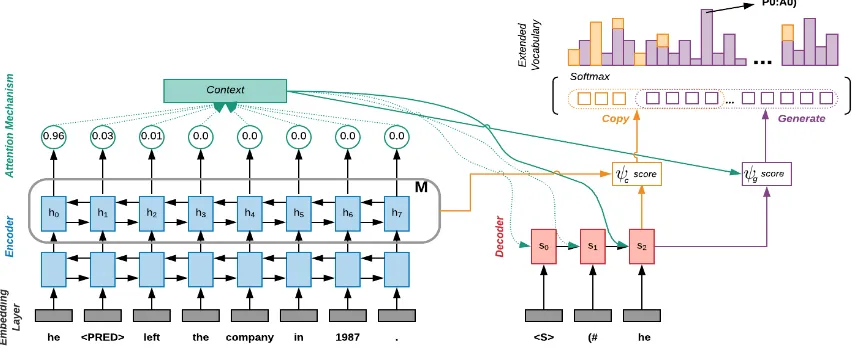
to-kens and SRL label toto-kens (see Figure 2). The source sentence, represented as a sequence of dense word vectors, is fed to an LSTM encoder to produce a series of hidden states that represent the input. This information is used by the decoder to recursively generate tokens step-by-step, con-ditioned on the previous generated tokens and the source by attending the encoder’s hidden states as proposed in Bahdanau et al. (2014). On top of this architecture, we add the copying mechanism (Gu et al.,2016), which helps the model to avoid lexical deviations in the output while still having the freedom of generating words and SRL labels based on the context. The attention-based gener-ation and copying mechanism will be competing with each other so that the model learns when to copy directly from the source and when to gener-ate the next token.
In our current setup we restrict role labeling to a single predicate per sentence. If a sentence has more than one predicate, we create a separate copy for each predicate; the same setting was applied in Zhou and Xu (2015). In each sentence copy the predicate whose roles are to be labeled is pre-ceded by a special token<PRED>that marks the position of the predicate under consideration. This helps the decoder to focus on generating argument labels for that specific predicate (see Table1.)
2.1 Vocabulary
We assume a unique vocabulary for both en-coder and deen-coder that comprises the words oc-curring during training, the out-of-vocabulary to-ken, and the special symbol used to mark the po-sition of the predicate, thus V = {v1, ..., vN} ∪ {U N K, < P RED >}. In addition, we employ a set L = {l1, ..., lM} with all the possible la-beled brackets and a setX = {x1..., xTx}, a
per-instance set containing theTxwords from the cur-rent source sequence. Thus, our total vocabulary is defined for each instance asV ∪ L ∪ X.
The label setL contains one common opening bracket (# for all argument types to indicate the beginning of an argument span, and several label-specific closing brackets, such as P0:A1), which indicates in this case that the span for argument
Figure 2: A sequence-to-sequence model for SRL. A score for copying and a score for generating tokens is computed at each time step and a joint softmax determines the probability of the next token over the extended vocabulary of wordsV, labelsLand current instance wordsX.
2.2 Encoder
We use a two-layer bi-RNN encoder with LSTM cells (Hochreiter and Schmidhuber, 1997) that outputs a series of hidden states hj =
h−→ hj;
←−
hj
i
where eachhj contains information about the sur-rounding context of the wordxj. We refer to the complete matrix of encoder hidden states as M, since it acts as a memory that the decoder can use to copy words directly from the source.
2.3 Attention Mechanism
We use the global dot product attention from Lu-ong et al.(2015) to compute the context vectorci:
ci =
PTx
j=1αijhj ; αij =
exp(ei,j)
PTx
k=1exp(ei,k) (1)
whereei,jis the dot product function between de-coder statesi−1and each encoder hidden statehj.
2.4 Decoder
The role of the decoder (a single-layer recurrent unidirectional LSTM) is to emit an output token
ytfrom a learned distribution over the vocabulary at each time steptgiven its state st, the previous output tokenyt−1, the attention context vectorct, and the memory M. To get this distribution it is necessary to compute two separate modes: one for generating and one for copying.
To obtain the probability of generating yt we use the context vector produced by the attention to learn a score ψg for each possible token vi of
being the next generated token. We defineψgas:
ψg(yt=vi) =Wo[st;ct], viV ∪ L (2)
where WoRN×2ds is a learnable parameter and st,ctare the current decoder state and context vec-tor respectively. This means that the model com-putes a generation score for both words and labels, based on what it is attending on at the current step. For the probability of copying yt we compute the scoreψcof copying a token directly from the source as:
ψc(yt=xj) =σ(hTjWc)st, xjX (3)
whereWcRdh×ds is a learnable parameter, h
j is the encoder hidden state representingxj,stis the current decoder state, andσ is a non-linear trans-formation; we usedtanhfor our experiments.
Using the two scoring methods, the decoder will have two competing modes: the generation mode, used to generate the most probable subsequent to-ken based on attention; and the copying, used to choose the next token directly from the encoder memoryM, which holds both positional and con-tent information of the source. A final mixed dis-tribution is calculated by adding the probability of generatingytand the probability of copyingyt:
p(yt|st, yt−1, ct,M) =p(yt,g|st, yt−1, ct)+
p(yt,c|st, yt−1,M) (4)
Source-1: The trade figures<PRED>turn outwell , and all those recently unloaded bonds spurt in price .
Target-1: (#The trade figuresP0:A1) (#turn outP0:V)(#wellP0:A2), and all those recently unloaded bonds spurt in price .
Source-2: The trade figures turn out well , and all those recently<PRED>unloadedbonds spurt in price .
Target-2: The trade figures turn out well , and all those(#recentlyP0:AM-TMP) (#unloadedP0:V)(#bondsP0:A1)spurt in price .
Source-3: The trade figures turn out well , and all those recently unloaded bonds<PRED>spurtin price .
Target-3: The trade figures turn out well , and(#all those recently unloaded bondsP0:A1)(#spurtP0:V)(#in priceP0:AM-ADV).
Table 1: A single sentence with three labeled predicates is converted into three different source-target pairs. The symbol <PRED>in each source marks the predicate for which the model is expected to generate a correct predicate-argument structure.
likelihood of generating and copying yt. Again followingGu et al.(2016), we define this as:
p(yt,g|·) =
1
Zeψg(yt) ytV ∪ L
0 otherwise
p(yt,c|·) =
(
1 Z
P
j:xj=yte
ψc(xj) y
tX
0 otherwise
(5)
where Z is the normalization term shared by the two modes, Z = P
vVeψg(v) + P
xXeψc(x).
Since a singlesoftmaxis applied over the copying and generating modes, the network learns by itself when it is proper to copy a word from the source and when it needs to generate a label.
During training, the objective is to minimize the negative log-likelihood of the target token yt for each time-step for both generate mode (given previous generated tokens) and copy mode (given source sequenceX). We calculate the loss for the whole sequence as:
loss=− 1
Ty Ty
X
t=0
logP(yt|y<t, X) (6)
3 Experimental Setup
3.1 Datasets and Evaluation Measures
We test the performance of our system on the span-based SRL datasets CoNLL-052 and CoNLL-12.3 These datasets provide the gold predicate as part of the input. Since we focus on argument identification and classification, we provide this information in the input to the sys-tem. We use the standard training, development
2
http://www.lsi.upc.edu/˜srlconll/ home.html
3http://conll.cemantix.org/2012/data.
html
and test splits and use the official CoNLL-05 eval-uation script on both datasets. We compare our re-sults withCollobert et al.(2011);FitzGerald et al. (2015);Zhou and Xu(2015) andHe et al. (2017) who use the same datasets and evaluation script. We show results separately for the Brown and WSJ portion of the CoNLL-05 test dataset.
The CoNLL-05 Shared Task4 evaluation script computes precision, recall and F1 measure (the harmonic mean of precision and recall) for the pre-dicted arguments. The script expects prediction-gold pairs that have the same number of words in order to consider them comparable, and only if this is the case, it computes a score. Furthermore, an argument is only considered correct if the words spanning the argument as well as its role label match with gold (Carreras and M`arquez, 2005). This means that it is essential to predict perfect argument spans besides the correct role label.
3.2 Pre-processing
For our seq2seq model we need to provide sources and targets in a linearized manner. The sequences are sentences with zero or more predicates. Fol-lowingZhou and Xu(2015), if a sentence hasnp predicates we process the sentencenptimes, each one with its corresponding predicate-argument structure. As shown in Table1, we linearize the target side by converting the CoNLL format into sequences of tokens that include brackets indicat-ing the span of the argument and the argument la-bel on the closing bracket. We inform the model about the predicate that it should focus on by adding the special token<PRED>to the source sequence immediately before the predicate word. This process is entirely reversible and thus we con-vert the system outputs back to CoNLL format and evaluate the results with the official script.
4
CoNLL-05 CoNLL-12
Dev WSJ Brown Dev Test
Seq2seq ( attention-only)
same length 29.19 29.98 32.24 -
-brackets 95.25 94.93 94.24 -
-Seq2seq (w/ Attention & Copying)
[image:5.595.309.525.64.156.2]same length 96.71 97.15 97.24 97.46 96.07 brackets 99.91 99.82 99.88 99.97 99.93
Table 2: Quality of reproducing words and SRL brackets with seq2seq: Attention-only vs. Atten-tion & Copying, on CoNLL-05 and CoNLL-12 datasets: percentage of correctly reproduced sen-tence length and percentage of balanced brackets.
3.3 Training
Since we process as many copies of sentences as it has predicates, the final amount of sequences is approximately 94K for CoNLL-05 and 185K for CoNLL-12 training sets. We keep linearized se-quences up to 100 tokens long and lowercase all tokens. Given this limit, we omit 30 (CoNLL-05) and 900 (CoNLL-12) sequences from train-ing. We initialize the model with pre-trained 100-dimensional GloVe embeddings (Pennington et al.,2014) and update them during training.5All the tokens that are not covered by GloVe or that appear less frequently than a given threshold6 in the training dataset are mapped to theU N K em-bedding. We keep track of this mapping to be able to post-process the sequence and recover the rare tokens. Our vocabulary size is set to|V| ≈ 20K
words for CoNLL-05 and |V| ≈ 18K words for CoNLL-12.
We use Adam optimizer (Kingma and Ba, 2014), a learning rate lr = 0.001 and gradient clipping at 5.0. Both encoder and decoder have hidden layer of 512 LSTMs. We use dropout (Sri-vastava et al.,2014) of 0.4 and train for 4 epochs with batch size of 6.
4 Evaluation and Results
Initially, we trained a model using attention only, and it learned to generate balanced brackets (ev-ery opening bracket has a corresponding closing
5We also experimented with word2vec word embed-dings (Mikolov et al., 2013) but found GloVe6B (trained on Wikipedia2014+Gigaword5) embeddings to perform better. Available at https://nlp.stanford.edu/ projects/glove/
6We used a threshold of 10 for CoNLL-05 and 15 for CoNLL-12.
CoNLL-05 CoNLL-12 dev test WSJ Brown dev test
Collobert 72.29 74.15 - - - -FitzGerald 78.3 - 79.4 71.2 79.2 79.6 Zhou & Xu 79.55 81.27 82.84 69.41 81.07 81.27 He 81.6 81.6 83.1 72.1 81.5 81.7 Ours (min) 76.05 76.7 78.13 66.28 73.4 73.61 Ours (max) 77.29 77.87 79.23 68.39 75.05 75.43
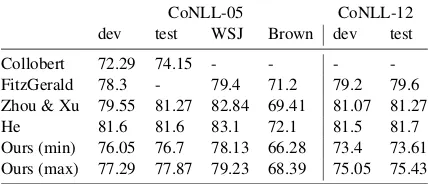
Table 3: F1 measure for argument role labeling of our seq2seq model w/ Attention & Copying on CoNLL-05 and CoNLL-12 dev and test sets, com-pared to Collobert w/o parser, FitzGerald single model, Zhou & Xu, and He single model .
bracket within the sequence) without further con-straints. Yet, due to its generative nature, many target sequences diverged from the source in both length and token sequences. This was expected, because the system has to learn to generate not only the labels at the correct time-step but also to re-generate the complete sentence accurately. This is a disadvantage compared to the sequence label-ing models where the words are already given.
By adding copying mechanism the model suc-cessfully regenerates the source sentence in the majority (up to 99%) of cases, as shown in Ta-ble2. Such behavior also enables us to measure the performance of the model as an argument role classifier against the gold standard. Thus, we can benchmark its labeling performance against previ-ous architectures built to solve the SRL task.
Table 3 displays the overall labeling perfor-mance of our copying-enhanced seq2seq model in comparison to previous neural sequence labeling architectures. For sequences that do not fully re-produce the input, we cannot compute appropriate scores against the gold standard. We compute two alternative scores for these cases: oracle-min, by setting the score for these sentences to 0.0 F1, and
oracle-max, by setting their results to the scores we would obtain with perfect (= gold) labels. With these scores, we can better estimate the loss we are experiencing by non-perfectly reproduced se-quences (see Table2.)
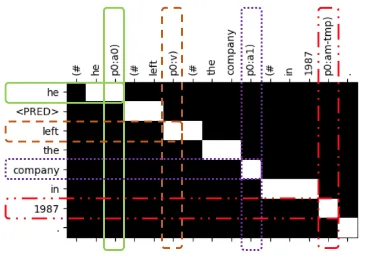
[image:5.595.82.280.64.174.2]Figure 3: Example of the alignments learned by the attention mechanism.
that in contrast to the stronger models of FitzGer-ald et al.(2015);Zhou and Xu(2015) andHe et al. (2017), our architecture is very lean and does not (yet) employ structured prediction (e.g. Condi-tional Random Field), to impose structural con-straints on the label assignment. While this is cer-tainly an extension we are going to explore in fu-ture work, here we will conduct deeper investiga-tion to learn more about the kind of errors that our unconstrained seq2seq model makes. We report the analysis on CoNLL-05 development set.
4.1 Analysis
Argument Spans The model needs to generate labeled brackets at the appropriate time-step, in other words, the prediction of correct spans for arguments. To verify how well it is doing this, we measure how much overlap exists between the generated spans and the gold ones. This is equiva-lent to computing unlabeled argument assignment. We found that 77.5% of the spans match the gold spans completely, 21.2% of spans are partially overlapping with gold spans, and only 1.2% of the spans do not overlap at all with gold.
Argument Labels Recall from Section 2 that our model is labeling the sentences as in a trans-lation task. It learns to use information from rel-evant words in the source sequence, aligning the labels to the argument words via learned attention weights as it is shown in Figure 3. This allows us to see where the model is looking when gen-erating the labeled bracket. The confusion ma-trix in Figure 4 shows predicted vs. gold labels for all correctly assigned argument spans (i.e., the spans that match the gold boundaries). We observe that the model does very well for A0 and A1 gold roles, and that it causes only few misclassifications for A2. However, it frequently predicts core
[image:6.595.327.504.63.239.2]ar-Figure 4: Confusion matrix showing percentage of predicted labels compared to the gold labels on the CoNLL-05 development set.
Figure 5: Percentage of sentences with 0,1,2 or more missing (blue) or excess (orange) arguments (seq2seq w/Copying, CoNLL-05, dev set).
gument roles A0–A3 for non-argument roles, and also tends to mix predictions among non-core ar-guments. Since A0 and A1 roles are most frequent in the data, this indicates that the seq2seq model would benefit from more training data, particularly for less frequent roles, to better differentiate roles, and this is more prominent for the ones that are marked with prepositions.
Role co-occurrence and role set constraints
[image:6.595.307.527.304.436.2]Figure 6: Performance of the model based on the number of tokens that the sequence has.
Figure 7: F1 score of arguments in buckets of in-creasing distances from their predicate, with dis-tance normalized by sentence length (CoNLL-05, dev). We compare our model withHe et al.(2017).
missed vs. excess arguments are balanced.
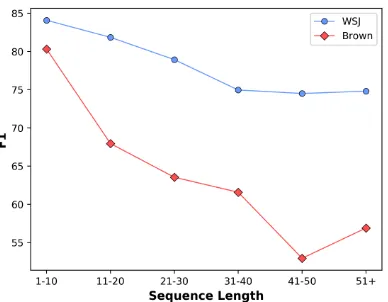
Sequence LengthAnother characteristic of the seq2seq model is that it encodes within a single sequence both words and labeled brackets. This increases the length of the sequences that need to be processed, and it is a well known problem that sequence length affects performance of recurrent neural models, even with the use of attention.
To measure the labeling performance difficulty with increasing sequence length, we partitioned the system outputs in six different bins containing groups of sentences of similar length (see Figure 6). As expected, the F1 score degrades propor-tionally to the length of the sequence, especially in sentences with more than 30 tokens.
Distance to predicate He et al. (2017) show
Figure 8: Error ratio of arguments in different re-gions of the sequences (CoNLL-05, dev).
that the surface distance between the argument and the predicate is also proportional to the amount of labeling errors. In our model, the distance between argument words and the predicate is even longer because of labeled brackets embedded in the se-quence. Figure7displays the F1 score for differ-ent token distances between predicate and the re-spective argument. We see that the seq2seq model follows the same trend as the sequence labeling model, despite the fact that our model has access to the hidden states from the encoded input sen-tence; however, the real distance between predi-cate and argument in the decoder is also bigger.
Distance from sentence beginning. With each token that the model generates in decoding, the distance to the end position of the encoded sen-tence representation grows. While intuitively we would expect the model performance to degrade with larger distance to the input, it is also true that the model could be more prone to making mistakes at the beginning of the sequence, when the decoder has not yet generated enough context. To investi-gate this, we traced the ratio of errors that occur in several ranges of the sequence. We can see in Figure8that the first intuition was correct, the dis-tance to the encoded representation is proportional to the mistakes that the model makes. We com-pare the error ratio to He et al. (2017) and show that the seq2seq system follows a similar trend but degrades faster with sequence length.
5 Related Work
[image:7.595.84.279.304.453.2](T¨ackstr¨om et al., 2015). First neural SRL at-tempts tried to mix syntactic features with neural network representations. For example,FitzGerald et al.(2015) created argument and role representa-tions using a feed-forward NN, and used a graphi-cal model to enforce global constraints. Roth and Lapata(2016), on the other hand, proposed a neu-ral classifier using dependency path embeddings to assign semantic labels to syntactic arguments.
Collobert et al. (2011) proposed the first SRL neural model that did not depend on hand-crafted features and treated the task as an IOB sequence labeling problem. Later,Zhou and Xu(2015) pro-posed a deep bi-directional LSTM model with a CRF layer on top. This model takes only the orig-inal text as input and assigns a label to each in-dividual word in the sentence. He et al. (2017) also treat SRL as a IOB tagging problem, and use again a deep bi-LSTM incorporating highway connections, recurrent dropout and hard decod-ing constraints together with an ensemble of ex-perts. This represents the best performing sys-tem on two span-based benchmark datasets so far (namely, CoNLL-05 and CoNLL-12). Marcheg-giani et al.(2017) show that it is possible to con-struct a very accurate dependency-based SRL sys-tem without using any kind of explicit syntactic information. In subsequent work, Marcheggiani and Titov(2017) combine their LSTM model with a graph convolutional network to encode syntactic information at word level, which improves their LSTM classifier results on the dependency-based benchmark dataset (CoNLL-09).
Sequence-to-sequence models. Seq2seq mod-els were first discovered as powerful modmod-els for Neural Machine Translation (Sutskever et al., 2014;Cho et al.,2014) but soon proved to be use-ful for any kind of problem that could be repre-sented as a mapping between source and target se-quences. Vinyals et al. (2015) demonstrate that constituent parsing can be formulated as a seq2seq problem by linearizing the parse tree. They obtain close to state-of-the-art results by using a large automatically parsed dataset. Dong and Lapata (2016) built a model for a related problem, seman-tic parsing, by mapping sentences to logical form. Seq2seq models have also been widely used for language generation (e.g.Karpathy and Li(2015); Chisholm et al.(2017)) given their ability to pro-duce linguistic variation in the output sequences.
More closely related to SRL is the AMR
pars-ing and generation system proposed by Konstas et al.(2017). This work successfully constructs a two-way mapping: generation of text given AMR representations as well as AMR parsing of natural language sentences. Finally, Zhang et al. (2017) went one step further by proposing a cross-lingual end-to-end system that learns to encode natural language (i.e. Chinese source sentences) and to de-code them into sentences on the target side con-taining open semantic relations in English, using a parallel corpus for training.
6 Conclusions
In this paper we explore the properties of a Sequence-to-Sequence model for identifying and labeling PropBank roles. This is motivated by the fact that using a seq2seq model gives more flexi-bility for further tasks such as constrained gener-ation and cross-lingual label projection. Another advantage is that our model is a very lean architec-ture compared to the deep Bi-LSTM of the recent SRL models.
To our knowledge, this is the first attempt to perform SRL using a seq2seq approach. Specific challenges emerged by formulating the problem in this way, such as: (i) the decoding of labels and words within a single sequence; (ii) generat-ing balanced labeled brackets at the correct posi-tion; (iii) avoiding repetition of tokens, and espe-cially, (iv) generating labeled sequences that per-fectly match the source sentence in order to make the labeled sequence absolutely comparable.
Despite these difficulties, we could show that a sequence-to-sequence model with attention and copying achieves quite respectable labeling per-formance with a lean architecture and without yet considering structural constraints. For future work we consider extensions towards joint semantic role labeling and constrained generation, to produce new variations of existing labeled data.
Acknowledgements
References
Dzmitry Bahdanau, Kyunghyun Cho, and Yoshua Ben-gio. 2014. Neural Machine Translation by Jointly Learning to Align and Translate.
Collin F. Baker, Charles J. Fillmore, John B. Lowe, Collin F. Baker, Charles J. Fillmore, and John B. Lowe. 1998. The berkeley framenet project. In
Proceedings of the 17th international conference on Computational linguistics, volume 1, page 86, Mor-ristown, NJ, USA. Association for Computational Linguistics.
Xavier Carreras and Llu´ıs M`arquez. 2005. Intro-duction to the conll-2005 shared task: Semantic role labeling. InProceedings of the Ninth Confer-ence on Computational Natural Language Learn-ing, CONLL ’05, pages 152–164, Stroudsburg, PA, USA. Association for Computational Linguistics.
Andrew Chisholm, Will Radford, and Ben Hachey. 2017. Learning to generate one-sentence biogra-phies from wikidata. In Proceedings of the 15th Conference of the European Chapter of the Associa-tion for ComputaAssocia-tional Linguistics: Volume 1, Long Papers, pages 633–642. Association for Computa-tional Linguistics.
Kyunghyun Cho, Bart van Merri¨enboer, C¸ alar G¨ulc¸ehre, Dzmitry Bahdanau, Fethi Bougares, Hol-ger Schwenk, and Yoshua Bengio. 2014. Learning phrase representations using rnn encoder–decoder for statistical machine translation. InProceedings of the 2014 Conference on Empirical Methods in Nat-ural Language Processing (EMNLP), pages 1724– 1734, Doha, Qatar. Association for Computational Linguistics.
Ronan Collobert, Jason Weston, Lon Bottou, Michael Karlen, Koray Kavukcuoglu, and Pavel P. Kuksa. 2011. Natural language processing (almost) from scratch. Journal of Machine Learning Research, 12:2493–2537.
Li Dong and Mirella Lapata. 2016. Language to logi-cal form with neural attention. InProceedings of the 54th Annual Meeting of the Association for Compu-tational Linguistics (Volume 1: Long Papers), pages 33–43. Association for Computational Linguistics.
Nicholas FitzGerald, Oscar T¨ackstr¨om, Kuzman Ganchev, and Dipanjan Das. 2015. Semantic role labeling with neural network factors. In Proceed-ings of the 2015 Conference on Empirical Methods in Natural Language Processing (EMNLP ’15).
Jiatao Gu, Zhengdong Lu, Hang Li, and Victor O.K. Li. 2016. Incorporating copying mechanism in sequence-to-sequence learning. In Proceedings of the 54th Annual Meeting of the Association for Com-putational Linguistics (Volume 1: Long Papers), pages 1631–1640, Berlin, Germany. Association for Computational Linguistics.
Luheng He, Kenton Lee, Mike Lewis, and Luke Zettle-moyer. 2017. Deep semantic role labeling: What works and whats next. In Proceedings of the An-nual Meeting of the Association for Computational Linguistics.
Sepp Hochreiter and J¨urgen Schmidhuber. 1997. Long short-term memory. Neural Comput., 9(8):1735– 1780.
Andrej Karpathy and Fei-Fei Li. 2015. Deep visual-semantic alignments for generating image descrip-tions. pages 3128–3137. IEEE Computer Society.
Diederik P. Kingma and Jimmy Ba. 2014. Adam: A method for stochastic optimization. CoRR, abs/1412.6980.
Ioannis Konstas, Srinivasan Iyer, Mark Yatskar, Yejin Choi, and Luke Zettlemoyer. 2017. Neural amr: Sequence-to-sequence models for parsing and gen-eration. pages 146–157.
Thang Luong, Hieu Pham, and Christopher D. Man-ning. 2015. Effective approaches to attention-based neural machine translation. In Proceedings of the 2015 Conference on Empirical Methods in Natural Language Processing, EMNLP 2015, Lisbon, Portu-gal, September 17-21, 2015, pages 1412–1421.
Diego Marcheggiani, Anton Frolov, and Ivan Titov. 2017.A simple and accurate syntax-agnostic neural model for dependency-based semantic role labeling. InProceedings of the 21st Conference on Computa-tional Natural Language Learning (CoNLL 2017), pages 411–420, Vancouver, Canada. Association for Computational Linguistics.
Diego Marcheggiani and Ivan Titov. 2017. Encoding sentences with graph convolutional networks for se-mantic role labeling. In Proceedings of the 2017 Conference on Empirical Methods in Natural Lan-guage Processing, pages 1506–1515, Copenhagen, Denmark. Association for Computational Linguis-tics.
Tomas Mikolov, Ilya Sutskever, Kai Chen, Greg Cor-rado, and Jeffrey Dean. 2013. Distributed represen-tations of words and phrases and their composition-ality. InProceedings of the 26th International Conference on Neural Information Processing Systems -Volume 2, NIPS’13, pages 3111–3119, USA. Curran Associates Inc.
Martha Palmer, Paul Kingsbury, and Daniel Gildea. 2005. The proposition bank: An annotated corpus of semantic roles.Computational Linguistics, 31.
Vasin Punyakanok, Dan Roth, and Wen-tau Yih. 2008.
The importance of syntactic parsing and infer-ence in semantic role labeling. Comput. Linguist., 34(2):257–287.
Michael Roth and Mirella Lapata. 2016. Neural se-mantic role labeling with dependency path embed-dings. In Proceedings of the 54th Annual Meet-ing of the Association for Computational LMeet-inguistics (Volume 1: Long Papers), pages 1192–1202, Berlin, Germany. Association for Computational Linguis-tics.
Nitish Srivastava, Geoffrey Hinton, Alex Krizhevsky, Ilya Sutskever, and Ruslan Salakhutdinov. 2014.
Dropout: A simple way to prevent neural networks from overfitting. J. Mach. Learn. Res., 15(1):1929– 1958.
Ilya Sutskever, Oriol Vinyals, and Quoc V Le. 2014.
Sequence to sequence learning with neural net-works. pages 3104–3112.
Oscar T¨ackstr¨om, Kuzman Ganchev, and Dipanjan Das. 2015. Efficient inference and structured learn-ing for semantic role labellearn-ing. Transactions of the Association for Computational Linguistics, 3:29–41.
Oriol Vinyals, Ł ukasz Kaiser, Terry Koo, Slav Petrov, Ilya Sutskever, and Geoffrey Hinton. 2015. Gram-mar as a foreign language. pages 2773–2781.
Sheng Zhang, Kevin Duh, and Benjamin Van Durme. 2017. Mt/ie: Cross-lingual open information ex-traction with neural sequence-to-sequence models. InProceedings of the 15th Conference of the Euro-pean Chapter of the Association for Computational Linguistics: Volume 2, Short Papers, pages 64–70. Association for Computational Linguistics.