Effect of TiB
2Particles on Microstructure of 7075 Al Alloy
in Semi-Solid State Near Liquidus
Gui-sheng Gan
1,+, Huai-shan Wang
1, Guo-qi Meng
1and Bin Yang
2 1Chongqing Municipal Engineering Research Center of Institutions of Higher Educationfor Special Welding Materials and Technology, Chongqing 400054, China
2State Key Laboratory for Advanced Metals and Materials, University of Science & Technology,
Beijing, Beijing 100083, China
TiB2/7075 Al matrix composites were formed byin situreaction, and effect of the TiB2particles content on microstructure of 7075 Al
alloy in semi-solid state near liquidus were investigated. The results have shown that the average grain size decreased with increased the amount of TiB2, and the microstructure became uniform rosette grains. The morphology of grains became big dendrite grains when the particles content
were over 4.5 mass%. Globular grains of 7075 Al alloy whose size reached 94 µm can be got for 7.5 min at 630°C. The minimum grain size of 3 mass%TiB2/7075, 4.5 mass%TiB2/7075 and 9 mass%TiB2/7075 Al matrix composites at 630°C were 88 µm, 51 µm and 69 µm for 30 min,
20 min and 50 min, respectively. The TiB2particles located in the grain boundary can hinder the Al atoms from diffusing within the semi-solid
state of the 7075 Al alloy and restrain¡-Al phase growth, but it can be conducive to improve the stability of semi-solid slurry in near-liquidus thixoforming. [doi:10.2320/matertrans.M2014447]
(Received December 4, 2014; Accepted August 24, 2015; Published October 9, 2015)
Keywords: in situ reaction, 7075 Al alloy, semi-solid, globular grain, TiB2particles
1. Introduction
Semisolid forming (SSM) was a near-net-shape forming technology for metals and alloys developing at MIT during the 1970s.1,2) SSM was considered as one of the most
prospective materials processing technologies in 21 century. The key issue of semi-solid forming is how to fabricate the proper slurry containing the non-dendritic microstructure.3)
Semisolid slurry of thixocasting is prepared by reheating at the solid state, which need no stirring.
7075 Al alloy have been widely used as structural materials in aeronautical industries due to their attractive comprehensive properties, such as low density, high strength, ductility, toughness. Previous work has shown that SSM processing were appropriate for 7075 Al alloy, including rheocasting49)and thixocasting.1012)The author also studied the effect of TiB2on the semi-solid microstructure of 7075 Al
alloy in the rheocasting process.1317) But the effect of the TiB2 particles on microstructure of 7075 Al alloy slurry by
thixocasting in semi-solid state near liquidus has no in-depth study. The present work is, combining with in-situreaction, to prepare 7075 Al alloy semi-solid slurry by reheating at semisolid temperature after adding TiB2 particles.
2. Experimental
The material we studied was a commercial wrought 7075 Al alloy. The liquidus and solidus temperature of the alloy were 639.1°C and 477.4°C, respectively.13) The chemical composition of 7075 alloy used in present study was Al-5.52 mass%Zn-2.36 mass%Mg-1.51 mass%Cu-0.18 mass% Si-0.26 mass%Fe-0.15 mass%Mn-0.25 mass%Cr. K2TiF6(mass>
97%) and KBF4 (mass>97%) mixture were put into the
molten of 7075 alloy at 850°C. After stirring at the same temperature for about 30 min and degassing by using C2Cl6,
the molten of TiB2/7075 Al composites and 7075 Al alloy at
720°C was casted in 15-mm diameter’s graphite mould. Casts were cut out respectively n height of 8 mm, and then these were put into the holding furnace at 630°C. Finally, the samples can be obtained by immediately quenching with the different holding time.
The grain size and area of the primary solid phase were analyzed statistically by a quantitative image analysis system. A close observation of microstructure can be given by average gain diameter D=2(A/³)1/2 and shape factor F=
4³A/P2, where A and P are average area and average
perimeter of primary phase, respectively.
3. Results and Discussion
3.1 Influence of the TiB2 particles content on micro-structure of 7075 Al alloy
Figure 1 shows the microstructure of 3% (in mass, similarly hereinafter) TiB2/7075 and 4.5%TiB2/7075,
6%TiB2/7075 and 9%TiB2/7075 Al matrix composites after
pouring into graphite mould at 720°C. After adding 3%TiB2,
the microstructure becomes uniform rosette grains, and the grain size shows a decreasing tendency with increasing of TiB2 particles. The morphology of grains become big
dendrite grains after adding 6%TiB2. 9%TiB2/7075 Al
matrix composites is also mainly composed of the dendrite grains, but the grain size is smaller than 6%TiB2/7075 Al
matrix composites.
Quested1821)found that the grain size shown a minimum as average particle diameter was decreased. Although it shown a different experiment result of minimum grain size and its average particle diameter, the tendencies are generally the same. As the average particle diameter is decreased, the number of particles must increase, and this leads to a decrease in grain size. But smaller particles give intrinsically less good refinement as their activation at greater under-cooling leads to faster growth. It is found that smaller particle
gives larger grain size if the number of particles is held constant. Particles larger than³1 µm are mostly active, while those smaller than³0.5 µm are mostly inactive.19)
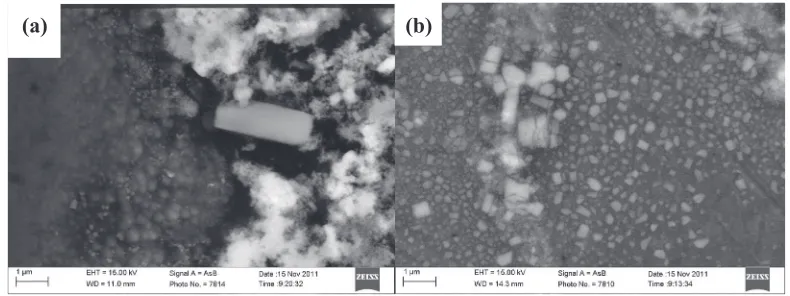
The micrograph of TiB2 particles in the TiB2/7075 Al
matrix composites is as shown in Fig. 2. Most TiB2particles
reach about 900³1400 nm in 3%TiB2/7075 composites,
even individual up to 2000 nm. Large size of TiB2 particles
are distributed in grain boundary area, and a large number of scattered small TiB2 particles with size of 100³400 nm are
irregular polygon near the boundary inside the nucleus in 9%TiB2/7075 composites. Tiny TiB2 particles are engulfed
easily in the interface, bringing about the pushing of TiB2
particles. More active TiB2 particles and much less small
TiB2 particles can be found in 4.5%TiB2/7075 composites,
so the grain size is the smallest, comparing with 9%TiB2/
7075 composites.
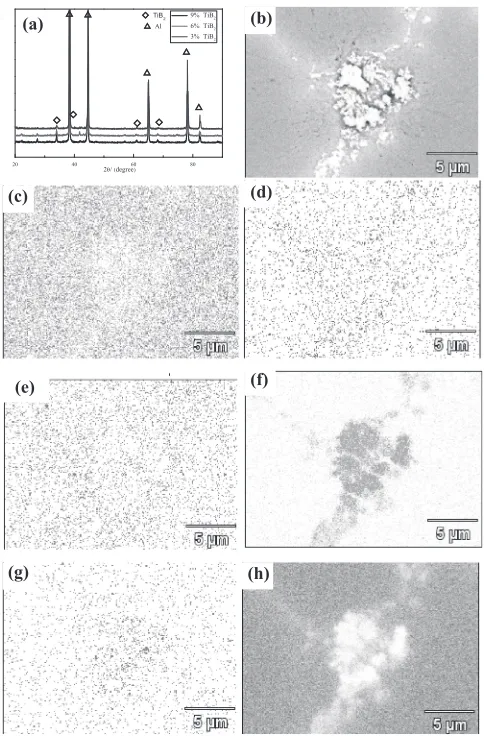
The XRD of TiB2/7075 and the area scanning of 3%TiB2/
7075 composites are listed as shown in Fig. 3(a) and (b)³(h), respectively. It can be seen that the microstructure consists of Al and TiB2phases, and no other phase can be found. At
the same time, the peak intensity of TiB2 became more
intense with the increasing of TiB2. The results show that
the elements of Mg, Cu and Zn to be determined are homogeneously distributed in samples. Ti elements and B elements mainly concentrate on the grain boundary, but some Ti elements and B elements distribute in the grain from Fig. 3(f ) and (g) which is to say that some TiB2particles can
play as the stable nucleus during solidification.
3.2 Influence of the holding time on microstructure of 7075 Al alloy in semi-solid state near liquidus
Figure 4 shows the microstructure of the solid 7075 Al
(d)
(c)
(b)
(a)
Fig. 1 The microstructure of the solid TiB2/7075 Al matrix composites; (a) 3%TiB2/7075, (b) 4.5%TiB2/7075, (c) 6%TiB2/7075,
(d) 9%TiB2/7075.
(b)
(a)
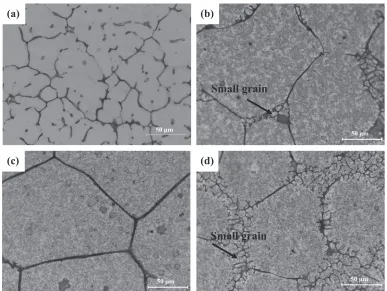
[image:2.595.105.491.69.359.2] [image:2.595.100.495.406.554.2]alloy with the different holding time at 630°C which is near liquidus in semi-solid state, the maximum grain size is about 250 µm of the solid 7075 Al alloy. The branch of rosette grains begins to melt increasing gradually with time, and ¡-Al grains contract to sphere because spherical surface has the smallest surface energy. It can be got good globular grains for 7.5³10 min. The mean grain size can reach 94 µm, and the shape factor can reach 0.65 and 0.78 for 7.5 and 10 min, respectively.
The magnified microstructure of the solid 7075 Al alloy with the different holding time at 630°C are shown in Fig. 5. The dendrite structures of¡-Al grains melt to form globular grain with holding 7.5 min, and the very small grain exists on the grain boundary. After holding 10 min, globular grain melt to form the melt because the liquid fraction at 630°C is about 73.05%. We can see very small grain around globular grain in Fig. 5(d), which is entirely different from small grain with holding 7.5 min.
The microstructure evolution of 7075 Al alloy semi-solid slurry contains three parts: the phenomenon of necking and remelting of dendrite grains can be found atfirst, then rosette grains melt and shrink into the globular grain, finally the globular grains begin to melt with increasing of the holding time because of no stable crystal nucleus. This is to say that
the holding time control is the key factor in near-liquidus thixoforming.
3.3 Influence of the TiB2 particles content and the holding time on microstructure of 7075 Al alloy in semi-solid state near liquidus
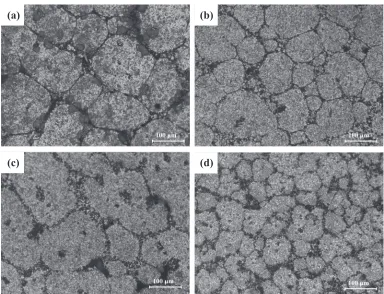
¡-Al phase of big rosette grain begin to fuse, small dendrite grains begin to grow up at 630°C for 20 min in Fig. 6. The microstructure becomes uniform rosette grains in 3%TiB2/7075 Al matrix composites, but it can be get
semi-solid microstructure in 4.5%TiB2/7075 Al matrix composites
whose mean grain size and shape factor can reach 51 µm and 0.68, respectively. It can be seen that the grains are elongated in 6%TiB2/7075 aluminum matrix composites, and the grain
boundary of 9%TiB2/7075 aluminum matrix composites gets
wider. After holding 25 min, the microstructure becomes uniform globular grain in 3%TiB2/7075 and 4.5%TiB2/7075
aluminum matrix composites, the mean grain size and shape factor can reach 94 µm and 84 µm, 0.71 and 0.78, respectively.
The microstructures of TiB2/7075 Al composite samples
have similar effect rules after held for 30 min in Fig. 7. The mean grain size and shape factor of 3%TiB2/7075 and
4.5%TiB2/7075 aluminum matrix composites can reach
88 µm and 81 µm, 0.67 and 0.72, respectively.
Dendrite grains can be found only in 6%TiB2/7075 Al
matrix composites after being held for 35 min, and it can be get semi-solid microstructure in 9%TiB2/7075 Al matrix
composites whose mean grain size and shape factor can reach 82 µm and 0.60, respectively. The mean grain size and shape factor of 3%TiB2/7075 and 4.5%TiB2/7075 Al matrix
composites can reach 114 µm and 98 µm, 0.70 and 0.67, respectively.
The mean grain size of 3%TiB2/7075, 4.5%TiB2/7075
and 9%TiB2/7075 aluminum matrix composites can reach
111 µm, 99 µm and 69 µm, respectively, the shape factor can reach 0.76, 0.78 and 0.66 for 50 min, respectively. The mean grain size and the shape factor of 9%TiB2/7075 Al matrix
composites can reach 111 µm and 0.72, respectively for 60 min.
Table 1 is the formation time and the grain size of globular grain at 630°C. 4.5%TiB2/7075 Al matrix composites are
easier to from globular grain because the original micro-structure is uniform rosette grains and the mean grain size is the smallest. It needs only about 20 min to from globular grain and the minimum grain size are about 51 µm. Whereafter, globular grains begin to grow, but the mean grain size is no significant change from 35 min to 50 min.
The change of the shape factor with the holding time are not obvious from 0.67 to 0.78. But the globular grains become rounder in the process of growth from minimum grain to maximum grain.
As we know, TiB2 has high melting point and is
thermodynamically stable. The TiB2 particles located in the
grain boundary can hinder the Al atoms from diffusing within the semi-solid state of the 7075 Al alloy, and restrain ¡-Al phase growth. Therefore, it need more time to form globular grain after adding TiB2 particles, comparing with 7075 Al
alloy. The minimum grain size of 3%TiB2/7075, 4.5%TiB2/
7075 and 9%TiB2/7075 Al matrix composites are 88 µm,
(g) (d) (h) (f) (c) (e) (b)
20 40 60 80
TiB2 Al
2θ/ (degree)
9% TiB2
6% TiB2
3% TiB2 (a)
Fig. 3 The XRD of TiB2/7075 (a) and the area scanning of 3%TiB2/7075
[image:3.595.48.290.68.436.2]51 µm and 69 µm, respectively. Maybe it need more time to get the globular grain in the experiment because dendrite grains of 6%TiB2/7075 Al matrix composites is the biggest
size in all TiB2/7075 Al matrix composites. The
micro-structure evolution mechanism of the solid TiB2/7075 Al
matrix composites with the different holding time at 630°C is proposed and schematically shown in Fig. 8. With increasing holding time, on one hand, some contiguous grains merge
(a)
(c)
(b)
(d)
Fig. 4 The microstructure of the solid 7075 Al alloy with the different holding time at 630°C; (a) 0 min, (b) 7.5 min, (c) 10 min, (d) 15 min.
(d)
Small grain
(b)
Small grain
(c)
(a)
[image:4.595.104.492.70.361.2] [image:4.595.105.492.407.698.2]into some bigger grains by coalescence. On the other hand, Ostwald ripening occurs: small grains disappear in favor of bigger grains by diffusion through the solid phase because of the reduction of surface energy and overlapped solutionfields
of neighboring grains. So the number of grains decreases and their mean grain size increases, with increasing holding time.21) Grains no longer melt at 630°C because of TiB
2
particles as the stable nucleus. This is to say that TiB2
(a)
(b)
(d)
(c)
Fig. 6 The microstructure of the solid TiB2/7075 Al matrix composites at 630°C for 20 min; (a) 3%TiB2/7075, (b) 4.5%TiB2/7075,
(c) 6%TiB2/7075, (d) 9%TiB2/7075.
(d)
(b)
(a)
(c)
Fig. 7 The microstructure of the solid TiB2/7075 Al matrix composites at 630°C for 30 min; (a) 3%TiB2/7075, (b) 4.5%TiB2/7075,
[image:5.595.107.490.69.363.2] [image:5.595.106.490.406.700.2]particles can be conducive to improve the stability of semi-solid slurry in near-liquidus thixoforming.
4. Conclusions
The results described in this work can be summarized as follows:
(1) TiB2/7075 Al matrix composites are formed byin situ
reaction in matrix melt. The microstructure becomes uniform rosette grains after adding 3%TiB2, and the
grain size shows a decreasing tendency with increasing of TiB2particles. The morphology of grains become big
dendrite grains when the TiB2particles content are over
4.5%.
(2) It can be got good globular grains with the different holding 7.5³10 min at 630°C. The mean grain size can reach 94 µm, which is smaller than the as-cast micro-structure. The phenomenon of necking and remelting of dendrite grains can be found atfirst, then rosette grains melt and shrink into the globular grain, finally the globular grains begin to melt with increasing of the holding time.
(3) The minimum grain size of 3%TiB2/7075, 4.5%TiB2/
7075 and 9%TiB2/7075 Al matrix composites are
88 µm, 51 µm and 69 µm for 30 min, 20 min and 50 min, respectively. The TiB2 particles located in the
grain boundary can hinder the Al atoms from diffusing within the semi-solid state of the 7075 Al alloy and
restrain ¡-Al phase growth, but it can be conducive to improve the stability of semi-solid slurry in near-liquidus thixoforming.
Acknowledgments
This work was supported by the National Natural Science Foundation of China (Grant No. 51505051), the Scientific Research Staring Foundation of Chongqing University of Technology as Project number 2012ZD12, and Project Supported by Scientific and Technological Research Program of Chongqing Municipal Education Commission number KJ130813.
REFERENCES
1) D. B. Spencer, R. Mehrabian and M. C. Flemings: Metall. Trans.3 (1972) 19251932.
2) M. C. Flemings:Metall. Trans. A22(1991) 957981.
3) A. Neag, V. Favier, R. Bigot and M. Pop:J. Mater. Process. Tech.212 (2012) 14721480.
4) A. Bolouri, M. Shahmiri and C. G. Kang:J. Alloy. Compd.509(2011) 402408.
5) M. R. Rokni, A. Zarei-Hanzaki, H. R. Abedi and N. Haghdadi:Mater. Des.36(2012) 557563.
6) F. Rikhtegar and M. Ketabchi:Mater. Des.31(2010) 39433948.
7) H. Mohammadi, M. Ketabchi and A. Kalaki:J. Mater. Eng. Perform.20 (2011) 12561263.
8) Ł. Rogal, J. Dutkiewicz, H. V. Atkinson, L. Lityńska-Dobrzyńska, T. Czeppe and M. Modigell:Mater. Sci. Eng. A580(2013) 362373.
9) G. M. Lu, J. Dong, J. Z. Cui and S. W. Luo: Acta Metall. Sin.37(2001) 10451048 (in Chinese).
10) H. M. Guo, X. J. Yang, J. X. Wang, B. Hu and G. L. Zhu:Trans. Nonferrous Met. Soc. China20(2010) 355360.
11) U. A. Curle and G. Govender:Trans. Nonferrous Met. Soc. China20 (2010) s832s836.
12) B. Yang, W. M. Mao and X. J. Song:Trans. Nonferrous Met. Soc. China23(2013) 35923597.
13) G. S. Gan, B. Yang, H. C. Wu, J. Han, Q. Gao and C. H. Du:Mater. Trans.53(2012) 11781183.
14) G. S. Gan, Q. Gao, B. Yang and S. D. Gan: Adv. Mater. Res.904 (2014) 5053.
15) G. S. Gan and B. Yang: Trans. Nonferrous Met. Soc. China24(2014) 11331140 (in Chinese).
16) G. S. Gan and B. Yang: Rare Metals38(2014) 954960 (in Chinese). 17) M. Wang, J. J. Gao and S. X. Chen: Foundry Technol.28(2007) 796
799 (in Chinese).
18) T. E. Quested, A. L. Greer and P. S. Cooper:Mater. Sci. Forum396 402(2002) 5358.
19) A. L. Greer, A. M. Bunn, A. Tronche, P. V. Evans and D. J. Bristow:
Acta Mater.48(2000) 28232835.
20) T. E. Quested and A. L. Greer:Acta Mater.53(2005) 46434653.
21) T. E. Quested and A. L. Greer:Acta Mater.52(2004) 38593868.
Table 1 Formation time, grain size and shape factor of globular grain at 630°C.
Composites
Globular
grain Minimum grain Maximum grain
Formation time/min
Size/ µm Shape factor Time/ min Size/ µm Shape factor Time/ min
3%TiB2/7075 25 88 0.67 30 111 0.76 50
4.5%TiB2/7075 20 51 0.68 20 99 0.78 50
9%TiB2/7075 35 69 0.66 50 111 0.72 60
Fig. 8 The microstructure evolution mechanism of the solid TiB2/7075 Al