Using subcategorization knowledge to improve case prediction
for translation to German
Marion Weller1 Alexander Fraser2 Sabine Schulte im Walde1
1Institut f¨ur Maschinelle 2Centrum f¨ur
Informations-Sprachverarbeitung und Sprachverarbeitung
Universit¨at Stuttgart Ludwig-Maximilians-Universit¨at M¨unchen
{wellermn|schulte}@ims.uni-stuttgart.de [email protected]
Abstract
This paper demonstrates the need and im-pact of subcategorization information for SMT. We combine (i) features on source-side syntactic subcategorization and (ii) an external knowledge base with quantita-tive, dependency-based information about target-side subcategorization frames. A manual evaluation of an English-to-German translation task shows that the subcategorization information has a posi-tive impact on translation quality through better prediction of case.
1 Introduction
When translating from a morphologically poor language to a morphologically rich language we are faced with two major problems: (i) the rich-ness of the target-language morphology causes data sparsity problems, and (ii) information about morphological features on the target side is not sufficiently contained in the source language mor-phology.
We address these two problems using a two-step procedure. We first replace inflected forms by their stems or lemmas: building a translation system on a stemmed representation of the target side leads to a simpler translation task, and the morphological information contained in the source and target language parts of the translation model is more balanced. In the second step, the stemmed output of the translation is then inflected: the mor-phological features are predicted, and the inflected forms are generated using the stem and predicted morphological features.
In this paper, we focus on improvingcase
pre-diction for noun phrases (NPs) in German
trans-lations. The NP feature case is extremely
dif-ficult to predict in German: while the NP
fea-tures gender and number are part of the stem or
can be derived from the source-side input,
respec-tively, the prediction ofcaserequires information
about the subcategorization of the entire clause. This is due to German being a less configurational language than English, which encodes grammati-cal relations (e.g. subject-hood, object-hood, etc.) through the position of constituents. German sen-tences exhibit a freer constituent order, and thus case is an important indicator of the grammatical functions of noun phrases. Correct case predic-tion is a crucial factor for the adequacy of SMT output, cf. the example in table 1 providing an erroneously inflected output (this is taken from a baseline “simple inflection prediction” system, cf. section 5.2). The translation of the English input sentence in terms of stems is perfectly acceptable; after the inflection step, however, the translation
of NP4ongoing military actionsrepresents a
geni-tive modifier of the subject NP2, instead of a direct
object NP of the verb anordnen (to order). The
meaning is thuswhy the government of the
ongo-ing military actions ordered, which has only one NP and is completely wrong.
The translation in table 1 needs verb subcatego-rization information. This is demonstrated by the invented examples (1) and (2):
(1) [Der Mitarbeiter]N P nomhat [den Bericht]N P acc[dem
Kollegen]N P datgegeben.
[The employee]N P nomgave [his colleague]N P dat[the
report]N P acc
(2) [Der Mitarbeiter]N P nomhat [dem Bericht]N P dat[des
Kollegen]N P genzugestimmt.
[The employee]N P nom agreed [on the report]P P [of
his colleague]P P
Both inflected sentences rely on the stem sequence [d Mitarbeiter] [d Bericht] [d Kollege]hverbi, so the case assignment can only be determined by
the verb: Whilegeben ( to give)has a strong
pref-erence for selecting a ditransitive
subcategoriza-tion frame1, including an agentive subject
(nomi-1A ditransitive verb takes a subject and two objects.
input [why]1[the government]2[ordered]3[the ongoing military actions]4
output stemmed [warum]1[d Regierung]2[d anhaltend milit¨arisch Aktion]4[angeordnet]3
inflected [warum]1[dieRegierung]2[deranhaltendenmilit¨arischenAktionen]4[angeordnet]3
Table 1: Example for case confusion in SMT output when using a simple prediction system.
native case), a benefactive (dative case) and a
pa-tient (accusative case), zustimmen (to agree) has
a strong preference for only selecting an agentive subject (nominative case) and an indirect object theme (dative case). So in the latter case the NP [d Kollege] cannot receive case from the verb and is instead the genitive modifier of the dative NP.
While for examples (1) and (2) knowledge about the syntactic verb subcategorization func-tions is sufficient to correctly predict the NP cases, examples (3) to (6) require subcategorization in-formation at the syntax-semantic interface.
(3) [Der Mitarbeiter]N P nom hat [dem Kollegen]N P dat
[den Bericht]N P accgegeben.
(4) [Der Mitarbeiter]N P nomhat [den Bericht]N P acc[dem
Kollegen]N P datgegeben.
(5) [Dem Kollegen]N P dat hat [der Mitarbeiter]N P nom
[den Bericht]N P accgegeben.
(6) [Den Bericht]N P acchat [der Mitarbeiter]N P nom[dem
Kollegen]N P datgegeben.
In all four examples, the verb and the
participat-ing noun phrasesMitarbeiter (employee),Kollege
(colleague)andBericht (report)are identical, and the noun phrases are assigned the same case. How-ever, given that the stemmed output of the trans-lation does not tell us anything about case fea-tures, in order to predict the appropriate cases of the three noun phrases, we either rely on ordering heuristics (such that the nominative NP is more likely to be in the beginning of the sentence (the
GermanVorfeld) than the accusative or dative NP,
even though all three of these would be grammati-cal), or we need fine-grained subcategorization in-formation beyond pure syntax. For example, both
MitarbeiterandKollegewould satisfy the agentive
subject role of the verbgebenbetter thanBericht,
and Bericht is more likely to be the patient of
geben.
The contribution of this paper is to improve the prediction of case in our SMT system by imple-menting and combining two alternative routes to integrate subcategorization information from the syntax-semantic interface: (i) We regard the trans-lation as a function of the source language in-put, and project the syntactic functions of the En-glish nouns to their German translations in the
SMT output. This subcategorization model is nec-essary when there are several plausible solutions for the syntactic functions of a noun in
combina-tion with a verb. For example, both Mitarbeiter
andKollege are plausible subjects and direct
ob-jects of the verbgeben, so the information about
these nouns’ roles in the input sentence allows for disambiguation. (ii) The case of an NP is de-rived from an external knowledge base comprising quantitative, dependency-based information about German verb subcategorization frames and noun modification. The verb subcategorization infor-mation is not restricted to syntactic noun func-tions but models association strength for verb– noun pairs with regard to the entire subcatego-rization frame plus the syntactic functions of the nouns. For example, the database can tell us that
while the verbgeben is very likely to
subcatego-rize a ditransitive frame, the verb zustimmen is
very likely to subcategorize only a direct object,
next to the obligatory subject(subcat frame
pre-diction). Furthermore, we can retrieve the
infor-mation that the noun Bericht is less likely to
ap-pear as subject of geben than the nouns
Mitar-beiter andKollege(verb–noun subcat case pre-diction). And we can look up that the nounAktion
is very unlikely to be a genitive modification of
Regierung(cf. table 1), whileKollege is a
plausi-ble genitive modification ofBericht (noun–noun
Wu and Fung (2009b) who demonstrated that on the one hand 84% of verb syntactic functions in a 50-sentence test corpus projected from Chinese to English, and that on the other hand about 15% of the subjects were not translated into subjects, but their semantic roles were preserved across lan-guage. These two findings correspond to the ex-pected uses of our models (i) and (ii), respectively.
2 Previous work
Previous work has already introduced the idea of generating inflected forms as a post-processing step for a translation system that has been stripped of (most) target-language-specific fea-tures. Toutanova et al. (2008) and Jeong et al. (2010) built translation systems that predict in-flected word forms based on a large array of mor-phological and syntactic features, obtained from both source and target side. Kholy and Habash (2012) and Green and DeNero (2012) work on En-glish to Arabic translation and model gender, num-ber and definiteness, focusing primarily on im-proving fluency.
Fraser et al. (2012) used a phrase-based system to transfer stems and generated inflected forms based on the stems and their morphological fea-tures. For case prediction, they trained a CRF with access to lemmas and POS-tags within a given window. We re-implemented the system by Fraser et al. as a hierarchical machine translation system using a string-to-tree setup. In contrast to the flat phrase-based setting of Fraser et al. (2012), syn-tactic trees on the SMT output allow us to work with verb–noun structures, which are relevant for case prediction. While the CRF used for case pre-diction in Fraser et al. (2012) has access to lexi-cal information, it is limited to a certain window size and has no direct information about the rela-tion of verb–noun pairs occurring in the sentence. Using a window of a limited size is particularly problematic for German, as there can be large gaps between the verb and its subcategorized nouns; in-troducing information about the relation of verbs and nouns helps to bridge such gaps. Furthermore, that model was not able to make effective use of source-side features.
One of the objectives of using an inflection prediction model is morphologically well-formed output. Kirchhoff et al. (2012) evaluated user re-actions to different error types in machine trans-lation and came to the result that morphological
well-formedness has only a marginal impact on the comprehensibility of SMT output in the case of English-Spanish translation. As already
dis-cussed, German caseis essential to the meaning
of the sentence, so this result will not hold for Ger-man output.
3 Translation pipeline
This section presents an overview of our two-step translation process. In the first step, English in-put is translated to German stems. In the sec-ond step, morphological features are predicted and inflected forms are generated based on the word stems and the morphological features. In subsec-tions 3.1 to 3.4, we present the simple version of the inflection prediction system; our new features are described in sections 4.2 and 4.3.
3.1 Stemmed representation/feature markup We first parse the German side of the parallel training data with BitPar (Schmid, 2004). This maps each surface form appearing in normal text to a stem and morphological features (case, gen-der, number). We use this representation to create the stemmed representation for training the trans-lation model. With the exception of stem-markup (discussed below), all morphological features are removed from the stemmed representation. The stem markup is used as part of the input to the ture prediction; the basic idea is that the given fea-ture values are picked up by the prediction model and then propagated over the phrase.
Nouns, as the head of NPs and PPs, are
anno-tated withgenderandnumber. We consider
gen-der as part of the stem, whereas the value for num-ber is derived from the source-side: if marked for number, singular/plural nouns are distinguished during word alignment and then translated accord-ingly. Prepositions are also annotated with case; many prepositions are restricted to only one case,
some are ambiguous and allow for either dative
3.2 Building a stemmed translation model We use a hierarchical translation system. Instead of translating phrases, a hierarchical system ex-tracts translation rules (Galley et al., 2004) which allow the decoder to provide a tree spanning over the translated sentence. In order to avoid sparsity during rule extraction, we use a string-to-tree setup, where only the target-side part of the data is parsed. Translation rules are of the following form:
[X]1 allows [X]2 → [NP]1 [NP]2 erlaubt
[X]1 allows [X]2 → [NP]1 erlaubt [NP]2
This example illustrates how rules can cover the different word ordering possibilities in German.
PP nodes are annotated with their respective case, as well as with the lemma of the preposition they contain. In our experiments, this enriched an-notation has small improvements over the simpler setting with only head categories (details omit-ted). This outcome, in particular that adding the lemma of the preposition to the PP node helps to improve translation quality, has been observed be-fore in tree restructuring work for improving trans-lation (Huang and Knight, 2006).
3.3 Feature prediction and generation of inflected forms
In this section we discuss our focus, which is pre-diction of case, but also the prepre-diction of num-ber, gender and strong/weak adjectival inflection.
The latter feature is German-specific; its values2
(strong/weak) depend on the combination of the other features, as well as on the type of determiner (e.g. definite/indefinite/none).
Morphological features are predicted on four separate CRF models, one for each feature. The models for case, number and gender are indepen-dent of another, whereas the model for adjecti-val inflection requires information about these fea-tures, and is thus the last one to be computed, tak-ing the output of the 3 other models as part of its input. In contrast, the adjectival inflection model in Fraser et al. (2012) is independent from the other features. Each model has access to stems, POS-tags and the feature to be modelled within a window of four positions to the right and the left
of the current position3.
2Note that the values for strong/weak inflection are not always the same over the phrase, but follow a certain pattern depending on the settings of case, number and gender.
3Preliminary experiments showed that larger windows do not improve translation quality.
Table 2 illustrates the different steps of the in-flection process: the markup (number and gender on nouns) in the stemmed output of the SMT sys-tem is part of the input to the respective feature prediction. For gender and number, the values given on the stems of the nouns are then propa-gated over the phrase. While the case of prepo-sitional phrases is determined by the case annota-tion on preposiannota-tions, the case of nominal phrases is computed only based on the respective contexts. After predicting all morphological features, the in-formation required to generate inflected forms is complete: based on the stems and the features, we use the morphological tool SMOR (Schmid et al., 2004) for the generation of inflected forms.
One general problem with feature-prediction is that the ill-formed SMT output is not well repre-sented by the training data which consists of well-formed sentences. This problem was also men-tioned by Stymne and Cancedda (2011) and Kholy and Habash (2012). They deal with this problem by translating the training data and annotating it with the respective features, and then adding this
new data set to the original training data. As
this method comes with its own problems, such as transferring the morphological annotation to not necessarily isomorphically translated text, we do not use translated data as part of the training data. Instead, we limit the power of the CRF model through experimenting with the removal of fea-tures, until we had a system that was robust to this problem.
3.4 Dealing with word formation issues To reduce data sparsity, we split portmanteau prepositions. Portmanteaus are compounds of
prepositions and articles, e.g.zur = zu der(to the).
Being components of nominal phrases, they have to agree in all morphological features with the rest of the phrase. As only some combinations of arti-cles and prepositions can form a portmanteau, the decision of whether to merge prepositions and ar-ticles is made after feature prediction. Since our focus is case prediction, we do not do special mod-elling of German compounds.
4 Using subcategorization information
SMT output predicted features inflected forms gloss
beeinflussen<VVFIN> – beeinflussen influence
d<ART> Fem.Acc.Sg.St die the
[image:5.595.165.434.62.105.2]politisch<ADJ> Fem.Acc.Sg.Wk politische political Stabilit¨at<NN><Fem><Sg> Fem.Acc.Sg.Wk Stabilit¨at stability
Table 2: Overview of the inflection process: the stem markup is highlighted in the SMT output.
discourse. On the one hand, this has led to a range of manually or semi-automatically developed lex-ical resources focusing on verb information, such as the Levin classes (Levin, 1993), VerbNet
(Kip-per Schuler, 2006), FrameNet4 (Fillmore et al.,
2003), and PropBank (Palmer et al., 2005). On the other hand, we find automatic approaches to the induction of verb subcategorization information at the syntax-semantics interface for a large num-ber of languages, e.g. Briscoe and Carroll (1997) for English; Sarkar and Zeman (2000) for Czech; Schulte im Walde (2002a) for German; Messiant (2008) for French. This basic kind of verb knowl-edge has been shown to be useful in many NLP tasks such as information extraction (Surdeanu et al., 2003; Venturi1 et al., 2009), parsing (Carroll et al., 1998; Carroll and Fang, 2004) and word sense disambiguation (Kohomban and Lee, 2005; Mc-Carthy et al., 2007).
4.1 Extracting subcategorization information As described in the introductory section, we make
use of two5 major kinds of subcategorization
in-formation. Verb–noun tuples referring to spe-cific syntactic functions within verb
subcatego-rization(verb–noun subcat case prediction)are
integrated with an associated probability for
ac-cusative (direct object), dative (indirect object) and nominative (subject).6 Further to the sub-ject and obsub-ject noun phrases, the subcategoriza-tion informasubcategoriza-tion provides quantitative triples for verb–preposition–noun pairs, thus predicting the case of NPs within prepositional phrases (we do this only when the prepositions are ambiguious, i.e., they could subcategorize either a dative or an accusative NP). In addition to modelling sub-categorization information, it is also important to differentiate between subcategorized noun phrases (such as object or subject), and noun phrases
4Even though the FrameNets approach does not only in-clude knowledge about verbal predicates, the actual lexicons are skewed towards verb behaviour.
5The third kind of information,subcat frame prediction is implicit, since verb–noun tuples rely on specific frames.
6Genitive objects can also occur in German verb subcate-gorization frames, but this is extremely rare and verb-specific and thus not considered in our model.
V-SUBJ V-OBJAcc V-OBJDat
EP 454,350 332,847 53,711
HGC 712,717 329,830 160,377
[image:5.595.321.508.146.193.2]Both 1,089,492 607,541 206,764
Table 3: Number of verb-noun types extracted from Europarl (EP) and newspaper data (HGC).
that modify nouns(noun–noun modification case
prediction). Typically, these NP modifiers are genitive NPs. To this end, we integrate
noun-nounGen tuples with their respective frequencies.
These preferences for a certain function (i.e. sub-ject, object or modifier) are passed on to the sys-tem at the level of nouns and integrated into the CRF through the derived probabilities.
The tuples and triples are obtained from dependency-parsed data by extracting all occur-rences of the respective relations; table 3 gives an overview of the number of extracted tuple types. For the subcategorization information, the
verb-noun tuples (verb-subject, verb-objectAcc,
verb-objectDat) are then grouped as follows:
tuple gloss Acc Dat Nom
SchemaNfolgenV pattern follow 0 322 19
We compute the probabilities for the verb-noun tu-ple to occur in the respective functions based on
the relative frequencies. In the case of SchemaN
folgenV, we find that the function ofSchemaas
da-tive object is predominant (to follow a pattern), but
it can also occur in the subject position (the
pat-tern follows). The fact that two functions are pos-sible for this noun are reflected in their probabili-ties. The probabilities are discretized into 5 buck-ets (Bp=0, B0<p≤0.25, B0.25<p≤0.5, B0.5<p≤0.75,
B0.75<p≤1). In contrast, noun modification in
noun-nounGen construction is represented by
co-occurrence frequencies.7
7The frequencies are bucketed to the powers of ten, i.e. f = 1,2≤f ≤10,11≤f ≤100, etc. and alsof = 0: this representation allows for a more fine-grained distinction in the low-to-mid frequency range, providing a good basis for the decision of whether a given noun-noun pair is a true noun-nounGen structure or just a random co-occurrence of
Gloss Stem Tag Acc Dat Nom Verb Gen N1 Gold
1 companies Unternehmen<NN> NN 0.00 0.00 1.00 erhalten – – Nom
2 should sollten<VVFIN> VVFIN – – – – – – –
3 financial finanziell<ADJ> ADJ – – – – – – Acc
4 funding Mittel<NN> NN 1.00 0.00 0.00 erhalten – – Acc
5 for f¨ur APPR<Acc> PRP – – – – – – –
6 the d<ART> ART – – – – – – Acc
7 introduction Einf¨uhrung<NN> NN – – – – – – Acc
8 new neu<ADJ> ADJ – – – – – – Gen
9 technologies Technologie<NN> NN – – – – 100 Einf¨uhrung<NN> Gen
[image:6.595.85.509.61.152.2]10 obtain erhalten<VVINF> VVINF – – – – – – –
Table 4: Adding subcategorization information into SMT output. (EN input: companies should obtain
financial funding for the introduction of new technologies). On the right, the correct labels are given.
4.2 Integrating subcategorization knowledge There are two possibilities to integrate subcat-egorization information into the case prediction model: (i) It can be integrated into the data set using the tree-structure provided by the decoder. Here, verb-noun tuples are extracted from VP and S structures, and then the probabilities for the dif-ferent functions are looked up. Similarly, for two adjacent NPs, the occurrence frequencies of the respective two nouns are looked up in the list of
noun-nounGen constructions. (ii) The
subcatego-rization information can be integrated based on the verb-noun tuples obtained by using tuples ob-tained from source-side dependencies.
The classification task of the CRF consists in predicting a sequence of labels: case values for NPs/PPs or no value otherwise, cf. table 4. The
model has access to the basic features stem and
tag, as well as the new features based on
subcat-egorizaion information (explained below), using unigrams within a window of up to four positions to the right and the left of the current position, as well as bigrams and trigrams for stems and tags (current item + left and/or right item).
An example for integrating subcategorization
features is given in table 4. The first word
Un-ternehmen(companies) is annotated as subject of
erhalten (obtain) with probability 1, and Mittel
(funding) is annotated as direct object of
erhal-ten with probability 1. The word Technologie
(technology) has been marked as a candidate for
a genitive in a noun-nounGen construction8; the
co-occurrence frequency of the tuple
Einf¨uhrung-Technologie(introduction - technology) lies in the bucket 11. . . 100.
In addition to the probability/frequency of the respective functions, we also provide the CRF with bigrams containing the two parts of the tuple,
8There is no annotation onEinf¨uhrungas the preposition
f¨uris always in accusative case.
DE stemmed output
warum<PWAV> die<ART>
Regierung<NN><Sg><Fem> die<ART>
anhaltend<ADJ> militärisch<ADJ> Aktion<NN><Pl><Fem> angeordnet<VVFIN>
derived features
SUBJ V:anordnen
OBJ V:anordnen
SUBJ
OBJ
EN input
why the government ordered the ongoing military actions
Figure 1: Deriving features from dependency-parsed English data via the word alignment.
i.e. verb+noun or the two nouns of possible
noun-nounGen constructions. As can be seen in the
ex-ample in table 4, the subject (line 1) and the verb (line 10) are far apart from each other. By pro-viding the parts of the tuple as unigrams, bigrams or trigrams to the CRF, all relevant information is available: verb, noun and the probabilities for the potential functions of the noun in the sentence. In addition to bridging the long distance between verbs and subcategorized nouns, a very common problem for German, this type of precise informa-tion also helps to close the gap between the well-formed training data and the broken SMT-output as it replaces to a certain extent the target-language context information (n-grams of stems or lemmas within a small window).
4.3 Integrating source-side features
For predicting case in SMT output, information about an NP’s function in the input sentence is essential. Syntax-semantic functions can be iso-morphic (e.g., English subjects and objects may have the same function in a German translation), but this is not necessarily the case. Despite this, an important advantage of integrating source-side features is that the well-formed source-side text can be reliably parsed, whereas SMT output is of-ten disfluent and cannot be reliably parsed.
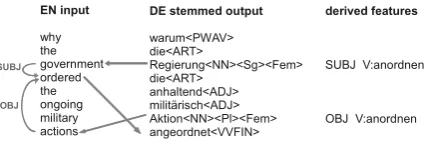
[image:6.595.314.527.210.281.2]to the SMT output via word alignment. We focus on English subjects, direct objects and
noun-of-noun structures (often equivalent to noun-of-noun-noun-of-nounGen
phrases on the German side): these structures are generally likely to correspond to each other within source and target language. In contrast to the subcategorization-based information, the difference between well-formed training data and disfluent SMT output tends to work to our benefit here: while the parallel sentences of the training data were manually translated with the objective to produce good target-language sentences, the syntactic structures of the source and target sentences are often diverging. In contrast, the SMT system often produces more isomorphic translations, which is helpful for annotating source-side features on the target language.
Figure 1 shows the process of integrating source-side features: for each German noun that is aligned with an English noun labelled as subject or direct object, this annotation is transferred to the target-side. Using the English dependency struc-tures, the verb subcategorizing the respective noun is identified, and via the alignment, the equivalent German verb is obtained. Similarly, candidates for
noun-nounGenstructures are identified by
extract-ing and alignextract-ing English noun-of-noun phrases.
5 Experiments and evaluation
In this section, we present experiments using dif-ferent feature combinations. We also present a manual evaluation of our best system which shows that the new features improve translation quality.
5.1 Data and experimental setup
We use the hierarchical translation system that comes with the Moses SMT-package and GIZA++ to compute the word alignment, using the “grow-diag-final-and” heuristics. The rule table was computed with the default parameter setting for GHKM extraction (Galley et al., 2004) in the im-plementation by Williams and Koehn (2012).
Our training data contains 1,485,059 parallel
sentences9; the German part of the parallel data
is used as the target-side language model. The dev and test sets (1025/1026 lines) are wmt-2009-a/b.
For predicting the grammatical features, we
used the Wapiti Toolkit (Lavergne et al., 2010).10
9English/German data released for the 2009 ACL Work-shop on Machine Translation shared task.
10To eliminate irrelevant features, we use L1
regulariza-We train four CRFs on data prepared as shown in section 3. The corpora used for the extrac-tion of subcategorizaextrac-tion tuples were Europarl and German newspaper data (200 million words). We choose this particular data combination in order to provide data that matches the training data, as well as to add new data of the test set’s domain (news). The German part of Europarl was dependency-parsed with Bohnet (2010), and subcategorization information was extracted as described in Scheible et al. (2013); the newspaper data (HGC - Huge German Corpus) was parsed with Schmid (2000), and subcategorization information was extracted as described in Schulte im Walde (2002b).
5.2 Results
We report results of two types of systems (ta-ble 5): first, a regular translation system built on surface forms (i.e., normal text) and second, four inflection prediction systems. The first inflection prediction system (1) uses a simple case predic-tion model, whereas the remaining systems are enriched with (2) subcategorization information (cf. section 4.2), (3) source-side features (cf. sec-tion 4.3), and (4) both source-side features and subcategorization information. In (2) and (4), the subcategorization information was included using
tuples obtained from source-side dependencies11.
The simple prediction system corresponds to that presented in section 3; for all inflection predic-tion systems, the same SMT output and models for number, gender and strong/weak inflection were used; thus the only difference with the simple pre-diction system is the model for case prepre-diction.
We present three types of evaluation: BLEU scores (Papineni et al., 2001), prediction accuracy on clean data and a manual evaluation of the best system in section 5.3.
Table 5 gives results in case-insensitive BLEU. While the inflection prediction systems (1-4) are
significantly12 better than the surface-form
tem (0), the different versions of the inflection sys-tems are not distinguishable in terms of BLEU; however, our manual evaluation shows that the new features have a positive impact on translation quality.
tion; the regularization parameter is optimized on held out data.
0 1 2 3 4
surface simple subcat. features source-side source-side system prediction (tuples from EN side) features + subcat. featues
BLEU 13.43 14.02 14.05 14.10 14.17
[image:8.595.122.478.61.116.2]Clean – 85.05 % 85.65 % 85.61 % 85.81 %
Table 5: Results of the simple prediction vs. three systems enriched with extra features.
One problem with using BLEU as an evalua-tion metric is that it is a precision-oriented met-ric and tends to reward fluency rather than ade-quacy (see (Wu and Fung, 2009a; Liu and Gildea, 2010)). As we are working on improving ade-quacy, this will not be fully reflected by BLEU. Furthermore, not all components of an NP do nec-essarily change their inflection with a new case value; it might happen that the only indicator for
the case of an NP is the determiner: er sieht [den
alten Mann]N P acc (he sees the old man) vs. er
folgt [dem alten Mann]N P dat (he follows the old
man). While the case marking of NPs is essential
for comprehensibility, one changed word per noun phrase is hardly enough to be reflected by BLEU.
An alternative to study the effectiveness of the case prediction model is to evaluate the prediction accuracy on parsed clean data, i.e. not on SMT output. In this case, we measure (using the dev set) how often the case of an NP is predicted
cor-rectly13. In all cases, the prediction accuracy is
better for the enriched systems. This shows that the additional features improve the model, but also that a gain in prediction accuracy on clean data is not necessarily related to a gain in BLEU. We ob-served that the more complex the model, the less robust it is to differences between the test data and the training data. Related to this problem, we observed that high-order n-gram POS/lemma-based features in the simple prediction (sequences of lemmas and tags) are given too much weight in training and thus make it difficult for the new fea-tures to have a larger impact, so we restricted the n-gram order of this type of feature to trigrams.
5.3 Manual evaluation of the best system In order to provide a better understanding of the impact of the presented features, in particular to see whether there is an improvement in adequacy, we carried out a manual evaluation comparing
sys-13The numbers in table 5 are artificially high and downplay the difference as they also include cases which are very easy to predict, such as nouns in PPs where only one value for case is possible. We measure how many case labels were correctly predicted, not correct inflected forms.
enriched simple equal preferred preferred
person 1 23 11 12
(a) person 2 21 8 17
person 3 26 11 9
person 1 23 5 18
(b) person 2 21 11 14
person 3 29 8 9
(c) agreement 17 2 6
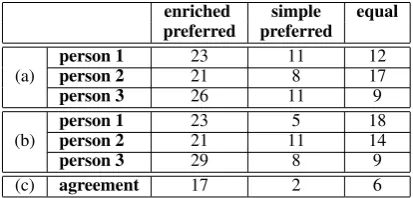
Table 6: Manual evaluation of 46 sentences: with-out (a) and with (b) access to EN input, and the annotators’ agreement in the second part (c).
tem (4) with the simple prediction system (1). From the set of different sentences between the simple prediction system and the enriched system (144 of 1026), we evaluated those where the En-glish input sentence was between 8 and 25 words long (46 sentences in total). We specifically re-stricted the test set in order to provide sentences which are less difficult to annotate, as longer sen-tences are often very disfluent and too hard to rate. Most of the sentences in the evaluation set differ only in the realization of one NP. For comparing the two systems, the sentences were presented in random order to 3 native speakers of German.
The evaluation consists of two parts: first, the participants were asked to decide which sentence is better without being given the English input (this measures fluency). In the second part, they should to mark that sentence which better repro-duces the content of the English input sentence (this measures adequacy). The test set is the same for both tasks, the only difference being that the English input is given in the second part. The re-sults are given in table 6. Summarizing we can say that the participants prefer the enriched sys-tem over the simple syssys-tem in both parts; there is a high agreement (17 cases) in decisions over those
sentences which were rated asenriched better.
When looking at the pairwise inter-annotator agreement for the task of annotating the test-set
with the 3 possible labelsenriched preferred,
[image:8.595.313.520.157.256.2]input hundreds of policemen were on alert , and [a helicopter]Subjcircled the area with searchlights .
1 simple Hunderte von Polizisten auf Trab , und [einen Helikopter]Acceingekreist das Gebiet mit searchlights .
enriched Hunderte von Polizisten auf Trab , und [ein Helikopter]N omeingekreist das Gebiet mit searchlights .
input while 38 %percent put [their trust]Objin viktor orb´an .
2 simple w¨ahrend 38 % [ihres Vertrauens]Genschenken in Viktor Orb´an .
enriched w¨ahrend 38 % [ihr Vertrauen]Accschenken in Viktor Orb´an .
input more than $ 100 billion will enter [the monetary markets]Objby means of public sales .
3 simple mehr als 100 Milliarden Dollar werden durch ¨offentlichen Verkauf [der Geldm¨arkte]Gentreten .
[image:9.595.77.523.62.165.2]enriched mehr als 100 Milliarden Dollar werden durch ¨offentlichen Verkauf [die Geldm¨arkte]Acctreten . Table 7: Output from the simple system (1) and the enriched system (4).
in terms of Kappa (κ= 0.6184), whereas the
agree-ment of P3 with P1/P2 respectively leads to lower
scores (κ= 0.4467 andκ= 0.3596). However, the
annotators tend to agree well on sentences with
the label enriched preferred, but largely disagree
on sentences labelled as eithersimple preferredor
no preference. The number of decisions where all three annotators agree on a label when given the English input is listed in table 6(c): for example,
only two sentences were given the labelbaseline is
betterby all three annotators. This outcome shows how difficult it is to rate disfluent SMT output. For evaluating the case prediction system, the
distinc-tion betweenenriched preferredandenriched
dis-preferredis the most important question to answer. Redefining the annotation task to annotating only
two values by grouping the labelssimple preferred
andno preferenceinto one annotation possibility
leads toκ= 0.7391,κ= 0.4048 andκ= 0.5652.
5.4 Examples
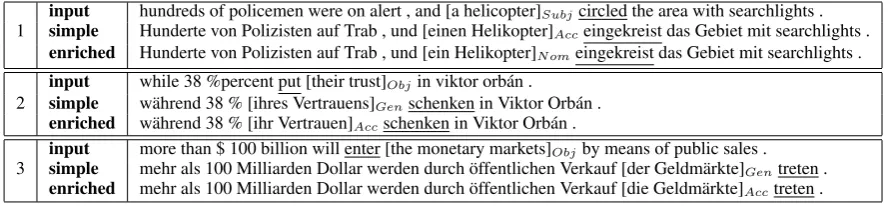
Table 7 shows some examples for output from the simple system and the system using source-side and subcategorization features. In the first
sen-tence, the subject NP a helicopter was inflected
as a direct object in the simple system, but as a subject in the enriched system, which was pre-ferred by all three annotators. In the second
sen-tence, the NPtheir trust, i.e. a direct object ofput,
was incorrectly predicted as genitive-modifier of
38 %(i.e. 38 % of their trust) in the simple
sys-tem. The enriched system made use of the
prefer-ence for accusative for the pairVertrauen schenken
(place trust), correctly inflecting this NP as di-rect object. Interestingly, only two annotators pre-ferred the enriched system, whereas one was unde-cided. The third sentence illustrates how difficult it is to rate case marking on disfluent SMT output:
there are two possibilities to translate enter the
money market; the direct equivalent of the English
phrase (den GeldmarktAccbetreten), or via the use
of a prepositional phrase (auf den GeldmarktAcc
treten: “to step into the money market”). The SMT-output contains a mix of both, i.e. the verb
treten(instead ofbetreten), but without the prepo-sition, which cannot lead to a fully correct inflec-tion. While the inflection of the simple system (a
genitive construction meaningthe public sales of
the money market) is definitely wrong, the inflec-tion obtained in the enriched system is not
use-ful either, due to the structure of the translation14.
This difficulty is also reflected by the annotators,
who gave twice the labelno preference and once
the labelenriched better.
6 Conclusion
We illustrated the necessity of using external knowledge sources like subcategorization infor-mation for modelling case for English to Ger-man translation. We presented a translation sys-tem making use of a subcategorization database
together with source-side features. Our method
is language-independent with regard to the source language; furthermore, no language-specific high-quality semantic annotation is needed for the tar-get language, but the data required to model the subcategorization preferences can be obtained us-ing standard NLP techniques. We showed in a manual evaluation that the proposed features have a positive impact on translation quality.
Acknowledgements
This work was funded by the DFG Research
ProjectDistributional Approaches to Semantic
Re-latedness (Marion Weller), the DFG Heisenberg Fellowship SCHU-2580/1-1 (Sabine Schulte im Walde), as well as by the Deutsche
Forschungsge-meinschaft grantModels of Morphosyntax for
Sta-tistical Machine Translation(Alexander Fraser).
14Furthermore, with treten being polysemous, die
References
Bernd Bohnet. 2010. Top Accuracy and Fast Depen-dency Parsing is not a Contradiction. In Proceed-ings of the 23rd International Conference on Com-putational Linguistics (COLING) 2010, pages 89– 97, Beijing, August.
Ted Briscoe and John Carroll. 1997. Automatic Ex-traction of Subcategorization from Corpora. In Pro-ceedings of the 5th ACL Conference on Applied Nat-ural Language Processing, pages 356–363, Wash-ington, DC.
John Carroll and Alex C. Fang. 2004. The Auto-matic Acquisition of Verb Subcategorisations and their Impact on the Performance of an HPSG Parser. InProceedings of the 1st International Joint Confer-ence on Natural Language Processing, pages 107– 114, Sanya City, China.
John Carroll, Guido Minnen, and Ted Briscoe. 1998. Can Subcategorisation Probabilities Help a Sta-tistical Parser? In Proceedings of the 6th ACL/SIGDAT Workshop on Very Large Corpora, Montreal, Canada.
Jinho D. Choi and Martha Palmer. 2012. Getting the Most out of Transition-Based Dependency Parsing. In Proceedings of the 49th Annual Meeting of the Association for Computational Linguistics: Human Language Technologies.
Charles J. Fillmore, Christopher R. Johnson, and Miriam R.L. Petruck. 2003. Background to FrameNet. International Journal of Lexicography, 16:235–250.
Alexander Fraser, Marion Weller, Aoife Cahill, and Fa-bienne Cap. 2012. Modeling Inflection and Word-Formation in SMT. InProceedings of the the Euro-pean Chapter of the Association for Computational Linguistics (EACL), Avignon, France.
Michel Galley, Mark Hopkins, Kevin Knight, and Daniel Marcu. 2004. What’s in a Translation Rule? InProceedings of the Human Language Technology and North American Association for Computational Linguistics Conference (HLT-NAACL).
Spence Green and John DeNero. 2012. A Class-Based Agreement Model for Generating Accurately Inflected Translations. pages 146–155.
Bryant Huang and Kevin Knight. 2006. Relabel-ing Syntax Trees to Improve Syntax-Based Machine Translation Quality. In Proceedings of the Hu-man Language Technology Conference of the North American Chapter of the ACL.
Minwoo Jeong, Kristina Toutanova, Hisami Suzuki, and Chris Quirk. 2010. A Discriminative Lexicon Model for Complex Morphology. InProceedings of the Ninth Conference of the Association for Machine Translation in the Americas (AMTA 2010).
Ahmed El Kholy and Nizar Habash. 2012. Translate, Predict or Generate: Modeling Rich Morphology in Statistical Machine Translation. InEuropean Asso-ciation for Machine Translation.
Karin Kipper Schuler. 2006. VerbNet: A Broad-Coverage, Comprehensive Verb Lexicon. Ph.D. the-sis, University of Pennsylvania, Computer and In-formation Science.
Katrin Kirchhoff, Daniel Capurro, and Anne Turner. 2012. Evaluating User Preferences in Machine Translation Using Conjoint Analysis. InEuropean Association for Machine Translation.
Upali S. Kohomban and Wee Sun Lee. 2005. Learning Semantic Classes for Word Sense Disambiguation. InProceedings of the 43rd Annual Meeting on Asso-ciation for Computational Linguistics, pages 34–41, Ann Arbor, MI.
Thomas Lavergne, Olivier Capp´e, and Franc¸ois Yvon. 2010. Practical very large scale CRFs. In Proceed-ings the 48th Annual Meeting of the Association for Computational Linguistics (ACL), pages 504–513. Association for Computational Linguistics, July.
Beth Levin. 1993. English Verb Classes and Alterna-tions. The University of Chicago Press.
Ding Liu and Daniel Gildea. 2008. Improved Tree-to-String Transducers for Machine Translation. In
ACL Workshop on Statistical Machine Translation.
Ding Liu and Daniel Gildea. 2010. Semantic Role Features for Machine Translation. InProceedings of the 23rd International Conference on Computa-tional Linguistics (COLING) 2010.
Diana McCarthy, Rob Koeling, Julie Weeds, and John Carroll. 2007. Unsupervised Acquisition of Pre-dominant Word Senses.Computational Linguistics, 33(4):553–590.
C´edric Messiant. 2008. A Subcategorization Acqui-sition System for French Verbs. InProceedings of the Student Research Workshop at the 46th Annual Meeting of the Association for Computational Lin-guistics, pages 55–60, Columbus, OH.
Martha Palmer, Daniel Gildea, and Paul Kingsbury. 2005. The Proposition Bank: An annotated Re-source of Semantic Roles. Computational Linguis-tics, 31(1):71–106.
Kishore A. Papineni, Salim Roukos, Todd Ward, and Wei-Jing Zhu. 2001. BLEU: a Method for Auto-matic Evaluation of Machine Translation. Technical Report RC22176 (W0109-022), IBM Research Di-vision, Thomas J. Watson Research Center.
Silke Scheible, Sabine Schulte im Walde, Marion Weller, and Max Kisselew. 2013. A Compact but Linguistically Detailed Database for German Verb Subcategorisation relying on Dependency Parses from a Web Corpus. InProceedings of the 8th Web as Corpus Workshop, Lancaster, UK. To appear.
Helmut Schmid, Arne Fitschen, and Ulrich Heid. 2004. SMOR: a German Computational Morphol-ogy Covering Derivation, Composition, and Inflec-tion. In Proceedings of the Fourth International Conference on Language Resources and Evaluation (LREC).
Helmut Schmid. 2000. LoPar: Design and Imple-mentation. Arbeitspapiere des Sonderforschungs-bereichs 340 ‘Linguistic Theory and the Foun-dations of Computational Linguistics’ 149, Insti-tut f¨ur Maschinelle Sprachverarbeitung, Universit¨at Stuttgart.
Helmut Schmid. 2004. Efficient Parsing of Highly Ambiguous Context-Free Grammars with Bit Vec-tors.
Sabine Schulte im Walde. 2002a. A Subcategorisa-tion Lexicon for German Verbs induced from a Lex-icalised PCFG. InProceedings of the 3rd Confer-ence on Language Resources and Evaluation, vol-ume IV, pages 1351–1357, Las Palmas de Gran Ca-naria, Spain.
Sabine Schulte im Walde. 2002b. A Subcategorisa-tion Lexicon for German Verbs induced from a Lex-icalised PCFG. InProceedings of the 3rd Confer-ence on Language Resources and Evaluation, vol-ume IV, pages 1351–1357, Las Palmas de Gran Ca-naria, Spain.
Sara Stymne and Nicola Cancedda. 2011. Productive Generation of Compound Words in Statistical Ma-chine Translation. InProceedings of the Sixth Work-shop on Machine Translation.
Mihai Surdeanu, Sanda Harabagiu, John Williams, and Paul Aarseth. 2003. Using Predicate-Argument Structures for Information Extraction. In Proceed-ings of the 41st Annual Meeting of the Association for Computational Linguistics, pages 8–15, Sap-poro, Japan.
Kristina Toutanova, Hisami Suzuki, and Achim Ruopp. 2008. Applying Morphology Generation Models to Machine Translation. InProceedings of the 46th An-nual Meeting of the Association for Computational Linguistics (ACL): Human Language Technologies.
Giulia Venturi1, Simonetta Montemagni, Simone Marchi, Yutaka Sasaki, Paul Thompson, John Mc-Naught, and Sophia Ananiadou. 2009. Bootstrap-ping a Verb Lexicon for Biomedical Information Extraction. In Alexander Gelbukh, editor, Linguis-tics and Intelligent Text Processing, pages 137–148. Springer, Heidelberg.
Philip Williams and Phillipp Koehn. 2012. GHKM-Rule Extraction and Scope-3 Parsing in Moses. In
Proceedings of the 7th Workshop on Statistical Ma-chine Translation, ACL.
Dekai Wu and Pascale Fung. 2009a. Can Semantic Role Labeling Improve SMT? InProceedings of the 13th Annual Conference of the European Associa-tion for Machine TranslaAssocia-tion (EAMT).