Efficient Search for Transformation-based Inference
Asher Stern§, Roni Stern‡, Ido Dagan§, Ariel Felner‡ § Computer Science Department, Bar-Ilan University ‡ Information Systems Engineering, Ben Gurion University
[email protected] [email protected]
[email protected] [email protected]
Abstract
This paper addresses the search problem in textual inference, where systems need to infer one piece of text from another. A prominent approach to this task is attempts to transform one text into the other through a sequence of inference-preserving transformations, a.k.a. a proof, while estimating the proof’s valid-ity. This raises a search challenge of find-ing the best possible proof. We explore this challenge through a comprehensive investi-gation of prominent search algorithms and propose two novel algorithmic components specifically designed for textual inference: a gradient-style evaluation function, and a local-lookahead node expansion method. Evalua-tions, using the open-source system, BIUTEE, show the contribution of these ideas to search efficiency and proof quality.
1 Introduction
In many NLP settings it is necessary to identify that a certain semantic inference relation holds be-tween two pieces of text. For example, in para-phrase recognitionit is necessary to identify that the meanings of two text fragments are roughly equiva-lent. Inpassage retrievalfor question answering, it is needed to detect text passages from which a sat-isfying answer can be inferred. A generic formula-tion for the inference relaformula-tion between two texts is given by theRecognizing Textual Entailment (RTE)
paradigm (Dagan et al., 2005), which is adapted here for our investigation. In this setting, a system is given two text fragments, termed “text” (T) and
“hy-pothesis” (H), and has to recognize whether the hy-pothesis is entailed by (inferred from) the text.
An appealing approach to such textual inferences is to explicitly transformTintoH, using a sequence of transformations (Bar-Haim et al., 2007; Harmel-ing, 2009; Mehdad, 2009; Wang and MannHarmel-ing, 2010; Heilman and Smith, 2010; Stern and Dagan, 2011). Examples of such possible transformations are lexical substitutions (e.g. “letter”→“message”) and predicate-template substitutions (e.g. “X [verb-active] Y”→ “Y [verb-passive] by X”), which are based on available knowledge resources. Another example is coreference substitutions, such as replac-ing “he” with “the employee” if a coreference re-solver has detected that these two expressions core-fer. Table 1 exemplifies this approach for a particu-larT-Hpair. The rationale behind this approach is that each transformation step should preserve infer-ence validity, such that each text generated along this process is indeed inferred from the preceding one.
An inherent aspect in transformation-based infer-ence is modeling the certainty that each inferinfer-ence step is valid. This is usually achieved by a cost-based or probabilistic model, which quantifies con-fidence in the validity of each individual transfor-mation and consequently of the complete chain of inference.
Given a set of possible transformations, there may be many transformation sequences that would trans-formT toH. This creates a very large search space, where systems have to find the “best” transformation sequence – the one of lowest cost, or of highest prob-ability. To the best of our knowledge, this search challenge has not been investigated yet in a
# Operation Generated text
0 - He received the letter from the secretary.
[image:2.612.74.539.60.141.2]1 Coreference substitution The employee received the letter from the secretary. 2 X received Y from Z→Y was sent to X by Z The letter was sent to the employee by the secretary. 3 Y [verb-passive] by X→X [verb-active] Y The secretary sent the letter to the employee. 4 X send Y→X deliver Y The secretary delivered the letter to the employee. 5 letter→message The secretary delivered the message to the employee.
Table 1: A sequence of transformations that transform the text “He received the letter from the secretary.” into the hypothesis “The secretary delivered the message to the employee.”. The knowledge required for such transformations is often obtained from available knowledge resources and NLP tools.
tial manner: each of the above-cited works described the search method they used, but none of them tried alternative methods while evaluating search perfor-mance. Furthermore, while experimenting with our own open-source inference system, BIUTEE1, we observed that search efficiency is a major issue, of-ten yielding practically unsatisfactory run-times.
This paper investigates the search problem in transformation-based textual inference, naturally falling within the framework of heuristic AI (Ar-tificial Intelligence) search. To facilitate such in-vestigation, we formulate a generic search scheme which incorporates many search variants as special cases and enable a meaningful comparison between the algorithms. Under this framework, we identify special characteristics of the textual inference search space, that lead to the development of two novel al-gorithmic components: a special lookahead method for node expansion, namedlocal lookahead, and a gradient-based evaluation function. Together, they yield a new search algorithm, which achieved sub-stantially superior search performance in our evalu-ations.
The remainder of this paper is organized as follows. Section 2 provides an overview of transformation-based inference systems, AI search algorithms, and search methods realized in prior in-ference systems. Section 3 formulates the generic search scheme that we have investigated, which cov-ers a broad range of known algorithms, and presents our own algorithmic contributions. These new algo-rithmic contributions were implemented in our sys-tem, BIUTEE. In Section 4 we evaluate them empir-ically, and show that they improve search efficiency as well as solution’s quality. Search performance is evaluated on two recent RTE benchmarks, in terms
1
www.cs.biu.ac.il/˜nlp/downloads/biutee
of runtime, ability to find lower-cost transformation chains and impact on overall inference.
2 Background
Applying sequences of transformations to recognize textual inference was suggested by several works. Such a sequence may be referred to as aproof, in the sense that it is used to “prove” the hypothesis from the text. Although various works along this line differ from each other in several respects, many of them share the common challenge of findingan optimal proof. The following paragraphs review the major research approaches in this direction. We fo-cus on methods that perform transformations over parse trees, and highlight the search challenge with which they are faced.
2.1 Transformation-based textual inference
Several researchers suggested using various types of transformations in order to derive H from T. Some suggested a set of predefined transforma-tions, for example,insertion,deletionand substitu-tion of parse-tree nodes, by which any tree can be transformed to any other tree. These transforma-tions were used by the open-source systemEDITS
(Mehdad, 2009), and by (Wang and Manning, 2010). Since the above mentioned transformations are lim-ited in capturing certain interesting and prevalent semantic phenomena, an extended set of tree edit operations (e.g., relabel-edge, move-sibling, etc.) was proposed by Heilman and Smith (2010). Simi-larly, Harmeling (2009) suggested a heuristic set of 28 transformations, which include various types of node-substitutions as well as restructuring of the en-tire parse-tree.
sug-gested by Bar-Haim et al. (2007) and de Salvo Braz et al. (2005). Their transformations are defined by knowledge resources that contain a large amount of
entailment rules, orrewrite rules, which are pairs of parse-tree fragments that entail one another. Typical examples for knowledge resources of such rules are
DIRT (Lin and Pantel, 2001), andTEASE (Szpek-tor et al., 2004), as well as syntactic transforma-tions constructed manually. In addition, they used knowledge-based lexical substitutions.
However, when only knowledge-based transfor-mations are allowed, transforming the text into the hypothesis is impossible in many cases. This limi-tation is dealt by our open-source integrated frame-work, BIUTEE (Stern and Dagan, 2011), which incorporates knowledge-based transformations (en-tailment rules) with a set of predefined tree-edits. Motivated by the richer structure and search space provided by BIUTEE, we adopted it for our empiri-cal investigations.
The semantic validity of transformation-based in-ference is usually modeled by defining a cost or a probability estimation for each transformation. Costs may be defined manually (Kouylekov and Magnini, 2005), but are usually learned automati-cally (Harmeling, 2009; Mehdad, 2009; Wang and Manning, 2010; Heilman and Smith, 2010; Stern and Dagan, 2011). A global cost (or probability esti-mation) for a complete sequence of transformations is typically defined as the sum of the costs of the involved transformations.
Finding the lowest cost proof, as needed for de-termining inference validity, is the focus of our re-search. Textual inference systems limited to the standard tree-edit operations (insertion, deletion, substitution) can use an exact algorithm that finds the optimal solution in polynomial time under cer-tain constraints (Bille, 2005). Nevertheless, for the extended set of transformations it is unlikely that ef-ficient exact algorithms for finding lowest-cost se-quences are available (Heilman and Smith, 2010).
In this harder case, the problem can be viewed as an AI search problem. Each state in the search space is a parse-tree, where theinitial stateis the text parse-tree, thegoal stateis the hypothesis parse-tree, and we search for the shortest (in terms of costs)
pathof transformations from the initial state to the goal state. Next we briefly review major concepts
from the field of AI search and summarize some rel-evant proposed solutions.
2.2 Search Algorithms
Search algorithms find a path from an initial state to a goal state byexpanding and generating states in a search space. The term generatinga state refers to creating a data structure that represents it, while
expandinga state means generating all its immedi-ate derivations. In our domain, each stimmedi-ate is a parse tree, which is expanded by performing all applicable transformations.
Best-first searchis a common search framework. It maintains an open list (denoted hereafter as OPEN) containing all the generated states that have not been expanded yet. States in OPEN are prior-itized by anevaluation function, f(s). A best-first search algorithm iteratively removes thebest state (according to f(s)) from OPEN, and inserts new states being generated by expanding this best state. The evaluation function is usually a linear combina-tion of the shortest path found from the start state to states, denoted byg(s), and a heuristic function, de-noted byh(s), which estimates the cost of reaching a goal state froms.
Many search algorithms can be viewed as spe-cial cases or variations of best-first search. The well-known A* (Hart et al., 1968). algorithm is a best-first search that uses an evaluation function f(s) = g(s) + h(s). Weighted A* (Pohl, 1970) uses an evaluation functionf(s) =w·g(s) +h(s), wherewis a parameter, while pure heuristic search usesf(s) =h(s). K-BFS (Felner et al., 2003) ex-pandskstates in each iteration. Beam search (Furcy and Koenig, 2005; Zhou and Hansen, 2005) limits the number of states stored in OPEN, while Greedy search limits OPEN to contain only the single best state generated in the current iteration.
The search algorithm has crucial impact on the quality of proof found by a textual inference system, as well as on its efficiency. Next, we describe search strategies used in prior works for textual inference.
2.3 Search in prior inference models
evaluation of search efficiency and quality was re-ported. For example, in (Harmeling, 2009) the order by which the transformations are performed is pre-determined, and in addition many possible deriva-tions are discarded, to prevent exponential explo-sion. Handling the search problem in (Heilman and Smith, 2010) was by a variant of greedy search, driven by a similarity measure between the current parse-tree and the hypothesis, while ignoring the cost already paid. In addition, several constraints on the search space were implemented. In the earlier version of BIUTEE(Stern and Dagan, 2011)2, a ver-sion of beam search was incorporated, named here-after BIUTEE-orig. This algorithm uses the evalua-tion funcevalua-tionf(s) =g(s) +wi·h(s), where in each iteration (i) the value ofw is increased, to ensure successful termination of the search. Nevertheless, its efficiency and quality were not investigated.
In this paper we consider several prominent search algorithms and evaluate their quality. The evaluation concentrates on two measures: the run-time required to find a proof, and proof quality (mea-sured by its cost). In addition to evaluating standard search algorithms we propose two novel compo-nents specifically designed for proof-based textual-inference and evaluate their contribution.
3 Search for Textual Inference
In this section we formalize our search problem and specify a unifying search scheme by which we test several search algorithms in a systematic manner. Then we propose two novel algorithmic components specifically designed for our problem. We conclude by presenting our new search algorithm which com-bines these two ideas.
3.1 Inference and search space formalization
Let t be a parse tree, and let o be a transforma-tion. Applying o on t, yielding t0, is denoted by t `o t0. If the underlying meaning of t0 can in-deed be inferred from the underlying meaning oft, then we refer to the application ofo as valid. Let O = (o1, o2, . . . on) be a sequence of transforma-tions, such thatt0 `o1 t1 `o2 t2. . . `on tn. We writet0 `O tn, and say thattn can beprovenfrom
2
More details in www.cs.biu.ac.il/˜nlp/ downloads/biutee/search_ranlp_2011.pdf
t0by applying the sequenceO. Theproof might be valid, if all the transformations involved are valid, or invalid otherwise.
An inference system specifies a cost, C(o), for each transformation o. In most systems the costs are automatically learned. The interpretation of a high cost is that it is unlikely that applyingowill be valid. The cost of a sequenceO = (o1, o2, . . . on)
is defined as Pn
i=1C(o) (or ,in some systems, Qn
i=1C(o)). Denoting bytT and tHthe text parse tree and the hypothesis parse tree, a proof system has to find a sequenceOwith minimal cost such that tT `O tH. This forms a search problem of finding the lowest-cost proof among all possible proofs.
The search space is defined as follows. A state
sis a parse-tree. Thestart stateistT and the goal stateistH. In some systems any statesin whichtH is embedded is considered as goal as well.
Given a state s, let {o(1), o(2). . . o(m)} be m transformations that can be applied on it. Expand-ing s means generating m new states, s(j), j = 1. . . m, such that s `o(j) s(j). The number m is
calledbranching factor. Our empirical observations on BIUTEEshowed that its branching factor ranges from 2-3 for some states to about 30 for other states.
3.2 Search Scheme
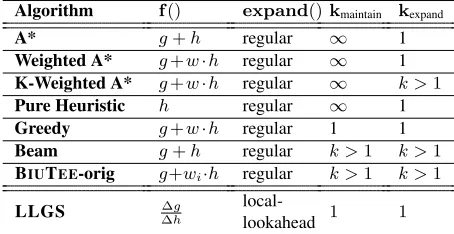
Our empirical investigation compares a range prominent search algorithms, described in Section 2. To facilitate such investigation, we formulate them in the following unifying scheme (Algorithm 1).
Algorithm 1Unified Search Scheme
Parameters: f(·): state evaluation function
expand(·): state generation function
Input: kexpand: # states expanded in each iteration kmaintain: # states in OPEN in each iteration sinit: initial state
1: OPEN← {sinit} 2: repeat
3: BEST←kexpandbest (according tof) states in OPEN 4: GENERATED←S
s∈BESTexpand(s) 5: OPEN←(OPEN\Best)∪GENERATED
6: OPEN←kmaintainbest (according tof) states in OPEN 7: untilBEST contains the goal state
Algorithm f() expand()kmaintain kexpand
A* g+h regular ∞ 1
Weighted A* g+w·h regular ∞ 1
K-Weighted A* g+w·h regular ∞ k >1
Pure Heuristic h regular ∞ 1
Greedy g+w·h regular 1 1
Beam g+h regular k >1 k >1
BIUTEE-orig g+wi·h regular k >1 k >1
LLGS ∆g
∆h
[image:5.612.73.300.61.178.2]
local-lookahead 1 1
Table 2: Search algorithm mapped to the unified search scheme. “Regular” means generating all the states which can be generated by applying a single transformation. Al-ternative greedy implementations usef =h.
(line 3), and expanded using the expansion func-tion expand(s). In classical search algorithms, expand(s) means generating a set of states by ap-plying all the possible state transition operators tos. Next, we remove from OPEN the states which were expanded, and add the newly generated states. Fi-nally, we keep in OPEN only the bestkmaintainstates, according to the evaluation function f(s) (line 6). This process repeats until the goal state is found in BEST (line 7). Table 2 specifies how known search algorithms, described in Section 2, fit into the uni-fied search scheme.
Since runtime efficiency is crucial in our domain, we focused on improving one of the simple but fast algorithms, namely, greedy search. To improve the quality of the proof found by greedy search, we in-troduce new algorithmic components for the expan-sion and evaluation functions, as described in the next two subsections, while maintaining efficiency by keepingkmaintain=kexpand= 1
3.3 Evaluation function
In most domains, the heuristic function h(s) esti-mates the cost of the minimal-cost path from a cur-rent state,s, to a goal state. Having such a function, the value g(s) +h(s) estimates the expected total cost of a search path containings. In our domain, it is yet unclear how to calculate such a heuristic func-tion. Given a states, systems typically estimate the difference (the gap) between sand the hypothesis tH(the goal state). In BIUTEEthis is quantified by the number of parse-tree nodes and edges oftHthat do not exist in s. However, this does not give an
estimation for the expected cost of the path (the se-quence of transformations) fromsto the goal state. This is because the number of nodes and edges that can be changed by a single transformation can vary from a single node to several nodes (e.g., by a lexi-cal syntactic entailment rule). Moreover, even if two transformations change the same number of nodes and edges, their costs might be significantly differ-ent. Consequently, the measurement of the cost ac-cumulated so far (g(s)) and the remaining gap totH (h(s)) are unrelated. We note that a more sophisti-cated heuristic function was suggested by Heilman and Smith (2010), based on tree-kernels. Neverthe-less, this heuristic function, serving ash(s), is still unrelated to the transformation costs (g(s)).
We therefore propose a novel gradient-style func-tion to overcome this difficulty. Our function is designed for a greedy search in which OPEN al-ways contains a single state, s. Let sj be a state generated from s, the cost of deriving sj from s is ∆g(sj) ≡ g(sj)−g(s). Similarly, the reduc-tion in the value of the heuristic funcreduc-tion is de-fined ∆h(sj) ≡ h(s) −h(sj). Now, we define f∆(sj) ≡ ∆g∆ (sj)
h(sj). Informally, this function mea-sures how costly it is to derive sj relative to the obtained decrease in the remaining gap to the goal state. For the edge case in whichh(s)−h(sj)≤0, we definef∆(sj) =∞. Empirically, we show in our experiments that the functionf∆(s)performs better than the traditional functions f(s) = g(s) +h(s)
andfw(s) =g(s) +w·h(s)in our domain.
3.4 Node expansion method
moreover, changing all other transformations would not affect it.
Carefully examining many examples, we general-ized this phenomenon as follows. Often, a sequence of transformations can be decomposed into a set of
coherent subsequencesof transformations, where in each subsequence the transformations strongly de-pend on each other, while different subsequences are independent. This phenomenon can be utilized in the following way: instead of searching for a com-plete sequence of transformations that transformtT intotH, we can iteratively search for independent co-herent subsequences of transformations, such that a combination of these subsequences will transform tT into tH. This is somewhat similar to the tech-nique of applyingmacrooperators, which is used in automated planning (Botea et al., 2005) and puzzle solving (Korf, 1985).
One technique for finding such subsequences is to perform, for each state being expanded, a brute-force depth-limited search, also known as looka-head (Russell and Norvig, 2010; Bulitko and Lus-trek, 2006; Korf, 1990; Stern et al., 2010). How-ever, performing such lookahead might be slow if the branching factor is large. Fortunately, in our domain, coherent subsequences have the following characteristic which can be leveraged: typically, a transformation depends on a previous one only if it is performed over some nodes which were af-fected by the previous transformation. Accordingly, our proposed algorithm searches for coherent subse-quences, in which each subsequent transformation must be applied to nodes that were affected by the previous transformation.
Formally, letobe a transformation that has been applied on a treet, yieldingt0.σaffected(o, t0)denotes the subset of nodes int0which were affected (modi-fied or created) by the application ofo.
Next, for a transformation o, applied on a parse tree t, we define σrequired(t, o) as the subset of t’s nodes required for applyingo(i.e., in the absence of these nodes,ocould not be applied).
Finally, lettbe a parse-tree and σbe a subset of its nodes. enabled ops(t, σ) is a function that re-turns the set of the transformations that can be ap-plied ont, which require at least one of the nodes in σ. Formally, enabled ops(t, σ) ≡ {o ∈ O :
σ∩σrequired(t, o) 6=∅}, whereOis the set of
trans-formations that can be applied on t. In our algo-rithm,σis the set of nodes that were affected by the preceding transformation of the constructed subse-quence.
The recursive procedure described in Algorithm 2 generates all coherent subsequences of lengths up to d. It should be initially invoked witht- the current state (parse tree) being expanded,σ- the set of all its nodes,d- the maximal required length, and∅as an empty initial sequence. We useO·oas concatenation of an operationoto a subsequenceO.
Algorithm 2 local-lookahead(t,σ,d,O)
1: ifd= 0then
2: return ∅(empty-set) 3: end if
4: SUBSEQUENCES← ∅ 5: for allo∈enabled ops(t, σ)do
6: Lett`ot0
7: Add{O·o}∪local-lookahead(t0, σaffected(o, t0), d−1, O· o)to SUBSEQUENCES
8: end for
9: return SUBSEQUENCES
The loop in lines 5 - 8 iterates over transforma-tions that can be applied on the input tree,t, requir-ing the same nodes that were affected by the pre-vious transformation of the subsequence being con-structed. Note that in the first callenabled ops(t, σ)
contain all operations that can be applied ont, with no restriction. Applying an operationoresults in a new subsequence O·o. This subsequence will be part of the set of subsequences found by the proce-dure. In addition, it will be used in the next recur-sive call as the prefix of additional (longer) subse-quences.
3.5 Local-lookahead gradient search
We are now ready to define our new algorithm
LOCAL-LOOKAHEAD GRADIENT SEARCH
(LLGS). In LLGS, like in greedy search, kmaintain=kexpand= 1. expand(s) is defined to return all states generated by subsequences found by thelocal-lookaheadprocedure, while the evalua-tion funcevalua-tion is defined asf = f∆ (see last row of Table 2).
4 Evaluation
of the found proofs (as measured by proof cost), and overall inference performance achieved through var-ious search algorithms. Finally we analyze the con-tribution of our two novel components.
4.1 Evaluation settings
We performed our experiments on the last two published RTE datasets: 5 (2009) and RTE-6 (2010). The RTE-5 dataset is composed of a training and test corpora, each containing 600 text-hypothesis pairs, where in half of them the text en-tails the hypothesis and in the other half it does not. In RTE-6, each of the training and test cor-pora consists of 10 topics, where each topic con-tains 10 documents. Each corpus concon-tains a set of hypotheses (211 in the training dataset, and 243 in the test dataset), along with a set of candidate en-tailing sentences for each hypothesis. The system has to find for each hypothesis which candidate sen-tences entail it. To improve speed and results, we used the filtering mechanism suggested by (Mirkin et al., 2009), which filters the candidate sentences by the Lucene IR engine3. Thus, only top 20 candi-dates per hypothesis were tested
Evaluation of each of the algorithms was performed by running BIUTEE while replacing BIUTEE-orig with this algorithm. We employed a comprehensive set of knowledge resources (avail-able in BIUTEE’s web site): WordNet (Fellbaum, 1998), Directional similarity (Kotlerman et al., 2010), DIRT (Lin and Pantel, 2001) and generic syn-tactic rules. In addition, we used coreference substi-tutions, detected by ArkRef4.
We evaluated several known algorithms, de-scribed in Table 2 above, as well as BIUTEE-orig. The latter is a strong baseline, which outperforms known search algorithms in generating low cost proofs. We compared all the above mentioned al-gorithms to our novel one, LLGS.
We used the training dataset for parameter tun-ing, which controls the trade-off between speed and quality. For weighted A*, as well as for greedy search, we usedw= 6.0, since, for a few instances, lower values of w resulted in prohibitive runtime. For beam search we usedk = 150, since higher
val-3
http://lucene.apache.org
4www.ark.cs.cmu.edu/ARKref/
See (Haghighi and Klein, 2009)
ues ofkdid not improve the proof cost on the train-ing dataset. The value ofd in LLGS was set to3. d= 4yielded the same proof costs, but was about3
times slower.
Since lower values of w could be used by weighted A* for most instances, we also ran ex-periments where we varied the value ofw accord-ing to the dovetailaccord-ing method suggested in (Valen-zano et al., 2010) (denoteddovetailing WA*) as fol-lows. When weighted A* has found a solution, we reran it with a new value of w, set to half of the previous value. The idea is to guide the search for lower cost solutions. This process was halted when the total number of states generated by all weighted A* instances exceeded a predefined constant (set to
10,000).
4.2 Search performance
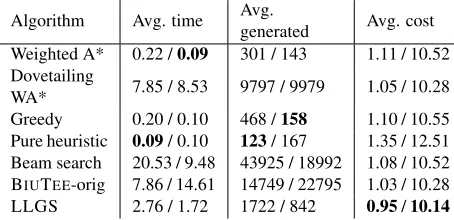
This experiment evaluates the search algorithms in both efficiency (run-time) and proof quality. Effi-ciency is measured by the average CPU (Intel Xeon 2.5 GHz) run-time (in seconds) for finding a com-plete proof for a text-hypothesis instance, and by the average number of generated states along the search. Proof quality is measured by its cost.
The comparison of costs requires that all experi-ments are performed on the same model which was learned during training. Thus, in the training phase we used the original search of BIUTEE, and then ran the test phase with each algorithm separately. The results, presented in Table 3, show that our novel algorithm, LLGS, outperforms all other algorithms in finding lower cost proofs. The second best is BIUTEE-orig which is much slower by a factor of 3 (on RTE-5) to 8 (on RTE-6)5. While inherently fast algorithms, particularly greedy and pure heuris-tic, achieve faster running times, they achieve lower proof quality, as well as lower overall inference per-formance (see next subsection).
4.3 Overall inference performance
In this experiment we test whether, and how much, finding better proofs, by a better search algorithm, improves overall success rate of the RTE system. Table 4 summarizes the results (accuracy in RTE-5
Algorithm Avg. time Avg.
generated Avg. cost Weighted A* 0.22 /0.09 301 / 143 1.11 / 10.52 Dovetailing
[image:8.612.75.302.61.171.2]WA* 7.85 / 8.53 9797 / 9979 1.05 / 10.28 Greedy 0.20 / 0.10 468 /158 1.10 / 10.55 Pure heuristic 0.09/ 0.10 123/ 167 1.35 / 12.51 Beam search 20.53 / 9.48 43925 / 18992 1.08 / 10.52 BIUTEE-orig 7.86 / 14.61 14749 / 22795 1.03 / 10.28 LLGS 2.76 / 1.72 1722 / 842 0.95/10.14
Table 3: Comparison of algorithms on RTE-5 / RTE-6
and F1 in RTE-6). We see that in RTE-5 LLGS out-performs all other algorithms, and BIUTEE-orig is the second best. This result is statistically significant withp <0.02according toMcNemartest. In RTE-6 we see that although LLGS tends to finds lower cost proofs, as shown in Table 3, BIUTEE obtains slightly lower results when utilizing this algorithm.
Algorithm RTE-5 accuracy % RTE-6 F1 %
Weighted A* 59.50 48.20
Dovetailing WA* 60.83 49.01
Greedy 60.50 48.56
Pure heuristic 60.83 45.70
Beam search 61.33 48.58
BIUTEE-orig 60.67 49.25
[image:8.612.322.527.177.222.2]LLGS 64.00 49.09
Table 4: Impact of algorithms on system success rate
4.4 Component evaluation
In this experiment we examine separately our two novel components. We examined f∆ by running LLGS with alternative evaluation functions. The re-sults, displayed in Table 5, show that usingf∆yields better proofs and also improves run time.
f Avg. time Avg. cost Accuracy %
f=g+h 3.28 1.06 61.50
f=g+w·h 3.30 1.07 61.33
[image:8.612.74.282.312.400.2]f=f∆ 2.76 0.95 64.0
Table 5: Impact off∆ on RTE-5. w = 6.0. Accuracy
obtained by retraining with correspondingf.
Ourlocal-lookahead (Subsection 3.4) was exam-ined by running LLGS with alternative node expan-sion methods. One alternative to local-lookahead is standard expansion by generating all immediate derivations. Another alternative is to use the stan-dard lookahead, in which a brute-force depth-limited
search is performed in each iteration, termed here “exhaustive lookahead”. The results, presented in Table 6, show that by avoiding any type of looka-head one can achieve fast runtime, while compro-mising proof quality. On the other hand, both ex-haustive and local lookahead yield better proofs and accuracy, while local lookahead is more than 4 times faster than exhaustive lookahead.
lookahead Avg. time Avg. cost Accuracy (%)
exhaustive 13.22 0.95 64.0
local 2.76 0.95 64.0
none 0.24 0.97 62.0
Table 6: Impact of local and global lookahead on RTE-5. Accuracy obtained by retraining with the corresponding lookahead method.
5 Conclusion
In this paper we investigated the efficiency and proof quality obtained by various search algorithms. Con-sequently, we observed special phenomena of the search space in textual inference and proposed two novel components yielding a new search algorithm, targeted for our domain. We have shown empirically that (1) this algorithm improves run time by factors of 3-8 relative to BIUTEE-orig, and by similar fac-tors relative to standard AI-search algorithms that achieve similar proof quality; and (2) outperforms all other algorithms in finding low cost proofs.
In future work we plan to investigate other search paradigms, e.g., Monte-Carlo style approaches (Kocsis and Szepesv´ari, 2006), which do not fall under the AI search scheme covered in this paper. In addition, while our novel components were moti-vated by the search space of textual inference, we foresee their potential utility in other application areas for search, such as automated planning and scheduling.
Acknowledgments
[image:8.612.80.294.532.580.2]References
Roy Bar-Haim, Ido Dagan, Iddo Greental, and Eyal Shnarch. 2007. Semantic inference at the lexical-syntactic level. InProceedings of AAAI.
Philip Bille. 2005. A survey on tree edit distance and related problems.Theoretical Computer Science. Adi Botea, Markus Enzenberger, Martin M¨uller, and
Jonathan Schaeffer. 2005. Macro-FF: Improving ai planning with automatically learned macro-operators.
J. Artif. Intell. Res. (JAIR), 24:581–621.
Vadim Bulitko and Mitja Lustrek. 2006. Lookahead pathology in real-time path-finding. Inproceedings of AAAI.
Ido Dagan, Oren Glickman, and Bernardo Magnini. 2005. The pascal recognising textual entailment chal-lenge. InProceedings of MLCW.
Rodrigo de Salvo Braz, Roxana Girju, Vasin Pun-yakanok, Dan Roth, and Mark Sammons. 2005. An inference model for semantic entailment in natural lan-guage. InProceedings of AAAI.
Christiane Fellbaum, editor. 1998. WordNet An Elec-tronic Lexical Database. The MIT Press, May. Ariel Felner, Sarit Kraus, and Richard E. Korf. 2003.
KBFS: K-best-first search. Ann. Math. Artif. Intell., 39(1-2):19–39.
David Furcy and Sven Koenig. 2005. Limited discrep-ancy beam search. Inproceedings of IJCAI.
Aria Haghighi and Dan Klein. 2009. Simple coreference resolution with rich syntactic and semantic features. In
Proceedings of EMNLP.
Stefan Harmeling. 2009. Inferring textual entailment with a probabilistically sound calculus. Natural Lan-guage Engineering.
Peter E. Hart, Nils J. Nilsson, and Bertram Raphael. 1968. A formal basis for the heuristic determination of minimum cost paths. IEEE Transactions on Sys-tems Science and Cybernetics, SSC-4(2):100–107. Michael Heilman and Noah A. Smith. 2010. Tree
edit models for recognizing textual entailments, para-phrases, and answers to questions. InProceedings of NAACL.
Levente Kocsis and Csaba Szepesv´ari. 2006. Bandit based monte-carlo planning. Inproceedings of ECML. Richard E. Korf. 1985. Macro-operators: A weak
method for learning.Artif. Intell., 26(1):35–77. Richard E. Korf. 1990. Real-time heuristic search.Artif.
Intell., 42(2-3):189–211.
Lili Kotlerman, Ido Dagan, Idan Szpektor, and Maayan Zhitomirsky-geffet. 2010. Directional distributional similarity for lexical inference.Natural Language En-gineering.
Milen Kouylekov and Bernardo Magnini. 2005. Rec-ognizing textual entailment with tree edit distance al-gorithms. InProceedings of Pascal Challenges Work-shop on Recognising Textual Entailment.
Dekang Lin and Patrick Pantel. 2001. DIRT - discov-ery of inference rules from text. In Proceedings of ACM SIGKDD Conference on Knowledge Discovery and Data Mining.
Yashar Mehdad. 2009. Automatic cost estimation for tree edit distance using particle swarm optimization. InProceedings of the ACL-IJCNLP.
Shachar Mirkin, Roy Bar-Haim, Jonathan Berant, Ido Dagan, Eyal Shnarch, Asher Stern, and Idan Szpektor. 2009. Addressing discourse and document structure in the rte search task. InProceedings of TAC.
Ira Pohl. 1970. Heuristic search viewed as path finding in a graph.Artificial Intelligence, 1(3-4):193 – 204. Stuart Russell and Peter Norvig. 2010. Artificial
Intel-ligence: A Modern Approach. Prentice-Hall, Engle-wood Cliffs, NJ, 3rd edition edition.
Asher Stern and Ido Dagan. 2011. A confidence model for syntactically-motivated entailment proofs. In Pro-ceedings of RANLP.
Roni Stern, Tamar Kulberis, Ariel Felner, and Robert Holte. 2010. Using lookaheads with optimal best-first search. Inproceedings of AAAI.
Idan Szpektor, Hristo Tanev, Ido Dagan, and Bonaven-tura Coppola. 2004. Scaling web-based acquisition of entailment relations. InProceedings of EMNLP. Richard Anthony Valenzano, Nathan R. Sturtevant,
Jonathan Schaeffer, Karen Buro, and Akihiro Kishi-moto. 2010. Simultaneously searching with multiple settings: An alternative to parameter tuning for subop-timal single-agent search algorithms. Inproceedings of ICAPS.
Mengqiu Wang and Christopher D. Manning. 2010. Probabilistic tree-edit models with structured latent variables for textual entailment and question answer-ing. InProceedings of COLING.
Rong Zhou and Eric A. Hansen. 2005. Beam-stack search: Integrating backtracking with beam search. In