Int. J. Mol. Sci. 2017, 18, x; doi: FOR PEER REVIEW www.mdpi.com/journal/ijms
Article
1
Molecular cloning, Expression and Functional
2
Analysis of Interferon Regulatory Factor 5 (IRF 5) in
3
Malabar grouper (Epinephelus malabaricus)
4
Thirunavukkarasu Periyasamy
1, Ming-Wei Lu
1, 2,*
5
1
Laboratory of Molecular Virology and Immunology, Department of Aquaculture, The College of
6
Life Science, National Taiwan Ocean University, No. 2, Beining Road, Keelung 202, Taiwan;
7
[email protected]
8
2
Center of Excellence for the Oceans, National Taiwan Ocean University, No. 2, Beining Road,
9
Keelung 202, Taiwan; [email protected], [email protected]
10
* Correspondence: [email protected]; Tel.: +886-24622192-5206
11 12 13 14 15
Abstract: Interferon regulatory factor 5 (IRF5) is known to be involved in the innate immune
16
response and pro-inflammatory cytokines. However, the roles of IRF5 in immune responses in
17
Malabar grouper (Epinephelus malabaricus) have not been extensively explored. In this study, IRF5
18
gene was identified and characterized from M. grouper. The full-length IRF5 cDNA consisted of a 5’
19
terminal untranslated region (5’-UTR) of 289 bp and a 3’-UTR of 542 bp, an open reading frame
20
(ORF) of 1500 bp encoding a polypeptide of 499 amino acids with a predicted molecular mass of
21
56.28 kDa and isoelectric point (pI) of 5.2. The putative MgIRF5 protein consists of four important
22
conserved domains: a helix DNA-binding domain (DBD) at the N-terminus, a middle region, an IRF
23
association domain (IAD) and a virus activated domain (VAD) at the C-terminus. Sequence
24
alignment and phylogenetic analysis showed that highest sequence similarity of IRF5 was observed
25
between the IRF5 genes from Oplegnathus fasciatus and Miichthys miiuy. The mRNA transcripts of
26
IRF5 were detected in a wide range of tissues types from healthy M. grouper with highest
27
expression in muscle, liver and skin. After treatment with poly (I: C), it was significantly
28
up-regulated in spleen and liver tissues. When infected with NNV, the expression level of MgIRF5
29
was up-regulated in spleen and head kidney and their transcriptional responses to IRF5 increased
30
in the grouper kidney cells. This approach suggests that MgIRF5 is important in the underlying
31
mechanism of the innate immune responses against antiviral response.
32 33
Keywords: IRF5, Transcriptional factors, Immuno-stimulation, Nervous necrosis virus, Malabar
34
grouper (Epinephelus malabaricus)
35 36
1. Introduction
37
Interferon regulatory factors (IRFs), a family of transcription factors play a viral role in the
38
regulation of IFN genes and IFN-stimulated genes (ISGs) [1], which mainly acknowledge in
39
regulating many facets of innate and adaptive immune responses [2]. In vertebrates,IRF1 (IRF1, 2
40
© 2017 by the author(s). Distributed under a Creative Commons CC BY license.
and IRF11), IRF3 (IRF3 and 7), IRF4 (IRF4, 8, 9, 10) and IRF5 (IRF5 and 6) are the four subfamilies of
41
IRF 11 members [3]. IRFs have the highly conserved region (DBD) and a low homologous region
42
(IRF association domain, IAD) the former with five tyrosines, which are responsible for recognizing
43
IFN-stimulated response element (ISRE) [4]. The expressions of genes are vital to the cellular
44
antiviral response.
45
IRF5 serves as a direct transducer for viral infection-mediated signaling pathways in type I
46
IFN genes and can induce expression of a gene with both IFN-α and IFN-β, upon viral infection [5].
47
Interestingly, recent studies have demonstrated that IRF5 plays an important role in RIG-I and
48
toll-like pathways [5-9], and is separated as lymphoid cells and apoptosis [7]. IRF5 is subjected to
49
TRAF6-mediated K63-linked ubiquitination [10] and the signaling connection amongst IRF5 and
50
mitochondrial antiviral signaling protein (MAVS) was distinguished in mice [11]. The receptors
51
mediated signaling pathways for activation of IRF5 dimerizes and translocate to the nucleus,
52
binding to the ISRE motifs in the promoters positively regulating cytokines, for example, IFN1, IL-6,
53
IL-1β, and TNF-α while suppressing IL-10 expression [10, 12]. IRF5 is communicated in dendritic
54
cells, monocytes and B cells, is a transcription factor that controls the transactivations of type I IFN
55
framework related genes and also inflammatory and immune response associated genes [13]. IRF5
56
is a vital transcription factor that regulates the transcription of type I interferon upon viral disease.
57
IRF5 has been characterized in turbot [14], Paddlefish [15], Zebrafish [16], Grass [17], Japanese
58
flounder [18], Rock bream [19], Tongue sole [20] and Common carp [21]. Precise evidence regarding
59
IRF5 induction by type I IFNs in grouper fish has not been identified.
60
Viral nervous necrosis (VNN) [22], also called viral encephalopathy and retinopathy [23], is
61
a disease in more than 40 species of freshwater and marine fish around the world. Clinical
62
symptoms of NNV affected fish develop vacuolization in the central nervous system, retina,
63
abnormal swimming behavior, and resulting in a high mortality rate (up to 100%) particularly in
64
larvae and juvenile stages [24]. In this research, the complementary DNA coding for the IRF5 gene
65
of grouper were successfully cloned and characterized. Expression analyses of these IRF5 mRNAs
66
were performed using real-time quantitative PCR in the developmental stages and various tissues
67
of healthy fish and fish injected by IP with Poly (1: C), LPS and NNV. The current study contributes
68
to understanding the immune system of grouper and provides important knowledge that can assist
69
in the creation of tools to control diseases of economic importance to the fish industry.
70
2. Results
71
2.1. Characterization of MgIRF5
72
The full-length sequence of MgIRF5 was identified from the transcriptome database and
73
deposited in Gene bank (accession no. KY428937). The full-length IRF5 cDNA sequence was 2331
74
bp in length and contained an open reading frame (ORF) of 1500 nucleotides including a 289 bp
75
5’-UTR and a 542 bp 3’-UTR. The MgIRF5 gene encoded a protein of 499 amino acids with a
76
predicted molecular weight of 56.28 KDa and a predicted isoelectric point (pI) of 5.2. Two mRNA
77
instability motifs ATTTA (1882-1887bp) and (2306-2310 bp) were identified in the 3’-UTR along
78
with polyadenylation signals sequences (AATAAA) located at 2041-2046 and 2280-2285 bp,
79
respectively (Figure 1A). The MgIRF5 protein structural domains were characterized by SMART
80
software tool (Figure 1B).
81
82
83
84 A
85
86 B
Figure 1. (A) Full-length cDNA and detected amino acid sequence of MgIRF5 from M. grouper
87
(E. malabaricus). The detected amino acid sequence is shown under the nucleotide sequence. The
88
5’-UTR and 3’-UTR are shown in small letters. The bold letters inside box represent the start codon
89
(ATG) and stop codon (AAA). Two mRNA instability motifs ATTTA (1884-1888bp) and
90
(2307-2311bp) were identified in the 3’-UTR along with polydenelation signals sequences (AATAAA)
91
are located at 2042-2047 and 2281-2286 bp, respectively. (B) The putative protein structure of IRF5
92
from E. malabaricus was generated using SMART-MODEL program.
93 94
2.2. Homology Sequence Comparison and Multiple Amino Acid Alignment
95
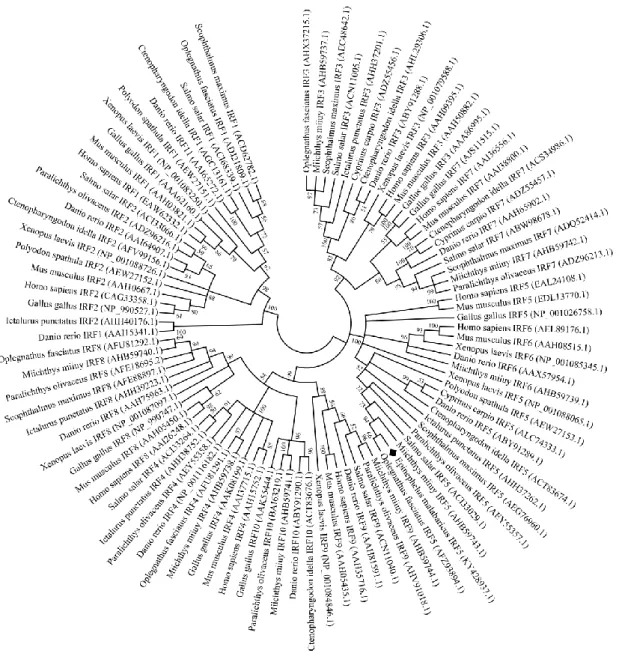
A pairwise alignment of the MgIRF5 protein sequence with other known IRF5 species
96
revealed that MgIRF5 shared 94% similarity and 92% identity with the O. fasciatus IRF5 homolog.
97
The teleost IRF5 homologs demonstrated 94 to 53% identities between O. fasciatus and H. sapiens
98
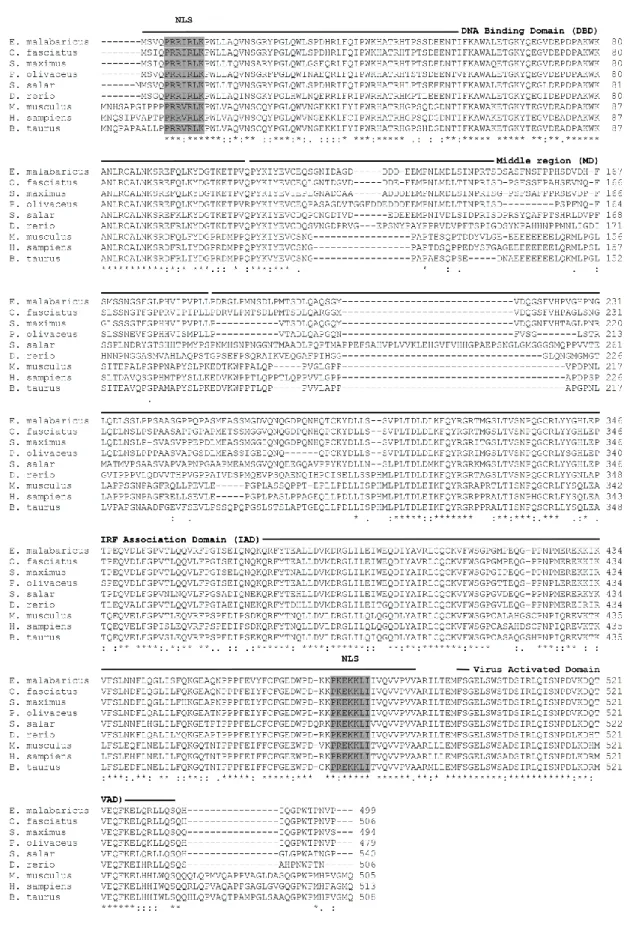
(Table 2). Multiple sequence alignments showed four conserved domains in both human and fish
99
IRF5 (Figure 2).
100 101
Table 2. The amino acid identities (%) and similarities (%) and gap of Malabar grouper IRF5 to
102
reprehension in other species.
103 104
Common name Species Accession no. AA Identity
(%)
Similarity (%)
Gap
Malabar grouper Epinephelus malabaricus ARI70656.1 500 100 100 0
Sea bream Oplegnathus fasciatus AFZ93894.1 498 92 94 0
Large yellow croaker
Larimichthys crocea KKF19013.1 492 89 92 1
Sciaenidae drum Miichthys miiuy AHB59743.1 492 89 92 1
Turbot fish Scophthalmus maximus AEG76957.1 487 84 88 2 Nile tilapia Oreochromis niloticus XP_003448868.1 474 82 87 5 Japanese flounder Paralichthya olivaceus ADZ96215.1 472 79 84 7
Atlantic salmon Salmo salar NP_001133324.1 532 70 78 6
Crass carp Ctenopharyngodon idella ACT83674.1 579 67 78 4
Zebrafish Danio rerio NP_001314746.1 516 66 77 4
Paddlefish Polyodon spathula AEW27153.1 496 63 74 5
Green sea turtle Chelonia mydas EMP28595.1 472 58 69 10
African clawed frog Xenopus laevis NP_001088065.1 517 54 67 6
Mouse Mus musculus NP_001239311.1 506 54 63 8
Human Homo sapiens XP_011514463.1 504 53 64 6