Uncertainty Reduction in Collaborative Bootstrapping:
Measure and Algorithm
Yunbo Cao Microsoft Research Asia
5F Sigma Center, No.49 Zhichun Road, Haidian
Beijing, China, 100080 [email protected]
Hang Li
Microsoft Research Asia 5F Sigma Center, No.49 Zhichun Road, Haidian
Beijing, China, 100080 [email protected]
Li Lian
Computer Science Department Fudan University No. 220 Handan Road Shanghai, China, 200433
Abstract
This paper proposes the use of uncertainty reduction in machine learning methods such as co-training and bilingual boot-strapping, which are referred to, in a gen-eral term, as ‘collaborative bootstrapping’. The paper indicates that uncertainty re-duction is an important factor for enhanc-ing the performance of collaborative bootstrapping. It proposes a new measure for representing the degree of uncertainty correlation of the two classifiers in col-laborative bootstrapping and uses the measure in analysis of collaborative boot-strapping. Furthermore, it proposes a new algorithm of collaborative bootstrapping on the basis of uncertainty reduction. Ex-perimental results have verified the cor-rectness of the analysis and have demonstrated the significance of the new algorithm.
1 Introduction
We consider here the problem of collaborative bootstrapping. It includes co-training (Blum and Mitchell, 1998; Collins and Singer, 1998; Nigam and Ghani, 2000) and bilingual bootstrapping (Li and Li, 2002).
Collaborative bootstrapping begins with a small number of labelled data and a large number of unlabelled data. It trains two (types of) classifiers from the labelled data, uses the two classifiers to label some unlabelled data, trains again two new classifiers from all the labelled data, and repeats the above process. During the process, the two
classifiers help each other by exchanging the la-belled data. In co-training, the two classifiers have different feature structures, and in bilingual boot-strapping, the two classifiers have different class structures.
Dasgupta et al (2001) and Abney (2002) con-ducted theoretical analyses on the performance (generalization error) of co-training. Their analyses, however, cannot be directly used in studies of co-training in (Nigam & Ghani, 2000) and bilingual bootstrapping.
In this paper, we propose the use of uncertainty reduction in the study of collaborative bootstrap-ping (both co-training and bilingual bootstrapbootstrap-ping). We point out that uncertainty reduction is an im-portant factor for enhancing the performances of the classifiers in collaborative bootstrapping. Here, the uncertainty of a classifier is defined as the por-tion of instances on which it cannot make classifi-cation decisions. Exchanging labelled data in bootstrapping can help reduce the uncertainties of classifiers.
Uncertainty reduction was previously used in active learning. We think that it is this paper which for the first time uses it for bootstrapping.
We propose a new measure for representing the uncertainty correlation between the two classifiers in collaborative bootstrapping and refer to it as ‘uncertainty correlation coefficient’ (UCC). We use UCC for analysis of collaborative bootstrap-ping. We also propose a new algorithm to improve the performance of existing collaborative boot-strapping algorithms. In the algorithm, one classi-fier always asks the other classiclassi-fier to label the most uncertain instances for it.
2 Related Work
2.1 Co-Training and Bilingual Bootstrapping Co-training, proposed by Blum and Mitchell (1998), conducts two bootstrapping processes in parallel, and makes them collaborate with each other. More specifically, it repeatedly trains two classifiers from the labelled data, labels some unlabelled data with the two classifiers, and ex-changes the newly labelled data between the two classifiers. Blum and Mitchell assume that the two classifiers are based on two subsets of the entire feature set and the two subsets are conditionally independent with one another given a class. This assumption is called ‘view independence’. In their algorithm of co-training, one classifier always asks the other classifier to label the most certain in-stances for the collaborator. The word sense dis-ambiguation method proposed in Yarowsky (1995) can also be viewed as a kind of co-training.
Since the assumption of view independence cannot always be met in practice, Collins and Singer (1998) proposed a co-training algorithm based on ‘agreement’ between the classifiers.
As for theoretical analysis, Dasgupta et al. (2001) gave a bound on the generalization error of co-training within the framework of PAC learning. The generalization error is a function of ‘dis-agreement’ between the two classifiers. Dasgupta et al’s result is based on the view independence assumption, which is strict in practice.
Abney (2002) refined Dasgupta et al’s result by relaxing the view independence assumption with a new constraint. He also proposed a new co-training algorithm on the basis of the constraint.
Nigam and Ghani (2000) empirically demon-strated that bootstrapping with a random feature split (i.e. co-training), even violating the view in-dependence assumption, can still work better than bootstrapping without a feature split (i.e., boot-strapping with a single classifier).
For other work on co-training, see (Muslea et al 200; Pierce and Cardie 2001).
Li and Li (2002) proposed an algorithm for word sense disambiguation in translation between two languages, which they called ‘bilingual boot-strapping’. Instead of making an assumption on the features, bilingual bootstrapping makes an assump-tion on the classes. Specifically, it assumes that the classes of the classifiers in bootstrapping do not
overlap. Thus, bilingual bootstrapping is different from co-training.
Because the notion of agreement is not involved in bootstrapping in (Nigam & Ghani 2000) and bilingual bootstrapping, Dasgupta et al and Abney’s analyses cannot be directly used on them.
2.2 Active Learning
Active leaning is a learning paradigm. Instead of passively using all the given labelled instances for training as in supervised learning, active learning repeatedly asks a supervisor to label what it con-siders as the most critical instances and performs training with the labelled instances. Thus, active learning can eventually create a reliable classifier with fewer labelled instances than supervised learning. One of the strategies to select critical in-stances is called ‘uncertain reduction’ (e.g., Lewis and Gale, 1994). Under the strategy, the most un-certain instances to the current classifier are se-lected and asked to be labelled by a supervisor.
The notion of uncertainty reduction was not used for bootstrapping, to the best of our knowl-edge.
3 Collaborative Bootstrapping and Un-certainty Reduction
We consider the collaborative bootstrapping prob-lem.
Let denote a set of instances (feature vectors) and let denote a set of labels (classes). Given a number of labelled instances, we are to construct a functionh: → . We also refer to it as a classi-fier.
In collaborative bootstrapping, we consider the use of two partial functions
h
1 andh
2, which either output a class label or a special symbol ⊥denoting ‘no decision’.Co-training and bilingual bootstrapping are two examples of collaborative bootstrapping.
In co-training, the two collaborating classifiers are assumed to be based on two different views, namely two different subsets of the entire feature set. Formally, the two views are respectively inter-preted as two functions X1(x)and X2(x),x∈ . Thus, the two collaborating classifiers
h
1 andh
2 in co-training can be respectively represented as)) ( ( 1 1 X x
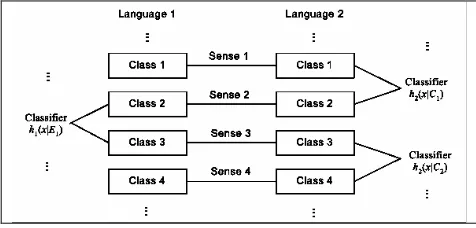
In bilingual bootstrapping, a number of classifi-ers are created in the two languages. The classes of the classifiers correspond to word senses and do not overlap, as shown in Figure 1. For example, the classifier h1(x|E1) in language 1 takes sense 2 and sense 3 as classes. The classifier h2(x|C1) in language 2 takes sense 1 and sense 2 as classes, and the classifier h2(x|C2) takes sense 3 and sense 4 as classes. Here we use E1,C1,C2 to
de-note different words in the two languages. Collabo-rative bootstrapping is performed between the classifiers h1(∗) in language 1 and the classifiers
) (
h2 ∗ in language 2. (See Li and Li 2002 for de-tails).
For the classifier h1(x|E1)in language 1, we assume that there is a pseudo classifier
) C , C | x (
h2 1 2 in language 2, which functions as a collaborator of h1(x|E1) . The pseudo classifier
) C , C | x (
h2 1 2 is based on h2(x|C1) and
) C | x (
h2 2 , and takes sense 2 and sense 3 as classes. Formally, the two collaborating classifiers (one real classifier and one pseudo classifier) in bilin-gual bootstrapping are respectively represented as
) | (
1 x E
h and h2(x |C),x∈ .
Next, we introduce the notion of uncertainty re-duction in collaborative bootstrapping.
Definition 1 The uncertaintyU(h)of a classi-fierhis defined as:
}) ,
) ( | ({ )
(h = P x h x =⊥ x∈
U (1)
In practice, we define U(h) as
}) , , ) ) ( ( | ({ )
(h =P x Chx =y < ∀y∈ x∈
U θ (2)
where θ denotes a predetermined threshold and )
(∗
C denotes the confidence score of the classifier h.
Definition 2 The conditional uncer-taintyU(h| y)of a classifierhgiven a class y is defined as:
) | } , ) ( | ({ ) |
(h y P x h x x Y y
U = =⊥ ∈ = (3)
We note that the uncertainty (or conditional un-certainty) of a classifier (a partial function) is an indicator of the accuracy of the classifier. Let us consider an ideal case in which the classifier achieves 100% accuracy when it can make a classi-fication decision and achieves 50% accuracy when it cannot (assume that there are only two classes). Thus, the total accuracy on the entire data space is
) ( 5 . 0
1− ×U h .
Definition 3 Given the two classifiers
h
1andh
2in collaborative bootstrapping, the uncertainty re-duction of
h
1 with respect toh
2 (denoted as) \ (h1 h2
UR ), is defined as
}) , ) ( , ) ( | ({ ) \
(h1 h2 =P x h1 x =⊥h2 x ≠⊥x∈
UR (4)
Similarly, we have
}) , ) ( , ) ( | ({ ) \
(h2 h1 =P x h1 x ≠⊥h2 x =⊥x∈
UR
Uncertainty reduction is an important factor for determining the performance of collaborative boot-strapping. In collaborative bootstrapping, the more the uncertainty of one classifier can be reduced by the other classifier, the higher the performance can be achieved by the classifier (the more effective the collaboration is).
4 Uncertainty Correlation Coefficient Measure
4.1 Measure
We introduce the measure of uncertainty correla-tion coefficient (UCC) to collaborative bootstrap-ping.
Definition 4 Given the two classifiers
h
1andh
2, the conditional uncertainty correlation coefficient (CUCC) betweenh
1andh
2given a class y (denoted as rh1h2y), is defined as) | ) ( ( ) | ) ( (
) | ) ( , ) ( ( 2
1 1 2
2 1
y Y x h P y Y x h P
y Y x h x h P y
h h r
= =⊥ =
=⊥
= =⊥ =⊥
=
(5)
Definition 5 The uncertainty correlation coeffi-cient (UCC) between
h
1andh
2 (denoted as Rh1h2), is defined as=
y
y h h h
h P(y)r
R12 12 (6)
UCC represents the degree to which the
[image:3.612.66.304.270.384.2]tainties of the two classifiers are related. If UCC is high, then there are a large portion of instances which are uncertain for both of the classifiers. Note that UCC is a symmetric measure from both classi-fiers’ perspectives, while UR is an asymmetric measure from one classifier’s perspective (ei-therUR(h1\h2)or UR(h2\h1)).
4.2 Theoretical Analysis
Theorem 1 reveals the relationship between the CUCC (UCC) measure and uncertainty reduction.
Assume that the classifier h1can collaborate
with either of the two classifiers h2and 'h2. The
two classifiers h2and h2′ have equal conditional
uncertainties. The CUCC values between
h
1and2
h′are smaller than the CUCC values between
h
1andh2. Then, according to Theorem 1,
h
1shouldcollaborate withh2′, becauseh2′can help reduce its uncertainty more, thus, improve its accuracy more.
Theorem 1 Given the two classifier pairs )
,
(h1 h2 and (h1,h2′) , if rh1h2y ≥rh1h2′y,y∈ and
), | ( ) |
(h2 y U h2 y
U = ′ y∈ , then we have
) \ ( ) \
(h1 h2 UR h1 h2
UR ≤ ′
Proof:
We can decompose the uncertaintyU(h1)of h1 as
follows: ) ( )) | } , ) ( , ) ( | ({ ) | } , ) ( , ) ( | ({ ( ) ( ) | } , ) ( | ({ ) ( 2 1 2 1 1 1 y Y P y Y x x h x h x P y Y x x h x h x P y Y P y Y x x h x P h U y y = = ∈ ≠⊥ =⊥ + = ∈ =⊥ =⊥ = = = ∈ =⊥ = ) ( )) | } , ) ( , ) ( | ({ ) | } , ) ( | ({ ) | } , ) ( | ({ ( 2 1 2 1 2 1 y Y P y Y x x h x h x P y Y x x h x P y Y x x h x P r
y hhy
= = ∈ ≠⊥ =⊥ + = ∈ =⊥ ⋅ = ∈ =⊥ = ) ( )) | } , ) ( , ) ( | ({ ) | ( ) | ( ( 2 1 2 1 2 1 y Y P y Y x x h x h x P y h U y h U r
y hhy
= = ∈ ≠⊥ =⊥ + = })) , ) ( , ) ( | ({ ) ( ) | ( ) | ( ( 2 1 2 1 2 1 ∈ ≠⊥ =⊥ + = = x x h x h x P y Y P y h U y h U r
y hhy
Thus, = − = ∈ ≠⊥ =⊥ =
y hhy
y Y P y h U y h U r h U x x h x h x P h h UR ) ( ) | ( ) | ( ) ( }) , ) ( , ) ( | ({ ) \ ( 2 1 1 2 1 2 1 2 1
Similarly we have
= ′
− =
′ ′
y hhy
y Y P y h U y h U r h U h h
UR( 1\ 2) ( 1) 12 ( 1| ) ( 2| ) ( )
Under the conditions,rh1h2y ≥ rh1h2′y,y∈ and ),
| ( ) |
(h2 y U h y2
U = ′ y∈ , we have
) \ ( ) \
(h1 h2 URh1 h2
UR ≤ ′
Theorem 1 states that the lower the CUCC val-ues are, the higher the performances can be achieved in collaborative bootstrapping.
Definition 6 The two classifiers in co-training are said to satisfy the view independence assump-tion (Blum and Mitchell, 1998), if the following equations hold for any class y.
) | ( ) , | ( ) | ( ) , | ( 2 2 1 1 2 2 1 1 2 2 1 1 y Y x X P x X y Y x X P y Y x X P x X y Y x X P = = = = = = = = = = = =
Theorem 2 If the view independence assump-tion holds, then rh1h2y =1.0holds for any class y.
Proof:
According to (Abney, 2002), view independence implies classifier independence:
) | ( ) , | ( ) | ( ) , | ( 2 1 2 1 2 1 y Y v h P u h y Y v h P y Y u h P v h y Y u h P = = = = = = = = = = = =
We can rewrite them as
) | ( ) | ( ) | ,,
(h1 u h2 v Y y Ph1 u Y yPh2 v Y y
P = = = = = = = =
Thus, we have
) | } ) ( | ({ ) | } , ) ( | ({ ) | } , ) ( , ) ( | ({ 2 1 2 1 y Y x x h x P y Y x x h x P y Y x x h x h x P = ∈ =⊥ = ∈ =⊥ = = ∈ =⊥ =⊥ It means ∈ ∀ = y
rh1h2y 1.0,
Theorem 2 indicates that in co-training with view independence, the CUCC values ( rh1h2y,∀y∈ ) are small, since by
defini-tion
0
<
r
h1h2y<
∞
. According to Theorem 1, it is easy to reduce the uncertainties of the classifiers. That is to say, co-training with view independence can perform well.How to conduct theoretical evaluation on the CUCC measure in bilingual bootstrapping is still an open problem.
4.3 Experimental Results
We conducted experiments to empirically evaluate the UCC values of collaborative bootstrapping. We also investigated the relationship between UCC and accuracy. The results indicate that the theoreti-cal analysis in Section 4.2 is correct.
agree with their ‘true’ labels. Moreover, when we refer to UCC, we mean that it is the UCC value on the test data. We set the value of θ in Equation (2) to 0.8.
Co-Training for Artificial Data Classification We used the data in (Nigam and Ghani 2000) to conduct co-training. We utilized the articles from four newsgroups (see Table 1). Each group had 1000 texts.
By joining together randomly selected texts from each of the two newsgroups in the first row as positive instances and joining together randomly selected texts from each of the two newsgroups in the second row as negative instances, we created a two-class classification data with view independ-ence. The joining was performed under the condi-tion that the words in the two newsgroups in the first column came from one vocabulary, while the words in the newsgroups in the second column came from the other vocabulary.
We also created a set of classification data without view independence. To do so, we ran-domly split all the features of the pseudo texts into two subsets such that each of the subsets contained half of the features.
We next applied the co-training algorithm to the two data sets.
We conducted the same pre-processing in the two experiments. We discarded the header of each text, removed stop words from each text, and made each text have the same length, as did in (Nigam and Ghani, 2000). We discarded 18 texts from the entire 2000 texts, because their main contents were binary codes, encoding errors, etc.
We randomly separated the data and performed training with random feature split and co-training with natural feature split in five times. The results obtained (cf., Table 2), thus, were averaged over five trials. In each trial, we used 3 texts for each class as labelled training instances, 976 texts as testing instances, and the remaining 1000 texts as unlabelled training instances.
From Table 2, we see that the UCC value of the natural split (in which view independence holds) is lower than that of the random split (in which view
independence does not hold). That is to say, in natural split, there are fewer instances which are uncertain for both of the classifiers. The accuracy of the natural split is higher than that of the random split. Theorem 1 states that the lower the CUCC values are, the higher the performances can be achieved. The results in Table 2 agree with the claim of Theorem 1. (Note that it is easier to use CUCC for theoretical analysis, but it is easier to use UCC for empirical analysis).
Table 2: Results with Artificial Data Feature Accuracy UCC Natural Split 0.928 1.006 Random Split 0.712 2.399
We also see that the UCC value of the natural split (view independence) is about 1.0. The result agrees with Theorem 2.
Co-Training for Web Page Classification We used the same data in (Blum and Mitchell, 1998) to perform co-training for web page classifi-cation.
The web page data consisted of 1051 web pages collected from the computer science departments of four universities. The goal of classification was to determine whether a web page was concerned with an academic course. 22% of the pages were actually related to academic courses. The features for each page were possible to be separated into two independent parts. One part consisted of words occurring in the current page and the other part consisted of words occurring in the anchor texts pointed to the current page.
[image:5.612.316.547.580.694.2]We randomly split the data into three subsets: labelled training set, unlabeled training set, and test set. The labelled training set had 3 course pages and 9 non-course pages. The test set had 25% of the pages. The unlabelled training set had the re-maining data.
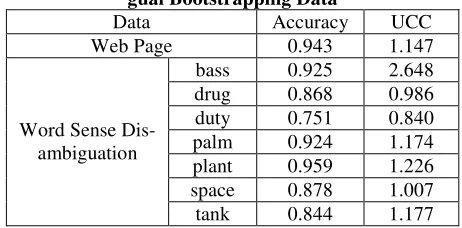
Table 3: Results with Web Page Data and Bilin-gual Bootstrapping Data
Data Accuracy UCC Web Page 0.943 1.147
bass 0.925 2.648 drug 0.868 0.986 duty 0.751 0.840 palm 0.924 1.174 plant 0.959 1.226 space 0.878 1.007 Word Sense
Dis-ambiguation
tank 0.844 1.177
We used the data to perform co-training and web page classification. The setting for the
Table 1: Artificial Data for Co-Training Class Feature Set A Feature Set B
experiment was almost the same as that of Nigam and Ghani’s. One exception was that we did not conduct feature selection, because we were not able to follow their method from their paper.
We repeated the experiment five times and evaluated the results in terms of UCC and accuracy. Table 3 shows the average accuracy and UCC value over the five trials.
Bilingual Bootstrapping
We also used the same data in (Li and Li, 2002) to conduct bilingual bootstrapping and word sense disambiguation.
The sense disambiguation data were related to seven ambiguous English words, each having two Chinese translations. The goal was to determine the correct Chinese translations of the ambiguous English words, given English sentences containing the ambiguous words.
For each word, there were two seed words used as labelled instances for training, a large number of unlabeled instances (sentences) in both English and Chinese for training, and about 200 labelled in-stances (sentences) for testing. Details on data are shown in Table 4.
We used the data to perform bilingual boot-strapping and word sense disambiguation. The set-ting for the experiment was exactly the same as that of Li and Li’s. Table 3 shows the accuracy and UCC value for each word.
From Table 3 we see that both co-training and bilingual bootstrapping have low UCC values (around 1.0). With lower UCC (CUCC) values, higher performances can be achieved, according to Theorem 1. The accuracies of them are indeed high.
Note that since the features and classes for each word in bilingual bootstrapping and those for web page classification in co-training are different, it is not meaningful to directly compare the UCC val-ues of them.
5 Uncertainty Reduction Algorithm
5.1 Algorithm
We propose a new algorithm for collaborative bootstrapping (both co-training and bilingual boot-strapping).
In the algorithm, the collaboration between the classifiers is driven by uncertainty reduction. Spe-cifically, one classifier always selects the most un-certain unlabelled instances for it and asks the other classifier to label. Thus, the two classifiers can help each other more effectively.
There exists, therefore, a similarity between our algorithm and active learning. In active learning the learner always asks the supervisor to label the
Table 4: Data for Bilingual Bootstrapping Unlabelled instances
Word
English Chinese Seed words Test instances
bass 142 8811 fish / music 200
drug 3053 5398 treatment / smuggler 197
duty 1428 4338 discharge / export 197
palm 366 465 tree / hand 197
plant 7542 24977 industry / life 197
Space 3897 14178 volume / outer 197
tank 417 1400 combat / fuel 199
Total 16845 59567 - 1384
Input: A set of labeled instances and a set of unla-belled instances.
Loop while there exist unlabelled instances{ Create classifier
h
1using the labeled instances; Create classifierh
2using the labeled instances; For each class (Y = y ){Pick upby unlabelled instances whose labels (Y = y) are most certain for
h
1and are most uncertain forh
2, label them withh
1and add them into the set of labeled instances;
Pick upby unlabelled instances whose labels (Y = y ) are most certain for
h
2and are most uncertain forh
1, label them withh
2 and add them into the set of labeled instances;} }
Output: Two classifiers
h
1andh
2most uncertain examples for it, while in our algo-rithm one classifier always asks the other classifier to label the most uncertain examples for it.
Figure 2 shows the algorithm. Actually, our new algorithm is different from the previous algo-rithm only in one point. Figure 2 highlights the point in italic fonts. In the previous algorithm, when a classifier labels unlabeled instances, it la-bels those instances whose lala-bels are most certain for the classifier. In contrast, in our new algorithm, when a classifier labels unlabeled instances, it la-bels those instances whose lala-bels are most certain for the classifier, but at the same time most uncer-tain for the other classifier.
As one implementation, for each class y,
h
1first selects its most certainay instances,h
2 nextse-lects from them its most uncertain by instances
(ay ≥by ), and finally
h
1labels theby instances with label y (Collaboration from the opposite di-rection is performed similarly.). We use this im-plementation in our experiments described below. 5.2 Experimental ResultsWe conducted experiments to test the effectiveness of our new algorithm. Experimental results indi-cate that the new algorithm performs better than the previous algorithm. We refer to them as ‘new’ and ‘old’ respectively.
Co-Training for Artificial Data Classification
We used the artificial data in Section 4.3 and con-ducted co-training with both the old and new algo-rithms. Table 5 shows the results.
We see that in co-training the new algorithm performs as well as the old algorithm when UCC is low (view independence holds), and the new algo-rithm performs significantly better than the old al-gorithm when UCC is high (view independence does not hold).
Co-Training for Web Page Classification We used the web page classification data in Sec-tion 4.3 and conducted co-training using both the old and new algorithms. Table 6 shows the results.
We see that the new algorithm performs as well as the old algorithm for this data set. Note that here UCC is low.
Table 6: Accuracies with Web Page Data Accuracy
Data
Old New UCC
Web Page 0.943 0.943 1.147 Bilingual Bootstrapping
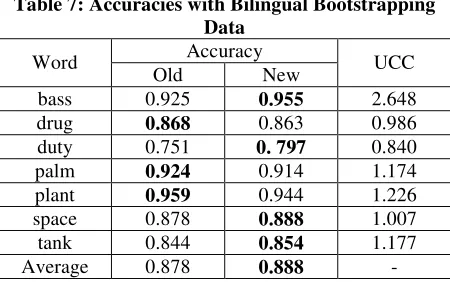
We used the word sense disambiguation data in Section 4.3 and conducted bilingual bootstrapping using both the old and new algorithms. Table 7 shows the results. We see that the performance of the new algorithm is slightly better than that of the old algorithm. Note that here the UCC values are also low.
We conclude that for both co-training and bi-lingual bootstrapping, the new algorithm performs significantly better than the old algorithm when UCC is high, and performs as well as the old algo-rithm when UCC is low. Recall that when UCC is high, there are more instances which are uncertain for both classifiers and when UCC is low, there are fewer instances which are uncertain for both classi-fiers.
Note that in practice it is difficult to find a situation in which UCC is completely low (e.g., the view independence assumption completely holds), and thus the new algorithm will be more useful than the old algorithm in practice. To verify this, we conducted an additional experiment.
Again, since the features and classes for each word in bilingual bootstrapping and those for web page classification in co-training are different, it is not meaningful to directly compare the UCC val-ues of them.
[image:7.612.311.545.111.159.2]Co-Training for News Article Classification In the additional experiment, we used the data
Table 5: Accuracies with Artificial Data Accuracy
[image:7.612.320.545.281.422.2]Feature Old New UCC Natural Split 0.928 0.924 1.006 Random Split 0.712 0.775 2.399
Table 7: Accuracies with Bilingual Bootstrapping Data
Accuracy Word
Old New UCC
from two newsgroups (comp.graphics and comp.os.ms-windows.misc) in the dataset of (Joachims, 1997) to construct co-training and text classification.
There were 1000 texts for each group. We viewed the former group as positive class and the latter group as negative class. We applied the new and old algorithms. We conducted 20 trials in the experimentation. In each trial we randomly split the data into labelled training, unlabeled training and test data sets. We used 3 texts per class as la-belled instances for training, 994 texts for testing, and the remaining 1000 texts as unlabelled in-stances for training. We performed the same pre-processing as that in (Nigam and Ghani 2000).
Table 8 shows the results with the 20 trials. The accuracies are averaged over each 5 trials. From the table, we see that co-training with the new al-gorithm significantly outperforms that using the old algorithm and also ‘single bootstrapping’. Here, ‘single bootstrapping’ refers to the conventional bootstrapping method in which a single classifier repeatedly boosts its performances with all the fea-tures.
The above experimental results indicate that our new algorithm for collaborative bootstrapping per-forms significantly better than the old algorithm when the collaboration is difficult. It performs as well as the old algorithm when the collaboration is easy. Therefore, it is better to always employ the new algorithm.
Another conclusion from the results is that we can apply our new algorithm into any single boot-strapping problem. More specifically, we can ran-domly split the feature set and use our algorithm to perform co-training with the split subsets.
6 Conclusion
This paper has theoretically and empirically dem-onstrated that uncertainty reduction is the essence of collaborative bootstrapping, which includes
both co-training and bilingual bootstrapping. The paper has conducted a new theoretical analysis of collaborative bootstrapping, and has proposed a new algorithm for collaborative boot-strapping, both on the basis of uncertainty reduc-tion. Experimental results have verified the correctness of the analysis and have indicated that the new algorithm performs better than the existing algorithms.
References
S. Abney, 2002. Bootstrapping. In Proceedings of the 40th Annual Meeting of the Association for Compu-tational Linguistics.
A. Blum and T. Mitchell, 1998. Combining Labeled Data and Unlabelled Data with Co-training. In P ro-ceedings of the 11th Annual Conference on Compu-tational learning Theory.
M. Collins and Y. Singer, 1999. Unsupervised Models for Named Entity Classification. In Proceedings of the 1999 Joint SIGDAT Conference on Empirical Methods in Natural Language Processing and Very Large Corpora.
S. Dasgupta, M. Littman and D. McAllester, 2001. PAC Generalization Bounds for Co-Training. In Proceed-ings of Neural Information Processing System, 2001. T. Joachims, 1997. A Probabilistic Analysis of the
Roc-chio Algorithm with TFIDF for Text Categorization. In Proceedings of the 14th International Conference on Machine Learning.
D. Lewis and W. Gale, 1994. A Sequential Algorithm for Training Text Classifiers. In Proceedings of the 17th International ACM-SIGIR Conference on Re-search and Development in Information Retrieval. C. Li and H. Li, 2002. Word Translation
Disambigua-tion Using Bilingual Bootstrapping. In Proceedings of the 40th Annual Meeting of the Association for Com-putational Linguistics.
I. Muslea, S.Minton, and C. A. Knoblock 2000. Selec-tive Sampling With Redundant Views. In Proceed-ings of the Seventeenth National Conference on Artificial Intelligence.
K. Nigam and R. Ghani, 2000. Analyzing the Effective-ness and Applicability of Co-Training. In Proceed-ings of the 9th International Conference on Information and Knowledge Management. D. Pierce and C. Cardie 2001. Limitations of
Co-Training for Natural Language Learning from Large Datasets. In Proceedings of the 2001 Conference on Empirical Methods in Natural Language Processing (EMNLP-2001).
D. Yarowsky, 1995. Unsupervised Word Sense Disam-biguation Rivaling Supervised Methods. In Proceed-ings of the 33rd Annual Meeting of the Association for Computational Linguistics.
Table 8: Accuracies with News Data Collaborative
Boot-strapping Average