Surface Analysis of Electrochromic Switchable Mirror Glass Based
on Magnesium-Nickel Thin Film in Accelerated Degradation Test
Kazuki Tajima
*, Hiromi Hotta, Yasusei Yamada, Masahisa Okada and Kazuki Yoshimura
Material Research Institute for Sustainable Development, National Institute of Advanced Industrial Science and Technology, Nagoya 463-8560, Japan
With the capability to change between reflective and transparent states, electrochromic switchable mirrors are expected to have numerous applications in optical devices, electronics devices and new energy-saving windows. If conventional windows can be adapted to incorporate switchable mirror technology, the solar radiation coming into a room could be effectively controlled, owing to features of the reflective state. Conventional windows are often subjected to environmental conditions such as high temperature and humidity. Considering practical use, we investigated the effects of the environment on the optical switching properties of the device in accelerated degradation tests using a thermostat/ humidistat bath at a constant temperature of 313 K and constant relative humidity of 80%. When the device was kept in the bath for 950.4 ks, it lost its optical switching properties. This result was associated with the degradation of the surface layer of the Mg4Ni thin film, which became rougher with increasing bath duration. We confirmed that the layer contained species in non-metallic states of oxide and hydroxide. Furthermore, the degradation mechanism to form the mixture state depended on the holding time in the bath. [doi:10.2320/matertrans.MBW201010]
(Received October 13, 2010; Accepted November 30, 2010; Published January 13, 2011)
Keywords: degradation, thin film, sputtering, environment, switchable mirror, accelerated test
1. Introduction
A switchable mirror material based on an yttrium-metal system was first proposed in the 1990s.1) Furthermore, another switchable mirror material based on a magnesium-metal system was discovered in the 21st century.2) The optical properties of these materials can be switched between transparent and reflective states via the hydrogenation and dehydrogenation of the films. Potential applications of switchable materials include new energy-saving windows, optical fibers, sensors and electronic devices.
In our group, we have been investigating and developing materials for use in new energy-saving windows.3–5)The type
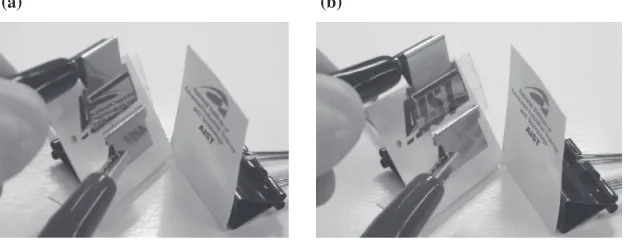
of electrochromic (EC) switchable mirror that we have developed consists of all-solid-state thin films, with a multi-layer structure of Mg4Ni/Pd/Al/Ta2O5/HxWO3/indium tin oxide (ITO) on a transparent substrate of glass or plastic sheet.5,6)The layers of Mg4Ni, Pd, Al, Ta2O5, WO3and ITO serve as an optical switching, a proton injector, a buffer, a solid electrolyte, an ion storage layer and a transparent conductor, respectively. The typical device on plastic sheet is in the reflective state, and becomes transparent under an applied voltage, as shown in Fig. 1. When a voltage is applied to the device, the protons in the WO3 ion storage layer move to the Mg4Ni optical switching layer, and the Mg4Ni thin film is hydrogenated to form MgH2 and Mg2NiH4. The hydrides exhibit higher transparency, switching the device to a transparent state. If the device is used in energy-saving window for houses and buildings, the energy costs of air conditioning in summer will be reduced because the reflective state of the device can reflect solar radiation effectively.
In our recent work, we evaluated the degradation of the optical switching layer of the Mg4Ni thin film under various environmental conditions.7,8) When the device was kept in open air, its optical switching capability vanished after
7.78 Ms due to the degradation of the Mg4Ni thin film surface.7) However, a detailed analysis of various
environ-mental dependence of the degradation of the device has not yet been conducted, which will be necessary for practical applications, particularly in Japan, which has a temperate climate with distinct seasonal variation. In this work, we investigated the effects of a simulated environment on the optical switching properties of the developed switchable mirror device in accelerated degradation tests using a thermostat/humidistat bath at constant temperature of 313 K and constant relative humidity of 80%.
2. Experimental
2.1 Device fabrication
A WO3/ITO/glass (30mm30mm1:1mm, Geomatec Co.) was used as the substrate. First, a 400-nm-thick Ta2O5 thin film was deposited by reactive direct current (dc) magnetron sputtering using a 50.4 mm (2 inch) tantalum metal target with 99.99% purity. The gas mixture ratio of PH2=ðPArþPO2þPH2Þ was set at 0.22. The protons for changing the state of the device were included in the Ta2O5 thin film.9)The sputtering power was 70 W, and the working
pressure was 0.7 Pa. A 2-nm-thick Al thin film was deposited by dc magnetron sputtering using a 50.4 mm (2 inch) aluminum metal target with 99.99% purity. The sputtering power was 52 W, and the working pressure was 0.65 Pa. Finally, Pd and Mg4Ni thin films were prepared by dc magnetron sputtering. A Pd thin film with thickness of 4 nm was deposited by dc magnetron sputtering using a 50.4 mm (2 inch) palladium target with 99.99% purity. Here, the sputtering power was 14 W, and the working pressure was 1.2 Pa. Subsequently, a 40-nm-thick Mg-Ni thin film was deposited on the Pd thin film using co-sputtering of Mg and Ni targets, both of which had 99.99% purity. The sputtering power ratio of Mg/Ni was adjusted to 1.88 in order to form the Mg4Ni thin film properly.3)
2.2 Accelerated degradation studies in simulated envi-ronment
The as-prepared device was kept in a thermostat/humidi-stat bath (PR-1K, Espec Co.) in order to investigate the effect of environmental conditions on its optical switching proper-ties. Both the temperature and relative humidity in the bath could be controlled to maintain constant values. The details of the test were described in our previous work.8) In the
present study, the temperature was set to 313 K and the relative humidity was set at 80%. These values mimicked typical conditions during the rainy and summer seasons in Japan, as well as the conditions in temperature and high-humidity areas elsewhere in the world. The device was kept in the bath for various periods of time.
2.3 Characterization of electrochromic switchable mirror
Changes in the optical switching properties of the device were measured with a 670-nm laser diode and a Si photo-diode, as shown in Fig. 2. The electrodes were connected between the Mg4Ni and ITO thin films on the device, and the applied voltage was controlled via LabVIEW. The program also measured the change in the reflectance of the device when a voltage was applied. The surface state of the device was evaluated by X-ray photoelectron spectroscopy (XPS; Sigma Probe, Thermo Scientific) with argon sputter etching, as well as by atomic force microscopy (AFM) with optical microscopy (VN-8000, Keyence Co.).
3. Results and Discussion
3.1 Optical switching properties of electrochromic switchable mirror glass
Figure 3 shows the optical switching properties of the device for an applied voltage of5V. When the voltage was applied at the time t¼5s, the transmittance of the mirror changed from 0.1% (reflective state) to 46% (transparent state) within 15 s, as shown in Fig. 3(a). At the same time, the reflectance of the mirror changed from the 57% to 16%, as shown in Fig. 3(b). Subsequently, the dependence of the switching speed on holding time in the bath was investigated. As the bath time increased, the switching speed decreased. Moreover, the maximum transmittance of the device in the transparent state, as well as the maximum reflectance in the reflective state also decreased. For example, after being kept in the bath for 604.8 ks, the device exhibited poor optical
switching properties, with an approximate switching time of 720 s. In addition, the device had reflectance of only 18% in the reflective state and transmittance of 31% in the trans-parent state. When the device was kept in the bath for longer, it lost its optical switching properties. The bath conditions of 313 K and 80% relative humidity caused more rapid degradation of the device compared to the results from our previous research.8) The device kept in the bath at a
temperature of 313 K and relative humidity of 80% for 604.8 ks exhibited a slower switching speed than the device kept in the bath at a temperature of 303 K and relative humidity of 80% for 1.04 Ms. The attenuation of switching speed is associated with the degradation of the optical switching layer of Mg4Ni thin film, as characterized by optical microscopy, AFM and XPS. The Mg4Ni thin film layer seemed to change to a non-metallic state due to the humidity in atmosphere. As a result, the maximum reflec-tance at the reflective state of the device decreased as the holding time increased. Details of the degradation of the Mg4Ni thin film are presented in Section 3.2.
3.2 Surface analysis of electrochromic switchable mir-ror glass
3.2.1 Surface observation by optical microscopy and AFM
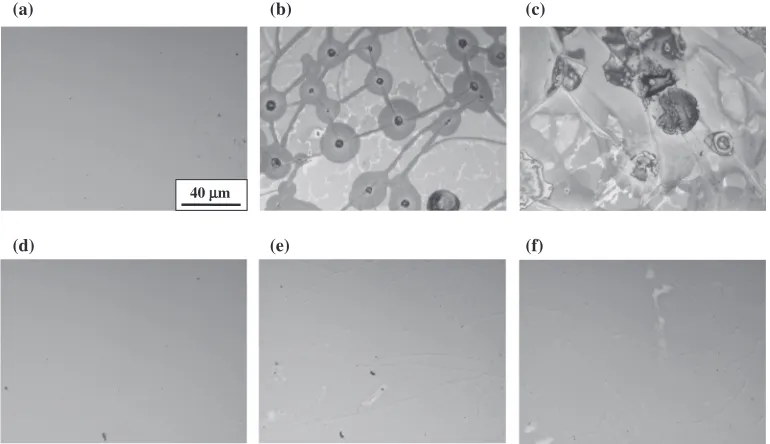
Figures 4(a)–(c) show optical surface images of the device for various holding times. Although the as-prepared device did not exhibit any atypical structural features on its surface, the surface of the device was gradually damaged with increasing holding time. After 950.4 ks in the bath, the surface of the device appeared severely degraded, as shown
Laser diode (670 nm)
Sample holder
Device
Transmittance
Photo diode
Reflectance
Angle: 45°
Fig. 2 Experimental setup for measuring optical switching properties of the device.
(a) (b)
[image:2.595.142.454.77.197.2] [image:2.595.324.532.238.360.2]in Fig. 4(c). To study the environmental effects on the device further, we also investigated the relationship between the degradation of the device exposed to open air and the holding time. Here, the as-prepared device was kept under laboratory conditions at a temperature of 293 K and relative humidity of 40%. These parameters were controlled by an air conditioner in the laboratory. Figures 4(d)–(e) show the resulting surface images of the device. In contrast to the effects induced by the bath, the surface structure of the device exposed to open air was almost unchanged.
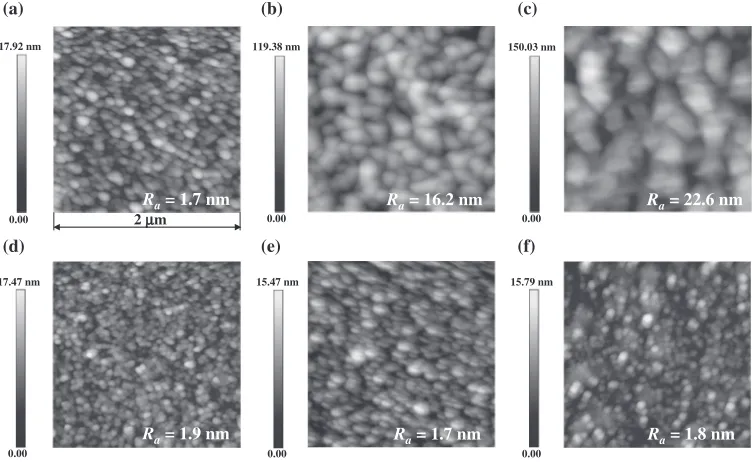
The surface of the device was also evaluated by AFM. Figures 5(a)–(c) show AFM images of the device surface for various holding times. The as-prepared device had a smooth surface with surface roughness ofRa¼1:7nm, as shown in Fig. 5(a). However, grains on the surface became large with a surface roughness ofRa ¼22:6nm for the device kept in the bath for 950.4 ks. On the other hand, for the device kept in open air, the surface roughness of around Ra¼1:8nm remained similar to that of the as-prepared device, as shown in Figs. 5(d)–(f). These results suggest that high humidity as well as high temperature had an adverse effect on the surface of the device.
3.2.2 Surface state analysis by XPS
We confirmed the impact of the simulated environment on the degradation of the device by XPS analysis. Figure 6 shows the XPS spectra of the Mg 1s state for the device kept in the bath. The binding energies of each spectrum were referenced to the C 1s peak at 285.0 eV. The etching time of 0 s corresponds to the top of the surface of the device. An etching rate by Arþ was approximately 0.1 nm/s. The reported Mg 1s peak position for the oxidized state is 1305.3 eV, while that of the metallic state is 1303.5 eV.10,11)
The oxidized state of magnesium was observed not only for the device kept in the bath, but also as a naturally grown magnesium oxide layer on the surface of the as-prepared device. In addition, the inner part of the optical switching layer contained a mixture of metallic and oxidized states of magnesium. Thus, it appeared that the degradation of the layer gradually progressed with increasing bath duration. In particular, when the device was kept in the bath for 950.4 ks, the surface layer hardly degraded. The metallic state of magnesium almost disappeared in the surface layer, as shown in Fig. 6(d). Furthermore, the layer showed a peak at approximately 1304.5 eV, which appeared to be related to
40µm
(a) (b) (c)
(d) (e) (f)
Fig. 4 Optical surface images of the device: (a) as-prepared, (b) after 296.2 ks, and (c) after 950.4 ks in the bath, and (d) as-prepared, (e) after 296.2 ks and (f) after 950.4 ks in open air.
(a) (b)
10 100 1000
0 10 20 30 40 50 60 70
T
ransimittance (%)
Time, t/s as-prepared 313K-80%-259.2ks 313K-80%-604.8Ks 303K-80%-1.04 Ms
10 100 1000
0 10 20 30 40 50 60 70
as-prepared 313K-80%-259.2ks 313K-80%-604.8ks 303K-80%-1.04Ms
Reflectance (%)
Time, t/s
[image:3.595.127.468.75.198.2] [image:3.595.106.491.250.472.2]the mixture of magnesium oxide and hydroxide states.11)In our previous work, we confirmed the existence of magnesium hydroxide depended on relative humidity.12)Although high
relative humidity of 80% contributed to creating magnesium hydroxide, low humidity of 30% did not contribute even at high temperature of 323 K. The device showed only magnesium oxide and metallic magnesium state in the layer at lower relative humidity conditions. We speculate that magnesium oxide was formed as a result of the absorption of oxygen from the air, and that magnesium hydroxide might be formed by moisture in this work. The peak position of the Mg 1s state appeared to shift gradually to lower binding energy because of the longer holding time in the bath. This result suggests that the magnesium in the layer was first oxidized by air, as well as that the layer was then converted gradually to the hydroxide state by moisture, resulting in a
mixture of oxide and hydroxide states of magnesium. Thus, the degradation appears to depend on the holding time in the simulated environment with high relative humidity. More-over, rapider degradation of the magnesium inside of the layer than the surface of the layer was observed. This reason will be related to surface cracks on the as-received substrate. A substrate has some cracks on the surface due to the deposition conditions. Therefore, some cracks remained on the surface observed by optical microscope analysis after fabricating the device. Therefore, oxygen and moisture seemed easily to diffuse into the layer at the test. Thus, the degradation has progressed inside of the layer.
Figure 7 shows the Ni 2p3=2 XPS spectra for the device kept in the bath. The reported Ni 2p3=2peak position for the metallic state of nickel is 852.9 eV.13)When the device was kept in the bath, the hydroxide state of nickel (856.6 eV)
(a) (b) (c)
(d) (e) (f)
0.00 17.92 nm
2µm
0.00 17.47 nm
Ra= 1.9 nm
0.00 15.47 nm
0.00 15.79 nm
Ra= 1.7 nm Ra= 1.8 nm
Ra= 1.7 nm Ra= 16.2 nm Ra= 22.6 nm
0.00 119.38 nm
0.00 150.03 nm
Fig. 5 AFM images of the device: (a) as-prepared, (b) after 296.2 ks, and (c) after 950.4 ks in bath, and (d) as-prepared, (e) after 296.2 ks and (f) after 950.4 ks in open air.
1310 1308 1306 1304 1302 1300 1298
Intensity (a.u.)
Binding Energy, BE /eV
1310 1308 1306 1304 1302 1300 1298
Intensity (a.u.)
Binding Energy, BE / eV
1310 1308 1306 1304 1302 1300 1298
Intensity (a.u.)
Binding Energy, BE / eV 1310 1308 1306 1304 1302 1300 1298
Intensity (a.u.)
Binding Energy, BE / eV
(c) (d)
(a) (b)
0s 60s 120s 180s 240s 300s 360s
0s 60s 120s 180s 240s 300s 360s
0s 60s 120s 240s 300s
180s
0s 60s 120s 240s 300s
180s 360s
360s
Fig. 6 Mg 1s XPS spectra and depth profile of the device: (a) as-prepared, (b) after 86.4 ks, (c) after 296.2 ks and (d) after 950.4 ks in bath.
(c) (d)
(a) (b)
860 858 856 854 852 850
Intensity (a.u.)
Binding Energy, BE / eV 860 858 856 854 852 850
Intensity (a.u.)
Binding Energy, BE / eV
860 858 856 854 852 850
Intensity (a.u.)
Binding Energy, BE / eV 860 858 856 854 852 850
Intensity (a.u.)
Binding Energy, BE / eV 0s
60s 120s 180s 240s 300s
0s 60s 120s 180s 240s 300s 360s 360s
0s 60s 120s 240s 300s
180s
0s 60s 120s 240s 300s
180s 360s
360s
[image:4.595.110.487.74.305.2] [image:4.595.49.291.354.543.2] [image:4.595.305.549.354.548.2]gradually appeared in the layer.13)The layer consisted of a mixture of metallic nickel and nickel hydroxide, as shown in Fig. 7(d). Although the increase of nickel hydroxide de-pended on the holding time in the bath, the peak position of nickel oxide (854.5 eV) was barely observed.13)Furthermore,
the Ni 2p peak was hardly observed for the surface of the device, and a small nickel peak was observed in the layer for the device kept in the bath. This result suggests that magnesium oxide is present predominantly near the surface, as shown in Fig. 6. Thus, the degradation of magnesium in the layer appears to occur primarily in the early stage of the accelerated degradation test using the bath at high temper-ature and high humidity.
To solve the above problems, we applied a surface coating layer to the device in our recent work.14)Although the surface coating layer can prevent degradation in the environment, its properties are not yet sufficient. It is necessary to investigate the relationship between the environment and the optical switching properties of the device to find a suitable surface coating layer, for example, finding better materials and fabrication methods. We will attempt to devise a suitable device structure with high durability and excellent optical switching properties in various environments. In particular, we plan to investigate the optical switching properties of the device below the freezing point. These details will be discussed in a future report.
4. Conclusions
We studied the relationship between the environment and the optical switching properties of an electrochromic switch-able mirror in accelerated degradation tests using a thermo-stat/humidistat bath. The as-prepared device was kept in a bath at a constant temperature of 313 K and relative humidity of 80%. When the device was kept in the bath for many days, the optical switching properties of the device became worse than those of the as-prepared device. The device kept in the bath for 604.8 ks showed a reflective-to-transparent switch-ing time of around 720 s. Furthermore, the device kept in the bath over 864 ks lost its optical switching properties. These results appeared to be related to environmentally induced degradation of the surface optical switching layer of Mg4Ni thin film. The surface layer became rougher and changed to non-metallic states of oxide and hydroxide, as characterized
by optical microscopy, atomic force microscopy and X-ray photoelectron spectroscopy. The degradation mechanism depended on the bath conditions. In particular, the magne-sium in the layer was first oxidized by air, and then the layer was changed gradually to the hydroxide state by moisture, resulting in mixture of oxide and hydroxide states of magnesium with increasing bath duration. In future work, aiming to develop a switchable mirror device for practical use, we will develop a new structure, for example, with a surface coating layer to avoid various environmental effects on the optical switching properties of the device.
Acknowledgement
This work was supported by Industrial Technology Research Grant Program in 2009 (Project No. 09B35402a) from New Energy and Industrial Technology Development Organization (NEDO) of Japan.
REFERENCES
1) J. N. Huiberts, R. Griessen, J. H. Rector, R. J. Wijngaargen, J. P. Dekker, D. G. de Groot and N. J. Koeman: Nature380(1996) 231–243. 2) T. J. Richardson, J. L. Slack, R. D. Armitage, R. Kostecki, B. Farangis
and M. D. Rubin: Appl. Phys. Lett.78(2001) 3047–3049.
3) K. Yoshimura, Y. Yamada and M. Okada: Appl. Phys. Lett.81(2002) 4709–4711.
4) Y. Yamada, K. Tajima, S. Bao, M. Okada and K. Yoshimura: Jpn. J. Appl. Phys.46(2007) 5168–5171.
5) K. Tajima, Y. Yamada, S. Bao, M. Okada and K. Yoshimura: Appl. Phys. Lett.91(2007) 051908-1–051908-3.
6) K. Tajima, Y. Yamada, S. Bao, M. Okada and K. Yoshimura: Appl. Phys. Lett.92(2008) 041912-1–041912-3.
7) K. Tajima, Y. Yamada, S. Bao, M. Okada and K. Yoshimura: Jpn. J. Appl. Phys.48(2009) 102402-1–102402-5.
8) K. Tajima, Y. Yamada, M. Okada and K. Yoshimura: Sol. Eng. Mater. Sol. Cells.94(2010) 1716–1722.
9) K. Tajima, Y. Yamada, S. Bao, M. Okada and K. Yoshimura: J. Electrochem. Soc.157(2010) J92–J96.
10) J. C. Fuggle, L. M. Watson, D. J. Fabian and S. Affrossman: J. Phys. F5
(1975) 375–383.
11) A. Fischer, H. Ko¨stler and L. Schlapbach: J. Less-Common Met.172– 174(1991) 808–815.
12) K. Tajima, H. Hotta, Y. Yamada, M. Okada and K. Yoshimura: Sol. Eng. Mater. Sol. Cells. to be submitted.
13) S. Oswald and W. Bru¨ckner: Surf. Interface Anal.36(2004) 17–22. 14) K. Tajima, Y. Yamada, M. Okada and K. Yoshimura: Appl. Phys.