BIOFERTILIZER PRODUCTION FROM AGRO - WASTES
Vidhya Devi and Dr. V. Judia Harriet Sumathy*
PG and Research Department of Biotechnology, Women’s Christian College,
Chennai – 600006.
ABSTRACT
A Bio fertilizer is a substance which contains living microorganisms
which, when applied to seeds, plant surfaces, or soil, colonize the
rhizosphere or the interior of the plant and promotes growth by
increasing the supply or availability of primary nutrients to the host
plant. Bio-fertilizers add nutrients through the natural processes
of nitrogen fixation, solubilizing phosphorus and stimulating plant
growth through the synthesis of growth-promoting substances.
Bio-fertilizers can be expected to reduce the use of chemical
fertilizers and pesticides. The microorganisms in bio-fertilizers restore
the soil's natural nutrient cycle and build soil organic matter. Through
the use of bio-fertilizers, healthy plants can be grown, while enhancing
the sustainability and the health of the soil. Since they play several
roles, a preferred scientific term for such beneficial bacteria is "plant-growth promoting
rhizobacteria" (PGPR). Therefore, they are extremely advantageous in enriching soil
fertility and fulfilling plant nutrient requirements by supplying the organic nutrients through
microorganism and their byproducts. Hence, bio-fertilizers are much preferred over other
Fertilizers as they do not contain any chemicals which are harmful to the living soil. The
present study is focused on producing Biofertilizer from Agro – wastes using Solid State
Fermentation (SSF).
KEYWORDS: Biofertilizer, Microorganisms, Rhizobacteria, Agro - wastes and Solid State
Fermentation.
INTRODUCTION
India’s agriculture is composed of many crops such as wheat and rice besides pulses,
potatoes, sugarcane, coffee, oil seeds and jute (Shah Alam and Rajendra Kumar Seth, *Corresponding Author
Dr. V. Judia Harriet
Sumathy
PG and Research Department of
Biotechnology, Women’s
Christian College, Chennai – 600006. Article Received on 30 June 2017,
Revised on 21 July 2017, Accepted on 11 August 2017
DOI: 10.20959/wjpr20179-9323
8533
2012). Currently, the total agricultural output is lost due to inefficiencies in harvesting,
transport and storage of government subsidized crops. (Abdullahi et. al., 2012). Decline of
agriculture is due to depletion of soil fertility and also partially associated with unfavourable
distribution of rainfall, drought, storm and floods. The major problem faced by the farmers
are high cost of inorganic fertilizers required for the plant growth (Anita Khanafari et. al.
2012). The chemical fertilizer pollutes the air, soil and water polluting agents during the
production of crops. To overcome this, researchers have found the term “Bio fertilizer” an
alternate to chemical fertilizer, especially in the developing countries (Soh-Fong Lim and
Sylvester Usan Matu, 2015). Fertilizers improve soil fertility and lead to increases in yield
of crops. Fertilizer is made up of two forms, organic and inorganic (José Thyago Aires
Souza et. al. 2016). High amount of fertilizers use may also reduce the nutrient produced by
beneficial microorganism present in the soil (Aher et. al. 2015). Proper use of fertilizer is
also required to retain the soil fertility. Organic fertilizer is also another way of supplying
nutrients to the soil. An organic material present in the soil may improve the soil fertility and
also slow down the release of nitrogen and thus help to control the depletion of the soil and
increase the other nutrient supply (Kanmani, P and Karuppasamy, P, 2009).
Biofertilizers are defined as preparations containing living cells or latent cells of efficient
strains of microorganisms that help crop plants’ uptake of nutrients by their interactions in the
rhizosphere when applied through seed or soil (Laditi et. al. 2012). They accelerate certain
microbial processes in the soil which augment the extent of availability of nutrients in a form
easily assimilated by plants (Moola Ram1 et. al. 2014). Very often microorganisms are not
as efficient in natural surroundings as one would expect them to be and therefore artificially
multiplied cultures of efficient selected microorganisms play a vital role in accelerating the
microbial processes in soil (Muhammad Yasin et. al. 2012). Use of biofertilizers is one of
the important components of integrated nutrient management, as they are cost effective and
renewable source of plant nutrients to supplement the chemical fertilizers for sustainable
agriculture (Bákonyi et. al. 2013). Several microorganisms and their association with crop
plants are being exploited in the production of biofertilizers (Rakesh Kumar Meena et. al.
Table 1: Types of Biofertilizers.
S. No. Groups Examples
N2 fixing Biofertilizers
1. Free-living Azotobacter, Beijerinkia, Clostridium, Klebsiella,
Anabaena, Nostoc,
2. Symbiotic Rhizobium, Frankia, Anabaena azollae
3. Associative Symbiotic Azospirillum
P Solubilizing Biofertilizers
1. Bacteria Bacillus megaterium var. phosphaticum, Bacillus subtilis
Bacillus circulans, Pseudomonas striata
2. Fungi Penicillium sp, Aspergillus awamori
P Mobilizing Biofertilizers
1. Arbuscular mycorrhiza Glomus sp.,Gigaspora sp.,Acaulospora sp.,
Scutellospora sp. & Sclerocystis sp.
2. Ectomycorrhiza Laccaria sp., Pisolithus sp., Boletus sp., Amanita sp.
3. Ericoid mycorrhizae Pezizella ericae
4. Orchid mycorrhiza Rhizoctonia solani
Biofertilizers for Micro nutrients
1. Silicate and Zinc
solubilizers Bacillus sp. Plant Growth Promoting Rhizobacteria
1. Pseudomonas Pseudomonas fluorescens
In the present study, different fruits are used as bio fertilizers to check the efficiency in
improving plant growth. The microorganisms present in various fertilizers which benefit the
plant growth have also been studied.
MATERIALS AND METHODS
Collection of Samples
Agro – wastes (rotten fruits) were collected from the fruit market near CMBT. The five
different fruits used for the present study are watermelon, papaya, pine apple, custard apple
and guava (Figure 2). Fruits were cut into small pieces and smashed. They were used for
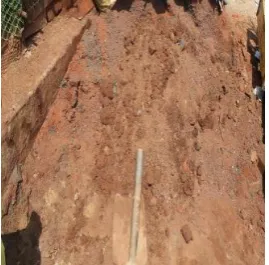
Solid-State Fermentation (SSF). The soil samples were collected from Kolathur (Figure 1).
[image:3.595.231.366.620.752.2]Figure 2: Collection of fruits wastes.
Preparation for fermentation process
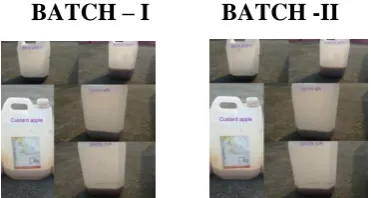
Two batch of fermentation process were carried out - BATCH – I & II.
Materials Required
1. Polyethene bottle
2. Fruit wastes (rotten)
3. Distilled water
Batch – I
Five hundred grams of water melon wastes was placed in a polythene bottle which has a
capacity of 2.5 L. Hundred milliliters of water was added to it. The bottle was kept
undisturbed for 30 -40 days until the soluble product was formed. This soluble product was
filtered with a fabricated filter. The fermented solution is the first batch water melon
biofertilizer.
Batch – II
Hundred milliliters of this filtered solution was used as inoculum precursor to the next SSF
process. 500 g of new water melon wastes were placed in a polythene bottle. The precursor
increases the rate of fermentation and minimizes the duration of SSF process. The bottle was
kept undisturbed for 20-30 days at room temperature until the soluble product was formed.
This soluble product was filtered with a fabricated filter. This filtered solution is called
second batch water melon biofertilizer. Agro-wastes from pine apple, papaya, and custard
Soil Fertility Analysis
Soil Fertility Analysis was carried out by estimating the Soil pH, Electric Conductivity,
Calcium, Magnesium, Sulphate, Chloride, Phosphorous, Total Organic Carbon, Nitrogen,
Sodium, Potassium, Iron, Zinc, Manganese and Copper.
Atomic Absorption Spectrophotometer
Standard solutions were prepared in the range 0, 1,2,5,10 µg/ml of the trace metal. The
standard solutions were diluted with DTPA solution. The working condition of the instrument
is optimized and the readings were taken for standard as well as soil samples.
Calculation
µg Te/g soil= µg Te/mlsample * 20ml/5 g soil.
Isolation of Microorganisms from Sample
10 gm of the soil sample was added to 90 ml of sterilized water and was mixed with a
magnetic blender for 30 minutes to separate the microorganisms from the soil completely.
After being deposited for 20 minutes, 1ml of suspension was added to the broth and was
incubated at 37°C for 24 hours.
Serial Dilution
The incubated tubes were taken for serial dilution. 9 ml of saline was added to 10 sterilized
test tubes. 1 ml from the incubated test tubes was added to the first test tube that gives 1:10
dilution. The tube was mixed well and 1 ml from the first test tube was transferred to the
second tube. This was continued till the eighth tube. And 1 ml from the eighth tube was
discarded. Dilutions such as 104, 105, 106 and 107 were chosen for plating.
Spread Plate Technique
Once the plates solidified, 0.1 ml from 104 dilution was taken and added to the petri plate,
L-rod was flame sterilized using ethanol and it was used to spread the sample on agar surface.
The same procedure was repeated for 105, 106 and 107 dilutions. 1 plate was used as control
and the plates were incubated at 37°C for 24 hrs. After the incubation period (24 - 48hrs) the
Selective Media were prepared for Bacillus, Yeast and Rhizobium Species
Biochemical Characterization
Biochemical screening was done by performing tests such as Indole, Methyl Red Test, Citrate
Utilization Test, Triple Sugar Iron Test, Urease Test, Oxidase Test and Catalase Test.
Applicability of the biofertilizer in vegetable plantation
The biofertilizers were applied on the various seed samples of 2 weeks of age in order to
determine the effectiveness of the biofertilizer. Each batch of the biofertilizers were applied
on 100 plant samples. At the same time, another 100 samples were planted in the absence of
any fertilizer.
Experimental Design – Pot Culture
250 g of soil was taken in empty box which has a capacity of 500gm. 50 g of Cumbu seeds
were taken. 5 ml of watermelon fertilizer and 5 ml of water were mixed and applied to the
soil. The procedure was followed for the rest of the fruits as well. At regular intervals, the
fertilizer was sprinkled on the soil.
RESULTS AND DISCUSSION
Solid State Fermenation
The fermented solution from Batch II was used to check the efficiency of vegetation
plantation (Figure 3).
BATCH – I BATCH -II
[image:6.595.205.391.501.600.2]
Figure 3: Batch 1 and II Fermentation Process.
Pot Culture (Soil Sample – (Kolathur)
500g of soil sample from Kolathur was weighed and taken in a tray. 50 g of seeds (Cumbu)
was taken. 5ml of the biofertilizer (watermelon) and 5ml of water is taken and mixed well.
The fertilizer is applied daily to the soil. The following method is carried out for other
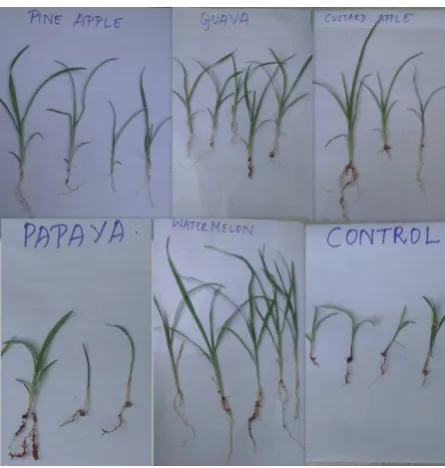
fertilizers. The growth of the plants was observed periodically and the height was noted
Custard Apple Water Melon Papaya
Pine Apple Control Plant Guava
[image:7.595.84.516.72.344.2]
Figure 4: Growth of Plants tested in Soil sample - Kolathur.
Measurement of Plants - (Soil Sample - Kolathur)
Observation of plant growth was noted in Soil sample from Kolathur and the measurement of
plant height was taken at 3 week age of the plant. Root elongation, shoot length and number
of leaves germinated were also recorded (Figure 5).
[image:7.595.186.409.481.715.2]Quantitative analysis of soil sample - Kolathur
Each fruit is unique in its nutritional elements which make the plant growth differ in their
morphological characters such as length of root, shoot and height of plant and seed
germination. Custard apple, watermelon and guava showed better growth in plant rate with
reference to the height of plant, length of root, shoot and seeds germinated in soil sample.
[image:8.595.58.542.515.691.2]The soil sample taken from Kolathur showed better seed germination (Table 2).
Table 2: Quantitative analysis of plant growth -Soil sample.
S.no Agro – waste
(rotten fruits)
Total height
of plant Root length Shoot length
No. of seeds germinated 1 Control Plant 5 cm 2cm 3cm 20 - 45% 2 Custard Apple 10 – 25 cm 7 – 22 cm 5 – 20 cm 75 - 80 % 3 Water Melon 20 – 35 cm 5 – 20cm 10 – 15 cm 80 - 85% 4 Guava 15 – 30 cm 10 – 25 cm 10 -20 cm 75 - 85% 5 Pine Apple 7-10 cm 1 – 3cm 4-6 cm 60 - 65% 6 Papaya 5 – 10 cm 4 – 7 cm 3 – 6 cm 40 - 60%
Quantification of Trace Elements in Agro - Wastes
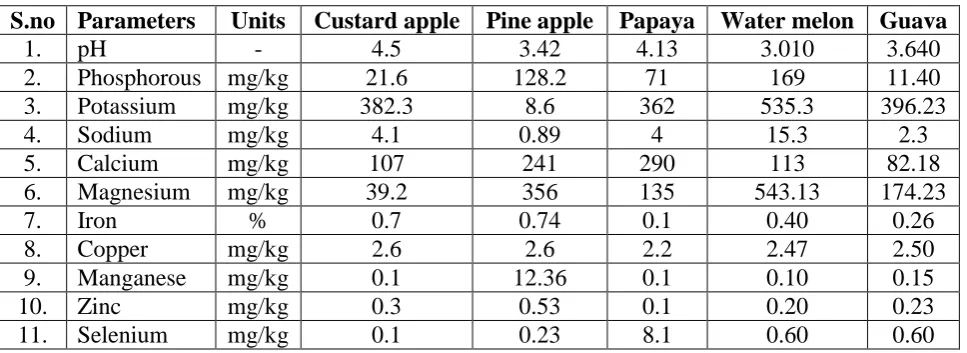
The trace elements were present in the fermented Agro-waste. In water melon, custard apple
and guava the level of Potassium (K) and Phosphorus (P) were high. Hence the plants can
utilize the amount of K and P present in the fertilizer as well as in the soil. The potassium
helps the plants in growth, whereas phosphorous helps in the growth of plants and also in the
ripening of fruits (Table 3).
Table 3: Quantification of Trace Elements in Agro – wastes.
S.no Parameters Units Custard apple Pine apple Papaya Water melon Guava
1. pH - 4.5 3.42 4.13 3.010 3.640
2. Phosphorous mg/kg 21.6 128.2 71 169 11.40 3. Potassium mg/kg 382.3 8.6 362 535.3 396.23
4. Sodium mg/kg 4.1 0.89 4 15.3 2.3
5. Calcium mg/kg 107 241 290 113 82.18
6. Magnesium mg/kg 39.2 356 135 543.13 174.23
7. Iron % 0.7 0.74 0.1 0.40 0.26
8. Copper mg/kg 2.6 2.6 2.2 2.47 2.50
9. Manganese mg/kg 0.1 12.36 0.1 0.10 0.15
10. Zinc mg/kg 0.3 0.53 0.1 0.20 0.23
11. Selenium mg/kg 0.1 0.23 8.1 0.60 0.60
Soil Fertility Analysis
Table 4: Comparison of Soil Fertility Analysis.
S.no Parameters Units Soil – 1 Soil – 2 Normal range
1. pH - 7.24 7.1 6 – 8
2. Electrical conductivity µs/cm 1489 735 - 3. Phosphorous mg/kg 131 117 0.2% 4. Potassium mg/kg 470 420 1.0% 5. Total organic carbon % 0.50 0.60 -
6. Sodium mg/kg 650 520 100 – 500mg/kg
7. Calcium mg/kg 348 204 0.5 %
8. Magnesium mg/kg 98.11 75.00 0.2 % 9. Sulphate mg/kg 643.30 149.68 0.1 % 10. Chloride mg/kg 154.91 169.60 100 mg / kg
11. Nitrogen % 2.90 2.10 1.5%
12. Iron % 1.20 0.98 2 – 5%
13. Copper mg/kg 65.21 68.16 70 – 100 mg/kg 14. Manganese mg/kg 55.63 58.00 70 – 100 mg/kg 15. Zinc mg/kg 82.13 86.12 70 – 100mg/kg 16. Molybdenum mg/kg 0.001 0.001 0.1% 17. Boron mg/kg 0.001 0.001 0.1% 18. Nickel mg/kg 0.001 0.001 0.1%
Isolation of soil organism
Soil was collected from Kolathur. Soil fertility analysis was done for the soil. The organisms
were isolated from the soil and also from the fermented fruits. The organism present in the
fermented solution helps to enhance the growth of the plants (Figure 6).
[image:9.595.131.463.478.629.2]Rhizobium spp. Bacillus spp.
Figure 6: Microorganisms isolated from Soil Sample from Kolathur.
Isolation of organism in fermented solution
The following microorganisms were isolated from the fermented solution (Figures 7 a- c & 8
Custard Apple and Papaya Guava and Watermelon
Aspergillus spp. Bacillus spp.
[image:10.595.152.439.75.208.2]
Figure 7: Isolation of microbes from the fermented solution.
PINE APPLE
[image:10.595.249.344.266.379.2]Bacillus spp.
Figure 8: Isolation of Microorganisms in Fermented Solution.
Figure 9: Bacillus spp. (Gram positive rods)
[image:10.595.250.345.418.528.2] [image:10.595.153.442.567.740.2]Table 5: Biochemical Tests.
S.no. Biochemical test Result
1. Indole test Negative 2. Methyl red test Negative 3. VogesProskauer test Positive 4. Citrate utilization test Positive
5. Triple sugar iron agar test A/K, no gas production 6. Oxidase test Positive
7. Catalase test Positive
Identification of organism
1) The selective media MYP agar was used to confirm the presence of Bacillus spp. Three
Bacillusspp. was isolated whose colony morphology are as follows:
a) Bacillus spp. 1- Red Colour Colony- Lecithinase Activity –Present (Positive Opaque
Zone around the colony)
b) Bacillus spp. 2 - Yellow Colour colony-Lecithinase activity – Absent
c) Bacillus spp. 3 - Red Color colony.
2) The selective media YEMA agar was used to confirm the presence of Rhizobium spp.
3) The selective media SDA agar was used to confirm the presence of Aspergillus spp.
a) Aspergillus spp. 1- Yellow-green, powdery and pale yellowish.
b) Aspergillus spp. 2- The initial growth is white and becomes black later on giving “salt and pepper appearance” which results from darkly pigmented conidia borne in large
numbers on conidiophores.
c) Aspergillus spp. 3- Blue – green, powdery and pale yellow.
d) Aspergillus spp. 4 - Greenish-blue with whitish edge, yellow to brownish colour.
Advantages of Microorganism
1) Bacillus spp.
Bacillus spp. is a plant growth promoting bacteria which helps to enhance the availability of
nutrient in the soil. Bacillus spp. produces plant hormones and solubilizes the insoluble form
of phosphates. Bacillus spp. like Bacillus subtilis, Bacillus megaterium and Bacillus pumillus
are the beneficial microorganism to the soil for improving the growth of plants. Bacillus spp.
is called as a Synergistic plant promoter because both the soil and the plant get benefited.
Thus Bacillus spp. helps the plant to absorb the phosphate by solubilizing the phosphates and
2) Aspergillus spp.
Aspergillusspp. is one of the most important filamentous fungal genera. Aspergillus species
are used in the fermentation industry. Aspergillus spp. is a saprophytic fungus that plays an
essential role in recycling environmental carbon and nitrogen. It is very effective in removing
the exchangeable, carbonate, and Fe/ Mn oxide fractions of Cu, Cd, Pb and Zn.
CONCLUSION
Biofertilizers are defined as carrier based materials which improves soil fertility. The
collected Agro-wastes were subjected to Solid State Fermentation process to produce soluble
fermented solution. The Agro – wastes used were water melon, guava, papaya, custard apple
and pine apple. Solid state fermentation aided in the formation of soluble product and helped
to produce the microorganism such as bacteria, fungi and yeast. The fermented solution was
applied to vegetation to check the efficiency of the Biofertilizer. The soil collected from
Kolathur showed better seed germination due to the presence of Aspergillus spp. It was also
able to prevent root diseases. Cumbu (Pennisetum glaucum) seeds were tested using the
biofertilizer. The elongation of root, shoot and germination of seeds were compared.
Watermelon, Custard Apple and Guava fertilizer showed the best efficiency in comparison to
others.
BIBLIOGRAPHY
1. Shah Alam and Rajendra Kumar Seth, Comparative Study on Effect of Chemical and
BioFertilizer on Growth, Development and Yield Production of Paddy crop (Oryza
sativa), International Journal of Science and Research (IJSR), 2012; 2319-7064.
2. Abdullahi I. N., Chuwang P. Z. and Isah A. D, Effect of bio fertilizer application on
growth of (Vitellariaparadoxa )seedlings. Journal of Research in Environmental Science
and Toxicology, 2012; 2315-5698.
3. Anita Khanafari, Maryam Beladi and FaribaSharifnia, An investigation of rhizobacteria
as biofertilizer on Mentha L. compounds change. Annals of Biological Research, 2013;
3(9): 4293-4302.
4. Soh-Fong Lim and Sylvester UsanMatu, Utilization of agro-wastes to produce
Biofertilizer. Int J Energy and Environmental Engineering, 2015;6: 31-35.
5. José Thyago Aires Souza, Lourival Ferreira Cavalcante, Járisson Cavalcante Nunes,
Francisco Thiago Coelho Bezerra, Juliete Araújo da Silva Nunes; Aldeir Ronaldo Silva;
biofertilizer and potassium on yellow passion fruit growth after planting and on soil
salinity. African Journal of Agricultural Research, 2016; 11(32): 2994-3003.
6. Aher S.B., Lakaria1 L.B., Swami Kaleshananda, A. B. Singh, S. Ramana , K. Ramesh
and J. K. Thakur, Effect of organic farming practices on soil and performance of soybean
(Glycine max) under semi-arid tropical conditions in Central India. Journal of Applied
and Natural Science, 2015; 7(1): 67–71.
7. Kanmani, P and Karuppasamy, P. Studies on lignocellulose biodegradation of coir waste
in Solid state fermentation using Phanerochaetechrysosporium and Rhizopusstolonifer.
Int J Energy Environment Engineering, 2009; 6: 31–35.
8. Laditi M. A., NwokeO. C., Jemo1. M., AbaidooR. C. andOgunjobiA. A. Evaluation of
microbial inoculants as biofertilizers for the improvement of growth and yield of soybean
and maize crops in savanna soils. Rican Journal of Agricultural Research, 2012; 405-413.
9. Moola Ram1, M. R. Davari and S.N. Sharma, Direct, residual and cumulative effects of
organic manures and biofertilizers on yields, npk uptake, grain quality and economics of
wheat (triticumaestivum l.) under organic farming of rice-wheat cropping system. Journal
of Organic Systems, 2014; 9(1): 1177-4258.
10. Muhammad Yasin, Kaleem Ahmad, WaqasMussarat and Asif Tanveer, Bio-fertilizers,
substitution of synthetic fertilizers in cereals for leveraging agriculture. Crop &
environment, 2012; 3(1-2): 62-66.
11. Bákonyi N, Bott S, Gajdos.E, Szabó.A, Jakab.A, Tóth.B, Makleit. P and Veres. Sz. Using
bio fertilizer to improve seed germination and early development of maize. Pol. J.
Environ. Stud, 2013; 1595-1599.
12. Rakesh Kumar Meena, Sanjay Kumar, SutanuMaji, Devendra Kumar and Manoj Kumar,
Effect of organic manures and biofertilizers on growth, flowering, yield and quality of