Abstract—The problem of sports tournament scheduling at a university sports event was the case being studied due to the inefficiency of previous schedules and the dissatisfaction from the sports players. Supports from the literature have provided strong ground for the exploitation of constraint-based programming and neighborhood search as the approach to solve the problem. In constructing the improved tournament schedules, various criteria, regulations and policies need to be taken into consideration. The result from this promising approach is able to assist the coach or the sports events management through efficient schedules and thus, minimizing the dissatisfaction.
Index Terms—scheduling, sport tournament scheduling, constraint-based programming, neighborhood search
I. INTRODUCTION
nterest in sport has increased greatly over the last decades ([1]), since it helps to maintain or improve physical fitness and also provides entertainment to participants. Various sports activities take place at school, college and professional levels. Normally, the sports events start to become popular at college or university level as this is the amateur phase. When organizing a tournament at any level, it is important to have a schedule for the sports tournament in order to achieve the sports event’s goal ([2]), as well as these sports activities need to be done within a timeframe ([3]). Therefore, the problem of sports tournament scheduling is of interest and the focus of our work in this paper.
A sports tournament scheduling is defined as the process of assigning essential sport activities in sequence with the time needed to complete each activity. It is a challenging task due to the wide variety of different needs and
Manuscript received March 19, 2012; revised April 14, 2012. This work was supported in part by the Ministry of Science and Technology Malaysia.
Razamin Ramli is with the School of Quantitative Sciences, College of Arts and Sciences, Universiti Utara Malaysia, 06010 Sintok, Kedah, Malaysia. Telephone: 604-9286918; fax: 604-9286906; e-mail:
Cai-Juan Soong was with Universiti Utara Malaysia, 06010 Sintok, Kedah, Malaysia. She is now with the Centre for Pre-University Studies (COPS), INTI International University, 71800 Nilai, Negeri Sembilan, Malaysia; e-mail: [email protected].
Haslinda Ibrahim is with the School of Quantitative Sciences, College of Arts and Sciences, Universiti Utara Malaysia, 06010 Sintok, Kedah,
requirements that must be taken into consideration ([1]), either at professional or amateur level. The inefficiency of the solution, which is the tournament’s schedule, normally exists when these requirements are not met and time consumed in constructing the schedules is relatively long. Hence, the search for the best and ideal solution approach is never ending.
II. SOMERELATEDWORKS
Previous works related to various sports tournaments scheduling problem have been identified as being solved by several approaches or techniques. For example, Mathematical Programming approaches have been utilized to solve Sports League Scheduling Problem (SLSP) by [4]. On the other hand, [5] and [6] have used Simulated Annealing technique. Furthermore, the traveling tournament problems (TTP) have been explored through the use of heuristic techniques ([7]; [8]) involving up to 32 teams. [9] have also worked with the venue allocation problem heuristically.
However, Constraint-based Programming (CP) technique has been widely utilized especially in the landscapes of sport tournament scheduling ([10]; [11]; [12]) due to its capabilities. CP technique also provides the optimum solution ([13]) as well as quick and feasible solution ([10]). In addition, hybrid techniques are promising as well ([14]) in this sport tournament scheduling. Such hybrids are the integration of CP and Integer Programming (IP) by [15] as well as hybrid of Tabu Search (TS) and agent based technique by [16]. Due to combined advantages and capabilities thus, a hybrid technique is deemed better.
III. THE HYBRID CONSTRAINT-BASED ALGORITHM
Consequently, a hybridized mechanism of constraint-based programming and a neighborhood search is presented in this paper encompassing three phases to generate an efficient complete schedule for a sports tournament problem. The main objectives are to satisfy time constraints and preferences, which at the same time able to achieve fair distribution of break or rest times and game venues among the competing teams. In applying the proposed approach, the sports tournament scheduling problem in a university campus setting is taken as a case problem and thus, modeled as a constraint satisfaction problem (CSP). Hence, the
A Sports Tournament Scheduling Problem:
Exploiting Constraint-based Algorithm and
Neighborhood Search for the Solution
Razamin Ramli, Cai-Juan Soong, and Haslinda Ibrahim
and results are presented in the following sections.
The university sports tournament scheduling problem is modeled as a constraint satisfaction problem (CSP), where a finite set of variables, a function which maps every variable to a finite domain and a finite set of constraints restricting the values that the variables can simultaneously take are declared as follows. However, the variables are only properly declared when they are assigned to a matchup (meeting between two teams). The CSP then consists of Constraint Network (CN): (X, D, C) where,
• A set of teams, T = {t1, t2,…, tn} as the set of variables,
where i = {1, 2,…, n}
• A set of teams’ domains, D = {D(t1), D(t2), D(t3), D(t4), …, D(tn)} where D(ti) is a finite set of possible
values for team ti, where ti refers to the team. In this
problem, domains are the timeslots.
• A set of constraints related to teams, C = {c1, c2,… , ck } where k = 1, 2, …, K are elaborated below.
• CN or objective: to assign pairs of teams in timeslots such that all constraints are satisfied.
Constraint 1: Every team play exactly once with every other team in prescheduled rounds. Constraint 2: One timeslot is one hour in duration if
relating to a time-based game and one and half hour in duration if relating to a score-based game.
Constraint 3: The timeslots from 12.00 noon - 4.00 pm and 7.00 pm - 9.00 pm on Fridays should be avoided.
Constraint 4: The timeslots from 9.00 am - 4.00 pm and 7.00 pm - 9.00 pm on Saturdays should be avoided.
from 9.00 am - 12.00 noon, 4.00 pm - 7.00 pm and 9.00 pm - 11.00 pm.
Constraint 6: The available timeslots on Saturdays are from 4.00 pm -7.00 pm and 9.00 pm - 11.00 pm.
Constraint 7: Each team must get at least one rest period (break) before continue to play the next match in the prescheduled rounds, where one rest period is defined as one timeslot. Constraint 8: No more than two teams can use one
venue in the same timeslot.
Constraint 9: Every team plays at least once in different venues during the tournament.
Constraint 10: Each team must get at least one rest period (break) before continue to play the next match in quarter-finals, semi-finals, match for third place and final (single elimination), where one rest period (break) is defined as four timeslots.
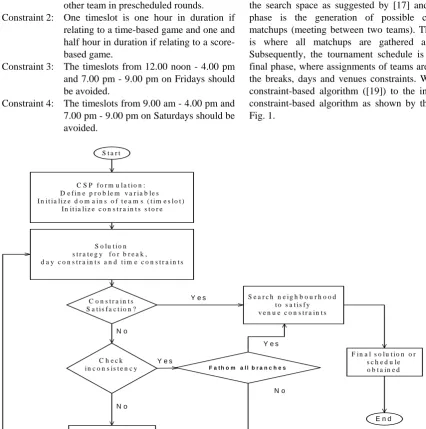
[image:2.595.55.482.322.752.2]Our approach divides the sports tournament scheduling problem into three-phase method for the intention to reduce the search space as suggested by [17] and [18]. The first phase is the generation of possible combinations of matchups (meeting between two teams). The second phase is where all matchups are gathered and enumerated. Subsequently, the tournament schedule is obtained in the final phase, where assignments of teams are made based on the breaks, days and venues constraints. We improved the constraint-based algorithm ([19]) to the innovative hybrid constraint-based algorithm as shown by the framework in Fig. 1.
S t a r t
C S P f o r m u l a t i o n : D e f i n e p r o b l e m v a r ia b le s I n i t ia l i z e d o m a i n s o f t e a m s ( t i m e s l o t )
I n it ia l i z e c o n s t r a i n t s s t o r e
S o lu t i o n s t r a t e g y f o r b r e a k ,
d a y c o n s t r a i n t s a n d t i m e c o n s t r a i n t s
S e a r c h n e i g h b o u r h o o d t o s a t i s f y v e n u e c o n s t r a i n t s
F in a l s o l u t i o n o r s c h e d u l e o b t a in e d C o n s t r a i n t s
S a t i s f a c t i o n ?
N o
Y e s
E n d
C h e c k
i n c o n s is t e n c y F a t h o m a l l b r a n c h e s
Y e s
N o Y e s
Fig. 2. A sample of a neighborhood search involving two matchups
There are several modules for this hybrid constraint-based algorithm (HCB). The solution strategy starts by identifying the available timeslots, where it fulfils the breaks, days and venues constraints. It then determines matchups by randomly allocating in the timeslots one at a time, while checking the suitability based on the relevant constraints in the inconsistency check module. Partial Round Robin strategy is embedded in the algorithm to help generating possible matchups.
If a solution is found (i.e. all matchups are filled in the schedule), then the algorithm proceeds to the neighborhood search module. The function of this neighborhood search is to search for proper and suitable venues satisfying venue constraint through swapping of possible two matchups as exhibited in Fig. 2.
On the other hand, if a matchup is unable to be allocated in any timeslot, then the process would go to the inconsistency check again. If all sub-problems or branches have not been explored and examined thoroughly for suitable matchups, then the algorithm proceeds to forward checking module. Else, if all branches have been thoroughly examined then the search is stopped.
IV. RESULTS AND EVALUATION
We generated six schedules based on the proposed algorithm (i.e. HCB) for the event of netball in the tournament. There are 14 teams and two venues involved. We have also generated the same schedules with just using the constraint-based heuristic (CBH) algorithm without the neighborhood search for the purpose of comparison. Obviously, comparisons with the manually constructed schedules have proved that the proposed algorithm outshines the human generated schedules as discussed in
[20]. The performance of the proposed schedules is compared with that of the constraint-based heuristic algorithm based on two criteria, which are fairness in the assignment of venue and duration of breaks. The result of CBH algorithm shows that seven teams were not assigned to play in either Venue 1 or Venue 2 throughout their matches, whereas the proposed HCB algorithm yields better in terms of fairness in the assignment venues with only three cases of unfairness in all six schedules. This is shown in Table 1.
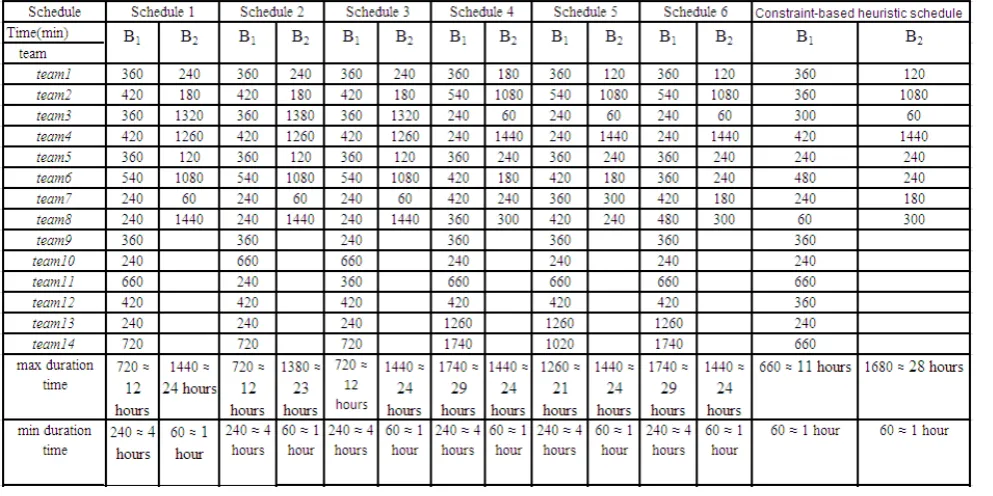
In Table 2, B1 is defined as the duration of break for a team in between playing its first match and the second match, while B2 is the duration of break for a team in between playing the second match and the third match. In the schedule generation, there are eight teams that play three matches, while six teams only play two matches. The average maximum duration of break time among the six generated HCB is 21.5 hours (i.e. [12+24+12+23+12+24+29+24+21+24+29+24]/12), while average duration of break time for the CBH is 19.5 hours (i.e. [11+28]/2). This would give sufficient times for the players to regain their strength and stamina before the next game, as required by game’s rule.
V. CONCLUSION
Table 1. Performance of the proposed HCB and CBH in term of venue assignment
[image:4.595.57.554.406.654.2]REFERENCES
[1] Hassapidou, M. (2001). Dietary Assessment of Five Male Sports Teams in Greece. Nutrition and Food Science, 31(1), 31-34.
[2] Walker, M. L. & Stotlar, D. K. (1997). Sport Facility Management. Boston: Jones and Bartlett.
[3] Lussier, R. B. & Kimball, D. (2004). Sport Management: Principles,
Application, Skill Development. South-Western: Thomson.
[4] McAloon, K., Trekoff, C., Wetzel, G. “Sports league scheduling,” in
Proc. of the 3rd ILOG Optimization Suite International Users Conference, Paris, 1997.
[5] Van Hentenryck, P. and Vergados, Y. “Minimizing breaks in sport scheduling with local search,” in Proc. of the Fifteenth International Conference on Automated Planning and Scheduling, (ICAPS2005),
California, 2005.
[6] Biajoli, F. L., Souza, M. J. F. Chaves, A. A., Mine, O. M., Cabral, L. A. F. and Pontes, R. C. “Scheduling the Brazilian Soccer Championship: A simulated annealing approach,” in Proc. of the Fifth International Conference on Practice and Theory of Automated
Timetabling, PATAT2004, Pittsburg, PA, USA, 2004.
[7] Hamiez, J. P. and Hao, J. K. “Solving the sports league scheduling problem with tabu search,” Lecture Notes in Computer Science 2148, Springer, pp.24-36, 2001.
[8] Ribeiro, C. C. and Urrutia, S. “Heuristic for the Mirrored Traveling Tournament Problem,” in Proc. of the Fifth International Conference
on Practice and Theory of Automated Timetabling, PATAT2004,
Pittsburg, PA, USA, 2004.
[9] Burke, E. K. Werra, D. De. Silva, J. D. L. and Raess, C. “Applying heuristic methods to schedule sports competitions on multiple venues,” Extended Abstract, in Proc. of the Fifth International Conference on Practice and Theory of Automated Timetabling,
PATAT2004, Pittsburg, PA, USA, 2004, pp. 441-444.
[10] Nemhauser, G. L. and Trick, M. A. “Scheduling a major college basketball conference,” Operations Research, vol. 46, pp. 1-8, 1997. [11] Henz, M., Muller, T., Thiel, S. “Global constraints for round robin
tournament scheduling,” European Journal of Operational Research
vol. 153, pp. 92-101, 2004.
[12] Easton, K.., Nemhauser, G. and Trick, M. “Solving the traveling tournament problem: a combined integer programming and constraint programming approach,” in Proc. of the Second International Conference on Practice and Theory of Automated Timetabling,
PATAT2002, pp.100-109, 2003.
[13] Henz, M. “Playing with constraint programming and large neighborhood search for traveling tournaments,” in Proc. of the Fifth International Conference on Practice and Theory of Automated
Timetabling, PATAT2004, Pittsburg, PA, USA, 2004.
[14] Costa, D. “An evolutionary tabu search algorithm and the NHL scheduling problem,” INFOR 33(3), pp. 437-461, 1995.
[15] Benoist, T. F. Laburthe B. and Rottembourg, “Lagrange relaxation and constraint programming collaborative schemes for traveling tournament problem,” Research Report, Wye College, UK, pp.15-26, 2001.
[16] Adriaen, M., Custers N. and Vanden Berghe, G. “An agent based metaheuritic for the traveling tournament problem,” presented at
Workshop on real-life applications of Metaheuristics, Antwerpen,
2003.
[17] Henz, M. (2001). Scheduling A Major College Basketball Conference-Revisited. Operations Research, 49(1), 163-168.
[18] Trick, M. A. (2004). Using Sports Scheduling to Teach Integer Programming. INFORMS Transactions on Education, 5(1), 10-17. [19] Kanet, J. J., Ahire, S. L. & Gorman, M. F. (2004). Constraint
Programming for Scheduling, in Handbook of Scheduling:
Algorithms, Models and Performance Analysis, USA: Chapman &
Hall.
[20] Soong, Cai Juan, Razamin Ramli. & Haslinda Ibrahim. (2011). A Hybrid Constraint-Based Programming Approach to Design a Sports Tournament Scheduling, European Journal of Scientific Research,