Lightweight Multi-direction-of-arrival Estimation
on a Mobile Robotic Platform
Caleb Rascon and Luis A. Pineda
Abstract—Knowledge of how many users are there in the environment, and where they are located is essential for natural and efficient Human-Robot Interaction (HRI). However, carry-ing out the estimation of multiple Directions-of-Arrival (multi-DOA) on a mobile robotic platform involves a greater challenge as the mobility of the service robot needs to be considered when proposing a solution. This needs to strike a balance with the performance of the DOA estimation, specifically the amount of users the system can detect, which is usually limited by the amount of microphones used. In this paper, a lightweight hardware system (based on a 3-microphone triangular system) is used, and a fast multi-DOA estimator is proposed that is able to estimate more users than the number of microphones employed.
Index Terms—direction of arrival, service robots, triangular array, lightweight, robust
I. INTRODUCTION
The problem known as multi-Direction-of-Arrival (multi-DOA) estimation provides a unique challenge when being carried out in a mobile hardware platform; such is the case of service robots. However, it plays an essential part of a natural Human-Robot Interaction (HRI), as it is important to know from where the users are talking to the robot and how many are there in the environment. From the user-experience point of view, the human will feel the interaction as more ‘natural’ if the robot is facing him/her during the conversation.
From the technical point of view, knowing the direction of the user in relation to the robot can benefit other system mod-ules, as well as improve the quality of the HRI. For instance, once the direction of the user is known, voice recognition can be improved using directional noise cancellation [1]. In addition, it is well known that face detection and recognition provide rich information relevant to HRI: the identity of the user, the direction the user is looking at, his mood, etc. [2], [3]. However, such analysis is carried out by visual means, and the user cannot always be expected to be in the line of sight of the robot. Knowing the direction of the user by sound alone, and facing the user accordingly, tackles this issue straight on. Moreover, the robot may be expected to be in a situation where several users are in the environment and actively speaking to the robot, such as taking a food order or while guiding a group of users in a tour. Knowing the amount of users and from where are they talking to the robot, can provide acoustic cues to separate several streams of audio data from the environment based on the Direction-of-Arrival
Manuscript received July 18, 2012; revised August 2, 2012. This work was supported by funding from CONACYT (CB2007-81965) and PAPIIT (IN-104408).
All authors are with the Departamento de Ciencias de la Computaci´on, Instituto de Investigaciones en Matem´aticas Aplicacas y en Sistemas, Universidad Nacional Aut´onoma de M´exico (DCC, IIMAS, UNAM).
E-mail: [email protected], [email protected] For more contact information, see: http://golem.iimas.unam.mx
(DOA) of the various sound sources and provide the single-source streams to the Automatic Speech Recognizer.
In addition, knowing the direction of the user in regard to the robot is also a good first step towards localizing the user in the environment. In a 3-dimensional polar coordinate system, the horizontal angle (i.e. the direction of the user) is one of three values that define a location (the other two being: vertical angle and distance from origin). And the location of the user is, in turn, another important variable in HRI. During a human-robot conversation, the phrase “robot, come here” may be emitted by the human. In this situation, even if the phrase was recognized correctly, the robot may know that it needs to move, but, because the term ‘here’ lacks context, it will not knowwhereto move.
Unfortunately, there are many challenges in the estimation of the DOA of the sound source. Reverberation is prevalent in the locations where a service robot is expected to be (supermarkets, condominiums, etc.) and has been shown to hinder considerably the effectiveness of current DOA estimators [4]. Moreover, too many sound sources may drown the acoustic environment, complicating the estimation process. A sophisticated audio capturing system may be able to overcome these issues, such as the one proposed in [5] that used a 24-microphone 1-D array for precision. However, the application landscape of service robots provides a unique challenge for the multi-DOA estimation topic: a high amount of microphones may be impractical to carry by many of the currently-in-use service robots [6], [7], such as our in-house robot, Golem, herein described.
Golem is a service robot built with a primary focus on HRI. It is integrated by a cognitive architecture focused on HRI, termed Interaction-Oriented Cognituve Architecture (IOCA, [8]), which can take advantage of different types of information interpreted from the world, including the direction of the user. Because Golem is a conversational robot, it is of interest that it is able to detect and carry out conversation with several users at any point. This implies that the system that is to be estimating the multiple DOAs of the environment, needs to be sufficiently light on the hardware side for the robot to carry and not hinder its mobility, but robust enough in the software side to handle different types of noise and disturbances, as well as simultaneous speech from various sources. Moreover, such a system should be able to estimate the direction of the users in a -179◦– 180◦ range, as no assumption can be made of the location of the users in the environment, and fast enough to do so with small utterances from the users. It is important to note, then, that the Multi-DOA Estimation problem is further complicated in a mobile robotic platform, and provides an interesting and unique challenge for current techniques.
of one or more sound sources; Section III describes the pro-posed system; in Section IV, the results of the evaluation of the system on a service robot placed on a highly acoustically-complex scenario are provided; and in Section V, conclusions and future work are discussed.
II. BACKGROUND ONSOURCEDIRECTION-OF-ARRIVAL ESTIMATION
Estimating a Sound Source Direction of Arrival (DOA) is a well written-about topic in Signal Processing. It has been proven useful in applications ranging from fault monitoring in aircrafts [5], to intricate robotic pets [9], to close-to-life insect emulation [10]. In addition, the principles employed in DOA estimation have been applied in the design of hearing aids [1].
Having two audio sensors (i.e. microphones), the Inter-aural Time Difference (ITD) is the delay of a sound from one microphone to the other. It is usually calculated as it being the shift value with the highest correlation measure of the Cross-Correlation Vector (CCV) between two captured signals. It is one the features most used for DOA estimation, particularly with two-microphone arrays, as in [11] where it provided limited results. The ITD yields a clear relation to the direction of the source, described in Equation (1).
θ=arcsin
ITD·V
sound
Fsample·d
(1)
where θ is the DOA angle; IT D is the Inter-aural Time Difference in number of samples; Vsound is the speed of sound (∼343 m/s);Fsample is the sampling frequency; and
dis the distance between microphones.
The Inter-aural Intensity Difference (IID) is the difference in magnitude between both microphones and can also be used for DOA estimation, although a training stage is usually necessary for it to be useful, as it was observed in [7].
In [4], the concept of Inter-aural Coherence (IC) is intro-duced, which is the highest correlation measure of the CCV. If a high IC is present, the signals are deemed coherent and, thus, an analysis using ITD and/or IID can proceed. This methodology was implemented in [9], and it was observed that it didn’t improve DOA estimation when dealing with complex signals (e.g. more than one source, reverberation present, etc.).
A popular methodology for DOA estimation in robotic platforms is to use a microphone array with, usually, two microphones, as it is proposed in [12]. The reasoning behind using only two microphones in robotic platforms ranges from that of practicality (it is lightweight) to that of biological similarity [13], where the robot is meant to be the most human-like possible [14]. However, doing so comes with four main problems.
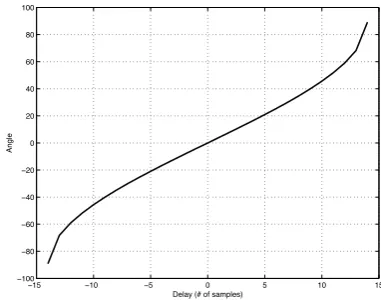
The first issue is that the relation between the ITD and the resulting DOA is not linear. In Figure 1, the DOA is plotted against the ITD, and it can be seen that in the -50◦–50◦ range, the relation between both seem close-to-linear. However, in the outer ranges, the relation becomes exponential. This causes major errors when estimating angles that are located in the sides of the robot [12].
The second is that, as it can also be seen in Figure 1, a 2-mic array only estimates DOAs in the -90◦– 90◦ range. This
ï15 ï10 ï5 0 5 10 15
ï100
ï80
ï60
ï40
ï20 0 20 40 60 80 100
Delay (# of samples)
[image:2.595.329.520.53.203.2]Angle
Fig. 1. DOA (orAngle) in degrees vs. ITD (orDelay) in # of samples.
can be surmounted by implementing ‘artificial ears’ that can detect if the sound source is coming from the front or back of the robot, but it has been proven impractical [15]. This can also be tackled by a two-phase strategy: a first pair of signals can be used to estimate an initial DOA, the robot can then rotate briefly, and then another pair of signals can be acquired to estimate a second DOA. A comparison between the DOAs results in an angle estimation in the -179◦– 180◦ range, but has its own set of issues: it requires considerably more time than when using one DOA estimate, the required rotation may hinder navigational requirements, and the user may be moving as well, rendering the DOA comparison mute.
The third problem is that the estimation of the ITD, based on the calculation of a CCV, can be very sensitive to reverberations and other noise sources [13] (pp. 213-215). This may result in significant errors in the DOA estimation without any form of redundancy.
And finally, a 2-microphone array has rarely been used for multi-DOA estimation, as it provides sparse information from the environment. Adding more microphones generalizes the strategy, as a 2-microphone array is an instantiation of classic reverse beamforming techniques [5], which create a noise map of the environment, and then, by using metrics such as energy levels, propose possible sources of sound and their respective DOAs. However, to obtain a high resolution noise map, and, thus, a precise DOA estimation, beamforming techniques require a large quantity of microphones, which is impractical for mobile robotic platforms. In addition, the more popular 1-dimensional (1-D) beamforming methodolo-gies are also bounded by the first three problems described earlier, and 2-D arrays can be cumbersome to the mobility of the robot.
The topic of how many microphones to use in a service robot is intrinsic to the nature of the application, as it is important for the audio capture system to be mobile. A many-microphone solution may provide good results, such as the one proposed in [6] where the sources were separated from each other, in order to enhance speech recognition, and as a preamble for DOA estimation. However, it required an array of 8 microphones positioned in a cube-like manner to work, doubling the height the robot occupied without it.
known a priori and any modification to the ear (even its location in relation to the microphone) required re-training. A popular technique is the Multiple Signal Classification algorithm (MUSIC) [16], which is able to detect the Direc-tion of Arrival (DOA) of as many sources as one less the available microphones (e.g. 1 source with 2 microphones, 2 sources with 3 microphones, etc). It does this by projecting the received signals in a DOA subspace, based on their eigenvectors, similar to Principal Component Analysis. It was applied in [17] with good results, although it has been observed that its performance decreases considerably in the presence of reverberation [13] (pp. 169).
In this paper, a technique is proposed where a lightweight hardware system (based on only 3 microphones) is able to estimate multiple DOAs, as much as 4 simultaneous sources.
III. PROPOSEDSYSTEM
The proposed system is comprised by three modules:
1) Audio Acquisition. Obtains audio data from the
micro-phones and provides it to the Initial DOA Estimation module.
2) Initial DOA Estimation. Estimates, from the audio data, an initial, fast, but reliable DOA estimation of a single sound source in the environment.
3) Multi-DOA Tracking. Carries out dynamic clustering of
the incoming DOA estimations, and proposes clusters of DOAs as sound sources.
In the following sections, the aforementioned modules will be described in more detail.
A. Audio Acquisition
As it will be described in the following section, the hard-ware is comprised by three omnidirectional microphones, and, because the DOA estimation is based on an ITD mea-sure, it requires that the audio from the three microphones be acquired simultaneously as well as in real-time. For this purpose, the JACK Audio Connection Toolkit [18] was employed, as it can sample at rates of 44.1 kHz and 48 kHz, providing a good resolution for ITD calculations, and it does so without slowing down the other robotic software modules.
B. Initial DOA Estimation
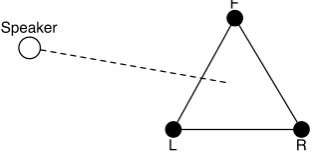
The Initial DOA Estimation is carried out by the technique described in [19]. It avoids the problems that arise when estimating a DOA using 1-D microphones arrays (described in Section II), and maintains a relatively light hardware setup: an equilaterial-triangular-array, as it is shown in Figure 2. To this effect, the system obtains a set of 3 simultaneous sample windows.
L R
[image:3.595.322.529.126.220.2]F Speaker
Fig. 2. Hardware setup of the proposed system.
[image:3.595.91.249.687.766.2]The audio data is passed through various serialized sub-modules: a band-pass filter, a Voice Activity Detection stage, multi-ITD estimation, a redundancy check, and, finally, a final DOA estimation. The flow of data is summarized in Figure 3.
Fig. 3. Initial DOA Estimation flow of data.
1) Multi-ITD Estimation, Redundancy Check, & Angle
Calculation: Three possible ITDs can be calculated using
cross-correlation between sample window R and L (IRL), L and F (ILF), and F and R (IF R). 2 DOAs are calculated from each ITD: one using Equation (1), and another shifting the first DOA to its possible counterpart on the ‘backside’ of the microphone pair.
The three DOA pairs are used to check if the three ITDs are from a sound source located in the same angle sector. To do this, the average of the differences between the DOA pairs is calculated using Equation (2).
Cpqr=
|DRLp −DLFq |+|DLFq −Dr
F R|+|DF Rr −D p RL|
3
(2) where aDi
xy is the ith DOA of the DOA pair from Ixy. A set of 8 Cpqr are calculated, where p, q, and r can be either 0 or 1, depending on which DOA of the DOA pair is being compared. Of the 8, the minimum is considered as the
incoherenceof the sample window set.
A pre-specified incoherence threshold (measured in de-grees of separation between the DOAs; a value between 30◦ and 40◦provided good results) is used to reject sample win-dow sets. A high incoherence implies that the sample winwin-dow set either has too much reverberation to be trustworthy for further processing or that it containsmore than one sound source. This rejection step serves as a type of redundancy checkper sampling window set.
If all of the DOAs are coherent/redundant with each other, a preliminary DOA value (θm) can be calculated using Equation (3),
θm=arcsin
I
min·Vsound
Fsample·d
(3)
where Imin is the ITD with the lowest absolute value of the three (IRL, ILF, IF R). θm is then shifted to the appropriate angle sector in relation to the orientation of the robot, resulting in the final DOA value (θ).
Because of both the redundancy check and the close-to-linear relation, the maximum error of this system can be known beforehand using Equation (4).
|error◦max| = arcsin
I>30◦·Vsound Fsample·d
−arcsin
I
<30◦·Vsound Fsample·d
(4)
where I>30◦ and I<30◦ are the ITDs that provide the
closest ceil and floor measurements, respectively, to 30◦. For example, sampling at 44.1 kHz and with the microphones spaced at 18 cm, a maximum error of ±2.8747◦ can be expected. In the same set of circumstances, when using a 2-Mic 1-D array, the maximum expected error, which occurs when the sound source is close to either side of the robot, is of ±15.0548◦.
2) Voice Activity Detection: To activate the ITD
estima-tion, Voice Activity Detection (VAD) needs to be carried out. Because the robotic platform may be changing position and environments, the VAD system is required to adjust itself to the environment. To this effect, a simple VAD algorithm is proposed that is based on adjusting the baseline of the environmental noise to any sound that is emitted with a pre-specified delay.
Two history buffers of sample window energy values are kept in memory, and shifted based on the specified delay (2 seconds provided good results). One is always being re-freshed by new sample window energy values (avg buffer), and is used to calculate the current average energy value (avg value). The other buffer (min buffer) is used to calcu-lated the current average minimum value (min value), and is refreshed with a new energy value if it is less than the current min value or if the difference between it andavg value is less than the difference betweenavg value andmin value (which would mean that its value is close to the values of min buffer).
The VAD is triggered if the energy value of the cur-rent sample window is greater than the average between avg value andmin valueby a multiplicative threshold (1.5 provided good results).
3) Band-Pass Filter: A general infinite impulse response
band-pass filter is used at the beginning of the process, to remove general ambient noise that is outside the human speech frequency bands. The filter model is described in Equation (5):
yn = 0.0348·xn−0.0696·xn−2+ 0.0348·xn−4+
3.2680·yn−1−4.1247·yn−2+ 2.3984·yn−3−
0.5466·yn−4 (5)
whereyi is the output of the filter,xi is the input, and n is the number of the current sample.
It was observed that this filter made the system less sensitive towards unwanted noises that should always be ignored, such as high-pitch sounds, microphone hiss, etc. Concurrently, it did not degrate the sensitivity of the system towards human speech.
C. Multi-DOA Tracking
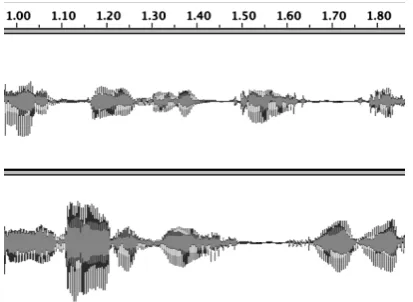
[image:4.595.324.531.212.363.2]The DOA estimator described in the previous section only provides results when there is considerable confidence of only one sound source being detected in a small sample window (up to 100 ms). It has been seen that, even in simultaneous-speech, users are not expected to talk with a 100% overlap over each other. In fact, when analyzing speech recognition, ‘spurts’ of non-overlapping speech has been considered to the order of 500 ms [20]. For example, in Figure 4, it can be seen how two randomly chosen tracks from the DIMEX corpus [21], when overlayed over each other, still have some portions with no overlap between them.
Fig. 4. Non-overlapping simultaneous speech.
This means that the DOA estimator described in the last section is able to provide reliable results of single sources even in multi-user scenarios. However, because of the stochastic nature of the presence of single user sample windows in the simultaneous audio timeline, such results would be provided in a sporadic fashion. To this effect, a simple tracking system is proposed that dynamically clusters similar DOAs into candidate sound sources.
The tracker maintains in memory the last DOAs provided by the initial DOA estimator in a specific time frame. When a new DOA is estimated, the tracker carries out the following: 1) If the new DOA is not ‘close enough’ to the average DOA of any current cluster (good results were obtained when using 5◦ for clusters with one DOA, 10◦ for clusters with more than one DOA, as thresholds for closeness), or there are no clusters in the environment: create a new cluster with the new DOA.
2) If it is close enough to a current cluster, add the new DOA to it, and re-calculate its new average DOA. If a DOA is too old (10 seconds old provided good results), it is ‘forgotten’ by removing it from its respective cluster and re-calculating its average DOA.
Every cluster is considered acandidate sound source, until it has a pre-specified number of DOAs attributed to it (2 DOAs provided good and fast results), when it becomes a ‘sound source’ and its average DOA becomes its main estimated DOA.
IV. TRIALS& RESULTS
room with a high sonic complexity (considerably reflective materials, with a low ceiling, hard floor, cement columns in the middle, and moderate reverberation). Two electronic speakers emitting, simultaneously, random recordings from the DIMEX corpus [21] for 20 seconds, were placed at 1.5 meters from the robot, one at 0◦, another at -45◦.
The Audio Acquisition module was sampling at 48 kHz, and providing sample windows of 4800 samples (100 ms). The buffers in the VAD were 10 energy values long, and considering a 2 second delay for adjustment to the envi-ronment noise. The DOA estimator had a 40◦ incoherence threshold (any sample window set with a higher incoherence was rejected). The multi-DOA tracker considered a new DOA as part of a cluster with more than one DOA if it was 10◦or closer to its average DOA; if the cluster only had one DOA, 5◦or closer was considered as part of the cluster. The results of the test are shown in Figure 5.
! "! #! $! %! &! '!
−&!
−%!
−$!
−#!
−"! ! "!
()*+,-./
0
,-123
-0
4
-56
1
1
75-41)81!
[image:5.595.306.543.212.395.2]75-41)81−%&
Fig. 5. Tracking 2 simultaneous sources (2 electronic speakers).
As it can be seen, the tracking system performed well with 2 sound sources (in the Figure referred to as ‘Users’).
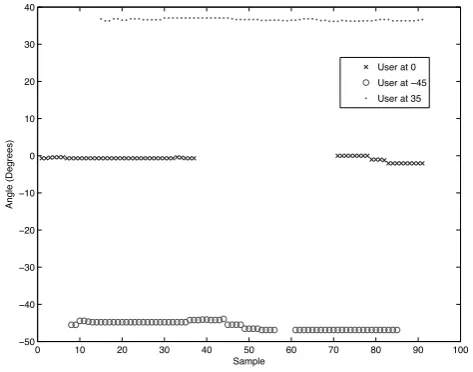
The system was then tested with an additional simultane-ous source: a human emitting continusimultane-ously the phrase “golem i am over here (pause)” placed at 35◦. The results of this scenario are shown in Figure 6.
! "! #! $! %! &! '! (! )! *! "!!
−&!
−%!
−$!
−#!
−"! ! "! #! $! %!
+,-./0
12
3
/0
456
0
3
70
0
89
4
4
:8074,;4! :8074,;4−%& :8074,;4$&
Fig. 6. Tracking 3 simultaneous sources (2 electronic speakers, 1 human).
As it can be seen, the system tracked the human and one of the electronic speakers (placed at -45◦) well. The other of the two electronic speakers (placed at 0◦) was ‘missed’ for a moderate amount of time, however, in any other moment, the tracking system was able to track it considerably well.
To assess if the ‘missed’ tracking issue was with the electronic speaker itself, and, in addition, to observe if the tracker is able to better identify humans than electronic speakers, an additional simultaneous source was added to the environment: another human emitting continuously the phrase “one two three (pause)” placed at -100◦. The results of this final scenario are shown in Figure 7.
! "! #! $! %! &!! &"! &#!
−&"!
−&!!
−%!
−$!
−#!
−"! ! "! #! $!
'()*+,
-.
/
+,
012
,
/
3,
,
45
0
0
64,30(70! 64,30(70−#8 64,30(70−&!! 64,30(7098
Fig. 7. Tracking 4 simultaneous sources (2 electronic speakers, 2 humans).
And, as it can be seen, the electronic speaker placed at 0◦ was again ‘missed’ in a similar fashion than in the 3-user scenario, which suggests a failure with the specific characteristics of the electronic speaker (positioning, volume, frequency enveloping of speech, etc.). However, both humans were tracked very well, and the electronic speaker placed at -45◦ was tracked relatively well. These results imply that the proposed system is well suited for tracking simultaneous human speech. Also, and more significantly, for a moderate amount of time, the 4 simultaneous sources were being tracked well. Considering that the system only employs 3 microphones, it showed that it was able to monitor more sources than the number of microphones present, a feat that the popular approach known as MUSIC is unable to accomplish [16].
The authors would like to remind the reader that the setting of the test scenario were considerably harsh: the sonic complexity of the room was high, there was moderate reverberation, the human user placement can be expected to be inconsistent, and no reverb adequation was carried out. When considering all of this, the proposed system has shown it is an adequate solution to the multi-user DOA estimation problem in a robotic mobile platform.
V. CONCLUSION& FUTUREWORK
[image:5.595.52.288.273.462.2] [image:5.595.51.288.580.766.2]information from the user (face recognition, voice context, etc.) is simplified. To do this, however, the direction of the user is required. Because a conversation is carried out via voice, it is appropriate that the direction of the user be estimated by sound analysis.
In addition, multi-user scenarios are common in the day-to-day dynamics that a service robot is expected to con-front. However, the multi-DOA estimation problem is further complicated when applied in mobile robotics, as it presents a unique challenge: the mobility of the robot should not be compromised, thus the hardware should be lightweight (limited amount of microphones), but it should be robust and flexible enough to be able to carry out DOA estimation in acoustically complex settings.
In this paper, a 3-microphone system was proposed, built upon earlier work published by the authors. It provides a reliable Multiple Direction-of-Arrival estimation, and it was shown that it was able to track more users than the amount of microphones used. Moreover, it did so while being light enough to be carried by a service robot. It also provided a robust estimation in the presence of moderate reverberation and high sonic complexity.
However, during the evaluation, were human speech and electronic-speakers were emitting simultaneously, it was observed that the human speech overcame the electronic speakers. Although this might be attributed to specific char-acteristics of the electronic speaker (as its tracking performed similarly in two different scenarios, regardless of audio data), it was observed that human speech was consistently tracked well, which is something desirable as it will be employed with real-life human speech.
This system is planned to be a preamble for a consequent module that will perform online source separation based on the DOA of the source, which will then provide the Automatic Speech Recognizer with speech data. This will result in a multiple-simultaenous-speech recognition, with a small hardware setup and redundant estimation.
REFERENCES
[1] M. E. Lockwood, D. L. Jones, R. C. Bilger, C. R. Lansing, W. D. O. Jr., B. C. Wheeler, and A. S. Feng, “Performance of time- and frequency-domain binaural beamformers based on recorded signals from real rooms,”Journal of the Acoustical Society of America, vol. 115, no. 1, pp. 379–391, January 2004.
[2] E. Hjelm˚as and B. K. Low, “Face detection: A survey,” Computer Vision and Image Understanding, vol. 83, no. 3, pp. 236 – 274, 2001. [Online]. Avail-able: http://www.sciencedirect.com/science/article/B6WCX-458P9XF-3/2/25c703bcdc7e96439e46210c9c9fffc2
[3] R. Stiefelhagen, H. K. Ekenel, C. Fugen, P. Gieselmann, H. Holzapfel, F. Kraft, K. Nickel, M. Voit, and A. Waibel, “Enabling multimodal human-robot interaction for the karlsruhe humanoid robot,” IEEE Transactions on Robotics, vol. 23, no. 5, pp. 840–851, October 2007. [4] C. Faller and J. Merimaa, “Source localization in complex listening situations: Selection of binaural cues based on interaural coherence,” The Journal of the Acoustical Society of America, vol. 116, no. 5, pp. 3075–3089, 2004. [Online]. Available: http://link.aip.org/link/?JAS/116/3075/1
[5] M. Smith, K. Kim, and D. Thompson, “Noise source identification using microphone arrays,”Proceedings of the Institute of Acoustics, vol. 29, no. 5, January 2007.
[6] J. Valin, J. Rouat, and F. Michaud, “Enhanced robot audition based on microphone array source separation with post-filter,” inin Proc. IEEE/RSJ Int. Conf. Intelligent Robots and Systems, 2004, pp. 2123– 2128.
[7] J. C. Murray, H. R. Erwin, and S. Wermter, “Robotic sound-source localisation architecture using cross-correlation and recurrent neural networks,” Neural Networks, vol. 22, no. 2, pp. 173– 189, 2009, what it Means to Communicate. [Online]. Avail-able: http://www.sciencedirect.com/science/article/B6T08-4VJ05VB-1/2/5163134fb71c8d28b24f8475d2c4f4c5
[8] L. Pineda, I. Meza, H. Aviles, C. Gershenson, C. Rascon, M. Alvarado-Gonzalez, and L. Salinas, “Ioca: Interaction-oriented cognitive archi-tecture,”Research in Computer Science, vol. 54, pp. 273–284, 2011. [9] R. Liu and Y. Wang, “Azimuthal source localization using interaural
coherence in a robotic dog: modeling and application,”Robotica, vol. First View, pp. 1–8, 2010.
[10] A. D. Horchler, R. E. Reeve, B. Webb, and R. D. Quinn, “Robot phonotaxis in the wild: a biologically inspired approach to outdoor sound localization,” inSound Localization,” 11 th International Con-ference on Advanced Robotics, (ICAR ’03, 2003, pp. 1749–1756. [11] J. C. Murray, H. Erwin, and S. Wermter, “Robotics sound-source
localization and tracking using interaural time difference and cross-correlation,” inAI Workshop on NeuroBotics, 2004.
[12] K. Nakadai, H. G. Okuno, H. Kitano, H. G. O. ´y, and H. K. , “Real-time sound source localization and separation for robot audition,” in in Proceedings IEEE International Conference on Spoken Language Processing, 2002, 2002, pp. 193–196.
[13] D. Wang and G. J. Brown, Eds.,Computational auditory scene anal-ysis: Principles, Algorithms, and Applications. IEEE Press/Wiley-Interscience, 2006. [Online]. Available: http://www.casabook.org/ [14] T. Fong, I. Nourbakhsh, and K. Dautenhahn, “A survey of
socially interactive robots,” Robotics and Autonomous Systems, vol. 42, no. 3-4, pp. 143 – 166, 2003. [Online]. Avail-able: http://www.sciencedirect.com/science/article/B6V16-47XG102-1/2/aae36740a7e349fe44fdae6bd229dabf
[15] A. Saxena and A. Y. Ng, “Learning sound location from a single microphone,” inICRA’09: Proceedings of the 2009 IEEE international conference on Robotics and Automation. Piscataway, NJ, USA: IEEE Press, 2009, pp. 4310–4315.
[16] R. Schmidt, “Multiple emitter location and signal parameter estima-tion,”Antennas and Propagation, IEEE Transactions on, vol. 34, no. 3, pp. 276–280, 1986.
[17] S. Mohan, M. E. Lockwood, M. L. Kramer, and D. L. Jones, “Localization of multiple acoustic sources with small arrays using a coherence test,”Journal of the Acoustical Society of America, vol. 123, no. 4, pp. 2136–2147, April 2008.
[18] P. Davis, “Jack connecting a wolrd of audio.” [Online]. Available: http://jackaudio.org/
[19] C. Rascon, H. Aviles, and L. A. Pineda, “Robotic orientation towards speaker for human-robot interaction,”Advances in Artificial Intelli-gence - IBERAMIA 2010, vol. 6433, pp. 10–19, 2010.
[20] E. Shriberg, A. Stolcke, and D. Baron, “Observations on overlap: Findings and implications for automatic processing of multi-party conversation,” inin Proceedings of Eurospeech 2001, 2001, pp. 1359– 1362.