[ 494 ]
EFFECTS OF HIGH HYDROSTATIC PRESSURES ON
THE ACTIVITY OF FLAGELLATES AND CILIATES
BY J. A. KITCHING
Department of Zoology, University of Bristol
{Received 4 July 1957)
INTRODUCTION
Within the range of from 100 to 1000 atm. (about 1470-14,700 p.s.i.) high hydro-static pressures affect living cells in various ways and in general adversely. Certain particular metabolic processes are known to be depressed; for instance, fermentation in yeast and (at ordinary temperatures) luminescence in bacteria. Various contractile processes associated wth protoplasmic gelation are inhibited; for instance, amoeboid movement, cleavage of eggs, and contraction of chromatophores. Certain biological activities, including various aspects of the response of nerve and muscle, are known to be enhanced at the lower end of this range of pressures; but at higher pressures activity is depressed or abolished. Aquatic animals are often stimulated to greater activity by pressures of about 100 atm., but they are paralysed or killed by pressures of from several hundred to 1000 atm.
The effects of high pressure are interpreted by Johnson, Eyring & Polissar (1954, with bibliography) in terms of the volume changes accompanying chemical reactions. The rate of a chemical reaction will be increased or decreased by high pressure according as to whether the formation of activated complex involves a decrease or increase in volume, and its equilibrium will be shifted in the direction of decreased volume. Metabolic effects of pressure are readily interpreted in terms of changed reaction rates. The effects on protoplasmic gelation are attributed by these authors to a shift in an equilibrium between extended and contracted protein molecules—an explanation which harmonizes well with observations on the antago-nistic action of pressure and temperature. The effects of pressure on the numerous interacting metabolic processes of cells are likely to prove as complex as are those of temperature. There are also interesting possibilities of effects on cell structure which might affect the interactions of enzymes with substrates. Although the effects of pressure on luminescence of intact bacteria and of cell-free extracts show remarkable similarities, there are certain differences which may be due to structural organization (Strehler & Johnson, 1954).
interpretation of results is possible in biochemical terms, experiments with high pressures are likely to lead to a variety of unexpected observations, as already found with Suctoria (Kitching, 1954). The occurrence of bacteria and of various invertebrate animals in the ocean deeps suggests an inquiry into the nature of biochemical adaptation to these pressures and into the limits of acclimatization possible without genie mutation.
METHODS
Protozoa of the various species mentioned later were mounted in a hanging drop of their own culture medium on the upper window of the pressure vessel already described (Kitching, 1954). The dead space was completely filled with a mineral oil, usually Boots's medicinal paraffin B.P., but in some experiments an I.C.I, high boiling-point paraffin. There was no difference between the results obtained with these two mineral oils. Specimens left mounted in the vessel after treatment survived for a number of days. For some of the experiments a new vessel was used having a thermocouple junction within it (and also provided with channels in the wall for temperature control and with a lever passing through the wall). The experimental procedure was varied to suit the material and circumstances, but certain standard procedures were used for interspecific comparisons. Experiments are summarized under the ' Results' for each species in the following terms:
(A) Single treatment: a single period of treatment at a constant high pressure, preceded and followed by observations at no applied pressure ( = 'zero pressure'). (B) Multiple treatment: more than one period of treatment at constant high pressure. These experiments are subdivided as follows:
(i) Standard step-wise: the pressure wa3 raised by steps of 1000 p.s.i. (68 atm.), with no intervening return to zero; 5 min. were spent at each step. The pressure of the highest step depended on the requirements of the experiment and is stated. From this there was a direct return to zero pressure in 1-5 sec.
(ii) Direct: the pressure was raised directly from zero to any given pressure, and was always returned to zero between periods of treatment. There was no standard time of treatment or standard series of pressures.
(iii) Irregular: the arrangement of treatments did not conform to either of the types described above.
Both in direct and in irregular multiple treatment experiments, treatments liable to cause obvious damage were left until the end.
The limits of room temperature for each series of experiments are stated under 'Results'. For any one experiment this temperature did not fluctuate by more than ± 0-5° C , except during overnight recovery periods. The light was fitted with a heat-absorbing filter. Ciliary frequency was measured stroboscopically in a number of experiments.
496 J. A. KlTCHING
longer measurable. It is likely that the changes were similar in the old vessel (no. 1), as the internal cavity is similar in the two vessels and small compared with the bulk of surrounding steel. In certain experiments carried out with the new vessel, in order to limit the momentary change of temperature to a negligible value, the pressure was raised or lowered in substages of 250 p.s.i. or 125 p.s.i. every half minute (' subdivided pressure change') until the desired change had been accomplished. In some other cases pressure was released continuously and very slowly, for the same purpose; details are given under 'Results'.
Polytoma uvella Culture: axenic, in Thorpe's (1932) medium.
Experiments: six standard stepwise (max. 14,000-18,000 p.s.i.), two single treatment, four multiple treatment (direct or irregular) (max. 3000 p.s.i.), very many individuals, iyi-2o-3° C.
In stepwise experiments, application of 1000 p.s.i. appeared to stimulate into activity such animals as were sluggish or stationary. Apart from this there was no noticeable effect up to 8000 p.s.i. From 9000 p.s.i. upwards the speed of swimming decreased, a few stopped movement at 10,000 p.s.i., and all eventually stopped at 14,000 p.s.i. The pressure required to stop movement was the same for a 4-day-old and a 33-day-4-day-old culture in adjacent hanging drops. At pressures of 16,000-18,000 p.s.i. some individuals developed what appeared to be minute blebs at the base of the flagella, but interpretation was difficult.
A few started moving again, slowly or very slowly, within about half a minute on release of pressure from 14,000 p.s.i. Most remained stationary for many hours, but had resumed normal activity by the next morning; in one experiment they were stimulated to activity sooner by the application of a moderate pressure (3500 p.s.i.). After stepwise experiments to 17,000 and 18,000 p.s.i., some few individuals (out of hundreds) eventually made slight wobbling movements, and a very few in each case swam again normally within 1-2 days of release of pressure.
The stimulating effect of moderate pressure was confirmed in single and multiple treatment experiments to 1000, 2000 and 3000 p.s.i. Without applied pressure about 25 % of the individuals, as judged at a glance, were stationary and resting at the surface of the glass window. Most of these became active when the pressure was raised to 1000 p.s.i., and almost all were active at 2000 or 3000 p.s.i. On release of pressure, the number of stationary individuals had risen within a minute or two to about the same as before treatment. In order to test whether these results were caused by the change of temperature which accompanies compression or decompression, two tests were carried out with compression by subdivided pressure change (125 p.s.i. per half minute) to 2000 and 3000 p.s.i., and with continuous slow release to zero pressure in 34 and 56 min. The same changes in activity occurred.
Chlamydomonas pubatilla
Culture: tap water with soil and trace of NH4MgPO«.
Experiments: two standard stepwise, maximum 13,000 p.s.i., very many individuals,
Swimming continued actively up to 7000 or 8000 p.s.i., but became noticeably and progressively slower from 9000 p.s.i. upwards. Some individuals stopped altogether at 11,000 p.s.i., more still at 12,000 p.s.i., and all at 13,000 p.s.i. On release of pressure all remained motionless at first, but a few individuals started making small movements within about an hour. By next morning (18-24 hr. after release of pressure) less than a quarter of the individuals were moving nearly normally, while the rest were motionless and probably dead.
Astoria longa
Culture: axenic, in Pringsheim's (1946, p. 47) yeast extract-acetate-peptone medium. Experiments: five standard stepwise4-one similar but with stepwise release also, max. 9000 or 10,000 p.s.i., very many individuals, i2-2-i4-o° C.
The organisms swam actively and with little or no loss of speed at pressures up to 4000 p.s.i. They lost speed progressively from 5000 p.s.i. upwards; at 8000 p.s.i. many were stationary and the rest were very slow; and at 9000 p.s.i. or 10,000 p.s.i. most became motionless, and movement in the rest was reduced to a faint wobble. The body was distinctly shorter, but still spindle-shaped, at 8000 p.s.i., but in most cases rounded or irregular at 9000 p.s.i.; the wobbling at 9000 p.s.i. was confined to those few which still remained spindle-shaped. On release of pressure to zero, nearly all started moving immediately, but the movement of those in which the body had become rounded up was in circles. Within half an hour after release of pressure many had resumed their usual elongated shape and their normal swim-ming speed. With stepwise release of pressure some movement was restored at 8000 p.s.i., and there was active swimming movement at 7000 p.s.i. down to 1000 p.s.i. However, the body remained rounded, pear-shaped, or irregular, until after all pressure had been released.
Paramecium spp.
Culture: Bristol tap water and carrot extract.
(a) P. aurelia, effects of pressures of up to 1000 p.s.i.
Experiments: six multiple treatment direct, treatments of 2-10 min., numerous in-dividuals, i6-7-2i'3° C.; three additional slow-release experiments, see below.
The organisms became noticeably less active with increasing pressure, with a tendency to halt among the debris or at the edge of the drop. This decrease in activity was noticeable at 500 p.s.i. and doubtfully so at 200 p.s.i. There was an immediate return to full activity on release of pressure, noticeable after pressures of 200 p.s.i. or over. The immediate response was one or more turns, followed by active swimming.
498 J. A. K I T C H I N G
increase in the number swimming actively until, at zero or above, all were fully active.
(A) Comparison of P. aurelia and P. caudatum in stepwise experiments
Experiments: six stepwise, max. 4000-7000 p.s.i., numerous individuals, i7-6-2O-5° C.; in three of the experiments each species was mounted in a separate drop, side by side, and in three the cultures were mixed in equal quantities.
P. aurelia became slow or stationary at 1000 p.s.i., although a few continued to move slowly at 2000—4000 p.s.i. Some began to swim and finally to rotate on the long axis at 6000 p.s.i. Many rotated violently and then became distorted and irregular in shape at 7000 p.s.i. On release of pressure, those least affected im-mediately swam rapidly. The distorted ones remained stationary, apparently dead. Rise of pressure to 5000 p.s.i. in one step halted some but not all. Swimming was resumed on release of pressure, and there were no other obvious effects.
P. caudatum swam actively before treatment and at 1000 p.s.i., more slowly at 2000 and 3000 p.s.i. Some developed busters at 4000 p.s.i.; all developed blisters by 5000 or 6000 p.s.i., but some continued to swim even so. Most were stationary at 7000 p.s.i. On release of pressure from 5000 and 6000 p.s.i., there was immediate swimming movement, in spite of busters, but most became quiet later. On release from 7000 p.s.i. there was no recovery of movement. When the pressure was raised to 5000 p.s.i. in one step, all immediately shortened, underwent rapid rotation on the long axis, and became very blistered. On release of pressure (after 2 min.) there was at first some slow movement, but all came to a halt within 15 min. The body shape was gradually restored, and the surface cilia were observed to beat.
(c) P. caudatum, contractile vacuole
Experiments: one single treatment, two multiple treatment direct (periods of up to 18 min. at pressure), one multiple treatment irregular, n-7-i4-o°C. A single Paramecium was confined in a volume sufficiently thin to impede rotation about the long axis, but sufficiently thick and extensive to allow considerable movement in a horizontal plane. The anterior contractile vacuole was observed, timed, and measured.
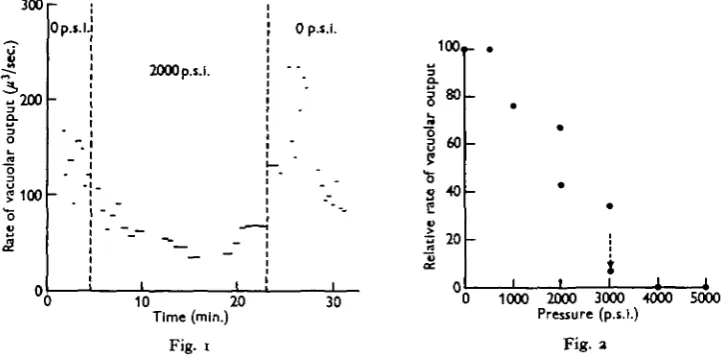
The rate of output of the contractile vacuole was reduced by increase of pressure (Fig. 1), and vacuolar activity was halted at 5000 p.s.i. The effect of pressure was mainly on the vacuolar duration, rather than on ultimate diameter. On release of the pressure the contractile vacuole resumed its normal rate of output, or even exceeded this for a time, provided that the treatment had not been too drastic. The effect of pressure on vacuolar output is summarized in Fig. 2.
Tetrahymena pyriformis Culture: axenic in beef extract (Lab Lemco) peptone medium.
Experiments: nine standard stepwise, max. 11,000-16,000 p.s.i.; three single treatment to 16,000 p.s.i. for 5,10 and 15 min.; two multiple treatment direct; very many individuals;
In stepwise experiments, swimming continued very actively to about 7000 p.s.i., and at this pressure those animals which had previously moved slowly along the glass/water interface swam freely and fast. At higher pressures swimming became progressively slower. Some movement continued up to 11,000 p.s.i., but all were stationary by the end of the period at this pressure or early during the period at 12,000 p.s.i. At the higher pressures, and especially from 12,000 p.s.i. upwards, some individuals became bulbousry deformed and finally spherical, but many remained normal in shape or nearly so even at 16,000 p.s.i. In one standard step-wise experiment 4-day-old and 48-day-old cultures were mounted in adjacent hanging drops for simultaneous observation. Effects on the two cultures were very similar; the older culture was possibly the less active at the higher pressures, but showed some slight movement at 10,000 p.s.i.
2. JUU
100
0(
0 p.s.i.
•
2000 p.s.i.
i 10
t 20
0 p.J.i.
'-30
100.-3 Q.
i 8°
1 6 0 5
"S
V
i 20
I
0
Time (mln.)
Fig. i
1000 2000 3000 4000 Pressure (p.s.i.)
Fig. a
5000
Fig. 1. Effect of hydrostatic pressure of 2000 p.s.i. (136 atm.) on the rate of output of the anterior contractile vacuole of Paramecium caudatum.
Fig. 2. Relation between hydrostatic pressure and rate of output of anterior contractile vacuole in Paramecium caudatum.
[image:6.451.45.407.245.423.2]5<X> J. A . K l T C H I N G
In three experiments many individuals of T. pyriformis were exposed directly to 16,000 p.s.i. (for 5, 10 and 15 min.) and then returned to zero pressure. All stopped movement immediately at high pressure, and many became spherical. After release from a 5 min. exposure, the stages were as described above; some eventually burst, but many recovered and divisions occurred by the next day. After 10 min. exposure only one recovered out of the many used in the experiment, although this one subsequently divided many times; none recovered after 15 min. exposure. Thus a 10 min. single treatment achieved practically the full mortality obtained by standard stepwise procedure to the same pressure.
Holopkrya sp.
Culture: Miquel sea water (Allen & Nelson, 1908, p. 428) with growing diatoms. Experiments: four standard stepwise, max. 12,000-14,000 p.s.i., numerous individuals, 16-4-190° C.
Before application of pressure most of the organisms were stationary and feeding, especially among debris, although some short excursions were made from time to time. They became slightly more restless at pressures up to 4000 p.s.i., and very distinctly so at 5000-7000 p.s.i., especially immediately after a rise in pressure. Many swam continuously at 8000 p.s.i. and all did so at 9000 p.s.i. At 10,000 p.s.i. swimming was at first fast, in spirals, but became slower. All, or almost all, stopped by the end of the period at 12,000 p.s.i. One individual moved very slowly at 13,000 p.s.i., but finally stopped. Many became rounded at 12,000 p.s.i., and all were rounded at 13,000 p.s.i. and 14,000 p.s.i.
A few began to move slowly within 1 min. after release from 12,000 p.s.i., and all appeared normal by the next day (20 hr.). All developed large vacuoles (pre-sumably contractile vacuoles) in 10-15 min. after release from 13,000 p.s.i.; many recovered within 2 days and appeared normal again. There was no sign of life nor any recovery after release from 14,000 p.s.i.
Colpidium campylum
Culture: Bristol tap water+carrot
extract-Experiments: four standard stepwise, max. 12,000 p.s.i. (three experiments) and 15,000 p.s.i., very many individuals, I7-2-22-60 C.
At 1000-3000 p.s.i. the number of individuals which were stationary alongside debris increased, in two of the experiments very greatly; but at still higher pressures more became free-swimming. At 6000 p.s.i. the rate of swimming was distinctly slower, and it became slower still as pressure was increased. At 9000 p.s.i. a small number had stopped and all came to a halt before the end of the period at 12,000 p.s.i. Many were slighdy more rounded at 10,000 p.s.i., and all were spherical or nearly so at 14,000 p.s.i. Many cytolysed at 15,000 p.s.i.
individuals in about 10 min., in others after a period ranging up to several hours. On release from 15,000 p.s.i., in a few which had not cytolysed a contractile vacuole began to operate, but all soon disintegrated.
Colpoda cucullus Culture: Bristol tap water+carrot extract.
Experiments: nine standard stepwise, max. 6000-8000 p.s.i.; two control (see below); numerous individuals, 17-2-21-2° C.
At no applied pressure most were stationary among debris, or creeping among it, but a few were sometimes free-swimming. At 1000 to 3000 p.s.i. there was an increasing restlessness among thigmotactic individuals, until by 3000 p.s.i. all were swimming freely. With each increase in pressure over this range, the restlessness did not develop or increase instantly, but took about half a minute or longer. At 2000-3000 p.s.i. there was a tendency to swim for brief periods rapidly in close circles, alternating with periods of normal swimming. Swimming was distinctly slower at 4000 p.s.i., and movement ceased at 6000 or 7000 p.s.i., more usually the former. Stopped individuals often became blistered or distorted, and the con-tractile vacuole was abnormally large and failed to discharge.
On release of pressure the organisms all remained stationary. In most cases the contractile vacuole discharged within about a minute, and after about 20 min. the normal body shape had been restored, with deeply incurved pharynx. Within 2-8 hr. of release of pressure many but not all individuals formed thin-walled resting cysts, from which they usually emerged within a few hours. Excysted individuals displayed normal activity. In two experiments a few division cysts were also formed. In control experiments, in which the organisms were mounted as usual in the pressure vessel but without subjection to high pressure, a very few division cysts were formed during the 8-9 hr. period of observation, but no resting cysts. More experiments are required with more uniform material before conclusions can be drawn about induction of encystment by treatment with high pressure.
In other experiments, individuals subjected to pressures of 7000-9000 p.s.i. disintegrated suddenly.
Spirostomum ambiguum
Culture: Chalkley'9 solution with wheat grains, in tall jar.
Experiments: three standard stepwise, max. 6ooo, 10,000, and 11,000 p.s.i., numerous individuals, i4-2-i6-5° C.; three multiple treatment direct, with measurement of swimming speed, single individuals, 14-2-17-1° C.; two stepwise releases of pressure (see below), 22-5° C.
(a) Swimming speed and body shape
5O2 J. A. KlTCHING
in circles. A number cytolysed at 9000-10,000 p.s.i. On release of pressure, those which had not cytolysed began to move again quite briskly, although they were contorted and deformed. Some broken-off pieces of Spirostotmtm also moved again actively. In another similar experiment (see below) one specimen continued to move slowly at 11,000 p.s.i., and some others recovered activity and approximately normal shape over a period of 22 hr. on release of pressure.
During a 12 min. exposure to 8000 p.s.i., the numerous individuals present became distorted by a shrinkage of the anterior end, most of the protoplasm collecting in the rest of the body. The anterior end bent around on itself and the Spirostomum swam in circles or spirals. Finally each became shaped like a sphere with a tail attached, and portions of the latter broke off with the cilia still beating rather weakly. On release of pressure there was some immediate recovery of movement, and distorted hulks of Spirostomum gyrated with actively beating cilia. A few small fragments showed some activity.
(b) Behaviour
It was noticeable in stepwise experiments that there was no reversal or avoiding reaction at the higher pressures. At 3000 p.s.i. the avoiding reaction appeared normal and the organisms were distributed throughout the drop; at 4000 p.s.i. and over no avoiding reaction was seen, and the organisms swam steadily around the edge of the drop but were absent from the middle.
Release of pressure from 6000 p.s.i., 4000 p.s.i., or 2000 p.s.i., to zero was immediately followed by a period of backwards swimming, lasting for about a minute after 6000 p.s.i. and less time after the lower pressures. Release of pressure was also carried out from 6000 p.s.i. by 1000 p.s.i. steps with 5 min. at each (one experiment). On release from 6000 p.s.i. to 5000 p.s.i. organisms continued swimming at the edge of the drop, and there was no reversal. A few cases of brief reversal were seen at 4000 p.s.i.; at 3000 p.s.i. there were a number of short reversals; and on release to 2000 p.s.i. many organisms immediately reversed, and many left the edge of the drop. Behaviour appeared normal at 2000, 1000 and o p.s.i. After recompression, and on release from 8000 p.s.i. by 2000 p.s.i. steps of 5 min. each, there was no reversal at 6000 p.s.i. and very little at 4000 p.s.i.; many reversed immediately on release to 2000 p.s.i. and to o p.s.i., and at these pressures the normal avoiding reaction was resumed and the organisms became distributed throughout the drop.
Stentor polymorphus Culture: Chalkley's solution with wheat grains.
Experiments: eight standard stepwise+four similar but with subdivided pressure change and stepwise release, max. 8000-11,000 p.s.i., few or single individuals; ten multiple treatment irregular experiments to lower pressures, for membranellar frequency, single individuals; i3-3-20-o° C.
frequency took place at any rate within a few seconds of the application of pressure, and was reversed with equal rapidity when the pressure was released. At somewhat higher pressures, varying from 4000 to 7000 p.s.i., metachronal rhythm broke down; some of the membranellae stopped completely, and the beating of the remainder was reduced to a weak and irregular flicker of small amplitude. This sudden stoppage was often associated with a relaxation or outward bulging of the disk, the points of the membranellae being directed stiffly backwards. In one case flickering
1500
[image:10.451.110.341.181.455.2]Pounds per square Inch 5000
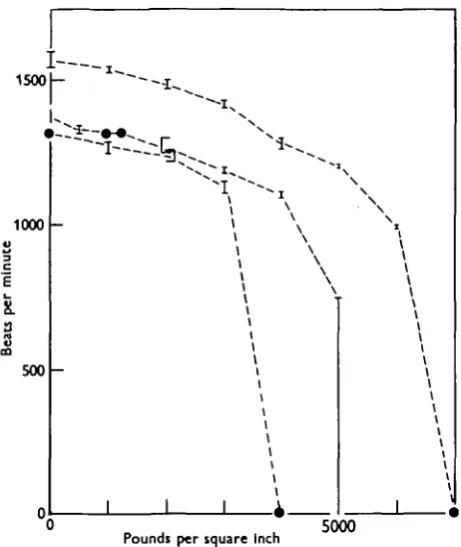
Fig. 3. Relation between hydrostatic pressure and frequency of the membranellar beat in Stentor. Results for three individuals and the limits of readings at each pressure are shown.
504 J. A. KlTCHING
Stylonychia mytilus Culture: Bristol tap water with wheat grains.
Experiments: two standard stepwise; one multiple treatment direct with same series of pressures, max. 7000 or 8000 p.s.i., one or two individuals, i6-5-i7-7° C. (material limited).
Before treatment, at no applied pressure, the organisms crawled around, with occasional avoiding reactions, short darts forward, and brief periods of no move-ment. At 1000 and 2000 p.s.i. there was no progression (two experiments) or much less, and there was none at 3000-5000 p.s.i.; feeding currents, however, continued. Release of pressure restored normal activity immediately. At 4000 p.s.i., and more especially at 5000 p.s.i., the locomotory membranellae and cirri, previously motion-less, began to nicker. At 6000-7000 p.s.i. all the cirri and membranellae beat wildly and the body turned in circles, but towards the end of the period at 7000 p.s.i. movement of cirri and body almost ceased. There was instant recovery of movement when the pressure was released, and the animals swam with an irregular rolling or circling motion. At 8000 p.s.i. there was some disintegration of the posterior end of the organism, with loss of cirri, but a considerable measure of normal activity was recovered by 3 hr. after release of pressure.
Euplotes sp. {patella group) Culture: pond water+wheat grains.
Experiments: two standard stepwise, one multiple treatment direct, max. 10,000 or 11,000 p.s.i.; one multiple treatment irregular; numerous individuals, I5-9-2O-60 C.
Before pressure was applied, the organisms were creeping among debris in short runs or sometimes swimming freely, with short alternating periods of no movement. At 1000 p.s.i. there was a just noticeable increase in activity, more time being spent in running or swimming and less at rest. At 2000-4000 p.s.i. there was continuous running, without any stops; on release of pressure intermittent stoppages recurred, as before treatment. At 5000-8000 p.s.i. the organisms swam actively in small circles; on release of pressure the organisms stopped swimming and spent most of the time stationary, with occasional short runs. At 9000-10,000 p.s.i. swirnrning was much weaker, and eventually ceased, the membranellae only moving very slowly. At 10,000 p.s.i. a group of vacuoles was seen in the posterior part of the body, as though contributory vacuoles had failed to fuse to form a contractile vacuole. Some individuals failed to recover on release of pressure from 10,000 p.s.i.; others instantly resumed swimming for a few seconds, and then returned to the normal behaviour of intermittent runs and rests.
Vorticella sp. ? marina Source: River Avon, Bristol (brackish water).
In all cases after an increase in pressure the ciliary frequency fell during the first minute or two to a lower level. At 4000 p.s.i. and over there was a slow downward drift throughout the 5 min. exposure, The cilia stopped at 6000 p.s.i. (one experiment) or 7000 p.s.i. (two experiments). On release of pressure the cilia always beat faster again and recovered their original frequency within a minute or two after a 5 min. exposure to 1000-3000 p.s.i. Recovery was slow after exposure to higher pressures.
During a prolonged exposure (1 hr.) to 8000 p.s.i. the contractile vacuole failed to discharge, but grew steadily larger until its diameter exceeded half the width of the body. Almost immediately on release of pressure it discharged, and thereafter operated normally.
Cothurnia ? curvula Source: River Avon, Bristol (brackish water).
Experiments: two multiple treatment direct, single individuals, I5-5-I7-80 C. There was no significant difference in frequency of discharge, ultimate diameter, or rate of output of the contractile vacuole at 1000 or 2000 p.s.i., but variation was considerable, so that minor differences could not have been detected. At higher pressures the ultimate diameter and rate of vacuolar output were reduced; vacuolar activity was very low at 5000 p.s.i. and reduced to zero at 7000 p.s.i.
EpistUis plicatilis Source: shells of freshwater snail Planorbis sp. from pond.
Experiments: four multiple treatment irregular; observations on single zooid of colony, i9-o-2io° C.
In all four experiments an increase of pressure within the range 1000-3000 p.s.i. produced an immediate significant increase in frequency of ciliary beat, and this effect was immediately reversed on release of pressure. At 1000 p.s.i. the ciliary frequency was increased by 3, 7, and 7%; at 2000 p.s.i. by 6, 8 and 9%; and at 3000 p.s.i. by 4, 5 and 5%, as compared with the frequency with no applied pressure. (In one case, illustrated in Fig. 4, contractions of the body prevented any assessment of the results at 3000 p.s.i.) At 4000-5000 p.s.i. and higher pressures there was a decrease in rate of beat, and the body also underwent repeated contraction. At 6000 p.s.i. the contractions were shorter in extent but they continued throughout the treatment; at 7000 p.s.i. they were reduced to short spasms, and at 8000 p.s.i. no contractions occurred. At 10,000 p.s.i. the body remained motionless, and there was no visible vacuolar activity. On release of pressure from 10,000 p.s.i. the cilia began flickering immediately, and the contractile vacuole resumed activity within a few minutes. The cilia subsequently resumed an active beat, although the fre-quency was still less than before treatment.
Carchesium polypinum
Source: a freshwater aquarium tank.
Experiments: one preliminary multiple treatment irregular, four single treatment (2000-8000 p.s.i. for 15-51 min.), i7-5-i8-7° C , single zooid for contractile vacuole.
506 J. A. K I T C H I N G
This organism contracted its body periodically, and this was particularly trouble-some at moderate pressures (around 4000 p.s.i.). Contraction ceased after a few minutes at 6000 or 8000 p.s.i., and did not occur at 10,000 p.s.i. The ciliary beat was, of course, interrupted by the contraction, and did not in any case occur when contraction had ceased at the higher pressures. Ciliary beating was restarted • within 2 min. of release of pressure after 5 min. exposure to 10,000 p.s.i., and
within a few seconds or less after release from 6000 p.s.i. (30 min. exposure) or 8000 p.s.i. (51 min. exposure).
1800
-1200
Time (min.)
90
Fig. 4. Effects of hydrostatic pressure on ciliary frequency in Epistilis plicatilis. Each small vertical mark at the upper margin records a contraction of the body.
The frequency, ultimate diameter, and rate of output of the contractile vacuole were not significantly affected at 2000 p.s.i. Observations could not be made at 4250 p.s.i., owing to repeated contractions of the organisms. Vacuolar activity was abolished at 6000 and 8000 p.s.i., but the rate of output was exceptionally high immediately after release from these pressures.
DISCUSSION
turn and advance. Rather little is known about the operation of activities at these three levels. It has generally been held that metachronal rhythm involves the passage of a co-ordinative impulse along the ciliary row (Gray, 1928; Worley, 1934; Sleigh, 1957).
Transmission of this impulse probably involves a phase of excitation within the cilium (Bradfield, 1955) and a phase of conduction between adjacent cilia. It is not known to what extent the 'neurofibrillar' or 'neuromotor' system takes part in conduction between the cilia. Recent work on the fine structure of this system in Paramecium (Sedar & Porter, 1955) has shown that the kinetodesma is less con-tinuous than had been supposed, but detailed information is wanted in many other types. The more condensed neuromotor system of hypotrichs has been regarded as a system for the co-ordination of certain of the cirri (Taylor, 1920). It is not known whether such co-ordination as may occur (either via the neuromotor system or otherwise) is operated by stimulation or inhibition. Various cilia can be reversed by a direct current, and there are observations connecting the direction of metachronal wave in Opatina with the potential difference across the cell surface (Kinosita, 1954). It is clear that any present attempt to explain the effects of pressure on behaviour must be speculative.
The frequency of ciliary beat in Protozoa is normally depressed by increase in pressure, at any rate at the temperatures used in these experiments. However, in EpistiUs pticatitis there is an increase for pressures of up to 3000 p.s.i., but there-after a decrease; and in Stentor pofymorpkus the frequency sometimes remains unchanged up to 1000 p.s.i. Of the various biological processes which are accelerated or enhanced by moderate pressures, bacterial luminescence has been investigated in detail. Pressure only increases luminescence at rather high tem-peratures, at which luminescence is less than normal. This increase is interpreted by Johnson et al. (1954) in terms of a shift in the equilibrium between an enzyme and its own denaturation product in the direction away from denaturation, while the decrease at still higher pressures is attributed to a direct effect of pressure on the rate of a chemical reaction. A similar type of explanation could be applied to the membranellar frequency of EpistiUsplicatilis, although the true explanation may be more complicated.
The lateral cilia of Mytilus show a brief increase in frequency in reponse to the application of pressure (Pease & Kitching, 1939), and this overshoot effect is also interpreted by Johnson et al. in terms of chemical reaction rates. It is not surprising that different kinds of cilia from different animals should give different results; with a number of reactions involved the possibilities for variation in the pattern of response are considerable. Paramecium spp. is able to swim for a time after the removal of all oxygen (Kitching, 1939), although a sufficient hydrostatic pressure will immobilize it immediately: this suggests that pressure depresses at least one reaction (among others) which is more closely associated with the ciliary beat than those involving molecular oxygen.
Both flagella and cilia are capable of beating for short periods at pressures of up to 10,000-12,000 p.s.i., and in one case {Polytoma uveUa) the flagella have shown
508 J. A. K I T C H I N G
Table i . Cessation of movement and onset of structural damage in standard ttepwise experiments (p. 495)
Species Polytoma uvella Chlamydomonas pulsatiUa Astoria longa Paramecium aurdia P. caudatum Tetrakymena pyriformis ColpuKum azmpylum Colpoda cuculltu Sptrostoffturn (Btwigw&n Stentor polymorphus
Pressures at which movement ceases
.8.1.
10,000-14,000
11,000-13,000 8,000-10,000
7,000 or over
4,000- 7,000 •11,000-12,000 9,000-12,000 6,000- 7,000 10,000-11,000 f9,ooo-io,ooo
Pressures at which structural damage becomes evident (p.s.i.) 16,000-18,000 — 8,000-10,000
7,000 or over
4,000-6,000 12,000 or over
10,000-14,000
6,000-7,000
6,000 and upwards
8,000 and over
Nature of structural damage
Minute blebs on some only None seen Became rounded or
irregular in shape Became distorted
and irregular in shape Became blistered Became bulbously deformed or rounded Became rounded or spherical Became distorted or blistered Became bent,
con-torted, or deformed General distortion,
especially bulging of foot; some bulging of disk at even lower
pressures
• Or 9000 for those at edge of drop.
t Metachronal rhythm lost at 4000-7000 p.s.i.
some slight activity even up to 14,000 p.s.i. Stoppage usually occurs after treatment sufficient or nearly sufficient to cause some visible structural alteration or damage to the cell as a whole, such as rounding up, distortion, or blistering (Table 1). If a sufficient pressure is applied, there is an immediate slowing down or stoppage of ciliary beat; and if the pressure is released without undue delay, normal or nearly normal activity is immediately resumed. On the other hand, the effects of pressure on activity become more pronounced with the passage of time, and recovery takes longer after a longer treatment. Although the activity of flagella and cilia and the integrity of the cell structure are evidently correlated, it is not possible to say whether activity stops because of structural degeneration, or whether both these phenomena result from an unbalancing or inhibition of metabolic processes. The second hypothesis seems the more probable. Further, we may suggest that deformation or disintegration of the cell is assisted by the extra osmotic stress imposed by stoppage of the contractile vacuole, and also perhaps by unstabilizing effects of a breakdown of ionic regulation and by additional osmotic disturbances which are likely to result from metabolic failure.
even after the body has been drastically distorted. This ciliate is so large that a very limited solation of cortical gel may well result in rounding up or fragmentation, whereas in other smaller Protozoa distortion probably does not occur until the metabolic effects of high pressure have become acute. The bulging of Stentor poly-morphus and the posterior disintegration of Stylonychia mytilus at high pressure also emphasize the skeletal importance of cortical gels in the larger ciliates.
In certain cases {Polytoma uvella, Tetrahymenapyriformis, Holophrya sp., Colpoda cuculhis and Euplotes sp.) a moderate increase of pressure causes an increase in locomotor activity. This is particularly well illustrated by the flagellate Polytoma uvella, of which stationary individuals are caused to swim. There are also certain cases in which the application of moderate pressure decreases locomotor activity, although at still higher pressures the organisms may become more active again; this is true of Colpidium campylum, Paramecium aurelia, and Stylonychia mytilus. Various explanations might be offered for these effects. Pressure might operate an already existing kinesis normally brought into play by some different but related factor. For instance, a kinesis responsive either to metabolic conditions or to mech-anical pressure might be called into play by hydrostatic compression. It may be relevant that Polytoma uvella in a hanging drop is also roused to activity if exposed to pure nitrogen. Alternatively, pressure might act specifically upon some cell component or system concerned with the mechanism of activity; this explanation might seem appropriate to Stylonychia mytilus.
It is particularly interesting that in certain cases co-ordination appears to break down before the capacity to beat is lost. The inhibition of the avoiding reaction in Spirostomum ambiguum at pressures of 4000 p.s.i. and over may be attributed to an inhibition of reversal, by which the whole reaction would be initiated. While unable to make the avoiding reaction, the organisms swim straight ahead, but when they reach the edge of the drop they are guided around by its curvature and cannot leave it. The wild beating of the membranellae of the hypotrich Stylonychia mytilus at high pressures could be ascribed either to uncontrolled stimulation or to a suppression of inhibition, but a study of the mechanism of behaviour of this organism is needed. It is possible that the breakdown of metachronal rhythm which occurs in Stentor at relatively low pressures is due to a failure of the stimu-lating mechanisms, perhaps associated with a structural change arising from cortical solation.
SUMMARY
1. The effects of brief exposure to high hydrostatic pressures, ranging in some cases up to 18,000 p.s.i. (1225 atm.) has been studied in various flagellates and ciliates. Closely related species may react very differently.
5IO J. A. KlTCHING
3. In the case of one peritrich ciliate (EpistiHs pHcatilis) a moderate pressure (1000-3000 p.s.i., or 68-204 atm.) caused an increase of ciliary frequency, but at still higher pressures the frequency was drastically reduced.
4. There is evidence that behaviour was affected by moderate pressures, quite apart from changes in the intrinsic activity of flagella or cilia. Certain flagellates and ciliates were stimulated to activity by application of moderate pressures, and others became motionless.
5. Spirostomwn ambiguum was deprived of its ability to reverse or make the avoiding reaction while at high pressure, and at certain pressures the cirri of the hypotrich Stylonychia mytikis beat in a wild and uncontrolled way. It is suggested that high pressure affects ciliary co-ordinating mechanisms in various Protozoa.
I am indebted to Dr J. Yule Bogue (Imperial Chemical (Pharmaceuticals) Ltd.) for a supply of high boiling-point sulphur-free liquid paraffin, used in certain experiments described in this and in the following paper. I am grateful to Mr E. Livingstone for most of the cultures, but for certain species to Mr R. Bassindale and Mr A. Chadwick.
REFERENCES
ALLEN, E. J. & NELSON, E. W. (1908). On the artificial culture of marine plankton organisms.
J. Mar. Biol. Ass. UJC. 8, 421-74,
BHADFTBLD, J. R. G. (1955). Fibre patterns in animal flagella and cilia. Symp. Soc. Exp. Biol. 9,
306-34-GRAY, J. (1928). Ciliary Movement. Cambridge University Press.
JOHNSON, F. H., EHRTNO, H. & POLISSAR, M. J. (1954). The Kinetic Basis of Molecular Biology. New York: John Wiley and Sons Inc.
KINOSITA, H. (1954). Electric potentials and ciliary response in Opalma. J. Fac. Sci. Univ. Tokyo,
7.
I-I4-KrrCHlNG, J. A. (1939). The effects of a lack of oxygen and of low oxygen tensions on Paramecium.
Biol. Bull., Woods Hole, 77, 339-53.
KrrcHINO, J. A. (1954). The effects of high hydrostatic pressures on a suctorian. J. Exp. Biol. 31, 56-67.
PEASE, D. C. & KITCHING, J. A. (1939). The influence of hydrostatic pressure upon ciliary frequency.
J. Cell. Comp. Physiol. 14, 135-42.
PRTNGSHEIM, E. G. (1946). Pure Cultures of Algae. Cambridge University Press.
SEDAR, A. W. & PORTER, K. R. (1955). The fine structure of cortical components of Paramecium
multimicronucleatum. J. Biophys. Biochem. Cytol. I, 583-604.
SLEIGH, M. A. (1957). Further observations on co-ordination and the determination of frequency in the peristomial cilia of Stentor. J. Exp. Biol. 34, 106-15.
STRBHLER, B. L. & JOHNSON, F. H. (1954). The temperature-pressure-inhibitor relation* of bacterial luminescence m vitro. Proc. Nat. Acad. Sci., Wash., 40, 606-17.
TAYLOR, C. V. (1920). Demonstration of the function of die neuromotor apparatus in Euplotes by the method of microdissection. Univ. Calif. Publ. Zool. 19, 403-71.
THORPB, W. H. (1932). Experiments upon respiration in the larvae of certain parasitic Hymenoptera.
Proc. Roy. Soc. B, 109, 450-71.
WORLEY, L. G. (1934). Ciliary metachronism and reversal in Paramecium, Spirostomum, and