Integrating Prosodic and Lexical Cues for
Automatic Topic Segmentation
G 6 k h a n Ttir* Bilkent University
A n d r e a s S t o l c k e t SRI International
D i l e k H a k k a n i - T t i r * Bilkent University
E l i z a b e t h S h r i b e r g t SRI International
We present a probabilistic model that uses both prosodic and lexical cues for the automatic seg- mentation of speech into topically coherent units. We propose two methods for combining lexical and prosodic information using hidden Markov models and decision trees. Lexical information is obtained from a speech recognizer, and prosodic features are extracted automatically from speech waveforms. We evaluate our approach on the Broadcast News corpus, using the DARPA-TDT evaluation metrics. Results show that the prosodic model alone is competitive with word-based segmentation methods. Furthermore, we achieve a significant reduction in error by combining the prosodic and word-based knowledge sources.
1. Introduction
Topic segmentation is the task of automatically dividing a stream of text or speech into
topically homogeneous blocks. That is, given a sequence of (written or spoken) words, the aim of topic segmentation is to find the boundaries where topics change. Figure 1 gives an example of a topic change boundary from a broadcast news transcript. Topic segmentation is an important task for various language understanding applications, such as information extraction and retrieval, and text summarization. In this paper, we present our work on automatic detection of topic boundaries from speech input using both prosodic and lexical information.Other automatic topic segmentation systems have focused on written text and have depended mostly on lexical information. This is problematic when segmenting speech. First, relying on word identities can propagate automatic speech recognizer errors to the topic segmenter. Second, speech lacks typographic cues, as shown in Figure 1: there are no headers, paragraphs, sentence punctuation marks, or capitalized letters. Speech itself, on the other hand, provides an additional, nonlexical knowledge source through its durational, intonational, and energy characteristics, i.e., its prosody. Prosodic cues are known to be relevant to discourse structure in spontaneous speech (cf. Section 2.3) and can therefore be expected to play a role in indicating topic transitions. Furthermore, prosodic cues, by their nature, are relatively unaffected by word identity, and should therefore improve the robustness of lexical topic segmenta- tion methods based on automatic speech recognition.
• .. tens of thousands of people are homeless in northern china tonight after a powerful earthquake hit an earthquake registering six point two on the richter scale at least forty seven people are dead few pictures available from the region but we do know tem- peratures there will be very cold tonight minus seven degrees <TOPIC_CHANGE> peace talks expected to resume on monday in belfast northern ireland former u. s. sen- ator george mitchell is representing u. s. interests in the talks but it is another american center senator rather who was the focus of attention in northern ireland today here's a. b. c.'s richard gizbert the senator from america's best known irish catholic family is in northern ireland today to talk about peace and reconciliation a peace process does not mean asking unionists or nationalists to change or discard their identity or aspirations...
Figure 1
An example of a topic boundary in a broadcast news transcript.
Topic s e g m e n t a t i o n research b a s e d o n prosodic i n f o r m a t i o n has generally relied on h a n d - c o d e d cues (with the notable exception of H i r s c h b e r g a n d N a k a t a n i [1998]), or has n o t c o m b i n e d p r o s o d i c i n f o r m a t i o n w i t h lexical cues (Litman a n d Passon- n e a u [1995] is one e x a m p l e w h e r e lexical i n f o r m a t i o n was c o m b i n e d w i t h h a n d - c o d e d prosodic features for a related task). Therefore, the w o r k p r e s e n t e d here is the first that combines automatic extraction of b o t h lexical a n d p r o s o d i c i n f o r m a t i o n for topic segmentation.
The general f r a m e w o r k for c o m b i n i n g lexical a n d p r o s o d i c cues for tagging speech with various kinds of " h i d d e n " structural i n f o r m a t i o n is a f u r t h e r d e v e l o p m e n t of o u r earlier w o r k o n sentence s e g m e n t a t i o n a n d disfluency detection for s p o n t a n e o u s speech (Shriberg, Bates, a n d Stolcke 1997; Stolcke a n d Shriberg 1996; Stolcke et al. 1998), conversational dialogue tagging (Stolcke et al. 2000), a n d i n f o r m a t i o n extraction f r o m b r o a d c a s t n e w s (Hakkani-T~ir et al. 1999).
In the n e x t section, w e r e v i e w p r e v i o u s w o r k o n topic segmentation. In Section 3, w e describe o u r p r o s o d i c a n d l a n g u a g e m o d e l s as well as m e t h o d s for c o m b i n i n g them. Section 4 reports o u r e x p e r i m e n t a l p r o c e d u r e s a n d results. We close w i t h some general discussion (Section 5) a n d conclusions (Section 6).
2. Previous Work
Work o n topic s e g m e n t a t i o n is generally b a s e d o n t w o b r o a d classes of cues. O n the one h a n d , o n e can exploit the fact that topics are correlated w i t h topical c o n t e n t - w o r d usage, a n d that global shifts in w o r d usage are indicative of changes in topic. Quite independently, discourse cues, or linguistic devices such as discourse markers, cue phrases, syntactic constructions, a n d p r o s o d i c signals are e m p l o y e d b y speakers (or writers) as generic indicators of e n d i n g s or b e g i n n i n g s of topical segments. Interest- ingly, m o s t p r e v i o u s w o r k has e x p l o r e d either one or the o t h e r t y p e of cue, b u t o n l y rarely both. In automatic s e g m e n t a t i o n systems, w o r d usage cues are often c a p t u r e d b y statistical l a n g u a g e m o d e l i n g a n d i n f o r m a t i o n retrieval techniques. Discourse cues, o n the other h a n d , are typically m o d e l e d w i t h rule-based a p p r o a c h e s or classifiers d e r i v e d b y m a c h i n e learning techniques (such as decision trees).
2.1 Approaches Based on Word Usage
Ttir, Hakkani-Tiir, Stolcke, and Shriberg Integrating Prosodic and Lexical Cues
of word repetitions. The method of Hearst (1994, 1997) uses cosine similarity in a word vector space as an indicator of topic similarity.
More recently, the U.S. Defense Advanced Research Projects Agency (DARPA) initiated the Topic Detection and Tracking (TDT) program to further the state of the art in finding and following new topics in a stream of broadcast news stories. One of the tasks in the TDT effort is segmenting a news stream into individual stories. Several of the participating systems rely essentially on word usage: Yamron et al. (1998) model topics with unigram language models and their sequential structure with hidden Markov models (HMMs). Ponte and Croft (1997) extract related word sets for topic segments with the information retrieval technique of local context analysis, and then compare the expanded word sets.
2.2 Approaches Based on Discourse and Combined Cues
Previous work on both text and speech has found that cue phrases or discourse parti- cles (items such as now or by the way), as well as other lexical cues, can provide valuable indicators of structural units in discourse (Grosz and Sidner 1986; Passonneau and Lit- man 1997, among others).
In the TDT framework, the UMass HMM approach described in Allan et al. (1998) uses an HMM that models the initial, middle, and final sentences of a topic segment, capitalizing on discourse cue words that indicate beginnings and ends of segments. Aligning the HMM to the data amounts to segmenting it.
Beeferman, Berger, and Lafferty (1999) combined a large set of automatically se- lected lexical discourse cues in a maximum entropy model. They also incorporated topical word usage into the model by building two statistical language models: one static (topic independent) and one that adapts its word predictions based on past words. They showed that the log likelihood ratio of the two predictors behaves as an indicator of topic boundaries, and can thus be used as an additional feature in the exponential model classifier.
2.3 Approaches Using Prosodic Cues
what extent features are automatically extractable and normalizable, and the machine learning approach used. Because of these vast difference, the overall results cannot be compared directly to each other or to our work, but we describe three of the approaches briefly here.
An early study by Litman and Passonneau (1995) used hand-labeled prosodic boundaries and lexical information, but applied machine learning to a training corpus and tested on unseen data. The researchers combined pause, duration, and hand-coded intonational boundary information with lexical information from cue phrases (such as
and
andso).
Additional knowledge sources included complex relations, such as coref- erence of noun phrases. Work by Swerts and Ostendorf (1997) used prosodic features that in principle could be extracted automatically, such as pitch range, to classify ut- terances from human-computer task-oriented dialogue into two categories: initial or noninitial in the discourse segment. The approach used CART-style decision trees to model the prosodic features, as well as various lexical features that, in principle, could also be estimated automatically. In this case, utterances were presegmented, so the task was to classify segments rather than find boundaries in continuous speech; some of the features included, such as type of boundary tone, may not be easy to extract robustly across speaking styles. Finally, Hirschberg and Nakatani (1998) proposed a prosody- only front end for tasks such as audio browsing and playback, which could segment continuous audio input into meaningful information units. They used automatically extracted pitch, energy, and "other" features (such as the cross-correlation value used by the pitch tracker in determining the estimate of F0) as inputs to CART-style trees, and aimed to predict major discourse-level boundaries. They found various effects of frame w i n d o w length and speakers, but concluded overall that prosodic cues could be useful for audio browsing applications.3. The Approach
Topic segmentation in the paradigm used in this study and others (Allan et al. 1998) proceeds in two phases. In the first phase, the input is divided into contiguous strings of words assumed to belong to the same topic. We refer to this step as chopping. For ex- ample, in textual input, the natural units for chopping are sentences (as can be inferred from punctuation and capitalization), since we can assume that topics do not change in mid sentence. 1 For continuous speech input, the choice of chopping criteria is less obvi- ous; we compare several possibilities in our experimental evaluation. Here, for simplic- ity, we will use "sentence" to refer to units of chopping, regardless of the criterion used. In the second phase, the sentences are further grouped into contiguous stretches belonging to one topic, i.e., the sentence boundaries are classified into topic b o u n d - aries and nontopic boundaries. 2 Topic segmentation is thus reduced to a boundary classification problem. We will use B to denote the string of binary b o u n d a r y classi- fications. Furthermore, our two knowledge sources are the (chopped) w o r d sequence W and the stream of prosodic features F. Our approach aims to find the segmentation B with highest probability given the information in W and F
argmax P( BI W, F )
(1)B using statistical modeling techniques.
1 Similarly, it is sometimes assumed for topic segmentation purposes that topics change only at paragraph boundaries (Hearst 1997).
Ttir, Hakkani-Ttir, Stolcke, and Shriberg Integrating Prosodic and Lexical Cues
In the following subsections, we first describe the prosodic model of the depen- dency between prosody F and topic segmentation B; then, the language model relating words W and B; and finally, two approaches for combining the models.
3.1 Prosodic Modeling
The job of the prosodic model is to estimate the posterior probability (or, alternatively, likelihood) of a topic change at a given word boundary, based on prosodic features ex- tracted from the data. For the prosodic model to be effective, one must devise suitable, automatically extractable features. Feature values extracted from a corpus can then be used in training probability estimators and to select a parsimonious subset of features for modeling purposes. We discuss each of these steps in turn in the following sections.
3.1.1 Features. We started with a large collection of features capturing two major aspects of speech prosody, similar to our previous work (Shriberg, Bates, and Stolcke 1997):
Duration features: duration of pauses, duration of final vowels and final rhymes, and versions of these features normalized both for phone durations and speaker statistics. 3
Pitch features: fundamental frequency (F0) patterns preceding and following the boundary, F0 patterns across the boundary, and pitch range relative to the speaker's baseline. We processed the raw F0 estimates (obtained with ESPS signal processing software from Entropic Research Laboratory [1993]), with robustness-enhancing techniques developed by S6nmez et al. (1998).
We did not use amplitude- or energy-based features since exploratory work showed these to be much less reliable than duration and pitch and largely redundant given the above features. One reason for omitting energy features is that, unlike duration and pitch, energy-related measurements vary with channel characteristics. Since channel properties vary widely in broadcast news, features based on energy measures can correlate with shows, speakers, and so forth, rather than with the structural locations in which we were interested.
We included features that, based on the descriptive literature, should reflect breaks in the temporal and intonational contour. We developed versions of such features that could be defined at each interword boundary, and that could be extracted by com- pletely automatic means (no human labeling). Furthermore, the features were designed to be as independent of word identities as possible, for robustness to imperfect recog- nizer output. A brief characterization of the informative features for the segmentation task is given with our results in Section 4.6. Since the focus here is on computational modeling we refer the reader to a companion paper (Shriberg et al. 2000) for a detailed description of the acoustic processing and prosodic feature extraction.
3.1.2 Decision Trees. Any of a number of probabilistic classifiers (such as neural net- works, exponential models, or naive Bayes networks) could be used as posterior prob- ability estimators. As in past prosodic modeling work (Shriberg, Bates, and Stolcke 1997), we chose CART-style decision trees (Breiman et al. 1984), as implemented by
the IND package (Buntine and Caruana 1992), because of their ability to model feature interactions, to deal with missing features, and to handle large amounts of training data. The foremost reason for our preference for decision trees, however, is that the learned models can be inspected and diagnosed by h u m a n investigators. This ability is crucial for understanding what features are used and how, and for debugging the feature extraction process itself. 4
Let
Fi
be the features extracted from a window around the ith potential topic boundary (chopping boundary), and letBi
be the boundary type (boundary/no-bound- ary) at that position. We trained decision trees to predict the ith boundary type, i.e., to estimateP(]3ilFi, W).
The decision is only weakly conditioned on the word sequence W, insofar as some of the prosodic features depend on the phonetic alignment of the word models (which we will denote with Wt). We can thus expect the prosodic model estimates to be robust to recognition errors. The decision tree paradigm also allows us to add, and automatically select, other (nonprosodic) features that might be relevant to the task.3.1.3 Feature Selection. The greedy nature of the decision tree learning algorithm implies that larger initial feature sets can give worse results than smaller subsets. Fur- thermore, it is desirable to remove redundant features for computational efficiency and to simplify the interpretation of results. For this purpose we developed an itera- rive feature selection "wrapper" algorithm (John, Kohavi, and Pfleger 1994) that finds useful, task-specific feature subsets. The algorithm combines elements of a brute-force search with previously determined heuristics about good groupings of features. The algorithm proceeds in two phases: In the first phase, the number of features is reduced by leaving out one feature at a time during tree construction. A feature whose removal increases performance is marked as to be avoided. The second phase then starts with the reduced feature set and performs a beam search over all possible subsets to max- imize tree performance.
We used entropy reduction in the overall tree (after cross-validation pruning) as a metric for comparing alternative feature subsets. Entropy reduction is the difference in entropy between the prior class distribution and the posterior distribution estimated by the tree, as measured on a held-out set; it is a more fine-grained metric than classification accuracy, and is also more relevant to the model combination approach described later.
3.1.4 Training Data. To train the prosodic model, we automatically aligned and ex- tracted features from 70 hours (about 700,000 words) of the Linguistic Data Consortium (LDC) 1997 Broadcast News (BN) corpus. Topic boundary information determined by h u m a n labelers was extracted from the SGML markup that accompanies the word transcripts of this corpus. The word transcripts were aligned automatically with the acoustic waveforms to obtain pause and duration information, using the SRI Broadcast News recognizer (Sankar et al. 1998).
3.2 Lexical Modeling
Lexical information in our topic segmenter is captured by statistical language models (LMs) embedded in an HMM. The approach is an extension of the topic segmenter
Tfir, Hakkani-Tfir, Stolcke, and Shriberg Integrating Prosodic and Lexical Cues
Figure 2
Structure of the basic HMM developed by Dragon for the TDT Pilot Project. The labels on the arrows indicate the transition probabilities. TSP represents the topic switch penalty.
developed by Dragon Systems for the TDT2 effort (Yamron et al. 1998), which was based purely on topical word distributions. We extend it to also capture lexical and (as described in Section 3.3) prosodic discourse cues.
3.2.1 M o d e l Structure. The overall structure of the model is that of an HMM (Rabiner and Juang 1986) in which the states correspond to topic clusters
Tj,
and the obser- vations are sentences (or chopped units) W1 . . . WN. The resulting HMM, depicted in Figure 2, forms a complete graph, allowing for transitions between any two topic clusters. Note that it is not necessary that the topic clusters correspond exactly to the actual topics to be located; for segmentation purposes, it is sufficient that two adjacent actual topics are unlikely to be mapped to the same induced cluster. The observation likelihoods for the HMM states,P(WilTj),
represent the probability of generating a given sentence Wi in a particular topic clusterTj.
[image:7.468.37.144.57.421.2]consist of unigram distributions that exclude stopwords (high-frequency function and closed-class words). To account for unobserved words, we interpolate the topic-cluster- specific LMs with the global unigram LM obtained from the entire training data. The observation likelihoods of the H M M states are then computed from these smoothed unigram LMs.
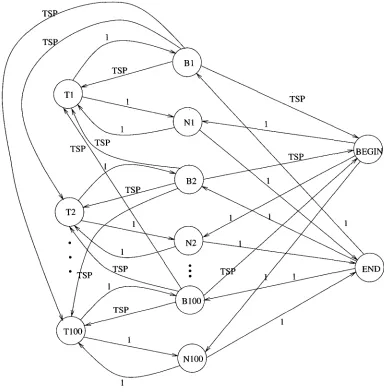
All H M M transitions within the same topic cluster are given probability one, whereas all transitions between topics are set to a global topic switch penalty (TSP) that is optimized on held-out training data. The TSP parameter allows trading off between false alarms and misses. Once the H M M is trained, we use the Viterbi al- gorithm (Viterbi 1967; Rabiner and Juang 1986) to search for the best state sequence and corresponding segmentation. Note that the transition probabilities in the model are not normalized to sum to one; this is convenient and permissible since the out- put of the Viterbi algorithm depends only on the relative weight of the transition weights.
We augmented the Dragon segmenter with additional states and transitions to also capture lexical discourse cues. In particular, we wanted to model the initial and final sentences in each topic segment, as these often contain formulaic phrases and keywords used by broadcast speakers (From W a s h i n g t o n , this is . . . . A n d n o w . . . ). We added two additional states, BEGIN and END, to the H M M (Figure 3) to model these sentences. Likelihoods for the BEGIN and END states are obtained as the unigram language model probabilities of the initial and final sentences, respectively, of the topic segments in the training data. Note that a single BEGIN and END state are shared for all topics. Best results were obtained by making traversal of these states optional in the H M M topology, presumably because some initial and final sentences are better modeled by the topic-specific LMs.
The resulting model thus effectively combines the Dragon and UMass H M M topic segmentation approaches described in Allan et al. (1998). In preliminary experiments, we observed a 5% relative reduction in segmentation error with initial and final states over the baseline H M M topology of Figure 2. Therefore, all results reported later use an H M M topology with initial and final states. Note that, since the topic-initial and topic- final states are optional, our training of the model is suboptimal. Instead of labeling all topic-initial and topic-final training sentences as data for the corresponding state, we w o u l d expect further improvements by training the H M M in unsupervised fashion using the Baum-Welch algorithm (Baum et al. 1970; Rabiner and Juang 1986).
3.2.2 Training Data. Topic unigram language models were trained from the pooled TDT Pilot and TDT2 training data (Cieri et al. 1999), covering transcriptions of broad- cast news from January 1992 through June 1994 and from January 1998 through Febru- ary 1998, respectively. These corpora are similar in style, but do not overlap with the 1997 LDC BN corpus from which we selected our prosodic training data and the eval- uaton test set. For training the language models, we removed stories with fewer than 300 and more than 3,000 words, leaving 19,916 stories with an average length of 538 words (including stopwords).
3.3 Model Combination
T~r, Hakkani-Ttir, Stolcke, and Shriberg Integrating Prosodic and Lexical Cues
TSI
TSP 1
•
TSP
TSP
TSP
TSP
1
TSP
TSP
Figure 3
Structure of an HMM with topic BEGIN and END states. TSP represents the topic switch penalty.
Below we present two approaches for building a combined statistical model that performs topic segmentation using all available knowledge sources. For both ap- proaches it is convenient to associate a "boundary" pseudotoken with each potential topic boundary (i.e., with each sentence boundary). Correspondingly, we introduce into the HMM new states that emit these boundary tokens. No other states emit boundary tokens; therefore each sentence boundary must align with one of the boundary states in the HMM. As shown in Figure 4, there are two boundary states for each topic cluster, one representing a topic transition and the other representing a topic-internal transition between sentences. Unless otherwise noted, the observation likelihoods for the boundary states are set to unity.
[image:9.468.36.350.62.421.2]TSP
TSP
T S P
Figure 4
Structure of the final HMM with fictitious boundary states used for combining language and prosodic models. In the figure, states B1, B2, . . . , B100 represent the presence of a topic boundary, whereas states N1, N 2 , . . . , N100 represent topic-internal sentence boundaries. TSP is the topic switch penalty.
is s i m p l y the s u m o v e r the c o r r e s p o n d i n g state posteriors: c
PHMM(Bi ~- yes]W) = ~ P ( q i = B j l W ) (2)
j=l c
PHMM(Bi = n o l W ) = ~ _ ~ P ( q i = N j l W )
j=l
[image:10.468.50.434.61.453.2]Tiir, Hakkani-T(ir, Stolcke, and Shriberg Integrating Prosodic and Lexical Cues
3.3.1 M o d e l C o m b i n a t i o n in the D e c i s i o n Tree. Decision trees allow the training of a single classifier that takes both lexical and prosodic features as input, provided we can compactly encode the lexical information for the decision tree. We compute the posterior probability
PHMM(Bi
= yeslW) as shown above, to summarize the HMM's belief in a topic boundary based on all available lexical information W. The posterior value is then used as an additional input feature to the prosodic decision tree, which is trained in the usual manner. During testing, we declare a topic boundary whenever the tree's overall posterior estimatePDT(BilFi, W)
exceeds some threshold. The threshold m a y be varied to trade off false alarms for miss errors, or to optimize an overall cost function.Using HMM posteriors as decision tree features is similar in spirit to the knowl- edge source combination approaches used by Beeferman, Berger, and Lafferty (1999) and Reynar (1999), who also used the output of a topical word usage model as in- put to an overall classifier. In previous work (Stolcke et al. 1998) we used the present approach as one of the knowledge source combination strategies for sentence and disfluency detection in spontaneous speech.
3.3.2 M o d e l C o m b i n a t i o n in the HMM. An alternative approach to knowledge source combination uses the HMM as the top-level model. In this approach, the prosodic decision tree is used to estimate likelihoods for the boundary states of the HMM, thus integrating the prosodic evidence into the HMM's segmentation decisions.
More formally, let Q =-
(rl, ql . . . ri, qi,...,rN, qN)
be a state sequence through the HMM. The model is constructed such that the statesri
representing topic (or BEGIN/END) clusters alternate with the statesqi
representing boundary decisions. As in the baseline model, the likelihoods of the topic cluster states Tj account for the lexical observations:P(Wi]ri ~-
Tj) =P(WilTj)
(4)as estimated by the unigram LMs. Now, in addition, we let the likelihood of the boundary state at position i reflect the prosodic observation
Fi.
Recall that, likeWi, Fi
refers to complete sentence units; specifically,Fi
denotes the prosodic features of the ith boundary between such units.P(Fi]qi
= Bj, W) =P(Fi]Bi
= yes, W)P(Fi[qi
= Nj, W) =P(FiIBi
= no, W) j for all j = 1 .. . . , C (5)Using this construction, the product of all state likelihoods will give the overall like- lihood, accounting for both lexical and prosodic observations:
N N
1-[ P(Wilri) I I P(Filqi, W) = P(W, FIQ )
(6)i = 1 i = 1
Applying the Viterbi algorithm to the HMM will thus return the most likely segmen- tation conditioned on both words and prosody, which is our goal.
Although decomposing the likelihoods as shown allows prosodic observations to be conditioned on the words W, we use only the phonetic alignment information Wt from the word sequence W in our prosodic models, ignoring the word identities, so as to make them more robust to recognition errors.
These can be converted to likelihoods using Bayes rule as in
P(Fi[Bi,
Wt) =P(FilWt)PDT (BilEG
Wt)P(BiIWt)
(7)The term P(FilWt) is a constant for all decisions
Bi
and can thus be ignored when applying the Viterbi algorithm. Next, we approximateP(BilWt) ,~ P(Bi),
justified b y the fact that the Wt contains information about start and end times of phones and words, but not directly about w o r d identities. Instead of explicitly dividing the posteriors, 1 we prefer to downsample the training set to makeP(Bi
= yes) =P(Bi
= no) = ~. A beneficial side effect of this approach is that the decision tree models the lower- frequency events (topic boundaries) in greater detail than if presented with the raw, highly skewed class distribution.As is often the case when combining probabilistic models of different types, it is advantageous to weight the contributions of the language models and the prosodic trees relative to each other. We do so b y introducing a tunable model combination weight (MCW), and by using
PDT(FilBi,
W t ) MCW a s the effective prosodic likelihoods. The value of MCW is optimized on held-out data.4. Experiments and Results
To evaluate our topic segmentation models, we carried out experiments in the TDT paradigm. We first describe our test data and the evaluation metrics used to compare model performance, then give the results we obtained with individual knowledge sources, followed by the results of the combined models.
4.1 Test Data
We evaluated our system on three hours (6 shows, about 53,000 words) of the 1997 LDC BN corpus. The threshold for the model combination in the decision tree and the topic switch penalty were optimized on the larger development training set of 104 shows, which includes the prosodic model training data. The MCW for the model combination in the H M M was optimized using a smaller held-out set of 10 shows of about 85,000 words total size, separate from the prosodic model training data.
We used two test conditions: forced alignments using the true words, and recog- nized words as obtained b y a simplified version of the SRI Broadcast News recognizer (Sankar et al. 1998), with a w o r d error rate of 30.5%.
Our aim in these experiments was to use fully automatic recognition and pro- cessing wherever possible. For practical reasons, we departed from this strategy in two areas. First, for word recognition, we used the acoustic waveform segmentations provided with the corpus (which also included the location of non_news material, such as commercials and music). Since current BN recognition systems perform this seg- mentation automatically with very good accuracy and with only a few percentage points penalty in word error rate (Sankar et al. 1998), we felt the added complication in experimental setup and evaluation was not justified.
Tfir, Hakkani-Ttir, Stolcke, and Shriberg Integrating Prosodic and Lexical Cues
4.2 Evaluation Metrics
We have adopted the evaluation paradigm used by the TDT2--Topic Detection and Tracking Phase 2 (Doddington 1998) program, allowing fair comparisons of various approaches both within this study and with respect to other recent work. Segmentation accuracy was measured using TDT evaluation software from NIST, which implements a variant of an evaluation metric suggested by Beeferman, Berger, and Lafferty (1999). The TDT segmentation metric is different from those used in most previous topic segmentation work, and therefore merits some discussion. It is designed to work on data streams without any potential topic boundaries, such as paragraph or sentence boundaries, being given a priori. It also gives proper partial credit to segmentation decisions that are close to actual boundaries; for example, placing a boundary one word from an actual boundary is considered a lesser error than if the hypothesized boundary is off by, say, 100 words.
The evaluation metric reflects the probability that two positions in the corpus probed at random and separated by a distance of k words are correctly classified as belonging to the same story or not. If the two words belong to the same topic segment, but are erroneously claimed to be in different topic segments by the segmenter, then this will increase the system's false alarm probability. Conversely, if the two words are in different topic segments, but are erroneously marked to be in the same segment, this will contribute to the miss probability. The false alarm and miss rates are defined as averages over all possible probe positions with distance k.
Formally, miss and false alarm rates are computed as 5
PMis, = Y~s ~N--~lk d~yp (i, i + k) x (1 - dS~¢f (i, i + k)) (8) E s E N s - k l ' ' i=1 , l - d ~ ¢ i ( i , i + k ) )
v " N ~ - k ( 1 • s • •
PFalseAla~m -- -- Y'~s A..M=I \ -- dShyp( l" i + k)) x d~ef(Z, ~ + k) (9) v-,N~-k as (i i + k)
E s Z.~i=l ~ r e f \ "
where the summation is over all broadcast shows s and word positions i in the test corpus and where
d sli,,={i
if words i and j in show s are deemed by sys tobe within the same story otherwise
Here sys can be ref to denote the reference (correct) segmentation, or hyp to denote the segmenter's decision.
An analogous metric is defined for audio sources, where segmentation decisions (same or different topic) are probed at a time-based distance A:
-T~ - A - s -
PMiss = GsJt=o
ahyp(t,t+A) x (1-d~¢f(t,t+A))dt
(10)
~ ' s J r = 0 ~ G - A ( 1 - d S c d ( t , t + A ) ) d t f • - a ( .
PFa,,¢A,a .... = Gsat=O ,l - d ~ y p ( t , t + A ) ) x d ~ ¢ / ( t , t + A ) d t (11) - G - A - s -
~s J,=o
a ~ z ( t , t + n ) d t
Table 1
Segmentation error rates for various chopping criteria, using true words of the larger development data set.
Chopping Criterion P Miss P FalseA larm C Seg
FIXED 0.5688 0.0639 0.2153
TURN 0.6737 0.0436 0.2326
SENTENCE 0.5469 0.0557 0.2030
PAUSE 0.5111 0.0688 0.2002
w h e r e the integration is o v e r the entire d u r a t i o n of all stories of the s h o w s in the test corpus, a n d w h e r e
if times tl a n d t2 in s h o w s are d e e m e d b y sys to be w i t h i n the same story
otherwise
We u s e d the same p a r a m e t e r s as u s e d in the official TDT2 evaluation: k = 50 a n d A = 15 seconds. F u r t h e r m o r e , again following NIST's e v a l u a t i o n p r o c e d u r e , w e c o m b i n e miss a n d false a l a r m rates into a single s e g m e n t a t i o n cost metric
Cseg : CMiss X PMiss X P~eg + CFalseAlarm X PFalseAlarm × (1 - P~¢9) (12) w h e r e the CMis~ = 1 is the cost of a miss,
CFalseAlarm
: 1 is the cost of a false alarm,a n d Pseg = 0.3 is the a priori probability of a s e g m e n t b e i n g w i t h i n an interval of k w o r d s or A seconds o n the TDT2 training corpus. 6
4.3 C h o p p i n g
Unlike w r i t t e n text, the o u t p u t of the automatic s p e e c h recognizer contains n o sentence b o u n d a r i e s . Therefore, c h o p p i n g text into (pseudo)sentences is a nontrivial p r o b l e m w h e n processing speech. Some p r e s e g m e n t a t i o n into r o u g h l y sentence-length units is necessary since otherwise the observations associated w i t h H M M states w o u l d com- prise too few w o r d s to give robust likelihoods of topic choice, causing p o o r perfor- mance.
We investigated c h o p p i n g criteria b a s e d o n a fixed n u m b e r of w o r d s (FIXED), at speaker changes (TURN), at p a u s e s (PAUSE), and, for reference, at actual sentence b o u n d a r i e s (SENTENCE) obtained f r o m the transcripts. Table 1 gives the error rates for the four conditions, using the true w o r d transcripts of the larger d e v e l o p m e n t data set. For the PAUSE condition, w e empirically d e t e r m i n e d an optimal m i n i m u m p a u s e d u r a t i o n threshold to use. Specifically, w e c o n s i d e r e d p a u s e s exceeding 0.575 of a second as potential topic b o u n d a r i e s in this (and all later) experiments. For the FIXED condition, a block length of 10 w o r d s was f o u n d to w o r k best.
We c o n c l u d e that a simple p r o s o d i c feature, p a u s e duration, is an excellent criterion for the c h o p p i n g step, giving c o m p a r a b l e or better p e r f o r m a n c e t h a n s t a n d a r d sentence b o u n d a r i e s . Therefore, w e u s e d p a u s e d u r a t i o n as the c h o p p i n g criterion in all f u r t h e r experiments.
[image:14.468.48.437.106.163.2]Tfir, Hakkani-Tiir, Stolcke, and Shriberg Integrating Prosodic and Lexical Cues
Table 2
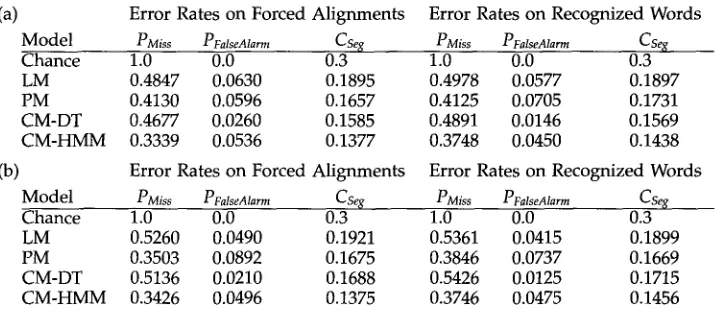
Summary of error rates with the language model only (LM), the prosody model only (PM), the combined decision tree (CM-DT), and the combined HMM (CM-HMM). (a) shows word-based error metrics, 00) shows time-based error metrics. In both cases a "chance" classifier that labels all potential boundaries as nontopic would achieve 0.3 weighted segmentation cost.
(a) Error Rates on Forced Alignments Error Rates on Recognized Words Model PMiss PFalseAlarm
Cseg
PMiss PFalseAlarm CsegChance 1.0 0.0 0.3 1.0 0.0 0.3
LM 0.4847 0.0630 0.1895 0.4978 0.0577 0.1897
PM 0.4130 0.0596 0.1657 0.4125 0.0705 0.1731
CM-DT 0.4677 0.0260 0.1585 0.4891 0.0146 0.1569 CM-HMM 0.3339 0.0536 0.1377 0.3748 0.0450 0.1438 (b) Error Rates on Forced Alignments Error Rates on Recognized Words
M o d e l
PMiss PFalseAlarm
Cseg
PMiss PFalseAlarm
Cseg
Chance 1.0 0.0 0.3 1.0 0.0 0.3
LM 0.5260 0.0490 0.1921 0.5361 0.0415 0.1899
PM 0.3503 0.0892 0.1675 0.3846 0.0737 0.1669
CM-DT 0.5136 0.0210 0.1688 0.5426 0.0125 0.1715 CM-HMM 0.3426 0.0496 0.1375 0.3746 0.0475 0.1456
4.4 Source-Specific Model Tuning
As m e n t i o n e d earlier, the s e g m e n t a t i o n m o d e l s contain global p a r a m e t e r s (the topic transition p e n a l t y of the H M M a n d the posterior threshold for the c o m b i n e d decision tree) to trade false alarms for miss errors. Optimal settings for these p a r a m e t e r s d e p e n d o n characteristics of the source, in particular on the relative f r e q u e n c y of topic changes. Since broadcast n e w s p r o g r a m s c o m e f r o m identified sources, it is useful a n d legitimate to optimize these p a r a m e t e r s for each s h o w t y p e . 7 W e therefore o p t i m i z e d the global p a r a m e t e r for each m o d e l to m i n i m i z e the s e g m e n t a t i o n cost on the training c o r p u s (after training all other m o d e l p a r a m e t e r s in a s o u r c e - i n d e p e n d e n t fashion).
C o m p a r e d to a baseline using s o u r c e - i n d e p e n d e n t global TSP a n d threshold, the s o u r c e - d e p e n d e n t m o d e l s s h o w e d b e t w e e n 5% a n d 10% relative error reduction. All results r e p o r t e d b e l o w use the s o u r c e - d e p e n d e n t approach.
4.5 Segmentation Results
Table 2 shows the results for b o t h i n d i v i d u a l k n o w l e d g e sources (words a n d prosody), as well as for the c o m b i n e d m o d e l s (decision tree a n d HMM). It is w o r t h n o t i n g that the p r o s o d y - o n l y results w e r e obtained b y r u n n i n g the c o m b i n e d H M M w i t h o u t language m o d e l likelihoods; this a p p r o a c h gave better p e r f o r m a n c e t h a n using the prosodic decision trees directly as classifiers.
Both w o r d - a n d time-based metrics are given; they exhibit generally v e r y similar results. A n o t h e r d i m e n s i o n of the evaluation is the use of correct w o r d transcripts (forced alignments) versus automatically r e c o g n i z e d words. Again, results along this d i m e n s i o n are v e r y similar, with some exceptions n o t e d below.
C o m p a r i n g the i n d i v i d u a l k n o w l e d g e sources, w e observe that p r o s o d y alone does s o m e w h a t better than the w o r d - b a s e d H M M alone. The t y p e s of errors m a d e differ
consistently: the prosodic m o d e l has a h i g h e r false alarm rate, while the w o r d - L M s h a v e m o r e miss errors. The prosodic m o d e l s h o w s m o r e false alarms because regular sentence b o u n d a r i e s often s h o w characteristics similar to those of topic b o u n d a r i e s . It also suggests that b o t h m o d e l s c o u l d be c o m b i n e d b y letting the prosodic m o d e l select c a n d i d a t e topic b o u n d a r i e s that w o u l d then be filtered using lexical information.
The c o m b i n e d m o d e l s generally i m p r o v e o n the i n d i v i d u a l k n o w l e d g e sources, s In the w o r d - b a s e d evaluation, the c o m b i n e d decision tree (DT) r e d u c e d overall seg- m e n t a t i o n cost b y 19% o v e r the l a n g u a g e m o d e l on true w o r d s (17% o n r e c o g n i z e d words). The c o m b i n e d H M M gave e v e n better results: 27% a n d 24% i m p r o v e m e n t in the error rate o v e r the language m o d e l for true a n d r e c o g n i z e d w o r d s , respectively.
Looking again at the b r e a k d o w n of errors, w e can see that the t w o m o d e l combina- tion a p p r o a c h e s w o r k quite differently: the c o m b i n e d DT has a b o u t the same miss rate as the LM, b u t a l o w e r false alarms rate. The c o m b i n e d H M M , b y contrast, c o m b i n e s a miss rate as low as (or l o w e r than) that of the prosodic m o d e l w i t h the l o w e r false a l a r m rate of the LM, suggesting that the functions of the t w o k n o w l e d g e sources are c o m p l e m e n t a r y , as discussed above. F u r t h e r m o r e , the different error patterns of the t w o c o m b i n a t i o n a p p r o a c h e s suggest that f u r t h e r error r e d u c t i o n s c o u l d be a c h i e v e d b y c o m b i n i n g the t w o h y b r i d models. 9
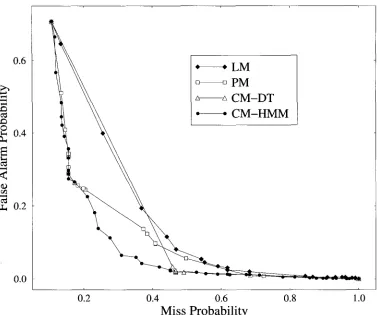
The trade-off b e t w e e n false alarms a n d miss probabilities is s h o w n in m o r e de- tail in Figure 5, w h i c h plots the t w o error metrics against each other. N o t e that the false a l a r m rate does not reach one because the s e g m e n t e r is constrained b y the chop- p i n g algorithm: the p a u s e criterion p r e v e n t s the s e g m e n t e r f r o m h y p o t h e s i z i n g topic b o u n d a r i e s e v e r y w h e r e .
4.6 Decision Tree for the Prosody-Only Model
Feature subset selection was r u n w i t h an initial set of 73 potential features, w h i c h the a l g o r i t h m r e d u c e d to a set of 7 n o n r e d u n d a n t features helpful for the topic segmen- tation task. The full decision tree learned is s h o w n in Figure 6. We can identify four different kinds of features u s e d in the tree, listed below. For each feature type, w e give the feature n a m e s f o u n d in the tree a n d the relative feature usage, an a p p r o x i m a t e m e a s u r e of feature i m p o r t a n c e (Shriberg, Bates, a n d Stolcke 1997). Relative feature usage is c o m p u t e d as the relative f r e q u e n c y w i t h w h i c h features of a g i v e n t y p e are q u e r i e d in the tree, o v e r a h e l d - o u t test set.
.
.
Pause duration (PhU_DUR, 42.7% usage). This feature is the d u r a t i o n of the n o n s p e e c h interval occurring at the b o u n d a r y . The i m p o r t a n c e of p a u s e d u r a t i o n is u n d e r e s t i m a t e d h e r e because, as e x p l a i n e d earlier, p a u s e d u r a t i o n s are a l r e a d y u s e d d u r i n g the c h o p p i n g process, so that the decision tree is a p p l i e d o n l y to b o u n d a r i e s e x c e e d i n g a certain duration. Separate e x p e r i m e n t s using b o u n d a r i e s b e l o w o u r c h o p p i n g threshold s h o w that the tree also distinguishes shorter p a u s e d u r a t i o n s for s e g m e n t a t i o n decisions.
FO differences across the boundary
(FOK_LRd~EAN_KBASELN
a n dFOK_WRD_DIFF_MNMI~_NG, 35.9% usage). These features c o m p a r e the m e a n 8 The exception is the time-based evaluation of the combined decision tree. We found that the posterior
probability threshold optimized on the training set works poorly on the test set for this model architecture and the time-based evaluation. The threshold that is optimal on the test set achieves
Csea = 0.1651. Section 4.7 gives a possible explanation for this result.
Ti.ir, Hakkani-Ttir, Stolcke, and Shriberg Integrating Prosodic and Lexical Cues
.~..~
,.Q
<
r.,g3
0.6
0.4
0.2
0.0
* * L M
[] [] P M
a ~ C M - D T
: C M - H M M
0.2 0.4 0.6 0.8 1.0
[image:17.468.39.416.53.368.2]M i s s P r o b a b i l i t y
Figure 5
False alarm versus miss probabilities (word-based metrics) for automatic topic segmentation from known words (forced alignments). The segmenters used were a words-only HMM (LM), a prosody-only HMM (PM), a combined decision tree (CM-DT), and a combined HMM (CM-HMM).
.
F0 of the word preceding the b o u n d a r y (measured from voiced regions within that word) to either the speaker's estimated baseline F0
(FOK_LR_MEAN_KBASELN) or to the mean F0 of the word following the b o u n d a r y (FOK_WRD_DIFF_.MNMN_N). Both features were computed based on a log-normal scaling of F0. Other measures (such as m i n i m u m or
m a x i m u m F0 in the word or preceding window) as well as other normalizations (based on F0 toplines, or non-log-based scalings) were included in the initial feature set, but were not selected in the
best-performing tree. The baseline feature captures a pitch range effect, and is useful at boundaries where the speaker changes (since range here is compared only within-speaker). The second feature captures the relative size of the pitch change at the boundary, but of course is not meaningful at speaker boundaries.
/
z
v
~a
z
z z
v
i
Tar, Hakkani-Ti~r, Stolcke, and Shriberg Integrating Prosodic and Lexical Cues
.
change occurred at the boundary, while TURN_TIME measures the time passed since the start of the current turn.
Gender (GEN, 6.8% usage). This feature indicates the speaker gender right before a potential boundary.
Inspection of the tree reveals that the purely prosodic features (pause duration and F0 differences) are used as the prosody literature suggests. The longer the observed pause, the more likely a boundary corresponds to a topic change. Also, the closer a speaker comes to his or her F0 baseline, or the larger the difference to the F0 following a boundary, the more likely a topic change occurs. These features thus correspond to the well-known phenomena of boundary tones and pitch reset that are generally associated with sentence boundaries (Vaissi6re 1983). We found these indicators of sentences boundaries to be particularly pronounced at topic boundaries.
While turn and gender features are not prosodic features per se, they do interact closely with them since prosodic measurements must be informed by and carefully normalized for speaker identity and gender, and it is therefore natural to include them in a prosodic classifier. 1° Not surprisingly, we find that turn boundaries are positively correlated with topic boundaries, and that topic changes become more likely the longer a turn has been going on.
Interestingly, speaker gender is used by the decision tree for several reasons. One reason is stylistic differences between males and females in the use of F0 at topic boundaries. This is true even after proper normalization, e.g., equatIng the gender- specific nontopic boundary distributions. In addition, we found that nontopic pauses (i.e., chopping boundaries) are more likely to occur in male speech. It could be that male speakers in BN are assigned longer topic segments on average, or that male speakers are more prone to pausing in general, or that male speakers dominate the spontaneous speech portions, where pausing is naturally more frequent. The details of this gender effect await further study.
4.7 Decision Tree for the C o m b i n e d M o d e l
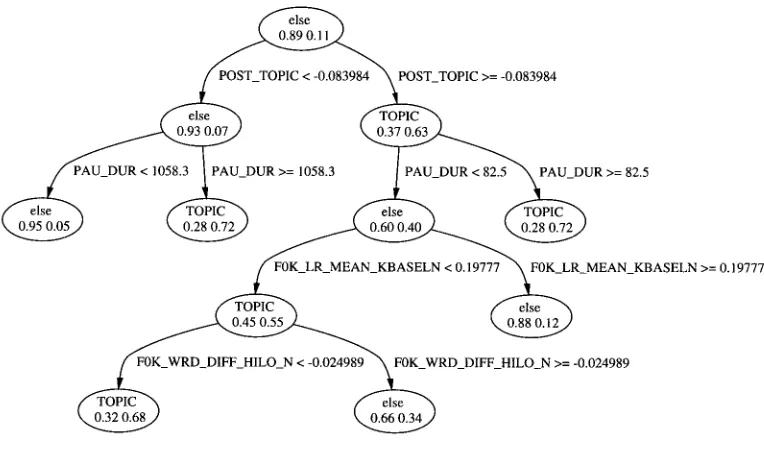
Figure 7 depicts the decision tree that combines the HMM language model topic deci- sions with prosodic features (see Section 3.3.1). Again, we list the features used with their relative feature usages.
1. Language m o d e l posterior (POST_TOPIC, 49.3% usage). This is the posterior probability
P(Bi
= yeslW) computed from the HMM. 2. Pause duration (PAU_DUR, 49.3% usage). This feature is the same asdescribed for the prosody-only model.
3. FO differences across the boundary
(FOK_WRD_DIFF_HILO_N
and FOK_LR_MEAN_KBASELN, 1.4% usage). These features are similar to those found for the prosody-only tree. The only difference is that for the first feature, the comparison of FO values across the boundary is done by taking the m a x i m u m FO of the previous w o r d and the m i n i m u m FO of the following word, rather than the m e a n for both cases.POST_TOPIC >= -0.083984
r PAU_DUR >= 1058.3
PAU_DUR <82.5 ~PAU_DUR >= 82.5
KBASELN < 0 . 1 9 7 7 ~ R
MEAN KBASELN >= 0.19777
[image:20.468.52.434.56.284.2]~_WRD_DIFF_HILO_N < - 0 . 0 2 4 9 8 ~ R D
DIFF HILO N >=-0.024989
Figure 7
The decision tree of the combination model.
The decision tree found for the combined task is smaller and uses fewer features than the one trained with prosodic features only, for two reasons. First, the LM poste- rior feature is found to be highly informative, superseding the selection of m a n y of the low-frequency features previously found. Furthermore, as explained in Section 3.3.2, the prosody-only tree was trained on a downsampled dataset that equalizes the priors for topic and nontopic boundaries, as required for integration into the HMM. A wel- come side effect of this procedure is that it forces the tree to model the less frequent class (topic boundaries) in much greater detail than if the tree were trained on the raw class distribution, as is the case here.
Because of its small size, the tree in Figure 7 is particularly easy to interpret. The top-level split is based on the LM posterior. The right branch handles cases where words are highly indicative of a topic boundary. However, for short pauses, the tree queries further prosodic features to prevent false alarms. Specifically, short pauses must be accompanied both by an F0 close to the speaker's baseline and by a large F0 reset to be deemed topic boundaries. Conversely, if the LM posteriors are low (left top-level branch), but the pause is very long, the tree still outputs a topic boundary.
4.8 Comparison of Model Combination Approaches
Results indicate that the model combination approach using an HMM as the top-level model works better than the combined decision tree. While this result deserves more investigation, we can offer some preliminary insights.
Tfir, Hakkani-Tiir, Stolcke, and Shriberg Integrating Prosodic and Lexical Cues
Table 3
Segmentation error rates with the language model only (LM), the combined HMM using all prosodic features (CM-HMM-all), the combined HMM using only pause duration and turn features (CM-HMM-pause-turn), and using only pause duration, turn, and gender features (CM-HMM-pause-turn-gender).
Model C~ex
LM 0.1895
CM-HMM-pause-turn 0.1519 CM-HMM-pause-turn-gender 0.1511
CM-HMM-all 0.1377
continuous character of the thresholded variable makes it hard to estimate a threshold on the training data that performs robustly on the test data. This could account for the poor result on the time-based metrics for the combined tree (where the threshold optimized on the training data was far from optimal on the test set; see footnote 8). The same phenomenon is reflected in the fact that the prosody-only tree gave better results when embedded in an HMM without LM likelihoods than when used by itself with a posterior threshold.
4.9 Contributions of Different Feature Types
We saw in Section 4.6 that pause duration is by far the single most important feature in the prosodic decision tree. Furthermore, speaker changes are queried almost as often as the F0-related features. Pause durations can be obtained using standard speech rec- ognizers, and are in fact used by m a n y current TDT systems (see Section 4.10). Speaker changes are not prosodic features per se, and would be detected independently from the prosodic features proper. To determine if prosodic measurements beyond pause and speaker information improve topic segmentation accuracy, we tested systems that consisted of the HMM with the usual topic LMs, plus a decision tree that had ac- cess only to various subsets of pause- and speaker-related features, without using any of the F0-based features. Decision tree and HMM were combined as described in Section 3.3.2.
Table 3 shows the results of the system using only topic language models (LM) as well as combined systems using all prosodic features (CM-HMM-all), only pause duration and turn features (CM-HMM-pause-turn), and using only pause duration, turn, and gender features (CM-HMM-pause-turn-gender). These results show that by using only pause duration, turn, and gender features, it is indeed possible to obtain better results (20% reduced segmentation cost) than with the lexical model alone, with gender making only a minor contribution. However, we also see that a substantial further improvement (9% relative) is obtained by adding F0 features to the prosodic model.
4.10 Results Compared to Other Approaches
Table 4
Word-based segmentation error rates for different corpora. Note that a hand-transcribed (forced alignment) version of the TDT2 test set was not available.
Error Rates on Forced Alignments Error Rates on Recognized Words Test Set
PMis~ PFalseAlarm
Cseg
PMissPFalseAlarrn
Cseg
TDT2 NA NA NA 0.5509 0.0694 0.2139
BN'97 0.4685 0.0817 0.1978 0.5128 0.0683 0.2017
1999). Nevertheless we have attempted to calibrate our results with respect to these TDT2 results, n We have not tried to compare our results to research outside the TDT evaluation framework. In fact, other evaluation methodologies differ too much to allow meaningful quantitative comparisons across publications.
We wanted to ensure that the TDT2 evaluation test set was comparable in seg- mentation difficulty to our test set drawn from the 1997 BN corpus, and that the TDT2 metrics behaved similarly on both sets. To this end, we ran an early version of our words-only segmenter on both test sets. As shown in Table 4, not only are the results on recognized words quite close, but the optimal false alarm/miss trade-off is similar as well, indicating that the two corpora have roughly similar topic granularities.
While the full prosodic component of our topic segmenter was not applied to the TDT2 test corpus, we can compare the performance of a simplified version of SRI's segmenter to other evaluation systems (Fiscus et al. 1999). The two best-performing systems in the evaluation were those of CMU (Beeferman, Berger, and Lafferty 1999) with Cse9 = 0.1463, and Dragon (Yamron et al. 1998; van Mulbregt et al. 1999) with Cse9 = 0.1579. The SRI system achieved Cs~g = 0.1895. All systems in the evaluation, including ours, used only information from words and pause durations determined by a speech recognizer.
A good reference to calibrate our performance is the Dragon system, from which we borrowed the lexical HMM segmentation framework. Dragon made adjustments in its lexical modeling that account for the improvements relative to the basic HMM structure on which our system is based. As described by van Mulbregt et al. (1999), a significant segmentation error reduction was obtained from optimizing the number of topic clusters (kept fixed at 100 in our system). Second, Dragon introduced more supervision into the model training by building separate LMs for segments that had been hand-labeled as not related to news (such as sports and commercials) in the TDT2 training corpus, which also resulted in substantial improvements. Finally, Dragon used some of the TDT2 training data for tuning the model to the specifics of the TDT2 corpus.
In summary, the performance of our combined lexical-prosodic system with Cs¢9 = 0.1438 is competitive with the best word-based systems reported to date. More impor- tantly, since we found the prosodic and lexical knowledge sources to complement each other, and since Dragon's improvements for TDT2 were confined to a better modeling of the lexical information, we would expect that adding these improvements to our combined segmenter would lead to a significant improvement in the state of the art.
Tiir, Hakkani-Ti.ir, Stolcke, and Shriberg Integrating Prosodic and Lexical Cues
5. D i s c u s s i o n
Results so far indicate that prosodic information provides an excellent source of in- formation for automatic topic segmentation, both by itself and in conjunction with lexical information. Pause duration, a simple prosodic feature that is readily available as a by-product of speech recognition, proved highly effective in the initial chopping phase, and was the most important feature used by prosodic decision trees. Additional, pitch-based prosodic features are also effective as features in the decision tree.
The results obtained with recognized words (at 30% word error rate) did not differ greatly from those obtained with correct word transcripts. No significant degradation was found with the words-only segmentation model, while the best combined model exhibited about a 5% error increase with recognized words. The lack of degradation on the words-only model may be partly due to the fact that the recognizer generally outputs fewer words than contained in the correct transcripts, biasing the segmenter toward a lower false alarm rate. Still, part of the appeal of prosodic segmentation is that it is inherently robust to recognition errors. This characteristic makes it even more attractive for use in domains with higher error rates due to poor acoustic conditions or more conversational speaking styles. It is especially encouraging that the prosody-only segmenter achieved competitive performance.
It was fairly straightforward to modify the original Dragon H M M segmenter (Yam- ron et al. 1998), which is based purely on topical word usage, to incorporate discourse cues, both lexical and prosodic. The addition of these discourse cues proved highly effective, especially in the case of prosody. The alternative knowledge source combi- nation approach, using H M M posterior probabilities as decision tree inputs, was also effective, although less so than the HMM-based approach. Note that the HMM-based integration, as implemented here, makes more stringent assumptions about the in- dependence of lexical and prosodic cues. The combined decision tree, on the other hand, has some ability to model dependencies between lexical and prosodic cues. The fact that the HMM-based combination approach gave the best results is thus indirect evidence that lexical and prosodic knowledge sources are indeed largely independent. Apart from the question of probabilistic independence, it seems that lexical and prosodic models are also complementary in the errors they make. This is manifested in the different distributions of miss and false alarm errors discussed in Section 4.5. It is also easy to find examples where the two models make complementary errors. Figure 8 shows two topic boundaries that are missed by one model but not the other.
Several aspects of our model are preliminary or suboptimal in nature and can be improved. Even when testing on recognized words, we used parameters optimized on forced alignments. This is suboptimal but convenient, since it avoids the need to run word recognition on the relatively large training set. Since results on recognized words are very similar to those on true words, we can conclude that not much was lost with this expedient. Also, we have not yet optimized the chopping stage relative to the combined model (only relative to the words-only segmenter). The use of prosodic features other than pause duration for chopping should further improve the overall performance.
(a) •.. we have a severe thunderstorm watch two severe thunderstorm watches and a tornado watch in effect the tornado watch in effect back here in eastern colorado the two severe thunderstorm watches here indiana over into ohio those obviously associated with this line which is already been producing some hail i'll be back in a moment we'll take a look at our forecast weather map see if we can cool it off in the east will be very cold tonight minus seven degrees < T O P I C _ C H A N G E >
LM probability: 0.018713 PM probability: 0.937276
karen just walked in was in the computer and found out for me that national airport in washington d. c. did hit one hundred degrees today it's a record high for them it's going to be uh hot again tomorrow but it will begin to cool off the que question is what time of day is this cold front going to move by your house if you want to know h o w w a r m it's going to be tomorrow comes through early in the day w o n ' t be that hot at all m i d d a y it'll still be into the nineties but not as hot as it was today comes through late in the day you'll still be in the upper nineties but some relief is on the w a y ...
(b) ... y o u know the if if the president has been unfaithful to his wife and at
this point you know i simply don't know any of the facts other than the bits and pieces that we hear and they're simply allegations at this point but being unfaithful to your wife isn't necessarily a crime lying in an affidavit is a crime inducing someone to lie in an affidavit is a crime but that occurred after this apparent taping so i'll tell y o u there are going to be extremely thorny legal issues that will have to be sorted out white house spokesman mike mccurry says the administration will cooperate in starr's investigation
< T O P I C _ C H A N G E >
LM probability: 1•000000 PM probability: 0.134409
cubans have been waiting for this day for a long time after months of plan- ning and preparation pope john paul the second will make his first visit to the island nation this afternoon it is the first pilgrimage ever by a pope to cuba judy fortin joins us n o w from havana with more . . . .
Figure 8
Examples of true topic boundaries where lexical and prosodic models make opposite decisions• (a) The prosodic model correctly predicts a topic change, the LM does not. (b) The LM predicts a topic change, the prosodic model does not.
6. C o n c l u s i o n
We h a v e p r e s e n t e d a p r o b a b i l i s t i c a p p r o a c h to t o p i c s e g m e n t a t i o n of s p e e c h , c o m b i n i n g b o t h lexical a n d p r o s o d i c cues. Topical w o r d u s a g e a n d lexical d i s c o u r s e c u e s are r e p r e s e n t e d b y l a n g u a g e m o d e l s e m b e d d e d in a n H M M . P r o s o d i c d i s c o u r s e cues, s u c h as p a u s e d u r a t i o n s a n d p i t c h resets, are m o d e l e d b y a d e c i s i o n tree b a s e d o n a u t o m a t i c a l l y e x t r a c t e d a c o u s t i c f e a t u r e s a n d a l i g n m e n t s . Lexical a n d p r o s o d i c f e a t u r e s c a n b e c o m b i n e d e i t h e r in t h e H M M or in t h e d e c i s i o n tree f r a m e w o r k .