Learning from the past: barriers and enablers
for industry 4.0 adoption
Author: Teussink, P.
University of Twente P.O. Box 217, 7500AE Enschede
The Netherlands
ABSTRACT,
The industrial sector has faced different revolutions in the last centuries.
Currently we are in the middle of the fourth industrial revolution. Businesses are
trying to benefit from the new technologies that come with this revolution, but
many businesses fail to adopt this new revolution because of barriers that withhold
these businesses to adopt these new technologies. But in the last decades there were
two major developments more, the rise of the internet/e-commerce and the
growing interest in environmental sustainability. This research aims to find
similarities between the barriers found with the adoption of e-commerce and
environmental sustainability and the predicted challenges faced by the adoption
of industry 4.0. The similarities that are found can help business to overcome the
barriers that are withholding them from adopting the fourth industrial revolution.
Graduation Committee members:
Torn I.A.R. Msc.
Dr. Schuberth F.
Keywords
industry 4.0, environmental sustainability, e-commerce, barriers, enablers
Permission to make digital or hard copies of all or part of this work for personal or classroom use is granted without fee provided that copies are not made or distributed for profit or commercial advantage and that copies bear this notice and the full citation on the first page. To copy otherwise, or republish, to post on servers or to redistribute to lists, requires prior specific permission and/or a fee.
11th IBA Bachelor Thesis Conference, July 10th, 2018, Enschede, The Netherlands.
1.
INTRODUCTION
The fourth industrial revolution has become one of the important topics in the realm of manufacturing (Liao,
Deschamps, Loures, & Ramos, 2017). Before we go over to the fourth industrial revolution, its three predecessors will be briefly explained. The first industrial revolution at the end of the 18th century started with the invention of water and steam powered mechanical machine facilities, former jobs that were done by hand production methods could now be done with machines. The second industrial revolution stated in the beginning of the 19th century with the introduction of electricity and the conveyor-belt. Here is where mass
production started, this revolution is marked by the division of labour which lead to shorter repetitive jobs. The third industrial revolution started in the 1970s and introduced electronics and information technology (IT) which made further automation possible. In this revolution, repetitive jobs were replaced by robots (Kagermann, Helbig, Hellinger, & Wahlster, 2013). Businesses constantly adapt their strategy for the future, now they need to take industry 4.0 into account to be ready for the future. The fourth industrial revolution is the vision of future production that contains modular and efficient manufacturing systems and characterizes scenarios in which products control their own manufacturing process. This is supposed to realize the manufacturing of individual products in a batch size of one while maintaining the economic conditions of mass production (Lasi, Fettke, Kemper, Feld, & Hoffmann, 2014). Industry 4.0 will cause a disruptive change of the value chain with the product at its core, strengthened by digital interfaces and innovative services. According to a senior manager industry 4.0 from PricewaterhouseCoopers (PwC), it is key for businesses to analyse where they stand today in the process of industry 4.0 and which opportunities and challenges waits for them. When it is clear where the business stands it is also important to know what is already possible within industry 4.0 and what we can expect from industry 4.0 in the future. Then a business can align their strategy with the possibilities of industry 4.0. Industry 4.0 is not the goal in this process, but businesses should try to find a strategy within the age of the fourth industrial revolution. One of the main challenge of businesses is to define their transformation roadmap from where they are now to where they want to be in the future with industry 4.0 (De Carolis, Macchi, Negri, & Terzi, 2017). The transformation to Industry 4.0 is powered by nine fundamental technological advances, many of them are already used in business, but the difference is that they will transform from isolated unit to connected systems which connect suppliers, producers and customers with each other as well as it connects humans and machines to optimize the entire supply chain. According to the Boston Consultancy Group (BCG), the nine pillars are:
-The industrial internet of things: Already some businesses are using some sensors which send information to a central computer which give operators and managers limited data on performance. However, with the industrial internet of things more devices and (unfinished) product will be enriched with sensors which will allow operators to make real-time decision based on real time data from the supply chain and at the same time collect a large amount of data that can be used for big data analyses.
-Cybersecurity: Many businesses have closed production system which does not communicate directly with entities outside the organisation. One of the main features of industry 4.0 is that the entire supply chain, from suppliers to customers interact with each other, which allows every individual business or machine to react in real-time. To reach this kind of data
sharing with organization and people outside the business, it is crucial that the shared data is protected from outsiders and that there is a reliable and sophisticated identity check for whoever want to excess the system.
-The cloud: Businesses are already using the cloud to share information within the company but in the industry 4.0 era, more systems will work on cloud-based programs which allows to easily excess all data necessary within and outside the company.
-Additive manufacturing: Additive manufacturing like 3D printing has just begun to be adopted by businesses. With the growing lack of resources this is a process with less wasted materials and a lot more possibilities for making small batch size or custom-made products and lightweight designs. Decentralized additive manufactory systems will also reduce transport cost, time and therefor decreases the stock on hand necessary.
-Augmented reality: Augmented-reality-based systems are system that that uses the real physical world and combines this with a layer of the digital world. This can for instance be helpful to correctly do maintenance on a machine as instructions and machine performance will be directly visible while the maintenance is done. It can also help employees to make better decision with all the necessary information that is real-time available.
-Big data and analytics: In industry 4.0, all machines are connected and many sensors throughout the supply chain are collecting data about the performance of each machine and the quality of each product. Analysing these large amounts of data from different sources can help to finds faulty products or machinery earlier on which will increase productivity of machines and quality of product at any place, anywhere it will support real-time decision making in the era of industry 4.0.
-Autonomous robots: These days, robots can do a large variety of repetitive tasks. Each robot with its own task which it will do repeatedly. They do not interact with other robots up or down the production line or with the product. This will change with industry 4.0, autonomous robots will be able to do a variety of task depending on the product they handle and the stage of production the product is in. Autonomous robots will be able to do more flexible and cooperative task, working side by side with humans. They will have a greater range of capabilities at a lower cost.
-Simulation: Simulations are already widely used in the engineering phase of product development. But with industry 4.0, simulations leverage real-time data to mirror the physical world in a virtual model. Therefor operators are able to test new machine settings before physical changeovers happen, which will decrease machine setup time and increase quality.
-Horizontal and vertical system integration: Most businesses work with different IT systems in different department and at different (management) levels within the business. When a business wants to enable a truly automated value chain it should intergrade all companies, departments and functions within one system to make it more cohesive.
(Rüßmann et al., 2015)
These pillars divide industry 4.0 in nine separate groups to better understand the overwhelming capabilities of industry 4.0. But as well as industry 4.0 is highly connected, so are these pillars. Many of them can’t be seen as a separate entity, but as a part of a wider network. One cannot exist without the other. The implementation of industry 4.0 isn’t the first important
businesses are the internet and environmental sustainability. Since the start of this millennium the use of the internet grew massively. Therefore, nowadays it is unimaginable that businesses continue to do business without e-commerce. E-commerce is the transaction of goods or services through electronic communication (the internet). This can be split up in two types, business-to-business and business-to-customer. E-commerce has been around for the past decades but only seen its awareness to the general public is the last few decades.The Internet became the fastest growing technology in economic history. Investors, businesses, and consumers alike were attracted by e-commerce during that period (Tian & Stewart, 2006). As well as for the internet, is the interest for the topic of environmental sustainability has significantly grown. For example, in literature this is shown by the amount of publication, in comparison to 2003 the amount of yearly publications sevenfold on scopus in 2017. The increasing interest for sustainability in businesses goes pared with the adoption of sustainability goal, alongside financial goals. This is further pushed by the United Nations (UN) which have made sustainability to a major topic. They have made a sustainability agenda which focusses on climate change and many other related topics. These two examples show that ultimately businesses can’t avoid the adaptation of these worldwide developments. If businesses don’t want to fall behind on competition, they should find means to overcome the challenges that these new, worldwide developments bring along. The goal of this research is to find out if businesses which want to implement industry 4.0 can learn from the past. To reach this goal, in this thesis, we will research if the challenges of industry 4.0 can be compared with the rise of the internet and the growing interest in environmental sustainability. Therefor the research question is defined as followed: Are the perceived challenges of the implementation of industry 4.0 for businesses comparable with the challenges that they faced with the rise of the internet and the increased interest in environmental sustainability?
2.
THEORETICAL FRAMEWORK
2.1
Introduction
This chapter consists of three parts, in the first part we will describe what the expected problems with implementation of industry 4.0 are. In the second part we will discuss which barriers where faced by the rise of the internet and in the third part we will describe which barriers faced with the rise of environmental sustainable innovations.
2.2 Industry 4.0
In this part we will discuss the expected challenges and barriers opposed with the transition for businesses toward industry 4.0. Challenges with regard to competitiveness and future viability do prevent industrial manufacturers from implementing Industry 4.0 independent of company size (Müller, Kiel, & Voigt, 2018). Which means that company size does not influence whether a company is able to implement these new technologies.
The implementation of industry 4.0 pose a general thread because of the large investments needed and the uncertain outcome of expected profits made by the investment (Müller et al., 2018). Therefor in is important to focus on the gains of resource productivity and efficiency and calculate the trade-offs between the additional resources and the resources needed in smart factories and the potential savings generated from this new development (Liao et al., 2017). Furthermore, industry 4.0 will have a great impact on the workforce. Some jobs will no longer be necessary because they will be taken over by machines, other
jobs will form as a result of these new machines, which need maintenance, operators and developers which have in-depth knowledge of the IT infrastructure. It will be a big challenge to source enough new employees or develop existing employees with the right knowledge and skills for the job. Managers should be eager to convince employees of the benefits of this new technology and give employees the right training to learn the competences and skills needed in an industry 4.0 manufactory (Müller et al., 2018). This should be a continues, life-long learning embedded in the businesses’ culture. The organisation should be organised and design to support workers in taking greater responsibilities to enhance their personal development (Liao et al., 2017). Part of the learning should include the change in business culture, towards a more digitalized culture within the business. According to PWC, a major reason for businesses to withstand the fourth industrial revolution is the lack of digital culture among employees. Because of this lack of digital culture, businesses find it difficult to predict what the challenges for the implementation of industry 4.0 are and which benefits it can bring for the business (Geissbauer, Vedso, & Schrauf, 2016). With industry 4.0 highly relying on IT, business should think about their digital security as well as important part of the revolution. Gaining the trust from other companies and customers. Safety and Security ensures that production facilities and products themselves do not pose a danger either to people or to the environment. Meanwhile, protect the data that they contain against misuse and unauthorised access. All this change should be led by the senior managers. The implementation of the Industry 4.0 concept necessitates top management involvement that promotes comprehensive change management activities and processes to arrange organizational and production structures according to the requirements of connected value creation. A collaborative, explorative, and entrepreneurial mind-set is a success factor that has to be established among a company’s most important resource: the employees (Müller et al., 2018). Also, a top manager at Wila confirmed that their shift towards industry 4.0 was mainly possible because of the leading role the CEO took. The CEO saw the potential of these new innovations and surrounded himself with managers with the same attitude toward these new technologies. This resulted in a culture within the company that embraced the idea that new innovations like industry 4.0 are the way to go. According to De Carolis et al. (2017), companies should develop a digital transformation roadmap which is shared and accepted by all senior managers. This not only refers to top management support but also to the importance of having a clear set of goals.
2.2
Internet (E-commerce)
In this part we will discuss which barriers where found in the adoption of the internet/e-commerce by businesses and which features enabled businesses to adopt this innovation.
the knowledge and skills to develop these internet technologies. Businesses which lack these knowledge and skills are less likely to risk the adoption of e-business. The third dimension, environmental and external pressure, is referring to competitors and trading partners up or down the value chain. New innovations like e-commerce can get a business the competitive advantage on its competitors, this can be a driver to implement an innovation. But because e-commerce is not an isolated technology but works at it best when it is used along the value chain. Therefor is also the readiness of the trading partners that is an important factor in the choice to adopt such a new technology or not (Oliveira & Martins, 2010).
2.3
Environmental sustainable development
According to a survey from Bain and company (2016) 93% of the CEO’s thinks that environmental sustainability will take an important role in the success of a business in the future but only 2% of the sustainability programs succeeded in reaching their goals. In this survey five main barriers and five success factors were found. The barriers to success are: lack of investment resources (25%), competing priorities (15%), culture change challenges (11%), organisational obstacles (10%) and lack of a compelling case for change. As shown above, the most important barrier for implementing sustainable development is the lack of resources. This is partly due to the decision-making process within a company, which brings us to the second barrier, competing priorities. Because sustainable achievements are often not part of decision process, resources are often allocated to other projects or developments, leaving sustainability behind. The third barrier, the culture change challenge, is aiming at the employees. Employees do often not see the benefits of sustainability and therefor, they are reluctant to act on sustainable development. A business can overcome this challenge by acting on the fived barrier, the lack of a compelling case. Most employees believe that sustainability is hurting business performance and therefor they are reluctant to adopt sustainable development. When employees see that sustainability can have great potential for the business as well as for the environment, they are more likely to embrace the change. Therefore, a business should start with an easy project which shows the employees that sustainability can be good for the business performance. The fourth biggest barrier, organisational obstacles, refer to the obstacles found in organisational structure and processes like the decision-making process.
The five greatest factor of success that came out of this survey were: senior leadership support (27%), employee engagement and interest (11%), clear goals and metrics (8%), effective internal communication (5%), introduction of environmentally friendly policies and processes (5%). Senior leadership support is the important factor of influence on a successful implementation of a sustainable project. If employees feel that they have the support of senior managers, they are more likely to act on sustainability project. This brings us to the second success factor, employee engagement and interest, which has a lot to do with the fourth success factor, effective internal communication. When Senior managers take the lead in the change toward sustainability, they should, from the start, have clear interaction with their employees about the goals and metrics they try to achieve and how they think to achieve it. Get the employees involved in the process, then they are more likely to embrace this change. Finely a business should start with implementing environmental policies and processes, starting with the smaller and easier ones, that shows the positive results of environmental sustainable developments clearly. This might convince employees that environmental sustainable projects do benefit the businesses’ overall performance (Bain and company, 2016).
There are a variety of options, but a clear strategy is essential. Impacts at all stages of the value chain and in every element of corporate activity mean retailers and consumer goods businesses need to understand and measure how their individual models are impacted. Responses will vary and change as businesses look to develop advantage and competition intensifies. It is essential that credible and transparent sustainable solutions are developed and embedded in the strategic decision-making process. Sustainability is now a business imperative (PricewaterhouseCoopers, 2008).
3.
METHODOLOGY
In this part we will explain how the research is conducted. The general idea is to find possible barriers to successfully implement industry 4.0 in the literature and then compare these to the barriers found with the adaption to internet and the adaption to environmental sustainable development.
To conduct this research, we will use the framework of Zaied (2012) which originated from e-commerce that will divide the barriers into six groups: social and culture barriers, technical barriers, economical barriers, political barriers, organisational barriers and, legal and regulatory barriers (Zaied, 2012). Then we can see per group which comparisons and differences are found with the aim to find which group(s) need more attention with regard to industry 4.0 and which groups can learn from the predecessors, e-commerce and/or sustainable development to overcome their barriers. From these six groups, four are also found in either or both, industry 4.0 and environmental sustainability. Therefore, in this paper we will focus on the following four groups: social and culture barriers, technical barriers, economical barriers, and organisational barriers. The other groups might be interesting for future research.
Data will be acquired mostly through literature research from consultancy reports and surveys, journals and, research and conference papers. We will extract qualitative and quantitative data from these sources to determine which barriers play a role in the adoption of industry 4.0, e-commerce and environmental sustainability. The practical knowledge of industry 4.0 will be obtained through a visit with guided tour to the fabrication lab at Saxion university of applied science (https://www.fablabenschede.nl) and a company visit to Wila which produces press brakes (https://www.wila.nl).
4.
RESULTS
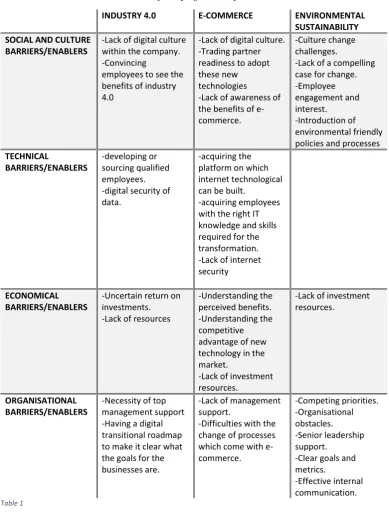
Table 1 shows the result of the research. On the left column the four groups of barriers and enablers are shown and in the remaining three columns are the barriers and enablers shown per subject group, industry 4.0, e-commerce and environmental sustainability. Therefor we can easily see the comparisons and differences between different technologies regarding to barriers and enablers per group.
4.1
Social and culture barriers and enablers
sustainability is the introduction of environmental friendly policies and processes.
4.2
Technical barriers and enablers
The similarities between industry 4.0 and e-commerce within the technical barriers and enablers are the lack of internet security and the challenge to source or develop employees with the right skills and knowledge. There are no differences found. In case of environmental sustainability there are no technical barriers or enablers found.
4.3
Economical barriers and enablers
The similarities between industry 4.0 and e-commerce are uncertain returns on investments and the lack of resources allocated to these projects. Furthermore, in e-commerce, the understanding of the competitive advantage was a barrier for adoption. The similarities between industry 4.0 and environmental sustainability are the lack of resources allocated to these developments.
4.4
Organisational barriers and enablers
The similarities between industry 4.0 and e-commerce is the lack of top management support, in e-commerce, difficulties with the Barriers for adopting new developments
INDUSTRY 4.0 E-COMMERCE ENVIRONMENTAL SUSTAINABILITY SOCIAL AND CULTURE
BARRIERS/ENABLERS
-Lack of digital culture within the company. -Convincing
employees to see the benefits of industry 4.0
-Lack of digital culture. -Trading partner readiness to adopt these new technologies
-Lack of awareness of the benefits of e-commerce.
-Culture change challenges.
-Lack of a compelling case for change. -Employee engagement and interest. -Introduction of environmental friendly policies and processes TECHNICAL
BARRIERS/ENABLERS
-developing or sourcing qualified employees. -digital security of data.
-acquiring the platform on which internet technological can be built.
-acquiring employees with the right IT knowledge and skills required for the transformation. -Lack of internet security
ECONOMICAL BARRIERS/ENABLERS
-Uncertain return on investments. -Lack of resources
-Understanding the perceived benefits. -Understanding the competitive advantage of new technology in the market.
-Lack of investment resources.
-Lack of investment resources.
ORGANISATIONAL BARRIERS/ENABLERS
-Necessity of top management support -Having a digital transitional roadmap to make it clear what the goals for the businesses are.
-Lack of management support.
-Difficulties with the change of processes which come with e-commerce.
-Competing priorities. -Organisational obstacles. -Senior leadership support.
-Clear goals and metrics.
[image:5.595.103.493.80.596.2]-Effective internal communication.
change of processes which come with e-commerce is also a barrier for the adoption of e-commerce. The similarities between industry 4.0 and environmental sustainability are senior leadership support and having clear goals which are also accepted by the top management. Furthermore, environmental sustainability had to cope with competing priorities, organisational obstacles and effective internal communication.
5.
CONCLUSION AND DISCUSSION
The aim of this research is to find similarities and differences between industry 4.0 and two earlier developments namely: The internet/e-commerce and environmental sustainability by answering the following research question:
Are the perceived challenges of the implementation of industry 4.0 for businesses comparable with the challenges that they faced with the rise of the internet and the increased interest in environmental sustainability?
Before answering the research question, we will look at the results found per group. In the group social and culture barriers there is a clear similarity between industry 4.0 and e-commerce as well as there is a clear similarity between industry 4.0 and environmental sustainability. This similarity also exists between e-commerce and environmental sustainability. What this shows is that the lack of (digital) culture and the lack of understanding the benefits of new innovations have a great influence on the ability for a business to adopt new development. Within the technical barrier group there only exists a similarity between industry 4.0 and e-commerce in the form of the risk of a lack of internet security and the lack of qualified employees. The missing connection between industry 4.0 and environmental sustainability is explainable because this development uses less new internet solution which create the need for extra internet security and IT personnel. Therefor, we can conclude that the barriers found in the group of e-commerce do also apply to industry 4.0. In the third group, economical barriers, there is one common barrier found among the three subject, which is the lack of resources. Furthermore, there is a similarity between industry 4.0 and e-commerce which is the uncertainty of the return on investments. In the fourth group, organisational barriers there is one similarity across the three subject, the lack of top management support and one similarity between industry 4.0 and environmental sustainability which is the lack of clear goals for the adoption of these new technologies. Overall there are many similarities found between industry 4.0 and e-commerce/environmental sustainability. Therefore, to answer the research question, it can be concluded that the perceived challenges of the implementations of industry 4.0 indeed are comparable with the challenges faced by the rise of the internet/e-commerce and environmental sustainability. Therefore, it is recommended for businesses to look further then the barriers of industry 4.0 and find out if these barriers are also found in other development. If that is the case, there is likely already a solution to overcome this barrier. The findings of this research suggest that businesses which want to adopt industry 4.0 should focus on top management involvement and acceptance of these new developments, leading the move toward industry 4.0 to convince employees of the benefits and by provide them with the right training and clear goals to achieve the fourth industrial revolution.
6.
THEORETICAL AND PRACTICAL
RELEVANCE
Despite the growing body of economic research on Industry 4.0, little attention has been paid to an examination of opportunities and challenges that are considered relevant for the implementation of Industry 4.0. It is still not clear which
opportunities and challenges are perceived as antecedents of Industry 4.0(Müller et al., 2018). According to Liao at al. (2017) it is key to first research, identify and understand which the enabling features of the fourth industrial revolution are before anyone can commit to implement such a development. This paper is contributing towards a better understanding of the barriers and enablers of the fourth industrial revolution by researching the enablers of two major development in the last few decades, the internet and the growing interest in environmental sustainability, and compare them to the challenges that are expected to arise or found with the implementation of industry 4.0 to find out if what the similarity and differences are. This can help businesses who are not yet involved in industry 4.0 to overcome the initial barriers which could withhold them from adopting this new development.
7.
LIMITATIONS AND FUTURE
RESEARCH
It should be noted that this research has its limitations. Partly because of the short period that we had to conduct this research and because of the exploratory nature of the research to find similarities between industry 4.0 and two other major developments in the last few decades, environmental sustainability and e-commerce. Therefor it is recommended to do more research on the subject of similarities between the barriers of industry 4.0 and other major development to find out if the outcome of this research will hold. Specifically, in the areas which are not conducted in his paper, political barriers and, legal and regulatory barriers.
8.
ACKNOWLEDGEMENTS
First, I would like to thank my first supervisor Robbert-Jan Torn Msc for being enthusiastic about the topic of industry 4.0 and for sharing his enthusiasm and knowledge about industry 4.0 with me. This really helped by the process of writing this paper. Secondly, I would like to thank my second supervisor dr. Florian Schuberth for his support, guidance and feedback throughout the writing of this thesis. Special thanks for dr. Juan Jauregui-Becker for his helpful feedback on this thesis.
9.
REFERENCES
Bain and company. (2016). What Makes Companies Embrace Sustainability? Retrieved from
http://www.bain.com/publications/articles/achieving-breakthrough-results-in-sustainability.aspx
De Carolis, A., Macchi, M., Negri, E., & Terzi, S. (2017). A maturity model for assessing the digital readiness of
manufacturing companies. Paper presented at the IFIP
International Conference on Advances in Production Management Systems.
Geissbauer, R., Vedso, J., & Schrauf, S. (2016). Industry 4.0: Building the digital enterprise. Retrieved from PwC Website: https://www.pwc.
com/gx/en/industries/industries-4.0/landing-
page/industry-4.0-building-your-digital-enterprise-april-2016. pdf.
Kagermann, H., Helbig, J., Hellinger, A., & Wahlster, W. (2013). Recommendations for implementing the strategic initiative INDUSTRIE 4.0: Securing the future of German manufacturing industry; final
report of the Industrie 4.0 Working Group:
Forschungsunion.
Lasi, H., Fettke, P., Kemper, H.-G., Feld, T., & Hoffmann, M. (2014). Industry 4.0. Business & Information Systems
Liao, Y., Deschamps, F., Loures, E. d. F. R., & Ramos, L. F. P. (2017). Past, present and future of Industry 4.0-a systematic literature review and research agenda proposal. International Journal of Production
Research, 55(12), 3609-3629.
Müller, J. M., Kiel, D., & Voigt, K.-I. (2018). What Drives the Implementation of Industry 4.0? The Role of Opportunities and Challenges in the Context of Sustainability. Sustainability, 10(1), 247.
Oliveira, T., & Martins, M. F. (2010). Understanding e-business adoption across industries in European countries.
Industrial Management & Data Systems, 110(9),
1337-1354.
PricewaterhouseCoopers. (2008). Sustainability: Are consumers buying it? Retrieved from
http://pwc.blogs.com/files/pwc-sustainability-pamphlet13_06_08.pdf
Rüßmann, M., Lorenz, M., Gerbert, P., Waldner, M., Justus, J., Engel, P., & Harnisch, M. (2015). Industry 4.0: The future of productivity and growth in manufacturing industries. Boston Consulting Group, 9.
Tian, Y., & Stewart, C. (2006). History of e-commerce
Encyclopedia of e-commerce, e-government, and
mobile commerce (pp. 559-564): IGI Global.
Zaied, A. N. H. (2012). Barriers to e-commerce adoption in Egyptian SMEs. International Journal of Information