Performance based Analysis of R.C. Irregular
Buildings
Kanchan Chandankhede
1, Apoorva Kitey
21, 2Civil Engineering Department, Guru Nanak Institute of Technology, Dahegaon Nagpur, MH.
Abstract: In today’s scenario structural engineers dealing with the challenging geometric designs which has become the inevitable part of modern architecture. The irregularities introduced has variations in performance against seismic loads which acts on the structure in lateral direction. The aim of this study is to investigate the performance of the vertically irregular structures subjected to lateral seismic load. For this four R.C. frame models (G+9) are considered out of which one is regular and three are irregulars. All four models are designed with the help of IS1893:2002 as well as with revised code IS1893:2016. The response of the structure in terms of base and deflection under pushover analysis is studied. The study providing with the results regarding shear carrying capacity of the structure and its performance in the highest seismic zone of India. The study resulted in the conclusion that the setback structure shows early deformation as compared with regular structure.
I. INTRODUCTION
Modern Architecture and increase in demand of aesthetic looks, increasing the use of irregular geometry in building designs and planning. The variations in geometric designs creating weaknesses in structure like discontinuity in stiffness, strength or mass at adjacent storeys. These irregularities are of two types i.e. plan irregularity and vertical irregularity.
Vertical irregularity is nothing but the decrease in lateral dimensions of building along the height. Earthquake affects structures laterally hence these vertical irregular dimensions plays a vital role in the sustainability of building during earthquake. These irregular structures shows variations in behavior when subjected to earthquake hence it is very important to study the behavior of such structures during earthquake. For this analysis the Indian standard earthquake codes are of great use.
After extensive literature study it is observed that in various papers authors have emphasized on study of seismic demands of regular and irregular structures (Chintanapakdee and Chopra 2004), some studied two-dimensional regular and irregular plane frames with the same peak ground acceleration (PGA) and material characteristics (Athanassiadou 2007), whereas combined experimental and analytical study about the response to strong base motions of reinforced concrete structures having irregular vertical configurations (Yachawad and Bhakre 2018). (Bhosale and Davis 2017) checks the adequacy of fundamental mode properties for the quantification of vertical irregularity which further check the correlation between existing vertical irregularity indicators and the seismic risk. (Cheung and Tso 1987) have analyzed the building for the lateral loadings and have presented the method to obtain the load distribution on the resisting elements of symmetric and eccentric setback which subjected to lateral loadings. (Kalibhat et al. 2014) examined about the method of pushover analysis which will be used to conduct the seismic analysis by considering the mass irregularities in structure. (Soni and Mistry 2006) discussed various criteria defining the vertical irregularity as per the current building codes and review of various studies on the seismic behavior of vertically irregular structures along with their findings has also been presented. (Sarkar 2010) There is a paper which proposes a new method of quantifying irregularity in stepped building frames, accounting for dynamic characteristics (mass and stiffness). (Kumar and Gupta 2012) studied the Response of Structurally Irregular Building Frames to Seismic Excitations in which Response of a plane frame to lateral loads is studied for mass and stiffness irregularities in the elevation. (Moehle and Alarcon 1986) studied about the methods which we can use for the seismic evaluation of the reinforced concrete building with vertical irregular profile.
A. Vertical Irregularities 1) Stiffness Irregularity
a) Soft storey: when in a storey lateral stiffness is less than 70 % of that in the storey above or less than 80 % of the average of all lateral stiffness of the three storeys above it is considered as soft storey.
Fig 1 Stiffness irregularities IS 1893 (Part 1):2016
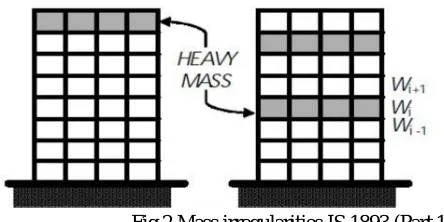
[image:2.595.150.372.309.420.2]2) Mass Irregularity: When the seismic weight of any storey in the building is more than 200 % of that of its adjacent storeys then the building is considered as having mass irregularity. Mass irregularity need not be considered in case of roofs. Fig. 2 shows the mass irregularities.
Fig 2 Mass irregularities IS 1893 (Part 1):2016
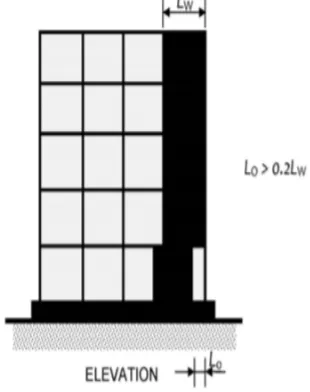
3) Vertical Geometric Irregularity: When the horizontal dimension of the lateral force resisting system in any storey in the building is more than 150%of that in its adjacent storey then such building is considered as having vertical geometric irregularity. Fig. 3 shows the vertical geometric irregularities.
Fig 3 Vertical geometric irregularity (IS 1893 (Part 1):2016)
[image:2.595.186.432.486.673.2]Fig 4 Strength irregularity – weak storey (IS 1893 (Part 1):2016)
5) In-Plane Discontinuity in Vertical Elements Resisting Lateral Force: An in-plane offset of the lateral force resisting elements greater than the length of those elements. Fig. 5 shows in plane discontinuity.
Fig 5 In-Plane Discontinuity (IS 1893 (Part 1):2016)
II. STRUCTURE ANALYZED
Four models of ten storey buildings are considered for analysis. First building is considered as regular frame with uniform distribution of mass, strength and stiffness along the height and width of the structure. This regular building is modified for irregular frames by introducing some setbacks without any change in design details. The setbacks are introduced by reducing the lateral dimensions of the structure along the height at different storey in different models so that the A/L ratio is different for all three models. All the four frames regular and irregular are modelled in SAP2000 computer code. These models are analyzed against earthquake loadings by using both IS 1893 (Part 1):2002 and also by the use of revised code for earthquake resistant building structure IS 1893 (Part 1):2016 to know the extent of effects the revision has caused to the structure. These frames are designed for the highest earth quake zone in India. Further these frames are designed by the use of pushover analysis to analyze the capacity of the regular structure and irregular structure against earthquake and their results are discussed here in this paper.
The irregularities has been differentiated under different categories in Indian Standard codes like IS1893- 2016 out of which vertical irregularity is discussed here as follows.
III.PROBLEM STATEMENT
[image:3.595.236.391.289.485.2]Table 1
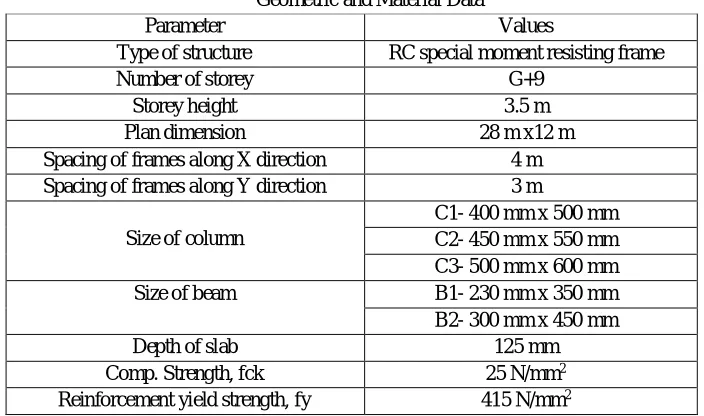
Geometric and Material Data
Parameter Values
Type of structure RC special moment resisting frame
Number of storey G+9
Storey height 3.5 m
Plan dimension 28 m x12 m
Spacing of frames along X direction 4 m
Spacing of frames along Y direction 3 m
Size of column
C1- 400 mm x 500 mm C2- 450 mm x 550 mm C3- 500 mm x 600 mm
Size of beam B1- 230 mm x 350 mm
B2- 300 mm x 450 mm
Depth of slab 125 mm
Comp. Strength, fck 25 N/mm2
Reinforcement yield strength, fy 415 N/mm2
[image:4.595.122.474.130.338.2]Plan of the model considered is as shown in Fig. 6
Fig. 6 Plan for regular and irregular models.
The live loads considered for the analysis of RC building are as referred in IS 875-part 2 and are given in Table 2.
Table 2
Geometric and Material Data
Parameter Magnitude
Live Load 2 kN/m2
Roof Live Load 1.5 kN/m2
Floor Finish 1 kN/m2
[image:4.595.109.515.372.554.2]Table 3
Seismic data required for analysis Parameter Values as per IS 1893 (part
1):2002
Clause
Type of structure RC Special moment resisting frame
Table 7, Clause 6.4.2
Seismic zone V Table 2, Clause 6.4.2
Zone factor (Z) 0.36 Table 2, Clause 6.4.2
Type of soil Medium soil Clause 6.4.5
Damping 5 % Figure 2, Clause 6.4.5
Response reduction factor (R)
5 Table 6, Clause 6.4.2
Importance factor (I) 1 Table 7, Clause 6.4.2
Time period 0.075 xℎ . Clause 7.6.1
For the analysis one structure with constant geometric dimensions along the height is considered as the regular model while the same structure with following setbacks are considered as vertically irregular models. When the A/L ratio is less than one but greater than 0.25 it is considered as irregular model. Where L is horizontal dimension of building in x-direction and A is reduced lateral dimension of building in x-direction only. Type of irregularities are as mentioned in Table 4 where ‘L’ is the dimension of building in x-direction and ‘A’ is the reduced lateral dimension of the building.
Table 4 Type of irregularities Model Irregularity Table 5 IS 1893 (part 1)
:2002
Type of irregularity
R L1=L2 Regular
S1 A/L = 24/28 = 0.85 > 0.25 Setback
S2 A/L = 20/28= .714> 0.25 Setback
S3 A/L = 16/28= 0.57 > 0.25 Setback
Elevations of regular model is as shown in Fig. 7 and that of irregular models are shown in Figs 8, 9 and 10.
Fig. 9 Elevation for setback-2 model. Fig. 10 Elevation for setback-3 model.
IV. RESULTS AND DISCUSSIONS
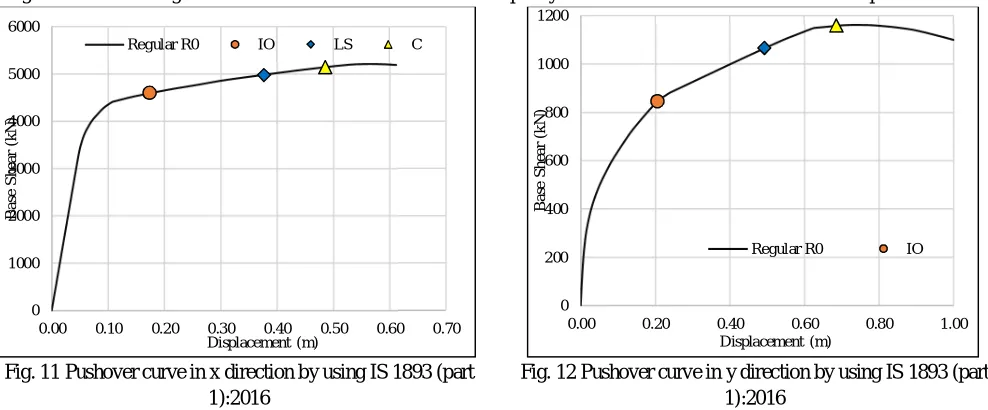
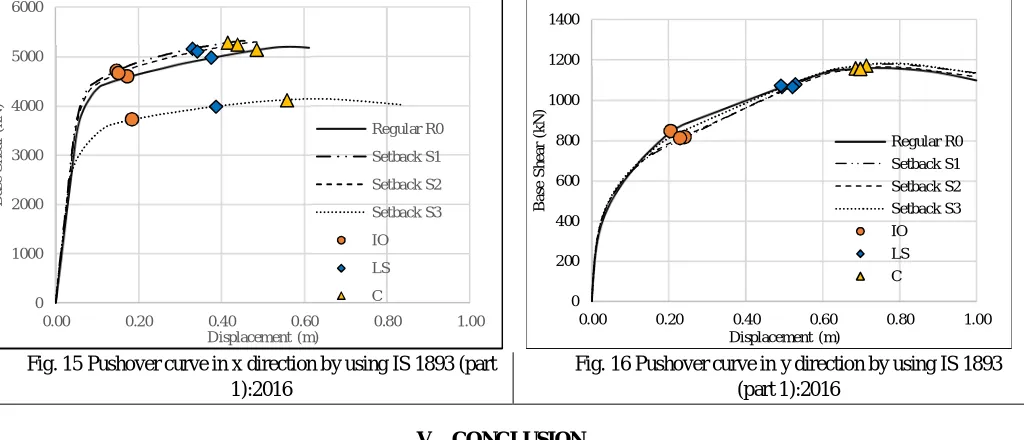
[image:6.595.321.529.119.342.2]The four models are designed with pushover analysis. Pushover analysis is a method where force is applied in lateral direction of the frame and gradually increased until the targeted displacement is achieved. Fig 11 and Fig. 12 shows the results of pushover analysis for regular structure designed with IS1893:2016 which shows the capacity of structure in the form of force and displacement.
Fig. 11 Pushover curve in x direction by using IS 1893 (part 1):2016
Fig. 12 Pushover curve in y direction by using IS 1893 (part 1):2016
As the Indian standard code IS1893:2002 has not given any specific criteria for the consideration of height for fundamental natural time period, so the complete height is considered for both regular and irregular structures. Which gives us the same time period for all the buildings with regular and irregular configurations. The same time period will give the same spectral acceleration and therefore approximately same base shear which we can see from the Fig. 13 and Fig. 14 which shows the pushover curve in x direction and y direction by using IS 1893 (part 1):2002. Due to same base shear values, the section demands approximately same reinforcement and section for both regular and irregular building.
0 1000 2000 3000 4000 5000 6000
0.00 0.10 0.20 0.30 0.40 0.50 0.60 0.70
B
a
se
S
h
ea
r
(k
N
)
Displacement (m)
Regular R0 IO LS C
0 200 400 600 800 1000 1200
0.00 0.20 0.40 0.60 0.80 1.00
B
a
se
S
h
ea
r
(k
N
)
Displacement (m)
[image:6.595.50.544.422.627.2]Fig. 13 Pushover curve in x direction by using IS 1893 (part 1):2002
Fig. 14 Pushover curve in y direction by using IS 1893 (part 1):2002
[image:7.595.48.560.422.642.2]In revised code of earthquake resistant building structure IS1893 (part 1): 2016, there is specific criteria about the height which has to be considered for the calculations of Fundamental period of building with regular and irregular configurations. For regular building, total height of the structure has to be used whereas for building with setbacks, weighted height with respect to floor areas along the setbacks has to be used. So the height in irregular building considered has found to be lesser than the height of regular building, Therefore the time period of irregular building observed to be less than that of the regular one. This criteria gives the larger spectral acceleration and base shear which makes the designed section to have more steel requirements and requires more sizes to resist the loads coming to the structure for irregular building that compared with the regular buildings. Fig. 15 and Fig. 16 shows the pushover curve in x direction and in y direction by using IS 1893 (part 1):2016
Fig. 15 Pushover curve in x direction by using IS 1893 (part 1):2016
Fig. 16 Pushover curve in y direction by using IS 1893 (part 1):2016
V. CONCLUSION The observations according to the performance of the building are as follows.
Even if the regular and irregular buildings are designed with two different codes i.e. IS1893:2002 and IS1893:2016, it is observed that it almost shows the same capacity curves in x direction and in y direction.
The displacement targeted is observed to be larger in regular models with respect to irregular models for both IS1893:2002 and IS1893:2016 both. The base shear at the targeted displacement is more in regular models with compared to setback-3 in x direction and y direction both for IS1893:2002. The base shear at the targeted displacement is more in regular model with compared to setbck-3 in x direction in IS1893:2016.
Whereas there is no much difference observed in base shear at targeted displacement in y direction for IS1893:2016.
0 500 1000 1500 2000 2500 3000 3500 4000 4500 5000
0.00 0.20 0.40 0.60 0.80 1.00
B as e S h ea r (k N )
Displacement (m)
Regular R0 Setback S1 Setback S2 Setback S3 IO LS C 0 200 400 600 800 1000 1200 1400
0.00 0.20 0.40 0.60 0.80 1.00
B a se S h ea r (k N )
Displacement (m)
Regular R0 Setback S1 Setback S2 Setback S3 IO LS C 0 1000 2000 3000 4000 5000 6000
0.00 0.20 0.40 0.60 0.80 1.00
B as e S h ea r (k N )
Displacement (m)
Regular R0 Setback S1 Setback S2 Setback S3 IO LS C 0 200 400 600 800 1000 1200 1400
0.00 0.20 0.40 0.60 0.80 1.00
B a se S h ea r (k N )
Displacement (m)
REFERENCES
[1] C. Chintanapakdee, Anil K. Chopra, “Seismic Response of vertically irregular Frames: Response History and Modal Pushover Analyses,” J. Struct. Eng., vol. 130(8), pp. 1177-1185, 2004
[2] C. J. Athanassiadou, “Seismic performance of R/C plane frames irregular in elevation,” Engineering Structures, vol. 30, pp. 1250-1261, 2007 [3] Yachawad and Bhakre, “A parametric study on seismic response of RC building having vertical geometrical irregularity by is1893 (part 1):2016,” 2018 [4] Bhonsale and Davis, “Vertical irregularity of buildings: regularity index versus seismic risk,”
[5] Cheug and Tso, Lateral load analysis for buildings with setbacks,” 1987
[6] Kalibhat, Kumar, Kiran Kamath, Prasad .S.K, Shrinath, “Seismic performance of R.C. frames with vertical stiffness irregularity from pushover analysis,” 2014 [7] Soni and Mistry, “Qualitative review of seismic response of vertically irregular building frames,” 2014
[8] Sarkar, “Vertical geometric irregularity in stepped building frames,” 2010