Detection of the Flower from Field Image using
Morphological Technique
Ruman Kumari1, Dr.Vishal Shrivastava2
1
Student, 2Professor, Department of Computer science Engineering, Arya College Of Engineering & Information Technology, Jaipur
Abstract: This paper presents an image analysis algorithm to detect and count red flowers in a field with uneven illumination conditions, complex growth conditions and different flower sizes. The algorithm is designed for yield estimation. Detecting the flowers can provide useful information for the farmer, such as the number of flowers in a row, and the number of flowers that were pollinated since the last visit to the row. The developed algorithm is designed to handle the real-world difficulties in farming which include varying lighting conditions, shadowing, and occlusion. The algorithm identifies flowers using an adaptive global threshold, segmentation over the HSV color space, and morphological cues. The adaptive threshold divides the images into darker and lighter images. Then, segmentation on the hue, saturation and volume is performed accordingly, and classification is done according to size and location of the flowers. 6 images of flowers were taken using different cameras. The images were acquired from multiple angles and distances and were sampled manually at various periods along the day to obtain varying lighting conditions. Precision, recall and their derived F1 score were calculated. Results indicate better performance for the view angle facing the flowers than any other angle. Acquiring images in the afternoon resulted with the best precision and recall results. Applying a global adaptive threshold improved the median F1 score by 3%. Results showed no difference between the two cameras used. Using hue values of 0.12-0.18 in the segmentation process provided the best results in precision and recall, and the best F1 score. The precision and recall average for all the images when using these values was 74% and 75% respectively with an F1 score of 0.73. Further analysis showed a 5% increase in precision and recall when analyzing images acquired in the afternoon and from the front viewpoint.
Keywords: Morphological Technique, Computer vision, Image processing, Flower detection, Agricultural engineering.
I. INTRODUCTION
Detecting objects using computer vision in field conditions is a key requirement for automating and improving many tasks in agriculture. Harvest of fruits and vegetables, pest control, pollination and yield estimation are only some of these potential tasks. However, without accurate and fast detection, these tasks could not compete with human labor. In recent years many researches have been dealing with the challenging task with limited success, mainly because of the diverse and complex agricultural environment. Detecting the flowers using computer vision is a complex task, and despite the progress in computer vision and image processing technologies, applications for agricultural use in the field have been scarce. As we know that with increasing in the development of different hardware and software technologies many researches are take place in different countries. Image processing is playing a important role in agricultural research as image processing have key features that define the ability to make approaches and a quick prototype solutions which decrease the cost and time. In these techniques processing numerical images by means of an arithmetical processor. An arithmetical image is composed of a finite amount of characteristics, each of which has a specific place and value. These elements are referred as picture elements, image elements, pels and pixels. Thus, in agricultural we need such technology that always deals with time consuming function and give the accurate information on time about agriculture related work. Unusual to manual observation, now different approaches are used to solve the agriculture related problem in yield estimation. Computer vision application are used in recent researches using case studies to get knowledge, I get to concluded also that to solve resolve the issues of yield prediction color segmentation play its part. Thus, my literature survey firstly creates an automating system or can say the decision support system that could generate the yield prediction info that helps in formulating the planning and management of flower marketing. The method used for creating this system is image processing which deal with the preservation of flower of color by the help of circular Hough transform and morphological technique. In this demonstration, I have work upon the offline images taken from the field at arbitrary time. The complexity of image is high due to different size, shape, noise which crate a difficulty for identifying the optimize result.
1) Develop an adaptive thresholding technique which will be able to deal with variable illumination conditions. 2) Use color information from the image in order to perform segmentation according to lighting conditions. 3) Detect flowers in given images with low false positives and high accuracy. Ease of Use
II. METERIALSANDMETHODS
A. Image Acquisition
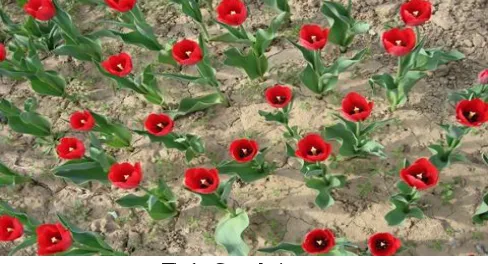
The experiment of detecting flowers is carried out on the sample images taken of the flower from the field. View of entire field is difficult to capture in single image. Also, image containing big area of field may result in blurring and thereby poor discrimination of the flowers. Therefore, images are taken in parts of the field, processed individually and finally result is combined.
Fig1. Sample image
B. Database
[image:2.612.184.428.190.322.2]The image processing and analysis is performed using MATLAB 15 a software with image processing toolbox after that,to get the accuracy and consistence in the result, the images were preprocessed using image cropping, filtering etc. Filter operation reduced the noise present in the images. Every image that is taken on the field in natural conditions is get polluted with noise. The noise may occur due to high or dull lights, shaking of camera etc. such images with errors affect the result of the experiments such as false negative or false positive detection of flowers. The images are taken on the field and with the help of digital camera along with date of image capture. Also, the color of the date portion was close to that of the flowers in the images. While segmenting the flower objects, date portion also get extracted as flower objects, generating error in the output. Therefore the date portion is removed by manual cropping, blurring etc.
Fig. 2 Examples of tagged image
C. Algorithm
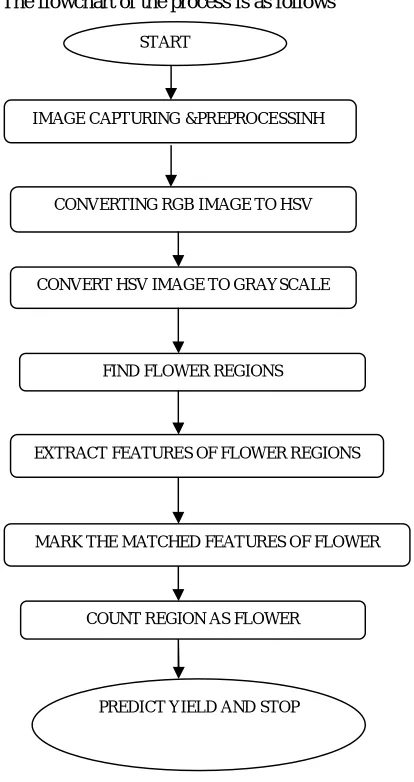
The flowchart of the process is as follows
[image:3.612.222.429.82.473.2]
Figure 3. Flow chart
D. Image Analysis
In current study, the prime objective is to extract with red color flowers from the field images. Every flower has its own color. To extract these flowers, the color values need to be known. In the study, petal color is used to separate them from the background. From the literature review, HSV color space is considered for the object extraction. To extract the flower objects, the pixel class that represents the flower objects is determined using histogram.
E. Flowers Extraction
Identification and separation of flowers from the field images is performed with the help of image segmentation using thresholding technique.
Thresholding consists of segmenting an image into two or more regions: object regions and a background region. For any gray scale image, the segmentation process is represented as Basically, this process works by setting to 1-white all pixels that cross the gray-level limit, called the threshold, and setting rest of the pixels in the image to 0-black (1). The resulting image is referred to as a binary image.
The threshold can be chosen manually or by using automated techniques. Manual threshold selection is normally done by trial and error, using a histogram as a guide. In our study, we have selected thresholds by analyzing the HSV histogram of flower images.
START
IMAGE CAPTURING &PREPROCESSINH
CONVERTING RGB IMAGE TO HSV
CONVERT HSV IMAGE TO GRAYSCALE
FIND FLOWER REGIONS
EXTRACT FEATURES OF FLOWER REGIONS
MARK THE MATCHED FEATURES OF FLOWER
COUNT REGION AS FLOWER
III. IMPLEMENTATION
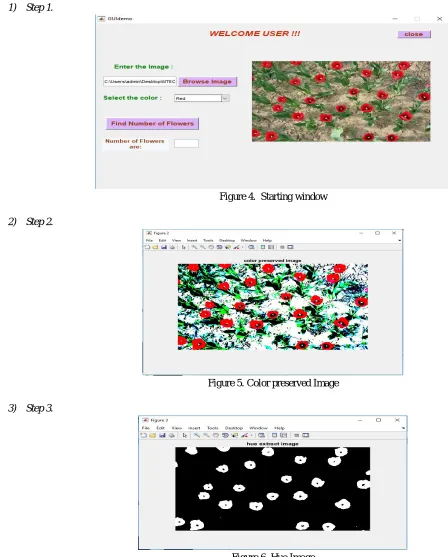
The entire process of flower detection and extraction involve various steps. In order to detect the flower region, threshold value is determined. From the histograms of various red flower images threshold value is determined. Flower segmentation is then performed. The flower region features are extracted and recognized from the binary image. A GUI application is designed to combine individual operations using GUIDE facility provided by Matlab 15a.
These are the following steps to get the result
[image:4.612.33.481.168.725.2]1) Step 1.
Figure 4. Starting window
2) Step 2.
Figure 5. Color preserved Image
3) Step 3.
[image:4.612.126.487.187.490.2]4) Step 4.
[image:5.612.171.437.84.399.2]5) Step 5.
Figure 8. Extracted feature of flower image
IV. RESULTS
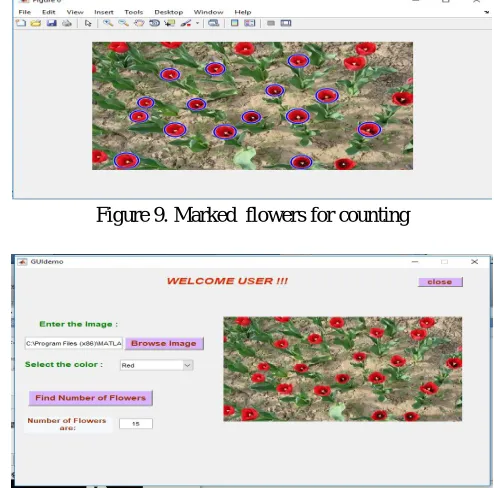
[image:5.612.180.427.473.717.2]The designed Matlab system has produced the desired results. Total 6 images, containing flowers Red colors were tested in the system. In case of counting the flowers, the system accuracy was varying in different condition for Red flowers. The overall accuracy of the system found to be 87.03%. The counting results got contaminated majorly due to overlapping of flowers.
Figure 9. Marked flowers for counting
Accuracy can be calculated using following expression
Algo count
Accuracy(%) = * 100 Manual Count
Image no Manual count Algo count Accuracy(%)
1 17 15 88.23
2 13 11 84.61
3 1 1 100
4 20 16 80
5 16 13 81.25
6 59 52 88.13
Overall accuracy is 87.03%
V. CONCLUSION
Images taken in the afternoon from an angle facing the plants provided better results in precision and recall than any other angle. Optimal hue values for detecting the red and yellow flowers were found as well. In this research, the system has able to fulfill the research objective by detecting and counting the flowers from images. The study has once again proved that computer vision can be effectively used in yield prediction. Somewhere result was affected by on field conditions. The errors in result are because of some basic limitations like illumination, overlapping etc.
VI. FUTUREWORK
Clearly the objective I have proposed had proved its result but at some places there is limitation due to the problems faced in the preprocessing of images. The images might have contained some noise problem, overlapping of flower and also the lack of some texture recognition problem, etc. So this sort of problem which have faced can be removed by taking the new approaches and applying the technique to the best. There can be use of an attempt in the future to make it as better as the desired result produced with precision. By the use of the different other approaches and methods like image segmentation methods, filtering methods, texture recognition methods etc we will usually prove this objective in the future as the better result and some issues must needed to be solved in the nearer future.
REFERENCES
[1] Application of computer vision and color image segmentation for yield prediction precision 978-1-4673-5986-3/13/$31.00 ©2013 IEEE
[2] Harshveer Singh Randhawa, Shanu Sharma,” A Survey of Computer Vision and Soft Computing Techniques for Ripeness Grading of Fruits,” Journal of
Advanced Computing and Communication Technologies (ISSN: 2347 - 2804) Volume No.2 Issue No. 4, August 2014.
[3] Anisha Syal, Divya Garg, Shanu Sharma, “A Survey of Computer Vision Methods for Counting Fruits and Yield Prediction,” Anisha Syal et al. / International
Journal of Computer Science Engineering (IJCSE) ISSN : 2319-7323 Vol. 2 No.06 Nov 2013
[4] Neetika Bairwa, Navneet Kumar Agrawal ,” Counting of Flowers using Image Processing”, International Journal of Engineering Research & Technology
(IJERT) IJERTIJERT ISSN: 2278-0181 IJERTV3IS090643 (This work is licensed under a Creative Commons Attribution 4.0 International License.) Vol. 3 Issue 9, September- 2014
[5] Hasnida Saadl, Ahmad Puad Ismaie, Noriza Othmanl, Mohamad Huzaimy Jusohl, Nani fadzlina Naiml , Nur Azam Ahmadi,” RECOGNIZING THE RIPENESS
OF BANANAS USING ARTIFICIAL NEURAL NETWORK BASED ON HISTOGRAM APPROACH”, 2009 IEEE International Conference on Signal and Image Processing Applications.
[6] Humaira Nisar, Hoo Zhou Yang and Yeap Kim Ho,” Predicting Yield of Fruit and Flowers using Digital Image Analysis”, Indian Journal of Science and Technology, Vol 8(32), DOI: 10.17485/ijst/2015/v8i32/93730, November 2015.
[7] Rupinder Kaur, Barkha Malkaniya, Ms. Shrusti,” A Survey of Image Segmentation of Color Flower Yield Prediction Precision”, International Journal of
[8] K. Kapach, E. Barnea, R. Mairon, Y. Edan, O. Ben-Shahar, and O. Ben Shahar, “Computer vision for fruit harvesting robots state of the art and challenges ahead,” Int. J. Comput. Vis. Robot., vol. 3, no. 1/2, p. 4, 2012.
[9] S. A. Cameron, J. D. Lozier, J. P. Strange, J. B. Koch, N. Cordes, L. F. Solter, and T. L. Griswold, “Patterns of widespread decline in North American bumble
bees,” Proc. Natl. Acad. Sci., vol. 108, no. 2, pp. 662–667, 2011.
[10] D. a Sumner and H. Boriss, “Bee-conomics and the Leap in Pollination Fees the Supply and Demand Issues and Operation of the Pollination Market,” pp. 9–11,
2006.
[11] R. Ward, A. Whyte, and R. R. James, “A Tale of Two Bees: Looking at Pollination Fees for Almonds and Sweet Cherries,” Am. Entomol., vol. 56, no. 3, pp.
170–177, 2010.
[12] A. Gongal, S. Amatya, M. Karkee, Q. Zhang, and K. Lewis, “Sensors and systems for fruit detection and localization: A review,” Comput. Electron. Agric., vol.
116, pp. 8–19, 2015.
[13] D. R. Martin, C. C. Fowlkes, and J. Malik, “Learning to detect natural image boundaries using local brightness, color, and texture cues,” IEEE Trans. Pattern
Anal. Mach. Intell., vol. 26, no. 5, pp. 530–549, 2004.
[14] M. Hočevar, B. Širok, T. Godeša, and M. Stopar, “Flowering estimation in apple orchards by image analysis,” Precis. Agric., vol. 15, no. 4, pp. 466–478, 2014.
[15] A. Payne, K. Walsh, P. Subedi, and D. Jarvis, “Estimating mango crop yield using image analysis using fruit at ‘stone hardening’ stage and night time imaging,”
Comput. Electron. Agric., vol. 100, pp. 160–167, 2014.
[16] C. Zhao, W. S. Lee, and D. He, “Immature green citrus detection based on colour feature and sum of absolute transformed difference (SATD) using colour images in the citrus grove,” Comput. Electron. Agric., vol. 124, pp. 243–253, 2016.
[17] U. Dorj, K. Lee, and M. Lee, “A computer vision algorithm for tangerine yield estimation,” Int. J. Bio-Science Bio-Technology, vol. 5, no. 5, pp. 101–110, 2013.
[18] A. Aquino, B. Millan, S. Gutiérrez, and J. Tardáguila, “Grapevine flower estimation by applying artificial vision techniques on images with uncontrolled scene
and multi-model analysis,” Comput. Electron. Agric., vol. 119, pp. 92–104, 2015.
[19] N. Bairwa and N. K. Agrawal, “Counting of Flowers using Image Processing,” Int. J. Eng. Res. Technol., vol. 3, no. 9, pp. 775–779, 2014.
[20] R. Kaur and S. Porwal, “An Optimized Computer Vision Approach to Precise Well-Bloomed Flower Yielding Prediction using Image Segmentation,” Int. J. Comput. Appl., vol. 119, no. 23, pp. 15–20, 2015.