ScholarWorks @ Georgia State University
ScholarWorks @ Georgia State University
Sociology Theses Department of Sociology
Summer 8-18-2010
Living Together: Conservative Protestants and Cohabitation
Living Together: Conservative Protestants and Cohabitation
Anthony E. Healy Georgia State University
Follow this and additional works at: https://scholarworks.gsu.edu/sociology_theses
Part of the Sociology Commons
Recommended Citation Recommended Citation
Healy, Anthony E., "Living Together: Conservative Protestants and Cohabitation." Thesis, Georgia State University, 2010.
https://scholarworks.gsu.edu/sociology_theses/27
This Thesis is brought to you for free and open access by the Department of Sociology at ScholarWorks @ Georgia State University. It has been accepted for inclusion in Sociology Theses by an authorized administrator of
by
ANTHONY E. HEALY
Under the direction of Dr. James W. Ainsworth
ABSTRACT
Recent research finds that conservative Protestants are cohabiting in no small numbers. Given
the strict moral orientation of conservative Protestants, that outcome appears paradoxical. This
thesis explains that paradox through the culture in action models of Swidler (1986), given the
social and economic location of conservative Protestants. The thesis employs pooled General
Social Survey data from 1993 to 2008 in which a question is asked that indicates cohabitation.
The thesis finds that the social and economic location of conservative Protestants is related to
their cohabiting. Though conservative Protestant cohabitors have lessened religiosity, much of
the decline in religiosity compared to married conservative Protestants is due to the factors
leading to cohabitation. But views and practices on premarital sex are the greatest factor in
reducing that difference. The evidence in this thesis lends support to Swidler‘s models of settled
and unsettled lives in explaining cohabitation among conservative Protestants.
by
ANTHONY E. HEALY
A Thesis Submitted in Partial Fulfillment of the Requirements for the Degree of
Master of Arts
in the College of Arts and Sciences
Georgia State University
Copyright by Anthony E. Healy
by
ANTHONY E. HEALY
Committee Chair: Dr. James W. Ainsworth
Committee: Dr. Deidre A Oakley
Dr. Adia Harvey Wingfield
Electronic Version Approved:
Office of Graduate Studies
College of Arts and Sciences
Georgia State University
TABLE OF CONTENTS
LIST OF TABLES v
1. INTRODUCTION 1
2. LITERATURE REVIEW 4
3. THEORETICAL FRAMEWORK 20
4. HYPOTHESES 26
5. DATA AND METHODOLOGY 29
5.1 THE GENERAL SOCIAL SURVEY AND THE DATA 29
5.2 METHODOLOGY AND PLAN OF ANALYSIS 34
6. RESULTS 37
7. DISCUSSION OF RESULTS 59
8. CONCLUSION 65
REFERENCES 71
LIST OF TABLES
TABLE 1: PROPORTIONS OF UNION TYPES BY RELIGIOUS IDENTITY 46
TABLE 2: MEANS AND PROPORTIONS, COHABITORS BY RELIGIOUS
IDENTITY
47
TABLE 3: OLS REGRESSION PREDICTING FAMILY INCOME BY
RELIGIOUS IDENTITY OF COHABITORS 49
TABLE 4: OLS REGRESSION PREDICTING RELIGIOSITY (Index) BY
RELIGIOUS IDENTITY OF COHABITORS 50
TABLE 5: OLS REGRESSION PREDICTING VIEW ON PREMARITAL
SEX BY RELIGIOUS IDENTITY OF COHABITORS 51
TABLE 6: OLS REGRESSION PREDICTING EDUCATION AND INCOME
BY UNION TYPE 52
TABLE 7: MEANS AND PROPORTIONS, CONSERVATIVE
PROTESTANTS BY UNION STATUS 53
TABLE 8: OLS REGRESSION PREDICTING RELIGIOUS ATTENDANCE
BASED ON UNION TYPE, CONSERVATIVE PROTESTANTS 55
TABLE 9: OLS REGRESSION PREDICTING RELIGIOSITY (INDEX)
1. INTRODUCTION
In no small numbers, conservative Protestants are cohabiting. That appears paradoxical
given that conservative Protestants hold strict beliefs on sex and marriage. This apparent paradox
raises theoretical questions about why cohabitation is increasing and how people are coming to
adopt cohabitation as a household arrangement. Surely the spread and adoption of cohabitation is
at the expense of traditional religious values, challenging the sanctity of marriage in the United
States, a nation in which presumably religion is respected and marriage is valued. This thesis
holds that the diffusion of the idea of cohabitation is not totally at the expense of religion, but is a
practice conservative Protestants have integrated culturally because the costs of marriage are
rising and economic disparities in society are increasing, including for conservative Protestants.
Eggebeen and Dew (2009) report that among young adults ages 18 to 28 about two-fifths
of those identified as conservative Protestant cohabited as their first union, a higher rate than
among those identified as mainline Protestant, Catholic, or other religion. Lehrer (2000), in data
drawn from the late 1980s, finds that 19 percent of conservative Protestant women born in the
post-1960 cohort had cohabited, a four-fold increase over the 1945 to 1955 cohort. In more
recent data, cohabitation appears more common among less active and less fervent conservative
Protestants than among less active and less fervent mainline Protestants, though the institutions
of the latter hold less stringent views about marriage and nonmarital sexual activity (Eggebeen
directives toward marriage and the economic location of conservative Protestants, in which the
two effects appear to offset the odds of cohabitation. Some explain the paradox differently. In a
longitudinal study based on a youth sample of metropolitan Detroit, for example, Thornton,
Axinn and Hill (1992) say their data supports the idea that the effect of religion and cohabitation
is reciprocal: Less religious activity as a child leads to cohabitation; cohabitation leads to less
religious activity as an adult.
Cohabitation poses two theoretical challenges. First, why has cohabitation suddenly
become the modal outcome for the first intimate union (as well as for subsequent unions)?
Second, how do people adopt cohabitation into their cultural schema, especially in a nation in
which marriage remains valued and religion is prominent (Cherlin 2005; 2004)? The latter
question poses a greater challenge in the case of conservative Protestants, whose institutions and
elites espouse strident support for marriage and heatedly resist accommodation on sexual issues.
On the former challenge, two explanations are offered. In the United States especially,
the dominant explanation for cohabitation‘s spread stresses the structural location of cohabitors,
and in particular, their economic location. For example, Oppenheimer (1988) contends that the
economic slippage in recent decades is reducing the incidence of marriage and increasing the
frequency of cohabitation among the less advantaged (Oppenheimer 2000). The second
explanation – found in European scholarship – is diffusion, the process by which a social idea
spreads and is accepted, supplanting cultural norms, such as about marriage. That view is
reflected in the United States in the work of Cherlin (2005; 2004). Nazio (2008) combines the
two explanations. He contends that both are responsible for the spread of cohabitation. Social
ideas are more easily accepted in some societies because of the socioeconomic location of
While Nazio (2008) provides an explanation on the macro level, why cohabitation is
adopted on the micro level remains unclear. Why is it that people whose upbringing and
institutions proffer marriage as the proper moral choice instead adopt cohabitation? As Lehrer
(2000) suggests, many conservative Protestants are situated in or near the socioeconomic
location in which people are most likely to cohabit. Driven to cohabitation by necessity, are
conservative Protestants forgoing religion in the process, or are they integrating an errant
household arrangement within their religious ideologies?
On this issue, the prevalent explanation in the family literature is rational choice, as in
Oppenheimer (1988). In short, people pick cohabitation over religion based on the potential costs
and return of that option. This study seeks instead to understand how individuals decide to
cohabit through culture in action (Swidler 1986). Swidler holds that in times of transformation,
when lives are unsettled, ideologies are explicit and contentious, as is the religious ideology that
conservative Protestants hold to on marriage and sexuality. But even such ideologies in unsettled
times are in flux as ―People formulate, flesh out, and put into practice new habits of action‖
(Swidler 1986, Pg. 279).
The structure of this thesis is first to review the relevant literature on cohabitation, with a
concentration on economic and religious effects, and with additional material on conservative
Protestants. That section is followed by a theoretical framework, in which I introduce Swidler‘s
culture-in-action and review weaknesses in rational choice theory. The hypotheses then follow.
In the last section, the data – the General Social Survey – are presented, along with the plan of
analysis. Next, I examine the results and then discuss the results. The conclusion highlights the
2. LITERATURE REVIEW
Though certainly not new, cohabitation is now common in the United States. This section
summarizes the literature on cohabitation in the United States, as well as Europe. The emphasis
is first on defining cohabitation, then second on discussing the literature relevant to this thesis in
cohabitation prevalence, expansion, duration, economic and social effects, and finally and
importantly, on identifying religious influences, including the socioeconomic location of
conservative Protestants.
Definition of Cohabitation
Marriage is easier to define than cohabitation because wedlock is a legal, traditional, and
socially legitimate form of intimate union that is considered permanent and has established
social, cultural, and religious expectations. Cohabitation is a progressively prevalent
phenomenon that is more fluid, more transient, and more difficult to define. It lacks many of the
legal protections and obligations of marriage, as well as the social and cultural legitimacy –
much less religious legitimacy – of marriage. It is not as institutionalized (Smock and Gupta
2002). I adopt the definition of Bachman, Hindin and Thomson (2000) that cohabitation ―refers
to an intimate sexual union between two unmarried partners who share the same living quarters
for a sustained amount of time‖ (Pg. 4). Such a definition generally precludes dating
co-residence in spells of days or a few weeks in the momentary intensity of a romantic affair; or
recurrent moving in and out of a household and a cohabiting relationship. Cohabitation thus
involves joint occupancy, a regularized sexual relationship, and the aspiration to stay together.
Cohabitation also entails some degree of financial sharing, role gendering, and behavioral
fine-tuning, however minimal (Smock and Gupta 2002; Bumpass, Sweet and Cherlin 1991).1
Aside from definitional difficulties, the purpose cohabitation serves is distinct from that
of marriage, though they are related. Of the conceptualizations of the purposes of cohabitation,
classic is that of Oppenheimer:
Cohabitation gets young people out of the high-cost search activities during a
period of social immaturity but without incurring what are, for many, the penalties
of either heterosexual isolation or promiscuity, and it often offers many of the
benefits of marriage, including the pooling of resources and the economies of
scale that living together provide… However, cohabitation also provides some of
the advantages of remaining single. While it may currently tie people up (though
not as much as marriage), its influence on future mating behavior is much less,
and the long-run financial obligations are relatively low. (1988, Pgs. 583-584)
Instead of as an alternative to marriage, many cohabitors in the United States see
cohabiting as a step toward marriage as they mature socially and strengthen financially.
Nevertheless, some possess attitudes that suggest they cohabit as an alternative to marriage
1
Unlike marriage, cohabitation is open to same-sex relationships, though same-sex unions evidently make up a small proportion of all cohabitations (Rosenfeld and Kim 2005).
(Clarkberg, Stolzenberg and Waite 1995), do not intend to marry (Manning and Smock 2002), or
happily remain in cohabitation instead of marriage (Brown 2000). Marriage remains valued and
symbolically important in the United States, unlike in a number of European countries (Cherlin
2005; 2004). Moreover, marriage appears to be increasingly an institution of the advantaged:
Amato et al. (2007) finds that categories of married individuals became more economically
privileged between 1980 and 2000. Yet, many cohabitors, including the poorest, plan or expect
to marry (Tucker 2000; Bumpass, Sweet and Cherlin 1991), though poor women often consider
the prospect of immediate marriage to their present partner as unrealistic (Jayakody and Cabrera
2002). Cohabitors see the arrangement as necessary to prepare financially for the commitments
of marriage, such as a house, or even a proper wedding (Smock, Manning and Porter 2005).
Cohabitation supplies pre-marital socialization that smoothes the trajectory toward marriage
(Oppenheimer 1988). Cohabitation is also the result of being legally precluded from marriage,
such as same-sex partners in most states.
Trends in Cohabitation
How is it that cohabitation became the modal form of first intimate union? This section
traces that development and related developments by exploring the current rates of cohabitation,
the expansion of cohabitation, changes in the characteristics of cohabitors, and changes in the
composition of cohabiting households.
Rates of cohabitation: Most persons now cohabit before marriage. Nearly half of
women ages 30 to 34 in the mid-1990s had at some point cohabited (Bramlett and Mosher 2002;
Bumpass and Lu 2000). About a fifth of that age cohort who had never married currently
(Bramlett and Mosher 2002). Of women born between 1990 and 1994, more than half had
cohabited as their first union or had cohabited before marriage (Bumpass and Lu 2000). Most of
the former had cohabited with their future husband, though in the 1990 to 1994 cohort more had
cohabited with someone who was not their future husband (Bumpass and Lu 2000). A fifth of
previously married women were cohabiting, a proportion that is higher among younger women
(Bumpass and Lu 2000). After marital disruption, the odds of cohabitation are 53 percent for
women after five years and 70 percent after 10 years (Bramlett and Mosher 2002). Though the
number of first intimate unions formed annually is relatively steady, cohabitation replaced
marriage many years ago as the first type of intimate union (Bumpass, Sweet and Cherlin 1991).
Expansion of cohabitation: As Cherlin (2004) recognizes, cohabitation expanded
rapidly in the past few decades, surprising social scientists. Cohabitation proliferated through
successive generations, but is more prevalent in younger age categories. Regardless of how
cohabitation is measured, subsequent studies document that expansion. About 6 percent of
individuals age 60 or older in the 1980s report having ever cohabited, about 5 percent having
done so before marriage (Bumpass and Sweet 1989). But more than two-fifths of 25 to 29 year
olds had ever cohabited and about 8 percent were currently cohabiting (Bumpass and Sweet
1989). In earlier data for never married women, the respective figures are 38 percent and 12
percent (Tanfer 1987). Between the 1940 to1944 and the 1960 to 1964 birth cohorts, the
estimated proportion of cohabitation before age 25 quadrupled for males and multiplied
twelve-fold for women (Bumpass and Sweet 1989). Altogether, a more than four-twelve-fold increase in the
number of cohabitors occurred between 1977 and 1997 (Casper and Cohen 2000).
Cohabitation also rapidly spread in several countries with advanced economies. As an
countries, cohabitation has largely replaced marriage as the primary union, unlike in the United
States, where marriage remains preeminent (Kiernan 2002, 2000).
Changes in cohabitors: As cohabitation rapidly spread in the United States, the social
and economic characteristics of cohabitors changed. Instead of educated elites and college
students who were dominant at first, cohabitors became poorer and less educated. Two sets of
measurements between the late 1980s and mid-1990s reflect the change. First, of women who
never married, 46% of those who had ever cohabited have less than 12 years of education
(Tanfer 1987). Second, the largest increases in subsequent rates of having ever cohabited are
among individuals with a high school education or less (Bumpass and Lu 2000). Not only did a
higher proportion of less educated women cohabit, more than a third of those women grew up in
households that received welfare (Bumpass and Sweet 1989). However, some cohabitors are
educated women: More than a third of college educated women ages 18 to 44 had ever cohabited
in the 1990s, in comparison to three-fifths of women with less than a high school education
(Bumpass and Lu 2000).
Changes in household composition: The structure of cohabiting households changed as
the characteristics of cohabitors changed. Cohabiting households came to include children.
Based on longitudinal data, the estimate is that about one in four children can expect to live in a
cohabiting household by age 14, with slightly higher likelihoods for minority children (Graefe
and Lichter 1999). Three factors contribute to the growth of the children within cohabiting
households. The first factor is a change in non-marital conception in which unmarried parents
instigate cohabitation instead of marriage before or after the birth of their child (Raley 2001;
Brien, Lillard and Waite 1999; Bumpass, Raley and Sweet 1995). The second factor is an
afterward (Raley 2001; Brien, Lillard and Waite 1999). And the third factor is the growth in the
number of children – generally older – entering cohabiting households when a parent cohabits,
usually after divorce (Graefe and Litcher 1999; Bumpass, Raley and Sweet 1995). Adding to the
sheer number of children in cohabitation is the fact that the number of cohabiting households has
rapidly increased (Raley 2001).2
Characteristics of Cohabitors and Cohabiting Households
Economic circumstances moderate the entry into, the duration of, and termination of
cohabitation. How does that happen? Here, I explore those transitions, as well as the social
factors, including race, which affect those transitions.
Entry into cohabitation: The evidence is that the decision to cohabit rather than marry is
associated with lessened economic advantage. Each year of accumulated education reduces the
rates of cohabitation for younger women and men by 32 and 25 percent, respectively (Thornton,
Axinn and Teachman 1995). The hazard of cohabitation for men and women under age 45 is
reduced 64% from non-high school graduates to college graduates (Bumpass and Sweet 1989).
Strong earnings potential raises substantially for men the likelihood of marriage over
cohabitation, but is irrelevant for women, and does not significantly affect the odds of entry into
cohabitation for either sex (Xie et al. 2003). Economic certainty appears to lead to marriage
rather than cohabitation, with the probability of marriage doubling for men with higher incomes
and the probability of cohabitation increasing about a fifth (Clarkberg 1999). High valuation of
2
Of the three factors, the first two are linked to what is called the second demographic revolution, in which child-bearing increasingly takes place outside of established, formal
money impedes men from any union, but among women, it impedes only marriage (Clarkberg,
Stolzenberg and Waite 1995). Among poorer individuals who have a child, greater education for
women lowers by about half the propensity to cohabit rather than marry, and higher male
earnings more than doubles the odds of marrying over cohabiting (Carlson, McLanahan and
England 2004).
Cohabitation is also linked to the socioeconomic and household characteristics of
cohabitors‘ family of origin. Women brought up in households that receive welfare or have low
incomes had a greater probability, or odds, of cohabiting, as do those who grew up in disrupted
families (Lichter, Qian and Mellott 2006; Lehrer 2004; Manning and Smock 2002; Xie et al.
2003; Clarkberg 1999; Cherlin, Kiernan and Chase-Landale 1995; Thornton 1993; Bumpass and
Sweet 1989). About two-fifths of the mothers of cohabitors have less than a high school
education (Lichter, Qian and Mellott 2006; Lehrer 2004; Smock and Manning 1997), and the
proportion is higher – about three-fifths – among poor female cohabitors (Lichter, Qian and
Mellott 2006).
Having an intact two-parent family of origin is negatively related to the transition to
cohabitation, though not to the transition to marriage (Clarkberg 1999; Bumpass and Sweet
1989). Parental divorce increases the possibility of cohabitation (Thornton, Axinn and Xie 2007;
Lehrer 2004; Xie et al. 2003; Brien, Lillard and Waite 1999; Cherlin, Kiernan and
Chase-Landale 1995; Thornton 1991); especially if a parental remarriage occurs (Thornton, Axinn and
Xie 2007; Xie et al. 2003; Thornton 1991). Parental death increases the odds of cohabitation
(Thornton, Axinn and Xie 2007; Lehrer 2004; Xie et al. 2003; Cherlin, Kiernan and
Chase-Landale 1995), but not always significantly (Cherlin, Kiernan and Chase-Chase-Landale 1995). Adult
Lehrer 2000). Interestingly, the chance that the cohabitation will end in marriage is positively
associated with parental divorce (Wolfinger 2005).
Duration of cohabitation: Two-thirds of all cohabitations end in less than three years,
though a fifth of cohabiting couples are together five years or more, especially among previously
married cohabitors, whose spell of cohabitation tends to be longer (Bumpass, Sweet and Cherlin
1991). In data from the 1990s, more than three-quarters of cohabitations dissolve after three
years (Lichter, Qian and Mellott 2006). After three years, too, more than two-fifths of
cohabitations turn into marriages. At the four-year mark, dissolution is less likely to be into
marriage (Lichter, Qian and Mellott 2006). (Bumpass and Sweet [1989] report from earlier data
that about three-fifths of cohabitations end in marriage.) In fact, the odds of cohabitation ending
in marriage are highest in the early years of the union and then drop substantially (Brien, Lillard
and Waite 1999). The pattern differs racially: Marriage occurs more for white female cohabitors
than for Black (Brien, Lillard and Waite 1999). However, the presence of children lengthens the
spell of cohabitation (Carlson, McLanahan and England 2004; Wu 1995).
Termination of cohabitation: Economic disadvantage hinders cohabitations turning into
marriages. The economic resources or potential of the male partner speed the transition to
marriage, more so than those of the female (Xie et al. 2002; Smock and Manning 1997).
Declines in male earnings are associated with declines in marriage among less educated couples;
increases in female wages are associated with declines in marriage among more educated
couples (Moffitt 2000). Steady employment and the money to pay for the wedding and
festivities, at least for poorer cohabitors, is the bar that cohabitors say they must surmount in
order to marry, though the height of that bar seems adjustable, or even is an excuse for not
who want to have the money for it, as well as acquiring a good job, a nice car, and a decent place
to live (Smock, Manning and Porter 2005).
Effects by race: The effects of socioeconomic location are different across race. The
propensity to cohabit, or the occurrence of cohabitation, appears strongest among Blacks
(Teachman 2003; Bumpass and Lu 2000; Clarkberg 1999; Bumpass and Sweet 1989), many of
whom are positioned less advantageously than whites. However, cohabitation has not necessarily
increased more for Blacks than for whites (Bumpass and Lu 2000). Compared to whites, the
propensity to cohabit, or occurrence of cohabitation, is higher among Hispanics, who are also
disadvantaged, but whose ethno-cultural attitudes about marriage may partially negate
cohabitation outcomes (Bumpass and Lu 2000; Bumpass and Sweet 1989). Black cohabitors
have a higher expectation of marriage than whites (Manning and Smock 2002), though
cohabiting Black women have lower rates of subsequent marriage than white cohabiting women
(Manning and Smock 2002).
The Effect of Religion
A primary source of values and cultural norms that shape the pathway to marriage and
cohabitation is religion. The effect of religion depends on the individual and their extent of
religiosity. But of what is religiosity comprised and how is it best measured in cohabitation
studies? This section first addresses that issue. It follows that with a discussion on premarital sex
and conservative Protestants, and then with a review of the effect of cohabitation on religiosity.
But more importantly, it discusses the co-variables shared by cohabitation and religiosity.
Measures of religiosity: Religious identity is the religiosity measure most commonly
cultural context in which views on family and sexuality are shaped for and by the individual.
Another measure employed is affinity (Nazio 2008; Manning and Smock 2002). Other measures
appear less frequently – not because they lack validity, but because suitable measurement
variables are usually not in the data sets with which sociologists work. Even measures of
religious identity are often restricted to larger identities, such as Catholic or generic Protestant
(for example, Lichter, Qian, and Mellott 2006; Teachman 2003; Xie et al. 2003; Brien, Lillard
and Waite 1999; Brines and Joyner 1999; Clarkberg 1999; Clarkberg, Stolzenberg and Waite
1995; Bumpass and Sweet 1989; Tanfer 1987). The latter is less desirable because subsets of
Protestants are theologically and culturally at odds (Steensland et al. 2000).
The more common measures – identity and participation – are generally used to weigh
the association of religious identity or participation with the propensity either to marry or to
cohabit. For example, the measures are used to determine the reciprocal effect of cohabitation (or
other family and sexual events) on religiosity (Thornton, Axinn and Hill 1992). The results can
be nebulous and insignificant (Lichter, Qian, and Mellott 2006; Brines and Joyner 1999). But
that is not always the case. Church membership is negatively associated with the propensity to
cohabit for women (Teachman 2003; and Clarkberg, Stolzenberg and Waite 1995). Being
Catholic is negatively related to cohabitation (Brien, Lillard and Waite 1999), though not
statistically distinctive from other religions (Xie et al. 2003; Clarkberg 1999; Bumpass and
Sweet 1989; and Tanfer 1987). Attending regularly is positively associated with female
cohabitors‘ expectations of marriage (Manning and Smock 2002).
Using multiple measures of religiosity produces more telling results, such as combining
identity, attendance, and affinity (Eggebeen and Dew 2009); utilizing identity, affinity, practice,
Stolzenberg, Blair-Loy and Waite 1995); identity; belief, participation, and affinity (Thornton,
Axinn and Xie 2007); and splitting Protestants into their theological subsets (Lesthaeghe and
Neidert 2006; Lehrer 2004; Lehrer 2000; Axinn and Thornton 1992; Thornton, Axinn and Hill
1992; Thornton 1991). In these studies, the role of cohabitation in the lives of conservative
Protestants is more evident. Young conservative Protestants who have low affinity and
participation have the greatest hazard of cohabitation as first union. In fact, they have a slightly
greater hazard of such than young mainline Protestants (in a more accepting identity) with low
affinity and participation, and a much greater hazard than similar Catholics (Eggebeen and Dew
2009). Identifying as Catholic reduces the hazard of cohabitation, but identifying as conservative
Protestant trims it slightly and not significantly (Lehrer 2004). In fact, in the post-1960 birth
cohort, about a sixth of conservative Protestants had cohabited by age 18, nearly twice the rate of
Catholics and about two-thirds the rate of mainline Protestants (Lehrer 2000).
Religion and premarital sex: Seemingly, acceptance of premarital sex is an attitude that
would situate individuals to cohabitation. Young conservative Protestants are less accepting of
premarital sex, though many engage regularly in it, but not to the extent as Catholics and
mainline Protestants (Wuthnow 2007; also Greeley and Hout 2006). Still, the mean age of sexual
debut among conservative Protestant youth is lower than among mainline Protestants or
Catholics, and a greater proportion of conservative youth have had multiple sexual partners than
in other identities (Regnerus 2007). However, sexual debut as a youth appears to have no
longstanding effect on religiosity (Meier 2003), as does not having had sex in early adulthood
(Uecker, Regnerus and Vaaler 2007). Greeley and Hout (2006) theorize that conservative
Protestants have taken to cohabitation not because they have become sexually lenient, but
stigma of sexual promiscuity otherwise inherent to being unmarried. It would appear that this
acceptance happens popularly rather than doctrinally or theologically. Even the institutions of
more theologically open religious identities, such as Episcopalians, have beaten back efforts to
reinstate betrothal as a religiously accepted state for cohabitation (Prichard 2008).
Cohabitation and religiosity: Does cohabitation reduce religiosity? Cohabitation is
associated with lack of religious membership among young adults (Stolzenberg, Blair-Loy and
Waite 1995). A greater proportion of cohabiting young adults attend religious services less
frequently, ascribe less importance to religion, and disaffiliate from religion altogether (Uecker,
Regernus and Vaaler 2007). The previously referenced studies assign the loss of religiosity by
cohabitors to the lack of acceptance of cohabitation among religious bodies, the consequence of
which is that it deters cohabitors from participation. The studies have limitations: The population
in these studies is young adults; first union is the event measured.
A conservative Protestant upbringing channels individuals toward marriage, and
relatively early marriage at that. Yet countervailing influences, and in particular economic
position, are judged to negate the effect of a conservative Protestant upbringing in weighing the
probability of first entering cohabitation instead of marriage as a young adult (Lehrer 2004). In
the previous study, the unaffiliated young are most likely to cohabit and Mormon young are the
least likely. Catholics are less likely to cohabit than mainline Protestants. In similar analysis,
Catholic young are less likely to cohabit than conservative Protestant young (and non-affiliated
young are much more likely), but the likelihood of cohabitation for young mainline Protestants is
non-significant compared to the odds of cohabitation for young conservative Protestants
(Eggebeen and Dew 2009). In the latter study, less active and less fervent young conservative
If religious ostracism is the root reason for the decline in public religious participation,
the predicted cohabitation rates for conservative Protestants does not appear in the literature to
reflect that effect. And this is among the religious identity in which such ostracism should be
strongest, even among marginal adherents. As Lehrer‘s analysis suggests, more is at work here
than religious influences – which of course are strong – but those religious influences are being
mitigated. These religious influences either are being weakened, as Lehrer and Eggebeen and
Dew suggest, or are being negotiated by individuals, as Greeley and Hout (2006) suggest.
Co-factors of religiosity and cohabitation: What is at work here is not religious
ostracism but perhaps the socioeconomic and cultural factors that lead to cohabitation and which
have an effect on religiosity, usually negatively. Among social and economic factors associated
with less religiosity or lack of religiosity is having grown up in a disrupted family and having
less education (Wuthnow 2007; Edgell 2006; Carroll and Roof 2002; Chatters, Taylor and
Lincoln 1999; and Smith 1998). Having had children is associated with heightened religiosity
(Stolzenberg, Blair-Loy and Waite 1995), though mainly in marriage (Wuthnow 2007), and may
be partly related to the familial emphases of religious institutions (Edgell 2006; Marler 1995).
Also, the evidence is that parental divorce and non-intact natal families are related to
increased cohabitation as an adult. Like cohabitation, the incidence of divorce also increased in
recent decades, though it now has reached a plateau (Amato and Booth 1997). Possibly because
of the family and community disruption that follows a divorce, parental divorce lowers the
religious involvement of children as young adults, but does not necessarily diminish their
religiousness (Zhai et al. 2007). Children from disrupted households are more likely to identify
are more likely to be nonreligious (Smith 2005). However, poor marital quality may have a
greater negative effect on church attendance than parental divorce (Amato and Booth 1997).
Personal divorce, which opens individuals to subsequent cohabitation, is associated with
less religiosity within a variety of social groups, though mainly for men (Edgell 2006; Chatters,
Taylor and Lincoln 1999; Sherkat 1998; Stolzenberg, Blair-Loy and Waite 1995; Hoge, Johnson
and Luidens 1994; and Albrecht and Cornwall 1989). For cohabitors, though, it might be
contended that divorce has effects in opposite directions. While it lowers religiosity, divorce
could be less negatively associated with religiosity among cohabitors because previously married
cohabitors have engaged in part of the family life cycle, or had children, and both that cycle and
children have a positive effect on religiosity, the former of which is discussed below.
Finally, if cohabitors are young, their religiosity would be lower than older persons
because among young persons maturation has not had time to occur fully. The positive
association of age with religiousness, as measured by religious importance or participation, is
attributed to three effects: developmental processes, life course events (particularly family
cycle), and time period (Argue, Johnson and White 2000; Stolzenberg, Ross and Waite 1995;
Chaves 1991; Firebaugh and Harley 1991; Chaves 1989; and Bahr 1970). The evidence weighs
toward developmental processes as the primary effect, creating a positive curvilinear relationship
with religiosity, the greatest increases coming in early adulthood regardless of family and period
effects (Argue, Johnson and White 2000), though religious participation differs by gender and
outlook on gender roles (Edgell 2006). Nonetheless, family events, such as marriage and
child-bearing, positively boost religiosity (Stolzenberg, Ross and Waite 1995). When family events are
not in unison, the effect is muted: Young unmarried men and women with children attend
(Wuthnow 2007). In fact, delays in formal family formation are held responsible for the
lessening of religious attendance in early adulthood in recent decades (ibid; Chaves 1989).
Another set of factors, having permissive sexual attitudes or engaging in nonmarital sex,
is in disfavor among conservative Protestants, and thus is to be assumed a deterrent to higher
religiosity among them. Younger adults who frequently engage in sex raise the odds of reduced
religious attendance and valuation (Uecker, Regnerus and Vaaler 2007), though, as shown
earlier, the religiosity of older adolescents is unchanged after first sex (Meier 2003), as it is for
adolescents of all ages, except for girls for a time after their first experience (Regnerus 2007).
Socioeconomic Location of Conservative Protestants
Since the early days of survey research, it was found that religious denominations in the
United States are ranked into distinct socioeconomic levels (Pope 1948). Conservative
Protestants have continued to occupy the lower levels of socioeconomic attainment, though like
the general population, they have made gains in education, income, and occupation in recent
decades (Massengill 2008; Smith and Faris 2005; Pyle 2006). Some scholars defer, contending
that socioeconomic differences among religious identities are dissipating and are blurred, if not
meaningless (Starke 2003; Park and Reimer 2002; Smith 1998; Wuthnow 1988).3
The socioeconomic differences among religious identities are important to this thesis
because if conservative Protestants remain disadvantaged in relation to other religious identities,
which I accept, then based on socioeconomic location they would be more prone to cohabit than
other identities. Also, the socioeconomic status of the religious identities is important
sociologically because it bears directly on Weber‘s division of religions into those of the
3
privileged and disprivileged, and the theodicy he claims governs the outlook of persons in
religious identities (Weber 1993 [1922]). If socioeconomic differences remain distinct as
Massengill (2008), Pyle (2006) and Smith and Faris (2005) argue, then presumably each could
3. THEORETICAL FRAMEWORK
In this thesis, I raise two questions. The first question is why cohabitation comes to be
accepted and spread within society, especially a society such as that of the United States, which
remains relatively religious? The second question is how individuals come to engage in
cohabitation, especially when that activity appears to violate the religious values in which
individuals are raised, especially for conservative Protestants?
As far as the causes of the spread of cohabitation, two theoretical views prevail. The first
view is structural – that cohabitation is more common because of the economic, social, and
cultural location of the individual has changed, thus disposing the individual to cohabit instead of
marrying. The second view is ideification – that cohabitation results from the diffusion of a
social idea about how to organize life, an idea that first penetrates, and then proliferates in
society through birth cohorts, displacing traditional societal concepts, including the institution of
marriage. In the first view, cohabitation happens because the individual is precluded normative
courses as social and economic structure change; in the second instance, it happens because the
individual gains knowledge of a new course to which the individual increasingly accedes in place
of older ideas that the individual ceases to regard as normative. The first view is a common
explanation in American social science (for example, Oppenheimer 1988); the second is
common to European social science (for example, Kiernan 2000), though not unknown in the
These two theoretical views are not antithetical. They can be combined, as for example in
Nazio (2008). He finds that structural location both speeds and impedes the diffusion of
cohabitation in European societies. In Italy, for example, the presence of religious influences and
lack of housing dampen the advance of cohabitation, but in Sweden, the lack of religious
influence and the relative abundance of housing fuel the advance of cohabitation.
The second theoretical question is how individuals themselves come to adopt
cohabitation given their economic, social, and cultural backgrounds. In much of the family
literature on cohabitation, the choices are regarded as instrumental and goal-oriented. Rational
choice is the leading theoretical model in the literature when authors provide theoretical
frameworks. The influential work of Gary S. Becker, an economist, is responsible for the
application of rational choice theory to the study of the family. Becker adapted rational choice to
family behavior. He concedes, however, that other non-instrumental factors shape family
behavior, including culture, but he claims ―powerful‖ economic and social forces outweigh those
other factors (Becker 1991).
Most cohabitation studies contrast the decision to cohabit with that to marry. Thus, not
surprisingly, the theoretical model through which the married family is understood, rational
choice laps over into cohabitation studies, sometimes reshaped into utilitarian sociological forms
instead of purely economic forms.
For example, Oppenheimer (1988) revises Becker‘s theory of marriage as it concerns the
roles of women in assortative mating and specialization, and provides, as quoted earlier, a more
sociological but still utilitarian explanation of why people arrive at cohabitation within an
economic context. Oppenheimer focuses on the structural location of individuals and an
partners within social location. To Becker (1991), however, cohabitation is the result of the
decline in the gain for women in marriage. Becker and Oppenheimer‘s models enter sociological
studies through different threads, for example, as in the influence of economic factors in the
context of cohabitation (Litcher, Qian and Mellott 2006; Carlson, McLanahan and England 2004;
Xie et al. 2003; Brines and Joyner 1999; Clarkberg 1999; Smock and Manning 1997); in the
transition from cohabitation to marriage (Brown 2000); or in the mate search process (Jepsen and
Jepsen 2002; Brien, Lillard and Waite 1999). Not all literature is utilitarian as these cited works.
Some add social and cultural factors as determinants (Eggebeen and Dew 2009; Lehrer 2004;
Lehrer 2000; Axinn and Thornton 1992).
But individuals do not always engage in utilitarian optimization. They make cognitive
choices, too, on normative expectations and beliefs, elements that rational choice reduces to
self-interest and the instrumental (Jerolmack and Porpora 2004; Boudon 2003). Rational choice fails
because the theory cannot account for how individuals base decisions on nontrivial,
non-consequential beliefs in which they have no self-interest (Boudon 2003). At its conceptual core,
rational choice is unsatisfactory, too, because when employed as a theory of religion, it allows
only instrumental ends to be rational, and not for the cognitive processes that engage with the
normative and epistemic, the latter defined as warranted beliefs that can be rooted in the
experiential (Jerolmack and Porpora 2004).4
People are choosing both marriage and cohabitation in different sequences according to
their structural location and their normative expectations and beliefs. While that does not
necessarily contradict rational choice, other theoretical perspectives may be more useful in
4
understanding cohabitation. Cohabitation in the United States remains a predecessor to marriage,
whether planned for, hoped for, or a tryout for, as well as sometimes a successor to marriage. In
choosing cohabitation, individuals are not choosing between being religious or less religious.
The evidence in the literature is not that individuals cease to be religious as the result of moral
choices that violate religious norms, but that individuals most open to cohabitation are those who
stop being (or who are not) religiously affiliated, and that cohabitors have less religiosity. More
over, conservative Protestantism has not had a noticeable falling out as more of their numbers
cohabit (as well as more of their numbers engage in premarital sex).
One explanation is that cohabitors engage in cost reduction (Emerson 1962). In order to
gain the benefits of cohabitation, they alter their beliefs or normative expectations. Cost
reduction is about relational power exchange. It is usually situated between individuals, one who
presumably holds financial or personal resources to which another individual, presumably the
female in cohabitation, submits by engaging to illicit moral behavior, for example, in the case of
cohabitation among conservative Protestants. This explanation might hold better for marriage,
but less so for cohabitation, because as the literature indicates, marriage tends to result when the
male has resources or prospects, but cohabitation tends to result when the male does not.
Unfortunately, the GSS data provide no means to study differentials in cohabiting dyads, only
the differentials between males and females, which may not be the same, given who answers the
household survey.
For theory, I turn instead to Swidler (2001; 1986) and culture in action. Her models of
settled and unsettled lives, which are in debt to conceptions of culture and social action of Max
Weber and Clifford Gertz, accommodate the normative and epistemic. In settled lives, Swidler
can be incongruent. In unsettled lives, by contrast, ideology comes strongly to the forefront in an
unstable society, even as individuals struggle to formulate new strategies of action.
The models provide a means to understand how individuals formulate and incorporate
new approaches in their lives with the culture they know rather than from instrumental goals.
The models hold that culture is a means and is not directed to an end. Stated again, culture
provides tools to make decisions, but culture exists not to bring about a desired result as much as
it is about familiar and known ways, given the social and economic location in which individuals
find themselves. Nor, importantly, do actions come about over values, though values are
important. Values orient the individual toward certain actions, but ―are not the reason why a
person develops one strategy of action rather than another‖ (Swidler 2001). In unsettled lives, the
role of values is lessened. Swidler‘s example is a contemporary study of the lives of young
women. The immediate situations of the young women drive their choices in jobs and boyfriends
rather than their values (Swidler 1986).
As such, the models allow for structural location. Swidler (2001) notes the
interrelationship of society and culture:
Strategies of action are the major links between culture and social structure.
Culture powerfully influences action by shaping the selves, skills, and worldviews
out of which people can build life strategies – strategies made possible in turn by
culture. But in periods of social change, when new cultural understandings and
new strategies are being tried out simultaneously, culture persists when the
strategies it helps to sustain can flourish within extant social structural constraints.
Finally, the models are consistent with the ―thick‖ rationality of new institutionalism in
which ―a context-bound rationality views agency as stemming from choices made by actors
according to the perceptions of costs and benefits embedded in the institutional environment‖
that admits of norms and beliefs (Alba and Nee 2005). It also moves away from a sociological
approach in which social forces are without actors to one in which individuals (or the subject)
act, especially within culture rather than society (Touraine 2009).
I contend that economic disparity in the United States has unsettled the lives of
individuals at a point when marriage both is more difficult to achieve economically and is more
valued. Within in a religious identity, in this case conservative Protestantism, less advantaged
individuals accept the idea of cohabitation by formulating new strategies of action from their
existing cultural tools in place of the taken-for-granted marital course of previous decades.
Importantly, I differentiate between the institutional or elite level of religion and the
popular level at which religion is actually practiced and lived. Even as institutions and elites
become ideological, at the popular level, individuals act according to their particular situations
and to the normative within a cultural frame rather than through rigid adherence. A case in point
is the changing marital gender relationships among conservative Protestants in which
institutional claims have given way to the economic and personal realities of two-earner families
with children (Gallagher 2003; Bartkowski 2001). Decisions about marital life by men and
women in those studies are not necessarily self-interested, and at the expense of religion, but are
4. HYPOTHESES
If the adoption of cohabitation by conservative Protestants is the result of a new strategy
borne of unsettled lives, rather than a choice away from marriage, or against a moralistic
ideology, then I can expect to find that the act of cohabitation itself does not primarily reduce the
religiosity of cohabitors. In fact, given the social and economic location of conservative
Protestants, I would expect that social and economic factors that play a role in directing
individuals toward cohabitation and that are associated with diminishing the religiosity of
individuals are responsible for the loss of religiosity in cohabitors.
Additionally, I expect that conservative Protestants would cohabit at high rates because
they experience more social and economic handicaps, though they still are ideologically more
likely to be directed toward marriage than cohabitation. I might then expect that cohabitation is
less attractive to mainline Protestants despite that identity‘s less rigorous adherence to religious
ideology, if not to a more lenient ideology, because those individuals are better positioned
socially and economically. For Catholics, I would expect a mixed picture given that many
Catholics today are Hispanic. I might expect that individuals who claim no affiliation would
have the highest rates of cohabitation because among them religious ideology is less strong or
explicit, and for which marriage holds no special benefit religiously. Moreover, Pyle (2006) has
Aside from these generalized expectations, the specific hypotheses in this thesis are
operationalized as follows.
H1a: Compared to marriage, cohabitation is associated with individuals whose education
and income, or socioeconomic location, is lower.
H1b: Conservative Protestant cohabitors are less advantaged in social and economic
characteristics than mainline Protestant, Catholic, and non-affiliated cohabitors.
H1c: Conservative Protestants have a greater propensity to cohabit than mainline
Protestants, Catholics, and non-affiliates.
Furthermore, conservative Protestants who cohabit remain comparatively religious. Thus,
to continue, the hypotheses are operationalized as:
H2a: Conservative Protestants who are cohabiting have less religiosity than conservative
Protestants who are married.
H2b: Conservative Protestant cohabitors retain substantially higher levels of religiosity
than mainline Protestant, Catholic, and non-affiliate cohabitors.
H2c: Conservative Protestant cohabitors are more likely to retain stricter views than
mainline Protestants, Catholics, and non-affiliates on sexuality and marriage.
H2d: The reduced religiosity of conservative Protestant cohabitors compared to married
conservative Protestants is due to social and economic factors associated with both cohabitation
and religiosity.
In summary, I expect that conservative Protestant cohabitors are positioned less
advantageously economically and possess less beneficial characteristics socially than their
religious counterparts, and those are the factors that lead to a higher incidence of cohabitation.
of cohabitation, but to the latter factors that are also associated with religiosity. In fact, given the
evidence of other studies, I expect that cohabitation is not a repudiation of marital and sexual
values among conservative Protestants. Such a result would suggest that cohabitation is a social
idea integrated into the lives of conservative Protestants because of its usefulness, much as
5. DATA AND METHODOLOGY
5.1. THE GENERAL SOCIAL SURVEY AND THE DATA
This thesis uses General Social Survey (GSS) data pooled from 1993 to 2008 in
regression analyses. The use of the GSS, as compared with other data sets, allows the study of
cohabitors across all age groups, except for those under age 18, which is not a serious limitation
in this analysis. The GSS is not limited to female respondents as are some data sets used in
cohabitation analysis. It contains more religious variables, especially those allowing for better
allocation of persons by denomination of different Protestant identities. The main limitations of
the data are that they are time series, rather than longitudinal, and require pooling successive
surveys over a 16-year period in order to create a substantial sample of cohabitors. The unit of
analysis is a respondent in a household. Persons not in a household are not included in the
survey.
Data
A nationally representative survey, the GSS is conducted in even-numbered years (but
annually before 1994). It collects in a module the roster of the respondent household. This
RELHHD data, which is consistent since 1993, is split into 14 files.5 The first, RELHHD1,
records a first person as head of household. The other files delineate the household relationship
of the second through the 14th person to that first person. One relationship is ―partner, financé-e,
5
boyfriend, girlfriend, etc.,‖ or partner here for short. The weighted RELHHD2 file has 21,306
cases (of 25,260 in the total pooled sample).6 When the RELHHD2 is filtered for partner, the
number of valid cases is 1,650. (The 12 other files have 77 cases of partner.) The cases are
individual respondents who describe the second person in the household as partner, and
individuals are the unit of analysis in this thesis. However, the individual respondent may not be
part of the partnership if more than two adults are in the household. To remove non-partner
respondents, I drop cases in which more than two adults are in the household.7 This step reduces
the cases to 1,354 in the nine pooled cross sections.8 The proportion of current cohabitation in
the pooled data is 6.4 percent, comparable to other studies, whose populations are generally
younger.9 The variable is used independently and to define the populations of cohabitors.
In defining households that are of married partners, the married variable is used for the
full pooled GSS sample, rather than for the RELHHD2 module. The module has a substantially
greater proportion of married persons (and substantially lesser proportions of divorced persons)
than the full data, which could misrepresent data for married persons.
Dependent variables: This thesis uses a series of dependent variables, individually and as
indexes to measure religiosity, socioeconomic status, and moral strictness. To measure
religiosity, this analysis uses four measures of religiosity: Identity, participation, practice, and
6
The data is weighted using the COMPWT variable that adjusts for sampling in the 2004-2008 surveys.
7
Of the 77 cases in the other files, only 25 were households with only two adults. 8
62.6% of dropped cases are in households with two or more family generations. The dropped cases are less educated persons more often in low-income families than are the retained cases. To the extent that the dropped cases are actual adults in cohabiting households, the retained cases are upwardly erroneous in education and income.
9
belonging. Only the latter three variables are dependent, used separately or in an index, and the
former, identity, is independent.
Diverging from Starke and Glock (1968), I hold that the primary religiosity measures are
identity (or affiliation), belonging, participation, practice, and belief rather than the five measures
those authors specify: belief, practice, experience, knowledge, and consequences. For Starke and
Glock, belief corresponds to theological outlook within a religion; practice includes involvement
in both the public and private rituals of religion; experience is best described as the degree or an
instance of religious feeling; knowledge is how much is known about the tenets of the religion;
and consequence is the type and extent of social and personal acts that follow from religion.
In place of these more instrumental measures, the five that I specify are more closely
related to religion practiced as a culture and in a community, and loosely resemble Starke and
Glock. Identity, the first measure, ties individuals to a particular religion or denomination, and
thus provides the cultural basis of their religion. The second measure, belonging, or affinity, is
the degree to which the individual feels affinity for their religion, for the branch of their religion,
or for its religious figures, such as its god or gods. The third measure, participation, is the extent
to which the individual takes part in the public or communal rituals or events of that religion or
of its religious communities. Practice, the fourth measure, is related to ritualistic and personal
aspects of the religion, such as prayer and meditation, which are more private and less
communal. Finally, belief, the fifth measure, is the strength by which individuals hold to the
tenets of their religion as central to their life or to particular tenets of that religion, such as
creeds, as for instance, a Christian‘s view of the bible.
Of course, measures differ in applicability among religions, as Starke and Glock admit,
to religions such as Christianity; but private ritual is more important to religions such as
Buddhism. For this study, the emphasis is on well-established religious identities in the United
States: conservative and mainline Protestants; Catholics; and the non-affiliated. For those
identities, all five measures are valid. The measures are not necessarily appropriate for newly
emergent and immigrant religious identities, many of whom, though, shape themselves to the
American religious environment (Warner 1998, 1994, 1993), but are not part of this analysis
because the sample is too small, and as an aggregate are not statistically consistent.
Three of the measures are represented by the frequency of religious attendance; the
frequency of prayer; and the strength of affiliation to the respondents‘ religious preference. The
variables are combined into an index, with an alpha of .725, in order to measure the three
dimensions of religiosity, with attendance also used separately. The first variable measures
participation; the second, practice; and the third, as a stand in, religious belonging.
The measures for socioeconomic status are education and family income. Entered
categorically, the reference for the first variable is having less than 12 years of education. The
second, family income, is included as a dependent categorical variable, and the reference is
individuals in households with $20,000 or less in income. The income variable, drawn from three
separate scales over the span of the surveys, is adjusted for inflation, based on the year 2000. As
a dependent variable in the regression for predicting socioeconomic status, missing data is not
replaced. In other analyses the two variables are used independently in a four-part category, and
the missing income data is replaced.
Finally, the measures for moral strictness are for nonmarital sexual practices and
attitudes. Practice is represented by a dichotomized variable for having three or more sex
believing premarital and extramarital sexual relationships are always or almost always wrong. As
four-part category, the premarital variable is also used as a dependent variable in the regression
for moral strictness.
Control variables: Controls are gender, race, urban, region, and age and cohort. All are
exogenous and have established associations with religiosity in the literature, as well as known
association with cohabitation. Age is entered as a categorical variable, with the reference persons
age 65 and over. Cohort is entered as a categorical variable with the reference for persons born
prior to 1936. Race (non-white) is Black and Other combined. Gender is female. Region is the
southern United States; urban is for respondents living in places defined as the largest urban
areas by the GSS. The latter four variables are dichotomies.
Other variables: The remaining variables as entered are dichotomous. The current
cohabitation variable is based on the data discussed earlier. Additional variables are being
currently divorced or separated; having a non-intact natal family at age 16; and having had
children. The latter variable is not for a child born into cohabitation, but of having had a child,
whether in cohabitation or prior to, and whether grown or living elsewhere.
Identity, the fourth religious measure, is stipulated for conservative Protestants, mainline
Protestants, and Catholics, the largest or most prominent religious identities in the United States,
as well as for persons claiming no religious affiliation. These identities appear in Lehrer (2000
and 2004) and Eggebeen and Dew (2009). They are categorized by current religious preference.
The GSS has two religious preference questions. The first (RELIG) asks the respondent‘s
religious preference, such as Catholic, Protestant, Jewish, Moslem, and so forth, if any. The
second (recorded in two files, DENOM and OTHER) asks Protestant respondents for their
(see appendix for list) according to Steensland et al. (2000), with adjustments.10 Of cohabitors,
the number of cases is 299 for conservative Protestants, 147 for mainline Protestants, 344 for
Catholics, and 305 for non-affiliated persons.
With the exception of the variables for prayer, sexual activity and sexual beliefs, the
variables are from questions asked of every respondent in every year of the GSS. The other
variables are asked in each year of the survey, but only of about half or more of the respondents
in the household relationship module, depending on the variable.
Institutional Review Board approval at Georgia State University as an exempt review was
granted on September 17, 2009, for the use of General Social Survey data in this thesis. A copy
of the approval is in the appendix. Because the data is secondary, no ethical problems are known
in the use of the GSS data in this thesis.
5.2. METHODOLOGY AND PLAN OF ANALYSIS
,
To test the hypotheses, this thesis uses three sets of ordinary least squares regressions.
Two descriptive tables and one bivariate table are also provided
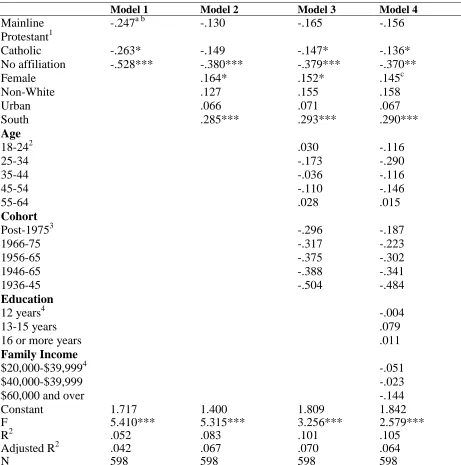
The first set of OLS regressions tests Hypotheses 1b, 2b, and 2c. The set includes two
separate regressions on family income (for socioeconomic status), the religiosity index, and
views on premarital sex (for moral strictness) for the population of cohabitors. Using four
10
models, the first model enters three religious identities (conservative Protestant is the reference),
while the second enters background controls (female, race, urban, and region). The third controls
for age and cohort. The final model controls for education and family income, with income
dropped in the socioeconomic regression. The hypotheses are supported if other religious
identities have higher family income, but less religiosity and less strictness on premarital sex
than for conservative Protestants.
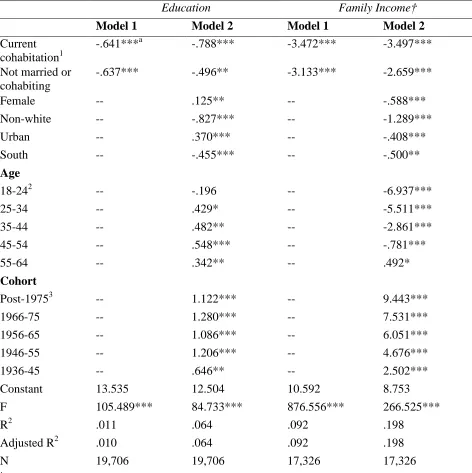
The second set of regressions tests Hypothesis 1a by predicting education and family
income for the population. Introduced in two models, education and family income are
separately regressed on union type (current cohabitation and not cohabiting or married with
married as the reference) in the first model. The second model in each regression introduces
controls for the background variables, and age and cohort. The hypothesis is supported if
cohabitation predicts lower education and income.
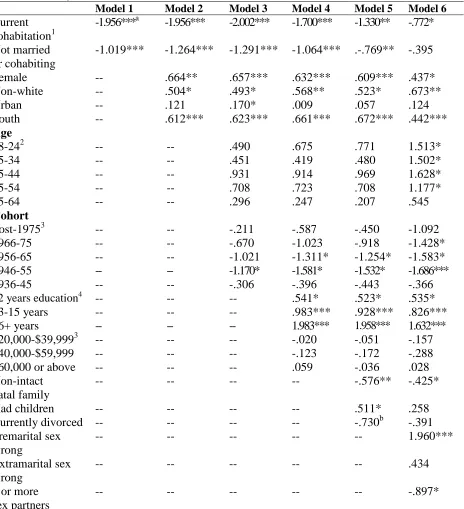
Finally, the third set of OLS regressions test Hypotheses 2a and 2d. It regresses religious
attendance and the religiosity index on union type for the population of conservative Protestants.
Using six models, the first is for union type as in the previous regression. The second model is
for background controls; the third for age and cohort controls. Model 4 enters education and
family income. In Model 5, the social variables for non-intact natal family, having had children,
and currently divorced are entered, followed in the sixth model by sexual variables (premarital
and extramarital sex, and sexual activity). The hypotheses are supported if cohabitors have lower
religiosity in comparison to married persons, and if the socioeconomic, social, and sexual
leniency variables associated with cohabitation statistically account for their loss in religiosity.
The bivariate table of the proportions of union types by religious identity supports
proportions tables, comparing variables among four religious identities, provides support for
hypothesis 1b, the relative status of conservative Protestant cohabitors to those of other religious
identities; the second means and proportions table provides support for Hypothesis 2a, the
relative status of conservative Protestant married and cohabiting persons to each other.
Finally, if all or most of the hypotheses are supported, evidence is provided that
socioeconomic location is the principal cause for cohabitation by conservative Protestants, and
that the adoption of cohabitation represents a cultural adaptation by conservative Protestants, as
described by Swidler, rather than a choice between religion and non-religion, as would be
6.RESULTS
In this section, I present and analyze the results of the six OLS regressions, as well as the
three descriptive tables, and the support they provide to the seven hypotheses which this thesis
proposes. The presentation and analysis is organized in three parts. First, I look at the rates of
cohabitation (and marriage) among the four religious identities: Conservative Protestant,
mainline Protestant, Catholic, and no affiliation. Second, I present and analyze the results for
cohabitor characteristics, including socioeconomic status, social and sexual factors, and
religiosity, among the four religious identities. Third, and finally, I examine the social,
economic, and religious differences between persons in married and cohabiting unions, and then
the differences between conservative Protestant persons in married and cohabiting unions.
Rates of Cohabitation
Showing the proportion of marital and cohabiting unions among the four religious
identities, Table 1 fails to confirm that conservative Protestants have a greater propensity to
cohabit than among other religious identities, as Hypothesis 1c holds. In fact, conservative
Protestants have a lower rate of current cohabitation (5.5%) than the population (6.4%), a
difference that is significant. Non-affiliates have a higher rate of current cohabitation (11.1%), a