Modified Energy Proficient ACO based LEACH
Protocol in Wireless Sensor Network
Renu Jangra1, Ramesh Kait2
1, 2
Kurukshetra University
Abstract:The key issue in a wireless sensor network is how to save energy for sensor nodes so that they can actively work for a long time. Many clustering protocols have been designed to overcome the issues related to power. One among them is theleach protocol. In this paper, we have proposed the energy resourceful protocol named as modified ACO leach protocol (MALP) compared with the traditional leach protocol. The proposed algorithm uses the term number of nodes, residual energy, and pheromone value in cluster head selection probability formula. The comparisons run on Matlab and simulation results conclude that MALP saves the energy of sensor nodes and its execution time andhence increasing the lifetime of the sensor network. Keywords: Leach Protocol; Wireless Sensor Network (WSN); Modified ACO leach protocol (MALP); Cluster Head;
I. INTRODUCTION
Wireless Sensor Network is a network that contains a base station and thousands of sensor nodes to analyze the environmental conditions like temperature, pressure, motion and so on. The sensor nodes are communicated with each other through the help of a base station and the wireless radios. The object that does the work of sensing is named as sensor. These sensors have the capability of converting material things into signals which can easily be analyzed and calculated. The size, physical security, power, memory space, unreliable communications, low costs, energy efficient, are the characteristics of wireless sensor network. Beyond that there are many issues regarding deployment of nodes, power consumption, heterogeneity of network, a topology of the network, reliabilityandscalability, medium of transmission etc that have been faced by the wireless sensor network. Among these challenges, the power management issue is also the main concern. The wireless sensor network requires the power stability throughout the network. Batteries are used for power in the nodes. But, the discharge of power in batteries is more which degrades the network lifetime. Frequently usage of battery power degrades the life span of the whole network. The classification of routing protocols in WSN is based on style of functioning of nodes; the way of nodes participated in the network; and the network structure. So, the routing protocol is divided into hierarchical, data centric, and location based on the basis of the network structure. The hierarchical routing protocols have energy efficient routing. Many algorithms come under this category [12]. The Researchers have been developed so many power-efficient algorithms like LEACH, PEGASIS, TEEN, APTEEN, HPAR etc to recover from the power issue; LEACH (Low Energy Adaptive Clustering Hierarchy) is one among them.
A. Leach Protocol
Leach protocol uses a hierarchical topology comes under the category of the hierarchical network. Heinzelman .et al. [16] has proposed that a cluster contains more than two nodes andsize of cluster varies according to the size of the network. To manage the power in the network one cluster head is selected randomly based on round robin policy from all the nodes. Every node gets the chance to become a cluster head. Leach is a self-organizing network which is considered as a protocol that uses the random distribution of energy between the nodes. The dense network made by thousand of nodes has been divided into the cluster with the same size. The nodes of the cluster head have been categorized as coordinate nodes, cluster member, normal nodes. By using the TDMA schedule, the related data is composed of the sensor node. If any node becomes the cluster head (CH) continuously, its energy starts to exhaust. To avoid such situation, other nodes also get the chance to become the cluster head after each particular round or after some specific time. The entire sensor node in a cluster, forward their data to the cluster head and the CH collect the data from its entire member nodes. Finally, cluster head combines the data and forward this data to the base station for further process [1].The operation of Leach is split into two phases: 1. Setup Phase; 2. Steady State.
T (n) = p/ 1−p× (r mod1/p) if n ∈ G (1) 0 otherwise
Where G is the group of nodes which are not selected as CH in last 1/p round; r is a current round of the process; p is the probability for cluster head and n is the node. Leach protocol is associated with rounds, after every cycle or 1/p rounds all the nodes are eligible for taking part in the selection process of the cluster head. Thus, every node gets the same chance of becoming a cluster head. 2) Steady State Phase: Once the cluster is formed in the first setup phase, based on Time Division Multiple Access (TDMA)
schedule, cluster head is allocated to all the member nodes of the cluster. On the basis of this schedule, the nodes send their related data to their particular CH. After receiving the data from nodes, CH calculates the sum of its own data and data that comes from other nodes. Then, it transmits this aggregated value to the base station [2]. The time taken by steady state phase is higher than setup phase. After every round, the new CHs are selected and the timeline operation composed of steady-state phase and setup phase is applicable.
II. LITERATURE SURVEY
T. GAO .et.al [3] proposed an algorithm EERMA to work on the huge scale of cluster-based wireless sensor networks by selecting the best nodes as cluster head based on their energy. This removes the problem of classical clustering algorithm of loosing energy too early. In proposed algorithm to avoid a collision and for equal selection of cluster head from nodes, density method, and the improved antnet algorithm is used. The simulation result showed that EERMA has better long lifetime than the LEACH type algorithms.
T. Jiang .et.al [4] suggested an algorithm based on radio-free space path loss to solve the problem of uneven energy consumption. The BACCA algorithm in distance and energy pheromones were calculated on the basis of remaining energy and aggregation of the sensor nodes. Simulation experiments presented that the proposed algorithm is better than LEACH and ACDCHA in terms of lifetime and energy dissipation.
L. M. hua .et.al [5] presented an algorithm based on Leach and ant colony principle with energy factor. Ant colony found the optimal path and new algorithm reduced the energy of cluster head and calculated energy usage when computing probability of next hop. Their work showed the best results from proposed algorithms in terms of energy usage and lifetime of the network.
Nishi and Vandna [6] presented a protocol which was heterogeneous in energy and analyzed the impact of this heterogeneity of energy of nodes in WSN. This showed the better lifetime of WSN when compared with LEACH protocol.
J. Y. Kim .et.al [7] gave an algorithm IC-ACO that used ACO concept for routing the packets in network. That also saved the energy which was wasted in the transfer of redundant data between the nodes. The results ensured more energy efficiency, extended network lifetime and improved stability period.
A. Mohajerani and D. Gharavian [8] solved the difficulty of power by inventing the algorithm called LTAWSN (Lifetime aware routing algorithm for wireless sensor networks) that used the special parameters in fitness function and new pheromone update operator to reduce energy. Comparison results of LTAWSN with other ant based routing algorithm showed that the proposed algorithm increasedthe stability and lifetime of the network. Thatalso lessened the power consumption hence enhancethe network lifespan. Saurav.et.al [9] proposed a proactive HRP LEACH-DS-ACO algorithm by making some modification in basic leach. A dominating set was obtained by applying dominating set formulation on the cluster; from which a cluster chain was implemented by ACO. A chain leader was also elected based on distance from base station and residual energy. The proposed algorithm showed better simulation results in terms of balanced load and network’s lifetime when compared with LEACH; LEACH-C; and PEGASIS. For better energy efficiency Annu Ghotra [10] proposed an algorithm that improved 30% of network’s lifetime and accurate delivery of packets as compared to the existing algorithm by constructing the path in WSN by sink mobility. Optimization problems were also solved using inter-ACO with the mobile sink and rendezvous nodes.
ETX (k, d) = k * Ee + k * Efs * d2, d < d0 (2) ETX (k, d) = k * Ee + k * Eamp * d4, d ≥ d0 ERX (k, d) = k * Ee
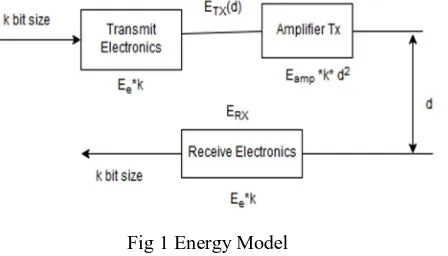
[image:3.612.202.426.216.344.2]Where ETX is the energy consumed by the transmitter to transmit the message of k bit in size, ETX is the energy consumed by the receiver to receive the message of k bit in size, Ee is the electronic energy consumed by the circuitry machine to sent one bit of data during transmitting and receiving. The Ee depends on the features like filtering, modulation, digital coding, distance from the receiver and the bit rate [14]. In energy model asshown in Fig: 1; the transmitter loses energy in power amplification and to run the radio electronics; and receiver loses energy in execution of radio electronics. Both free space and multipath model are used and both depend on the distance between the receiver and the transmitter. Efs and Eamp are parameters of amplification energy during transmission in free space model and multipath model, respectively. Threshold distance is represented by d0.
Fig 1 Energy Model d0 = √ Efs/ Eamp
If d≤d0 then free space model is considered and energy consumption is multiple of d2. If d>d0 then the multipath model is considered and energy consumption is multiple of d4.
2) Ant Colony Optimization: The ACO is a meta-heuristic technique that is based on the behaviour and exploring capability of real ants. The main idea behind ACO is the indirect communication among ants with the help of pheromone trails. The pheromone is the chemical release by ants during exploration in search of food. The pheromone helps to find the shortest path from their home to the food. The ACO algorithms are based on the same concept. The path which has more pheromone concentration has more number of ants. So, it attracts more ants to follow the same path and gives the probability of finding the shortest path [13] [15].
3) Modified ACO Leach Protocol: Wireless Sensor network faces the complex issues regarding the management of energy in sensor nodes. Many algorithms have been designed by researchers to resolve the related concern. Leach protocol saves energy to a great extent because of the direct communication of nodes with the base station. It has improved the network lifetime around eight times than the direct transmission [11]. Instead of this, the basic leach protocol suffers from the weakness of randomly selecting the cluster head and energy consumption. The cluster head isselected randomly after few rounds in leach. Residual energy of nodes varies; the nodes which are at more distance from the base station consume more energy comparative to the other for the same length of data. When the same node is elected as cluster head then it dies soon as of low energy hence decreases the lifespan of the network. The proposed algorithm has been planned to proper manage the battery power of the sensor nodes and the selection of cluster head among the nodes is done by combining the existing Leach with the ACO concept. In the proposed algorithm, ACO is applied to find optimal path from nodes to the base station for efficient transmission. While choosing the cluster head, the current energy and the residual energy of a node is multiplied by the number of nodes because the node that is selected as cluster head has more battery power. ACO is used to find the optimum path between the nodes and the base station. The Optimal Election of probability of a node to become a cluster head has now given by:
ENR = (E0/Eres*No of Nodes) ^rho;
T (n) = p/ 1−p× (r mod1/p) * ENR if n ∈ G (3) Zero otherwise.
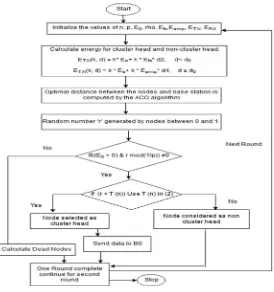
4) Proposed Algorithm Begin
(Set Up Phase)
a) Create the network and initialize the initial probability (p), number of nodes (n), Initial energy E0, rho, Efs, Eamp, ETX,ERX. b) Calculate energy consumption for cluster head and non cluster head by (2).
c) The optimal distance between the nodes and base station is computed by ACO algorithm.
d) If {(E0 > 0) and r mod (1/p)} ≠0 then that node is elected as the cluster head for that round otherwise considered as a node itself and go to step 8.
e) Cluster head advertises the messages to nodes (Steady Phase).
f) If the node is cluster head then it computes the received data from nodes aggregate it and send to the base station otherwise it is a node itself send data to the cluster head.
g) If (E0 < 0) then calculate dead nodes. h) One round completed End
5) Proposed Algorithm Flowchart
6) Experimental Result: Table 1 highlights the parameter values taken for simulation.
Parameter Values
Protocol Leach and MALP
Area of Network 100m * 100m
Ee 50nJ/bit
Efs 10pJ/bit/m4
Eamp 0.013pJ/bit/m4
E0 0.5 J/bit
Packet length (CH to BS) 6400 bytes Packet Length (nodes to CH) 200 bytes
[image:4.612.169.443.272.564.2]p 0.1
Figure 2 Network setup with Nodes and Base Station
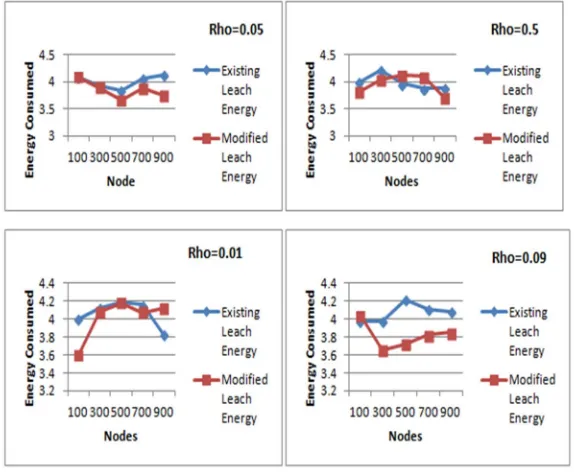
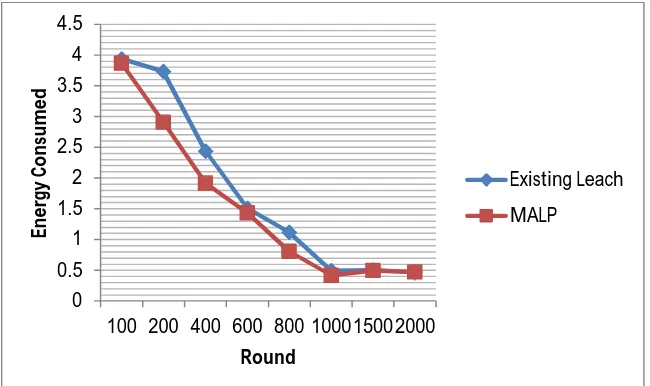
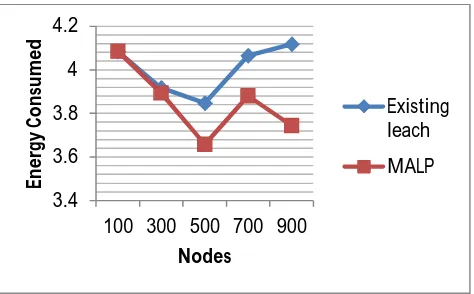
In figure 2, the setup of the network with nodes and base station are built through Matlab tool. The green dot represents the base station and the blue dot is nodes. In figure 3, The Simulation results are executed with parameter value number of rounds = 100 shows the energy consumed with varying number of nodes at different pheromone values (rho). Initially, we take some default value for rho parameter to execute the ACO algorithm. But, we want to set some optimal value as default value for rho in our experiment. So, plotted the graph for rho values (0.05, 0.5, 0.01, and 0.9) between leach and modified ACO leach protocol (MALP), the comparison at rho values 0.05 and 0.09 depicts the optimal values. The rest simulation results are executed on rho value 0.05. In figure 4, the different round, the comparison is done between existing leach and MALP to show the energy consumed by the nodes and is found to be less in case of MALP. In figure 5, the dead nodes are calculated for both existing leach and MALP and are compared. For MALP, dead nodes are mainly less than existing leach. In figure 6, the execution time is computed for leach and MALP for different rounds and takes less time in case of MALP. In figure 7, energy consumed in MALP is less than existing leach at different nodes. In figure 8, the time taken by MALP is less than existing leach at different nodes.
[image:5.612.162.449.464.700.2]Figure 4 Comparison of Energy consumed at different rounds between Existing Leach and MALP.
[image:6.612.144.469.76.269.2]Figure 5 Comparison of dead nodes at different rounds between Existing Leach and MALP.
Figure 6 Comparison of Execution Time at different rounds between Existing Leach and MALP. 0 0.5 1 1.5 2 2.5 3 3.5 4 4.5
100 200 400 600 800 100015002000
En e rg y C o n su m ed Round Existing Leach MALP 0 1 2 3 4 5 6 7 8 9 10
100 200 400 600 800 100015002000
D e ad N o d es Round Existing Leach MALP 0 1000 2000 3000 4000 5000 6000
100 200 400 600 800 100015002000
Figure 7 Comparison of Energy Consumed by different nodes between Existing Leach and MALP.
Figure 8 Comparison of Execution Time at different nodes between Existing Leach and MALP.
III. CONCLUSION
The main major concern in wireless sensor network is best energy utilization in sensor node by making it more efficient using proposed algorithm MALP. By enhancing the cluster head probability selection formula and using the ACO approach in the selection of the optimal path between the cluster head and base station, MALP handles the proper energy utilization, better execution time and increment in the lifespan of the network. Hence, the overall performance of MALP is better than the existing LEACH.
REFERENCES
[1] Qian Liao, Hao Zhu,” An Energy Balanced Clustering Algorithm Based on LEACH Protocol”, Proceedings of the 2nd International Conference On Systems Engineering and Modeling ICSEM-13, France, pp 0072-0077, 2013.
[2] Salim EL KHEDIRI, Nejah NASRI, Anne WEI, Abdennaceur KACHOURI,” A New Approach for Clustering in Wireless Sensors Networks Based on LEACH”, International Workshop on Wireless Networks and Energy Saving Techniques WNTEST, Elsevier, pp 1180-1185, 2014.
[3] TENG GAO, RENCHENG JIN, TAIBING XU, LIDINGWANG”, Energy-Efficient Hierarchical Routing for Wireless Sensor Networks”, Ad Hoc & Sensor Wireless Networks, Vol. 11, pp. 35–72, 2010.
[4] Ting Jiang, Wei Zang, Chenglin Zhao and Jiong Shi,” An Energy Consumption Optimized Clustering Algorithm for Radar Sensor Networks Based on an Ant Colony Algorithm”, EURASIP Journal on Wireless Communications and Networking, 7 pages, 2010.
[5] Liao Ming-hua, Zhang Hua, Sun Guang, “Energy Aware Routing Algorithm for Wireless Sensor Network Based on Ant Colony Principle”, Journal of Convergence Information Technology (JCIT), Volume 7, Number 4, pp 215-221, March 2012.
[6] Nishi Sharma and Vandna Verma, “Heterogeneous LEACH Protocol for Wireless Sensor Networks”, International Journal Advanced Networking and Applications, Volume 05, Issue 01, pp 1825-1829, 2013
[7] Jung-Yoon Kim, Tripti Sharma, Brijesh Kumar, G. S. Tomar,Karan Berry and Won-Hyung Lee, ”Intercluster Ant Colony Optimization Algorithm for Wireless Sensor Network in Dense Environment”, International Journal of Distributed Sensor Networks, 10 pages, 2014
[8] Abdolreza Mohajerani, Davood Gharavian,” An ant colony optimization based routing algorithm for extending network lifetime in wireless sensor networks”, Journal of Wireless Network, Springer, New York, pp 2637-2647, 2015.
3.4 3.6 3.8 4 4.2
100 300 500 700 900
[9] Saurav Ghosh, Sanjoy Mondal, Utpal Biswas,” A Dominating Set based modified LEACH using Ant Colony Optimization for data gathering in WSN”, International Conference on Advances in Electrical, Electronics, Information, Communication and Bio-Informatics (AEEICB16), IEEE, 2016.
[10] Annu Ghotra, ”Optimization Data Aggregation Algorithm with Rendezvous Nodes and Mobile Sink” , Wireless Sensor Network, pp 16-24, 2017.
[11] Payal Khurana Batra and Krishna Kant,” Stable Cluster Head Selection in LEACH Protocol: A Cross-Layer Approach”, Proceeding of the 7th ACM India
Computing Conference, Nagpur, 2014
[12] Renu Jangra and Ramesh Kait, “ Principles and Concepts of Wireless Sensor Network and Ant Colony Optimization: A Review”, International Journal of Advanced Research in Computer Science, Volume 8, No. 5, pp 1180-1191,2017
[13] Renu Jangra and Ramesh Kait, “ACO Parameters Analysis of TSP Problem”, International Journal of Computer Science and Mobile Applications, Vol.5 Issue. 8, pp 24-29, 2017
[14] JOAO C. GIACOMIN, LUIZH. A. CORREIA, TALES HEIMFARTH, GERALDO M. PEREIRA, VINICIUS F. SILVA, JOAO L. P. DE SANTANA, “Radio Channel Model of Wireless Sensor Networks Operating in 2.4 GHz ISM Band”.
[15] Renu Jangra and Ramesh Kait, “Ant Colony Algorithms: A Brief Review and Its Implementation”, International Journal of Scientific & Engineering Research, Volume 7, Issue 12, pp 332-337, 2016