An Oracle Solution Brief September 2012
Process-Centric Banking:
The Promise of BPM Technology for
Financial Services Institutions
Disclaimer
The following is intended to outline our general product direction. It is intended for information purposes only, and may not be incorporated into any contract. It is not a commitment to deliver any material, code, or functionality, and should not be relied upon in making purchasing decisions. The development, release, and timing of any features or functionality described for Oracle’s products remains at the sole discretion of Oracle.
Process-Centric Banking: The Promise of BPM Technology for Financial Services Institutions
Introduction ... 4
Introducing Oracle Business Process Management ... 5
Use Case #1: Loan Origination ... 6
Use Case #2: Credit Card Dispute Resolution ... 7
Use Case #3: Payment Processing ... 8
Use Case #4: Risk and Compliance ... 10
Getting Started with BPM Technology ... 11
Integration with SOA ... 11
Introduction
For many financial institutions, the rapid pace of innovation, coupled with geographic expansion, has resulted in many new back-office, mid-office, and front-office business processes. These processes are often at the heart of the enterprise and are the basis for what differentiates one financial services institution from another.
These business processes are not confined to one set of data or one discrete information system. They are better described as multifaceted implementations of real-world activities— logically organized steps that span multiple IT systems, departments, and roles. Some activities are automated and performed by machines; others are manual and performed by people, both inside and outside of the company.
Unfortunately, due to continually shifting business needs and an unpredictable regulatory landscape, many of these fundamental business processes have become difficult to use, error prone, and inefficient. Social, organizational, and technical barriers inhibit innovation and result in accidental breaches, increased vulnerability to regulatory inadequacies, and, in some cases outright process breakdowns.
Business needs and regulatory requirements inevitably outgrow even the most comprehensive packaged or custom-built business application. Processes that originally resided within an application eventually “spill outside” the application boundary. It is precisely at such hand-offs that vulnerabilities arise, either between applications or between overlaying processes, sometimes called “shadow processes.”
These “extra application” gaps constitute a latent operational risk that spans the end-to-end value chain. For instance, distortion of data flowing from an account-opening application to a credit-rating system, if left un-checked, renders compliance with Know Your Customer (KYC) policies void even when the KYC checklist was enforced at the time of data capture by the account-opening application.
Process-Centric Banking: The Promise of BPM Technology for Financial Services Institutions
Introducing Oracle Business Process Management
To create new business processes and improve existing ones, many financial institutions are deploying Oracle Business Process Management (BPM) Suite, a set of tools for business managers, business analysts and developers that enables the efficient management of all types of business processes.
Oracle BPM Suite 11g is ideal for modeling, simulating, executing, and optimizing, business processes across divisions, systems, and applications. They provide a methodology and supporting tools to model and analyze business processes in a nontechnical, business-friendly manner, along with technology for implementing, executing, and monitoring end-to-end processes.
Oracle’s comprehensive BPM technology enables complete introspection into business processes so analysts can predict, architect, and enable interactions in ways that don’t slow down the cycle or interrupt the flow. They can model processes by defining the logical structure and sequence of the process itself, rather than its underlying technical implementation—without any technical knowledge of SOA, Web services, or XML.
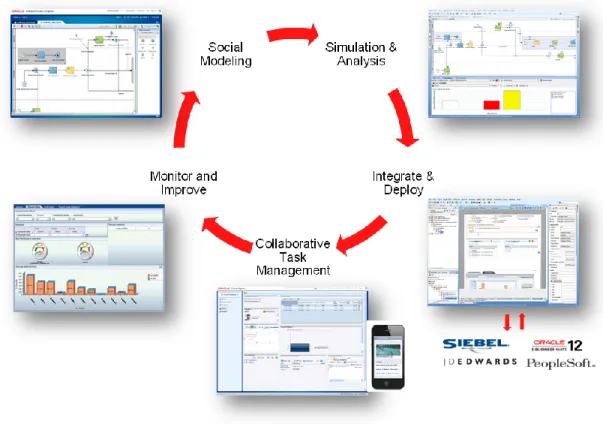
Oracle developed a unified process foundation that simplifies and removes complexity from process development, deployment, monitoring, and execution. In addition, Social BPM interaction simplifies collaboration by incorporating the latest in social computing technologies and enabling a wide choice of communications channels, enabling continuous improvement as shown below.
Figure 1. Continuous improvement across multiple channels via Oracle BPM Suite
This unique BPM toolset enables financial institutions to lower the risk of process “gaps” within common financial services processes including Customer On-boarding, Payment Processing, Quote-to-Contract, Deposit/Loan Origination, Trade Exceptions, Regulatory Compliance, Risk Management, and
Interest Claim Tracking. Oracle BPM facilitates compliance and reduces risk by increasing visibility into these essential business processes while also improving efficiency.
Use Case #1: Loan Origination
Customers use many different channels to communicate with the bank throughout the loan origination cycle (internet banking, email, fax, branch visits, phone calls, mobile apps, and the U.S. Postal Service, to name the most common ones). Customers expect a rapid turnaround with minimal loan processing fees, yet this multi-channel interaction makes it difficult for banks to deliver a consistent experience. It is extremely easy for customers to move from one bank to another in response to highly attractive offers. So if the customer is dissatisfied, he or she might quickly defect.
Banks must accommodate customer demands by enforcing fast and accurate loan origination processes, while maintaining enough flexibility to react to market changes. How quickly can the bank respond when the central bank changes its rates? How easily can it address new audit rules and generate compliance reports? How efficiently can the bank’s underwriters and risk analysts adjust policies and calculate necessary reserves?
Each of these items impacts the loan application cycle. While common transactions in that cycle are automated, the smallest variant can stall an application in the queue until a banker or loan officer can address the issue. For example, what happens if the applicant has a change of status midstream, perhaps losing a job or filing for bankruptcy. These dynamics put many banks into a quandary: on the one hand, increasing the use of electronic communication and enforcing online transactions simplifies the process. However, once these electronic wheels are in motion, customer service representatives lose touch with the process and don’t always know when to manually intervene to address unique issues.
Loan origination includes a series of steps from the time a customer shows interest in a loan product all the way to disbursing funds (or declining the application). The basic steps in this process are as follows:
Define customer needs
Analyze loan options
Calculate rates and payments
Verify customer identity
Review risk profiles
Accept application data
Conduct customer credit verifications
Initiate legal review process
Coordinate appraisals
Write title insurance policies
Monitor customer registration
Generate loan disclosures
Interact with escrow officers
Sign loan documents
Process-Centric Banking: The Promise of BPM Technology for Financial Services Institutions
Hand off to loan servicers
Some of these steps can be automated with machine-to-machine connections, but loan officers also need visibility into the process to make notes, approve exceptions, and track a host of variables. BPM provides a framework for “decoupling” and synchronizing automated loan origination processes and discrete sub processes so that the bank’s representatives can easily interact and maintain control throughout the loan origination cycle.
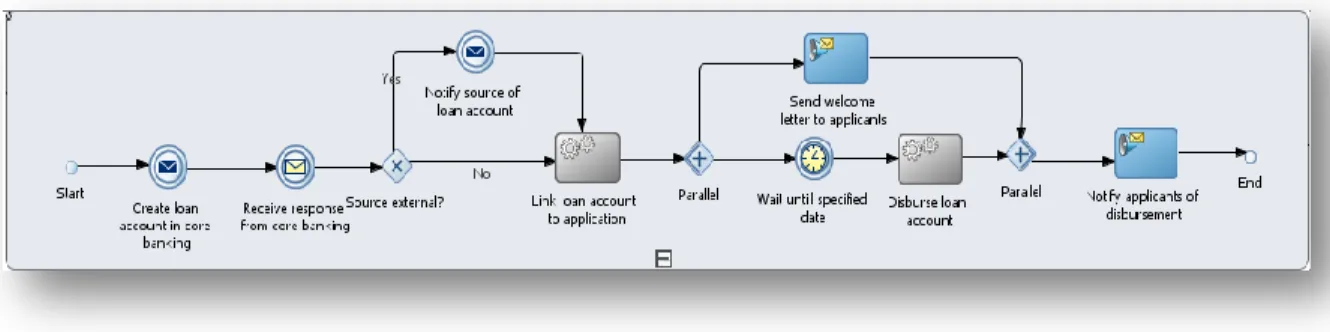
Oracle BPM Suite 11g is very conducive to this type of top-down, business-driven process modeling, since it includes both a business modeling tool (Oracle Business Process Composer) and an IT-oriented tool (BPM Studio). Support for the BPMN 2.0 standard makes it easy to break processes into sub-processes and tasks. For example, the details for the “Create and Disburse Loan” task are shown below:
Figure 2. An illustration of how easy it is to understand and define a loan origination process using Oracle’s process composer
Use Case #2: Credit Card Dispute Resolution
Another common financial services scenario involves resolving credit card disputes. The typical process is as follows:
Cardholder reports an unauthorized transaction on his or her statement
A customer service rep logs the incident as a particular type of dispute
A customer service rep creates a new dispute case
Customer service rep requests a signed affidavit from the cardholder
Once this document is received, the rep assigns the case to a dispute analyst
Dispute analyst requests a sales draft from the merchant.
Card holder signature matching
Issue a chargeback
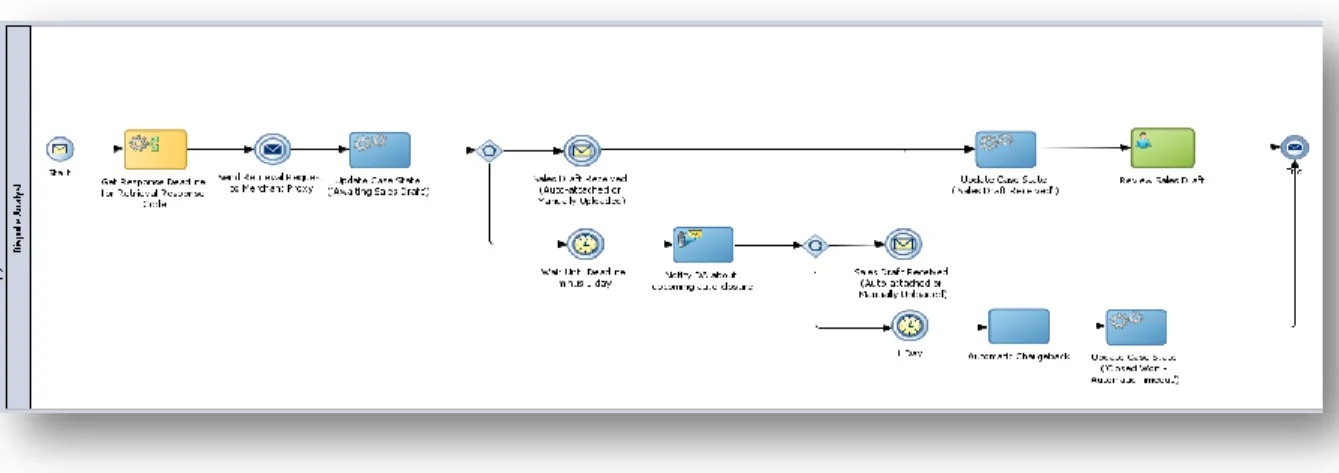
Close case with all associated details (reason code, explanation, cardholder’s affidavit, etc.) While going through there steps various participants have to make multiple decisions. The figure below shows a BPM process model, revealing steps a dispute analyst may follow.
Figure 3. Automating the process of resolving credit card disputes
In addition to unauthorized transaction, disputes might involve a card holder who has been charged more than once for same purchase, who paid by other means and yet was still charged, who was billed an incorrect amount, or who did not received the merchandize/service in question. Each type of dispute has different needs related to the type of data collected, the required documents from cardholders and merchants, the mandated time limits, and the chargeback requirements.
Based on these variables, dispute analysts make informed, discretionary, or judgment calls. For example, an analyst might decide to write-off the charge, engage the fraud department, or request arbitration if the dispute cannot be resolved satisfactorily. A case might be escalated to a customer service manager, dispute department manager, or fraud investigator. The analyst might also utilize a social media interface to confer with colleagues about similar cases, to obtain policy clarification, or to report other issues. These dispute cases need to be resolved efficiently to ensure customer satisfaction, meet regulatory mandates, and minimize additional fraud associated with the account. Unfortunately, given the many variables associated with each case, credit card dispute resolution is often a time-consuming manual process. Inconsistencies among merchant practices, credit card policies, and cardholder guidelines make it difficult for banks and credit unions to automate the resolution process.
BPM technology can reduce costs and speed up processing by coordinating the initiation, handoff, and completion of each step in the dispute resolution process—streamlining the workflow among
departments and integrating the required information.
Use Case #3: Payment Processing
These same dynamics apply to other financial processes, such as setting up a corporate payment system. Payment processing is a central activity for financial institutions, especially retail banks and intermediaries that provided clearing and settlement services. These institutions need visibility into these processes to track payments and handle exceptions as transactions flow from initiation to settlement. However, processing payments has become more challenging due to increased numbers and types of payments, operational challenges such as complex systems and organizational silos, and a lack of visibility into semi-automated processes.
Process-Centric Banking: The Promise of BPM Technology for Financial Services Institutions
When a company’s treasury department interacts with the bank, there are several daily activities that require oversight:
Retrieving beginning of day totals
Monitoring cash accounts
Sending or receiving cash between accounts
Making supply chain payments
Initiating payment settlements
Calculating settlement positions
Retrieving end of day totals
Assessing the financial impact of the cumulative transactions
From the bank’s perspective, common activities include:
Managing various formats of data arriving from customers
Processing beginning of day and end of day reporting requests
Meeting compliance requirements
Processing payments
Transmitting payment status updates
Oracle BPM Suite 11g helps financial institutions to build shared processes that unify existing payments systems across internal and external interfaces in a timely and cost efficient manner. By modeling these processes as a succession of events that are triggered and invoked by different systems, business analysts can establish a chronological view of the payments flow, as shown below:
Figure 4. Establishing a chronological view of the payments flow as a precursor to BPM
For example, the objective of Straight Through Processing (STP) is to automate the trade process for capital markets and payments, so that these transactions can be conducted electronically without the need for re-keying or manual intervention. STP concerns the fundamental interaction between a bank and its corporate customers, which depend on electronic payment solutions to connect their ERP systems into the bank’s payment hub. But even though payment processes are highly automated, there are additional dimensions to these transactions that may require manual intervention.
Use Case #4: Risk and Compliance
Competitive advantage stems from being able to efficiently comply with regulatory mandates, wither it is Sarbanes Oxley, KYC, BASEL II, MiFiD, and other mandates. It’s not easy to keep up. These regulations are dynamic in nature. Risk officers need to respond quickly or their companies can face dire
consequences, from punitive fines to jail time for executives.
Unfortunately, process inconsistencies across lines-of-business, customer channels and product/service offerings make it difficult for risk officers to enforce standardized methodologies. Short of outright errors, breaches, or failures, process inconsistencies present a “drag effect” that manifests itself in several ways:
Increased time and cost of compliance due to duplication of effort in conforming to regulatory requirements
Delays in audit reporting due to quality issues in reconciling non-standard
Integrity concerns arising from the need to rely on multiple data sources for a given process
Exposure to fines and penalties by regulatory agencies such as the SEC
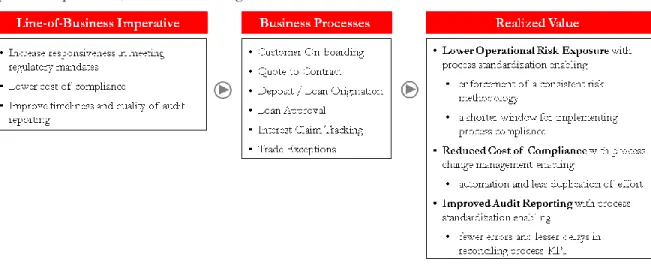
BPM can reduce the risk and costs associated with compliance by aligning finance, line-of-business, and operational processes, as shown in the figure below:
Figure 5. Mitigating risk by aligning finance, line-of-business, and operational processes
While many of these activities are automated with modern software applications, essential business processes inevitably evolve to extend outside of application boundaries. It is precisely at these hands-offs
Process-Centric Banking: The Promise of BPM Technology for Financial Services Institutions
between applications and overlaying processes where vulnerability to unknown and accidental faults can occur.
Oracle Business Process Management helps you to lower the operational risk of these process gaps by enabling business-driven process change management, so you can meet regulatory requirements in a timely and cost-efficient manner. It ensures that all the appropriate steps, rules and policies are followed, with consistent document collection, automatic alerts if something is amiss, and rapid trace and audit capabilities to record and review each step in the cycle.
Getting Started with BPM Technology
The combination of Oracle Business Process Management Suite 11g and Oracle SOA Suite 11g provides everything organizations need to implement, execute, and monitor end-to-end business processes as well as individual sub-processes and tasks. As part of the Oracle Fusion Middleware family, these products are based on industry standards and provide “design time at runtime” support to allow for dynamic,
business-driven, on-the-fly reconfiguration and restructuring of business processes.
To speed up BPM deployments, Oracle is creating Process Accelerators that embody best practices and serve as blueprints for developing common Financial Services processes, such as Loan Origination, Credit Card Dispute Resolution, and Payment Processing. Process Accelerators can be deployed as-is or extended to meet customer-specific requirements. Oracle Process Accelerators improve the learning curve associated with adopting BPM technology, serving as a launching pad for critical business processes.
These interrelated tools enable financial services organizations to complete their process management initiatives faster and to embrace best practices with lower risk. By modeling data and process interactions among applications and user-channels, BPM helps institutions to mitigate unknown and accidental faults, eliminating the errors and that can lead to partial or total process failures.
Integration with SOA
Service-oriented architecture (SOA) has become a popular method for linking disparate applications across many different business lines and functions, thereby centralizing and improving process efficiency. SOA interoperates with all parts of the IT architecture to integrate business applications, moving them on to a common service bus and a common workflow engine. It brings reusability to the IT
infrastructure, but how can you leverage this IT infrastructure efficiently while accommodating human intervention and introspection at key junctures within the business process?
This is where BPM technology comes in. It is the vehicle that business analysts use to optimize a process, improve visibility, check statistics, perform activity monitoring, combine elements of social collaboration, and a host of other tasks. If an issue arises that requires intervention—such as when a payment goes through the ERP system, and you need to intervene to send a note or collaborate via a portal—BPM lets you set this up, quickly and easily.
Oracle BPM Studio works with Oracle SOA Suite to create end to end business processes that can be triggered, executed, and monitored from browser-based Web interfaces. Another browser-based
application, called BPM Composer offers insight into BPM process definitions and enables business analysts to document and edit these definitions online.
Analyzing and modeling business processes with these Oracle tools can lead to a seamless
implementation of process activities through services and human tasks. Execution of process instances is centrally coordinated and monitored—allowing for real-time insight into exceptions and bottlenecks as well as on-the-fly intervention and improvements within the process flow. If there are regulatory or policy changes, adjustments can be done quickly.
Conclusion
Outdated information systems prevent financial institutions from offering targeted and differentiated products on a timely basis. In a day and age when it is essential for companies to quickly launch targeted products in order to remain competitive, rigid business processes and outdated systems hold them back. The promise of greater efficiency, business visibility, and agility in process management is driving many financial services organizations to invest in BPM software. Interest in BPM is increasing rapidly, with organizations moving their focus from lower infrastructure layers to higher layers of abstraction. Oracle BPM removes complexity from process development, deployment, monitoring, and execution with a unified process engine and pre-integration of process subsystems. It enables organizations to rethink the way IT supports the business, by focusing on modeling business processes that span roles, departments, and enterprise resources.
Process-Centric Banking: The Promise of BPM Technology for Financial Services Institutions
Process-Centric Banking: The Promise of BPM Technology for Financial Services Institutions September 2012
Oracle Corporation World Headquarters 500 Oracle Parkway Redwood Shores, CA 94065 U.S.A.
Worldwide Inquiries: Phone: +1.650.506.7000 Fax: +1.650.506.7200
oracle.com
Copyright © 2012, Oracle and/or its affiliates. All rights reserved. This document is provided for information purposes only and the contents hereof are subject to change without notice. This document is not warranted to be error-free, nor subject to any other warranties or conditions, whether expressed orally or implied in law, including implied warranties and conditions of merchantability or fitness for a particular purpose. We specifically disclaim any liability with respect to this document and no contractual obligations are formed either directly or indirectly by this document. This document may not be reproduced or transmitted in any form or by any means, electronic or mechanical, for any purpose, without our prior written permission.
Oracle and Java are registered trademarks of Oracle and/or its affiliates. Other names may be trademarks of their respective owners.
Intel and Intel Xeon are trademarks or registered trademarks of Intel Corporation. All SPARC trademarks are used under license and are trademarks or registered trademarks of SPARC International, Inc. AMD, Opteron, the AMD logo, and the AMD Opteron logo are trademarks or registered trademarks of Advanced Micro Devices. UNIX is a registered trademark of The Open Group. 0612