Planning and Performance
Management Framework
This document is available, on request, in accessible formats,Page
1. EXECUTIVE SUMMARY 2 – 3
l Planning
l Performance Management
2. PLANNING FRAMEWORK 4 - 6
l Strategic Direction
l Corporate Plan
l Trust Delivery Plan
l Annual Planning Cycle
3. SERVICE PRESSURES AND DEVELOPMENT PROPOSALS 7 - 9
l Service and Financial Pressures
l Service Development
l Business Cases
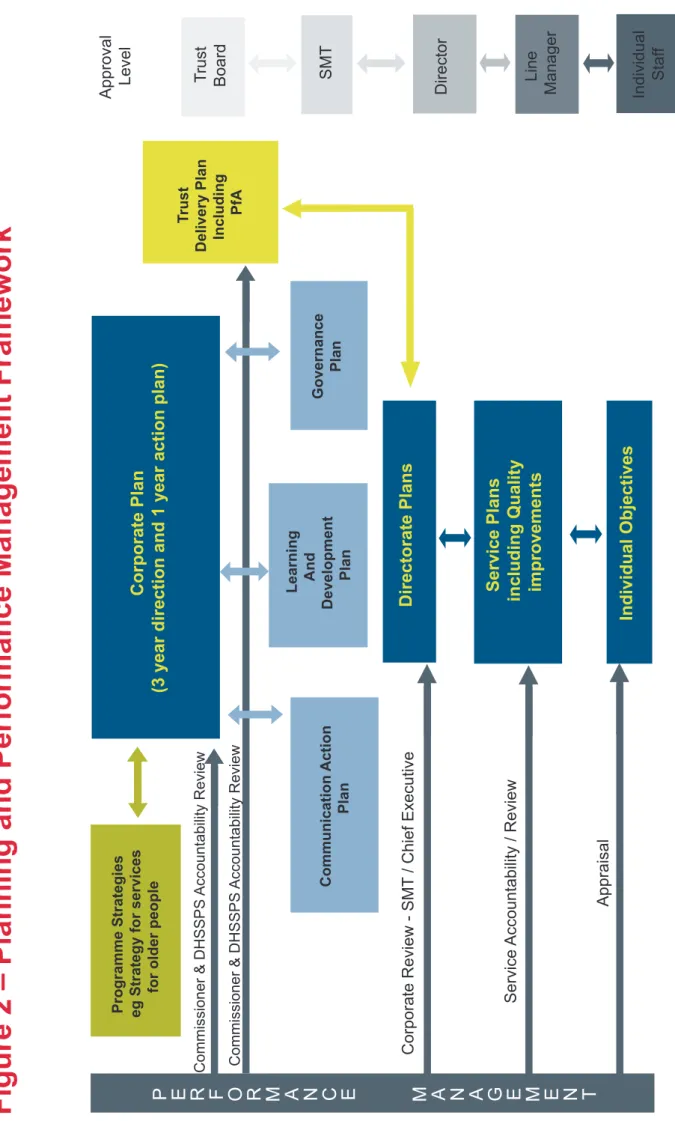
l Figure 2 – Planning and Performance Management Framework
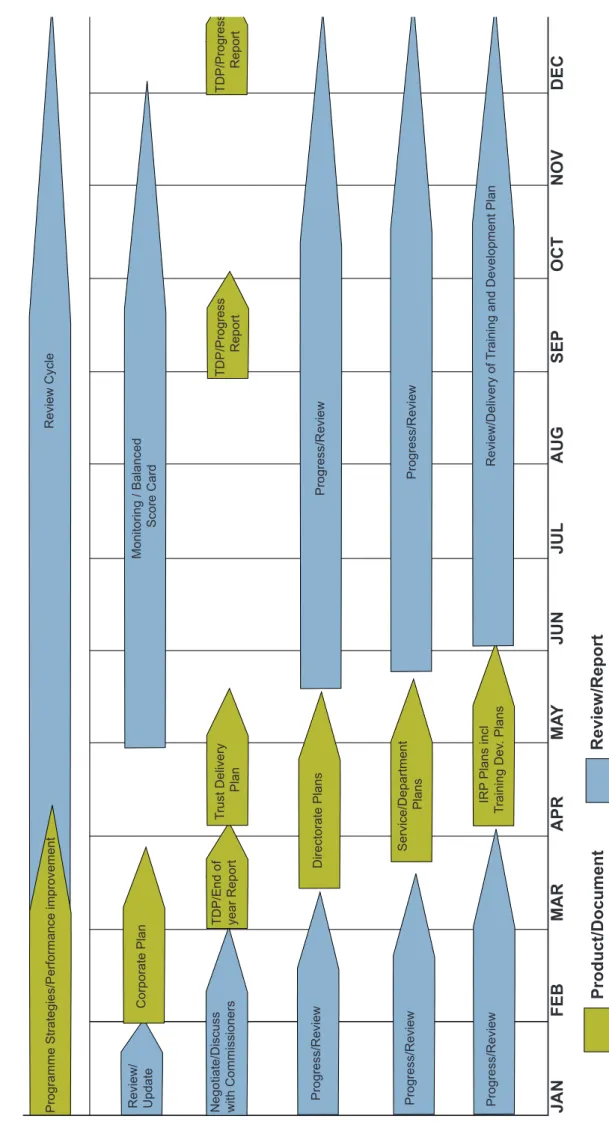
l Figure 3 – Planning: Timetable and Products
4. PERFORMANCE MANAGEMENT FRAMEWORK 10 - 12
l Trust Corporate and Delivery Plans: Organisational Accountability
l Directorate Plan – Objectives, Targets and Accountability
l Department/Service Plans – Involving the Team
l Individual Plans – Personal Accountability
l ProfessionalAccountability
5. MEASURING PROGRESS-BALANCED SCORECARD 13 – 14
APPENDICES 15 – 24
Appendix I Principal Corporate Goals
Appendix II Template for Directorate Plan
Appendix III Balanced Scorecard Template - Sample
Appendix IV Contact Details
Planning
The delivery of high quality, appropriate, effective and accessible health and social care
services, that are efficient and represent value for money, is the core business of the Trust. It is vital therefore that all the resources of the Trust, including it’s staff, skills, finance,
facilities and equipment are focused and aligned to this common goal and continually
seek to improve our performance in all these areas.
Effective organisational planning and service modernisation is a vital component in
pursuing continuous improvements. The Trust Planning Framework is made up of the
following elements to ensure a comprehensive and integrated process is adopted by all parts of the organisation:
l A direction of travel for the modernisation and future delivery of services, in hospital
and community settings, has been set out regionally and for the Northern Board area, focussing on supporting independent living, avoidance of hospitalised and
institutional care, and the availability of accessible services. Individual programmes
must consider the future provision of services in this context and set out plans that
take account of those regional, area and local drivers. Programme Strategies
such as those developing services for older people or those with disability as well
as regional performance targets drive the Strategic Direction, nature, shape and
focus of services looking to the years ahead.
l The Corporate Plan takes forward those objectives into aims and goals over a 3
year period and the TrustDeliveryPlan sets steps and targeted outcomes on an
annual basis taking cognisance of the HPSS Priorities for Action and Commissioners
requirements.
l Directorates set out their contributions to those annual plans in their Directorate
Plan and departments within the Directorate produce their annual ServicePlan,
which the whole team must be involved in developing and delivering.
l Individuals agree personal goals and objectives with their line manager through
their individual Work Plan or IPR Plan (Individual Performance Review) directly
linking to objectives set out in the Service Plan. In this way, all of the staff of the
organisation can clearly contribute to organisational objectives and targets, and
the opportunity for sustained progress and improvements is established.
l At all levels of planning, the principles of effective Personal and Public Involvement
must be adopted ensuring that we create appropriate opportunities and processes
to enable individuals and communities to have meaningful involvement.
Performance Management
The strategic and annual planning cycle, including the setting of measurable objectives and targets, will in itself not achieve progress without a means to ensure accountability for the delivery of those objectives and the use of effective tools to measure and pursue positive
progress. The PerformanceManagementFramework, coupled with the planning cycle,
is the means to achieving a focus on continuous improvement and provide an open and
transparent performance reporting system.
Performance Management Framework Objectives and
Targets Level What? (Accountable Officers)Who? (Mechanism for Monitoring)How?
Organisational Corporate Plan and Trust Delivery Plan
Trust Board and
Chief Executive • Reviewed at Performance and Accountability Review meetings
with DHSSPS & Commissioners. • Progress reports support
monitoring and actions.
• Corporate Balanced Scorecard
• Appropriate and supported public
and personal involvement.
Directorate Directorate Plan Director and
Senior Team • Reviewed by Directorate at regular team meeting led by Director
• Accountability meetings held with CE supported by Finance/ Planning
• Directorate Balanced Scorecard
• Appropriate and supported public
and personal involvement.
Department/
Service Department/ Service Plan Head of Department or Service Manager
• Reviewed by Team regularly
using Balanced Scorecard
tailored to the service.
• Objectives and progress reported on specific projects/initiatives • Appropriate and supported public
and personal involvement.
Individual Work Plan or IPR
Strategic Direction
A number of strategic service and programme reviews influence the shape and delivery
of services locally, including:
- Developing Better Services, plans for reform of acute hospital provision - Outputs from regional strategic service reviews such as the Bamford
Review (Mental Health Services)
- Regional and area direction to support independent living, avoidance of hospitalised and institutional care where possible
- A range of regional performance targets (Priorities for Action) - The requirement to ensure adoption of best practice and achieve
optimum outcomes
- Recognition of local needs, integration within regional services and development of clinical networks
- Valuing the role of people in delivering effective services
- The need to secure value for money and effective use of resources - Promote and seek opportunities for partnership working
Duration: Looks 5 – 10 years ahead.
Production: Involves Trust Board representatives, Senior Management Team, Senior Managers, Professionals, Staff representatives and external stakeholders in local, regional and professional forums, as well as public
and personal involvement processes.
Corporate Plan – 3 Year Plan
Key objectives of the Corporate Plan:
- to provide common aims and measurable goals for the organisation in keeping with strategic direction and local service needs
- to identify Trust priorities and harness collective efforts to achieve them
Duration: 3 year timescale, reviewed annually
Production: Lead by Planning Department engaging Trust Board, Senior Management Team, Senior Managers, Professionals, Staff representatives and external stakeholders, through appropriate and supported public and personal
involvement processes.
Appendix 1 sets out the key objectives of the Corporate Plan.
Trust Delivery Plan – Annual Plan
Key objectives of the Trust Delivery Plan:
- produced to directly respond to the DHSSPS Priorities for Action targets
- to respond to Commissioner requirements in light of local needs and budget allocations
- to measure contribution and progress towards the achievement of regional objectives
Duration: Annual Plan with three year view: Detail for year 1 and indications for
years 2 and 3, with quarterly progress reporting.
Production: Lead by Planning Department engaging with Directorates and
Commissioners and appropriate involvement of other stakeholders.
Annual Planning Cycle
Other planning processes and outputs, led by appropriate Directorates, support the development of underpinning strategies and arrangements throughout an Annual
Planning Cycle. These include:
• Governance Plan - effective corporate Clinical and Social Care Governance
• Learning and Development Plan - developing and supporting the staff of the
Trust through training and development
• Communications Action Plan - securing effective communications arrangements
within the organisation and with external stakeholders
Duration: Annual cycle, regular progress reporting.
Production: Lead by appropriate Directorates (Governance, Human Resources, Corporate Communications) engaging with Directorates and involving
stakeholders appropriately.
Annual
Planning
Cycle
Mon
thl
y M
on
ito
rin
g
Corporate Plan Annual Review W
orkshop
(February)
Directorate
Annual Review
W
orkshop
(February/early March) Feedback from Directorates to Planning (early March) Produce Draft Corporate Plan (mid March)
Trust Board
Review/Approval of Draft
Corporate Plan (late March)
Trust Board Performance Reporting Monthly Accountability Reviews against objectives/targets Monthly
Launch/Publish Corporate Plan (April)
Service and Financial Pressures
Where the Trust experiences service and financial pressures, it is vital to alert appropriate Commissioners in a timely fashion. Monthly meetings with the Commissioner provide an
opportunity to do so, and Directorates must document such pressures on an ongoing basis
with the aid of Planning and Finance Departments. A standing item on the Commissioner/
Trust Review meeting agenda allows an opportunity to raise the issues and agree a way
forward.
Service Developments
Where there is a need for additional investment to meet presenting demands or new demands as a result of legislation for example, the appropriate Directorate must
complete a Financial Evaluation Proforma (FE) setting out the options and costs. The
Directorate Business Manager (or equivalent) will take the lead role, supported by the
Planning Department and with Finance Department involvement. The FE protocol sets
out the mechanism for consideration/approval of proposals and a corporate database is
maintained of all proposals and outcomes after submission to the Commissioner.
Business Cases
Service development proposals must be set out as a Business Case adhering to ‘Green
Book’ standards. The appropriate Directorate, with the Director and Business Manager
as key leads, supported by the Planning, Information, Human Resources and Finance
Directorates will develop the business case. For corporate projects, Planning, Information,
Human Resources and Finance Directorates will take the lead where it is a corporate
or cross cutting Directorate business case. A corporate database records all business cases submitted/ current status/outcomes.
Figure 2 sets out the Planning Framework and how the different elements fit together.
Figure 3 shows the timescale for the production of plans and associated progress reports/
reviews.
Approval Level T
rust
Board SMT Director Line Manager
Individual Staf
f
Corporate Review - SMT
/ Chief Executive
Service
Accountability / Review
Appraisal
Individual Obj
ectives
Service Plans including Quality improvements
Directorate Plans
Communication
Action
Plan
Learning and Development Plan Goverance Plan
T
rust
Delivery Plan Including PfA
Corporate Plan
(3 year direction and 1 year action plan)
Communication
Action
Plan
Learning
And
Development Pl
an
Governance
Plan
Programme Strategies eg Strategy for services for older people
Commissioner & DHSSPS
Accountability Review
Commissioner & DHSSPS
Accountability Review
PERFORMANCE MANAGEMENT
Figure 3 – Planning Framework: T
imetable and Products
JAN FEB MAR APR MA Y JUN JUL AUG SEP OCT NOV DEC Product/Document Review/Report
Programme Strategies/Performance improvement Review/ Update
Corporate Plan
Negotiate/Discuss with Commissioners Progress/Review Progress/Review
Progress/Review
Progress/Review
TDP/End of year Report Trust Delivery Plan
Directorate Plans Service/Department Plans
IRP
Plans incl
Training Dev
. Plans
Monitoring / Balanced Score Card
Progress/Review Review/Delivery of
Training and Development Plan
TDP/Progress Report
TDP/Progress Report
Trust Corporate and Delivery Plans: Organisational Accountability
The Trust Corporate and Delivery Plans directly respond to DHSSPS priorities and
targets and to the specific requirement of our Commissioners. The Trust Board is held
to account on the achievement of the objectives through Accountability meetings held between senior Trust staff and DHSSPS senior representatives, and through the regional
Service Delivery Unit. Regular meetings are held with Commissioners to review progress
in relation to both these regional objectives and achievements against Commissioner
required levels of service, set out in Service Budget Agreements (SBA).
Directorate Plan: Objectives, Targets and Accountability
The Trust is made up of Directorates focused on delivering specific health and social care or support services. There are four Service Delivery Directorates:
l Mental Health and Disability Services
l Elective and Acute Services
l Women and Children’s Services
l Primary Care & Older Peoples’ Services
There are four Support Services Directorates:
l Strategic Planning & Performance Management
l Human Resources
l Finance
l Medical and Governance
To ensure achievement of the Trust objectives and targets within the Corporate Plan,
4. Performance Management Framework
each Directorate develops a directorate plan. This sets out the objectives and targets
that will be pursued by the Directorate with tasks and activities assigned to accountable
departments/individuals, with identified timescales and risks. (See Appendix II for the template used to develop Directorate Plans). Progress towards objectives is monitored
through monthly Directorate meetings and corporately through the Senior Management
Team.
Individual Directorate Accountability Review meetings are held with the Chief Executive,
supported by Finance and Planning Departments. The use of a standard agenda format
covering corporate goals, and the production of a monthly Directorate Balanced Scorecard,
supports the review of performance outcomes consistently across the organisation.
Department/Service Performance: Involving the Team
Directorate Plans are broken down into individual department or service areas to provide
direction and specific objectives at service delivery level. Tasks are assigned to accountable officers and department risks identified. Regular review within the Team, and through the Directorate, charts progress and directs actions.
Individual/Personal Accountability
Department/Service Plans commit individuals to specific tasks and activities. These and other personal goals and tasks associated with the individual role/job profile, are set out in an annual Work Plan or Individual Performance Review (IPR) plan. This is set
out early in the year, subject to approval of the line manager, and forms the basis of
individual appraisal throughout the course of the year. This personal plan also allows
for the individual and manager to identify training and development needs to ensure the
Professional Accountability
As the Trust employ a wide range of health and social care professionals there is a need to ensure that each are adopting and maintaining appropriate expertise and practice in
their specific roles.
The arrangements for professional accountability are central to the Trust’s governance
arrangements. Three Executive Directors lead on professional standards and
development:
Nursing: Executive Director of Nursing
Medical: Medical Director and Governance
Social Work: Executive Director of Social Work
The following table summarises how individual effort contributes to organisational
objectives and the associated accountability arrangements. Performance Management Framework Objectives and
Targets Level What? (Accountable Officers)Who? (Mechanism for Monitoring)How?
Organisational Corporate Plan and Trust Delivery Plan
Trust Board and
Chief Executive • Reviewed at Performance and Accountability Review meetings
with DHSSPS & Commissioners. • Progress reports support
monitoring and actions.
• Corporate Balanced Scorecard
• Appropriate and supported public
and personal involvement.
Directorate Directorate Plan Director and
Senior Team • Reviewed by Directorate at regular team meeting led by Director
• Accountability meetings held with CE supported by Finance/ Planning
• Directorate Balanced Scorecard
• Appropriate and supported public
and personal involvement.
Department/
Service Department/ Service Plan Head of Department or Service Manager
• Reviewed by Team regularly
using Balanced Scorecard
tailored to the service.
• Objectives and progress reported on specific projects/initiatives • Appropriate and supported public
and personal involvement.
Individual Work Plan or IPR
The Balanced Scorecard is a widely recognised tool to support performance
management processes. The Scorecard represents a range of views on the
performance of the organisation and, within these areas, sets out key measurable
indicators that provide a view of progress or achievement.
The range of areas or views selected by an organisation will differ depending on
the nature of the organisation and its priorities. Outcomes in performance terms are represented together, so that the impact of one area on another can be seen. For
example, positive achievement in terms of targets for reducing waiting times must be assessed against spend to determine if the achievement of the target is at the
expense of overspending. The objective in using the Scorecard is to focus on overall organisational performance without detriment to one or more specific areas. Hence a ‘balanced’ view is represented.
The Trust as a health and social care provider has tailored the areas of the scorecard suitable to a health and care environment and in keeping with the key goals of our
corporate plan.
Both at a corporate and directorate level the following areas of performance are measured and monitored:
• Service Delivery and the experience of Service Users
• Financial Performance
• Governance Performance
• Levels of activity sought by Commissioners and performance targets achieved
• Performance associated with staffing
Appendix 3 sets out a sample template for the adopted Balanced Scorecard.
A monthly performance Report informs Trust Board on progress and outcomes in the
key corporate goals. Balanced Scorecards tailored to the role, functions and goals of
the Service Delivery and Support Directorates, aid the collective pursuit of those goals
and a focus on continuous improvement.
The Scorecard is critical in supporting the Directorate to prepare in advance of their
monthly, or regular, accountability review with the Chief Executive. That review meeting
is kept short, aided by a focused agenda, emphasis on progress and problem areas,
Principal Corporate Goals
1. Service Delivery
To deliver efficient and effective health and social care services to meet the needs of our population as defined by our local commissioners.
2. Performance Management
To track performance against targets and identify opportunities for improvement. 3. Resource Management [finance/estates/equipment/technology/info]
To secure, deploy and manage resources to achieve best outcomes. 4. Integrated Governance
To have systems and processes in place to lead, direct and control our functions in order to achieve organisational objectives, and to relate to our partners and the
wider community. 5. People
To recruit, retain and develop staff and provide effective leadership throughout the
Trust.
6. Personal and Public Involvement
To work with local communities and service users and carers to improve the quality,
safety and effectiveness of services in the Trust. 7. Modernisation and Reform of services
To develop policies, service plans and strategies to modernise and reform
services.
8. Developing the Northern Trust
To further develop integrated systems and structures to enable the Trust to deliver
patient/client centred services.
Directorate:
Section:
Date:
Directorate Objectives
Link to Corporate Strategic
Plan/other (why)
Actions
Timescales
Lead
1. Service Delivery To deliver efficient and effective health and social care services to meet the needs of our population as defined by our local commissioners.
Directorate Objectives
Link to Corporate Strategic
Plan/other (why)
Actions
Timescales
Lead
2.
Performance
Management
Directorate Objectives
Link to Corporate Strategic
Plan/other (why)
Actions
Timescales
Lead
Directorate Objectives
Link to Corporate Strategic
Plan/other (why)
Actions
Timescales
Lead
4. Integrated Governance To have systems and processes in place to lead, direct and control our functions in order to achieve organisational objectives, and to relate to our partners and the wider community
Directorate Objectives
Link to Corporate Strategic
Plan/other (why)
Actions
Timescales
Lead
5. People To recruit, retain and develop staf
f and provide
ef
fective leadership
throughout the
Directorate Objectives
Link to Corporate Strategic
Plan/other (why)
Actions
Timescales
Lead
6. Personal and Public Involvement To work with local communities and service users and carers to improve the quality
,
safety and ef
fectiveness
of services in the
Directorate Objectives
Link to Corporate Strategic
Plan/other (why)
Actions
Timescales
Lead
Directorate Objectives
Link to Corporate Strategic
Plan/other (why)
Actions
Timescales
Lead
8. Developing the Northern T
rust
To further develop integrated systems and structures to enable the
Trust to deliver
Appendix lll:
Monthly Performance Scorecard - Sample
Performance
Perspective Sample Indicators Out-turn Traffic Light Trend Resource
Management Salaries/Wages spend against budget Goods & Services spend against budget Overall spend against budget
Service Delivery and Performance Targets
Activity Levels against HWIP targets
PFA targets (specify)
People Number temporary
contracts Absence rate
Locum/Agency levels
User Perspective Waiting times for key services (specify) Number of formal complaints received Response achieved to formal complaints
Number of compliments received
Integrated
Governance Number incidents reported Number serious adverse incidents
Directorate:
Month End/Year:
Traffic lights Key:
Red = Target met
Amber = Target nearing achievement or within reach Green = Target achieved or exceeded
For further information on Planning and Performance Management
please contact:
Director of Planning & Performance Management
Northern Health & Social Care Trust Trust Headquarters
The Cottage
5 Greenmount Ave BALLYMENA
Co. Antrim N. Ireland
BT43 6DA
Tel: 028 2563 3718 Fax: 028 2563 3733
Web: http://www.northerntrust.hscni.net