Available online through
ISSN 2229 – 5046MORE RESULTS ON EDGE TRIMAGIC LABELING OF GRAPHS
M. Regees
1and C. Jayasekaran
2*1,Department of Mathematics, Malankara Catholic College, Mariagiri,
Kaliakavilai - 629153, Tamilnadu, India.
2Department of Mathematics, Pioneer Kumaraswamy College,
Nagercoil - 629 003, Tamilnadu, India.
(Received on: 12-10-13; Revised & Accepted on: 06-11-13)
ABSTRACT
A
n edge magic total labeling of a (p, q) graph is a bijection f: V(G) ∪ E(G) → {1, 2, …, p+q} such that FOR each edge xy∈E(G), the value of f(x)+f(xy)+f(y) is a constant k. If there exists three constants k1, k2 and k3 suchthat f(x)+f(xy)+f(y) is either k1or k2 or k3, it is said to be an edge trimagic total labeling. In this paper we prove
that the ladder Ln (odd n), triangular ladder TLn, generalized Petersen graph P(n,
n–1
2 ), the helm graph Hn and the flower graph Fln are edge trimagic total and super edge trimagic total graphs.
Keywords: Function, Bijection, Magic labeling, Trimagic labeling.
AMS Subject Classification: 05C78.
1.
INTRODUCTIONWe begin with simple, finite and undirected graph G = (V(G), E(G)). A graph labeling is an assignment of integers to elements of a graph, the vertices or edges, or both subject to certain conditions. The concept of graph labeling was introduced by Rosa in 1967. In 1970, Kotzig and Rosa[5] defined, a magic labeling of graph G = (V(G), E(G)) is a bijection f: V ∪ E → {1, 2, …, p+q} such that for each edge xy ∈ E(G), f(x)+f(xy)+f(y) is a magic constant. In 1996, Ringel and Llado called this labeling as edge magic. In 2001, Wallis [6] introduced this as edge magic total labeling. An edge magic total labeling is called a super edge magic total if the vertices are labeled with smallest positive integers.
In 2004, J.Baskar Babujee[1] introduced the bimagic labeling of graphs. In 2013, C. Jayasekaran, M. Regees and C. Davidraj[3] introduced the edge trimagic total labeling of graphs. An edge trimagic total labeling of a (p, q) graph G is a bijection f:V(G) ∪ E(G) → {1, 2, …, p+q} such that for each edge xy∈E(G), the value of f(x)+f(xy)+f(y) is equal to any of the distinct constants k1 or k2 or k3. A graph G is said to be an edge trimagic total if it admits an edge trimagic total labeling. An edge trimagic total labeling is called super edge trimagic total labeling if G has the additional property that the vertices are labeled with smallest positive integers. A simple graph in which there exists an edge between every pair of vertices is called a complete graph. The complete graph with n vertices is denoted by Kn. A walk of a graph G is an alternating sequence of vertices and edges v0, x1, v1, …, vn-1, xn, vn beginning and ending with vertices, in which each edge is incident with the two vertices immediately preceding and following it. It is closed if v0 = vn and is open otherwise. An open walk in which no vertex appears more than once is called a path. A path with n vertices is denoted by Pn. A ladder Ln is a graph Pn×P2 with V(Ln) = {ui, vi / 1≤ i ≤ n} and E(Ln) = {uiui+1, vivi+1 / 1≤ i ≤ n–1}∪{ uivi / 1≤ i ≤ n}. A triangular ladder TLn, n ≥ 2, is a graph obtained from the ladder Ln ≈Pn×P2 by adding the
edges uivi+1 for 1≤ i ≤ n–1. The generalized Petersen graph P(n, m) is a graph that consists of an outer-cycle y0, y1, y2, . . . , yn-1 a set of n spokes yixi, 0 ≤ i ≤ n–1, and n edges xixi+m, 0 ≤ i ≤ n–1, where all subscripts are taken modulo n. A wheel Wn with n spokes is a graph that has a centre x connected to all the n vertices in cycle Cn. A helm Hn is constructed from a wheel Wn by adding n vertices of degree one adjacent to each terminal vertex. A flower graph Fln is constructed from a helm Hn by joining each vertex of degree one to the center.
Corresponding author: C. Jayasekaran2*
2Department of Mathematics, Pioneer Kumaraswamy College,
For further references, we use Dynamic survey of graph labeling by J. A. Galian[5]. We follow the notations and terminology of [2]. In [4], we introduced the concept edge trimagic and super edge trimagic total labeling and proved, the pyramid graph Py(n), K4 snake graph, wheel snake nW4 and a fan graph Fn are edge trimagic total and super edge
trimagic total graphs. In this paper, we prove the ladder Ln, triangular ladder TLn, generalized Petersen graph P(n, n–1
2 ),
the helm graph Hn and the flower graph Fln are edge trimagic total and super edge trimagic total graphs.
2.
EDGE TRIMAGIC LABELING FOR SOME FAMILIES OF GRAPHSIn this section, we prove edge trimagic total and super edge trimagic total labeling for the families of graphs like Ladder, Triangular Ladder, generalized Petersen graph, Helm and Flower graphs and give examples for edge trimagic labeling for each of the above graphs.
Theorem: 2.1 The Ladder Ln = PnxP2 admits an edge trimagic total labeling for all n≥2.
Proof: Let V = {ui, vi /1≤ i ≤ n} be the vertex set and E = {uiui+1, vivi+1 /1≤ i ≤ n-1}∪{uivi /1≤ i ≤ n} be the edge set of the ladder Ln. Then Ln has 2n vertices and 3n-2 edges.
Case: 1 n is odd.
Define a bijection f: V∪E → {1, 2, …, 2n, 2n+1, …, 5n-2} such that
f(ui) = �
i+1
2 , i is odd n+i+1
2 , i is even
f(vi) = �
3n+i
2 , i is odd 2n+i
2 , i is even
f(uiui+1) = 3n– i, 1≤ i ≤ n–1; f(vivi+1) = 5n– i–1, 1≤ i ≤ n–1 and f(uivi) = 4n– i, 1 ≤ i ≤ n.
Now we prove this labeling is an edge trimagic total labeling.
Consider the edges uiui+1, 1≤ i ≤ n–1.
For odd i, f(ui)+f(uiui+1)+f(ui+1) = i+1
2 + 3n– i + n+i+1+1
2 = 7n+3
2 = λ1(say).
For even i, f(ui)+f(uiui+1)+f(ui+1) = n+i+1
2 + 3n– i + i+1+1
2 = 7n+3
2 = λ1.
Next we consider the edges vivi+1, 1≤ i ≤ n–1.
For odd i, f(vi)+f(vivi+1)+f(vi+1) = 3n+i2 + 5n– i– 1+ 2n+i+12 = 15n–12 = λ2(Say).
For even i, f(vi)+f(vivi+1)+f(vi+1) =2n+i
2 + 5n– i– 1+ 3n+i+1
2 = 15n–1
2 = λ2.
Finally we consider the edges uivi, 1 ≤ i ≤ n.
For odd i, f(ui)+f(uivi)+f(vi) = i+12 +4n – i + 3n+i2 = 11n+1
2 = λ3 (say).
For even i, f(ui)+f(uivi)+f(vi) = n+i+12 + 4n– i + 2n+i
2 = 11n+1
2 = λ3.
Hence for each edge uv∈E, f(u)+f(uv)+f(v) yields any one of the magic constant λ1 = 7n+3
2 , λ2 = 15n−1
2 and λ3 = 11n+1
2 .
Hence the Ladder Ln is an edge trimagic total when n is odd.
Case: 2 n is even.
Define a bijection f: V∪E →{1, 2, …, 2n, 2n+1, …, 5n–2} such that
f(ui) = �
i+1
2 , i is odd n+i
f(vi) = �
3n+i+1
2 , i is odd 2n+i
2 , i is even
f(uiui+1) = 3n – i, 1≤ i ≤ n–1; f(vivi+1) = 4n– i–1, 1≤ i ≤ n–1 and f(uivi) = 5n– i–1, 1 ≤ i ≤ n.
Now we prove this labeling is an edge trimagic total.
Consider the edges uiui+1, 1≤ i ≤ n–1.
For odd i, f(ui)+f(uiui+1)+f(ui+1) = i+1
2+3n – i+ n+i+1
2 = 7n+2
2 = λ1(say).
For even i, f(ui)+f(uiui+1)+f(ui+1) = n+i
2 +3n – i + i+1+1
2 = 7n+2
2 = λ1.
Consider the edges vivi+1, 1≤ i ≤ n–1.
For odd i, f(vi)+f(vivi+1)+f(vi+1) = 3n+i+1
2 +4n – i –1 + 2n+i+1
2 = 13n
2 = λ2(say).
For even i, f(vi)+f(vivi+1)+f(vi+1) =2n+i2 +4n–i–1+3n+i+1+12 = 13n2 = λ2.
Consider the edges uivi, 1 ≤ i ≤ n.
For odd i, f(ui)+f(uivi)+f(vi) = i+1
2 +5n – i – 1+ 3n+i+1
2 = 13n
2 = λ2.
For even i, f(ui)+f(uivi)+f(vi) = n+i2 +5n–i –1+2n+i2 = 13n–22 = λ3(say).
Hence for each edge uv∈E, f(u)+f(uv)+f(v) yields any one of the magic constant
λ1 = 7n+2
2 , λ2 = 13n
2 and λ3 = 13n−2
2 .
Hence the Ladder Ln is an edge trimagic total when n is even.
Therefore, by case1 and case 2 the ladder Ln admits an edge trimagic total labeling.
Theorem: 2.2 The Ladder Ln = PnxP2 is a super edge trimagic total for all n≥2.
Proof: We proved that the Ladder Ln = PnxP2 is an edge trimagic total graph for all n with 2n vertices. The labeling given in Theorem 2.1 is as follows:
When n is odd,
f(ui) = �
i+1
2 , i is odd n+i+1
2 , i is even
f(vi) = �
3n+i
2 , i is odd 2n+i
2 , i is even .
When n is even,
f(ui) = �
i+1
2 , i is odd n+i
2 , i is even
f(vi) = �
3n+i+1
2 , i is odd 2n+i
Hence the 2n vertices get labels 1, 2, …, 2n. Therefore, the ladder Ln is a super edge trimagic total for all n.
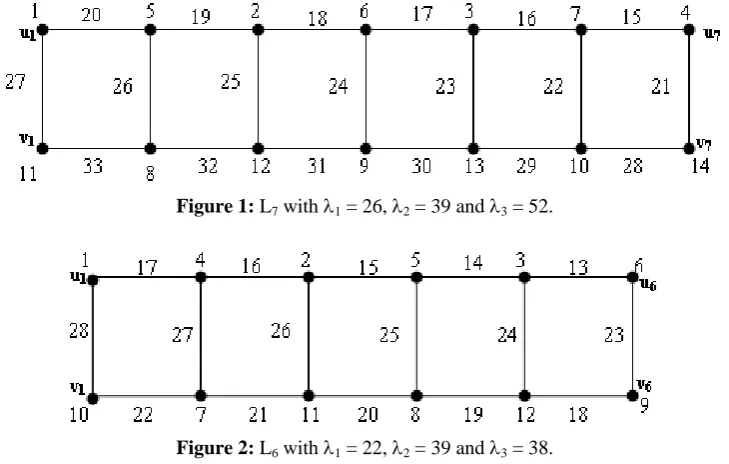
Example: 2.3 An edge trimagic total labeling of the Ladders L7 and L6 are given in figure 1 and figure 2, respectively.
Figure 1: L7 with λ1 = 26, λ2 = 39 and λ3 = 52.
Figure 2: L6 with λ1 = 22, λ2 = 39 and λ3 = 38.
Theorem: 2.4 The triangular Ladder TLn admits an edge trimagic total labeling for all n≥2.
Proof: Let V= {vi, ui /1≤ i ≤ n} be the vertex set and E = {vivi+1, uiui+1 /1≤ i ≤ n–1}∪{uivi /1≤ i ≤ n}∪{ uivi+1 /1≤ i ≤ n– 1} be the edge set of the triangular Ladder TLn. Then TLn has 2n vertices and 4n–3 edges.
Case: 1 n is odd.
Define a bijection f: V∪E→{1, 2, …, 6n–3} such that f(ui) = 2i, 1≤ i ≤ n; f(vi) = 2i–1, 1≤i≤n; f(uiui+1) = 6n–4i, 1≤i≤ n– 1; f(vivi+1) = 6n–4i–2, 1≤i≤ n–1; f(ui vi) = 6n4i+1, 1≤ i ≤ n and f(uivi+1) = 6n–4i–1, 1≤ i ≤ n–1.
Now, we prove this labeling is an edge trimagic total.
For the edge uiui+1, 1≤ i ≤ n–1,
f(ui)+ f(uiui+1)+f(ui+1) = 2i+6n– 4i +2(i+1) = 6n+2 = λ1 (say).
For the edges vivi+1, 1≤ i ≤ n–1,
f(vi)+f(vivi+1)+f(vi+1) = 2i–1+6n – 4i–2+2(i+1) –1 = 6n–2 = λ2 (say).
For the edges uivi, 1≤ i ≤ n,
f(ui)+f(uivi)+f(vi) = 2i+6n–4i+1+2i–1 = 6n = λ3 (say).
Also, for the edges, uivi+1, 1≤ i ≤ n–1,
f(ui)+f(uivi+1)+f(vi+1) = 2i+6n–4i–1+2(i+1) –1 = 6n = λ3.
Hence for each edge uv∈E, f(u)+f(uv)+f(v) yields any one of the magic constant λ1 = 6n+2, λ2 = 6n–2 and λ3 = 6n.
Therefore, the triangular Ladder TLn admits an edge trimagic total labeling when n is odd.
Case: 2 n is even.
Define a bijection f: V∪E → {1, 2, …, 6n–3}such that
Now we prove this labeling is an edge trimagic total.
For the edges uiui+1, 1≤ i ≤ n–1,
f(ui)+f(uiui+1)+f(ui+1) = 2i–1+6n–4i–1+2(i+1) –1 = 6n–1= λ1(say).
For the edges vivi+1, 1≤ i ≤ n–1,
f(vi)+f(vivi+1)+f(vi+1) = 2i+6n– 4i– 2(i+1) = 6n +2 = λ2(say).
For the edges uivi, 1≤ i ≤ n,
f(ui)+f(uivi)+f(vi) = 2i–1+6n– 4i+1+2i = 6n = λ3 (say).
Also, for the edges uivi+1, 1≤ i ≤ n–1,
f(ui)+f(uivi+1)+f(vi+1) = 2i–1+6n– 4i–2+2(i+1) = 6n–1 = λ1.
Hence for each edge uv∈E, f(u)+f(uv)+f(v) yields any one of the magic constant λ1 = 6n–1, λ2 = 6n+2, and λ3 = 6n.
Therefore, the triangular Ladder TLn admits an edge trimagic total labeling for even n.
Hence by case 1 and case 2, the triangular Ladder TLn admits an edge trimagic total labeling.
Theorem: 2.5 The triangular ladder TLn admits a super edge trimagic total labeling.
Proof: We have proved that the triangular ladder TLn has an edge trimagic total labeling with 2n vertices. The labeling given in the proof of Theorem 2.4, is as follows:
For odd n, f(ui) = 2i, 1≤ i ≤ n and f(vi) = 2i–1, 1≤ i ≤ n.
For even n, f(ui) = 2i–1, 1≤ i ≤ n and f(vi) = 2i, 1≤ i ≤ n.
Hence the 2n vertices get labels 1, 2, …, 2n. Therefore, the triangular ladder TLn admits a super edge trimagic total labeling for all n ≥ 2.
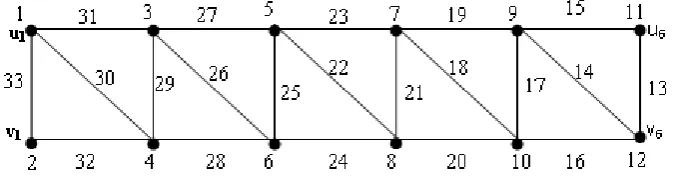
Example: 2.6 An super edge trimagic total labeling of the triangular ladders TL7 and TL6 are given in figure 3 and figure 4, respectively.
Figure 3: TL7 with magic constants λ1 = 40, λ2 = 42 and λ3 = 44.
Theorem: 2.7 The generalized Petersen graph P(n, n–1
2) admits an edge trimagic total labeling (n is odd).
Proof: Consider a generalized Petersen graph P(n, n–12 ) with the vertex set V = {xi, yi / 0 ≤ i ≤ n–1} and the edge set
E = {xiyi / 0 ≤ i ≤ n–1}∪ {yiyi+1 / 0 ≤ i ≤ n–2}∪{xix
i+n–1
2
/ 0 ≤ i ≤ n–1}∪{y0yn–1}, where the subscripts taken modulo n.
Then P(n, n–12) has 2n vertices and 3n edges.
Define a bijection f: V∪E →{1, 2, …, 5n}such that f(xi) = 2n–i, 0 ≤ i ≤ n–1;
f(yi) = n–i, 0 ≤ i≤ n–1; f(yiyi+1) = 3n+2i+2, 0 ≤ i ≤ n–2; f(y0yn–1) = 5n; f(xiyi) = 3n+2i+1,
0 ≤ i ≤ n–1 and f(xix
i+n–1
2
) = 2n+2i+1, 0 ≤ i ≤ n–1.
Now we have to prove that the generalized Petersen graph P(n, n –1
2 ) admits an edge trimagic total labeling.
For the edges yiyi+1, 0≤ i≤ n–2;
f(yi)+f(yiyi+1)+f(yi+1) = n–i+3n+2i+2+n–(i+1) = 5n+1 = λ1(say).
For the edge y0yn–1;
f(y0)+f(y0yn–1)+f(yn–1) = n–0+5n+n– (n–1) = 6n+1 = λ2(say).
For the edges xiyi, 0 ≤ i ≤ n–1;
f(xi)+f(xiyi)+f(yi) = 2n– i+3n+2i+1+n–i = 6n+1 = λ2.
For the edges xi x
i+n–1
2
, 0≤ i ≤ n–1 with i taken modulo n.
f(xi)+f(xix
i+n–1
2 )+f(x
i+n–1
2
) = 2n– i+2n+2i+1+2n – (i+n–1
2) = 11n+3
2 = λ3(say).
Hence for each edge uv∈E, f(u)+f(uv)+f(u) yields any one of the magic constants λ1 = 5n+1, λ2 = 6n+1 and λ3 = 11n+3
2 .
Therefore, the generalized Petersen graph P(n, n –12 ) admits an edge trimagic total labeling.
Theorem: 2.8 The generalized Petersen graph P(n, n–1
2) admits a super edge trimagic total labeling.
Proof: We have proved that the generalized Petersen graph P(n, n –12 ) admits edge trimagic total labeling. The labeling given in the Theorem 2.7 for the vertices is, f(xi) = 2n–i, 0 ≤ i ≤ n–1 and f(yi) = n–i, 0 ≤ i ≤ n–1. Since the vertices get
labels 1, 2, …, 2n the generalized Petersen graph P(n, n –1
2 ) is a super edge trimagic total.
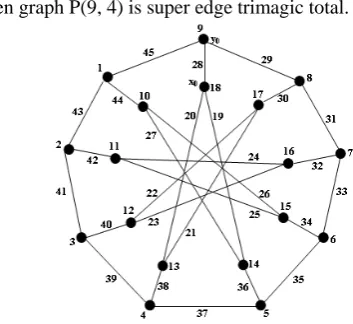
Example: 2.9 Generalized Petersen graph P(9, 4) is super edge trimagic total.
Theorem: 2.10 The Helm graph Hn has an edge trimagic total labeling for every positive even integer n.
Proof: Let V = {u}∪{vi /1 ≤ i ≤ n}∪{wi /1 ≤ i ≤ n} be the vertex set and E = {uvi, viwi / 1 ≤ i ≤ n}∪ {vivi+1 / 1 ≤ i ≤ n–1}∪{v1vn} be the edge set of the helm graph Hn. Then Hn has 2n+1 vertices and 3n edges.
Define a bijection f: V∪E → {1, 2, …, 5n+1} such that f(u) = 1,
f(vi) = �
i+1
2 +1, i is odd i+n
2 +1, i is even
f(wi) = �n+
i+1
2 +1, i is odd
n+i+n
2 +1, i is even
f(uvi) = �5n–
i+1
2 +2, i is odd
5n–n+i
2 +2, i is even
f(v1vn) = 4n+1, f(vivi+1) = 4n–i +1, 1 ≤ i ≤ n–1 and f(viwi) = 3n– i+2, 1 ≤ i ≤ n.
Now we prove this labeling is an edge trimagic total.
Consider the edges uvi, 1 ≤ i ≤ n.
For odd i, f(u)+f(uvi)+f(vi) = 1+ i+1
2 +1+5n– i+1
2 +2 = 5n+4 = λ1 (say).
For even i, f(u)+f(uvi)+f(vi) = 1 +5n–n+i
2 +2+ i+n
2 +1 = 5n+4 = λ1.
Consider the edges vivi+1, 1 ≤ i ≤ n–1.
For odd i, f(vi)+f(vivi+1)+f(vi+1) = i+12 +1+4n–i+1+i+1+n2 +1 = 4n+n2+4 = λ2 (say).
For even i, f(vi)+f(vivi+1)+f(vi+1) = i+n
2 +1+4n–i+1+ i+1+1
2 +1 = 4n+ n
2+4 = λ2
Consider the edges viwi, 1 ≤ i ≤ n.
For odd i, f(vi)+f(vi wi)+f(wi) = i+1
2 +1+3n–i+2+n+ i+1
2 +1 = 4n+5 = λ3 (say).
For even i, f(vi)+f(viwi)+f(wi) = i+n
2 +1+3n–i+2+n+ i+n
2 +1 = 5n+4 = λ1.
For the edge v1vn, f(v1)+f(v1vn)+f(vn) = 1+1
2 +1+4n+1+ n+n
2 +1 = 5n+4 = λ1.
Hence for each edge uv∈E, f(u)+f(uv)+f(v) yields any one of the constants λ1= 5n+4, λ2 = 4n+n
2+4 and λ3 = 4n + 5.
Therefore, the helm graph Hn admits an edge trimagic total labeling for every positive even integer n.
Theorem: 2.11 The helm graph Hn is a super edge trimagic total for even n.
Proof: We have proved that the helm graph Hn is an edge trimagic total for even n. The labeling given in the proof of Theorem 2.10, the labeling for the vertices are f(u) = 1,
f(vi) = �
i+1
2 +1, i is odd i+n
2 +1, i is even
and f(wi) = � n+
i+1
2 +1, i is odd
Since the helm graph Hn has 2n+1 vertices and get labels 1, 2, …, 2n+1, the helm graph Hn is a super edge trimagic total labeling.
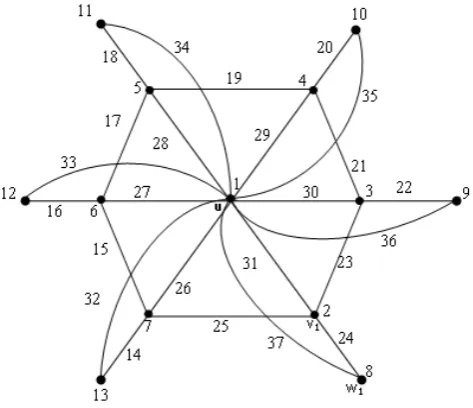
Example: 2.12 The helm graph H6 given in figure 6 admits a super edge trimagic total labeling with magic constants 29, 31and 34.
Figure 6: Helm graph H6 with λ1 = 29, λ2 = 31 and λ3 = 34.
Theorem: 2.13 The flower graph Fln has an edge trimagic total labeling for all n.
Proof: Let V = {vi, wi /1 ≤ i ≤ n}∪{u} be the vertex set and E = {uvi, viwi, uwi / 1 ≤ i ≤ n}∪{vivi+1 /1 ≤ i ≤ n–1}∪{v1vn}
be the edge set of the flower graph Fln. Then the flower graph Fln has 2n+1 vertices and 4n edges.
Define a bijection f: V∪E →{1, 2, …, 6n+1} such that f(u) = 1, f(vi) = i+1, 1 ≤ i ≤ n; f(w i) = n+i+1, 1 ≤ i ≤ n; f(uvi) = 5n– i +2, 1 ≤ i ≤ n; f(vivi+1) = 4n–2i+1, 1 ≤ i ≤ n – 1; f(viwi) = 4n –2 i +2, 1 ≤ i ≤ n; f(uwi) = 6n – i+2, 1 ≤ i ≤ n and f(v1vn) = 4n+1.
Now, we prove the above labeling is an edge trimagic total.
For the edges uvi, 1 ≤ i ≤ n,
f(u)+f(uvi)+f(vi) = 1+5n – i+2+i+1 = 5n+4 = λ1 (say).
For all the edges vivi+1, 1 ≤ i ≤ n–1,
f(vi)+f(vivi+1)+f(vi+1) = i+1+4n–2i+1+i+1+1 = 4n+4 = λ2 (say).
For the edges viwi, 1 ≤ i ≤ n,
f(vi)+f(viwi)+f(wi) = i+1+4n–2i+2+n+i+1 = 5n+4 = λ1. .
For the edge uwi, 1 ≤ i ≤ n,
f(u)+f(uwi)+f(wi) = 1+6n – i+2+n+i+1 = 7n+4 = λ2 (say).
And for the edge v1vn, f(v1)+f(v1vn)+f(vn) = 1+1+4n+1+n+1 = 5n+4 = λ1.
Hence for each edge uv, f(u)+f(uv)+f(v) yields any one of the magic constant λ1 = 5n + 4, λ2 = 4n+4 and λ3 = 7n + 4.
Therefore, the flower graph Fln admits an edge trimagic total labeling for all n.
Theorem: 2.14 The flower graph Fln is a super edge trimagic total for all n≥3.
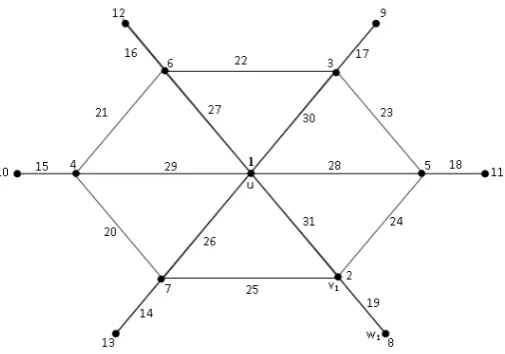
Example: 2.15 The flower graph Fl6 given in figure 7 is a super edge trimagic total graph with magic constants 34, 28 and 46.
Figure 7: Flower graph Fl6 with λ1 = 34, λ2 = 28 and λ3 = 46.
CONCLUSION
In this paper, we have proved some classes of graphs namely, the ladder Ln, triangular ladder TLn, generalized Petersen
graph P(n, n–1
2 ), the helm graph Hn and the flower graph Fln are edge trimagic total and super edge trimagic total
graphs. There will be many trimagic graphs can be constructed in future.
REFERENCES
[1] J. Baskar Babujee, “On Edge Bimagic Labeling”, Journal of Combinatorics Information & System Sciences, Vol. 28-29, Nos. 1-4, pages. 239-244 (2004).
[2] N. Hartsfield and G. Ringel, “Pearls in Graph Theory”, Academic press, Cambridge, 1990.
[3] C. Jayasekaran, M. Regees and C. Davidraj, “Edge Trimagic Labeling of Some Graphs” Accepted for publication in the, International Journal of Combinatorial Graph Theory and Applications.
[4] Joseph A. Gallian, “A Dynamic Survey of Graph Labeling”, The Electronic Journal of Combinatorics, 19 (2012), #DS6.
[5] A. Kotzig and A. Rosa, “Magic Valuations of finite graphs”, Canad. Math. Bull., Vol. 13, pages. 415-416 (1970). [6] W.D. Wallis, E.T. Baskoroo, M. Miller and Slamin, “Edge magic total labelings”, Australasian Journal of
combin., Vol. 22, pages. 177-190 (2000).