1 Strong structuration and carbon accounting: A position-practice perspective of policy development
at the macro, industry and organizational levels
Abstract
Purpose – The purpose of this paper is to utilize the three abstract-concrete levels of ontology of strong structuration theory (strong ST) to examine how, and to what extent, was the development of carbon accounting frameworks at the policy, industry and organizational levels enabled by external structures as conditions of action, that is, what was the nature of active agency within a field of position-practice relations that led to the development of these frameworks.
Design/methodology/approach – A case study was undertaken drawing upon interviews that were undertaken between 2008 and 2011 at the industry and organizational levels as well as documentary evidence relating to carbon accounting policy development at the macro, or policy level.
Findings – Theparliamentary committee hearings into the development of the carbon price legislation represented fields of position-practice relationships which highlighted the interplay of the internal structures, capabilities and the roles of both power and trust of the agent(s)-in-focus. A meso level analysis of the Victorian water industry highlighted how it was able to mediate the exercise of power by the macro level through the early adoption of carbon accounting frameworks. At the ontic or micro level of the individual water business, the development of a greenhouse strategy was also the outcome of position-practice relationships which highlighted the interplay of the internal structures and dispositions of the agent(s)-in-focus. The position-practice relationships at both the industry and organizational level were characterized by both soft power and trust.
Research limitations – Future research could investigate how the withdrawal of the carbon pricing mechanism in Australia has affected the development of carbon accounting practices whilst overseas research could examine the extent to which carbon accounting frameworks were the outcome of position-practice relationships.
Practical implications – Given the global significance of carbon accounting, this paper provides an overview as to how the early adoption of voluntary carbon accounting practices resulted in a reduction in carbon emissions within the water industry and therefore limited its liability for the carbon price. Originality/value – This paper illustrates how the strong ST ontological concept of position-practices can be utilized at the macro, meso and ontic levels and how these relationships mediated the impact of the carbon price upon both the water industry and the individual water business.
2 Strong structuration and carbon accounting: A position-practice perspective of policy development
at the macro, industry and organizational levels
1. Introduction
In an attempt to promote action on climate change, the then Commonwealth Government of Australia introduced the Clean Energy Act in 2011, resulting in the introduction of a fixed carbon price from 2012 to 2015. However, a new government was elected in 2013 and repealed the Act in 2014, resulting in the withdrawal of the scheme. Prior to this, a carbon reporting system was introduced whilst state governments, as well as industry organizations, had facilitated the development of voluntary frameworks. This is consistent with the observation that carbon accounting is contestedi (Ascui and Lovell, 2011, 2012; Bebbington and Larrinaga, 2014), and therefore characterized by “emerging tensions between different communities over the limits and boundaries of professional expertise” (Ascui and Lovell, 2012, p.48). Bowen and Wittneben (2011) believe that understanding these tensions can help to illuminate the resulting key challenges.
3 How, and to what extent, was the development of carbon accounting frameworks at the policy, industry and organizational levels enabled by external structures as conditions of action, that is, what was the nature of active agency within a field of position-practice relations that led to the development of these frameworks?
In order to answer this question, this paper utilizes the three abstract-concrete levels of ontology of strong structuration theory (strong ST): 1. the macro level; 2. the meso-level; and 3. the ontic, or micro, level (Stones, 2005). At the macro level, the application of the strong ST concept of position-practices enables an understanding of how a carbon pricing system was developed whilst recognising legitimate uncertainty in carbon measurement science (Bowen and Wittneben, 2011) as well as the role of trust in climate science, policies and markets (Ascui and Lovell, 2011). Specifically, the case illustrates a shifting of analysis (Coad and Herbert, 2009) of the conduct of agents from a variety of professional backgrounds such as economics and science, enabling a re-examination of how knowledge of carbon accounting is produced through the interaction between these disciplines (Bebbington and Larrinaga, 2014), in the process highlighting the role of Lukes (2005) third dimension of power as well as the dialectic of control (Giddens, 1984). This ‘broader brush’ approach employing strong ST therefore enables an understanding of the “structural clusters that (are) relevant to any agent’s analysis of context” (Stones, 2005, pp.134/5). At the meso or industry level, strong ST illustrates how the early adoption of carbon accounting practices, through the exercise of soft power (Suddaby et al., 2007), mediated the impact of the carbon price. According to Modell (2009), there is a need to pay more explicit attention to the recursive aspects of reforms across different levels of analysis in the public sector.
4 paper is structured as follows. We develop the theoretical framework in section 2. Section 3 outlines the research method. Section 4 analyses the results from the case study whilst section 5 provides a discussion and concluding comments.
2. Strong structuration: A position-practice perspective at three levels of ontology
We begin this section by outlining strong ST. Given that it was developed based upon structuration theory (ST), we provide an initial overview of ST before summarizing the development of strong ST in sections 2.1 and 2.2. We then provide an overview in section 2.3 of how the ontological concept of positon-practice relations can be applied on a sliding scale of the three abstract levels of ontology (Stones, 2005; Coad et al., 2015) with reference to carbon accounting, which is then used to analyse the case study and therefore research question.
2.1 The development of strong ST
5 enables an understanding of “the power of independent and irresistible causal influences on particular agents-in-focus” (Stones, 2005, pp.134/5). The central component of both ST and strong ST is the duality of structureiv, which, according to Stones (2001, p.185), “stresses that agents often draw upon structures prereflexively, in practical consciousness, rather than in explicit or reflexive awareness of what they are doing”.
2.2 The strong ST duality of structure
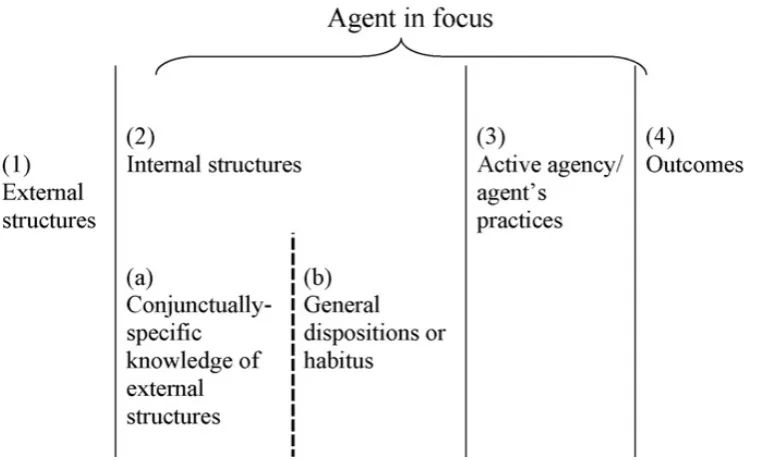
The strong ST version of the duality of structure is a quadripartite cycle that comprises: 1. external structures; 2. internal structures within the agent; 3. active agency; and 4. outcomes (Stones, 2005; Coad and Herbert, 2009; Coad et al., 2015) as illustrated in figure 1:
Fig. 1. The quadripartite nature of structuration (Stones, 2005, p. 85).
6 linked to the position.This knowledge is therefore related outwards to the external structure (Jack and Kholeif, 2007), or position that the agent occupies.
Strong ST seeks to overcome ST’s neglect of epistemology by incorporating Bourdieu’s habitus (Stones, 2005). Stones (2001, p.185) argues that, given the prereflexive nature of the duality of structure, there is “a large place here for habits, prereflexive routines and back- ground assumptions”. Habitus, or disposition in the case of strong ST, is where external structures are interpreted in the context of an agent(s) dispositions or their world views, habits of speech, attitudes and values (Stones, 2005; Coad and Herbert, 2009; Archel et al., 2011) and is formed and produced through both socialization and formal education (Malsch et al., 2011). The disposition or habitus associated with Latin American education programs that were funded by the World Bank was characterized by terms such as “cost–
efficiency”, “quality” and “accountability” (Neu et al., 2006). The difference between the general dispositional (habitus) and conjuncturally specific is that the general dispositional is transituational (Coad and Herbert, 2009), whilst as explained earlier, the conjuncturally specific is specific to a position. Wacquant (2013, p.195) observed the distinction that Bourdieu makes between the primary habitus and the secondary habitusvi.
7 obligations of the position which are reconstituted by the agent-in-focus through praxisviii whilst capabilities is the ability of actors to make use of established practices as well as envisage future position–practice relations (Coad and Glyptis, 2014). The fourth aspect, trust, can take the form of either trust in expert systemsix or personal trust, which is trust in the expertise of specific individuals (Giddens, 1990; Busco et al., 2006). In summary, the strong ST ontological concept of position-practices enables the researcher to analyze the realities of agent(s) –in-focus from the perspective of multiple positions within a field of position-practice relations (Coad and Glyptis, 2014; Coad et al., 2015).
2.3 Applying the position-practice perspective at the three abstract-concrete levels of ontology
In order to answer the research question, an understanding is required of how the strong ST concept of position-practices can adopted at the three abstract levels of ontology, that is: 1. the macro level; 2. the meso level; and 3. the ontic or micro, level (Stones, 2005; Coad et al., 2015).
2.3.1 The position-practice perspective at the macro level
8 was characterized by diverse positions, values and therefore dispositions including climate change scepticism, the mainstream position and the radical position (Carter et al., 2011). The dispositions of agent(s) within the Australian Commonwealth public sector with regards to environmental reporting was one of “risk aversion” (Lodhia and Jacobs, 2013).
The implementation of the carbon price by the Commonwealth Parliament of Australia was dependent upon the Clean Energy Act 2011 passing through the two houses of the parliament, the House of Representatives and the Senate. Prior to this, it was referred for an advisory report to a parliamentary committeexi. Parliamentary committees, a central element of the Westminster parliamentary systemxii and the process of democratic accountability (Jacobs and Jones, 2009), seek to inform the policy-making process by providing the parliament with a range of expert views from the economic and scientific communitiesxiii, for example, who, in the context of their external positions or structures as an economist or scientist, provide their advice and opinions on the carbon pricing legislation. As shall be illustrated in the case study, the committee hearings represent a field of position-practice relations, with the result that the carbon pricing legislation as a ‘situational logic’, was “produced and reproduced again and again by a plurality of agents within a variety of structural clusters” (Stones, 2005, p.143). As a part of this process, the agent(s)-in-focus exercise power, specifically Lukes third dimension of power (Lukes, 2005; James, 2010; Cooper et al., 2013; Malsch and Gendron, 2011) whilst their understanding of the conditions of action is informed by the conjuncturally specific knowledge of networked others (Coad and Herbert, 2009). Their ability to utilize their knowledge in order to influence the committee process is evidence of dialectic of control (Giddens, 1984).
2.3.2 The position-practice perspective at the meso level
9 the exercise of power by oil majors and regulators by exceeding minimum industry expectations. From a strong ST perspective, an organizational field can be classified as an external structure which comprises position-practice relations (Coad et al., 2015), in the form of professional associations and their working groups, which enable organizations and their relevant agent(s)-in-focus, to: 1. interact and collectively represent themselves; 2. develop understandings of reasonable conduct; and 3. shape and redefine appropriate practices (Greenwood et al., 2002). This represents a process of socialization and education (Malsch et al., 2011), which assists in the development of the disposition, or a secondary habitus (Wacquant, 2013). Key agent(s)-in-focus would include industry leaders and professionals (Dillard et al., 2004), along with members of associated working groups, such as a sustainability task group (Moore, 2013).
10 2.3.3 The position-practice perspective at the micro/ontic level
At the micro/ontic level, industry working groups represent an external structure as a condition of action, that is position-practice relationships, participation in which enables agent(s)-in-focus from the micro or ontic level to engage in both reflective praxis, such as understanding their existing carbon performance, and active praxis (Coad and Glyptis, 2014), the development of new carbon strategies., which illustrates the interplay of both the disposition of the agent(s)-in-focus, based upon their professional background (Malsch et al., 2011), and their understanding of practices, which is guided by position-specific structures as well as the conjuncturally specific knowledge of networked others (Coad and Herbert, 2009).
Bowen and Wittneben (2011) identified positions within organizations associated with carbon accounting, such as counting carbon, which includes scientists, and carbon accounting, which includes accountants. Capabilities are evident when agents utilize existing resources in the development of carbon accounting practices (Coad and Glyptis, 2014), which are characterized by both soft power (Suddaby et al., 2007) and Lukes (2005) third dimension of power. These new practices also contain structuring properties in the form of interpretive schemes, normative rules and resources (Coad and Glyptis, 2014). Within the organization, industry frameworks represent an expert system that can be a source of system trust, whilst carbon accounting procedures can also represent symbolic tokens (Busco et al., 2006; Giddens, 1990). In the case of a water business, the development of a carbon accounting procedure was the responsibility of positions that included the environment and technology manager and the greenhouse and energy specialist (Vesty et al., 2015).
3. Research method
In order to answer our central research question, How, and to what extent, was the development of carbon accounting frameworks at the policy, industry and organizational levels enabled by external
11 position-practice relations that led to the development of these frameworks?, a case study was
undertaken of the development of carbon accounting frameworks at the macro, or policy level, the meso or organizational field of the Victorian water industry, and the ontic or micro level or an individual water business. The analysis at the meso and ontic levels involves an ex post analysis of interview and documentary data that was collected during the period 2008 to 2011 as part of a longitudinal case study of an Australian state water authority (Moore 2013). Consistent with the approaches of Jack and Kholeif (2007, 2008) and Coad and Herbert (2009) as well as the observation of Coad et al. (2015), it is useful to use Stones (2005) quadripartite framework for an ex post analysis of case evidence. As explained by Ahrens and Chapman (2006, p.827), in order to achieve a ‘fit’ between factors such as theory, method and domain, there needs to be “ongoing theoretical repositioning”. As the study shall illustrate, this ex post analysis highlights the role of position-practice relationships in the form of committees and working groups, as well as the roles of both power and trust in the adoption of carbon accounting practices, evidence that the the field is shaped by the theoretical interests of the researcher (Hoque et al., 2013), in this instance strong ST. A case study approach is appropriate because, as explained by Parker (2005, p.854), the need for further employment of case research, in this instance carbon accounting, is “considerable”, which Gray and Laughlin (2012) believe increases the understanding of its adoption. In support, Bebbington and Thomson (2013) observe that case studies provide an ‘inside-out’ view which enhances our understanding of decision-making.
12 contained in the associated Hansardxiv transcripts. For the purpose of this study, the following Hansard transcripts were examined:
Table 1 Hansard transcripts analyzed
Date Committee hearing
21 September 2011 JOINT SELECT COMMITTEE ON AUSTRALIA'S CLEAN ENERGY FUTURE LEGISLATION Clean Energy Bill 2011 and related bills, WEDNESDAY, 21 SEPTEMBER 2011, Canberra, Commonwealth of Australia (COA)
23 September 2011 SENATE SELECT COMMITTEE ON THE SCRUTINY OF NEW TAXES Carbon tax pricing mechanisms, FRIDAY, 23 SEPTEMBER 2011, Canberra, Commonwealth of Australia (COA).
26 September 2011 JOINT SELECT COMMITTEE ON AUSTRALIA'S CLEAN ENERGY FUTURE LEGISLATION Clean Energy Bill 2011 and related bills, MONDAY, 26 SEPTEMBER 2011, Canberra, Commonwealth of Australia (COA).
27 September 2011 JOINT SELECT COMMITTEE ON AUSTRALIA'S CLEAN ENERGY FUTURE LEGISLATION
Clean Energy Bill 2011 and related bills,
TUESDAY, 27 SEPTEMBER 2011, Melbourne, Commonwealth of Australia (COA).
28 September 2011
JOINT SELECT COMMITTEE ON AUSTRALIA'S CLEAN ENERGY FUTURE LEGISLATION
Clean Energy Bill 2011 and related bills,
WEDNESDAY, 28 SEPTEMBER 2011, Sydney, Commonwealth of Australia (COA).
13 p.158), this approach enables researchers “to map out systemic relations at (macro) levels, whilst self-consciously bracketing out contextual detail including the ways in which social actors understand and interpret their situation”.
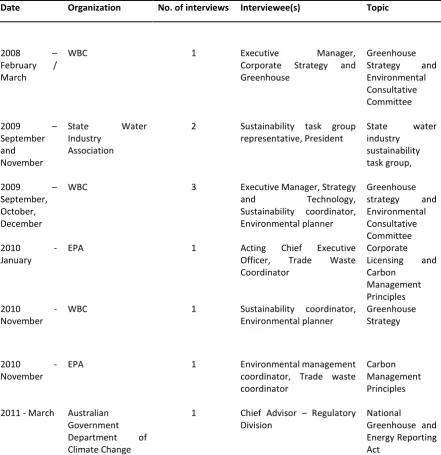
At the meso and micro/ontic levels, the data analysis is based upon interviews that were undertaken during the period 2008 to 2011 as set out in table 2xv:
Table 2 Interview schedule
Date Organization No. of interviews Interviewee(s) Topic
2008 –
February / March
WBC 1 Executive Manager,
Corporate Strategy and Greenhouse Greenhouse Strategy and Environmental Consultative Committee
2009 –
September and November State Water Industry Association
2 Sustainability task group
representative, President State water industry
sustainability task group,
2009 –
September, October, December
WBC 3 Executive Manager, Strategy
and Technology, Sustainability coordinator, Environmental planner Greenhouse strategy and Environmental Consultative Committee
2010 -
January EPA 1 Acting Chief Executive Officer, Trade Waste
Coordinator Corporate Licensing and Carbon Management Principles
2010 -
November WBC 1 Sustainability coordinator, Environmental planner Greenhouse Strategy
2010 -
November EPA 1 Environmental management coordinator, Trade waste
coordinator
Carbon Management Principles
2011 - March Australian
Government
Department of Climate Change
1 Chief Advisor – Regulatory
Division National Greenhouse and
14 An ex post analysis of these interviews utilizing strong ST, specifically an agent’s context analysis (Stones, 2005; Coad and Herbert, 2009), required the identification of the appropriate fields of position-practice relationships, or external structures. At both the meso level and within the individual water business, WBCxvi, it was the water industry professional groups, such as the Sustainability Task Group. It was then necessary to identify the relevant agent(s)-in-focus. At the meso or industry level, this included: 1. two representatives from the Victorian Water Industry Association; and 2. three representatives from the Victorian Environmental Protection Authority (EPA). At the micro or ontic level, it was those employees responsible for the implementation and development of the Greenhouse Strategy.
4. A position-practice perspective on the development of carbon accounting frameworks
This section analyses the results of the case study in response to the research question of: How, and to what extent, was the development of carbon accounting frameworks at the policy, industry and
organizational levels enabled by external structures as conditions of action, that is, what was the nature of active agency within a field of position-practice relations that led to the development of these frameworks? Section 4.1 analyses the policy or macro level, section 4.2 provides a meso level analysis
of the Victorian water industry, whilst section 4.3 provides a micro or ontic level analysis of the individual water business.
4.1 The macro level of carbon pricing
15 committeexix, whilst eighty-four witnesses appeared before the committee in either a personal capacity or on behalf of a variety of organizations (APH, 2011). The committee met on four occasions: 1. 21/9/2011; 2. 26/9/2011; 3. 27/9/2011; and 4. 28/9/2011xx. In addition to this, a Senate select committee met on 23/9/2011 to inquire into and report on the proposed carbon price and its economic effects (COA, 2011b).
4.1.1 External structures and agent(s)-in-focus
The committee hearings represented fields of position-practice relationships. The relevant agent(s)-in-focus included economists who represented and appeared on behalf of: 1. the Commonwealth Department of Climate Change and Energy Efficiency (DCC); 2. the Commonwealth Department of Treasury (DOT); and 3. universities, a professional organization, “think tanks” and in a private capacity. The obligations of the DCC representatives included: 1. the development and co-ordination of climate change policy and adaptation strategies; and 2. the design and implementation of emissions trading (COA, 2008). The obligations of the DOT representatives included advising the government and ministers on macroeconomic policies and issues as well as contributing to broader public understanding of these issuesxxi. Section 4.1.2 analyses the responses of these witnesses, whilst section 4.1.3 provides a position-practice perspective of the Chief Scientist for Australia.
4.1.2 Internal structures of agent(s)-in-focus
16
The bill provides a framework in which you can link to schemes….. The first is the CDM market under the UNFCCC, the Clean Development Mechanism market. The second is the European Union Emissions Trading System. The third is the New Zealand Emissions Trading Scheme (Secretary, DCC, 21/9/2011)
The Clean Energy Bill contains provisions to apply both quantitative and qualitative restrictions on the use of international units. Regarding the quantitative restrictions, in the fixed price period there will be no ability for liable entities to surrender their units against liabilities; that comes into play in the flexible price period only (Assistant Secretary, DCC, 21/9/2011)
In contrast, the focus of the DOT representative was explaining the legislation’s macroeconomic impact of the legislation, the cost of financing carbon abatement for example, evidence of her conjuncturally specific internal structures:
Treasury has found that forgoing cheaper international sources abatement would roughly double the
economic cost of achieving the 2020 target….In relation to international action, what is important here
is what the access to international permits is and what their price may be in terms of determining their overall economic costs for Australia achieving a particular target….. It is a general proposition that, if you use a narrower base to achieve the same amount of environmental action, it will raise the overall economic cost. (General Manager, Macroeconomic Modelling Division, DOT, 21/9/2011)
On Friday, September 23, three DOT representatives appeared together before the Senate select committee. The general-disposition of one representative was observed when he supported a market based approach to addressing climate change:
I think it would be fair to say that that is true and that a significant majority of economists would argue that a market-based approach is likely to deliver a change in behaviour by the community at large in a way that is less economically costly than alternatives (Executive Director, Macroeconomic Group, DOT, 23/9/2011)
This disposition was shared by two economists who appeared before the joint select committee on Monday, September 26, one appearing on behalf of a “think-tank”, the other in a private capacity:
Firstly, I think the economic evidence is quite clear that a price on pollution is the most efficient and equitable way to act (Executive Director, Australia Institute, 26/9/2011)
I am prepared to answer the question as an economist, not to make any political comment at all. Just by way of background, I have been a market economist for nearly 40 years and have worked on price setting mechanisms for many markets, particularly financial markets as an example. When I come to the issue of how best to put a price on carbon I think the emissions trading types of structures are the best in terms of being the most cost effective (Economist, Private Capacity, 26/9/2011)
17 associated with carbon pricing, the financial markets, and therefore trust in a carbon price as a symbolic token (Busco et al., 2006; Giddens, 1990).
4.1.2.1 Active agency
During the committee hearings, the agent(s)-in-focus drew upon both their background education and dispositions with regards to climate change in order to discuss the impact of the legislation. The secretary of the DCC drew upon his background education as an economist to explain that the economic impact of the carbon pricing scheme should be analysed in terms of its coverage as opposed to the revenue that it generates:
The second point is that if you asked most economists how they would measure the impact of a set of measures on an economy they would typically say that they would consider the coverage—that is, how broadly does the measure apply across the economy?... All the economic analysis that has been done says that the economic impact of a scheme……. is a matter of the price of those permits and how broad the coverage is (Secretary, DCC, 21/9/2011)
This was subsequently supported by a DOT representative:
This question was raised on Wednesday morning in the joint committee on the legislative program…. the Secretary of the Department of Climate Change and Energy Efficiency….. provided a comprehensive answer, the short version of which is that that analysis is looking at the revenue raised by two schemes, not the economic impact of the two schemes, and it is not appropriate to look at the revenue raised to then draw the conclusion about the impact on the economy (General Manager, Macroeconomic Modelling Division, DOT, 23/9/2011)
The interplay of the internal structures of two DOT representatives was observed when they explained how a market based approach would operate in the context of the proposed scheme, along with their the general dispositional, which advocates this approach:
The $23 is a fixed price for the first three years, and it rises at 2½ per cent real each year for the first three years. At the end of the first three years we go to a flexible price, and the price will then be
determined by the market…It is a market in the sense that a price has been established, and then it is
a matter for the market as to how they adjust their behaviour (General Manager, Industry, Environment and Defence Division, DOT, 23/9/2011)
It is a market in the sense that you set a price and you leave it to the market to decide how to adjust, as opposed to the government, for instance, saying, 'We will close all coal fired power stations.' That
would be a regulatory response….A market based mechanism can be thought of either as setting a
18 The disposition of two DOT representatives with regards to climate change was observed when they explained the scheme’s proposed environmental outcomes and its macroeconomic impact, further evidence of the interplay of the internal structures:
Putting a price on carbon…… is a structural adjustment of the Australian economy. It is going to make producing emissions in future more expensive to account for the fact that up until now people have not had to pay a price even though it has had consequences for other people in the community…. The intention of the policy is to reduce emissions to reduce the risks of dangerous climate change (General Manager, Macroeconomic Group, DOT, 23/9/2011)
I guess one is really talking about two very different things. One is the nature of economic activity in the world at the moment and the other is a long-term threat of the risks of dangerous climate change …..But the other issue is one of responding to the threat of something potentially catastrophic over a long period of time and, combined with that, an economic argument that if you accept that science there are substantial economic benefits in moving to respond to that in a gradual way but doing it now (Executive Director, Macroeconomic Group, DOT, 23/9/2011)
The response of the General Manager, DOT, illustrates her general-disposition, that is her belief in the potential of a carbon price to create “new visibilities” that facilitates “surveillance from a distance” (Neu et al., 2006, p.648). The recognition of the risks of climate change by these representatives is transituational (Coad and Herbert, 2009), which also illustrates their trust in the expert systems associated with climate science.
The capabilities (Coad and Glyptis, 2014) of two DOT economists were evident when they discussed the impact of the policy upon future relations with Australia’s trading partners:
The second issue is if that was not to happen—if the world takes action and Australia does not take action and then Australia eventually takes action off its own bat. It is potentially quite expensive to adjust at that point because, if someone has a dollar of investment and they are looking at investing in a country that has already moved along the path to reducing their emissions versus a dollar of investment in a country that has a high emission intensity industrial structure, it could well be that the investment moves away from Australia quite sharply…. Sharp transitions involve higher economic cost (General Manager, Macroeconomic Group, DOT, 23/9/2011)
As I think I answered at a different committee on Friday, presuming that the world takes action on climate change—there are significant economic benefits in making the transition gradual and starting it early (Executive Director, Macroeconomic Group, DOT, 26/9/2011)
19 al., 2016), that is carbon pricing policy uncertainty upon the positions of these DOT representatives to identify the associated macroeconomic impacts. Three witnesses subsequently explained to the committee the consequences of this and observed the need to distinguish between policy uncertainty and price uncertainty:
You can argue that we have had carbon pricing uncertainty for well over a decade, because it is well over a decade ago that the then Howard government first started producing blueprints for emissions trading. What does it do and what has it done? One example is the hold-up of investment in the electricity supply sector (Director, Centre for Climate Economics and Policy, Australian National University, 26/9/2011)
So it is policy uncertainty that I think we should be worried about. But the debate has focused on price uncertainty. There will always be carbon price uncertainty—the worst thing that could happen is if we introduce it, then we remove it and then we reintroduce it in around 2020. (Executive Director, Australia Institute, 26/9/2011)
I would strongly endorse that sentiment. A principal focus of this legislation should be to set a framework that pretty much is set in cement going forward so that people have a very clear idea how that policy will evolve over time. (Economist, Private Capacity, 26/9/2011)
This is also further evidence of the interplay between the internal structures of these agents, the conjuncturally specific, the need for certainty in carbon pricing policy, and their disposition, which supports a market based approach. In summary, the dispositions of the committee witnesses in this section who advocate a market based approach to addressing climate change, that is a carbon price, was based upon their formal education (Malsch et al., 2011) in economics.
4.1.2.2 Conditions of action, power and carbon pricing
20 of the Australia Institute have been able to exercise power in a subtle way by shaping the thoughts of both the economist and the DOT General Manager of Macroeconomic modelling respectively with the result that they both believe that their interests are aligned (James, 2010), evidence of Lukes (2005) third dimension of power.
The dialectic of control (Giddens, 1984) was also in operation. These agent(s) are using their background training and knowledge of economics to emphasise that the economic impact of the scheme should be assessed in terms of its economic coverage as well as to justify how a market based approach would operate in the context of the policy objective of economic growth . It is also another example of Lukes (2005) third dimension of power. These agents are using the “power of language” (Cooper et al., 2013, p.446) in order to shape the thoughts of the committee members, witnesses and therefore members of parliament in order to prevent differences of interest (Malsch and Gendron, 2011). As shall be illustrated in the next section, an unintended outcome of this is that it informs the Chief Scientist of Australia’s understanding of the carbon pricing scheme which constrains his action (Stones, 2005), specifically his “knowledgeability about the distributions and configurations of power, meaning and norms within the field of action” (Coad and Herbert, 2009, p.179). It also informs the understanding of agent(s)-in-focus at the meso and micro / ontic levels of the impact of the carbon pricing legislation and therefore their understanding of the conditions of action (Coad and Herbert, 2009). As shall be illustrated, their ability to minimize the impact of the legislation is dependent upon their capabilities to develop carbon accounting strategies and procedures. As explained by Jack and Kholeif (2007, p.35), “agents who resist need perceived power or capability in relation to other actors, adequate knowledge of relevant external structures and requisite reflective distance”.
4.1.3 A position-practice perspective of the Chief Scientist for Australia
21 scientific community. During the hearing, he provided an overview of his responsibilities as a committee witness:
As a private citizen, I have a view. As the Chief Scientist for Australia, my job is to put the science to you and to make sure the science gets to you. I am trying to do that, not by claiming to be an expert but by making sure that you have available to you the expertise that is available in this country and the analyses that scientists do about the weight and direction of evidence and the uncertainties within that evidence (Professor Ian Chubb, Chief Scientist for Australia, 26/9/2011)
This response illustrates the impact of external structures (Elmassri et al., 2016), the position of Chief Scientist of Australia, upon the agent-in-focus, Professor Ian Chubb. The obligations of this position included providing high-level independent advice to the Prime Minister and other Ministers on matters relating to science, technology and innovationxxiii. His capabilities (Coad and Glyptis, 2014) were observed when he discussed the impact of future policy development upon climate change:
And if the world does nothing too I suppose. I think there does need to be a recognition that the evidence of science is suggesting that we will have changed weather patterns and extreme weather events with much greater frequency than we have at the moment. That is where the evidence sits right now (Professor Ian Chubb, Chief Scientist for Australia, 26/9/2011)
The preceding responses illustrate the intention of the Chief Scientist to use the structuring properties of climate science, that is climate science as a resource, climate science as an interpretive scheme and climate science as a norm of behaviour (Coad and Glyptis, 2014). It is also evidence of system trust, that is trust in the expert system (Busco et al., 2006; Giddens, 1990) associated with climate science, which is also mutually dependent on the expertise of specific individuals (Busco et al., 2006), in this instance the Chief Scientist of Australia. In the process he is seeking to exercise “soft power” (Suddaby et al., 2007), specifically Lukes (2005) third dimension of power:
I have never really commented on what countries do to respond to the science, Senator. I do not think it is my job to actually tell a government or governments, in this country or any other, how to respond to the science. My job is to make sure that scientists have a fair go at putting the evidence on the table, putting the uncertainties on the table, and having them debated in a rational and civilised way. After that, you decide what to do and they decide what to do (Professor Ian Chubb, Chief Scientist for Australia, 26/9/2011)
22 However, as shall be explained in this section, his perception of his ability to do so has been constrained by the media coverage of the science of climate change.
The disposition of Professor Chubb with regards to climate change reflected the mainstream positionxxiv (Carter et al., 2011):
The latest information I have seen shows that the CO2 levels are high and that the rate of accumulation is accelerating. The scientists who study this would argue that it is getting to the point where something has to be done quickly in order to cap them at least and start to have them decrease over a sensible period of time (Professor Ian Chubb, Chief Scientist for Australia, 26/9/2011)
What we are projecting seeing is hugely changing patterns of rainfall and weather and the intensity of certain weather events (Professor Ian Chubb, Chief Scientist for Australia, 26/9/2011)
The response of Professor Chubb as well as the recognition of the risks of climate change by the DOT representatives, that is their dispositions, is evidence of their “socio-historical conditioning”, that is their “sense of where (they are) in the social space and what actions are possible as a result” (Archel et al., 2011, p. 333). There was also evidence of his general disposition towards economists and the role of economics in managing climate change when asked about the cost to Australia of not taking action:
You have a whole bunch of economists before me and after me that could give you better answers than I could on that. My opinion is that Australia does need to take action so that we are in amongst the other countries taking action. But the extent of that action and the likely cost and benefit I think is better asked of the people coming after me and the ones that you had just before me (Professor Ian Chubb, Chief Scientist for Australia, 26/9/2011) (COA, 2011b).
23 The Chief Scientist’s perception of the ability of the scientific community to exercise power and influence was observed in response to a question with regards to the media coverage of the science of climate change which “legitimised the idea that you can be a believer or a nonbeliever” (COA, 2011b, p.15):
I ask the scientific community to stand up to be counted on important issues of science. I do not think it is helpful that it is left to very few. I think that the majority of scientists ought to be out there explaining to the public why they do science, how they do science, how they accumulate scientific evidence and what happens when it is wrong (Professor Ian Chubb, Chief Scientist for Australia, 26/9/2011)
I think the coverage has been very ordinary. I think the proportions of arguments given, the weight given, the space given, to arguments seems to me to be more in the nature of demonstrating conflict rather than a contest of ideas. I think the scientific community as a whole has a great deal of responsibility to ensure that science is elevated to where it once used to be and is not subject to the attacks that it is presently suffering, from people with all sorts of different agendas—whatever they might be………I think the way this has been approached has been really unfortunate. It has raised doubts where doubts should not exist and in fact has not raised doubts where we probably do need to be asking questions about whatever it might be. (Professor Ian Chubb, Chief Scientist for Australia, 26/9/2011)
These comments are consistent with the view of Carter et al. (2011, pp.694/5) that “opposition politicians in many countries use climate scepticism as an interpretive device and political weapon in the daily grind of being in opposition” with the result “that public confidence in climate science continues to shrink under attacks on the legitimacy of the science as an institution”. To counter this, he sought to exercise soft power (Suddaby et al., 2007), specifically Lukes (2005) third dimension of power to enable climate science to operate as a discourse (Cooper et al., 2013).
24 emissions to 80% below 2000 levels by 2050 (COA, 2011d). A new commonwealth government was elected in 2013 and repealed the legislation in 2014, resulting in the withdrawal of the scheme.
4.2 A meso level analysis of carbon accounting position-practice relationships within the Victorian water industry
Prior to the introduction of the carbon price, the Victorian Water Industry Association (VWIA)xxvii recognized the importance of position-practice relationships through the establishment in 2001 of the Sustainability Task Group (STG) for the purpose of improving sustainable decision makingxxviii:
The sustainability task group….. It’s an advisory group to the Vic water board…. made of people who are driving change within their own organizations, within the industry….we’ve got this group here at industry level really bringing up issues from a grassroots level…. trying to drive change back through the industry (Sustainability task group representative, 3/9/2009)
As shall be illustrated in this section, the STG, as a field of position-practice relationships, enabled the early adoption of carbon accounting frameworks. The first step in this process was the establishment by the STG in December 2005 of a working group, which, given the absence of carbon accounting policies at the macro level in 2005, represented a period of regulatory uncertainty (Elmassri et al., 2016). The instigator was the recognition that the industry is highly vulnerable to climate change which will require new thinking in order to provide for the needs of future generations (VWIA, 2006), evidence that the industry is seeking to develop the disposition, or a secondary habitus (Wacquant, 2013). Climate change represents a significant risk for the industry because its water businesses were amongst the top twenty electricity consuming businesses in Victoria in 2005 whilst the carbon emissions of the industry in 2004/5 were more than 810,000 tonnes (VWIA, 2006). The establishment of the working group was explained by a senior VWIA representative:
25 The recognition of the risks of climate change was evidence of a reflective praxis (Coad and Glyptis, 2014; Coad and Herbert, 2009) by the working group, characterized by an approach of “beyond compliance”, as explained by an STG representative:
When we talk about going beyond compliance, we are generally talking about environmentally doing more than we have to do, at a social level, doing more than we have to do...…We were thinking carbon trading and talking about carbon trading three or four years ago in a political environment that wouldn’t mention it, because we recognize what we are seeing in Europe, what we are seeing elsewhere (Sustainability task group representative, 3/9/2009)
As part of this process, a greenhouse emissions profilexxix (VWIA, 2006) was developed. Subsequent to this, the working group developed emissions reduction goals, evidence of an active praxis (Coad and Herbert, 2009; Coad and Glyptis, 2014). These included: 1. demonstrating leadership in greenhouse gas reduction; 2. setting realistic greenhouse gas reduction targets; and 3. incorporating an industry wide collaborative and cooperative approach (VWIA, 2006). The development of goal 2 was based upon the pre-existing carbon management practices of individual businesses (VWIA, 2006), evidence of the capabilities of the working group members to “make use of established practices” (Coad and Glyptis, 2014, p.147).
The prerogative or obligation (Coad and Glyptis, 2014) of the working group was to address the greenhouse emissions challenge for the industry (VWIA, 2006). The working group comprised a chair from Sustainability Victoria as well as 17 representatives from Victorian water businesses (VWIA, 2006), an example of “networks and relationships between clusters of agents within (a) specific landscape” (Coad and Herbert, 2009):
26 The agents-in-focus therefore occupied multiple positions (Coad and Glyptis, 2014), membership of the STG, the working group and employee of their respective water business. The STG representative explained its views on climate change:
The water industry at one level is at the pointy end. They see the change first, they see the lack of resources, they see the increase in energy costs, and they see that customer impact, the direct impact on customers of restrictions. So the because they are at the pointy end, they have tended to think more broadly (Sustainability task group representative, 3/9/2009)
This disposition, and the recognition of the need by the industry to meet the needs of future generations, is evidence of a process of socialization and education, or socio-historical conditioning (Archel et al., 2011; Malsch et al., 2011).
4.2.1 Active agency – achieving the goals of the framework
Active agency enabled the achievement of the framework’s goals. Consistent with goal 1, the VWIA recommended that the Victorian Department of Sustainability and Environment (DSE)xxx modify the statement of obligationsxxxi to include a statement that water authorities will consider the reduction of greenhouse emissions (VWIA, 2006). In response to this, the Water Act 1989 was amended in 2006 requiring that water businesses adopt sustainable management principlesxxxii (DSE, 2009):
Part of the recommendations in that framework was to have modifications to the statement of obligations to make a number of things compulsory, which has occurred. So the framework itself required modifications to the statement of obligations to make sure that people were paying proper attention to greenhouse reporting. (President, State Water Industry Association, 24/11/2009)
This is an example of the role of soft power, because the relevant agents within the water industry made use their of “status, position and membership within a network of actors”, in this instance the STG, “as a means of influencing behaviour” (Suddaby et al., 2007, p. 355). The delivery of goal 2 required the VWIA, EPA Victoria and Sustainability Victoria to develop a process to assist water business to identify, measure and reduce emissions using a common framework (VWIA, 2006). As a part of this, the EPA developed the carbon innovators networkxxxiii:
we developed our carbon innovators network, which is a network for businesses, which a number of
27
had events focused on the carbon management principles …..we also have a carbon alert…providing alert on any new carbon legislation (EPA, Environmental Management Coordinator, 18/11/2010)
The role of trust within this network was recognized by the CEO of the EPA at the time:
What we did was say to the water sector, we’re going to change what we do…..we will work with you, in partnership, on how to do that in a way that is cheaper, and how to change the focus to being good for the economy and to being about water use reduction…. some of the water authorities have a
commitment to go carbon neutral, greenhouse neutral… that’s a voluntary commitment, we then
provide support to them (EPA, Acting CEO, 7/1/2010)
An unintended outcome of this was the development of the EPA’s carbon management principlesxxxiv (EPA, 2007), which were utilized by ten Victorian water businesses in 2011 in order to develop carbon abatement programsxxxv, evidence of system trust, that is trust in the carbon management principles as an expert system (Busco et al., 2006; Giddens, 1990). An EPA representative explained their purpose:
The purpose of the principles is that a business could pick up these principles and have a framework, a structured framework, to step through, for their organization, so they can first of all understand and then manage and reduce their carbon impact. (EPA, EMS Coordinator, 18/11/2010)
Their adoption was voluntary:
Because it’s voluntary, people can pick and choose any of this….we do not enforce this in any way, because we can’t …..So we decided to work with them in a beyond compliance space in order to do that. When you go beyond compliance and it’s voluntary, businesses can do whatever they want and they can (EPA, EMS Coordinator, 18/11/2010)
The emphasis on “beyond compliance” in both this section and section 4.2 is an example of how the water industry mediates the exercise of power by regulatory bodies (Coad and Glyptis, 2014) through “soft power” (Suddaby et al., 2007). It is also a means by which the water industry and the EPA is seeking to develop an associated disposition or a secondary habitus (Wacquant, 2013) within the employees of the water industry through a process of socialization and education (Malsch et al., 2011). In summary, the process through which the goals were achieved illustrated Lukes (2005) third dimension of power :
28
It’s an issues based group. And the issue for us obviously is sustainability and the things that flow into that. (Sustainability task group representative, 3/9/2009)
The STG therefore seeks to shape the thoughts and wishes of the industry, its employees and the government through the power of language and discourse in order to prevent differences of interest from occurring (Malsch and Gendron 2011; Cooper et al., 2013).
4.2.2 External structures as a condition of action within the water industry
In summary, the development and achievement of the emissions reduction goals was an example of how an external structure, the STG, enabled action. The development of the goals was evidence of how the understanding of the conditions of action by the agent(s)-in-focus within the working group was informed by the conjuncturally specific knowledge of networked others (Coad and Herbert, 2009). That is, the development of the goals was based upon existing practices within the industry and therefore the knowledge of the members of the working group. This process was characterized by the application of soft power and the members’ knowledge of the external context as well as the norms within the field. The approach of “beyond compliance” was evidence of how the STG, as a condition of action through active agency, mediated the exercise of power (Coad and Glyptis, 2014) at the macro level, by developing an associated disposition or a secondary habitus (Wacquant, 2013) within its members.
29 enabled the water industry to mediate the introduction of the carbon price, as only one water business was subsequently liable for the carbon price in 2013/13.
4.3 The ontic or micro level
External structures as conditions of action also enabled the development of a greenhouse strategy in 2009 within an individual water business, WBC. This process began in 2004, when individuals within WBC started to measure its annual yearly greenhouse footprint and implement energy avoidance and reduction practices, reducing its emissions by 5% per year (WBC, 2009):
The water industry and in particular authorities such as ours, which move a lot of water around from our catchment right through to treating sewerage, (are) very intensive in terms of energy, and we actually produce 54,000 tons of carbon per year. Going back to 2004-05, we actually took the initiative of seeing what our carbon footprint was, and the purpose was to try to minimize it or avoid it (WBC, Strategy and Technology, 2009).
This process included understanding the sources of WBC’s emissions, for the purpose of which WBC participated in the STG (WBC, 2008):
Greenhouse, it has taken us 4 or 5 years, probably every water authority 4 or 5 years or more to actually get to a point where it starts to understand where its emissions are being incurred and the relative contribution of different parts of the organization. (WBC, Sustainability Coordinator, 2009)
the sustainability task force, we are part of it anyway….. I think that’s just again another opportunity of learning from others and what they are doing, and try to see what the best of what they are doing and bring it to the organization……We’ve got some terrific people on that, we’ve got environment Victoria as well. (WBC, Executive Manager, Strategy and Technology, 2009).
The STG therefore represented an external structure, a field of position-practice relations within which WBC could evaluate its carbon footprint by drawing upon the “conjuncturally specific knowledge” of its members. The subsequent development of the greenhouse strategy was informed by the conjuncturally specific knowledge of networked others (Coad and Herbert, 2009), that is members of the STG and the EPA.
30 establishment of a cross-functional steering committee (WBC, 2009). The agent responsible for the strategy was the Capital Projects and Greenhouse General Manager:
One of my key jobs for this year is to put together a greenhouse gas strategy and the board will adopt a target (WBC, Capital Projects and Greenhouse General Manager, 2008)
The responsibilities of this position included advising the board on greenhouse policy and strategy development (WBC, 2009), evidence of how understanding the conditions of action by WBC’s board was informed by the conjuncturally specific knowledge (Coad and Herbert, 2009) of this manager. His disposition with regards to climate change was developed based upon his formal education (Malsch et al., 2011) in engineering:
My background, I’ve done a Bachelor in Civil Engineering and a Masters in Environmental Engineering ….. water resource planning has traditionally been based on gathering historical records in terms of stream flows and runoff and rainfall… it is based on the assumption that the patterns that we’ve had in the past will basically be replicated in the future……... Climate change has thrown all of that on its head because people are now saying “Well, what happened in the past isn’t going to happen in the future”. And, traditionally, we have used 100 year models, 100-year data sets, and people are now saying, well you should only use the last 10 years. And some people are now saying you should only use the last three years… (WBC, Capital Projects and Greenhouse General Manager, 2008)
This response also illustrates the interplay of this agent’s general dispositions with regards to climate change and his understanding, or memories, of the practices guided by position-specific structures (Coad and Herbert, 2009), in this instance engineering and water resource planning.
The EPA exercised soft power (Suddaby et al., 2007) upon WBC in this process as its role was to provide feedback and advice as well as support WBC in the application of the carbon management principles (EPA, 2008). In September 2009, the Greenhouse Strategy was launched consistent with WBC’s objective of environmental leadership (WBC, 2010a):
I‘ve also been responsible for the development of corporate strategies, and the new document, which is the strategic intent, really one of our pillars of our strategic intent is to be seen as an environmental leader (WBC, Executive Manager, Strategy and Technology, 2009).
31 example of Lukes (2005) third dimension of power as agents within WBC are seeking to utilize the power of language so as that ‘environmental leadership’ operates as a discourse (Cooper et al., 2013). Subsequent to the introduction of the strategy, a key agent involved in its implementation was the sustainability coordinator:
I’m the sustainability coordinator and my responsibility is to lead the team…we’re charged with trying to encourage all staff….to be sustainable in their decision making and in their actions in the workplace. (WBC, Sustainability Coordinator, 2009)
His disposition with regards to climate change was also evidence of socio-historical conditioning (Archel et al., 2011):
I would say that’s a fundamental part of it and that’s generally the part of it people gravitate to, which is about resource sustainability, or natural resource sustainability, whether its water, or inputs to human systems, using them wisely and not polluting the planet. But I think it goes a bit further than that. I think it’s also about the equity aspects of it, sustainable development, if we think about human development….. we should be ensuring that people, wherever they are and whoever they are, can aspire to that. And so there is an equity component to it. And that equity extends across generations (WBC, Sustainability Coordinator, 2009)
The capabilities (Coad and Glyptis, 2014) WBC’s agents were evident in the development of a carbon emissions database and a carbon accounting procedure as part of the strategy:
Through our environmental aspects register, through the review of that, we identified that GHG emissions are very significant thing that we need to keep a handle on. So in response to that, looking at how we were managing and tracking that, we identified that we needed to develop something to enable us to do that. And so we developed this scorecard database. (WBC, Environmental Planner, 2010)
In 2010/11, WBC commissioned the PRIMA Sustainability SCO₂ recard, an emissions database (WBC, 2011a). It was developed based upon WBC’s environmental aspects and impacts register, as well as the conjuncturally specific knowledge (Coad and Herbert, 2009) of the relevant agents within WBC.
32
Our strategy is pretty much based on the carbon management principles and we’re doing everything we can at the moment. We’ve tried to avoid all our emissions and that’s what the carbon accounting procedure does, that’s an avoidance measure….What the carbon accounting procedure asks people, planners and designers to do is factor in what is likely to be the real cost of electricity over the life of the project. And of course those costs build in a carbon price as well. (WBC, Sustainability Coordinator, 2010).
Its specific purpose was to internalize emissions costs in all capital works projects (WBC, 2009, 2011c). Both the emissions scorecard database and the carbon accounting procedure are practices which contain structuring properties (Coad and Glyptis, 2014). The emissions scorecard database is an interpretative scheme which provides WBC with information that it can provide to the Clean Energy Regulator, consistent with its objective of ensuring that its activities remain compliant with legal requirements. The carbon accounting procedure, as an interpretative scheme, enables the cost of emissions to be included in all capital works projects and therefore communicated to the capital works committee for the purpose of overseeing the delivery of capital projects in accordance with WBC’s strategic direction (WBC, 2009).
In summary, the development of both the emissions database and carbon accounting procedures illustrated the relevant agents’ stocks of knowledge about the external context and conditions of action (Coad and Herbert, 2009), specifically the EPA’s carbon innovators network and the EPA’s carbon management principles (WBC, 2009, 2010a, 2011c):
The EPA is starting to become interested in the greenhouse component of the business, so they’re starting to actively engage us in how they can help with us getting a better handle on that aspect (WBC, Sustainability Coordinator, 2009)
They said….greenhouse is an important thing, but there are certain things you should do or types of measures you should do before you do other types of measures. And basically they were saying, reduce first, reuse, recycle. From a greenhouse perspective, that means avoid emissions first and foremost if you can, reduce those emissions, reduce your emissions by getting efficiencies into your system……Once you’ve done those two things, that’s when you look at what’s the next cab off the rank, and that should be things like switching to lower emissions energy (WBC, Sustainability Coordinator, 2010).
33 2006) that enables electricity costs to be included in capital projects costs for assessment by the capital works committee.
An unintended outcome of the strategy was that WBC was not liable in 2013/14 for the carbon price (WBC, 2014) as it was able to reduce its emissions by 26% from 2004/5 to 2013/14xxxvi, in the process recording the largest decrease in emissions of any Australian water business of 34% from 2011/12 to 2012/13.xxxvii In summary, the implementation of the Greenhouse strategy and the associated position-practice relationships was a means by which WBC was able to mediate the exercise of power by the regulatory bodies (Coad and Glyptis, 2014), in this instance the DCC, by not being liable for the carbon price. This strategy therefore provided the agent(s)-in-focus at WBC with the power and capabilities to resist the pressure of external forces, reinterpret position–practices and mobilise resources in a purposeful manner (Coad and Herbert, 2009).
5. Discussion and conclusion
This paper has provided an overview of strong ST and then illustrated how its position-practice perspective can be utilized at the three abstract-concrete levels of ontology in order to answer the research question through a case study of the development of carbon accounting frameworks at the policy, industry and organizational levels within Australia.
34 (2005) developed both agents’ context and conduct analyses, which presents a more nuanced way of understanding how agents in focus act reflexively on both their internal structures and the knowledge of external, or networked, others, that produce and reproduce outcomes which enable or constrain external agents who may or may not be in hierarchical relationships with each other. This active agency is not necessarily sequential, or top-down or the result of planned strategic alignment. It may be complex, messy and the result of several structuration processes happening simultaneously at different ontological levels, such as at the macro, meso and ontic levels in this study, which may or may not coalesce at some future point into shared, institutionalised practice.
35 for Australia to the committee and the development of carbon accounting frameworks by members of the STG and the EPA’s carbon innovators network. In summary, the development of carbon accounting frameworks at both the meso and ontic levels was enabled by the conjuncturally-specific knowledge of networked agents within a field of position-practice relationships, which subsequently mediated the impact of the introduction of the carbon price.
Thus, strong ST sensitises researchers to unpack the more complex relationships and structuration processes in nuanced ways, such as the role of the internal structures of, and the exercise of power by, parliamentary committee witnesses in the development of carbon pricing legislation, STG members in the development of emissions reduction goals and agents within WBC in the development of its greenhouse strategy. The contribution here therefore is to encourage researchers to concentrate on active agency which is at the centre of Stones (2005) strong ST. For accounting researchers, this means investigating deeply the communications, actions and therefore power which accountants, managers and other professionals choose to use in embedding practices, and what it is about the nature of those communications and actions that enables or constrains networked others, that is their understanding of the conditions of action, as illustrated in this study. Stones (2005) extends but has not fully developed the notions of epistemology and active agency in ways which inform empirical research. Because of this, this study and potentially many others in accounting show how practices are shaped at many different levels not necessarily from coercive external pressures but from the interplay of different structuration processes over time and space. In turn, this shows that theoretically, strong ST needs to incorporate further development on the nature of active agency, in terms of the use of soft power and persuasive communication. This study also illustrates the potential of strong ST to be used to investigate multiple structuration processes that may or may not finally coalesce into one or more institutionalised practices.
36 Notes
i This is because “multiple communities are involved in carbon accounting, each framing it in their own discourse,
with their own standards, techniques and practices” (Ascui and Lovell, 2012, p.57). Bebbington and Larrinaga (2014, p.406) subsequently argue that contestability is “a reality with which any account must work”.
ii Stones (2005, p.35) is critical of ST as a sensitizing device because: 1. it does not explore the ‘methodological
relation’ between ontology and empirical research with “the same rigour and sense of focus that (it) devotes to the level of ontology”; and 2. it does not identify the problems associated with moving from ontology-in-general
to ontology-in-situ. According to Stones (2005), the outcome of this is a neglect of epistemologyii and
methodology.
iii These articles provide an extensive review of the application of ST as a sensitizing device, in particular Englund
et al. (2011) and Englund and Gerdin (2014).
iv As explained by Stones (2005, p.16), by focusing on ‘duality’, Giddens “combines the subjective and the
objective” within both his conceptualization of structure and agency.
v According to Stones (2005), this knowledge is drawn upon naturally, without thinking, in the majority of actions
that agents engage in. See Stones (2005, p.88) for further detail.
vi The primary habitus is the set of dispositions that one acquires in early childhood whilst the secondary habitus
is any system of “transposable schemata that becomes grafted subsequently through specialized pedagogical labor” and which is “explicit in organization”(Wacquant, 2013, p.195).
vii Stones (2001, p.184) defines agency as “the ability to act, the ability to act routinely or to act differently”, the
ability “to act reflexively (or prereflexively) in relation to the external and internal structures that provide the conditions of action”
viii Coad and Glyptis (2014, p.146) subsequently explain that whilst social positions are constituted by a process
of “institutionalized praxis”, they can only be understood in the context of “institutionalized praxis between social positions in a network of position–practice relations”.
ix Trust in expert systems is mutually dependent upon personal trust (Busco et al., 2006).
x The EPA is responsible for environmental regulation, which from a strong ST perspective represents a “praxis
of regulation” (Coad and Glyptis, 2014).
xi A parliamentary committee is a group of Members or Senators (or both in the case of joint committees)
appointed by one or both Houses of Parliament to undertake certain specified tasks which include: 1. investigating specific matters of policy; and 2. gathering evidence from expert groups or individuals.
http://www.aph.gov.au/About_Parliament/House_of_Representatives/Powers_practice_and_procedure/00_-_Infosheets/Infosheet_4_-_Committees <accessed 13/1/2016>
xii Australia, like the U.K., has a Westminster parliamentary system.
xiii
http://www.aph.gov.au/About_Parliament/House_of_Representatives/Powers_practice_and_procedure/00_-_Infosheets/Infosheet_4_-_Committees <accessed 13/1/2016>
xiv Hansard is the name given to the edited transcripts of debates in the Senate, House of Representatives and
parliamentary committees within the Commonwealth of Australia.
xv Ethical approval to undertake these interviews for a three-year period was obtained from an Australian
university in early 2008.
xvi The name of the water business is not disclosed. It is referred to by pseudonym, WBC.
xvii
http://www.aph.gov.au/Parliamentary_Business/Committees/House_of_representatives_Committees?url=jsc acefl/members.htm <accessed 31/5/2015>
xviii
http://www.aph.gov.au/Parliamentary_Business/Committees/House_of_representatives_Committees?url=jsc acefl/index.htm <accessed 31/5/2015>
xix
http://www.aph.gov.au/Parliamentary_Business/Committees/House_of_representatives_Committees?url=jsc acefl/subs.htm <accessed 31/5/2015>
xx
http://www.aph.gov.au/Parliamentary_Business/Committees/House_of_representatives_Committees?url=jsc acefl/hearings.htm <accessed 31/5/2015>