SOLVENTS EFFECT ON THERMAL STABILITY AND
ELECTROCHEMICAL BEHAVIOUR OF GRIFFONIA
SIMPLI-CIFOLIA EXTRACTS AS STEEL CORROSION INHIBITOR IN
ACIDIC ENVIRONMENT
Ekemini Ituen,
[a],[b]*Onyewuchi Akaranta
[b],[c]and Abosede James
[c]Keywords: Griffonia simplicifolia, adsorption, solvent effect, EIS, SEM, corrosion inhibitor.
Different solvents were used to extract Griffonia simplicifolia and tested corrosion inhibitors for as X80 steel in 1 M HCl solution. The corrosion tests were conducted by thermo-gravimetric analyses (TGA), electrochemical impedance spectroscopy (EIS) and potentiodynamic polarization (PDP) while the surface morphologies were checked by scanning electron microscopy (SEM). The essence was to investigate the effects of the solvents on the yield, phytochemical profile, corrosion inhibition properties and thermal stability of the extracts. The highest yields of 63.24 g kg-1 and 51.63 g kg-1 were obtained with seeds (SEGS) and leaves (LEGS) extracts respectively in
ethanol-water (1:1) system. Acetone extract showed presence of all the tested phytochemicals namely alkaloids, tannins, saponins, glycosides, steroids and terpenoids. The highest inhibition efficiencies of 95.86 % (SEGS) and 82.14 % (LEGS) were obtained with acetone extracts. Acetone extract was also most thermally stable being 66.4 % (SEGS) and 50.05 % (LEGS) efficient at 90 C, followed by ethanol extract while methanol extract was least stable and least efficient. Inhibitors act as mixed type and their addition increased charge transfer resistance and decreased corrosion current density with respect to the free acid solution. Micrographs of the steel surface in some systems show evidence of slight surface protection by the inhibitors. It has been inferred from this study that both acetone and ethanol are better solvents for extraction of Griffonia simplicifolia based corrosion inhibitors.
* Corresponding Author’s E-Mail: [email protected]
[a] Materials and Oilfield Chemistry (MOC) Research Group, Department of Chemistry, University of Uyo, Nigeria [b] African Centre of Excellence in Oilfield Chemicals Research,
Institute of Petroleum Studies, University of Port Harcourt, Nigeria.
[c] Department of Pure and Industrial Chemistry, University of Port Harcourt, Nigeria.
Introduction
Corrosion of metals and alloys in various aggressive media has been an active area of research. In the oil and gas industry where corrosion is associated with various operations such as pickling, well acidizing and fracture, corrosion inhibitors are usually deployed to reduce the rate of corrosion. Several chemicals and organic compounds have been reported to be capable of inhibiting corrosion in various oilfield environments.1 Many of these compounds
are toxic and very expensive. Environmental and economic concerns have triggered preference for green corrosion inhibitors derived from sustainable and cheap sources. A vast number of plant extracts have been investigated and some of them have shown excellent inhibitive effects especially at low temperatures.2-4
If plants that are meant for food are used to produce corrosion inhibitors, food scarcity may set in. Therefore, inedible plants and agricultural wastes are better options. Previously, we have reported the efficiency of extracts of seeds (SEGS) and leaves (LEGS) of Griffonia simlicifolia as corrosion inhibitor for different oilfield grades of steel in various simulated acidizing and fracture fluids.5,6 Detailed
information on Griffonia simplicifolia were also given in the articles cited while others are available in literature,7 the
In this study, the plant parts were extracted in different solvents and the phytochemical profile of each solvent fraction was screened. The extracts were subjected to corrosion tests using X80 steel with 1 M HCl being the corroding medium. Standard techniques such as TGA, EIS and PDP were used for the corrosion tests. SEM was also used to probe the surface of the steel in the absence and presence of the inhibitors. The effects of the different solvents on the corrosion inhibitive potential of the extracts were evaluated. The choice of X80 steel was motivated by its widespread application in construction of casings, tubing, pipe works and transport lines in the oil and gas industry.8-14
On the other hand, the choice of Griffonia simplicifolia is due to the broad alkaloid composition which has been reported about the plant, especially the presence of 5-hydroxytryptophan.15
Experimental
Steel samples and surface preparation
X80 steel samples were purchased from Qingdao Tengxiang Instrument and Equipment Co. Ltd., China and were cut into coupons of dimension 2 cm x 2 cm for thermo-gravimetric experiments and 1 cm x 1 cm for electrochemical studies. The surface of each coupon was treated as provided by NACE Recommended Practice RP-0775 and ASTM G-1 & G-4 for surface finishing and cleaning of weight-loss coupons. The coupons for electrochemical studies were abraded using different grades of silicon carbide paper and finished to mirror surface with CC-22F P1000. The prepared specimens were put in sealed water-proof containers and stored in moisture free desiccator prior to use. The chemical composition of the X80 steel was C (0.065), Si (0.24), Mn (1.58), P (0.011), S (0.003), Cu (0.01), Cr (0.022), Nb (0.057), V (0.005), Ti (0.024), B (0.0006), and Fe (balance).
Preparation of plant extracts
Mature seeds and leaves of Griffonia simplicifolia were harvested from a local bush in Ikot Ambon Ibesikpo, Uyo, Nigeria. The seed pericarps were removed and the seeds were washed and air-dried in the laboratory for one week, ground to powder and soaked in the different solvents for 48 h, then retrieved and filtered. The filtrate was concentrated using rotary evaporator at room temperature. The washed leaves were air-dried in the absence of light for one week, ground and extracted as described above.
Phytochemical screening
The extract was screened for the presence of alkaloids, tannins, terpenoids, glycosides, flavonoids, saponins, and steroids using standard procedures reported in literature.15
Preparation of extract for corrosion study
The dry extracts were accurately weighed and prepared in 1 M HCl (analytical grade) to concentration of 1000 ppm
with distilled water and labelled SEGS (seed extract) and LEGS (leave extract).
Control experimental sample
A commercially corrosion inhibitor for acidizing was purchased and also tested under the same conditions. It was a reddish brown liquid with pH around 3-5. About 5ml of the liquid was dissolved in 995 ml 1 M HCl and well shaken before use in the corrosion experiment. This sample was labeled CTR-INH.
Thermogravimetric analysis (TGA)
Pre-weighed steel coupons were immersed in the test solutions in the absence and presence of the studied inhibitors for 5 h at 30 C in a water bath. They were retrieved, cleaned using standard procedures16 and weighed
to determine the weight loss. Experiments were carried out in triplicates and the mean values of the weight losses were used for computation. By denoting the initial and final weights of the coupons as w1 and w2 respectively, corrosion
rate of iron, percentage inhibitor effectiveness (inhibition efficiency WL, and degree of surface coverage (θ), were
calculated as follows:
𝐶𝑅 =87.6(𝑤1− 𝑤2)
𝜌𝐴𝑡 (1)
ℇWL = 100( 𝐶𝑅b− 𝐶𝑅i
𝐶𝑅b ) (2)
𝜃 = 0.01ℇinh
(3)
where
CRb and CRi are the corrosion rates (mmpy) in the
absence and presence of the inhibitor, is the density of iron, A is the average surface area (cm2) of the metal
specimens and t is the immersion time. This procedure was repeated at 60 C and 90 C. Also, the procedure was followed using CTR-INH at the different temperatures.
Electrochemical measurements
The corrosion process was monitored using Gamry ZRA REF 600-18042 electrochemical workstation. The conventional three electrode set up was used consisting of saturated calomel electrode (SCE) as reference electrode, platinum as counter electrode and the different steel coupons as working electrode. EIS measurements were conducted at frequency of 105 to 10-2 Hz for immersion time of 30 min at
30 C. The voltage was changed to -0.15 V to +0.15 V vs.
EOC at scan rate of 1 mV/s for PDP measurements. E-Chem
software package was used for data fitting and analyses. Electrochemical studies were conducted for only SEGS.
(4) while the inhibition efficiencies from PDP was calculated from the corrosion current densities using Eqn. (5).
ℇEIS = 100 (
𝑅ctI− 𝑅ctB
𝑅ctI ) (4)
where
RCtB and RctI are charge transfer resistances in the
absence and presence of inhibitor respectively.
ℇPD = 100(1 − 𝐼corri
𝐼corrb
)
(5)where
Ib
corr and Iicorr are the corrosion current densities in the
absence and presence of the inhibitor respectively. The magnitude of the double layer capacitance (Cdl) of the
adsorbed film was calculated from constant phase element (CPE) constant (Y0) and charge transfer resistance (Rct))
using eqn (6).
(6)
where n is a constant showing degree of roughness of the metal surface obtained from the phase angle given that (j2
=-1) and n=2/ and is the CPE exponent. EIS and PDP measurements were also conducted using CTR-INH at 30
C.
SEM studies
X80 steel coupons of dimensions 1 cm × 2 cm were abraded to mirror finish as earlier described. The morphologies of the surfaces immersed in 1 M HCl and those of acetone and ethanol SEGS for 12 h were scanned by SEM.
RESULTS AND DISCUSSION
Yield of extract
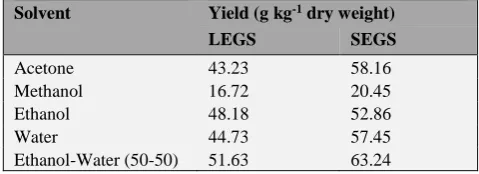
The yield of the crude extract obtained by direct extraction of 1.0 kg of the ground leaves and seeds of Griffonia simplicifolia at room temperature is given in Table 1. The highest yield of 63.24 g/1000 g and 51.63 g/1000 g was obtained with 1:1 (v/v) water-ethanol solvent mixer for SEGS and LEGS respectively. As can be observed in table 1, the seeds yield higher than the leaves, and the yield follows the trend ethanol-water > acetone > water > ethanol > methanol.
Table 1. Yield of LEGS and SEGS in different solvents at room temperature.
Solvent Yield (g kg-1 dry weight)
LEGS SEGS
Acetone 43.23 58.16
Methanol 16.72 20.45
Ethanol 48.18 52.86
Water 44.73 57.45
Ethanol-Water (50-50) 51.63 63.24
Phytochemical profile of extract
Phytochemical screening of the extracts from the different solvents reveals that acetone extracts of LEGS and SEGS contained all the groups of compounds tested namely alkaloids, tannins, saponins, glycosides and terpenoids. These substances are rich in functionalities containing lone pair of electrons and -electrons which are potential adsorption sites of established corrosion inhibitors.1 Table 2
shows the phytochemical profile of LEGS and SEGS in the different solvents studied. Alkaloids are detected in extracts of all the solvents studied while flavonoids were not detected in any. These result are in partial agreement with those reported for seeds of Griffonia simplicifolia in Ghana.17
TGA studies
In other to determine which solvent would provide the highest inhibition efficiency, LEGS and SEGS were extracted using methanol (MeOH), ethanol (EtOH), acetone, water and ethanol-water (1:1) (EtOH-H2O) as solvents.
Results (Table 3) show that acetone extract gave the highest inhibition efficiency which also sustained appreciably at high temperature. It was earlier observed that acetone extract contained all the phytochemicals tested, which may be responsible for the high inhibition efficiency obtained.
EIS studies
EIS measurements for corrosion of X80 in 1 M HCl were carried out in the absence and presence the SEGS as well as CTR-INH. Nyquist plots shown in Fig. 2 were constructed using the experimental data obtained. The plots yielded imperfect semicircles with diameters influenced in the presence of SEGS from that of HCl solution. The differences in sizes of the diameters of the curves obtained can be due to the influence of the different solvents on the efficiency of SEGS. It can be observed that all the curves are larger in diameter in the inhibited solutions than the free acid solution which may be due to corrosion inhibition.
The diameters increase according to the trend CTR-INH > ETOH > ETOH-H2O > Acetone > H2O > MeOH > HCl
which is similar to the trend of inhibition efficiency obtained from TGA. This indicates that TGA and EIS are in agreement. A close look at table 2 also reveals that the inhibition efficiencies obtained from both measurements are comparable.
n1
1/ n dl
0 ctTable 2.Phytochemical profile of SEGS and LEGS in different solvents.
Solvent Alkaloids Tannins Saponins Glycosides Steroids Terpenoids
LEGS SEGS LEGS SEGS LEGS SEGS LEGS SEGS LEGS SEGS LEGS SEGS
Acetone + + + + + + + + + + + +
Methanol + + - + - - + - + + + -
Ethanol + + - + + - + + + + + -
Water + + + + + + + + - - + +
EtOH-H2O + + + + + + + + - + + -
Table 3.Effect of solvent on the inhibition efficiency of LEGS and SEGS using weight loss measurement.
T, C EtOH-H2O MeOH EtOH H2O Acetone
CNTR-INH
SEGS LEGS SEGS LEGS SEGS LEGS SEGS LEGS SEGS LEGS
30 91.73 79.68 84.63 56.08 91.02 78.43 90.31 76.17 95.86 82.14 100.0 60 78.41 65.18 62.54 42.17 78.91 67.02 73.02 61.13 82.64 69.42 99.8 90 56.25 41.45 42.49 36.34 57.14 42.85 50.42 39.12 66.04 50.15 94.2
Imperfections in the shapes of the semicircles can be attributed to roughness or heterogeneity of the steel surface.18 The shapes of the plots were similar in both
inhibited and free acid solution indicating that the mechanism of steel corrosion is not influenced by SEGS. However, slight differences can be observed in ethanol-water mixture and acetone. This implies that in addition to charge transfer mechanism, SEGS adsorption in these two solvents may also be associated with diffusion mechanism For uniformity, the same equivalent circuit in Figure 3 corresponding to Rs(Rct∅CPE)model was used to analyze the
obtained data. Goodness of the fits obtained was in the order of 10-4 indicating good correlation with the model. The
surface roughness or heterogeneity of the steel was compensated by introduction of a non-integer element dependent on frequency called constant phase element, CPE, estimated in terms of Y0 and n, related to impedance by Eqn.
(7).
(7)
where
ZCPE is the impedance of the CPE,
Y0 is the CPE constant,
is the angular frequency,
j is an imaginary complex number, (j2=-1) is the
phase angle of CPE and n=2/,
Table 4. Some EIS parameters determined for the inhibition of X80 steel corrosion in 1 M HCl without and with SEGS extracted from different solvents.
Test solution
RCT
cm2
RS
cm2
n Cdl
F cm-2
EIS,
%
1 M HCl 68.9 0.982 0.736 15.4 - MeOH 429.8 1.225 0.724 11.4 83.9 H2O 630.1 1.122 0.805 8.6 89.0
Acetone EtOH-H2O
EtOH CTR-INH
825.1 767.0 837.6 1089.1
1.410 1.136 1.213 1.679
0.786 0.811 0.816 0.776
5.8 9.2 4.7 2.6
91.6 91.0 91.7 93.6
Some of the EIS parameters calculated are presented in Table 4. The value of 𝑛 can be used to predict the degree of roughness or inhomogeneity of the steel surface. This value decreases on addition of SEGS suggesting that the surface roughness of the steel is increased by adsorption of inhibitor molecules.20 It also shows that there is relative and/or
integrated influence on the CPE and not just a single resistance, capacitance or inductive element. Decrease in n
on addition inhibitors also signifies insulation of the metal/solution interface by formation of a surface film, which results in increase in charge transfer resistance in the presence than in the absence of inhibitor. The charge transfer resistance increases according to the trend of inhibition efficiency showing that the ‘insulating’ property of the film improved as solvent elicits better cooperative or synergistic effect with the extract.
The Cdl values obtained decreases in the presence of
inhibitors similar to results reported in literature.18 This has
been attributed to decrease in the local dielectric or increase in the thickness of the double layer or both, caused by the adsorbed protective film of the inhibitors.18
Figure 2. Nyquist plot for the inhibition of X80 steel corrosion in 1 M HCl using SEGS in different solvents.
1 nCPE 0
PDP study
Polarization (Tafel) curves for X80 steel corrosion in 1 M HCl in the absence and presence of SEGS from different solvents obtained at 30 C is shown in figure 3. The corrosion potential (Ecorr) and the corresponding corrosion
current density (Icorr), Tafel anodic slope constant (a,),
Tafel cathodic slope constants (c) and inhibition efficiency
(PD) deduced from the plots are listed in Table 5. The Ecorr
values obtained in the presence of SEGS are more positive than that of the free acid solution indicating that SEG has influenced the corrosion rate of the steel. Ecorr values shift to
more positive regions on addition of SEGS from all the solvents signifying that the SEGS has more effects on anodic half reaction by suppressing the oxidation or corrosion of iron.21 In the literature, when the shift in E
corr
values is up to -85 mV, the inhibitor is classified as anodic or cathodic type inhibitor.22 The shifts in E
corr values
obtained is not up to -85 mV indicating that SEGS acts as a mixed type inhibitor with anodic predominance.22
SEM analyses
The surfaces of the coupons in 1 M HCl and those in acetone and ethanol SEGS were scanned by SEM. Results (Figure 4) show that roughness of the micrographs of the
steel surface were more highly attacked in the uninhibited acid solution compared to the inhibited solutions. This demonstrates that the extracts inhibit X80 steel corrosion. Though the adsorbed film is not very visible, it can be seen inferred that corrosion inhibition is due to adsorption of the extracts on the steel surface.
Figure 3. Tafel plots for the inhibition of X80 steel corrosion in 1 M HCl using SEGS in different solvents.
Table 5. Some PDP parameters determined for the inhibition of X80 steel corrosion in 1 M HCl without and with SEGS extracted from different solvents.
Test Solution Ecorr, mV vs SCE Icorr, μA cm-2 a, mV dec-1 c, mV dec-1 PD, %
1 M HCl -499 693.1 82.5 98.4 ̶
MeOH -492 119.2 103.7 110.6 82.8
H2O -481 74.8 99.4 108.5 89.2
Acetone -464 56.8 101.7 131.2 91.8
EtOH-H2O -494 63.1 98.5 102.4 90.9
EtOH -483 53.4 112.1 109.7 92.3
CTR-INH -463 41.6 107.9 99.8 84.0
Figure 4. SEM micrographs of X80 steel immersed in 1 M HCl (left), Acetone SEGS (middle) and EtOH SEGS (right).
Conclusion
Effects of solvents on the yield, phytochemical profile, corrosion inhibition properties and thermal stability of the
Griffonia simplicifolia extracts have been investigated. Based on the results, the following conclusions are drawn:
the lowest yield of the extracts per 1000 g of solvent. Acetone extract contains alkaloids, tannins, saponins, glycosides, steroids and terpenoids. Acetone extract is most efficient in the inhibition of X80 steel corrosion in 1 M HCl while methanol extracts is the least efficient. Acetone and ethanol extracts are more thermally stable at 90 oC while
References
1Finšgar, M, Jackson, J., Corros. Sci., 2014, 86, 17.
https://doi.org/10.1016/j.corsci.2014.04.044
2Sangeetha M, Rajendran S, Muthumegala T.S, Krishnaveni A.,
Mater. Prot., 2011, 52, 3.
3Raja, P.B. and Sethuraman, M.G., Mater. Lett., 2008, 62, 113.
https://doi.org/10.1016/j.matlet.2007.04.079
4Rani, B. and Basu, B. B. J., Int. J. Corros., 2012, Article ID
380217, 15 pages. http://dx.doi.org/10.1155/2012/380217
5Ituen, E., Akaranta, O., James, A., Sun, S., Sustain. Mater.
Technol., 2017, 11, 12
6Ituen, E. B, Akaranta, O., James, A. O, Sun, S., J. Chem. Mater.
Res., 2016, 5, 45.
7Kumar, P. S., Praven, T., Jain, N. P., Jitendra, B., Int. J. Pharm.
Life Sci., 2010. 1, 174.
8Craig, B. D., SPE Reprint Series, 1997, 143.
9Kennedy, J. L., Oil and gas pipeline fundamentals, Pennwell
Books, Tulsa, Oklahoma, 1993
10Crolet, J. L., J. Petrol. Technol. 1983, 35, 1553.
https://doi.org/10.2118/10045-PA
11Heidersbach, R., Metallurgy and corrosion control in oil and gas
production, John Wiley & Sons, 2010, Hoboken, New Jersey.
12Siciliano, F., Stalheim, D. G., Gray, J. M., Modern high strength
steels for oil and gas transmission pipelines, 7th International Pipeline Conference, American Society of Mechanical Engineers, Alberta, 2008. https://doi.org/10.1115/IPC2008-64292
13Ueda, M., Takabe, H., Nice, P. I., The development and
implementation of a new alloyed steel for oil and gas production wells, CORROSION 2000 NACE International,
2000, Orlando, Florida.
14Smith, L., Brit. Corr. J., 1999. 34, 2471.
https://doi.org/10.1179/000705999101500905
15Ituen, E. B. and Udo, U. E., Der Chemica Sinica, 2012, 3, 1394. 16Ahmad, Z., Principles of Corrosion Engineering and Corrosion
Control, Butterworth-Heinemann, 2006, Boston.
17Addotey, A., Local production of 5-HTP from the seeds of
Griffonia simplicifolia, Doctoral dissertation, Kwame Nkrumah University of Science and Technology, Kumasi, Ghana, 2010.
18Singh, P., Singh, A., Quraishi, M., J. Taiwan Inst. Chem. Eng.,
2015, 60, 588.
19Artamonova, I. V., Gorichev, I. G., Godunov, E. B., Chem. Petrol.
Eng., 2017, 52, 710. https://doi.org/10.1007/s10556-017-0257-2
20Anupama, K. K., Ramya, K., Shainy, K. M., Joseph, A., Mater.
Chem. Phys., 2015, 167, 28.
https://doi.org/10.1016/j.matchemphys.2015.09.013
21Ehsani, A., Mahjani, M. G., Hosseini, M., Safari, R., Moshrefi, R.,
Mohammad S. H., J. Colloid Interface Sci., 2017, 490, 444. https://doi.org/10.1016/j.jcis.2016.11.048
22Singh, A., Ansari, K. R., Kumar, A., Liu, W., Songsong, C., Lin,
Y., J. Alloys Comp., 2017, 712, 121.