Research Article
a
April
2018
Special Issue: National Conference on Emerging Trends in Engineering 2018
Conference Held at Sri Venkatesa Perumal College of Engineering & Technology, Puttur, A.P., India
Computer Science and Software Engineering
ISSN: 2277-128X (Volume-8, Issue-4)
Development and Characterization of AL6061-ZrO2
Reinforced Metal Matrix Composites
K. Aruna1, K. Diwakar2, K. Bhargav Kumar3
1, 3
Assistant Professor, Department of ME, Sri Venkatesa Perumal College of Engineering and Technology, AP, India 2
Assistant Professor, Department of ME, Annamacharya Institute of Technology & Science, Kadapa, AP, India
Abstract: The aim of the present investigation is to find out the effect of reinforced particles zirconium dioxide(ZrO2)
on mechanical properties of aluminium alloy AL6061 composites which is developed by using the liquid metallurgy process (Stir Casting technique).
The proposed work is to fabricate the Al6061/ZrO2 composite material and compare the mechanical properties like
tensile strength and hardness of the Al6061 with the developed AL6061/ ZrO2 composite material. The composites of
Al6061/ZrO2 can be prepared by using the stir casting technique in which the ZrO2 can be varied separately from 2-10
wt% in steps of 2wt%(i.e. 2,4,6,8,10).Micro structural studies and analysis were carried out on all developed Al6061/ZrO2 composites by using SEM (Scanning electron microscope). Micro structural study reveals that uniform
distribution of reinforcement zirconium dioxide (ZrO2)particles in as cast AL6061 metal matrix composites.The results of this study is reveled that, there is a significant improvement in Hardness and Tensile strength was found with increase in Zirconium dioxide particles in weight percentage of composites. As expected, the percentage elongation diminished with increased weight percentage of reinforcement in the aluminum matrix.
I. INTRODUCTION
In recent years, there has been a drastic development in materials used for engineering applications. Theconventional engineering materials are not suitable for many applications as they are unmodified monolithic materials. However, composite materials have been resourceful in meeting the requirements for such applications. Composite materials differ from conventional engineering materials. They have a dual phase; mostly the second phase is added to obtain the desired performance characteristic. The de sired performance characteristics include stiffness, strength, toughness and self-lubrication [1].Composite materials have been most promising material compared to conventional materials in almost all field of engineering applications [2, 3]. Some of the major appreciable propertiesof composites are high thermal conductivity, high stiffness, high strength, low density, corrosion resistance, hardness, strength to weight ratio and various other mechanical properties [4, 5, 6].Aluminium metal matrix composites have been the subject of interest for many researchers as, the aluminium alloy overcomes the drawbacks of ferrous materials and the composite provides the desired characteristic of specific performance. MMC’s combine the metallic properties of matrix alloys (ductility and toughness) with ceramic properties of reinforcements (high strength and high modulus) and lead to higher strength in tension and compression and higher service temperature capabilities [10]. Aluminum alloy possesses good strength to weight ratio, excellent corrosion resistance and good ductility [7, 8].Aluminum based metal matrix composites are manufactured by various techniques such as - liquid metallurgy, powder metallurgy, diffusion bonding and spray forming. Liquid metallurgy route is economical and is useful in mass production over the powder metallurgy route [9].With an extensive literature survey a comparatively new aluminum alloy 6061 is used for the development and characterization of composites in the present work. AA6061 is extensively developed and marketed by Kaiser Aluminum (Foothill Roach, CA).The aim of this work is to fabricate aluminium matrix ZrO2 reinforced composites by stir casting (vortex-method) and to examine the mechanical properties. The microstructure of produced composites was executed using Optical Microscopy and scanning electron microscopy; mechanical properties were measured through hardness and tensile tests.
II. MATRIX METAL AND REINFORCED MATERIALS. 2.1 Materials
Matrix metal:
For the present investigation AL6061 was selected as matrix material due to their wide range of applications in automobile and aircraft industry and it was reinforced with ZrO2, in which the reinforcement is varied from 2-10 wt% in steps of 2wt%. The reinforcement is used to overcome the failures due to wear for the wide applications in automobile and aircraft industries.
Al6061 is the strongest aluminum alloy having zinc and magnesium as its major alloying elements. Compared to other alloys, if offers good mach inability and high resistance to corrosion.
ISSN(E): 2277-128X, ISBN: 978-93-87396-07-4, pp. 270-275
Table 1:Chemical composition of Al6061 Weight% AL6061 Al (Aluminum) Balance Si (Silicon) 0.12 Fe (Ferrous) 0.15 Cu (Copper) 1.6-2.4 Mn (Manganese) 0.10 Mg (Magnesium) 2.2-3.0 Cr (Chromium) 0.05 Zn (Zinc) 7.3-8.3 Ti (Titanium) 0.10
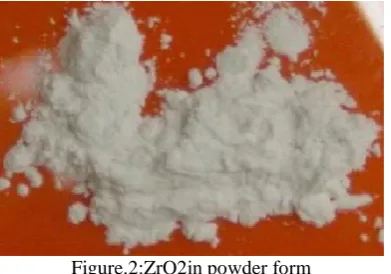
Reinforced Material: For the present investigation Zirconium Dioxide (ZrO2) is taken as reinforced material due to their excellent properties like high fracture toughness, high strength, high hardness and excellent wear resistance. The density of ZrO2 is 5.85 g/cm3 and the melting point is greater than 2600oC. For the present investigation ZrO2 is taken in the powder form (Shown in figure) of size (40-50µm) and it is varied from 2-10 wt% in steps of 2wt%.
Figure.2:ZrO2in powder form
The chemical composition of zirconium dioxide is shown in Table.2 and it was purchased from Neha scientific Pvt Ltd, Bangalore.
Table 2:Chemical composition of ZrO2 Constituent Weight % ZrO2 (Zirconium Dioxide) 99.5 SiO2 (Silicon Dioxide) 0.10 TiO2 (Titanium oxide) 0.007 Fe2O3 (Ferrous Oxide) 0.002
Other 0.39
2.2 Experimental procedure:
There are various methods are available to synthesize the aluminium based composite metal matrix composites like diffusion bonding, osprey method, liquid infiltration, powder metallurgy, in-situ techniques etc.., Many researchers are adopted to various methods to fabricate the metal matrix materials.
For the present investigation, the components are fabricated by using the stir casting technique (Liquid metallurgy route).Stir casting is convenient method to produced metal matrix composites in large quantities compared to other metal forming processes. In this method varying weight percentage of reinforcement is added to the molten metal and stirred with a uniform speed using a ceramic coated stirrer in order to have uniform distribution of reinforcement.
ISSN(E): 2277-128X, ISBN: 978-93-87396-07-4, pp. 270-275
Figure 4: Pouring molten metal into mould
MMC’S are fabricated with different weight proportions of ZrO2 in range of 0 wt% to 10 wt% in Al6061 matrix. The value of ZrO2 is varied from 2 to 10 wt% and six different composition samples were produced whose compositions are given in table3.
Table 3:Composition of specimen Sample
No
Al6061
(grams) ZrO2(grams) ZrO2 (Wt %)
1 1000 0 0
2 980 20 2
3 960 40 4
4 940 60 6
5 920 80 8
6 900 100 10
2.2.1 Wettability: One of the major drawbacks in stir casting is its Wettability condition. To overcome Wettability, and
to remove the dissolved gases present in the molten metal and then it act as a cover flux to decrease of contact angle and surface tension forces and also to enhance the physical properties of composites Hexa chloro ethane (C2Cl6) is added. 2.2.2 Testing the quality of casting: It is necessary to check the quality of the fabricating composite materials (Al6061+ZrO2). Visual inspection and Non destructive testing methods are used to detect the macro and micro-cracks
and voids present on the surface of the specimen.
III. RESULTS AND DISCUSSION 3.1 Micro structural characterization
The MMC’s were observed by inverted optical microscope. The specimen surfaces were prepared by grinding through 220 to 1500 mesh size abrasive papers and polishing with velvet cloth. After that the specimens were etched using Keller’s regent (1 ml hydrofluoric acid, 1.5 ml hydrochloric acid, 2.5 ml nitric acid and 95 ml distilled water) prior to microscopic examination.
Figure 5 (a) Optical micrograph (100X) of Al6061 &Al6061 + 2wt% ZrO2
ISSN(E): 2277-128X, ISBN: 978-93-87396-07-4, pp. 270-275
Figure 5 (c) Optical micrograph (100X) of Al6061+8wt% ZrO2& Al6061 + 10wt% ZrO2
4.2 Tensile strength
To characterize the fabricated composite materials it is necessary to conduct the tensile test and hardness test. The tensile testing was done using a computerized universal testing machine (Model:-UTE-20, Sr.No:-10/2009-4191, Max Capacity:-200KN) at room temperature. The tensile test specimens are prepared as per ASTM-E8 standard values as shown in Figure 6.
Figure 6(a) Standard tensile test specimen (ASTM E8)
Figure 6(b) shows the effect of weight percentage of zirconium dioxide on the tensile strength of the aluminium alloy Al6061. Results show that by increasing the weight percentage of Zirconium dioxide ZrO2 it increases the tensile
strength ofthealuminiumalloyAl6061.Tensile strength of unreinforced component of Aluminum alloy Al6061 is 140MPa and this value increase to a maximum of 173 for the composition of Al6061 + 10 wt% of ZrO2.
Figure 6(a) Tensile strength (MPa) Vs Wt% of ZrO2
Figure 6(b) shows the graph between the elongation and weight percentage of zirconium dioxide. Results show that by increasing the weight percentage of zirconium dioxide the elongation of the material reduces. By adding the zirconium dioxide the Al6061 loses its ductility nature and gains the brittle nature. Elongation of Al6061 is observed as 5%, this value is decreased to 3.2% for the composition of Al6061 + 10 wt% of ZrO2.
Figure 6(b) Tensile strength (MPa) Vs Wt% of ZrO2 140 149 153 160 167 173
0 50 100 150 200
T
en
si
le
s
tr
en
g
th
(
MP
a
)
Wt % Reinforcement
Tensile strength
Tensile strength
5 4.6 4.2 3.9
3.5 3.2
e
lon
ga
ti
on
(%
)
Wt% Reinforcement
Elongation
ISSN(E): 2277-128X, ISBN: 978-93-87396-07-4, pp. 270-275
4.3 Hardness:
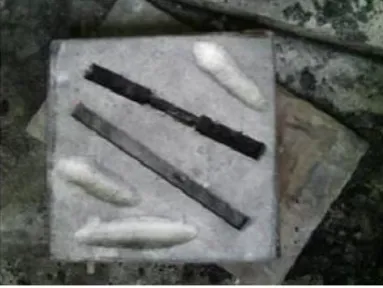
Hardness test was carried out at room temperature using Rockwell hardness tester (Model:- AI-RAS, SR.No:-163-2009/10, Make:- Arun Industries, Maharashtra, India). 1.58 mm ball is utilized for measuring hardness. The specimens are prepared as per dimensions as shown in below figure.
Fig: 7(a) Hardness Test Specimens
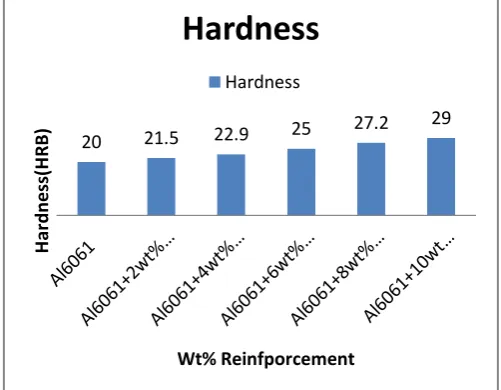
Figure 7(b) shows the comparison of the experimental hardness of the MMC’s in HRB. From the results it is observed that by increasing the weight percentage of zirconium dioxide offers more resistance to plastic deformation which leads to increase in the hardness of MMC’s. The hardness of specimen Al6061 is 20HRB and it reaches the maximum value of 29HRB for the composition ofAl6061 + 10 wt% of ZrO2.
Figure 7(b) Hardness Comparison
V. CONCLUSION
Aluminium based metal matrix composites have been successfully fabricated by stir casting technique with uniform distribution of zirconium dioxide particles. Tensile strength & hardness of MMC’s was improved with increase weight fraction of ZrO2 particle in Al6061 matrix.
Tensile strength of unreinforced component of Aluminum alloy Al6061 is 140MPa and this value increase to a maximum of 173 for the composition of Al6061 + 10 wt% of ZrO2.
Elongation of Al6061 is observed as 5%, this value is decreased to 3.2% for the composition of Al6061 + 10 wt% of ZrO2.
The hardness of specimen Al6061 is 20HRB and it reaches the maximum value of 29HRB for the composition of Al6061 + 10 wt% of ZrO2.
REFERENCES
[1] U. C. Jindal, Material Science and Metallurgy, Pearson Education, ISBN:978-81-317-5911-0.
[2] Sachin Malhotra, Ram Narayan, R. D Gupta, “Synthesis and Characterization of Aluminium 6061 Alloy-Fly ash& Zirconia Metal Matrix Composite”, International Journal of Current Engineering and Technology, Vol. 3, No. 5, pp. 1716-1719, 2013.
[3] K. B. Girisha, Dr. H. C. Chittappa, “Preparation, Characterization and Wear Study of Aluminium Alloy (Al 356.1) Reinforced with Zirconium Nano Particles”, International Journal of Innovative Research in Science, Engineering and Technology, Vol. 2, Issue 8, pp. 3627-3637, 2013.
20 21.5 22.9 25 27.2 29
H
ar
d
n
e
ss(
H
R
B)
Wt% Reinfporcement
Hardness
ISSN(E): 2277-128X, ISBN: 978-93-87396-07-4, pp. 270-275
[4] J. JenixRino, Dr. D. Sivalingappa, HaleshKoti, V. Daniel Jebin, “Properties of Al6063 MMC Reinforced with Zircon Sand and Alumina”, IOSR Journal of Mechanical and Civil Engineering, Vol. 5, Issue 5, pp. 72-77, 2013. [5] K. L. Meena, Dr. A. Manna, Dr. S.S. Banwait, Dr. Jaswanti, “An Analysis of Mechanical Properties of the
Developed Al/SiC-MMC’s”, American Journal of Mechanical Engineering, Vol. 1, No. 1, pp. 14-19,2013. [6] Sandeep Kumar Ravesh, Dr. T. K. Garg, “Prepration& Analysis for Some Mechanical Property of Aluminium