CONFORMATIONAL ISOMERISM IN A CONFORMATIONAL
POLYMORPH OF 2,5-DIBENZYLIDENECYCLOPENTANONE:
CRYSTALLOGRAPHIC AND QUANTUM CHEMICAL
STRUCTURES
Ifzan Arshad,
[a]Shumaila Ashraf,
[a]Asghar Abbas,
[a]Shahid Hameed,
[a]Kong Mun Lo,
[b]and
Muhammad Moazzam Naseer
[a]*
Keywords: polymorph; conformers; molecular packing; quantum chemical calculations; DFT/B3LYP; 2,5-dibenzylidenecyclopentanone A new polymorph (II) of 2,5-dibenzylidenecyclopentanone (DBCP) has been obtained by slow evaporation of ethanol solvent at room temperature. Interestingly, two conformational isomers of the title compound with slight difference in their bond lengths, torsion angles and dihedral angles were found within the same crystal lattice of polymorph (II). The crystal structure of polymorph (II) showed monoclinic
P21 space group with a = 6.0983 (2) Å, b = 14.9200 (7) Å, c = 15.0740 (6) Å, V= 1368.69 Å3, Z = 2 as compared to orthorhombic C2221 space group with a = 11.803 (2) Å, b = 5.698 (4) Å, c = 20.872 (2) Å, V= 1403.6 Å3, Z = 4 for previously reported polymorph (I) crystallized in CHC13/MeOH solvent. The concomitant origin of polymorphism and conformational isomerism was credited to C-H…O, π-π and C-H…π interactions resulting in intriguing supramolecular sheet-like multilayered molecular packing of polymorph (II). The results of the complementary electronic structure calculations, performed by DFT/B3LYP method using 6-31G* basis set were found in good agreement with the experimental results.
Corresponding Author
Fax: +92 51 90642241 Phone: +92 51 90642129 E-Mail:[email protected] (M.M. Naseer) [a] Department of Chemistry, Quaid-i-Azam University,
Islamabad 45320, Pakistan
[b] Department of Chemistry, University of Malaya, Kuala Lumpur 50603, Malaysia
Introduction
Polymorphism, a type of supramolecular isomerism is the ability of the same molecule to exist in more than one type of network superstructure resulting from interplay of kinetic and thermodynamic parameters and can therefore be related to structural isomerism at the molecular level.1-8 The different nature of intermolecular forces, not only influence crystal packing but also affect physical, chemical and mechanical properties of the organic solid-state materials.9-15 By slight variations in the crystallization environment such as temperature, solvent, using of additives and concentration; the same molecules can pack differently forming different crystal lattices or polymorphs.5,16,17 The generality of this phenomenon can be estimated from this fact that 80-90% of active pharmaceutical ingredients are capable of existing in polymorphic forms18 and hence may show distinguished physicochemical properties, bioavailabilities and therapeutic effects due to different arrangement of molecules in the crystal lattice.19-21
Molecules with conjugated backbone and spatially separated electron donor/acceptor functionalities have actively been investigated for their non-linear optical (NLO) and thermotropic properties.22-28 Similar molecules with different substituents are also used as in vivo multiphoton fluorescent markers and in the control of blood coagulation pathways.29 Among diverse conjugated systems recently explored, the molecular architectures having extended
donor-(π-spacer)-acceptor-(π-spacer)-donor (D-π-A-π-D) motifs were found potential biophotonic materials.30 The double Claisen-Schmidt condensation reaction of a ketone having two active α,α´ sites with two equivalents of aldehyde is the best method to prepare compounds with (D-π-A-π-D) motif, often referred to by their generic name of bis-chalcone 31. Recently, desirable NLO properties were obtained from piperidone-based bis-chalcones.30
In recent years, chalcones in general32 and bis-chalcones 33-38 in particular, showed a number of biological applications.
Therefore, controlling the polymorphic properties of this D-π-A-π-D class of compounds is important in medicinal chemistry and this can be achieved through combined experimental and computational approach to understand the interplay of intermolecular interactions and relative stability of different polymorphic forms of a compound. Herein, we report both experimental and computational results of second conformational polymorph of 2,5-dibenzylide-necyclopentanone which show conformational isomerism i-e two independent molecules with slightly different bond lengths, torsion angles and dihedral angles are present in its unit cell. The geometric parameters of two polymorphic forms are also compared through quantum chemical computations.
Experimental
Synthesis
DOI: 10.17628/ECB.2014.3.587
X-ray Crystallography
Single crystal X-ray diffraction measurements for the title compound were carried out using Bruker APEX-II CCD area-detector equipped with the graphite monochromator at 140(2) K with MoK\α radiations ( λ = 0.71073 Å). Structure solved by direct methods40 full-matrix least-squares refinement40 on F² and 355 parameters for 5355 unique intensities (Rint = 0.011). The crystal parameters are shown in Table 1. CCDC-983901 contains the supplementary crystallographic data for this paper.
Table 1. Crystallographic data for polymorph (II) of DBCP
Crystal data DBCP
CCDC Number 983901
Mr 516.60
Crystal system, space group Monoclinic, P21
Temperature (K) 140
a,
b,
c (Å)
6.0983(2),
14.9200(7), 15.0740 (6)
(°) 93.687 (3)
V (Å3) 1368.69 (10)
Z 2
Radiation type Mo Ka
m (mm-1) 0.08
Crystal size (mm) 0.17 × 0.10 × 0.10
Data collection
Diffractometer Bruker APEX-II CCD
area-detector diffractometer Absorption correction Multi-scan (SADABS;
Sheldrick, 1996)
Tmin, Tmax 0.568, 0.746 No. of measured, independent and
observed [I > 2s(I)] reflections
11078, 5355, 2558
Rint 0.246
Refinement
R[F2 > 2s(F2)], wR(F2),
S
0.111, 0.335, 0.98
No. of reflections 5355
No. of parameters 361
No. of restraints 1
H-atom treatment H-atom parameters
constrained ρmax, ρmin (e Å-3) 0.84, -0.54
Computational Detail
The molecular structure of DBCP is optimized using DFT/B3LYP level of theory with 6–31G* basis set.41-43 The initial guess of compound was first obtained from the X-ray coordinates. All calculations were performed using the ORCA 3.0.1 program package44 with Gabedit graphical user interface45 on a personal computer without specifying any symmetry for the title molecule.
Results and Discussion
Crystal structure of polymorph (II)
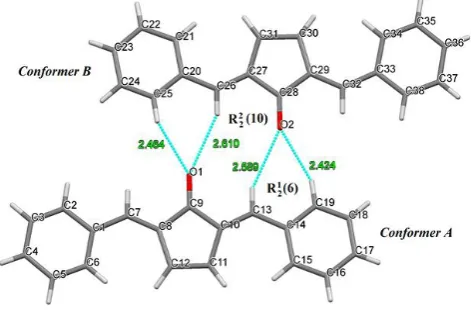
The crystal structure of polymorph (II) of 2,5-dibenzylidenecyclopentanone (DBCP) is shown in the ORTEP diagram with labeling in Figure 1. It crystallizes in the monoclinic P21 space group with Z = 2, Z' = 0 in contrast to the orthorhombic C2221 space group with Z = 4 for previously reported Polymorph (I).39
Figure 1. The crystal structure of polymorph (II) of DBCP having two conformational isomers.
Interestingly, in a unit cell of the polymorph (II), there are two different/independent molecules (called conformer A & conformer B) having slightly different bond lengths, dihedral angles and torsions angles. The peripheral phenyl rings and central cyclopentanone rings in both the conformers A & B are not coplanar. The angle between the least square planes of the rings containing the atoms C9 and C2, and C9 and C19 in conformer A = 5.67° and 5.68° and of the rings with C28 and C38, and C28 and C25 in conformer B = 3.87° and 3.38°. The Bond lengths for C=C-Car single bonds (C8-C9 1.496 Å, C10-C9 1.471 Å, C27-C28 1.463 Å, C29-C27-C28 1.471 Å) in both the conformers are shorter than the normal single bond length due to conjugation and C=C-Car double bonds (C7-C8 1.320 Å, C10-C13 1.360 Å, C29-C32 1.368 Å, C26-C27 1.355 Å are also slightly different as compared to normal double bond length.46 The bond lengths of carbonyl groups of two conformers are C9-O1 1.220 Å and C28-O2 1.254 Å, respectively. All the other bond lengths are also different in both the conformers. This difference in bond lengths, torsion angles and bond angles can be attributed to the varied amount of conjugation due to different conformations of two molecules.
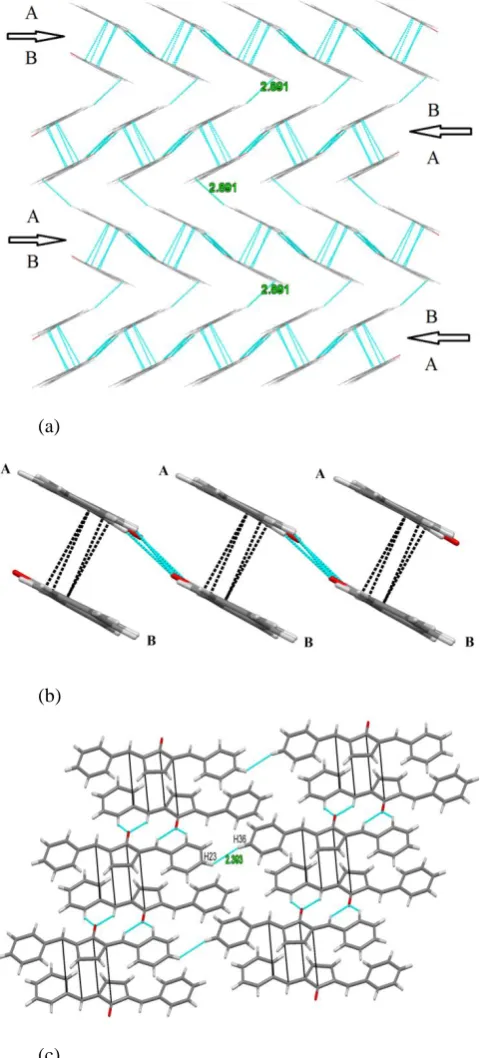
and π-π (C9-C27 3.393 Å, C10-C28 3.339 Å, C13-C29 3.385 Å and C14-C32 3.381 Å) interactions 48 and vice versa making chains like structure (Figure 2b). Each 1D-supramolecular chain is further connected to the neighboring chain by means of H-H (C36-H36….H23-C23 2.393 Å) interactions49,50 forming 2D-sheet like layer (Figure 2c). These sheet-like layers are then stacked one above the other by means of CH-π interactions (C22-C22….C16 2.891 Å)48,51 forming sheet-like multilayered structure. It is interesting to mention here that chains of the every two neighboring layers are connected with each other in a head to tail fashion (Figure 2a).
(a)
(b)
(c)
Figure 2. a) Sheet-like multilayered structure of polymorph (II) stabilized by C-H…O, π-π and C-H…π interactions. b) C-H…O and π-π interactions in 1D-Supramolecular chain (side view). c). Inter-chain hydrogen-hydrogen interactions between sheets forming 2D-sheet like layer.
Table 2. Measured and calculated bond lengths (Å).
Bond lengths, Å
X-ray B3LYP/6-31G Combined
(A and B)
Conformer A
O1-C9 1.220 1.225 1.221
C1-C2 1.411 1.410 1.410
C1-C6 1.387 1.410 1.411
C1-C7 1.471 1.461 1.461
C2-C3 1.341 1.393 1.393
C3-C4 1.371 1.397 1.397
C4-C5 1.401 1.398 1.398
C5-C6 1.391 1.393 1.393
C7-C8 1.321 1.356 1.356
C8-C9 1.501 1.506 1.507
C8-C12 1.514 1.458 1.457
C9-C10 1.471 1.505 1.500
C10-C11 1.514 1.458 1.459
C10-C13 1.361 1.356 1.358
C11-C12 1.511 1.362 1.361
C13-C14 1.451 1.461 1.461
C14-C15 1.411 1.410 1.411
C14-C19 1.418 1.411 1.412
C15-C16 1.381 1.392 1.393
C16-C17 1.411 1.399 1.398
C17-C18 1.411 1.397 1.398
C18-C19 1.381 1.393 1.393
O2-C28 1.254 1.225
C20-C21 1.386 1.411
C20-C25 1.421 1.412
C20-C26 1.461 1.461
C21-C22 1.401 1.393
C22-C23 1.381 1.398
C23-C24 1.381 1.397
C24-C25 1.341 1.393
C26-C27 1.361 1.358
C27-C28 1.451 1.500
C27-C31 1.497 1.459
C28-C29 1.471 1.507
C29-C30 1.510 1.458
C29-C32 1.371 1.356
C30-C31 1.531 1.361
C32-C33 1.441 1.461
C33-C34 1.408 1.410
C33-C38 1.409 1.410
C34-C35 1.391 1.393
C35-C36 1.391 1.398
C36-C37 1.411 1.397
C37-C38 1.391 1.393
Geometry optimization
DOI: 10.17628/ECB.2014.3.587 The small differences between the calculated and
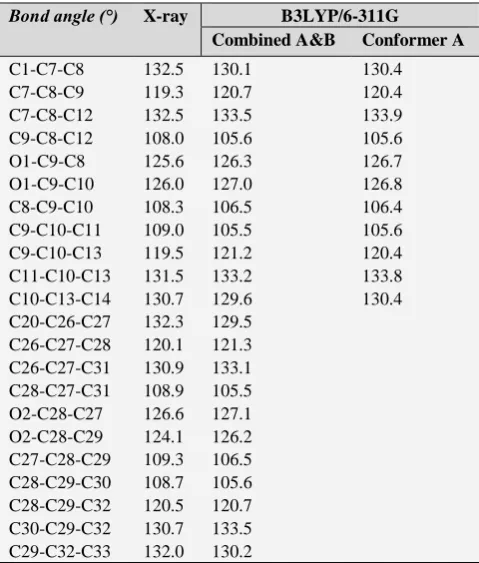
observed geometrical parameters can be attributed to the fact that the theoretical calculations were carried out with isolated molecules in the gaseous phase whereas the experimental values were based on the molecule in the crystalline state. Geometric parameters bond lengths and angles were listed in the Table 2 and Table 3, respectively along with the experimental results. As can be seen from the table all the bond lengths are extremely closed to experimental results and the biggest deviations of the selected bond lengths are 0.17 Å (C30-C31).
Table 3. Optimized bond angles of conformers A & B and conformer A in comparison with experimental results, (°).
Bond angle (°) X-ray B3LYP/6-311G
Combined A&B Conformer A
C1-C7-C8 132.5 130.1 130.4
C7-C8-C9 119.3 120.7 120.4
C7-C8-C12 132.5 133.5 133.9
C9-C8-C12 108.0 105.6 105.6
O1-C9-C8 125.6 126.3 126.7
O1-C9-C10 126.0 127.0 126.8
C8-C9-C10 108.3 106.5 106.4
C9-C10-C11 109.0 105.5 105.6
C9-C10-C13 119.5 121.2 120.4
C11-C10-C13 131.5 133.2 133.8
C10-C13-C14 130.7 129.6 130.4
C20-C26-C27 132.3 129.5 C26-C27-C28 120.1 121.3 C26-C27-C31 130.9 133.1 C28-C27-C31 108.9 105.5 O2-C28-C27 126.6 127.1 O2-C28-C29 124.1 126.2 C27-C28-C29 109.3 106.5 C28-C29-C30 108.7 105.6 C28-C29-C32 120.5 120.7 C30-C29-C32 130.7 133.5 C29-C32-C33 132.0 130.2
Experimental and computed vibrational spectra
It is normally observed that the calculated vibrational frequencies are higher than the normal due to the neglect of anharmonicity in the real system. Small differences between the theoretical and experimental values vibrational modes are observed. These differences can come from the non-covalent interactions. Also experimental results are for solid phase, and theoretical calculations belong to gaseous phase. Comparison of the experimental and calculated spectra is shown in Figure 4 and selected FT-IR and calculated vibrational wave numbers and assignments are listed in Table 4 for the conformer A and B considering a single molecule in a lattice.
The IR spectrum of the compound showed stretching band at 1687 cm-1 due to the carbonyl group while stretching for carbonyl groups are calculated at 1782-1784 cm-1 for the carbonyl groups of conformer A and B in a single lattice. The CH stretching modes, which were observed at 3054 and 2911 for the 5-member ring and phenyl group in the FT-IR spectrum, were calculated as 3257 and 3255 for CH stretching of cyclopentanone ring and number of stretching between 3220-3177 for the phenyl rings.
Figure 3. Atom-by-atom superimposition of the structures calculated (blue) on the X-ray structure (red) of polymorph (II) of DBCP.
As can be seen in table C=C (α,β-unsaturated) stretching mode, calculated as 1684-1674, were observed at 1622 in the FT-IR spectrum. These results obtained by the calculations have shown an adequate consistency with the experimental values, and small differences can be explained by the existence of intermolecular interactions like C-H…π and C-H…O.
Figure 4. The experimental and calculated infrared spectra of the tiled compound.
Frontier Molecular Orbitals analysis
Table 4. Selected vibrational assignments (cm-1) for polymorph (II).
Assignment Experimental Calculated 6-31G* for confor-mer A and B
5-member ring C-H str. 3054 3257, 3255 5-member ring C-H
asym str.
3019 3240,3239
phenyl rings C-H str. 2911 3220-3177
α,β-unsaturated -C=C-H str.
3166-3149
carbonyl str. 1687 1784,1782
α,β-unsaturated C=C str. 1622 1683-1674 phenyl rings C=C str. 1600 1626-1653
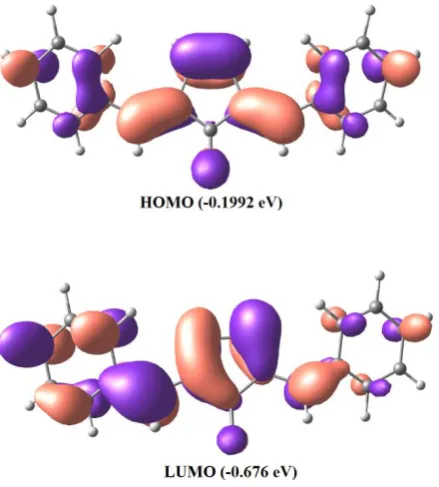
In the present study, the HOMO and LUMO energies are predicted at B3LYP method with 6-31G* basis set. Accordingly to the results, the molecule contains 68 occupied molecular orbitals and 240 unoccupied molecular orbitals. Figure 5 shows the distributions and energy levels of HOMO and LUMO orbitals for the title molecule in gaseous phase.
Figure 5. The molecular orbitals and energies for the HOMO and LUMO of 2,5-dibenzylidenecyclopentanone in gas phase.
It is clear from the Figure 5 that isodensity plot for the HOMO is well localized symmetrically over the cyclopentanone and on ipso, ortho and para position of the phenyl rings where the LUMO is populated on cyclopentanone and one of the phenyl ring along with the carbonyl group. The HOMO–LUMO energy separation can be used as a sign of kinetic stability. A large HOMO– LUMO gap implies high kinetic stability and low chemical reactivity.54,55 As can be seen the magnitude of energy separation between HOMO and LUMO is 0.1768 eV this small gap indicates the chemical softness and high reactivity of compound.
Conclusion
The polymorph (II) of 2,5-dibenzylidenecyclopentanone (DBCP) having two conformationally different/independent molecules in its unit cell has been obtained by slow evaporation of ethanol solvent at room temperature and further investigated by the computational calculations using B3LYP method with 6-31G* basis set to explore its structural aspects in comparison to its previously reported polymorph (I). The polymorph (II) pack in 1D-supramolecular chains mainly stabilized by C-H…O hydrogen bonds, π-π, C-H…π interactions with every two neighbouring chains moving in opposite directions. The analysis of both the experimental and calculated molecular geometries of polymorph (II) shows good agreement with each other. In addition, all the vibrational modes are closed to the observed vibrations and small energy difference between the HOMO-LUMO orbitals frontier provides significant information regarding the softness and high reactivity of the molecule.
Acknowledgements
We are highly grateful to the Higher Education Commission (HEC), Govt. of Pakistan for financial support. The financial support by Quaid-i-Azam University through URF is also highly acknowledged.
References
1Desiraju, G. R., Angew. Chem.-Int. Ed. Engl., 1995, 34, (21), 2311-2327.
2Boistelle, R., Actual. Néphrol.,. 1985, 159-202.
3Choudhury, A. R., Islam, K., Kirchner, M. T., Mehta, G., Row, T. N. G., J. Am. Chem. Soc., 2004,126 (39), 12274-12275.
4Herbstein, F. H., Crystal Growth Design, 2004,4(6), 1419-1429.
5Bernstein, J., Davey, R. J., Henck, J. O., Angew. Chem.-Int. Ed.
Engl., 1999,38(23), 3440-3461.
6Braga, D., Maini, L., Polito, M., Scaccianoce, L., Cojazzi, G., Grepioni, F., Coord. Chem. Rev., 2001,216, 225-248.
7Kawamura, T., Miyazaki, Y., Sorai, M., Chem. Phys. Lett., 1997,
273(5-6), 435-438.
8Kalman, A., Fabian, L., Argay, G., Bernath, G., Gyarmati, Z., J.
Am. Chem. Soc., 2003,125 (1), 34-35.
9Matsumoto, A., Tanaka, T., Tsubouchi, T., Tashiro, K., Saragai, S., Nakamoto, S., J. Am. Chem. Soc., 2002,124(30), 8891-8902.
10McMahon, J. A., Zaworotko, M. J., Remenar, J. F., Chem.
Commun., 2004(3), 278-279.
11Barendt, J. M., Bent, E. G., Haltiwanger, R. C., Squier, C. A., Norman, A. D., Inorg. Chem., 1989,28(24), 4425-4427.
12Reger, D. L., Gardinier, J. R., Smith, M. D., Shahin, A. M., Long, G. J., Rebbouh, L., Grandjean, F., Inorg. Chem., 2005,44(6), 1852-1866.
13Reed, S. M., Weakley, T. J., Hutchison, J. E., Crystal Eng., 2000,
3(2), 85-99.
14Ballester, L., Gil, A. M., Gutierrez, A., Perpinan, M. F., Azcondo, M. T., Sanchez, A. E., Amador, U., Campo, J., Palacio, F.,
DOI: 10.17628/ECB.2014.3.587 15Basavoju, S., Boström, D., Velaga, S. P., Mol. Cryst. Liq.Cryst.,
2012,562(1), 254-264.
16Munshi, P., Venugopala, K. N., Jayashree, B. S., Row, T. N. G.,
Crystal Growth Design, 2004,4(6), 1105-1107.
17Davey, R. J., Blagden, N., Potts, G. D., Docherty, R., J. Am.
Chem. Soc., 1997,119(7), 1767-1772.
18Sarma, B., Chen, J., Hsi, H.-Y., Myerson, A., Korean J. Chem.
Eng., 2011,28(2), 315-322.
19Aakeröy, C. B., Forbes, S., Desper, J., J. Am. Chem. Soc., 2009,
131(47), 17048-17049.
20Chieng, N., Rades, T., Aaltonen, J., J. Pharm. Biomed. Anal.,
2011,55(4), 618-644.
21Blagden, N., De Matas, M., Gavan, P., York, P., Adv. Drug Deliv.
Rev., 2007,59(7), 617-630.
22Kawamata, J., Inoue, K., Inabe, T., Appl. Physics Lett., 1995,
66(23), 3102-3104.
23Kawamata, J., Inoue, K., Inabe, T., Bull. Chem. Soc. Jap., 1998,
71(12), 2777-2786.
24Kawamata, J., Inoue, K., Inabe, T., Kiguchi, M., Kato, M., Taniguchi, Y., Chem. Phys. Lett., 1996,249(1), 29-34.
25Ravindra, H., Chandrashekaran, K., Harrison, W., Dharmaprakash, S., Appl.Phys. B. 2009,94(3), 503-511.
26Indira, J., Karat, P. P., Sarojini, B., J. Cryst. Growth, 2002,
242(1), 209-214.
27Nesterov, V. V., Antipin, M. Y., Nesterov, V. N., Penn, B. G., Frazier, D. O., Timofeeva, T. V., Crystal Growth Design,
2004,4(3), 521-531.
28Nesterov, V. V., Antipin, M. Y., Nesterov, V. N., Moore, C. E., Cardelino, B. H., Timofeeva, T. V., J. Phys. Chem., B. 2004, 108(25), 8531-8539.
29Guilford, W. J., Shaw, K. J., Dallas, J. L., Koovakkat, S., Lee, W., Liang, A., Light, D. R., McCarrick, M. A., Whitlow, M., Ye, B., J. Med. Chem., 1999,42(26), 5415-5425.
30Nesterov, V. N., Timofeeva, T. V., Sarkisov, S. S., Leyderman, A., Lee, C. Y. C., Antipin, M. Y., Acta Cryst. Sect. C. 2003, 59(11), o605-o608.
31March, J., Adv. Org. Chem., Wiley, New York, 1992.
32Katsori, A. M., Hadjipavlou-Litina, D., Expert. Opin. Ther. Path.,
2011,21(10), 1575-96.
33Asiri, A. M., Khan, S. A., Molecules. 2011,16 (1), 523-31.
34Husain, A., Rashid, M., Mishra, R., Kumar, D., Acta Pol. Pharm.,
2013,70(3), 443-9.
35Solano, J. D., Gonzalez-Sanchez, I., Cerbon, M. A., Guzman, A., Urbina, M. A., Vilchis-Reyes, M. A., Martinez-Zuniga, E. C., Alvarado, C., Quintero, A., Diaz, E., Eur. J. Med. Chem., 2013,60, 350-9.
36Dominguez, J. N., de Dominguez, N. G., Rodrigues, J., Acosta, M. E., Caraballo, N., Leon, C., J. Enzyme Inhib. Med. Chem.,
2013,28(6), 1267-73.
37Vijaya Bhaskar Reddy, M., Shen, Y. C., Ohkoshi, E., Bastow, K. F., Qian, K., Lee, K. H., Wu, T. S., Eur. J. Med. Chem.,
2012,47(1), 97-103.
38Modzelewska, A., Pettit, C., Achanta, G., Davidson, N. E., Huang, P., Khan, S. R., Bioorg. Med. Chem., 2006,14(10), 3491-5.
39Theocharis, C. R., Jones, W., Thomas, J. M., Motevalli, M., Hursthouse, M. B., J. Chem. Soc., Perkin Trans. 2. 1984(1), 71-76.
40Sheldrick, G. M., Acta Cryst., Sect. A. Found. Cryst., 2007,64(1), 112-122.
41Becke, A. D., J. Chem. Phys., 1993,98(7), 5648-5652.
42Lee, C., Yang, W., Parr, R. G., Phys. Rev. B., 1988,37(2), 785.
43Hehre, W. J., Ditchfield, R., Pople, J. A., J. Chem. Phys., 1972,
56(5), 2257-2261.
44Neese, F., Wiley Interdiscipl. Rev.: Comput. Mol. Sci., 2012,2(1), 73-78.
45Allouche, A. R., J. Comput. Chem., 2011,32(1), 174-182.
46Allen, F. H., Kennard, O., Watson, D. G., Brammer, L., Orpen, A. G., Taylor, R., J. Chem. Soc., Perkin Trans. 2., 1987(12), S1-S19.
47Etter, M. C., Acc. Chem. Res., 1990,23(4), 120-126.
48Naseer, M. M., Hameed, S., Crystengcomm, 2012,14(13), 4247-4250.
49Casadesús, R., Moreno, M., González-Lafont, à., Lluch, J. M., Repasky, M. P., J. Comput. Chem., 2004,25(1), 99-105.
50Abbas, A., Nazir, H., Naseer, M. M., Bolte, M., Hussain, S., Hafeez, N., Hasan, A., Spectrochim. Acta. A. Mol. Biomol. Spectr., 2014,120, 176-84.
51Mikhailov, O. V., Chachkov, D. V., Eur. Chem. Bull., 2014,3(4), 367-371.
52Becker, H. G. O., J. Prakt. Chem., 1978,320(5), 879-880.
53Kosar, B., Albayrak, C., Spectrochim. Acta Part A. Mol. Biomol.r
Spectr., 2011,78(1), 160-167.
54Özbek, N., Kavak, G., Özcan, Y., Ide, S., Karacan, N., J. Mol.
Struct., 2009,919(1), 154-159.
55Kumar, P. S., Vasudevan, K., Prakasam, A., Geetha, M., Anbarasan, P., Spectrochim. Acta Part A. Mol. Biomol. Spectr., 2010,77(1), 45-50.