Proceedings of the 45th Annual Meeting of the Association of Computational Linguistics, pages 720–727,
A Probabilistic Approach to Syntax-based Reordering
for Statistical Machine Translation
Chi-Ho Li, Dongdong Zhang, Mu Li, Ming Zhou Microsoft Research Asia
Beijing, China
chl, [email protected] muli, [email protected]
Minghui Li, Yi Guan Harbin Institute of Technology
Harbin, China
[email protected] [email protected]
Abstract
Inspired by previous preprocessing ap-proaches to SMT, this paper proposes a novel, probabilistic approach to reordering which combines the merits of syntax and phrase-based SMT. Given a source sentence and its parse tree, our method generates, by tree operations, an n-best list of re-ordered inputs, which are then fed to stan-dard phrase-based decoder to produce the optimal translation. Experiments show that, for the NIST MT-05 task of Chinese-to-English translation, the proposal leads to BLEU improvement of 1.56%.
1 Introduction
The phrase-based approach has been considered the default strategy to Statistical Machine Translation (SMT) in recent years. It is widely known that the phrase-based approach is powerful in local lexical choice and word reordering within short distance. However, long-distance reordering is problematic in phrase-based SMT. For example, the distance-based reordering model (Koehn et al., 2003) al-lows a decoder to translate in non-monotonous or-der, under the constraint that the distance between two phrases translated consecutively does not ex-ceed a limit known asdistortion limit. In theory the distortion limit can be assigned a very large value so that all possible reorderings are allowed, yet in practise it is observed that too high a distortion limit not only harms efficiency but also translation per-formance (Koehn et al., 2005). In our own
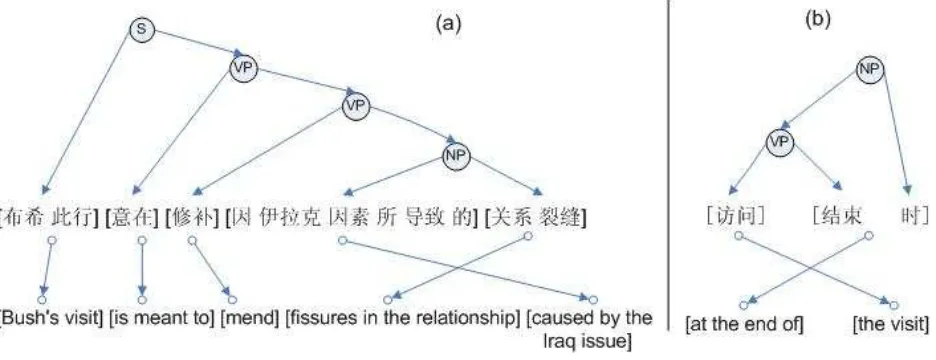
exper-iment setting, the best distortion limit for Chinese-English translation is4. However, some ideal trans-lations exhibit reorderings longer than such distor-tion limit. Consider the sentence pair in NIST MT-2005 test set shown in figure 1(a): after translating the word “dd/mend”, the decoder should ‘jump’ across six words and translate the last phrase “d d dd/fissures in the relationship”. Therefore, while short-distance reordering is under the scope of the distance-based model, long-distance reorder-ing is simply out of the question.
A terminological remark: In the rest of the paper, we will use the terms global reorderingand local reorderingin place of long-distance reordering and short-distance reordering respectively. The distinc-tion between long and short distance reordering is solely defined by distortion limit.
Syntax1is certainly a potential solution to global
reordering. For example, for the last two Chinese phrases in figure 1(a), simply swapping the two chil-dren of the NP node will produce the correct word order on the English side. However, there are also reorderings which do not agree with syntactic anal-ysis. Figure 1(b) shows how our phrase-based de-coder2obtains a good English translation by
reorder-ing two blocks. It should be noted that the second Chinese block “dd d” and its English counterpart “at the end of” are not constituents at all.
In this paper, our interest is the value of syntax in reordering, and the major statement is that syntactic information is useful in handling global reordering
1Here by syntax it is meant linguistic syntax rather than
for-mal syntax.
2The decoder is introduced in section 6.
Figure 1: Examples on how syntax (a) helps and (b) harms reordering in Chinese-to-English translation The lines and nodes on the top half of the figures show the phrase structure of the Chinese sentences, while the links on the bottom half of the figures show the alignments between Chinese and English phrases. Square brackets indicate the boundaries of blocks found by our decoder.
and it achieves better MT performance on the ba-sis of the standard phrase-based model. To prove it, we developed a hybrid approach which preserves the strength of phrase-based SMT in local reordering as well as the strength of syntax in global reordering.
Our method is inspired by previouspreprocessing approaches like (Xia and McCord, 2004), (Collins et al., 2005), and (Costa-juss`a and Fonollosa, 2006), which split translation into two stages:
S→S0 →T (1)
where a sentence of the source language (SL), S, is first reordered with respect to the word order of the target language (TL), and then the reordered SL sentence S0 is translated as a TL sentence T by monotonous translation.
Our first contribution is a new translation model as represented by formula 2:
S →n×S0 →n×T →Tˆ (2)
where ann-best list ofS0, instead of only oneS0, is generated. The reason of such change will be given in section 2. Note also that the translation process S0→T is not monotonous, since the distance-based model is needed for local reordering. Our second contribution is our definition of the best translation:
arg max
T exp(λrlogPr(S→S 0)+X
i
λiFi(S0→T))
where Fi are the features in the standard phrase-based model and Pr(S → S0) is our new feature, viz. the probability of reorderingS asS0. The de-tails of this model are elaborated in sections 3 to 6. The settings and results of experiments on this new model are given in section 7.
2 Related Work
There have been various attempts to syntax-based SMT, such as (Yamada and Knight, 2001) and (Quirk et al., 2005). We do not adopt these models since a lot of subtle issues would then be in-troduced due to the complexity of syntax-based de-coder, and the impact of syntax on reordering will be difficult to single out.
There have been many reordering strategies un-der the phrase-based camp. A notable approach is lexicalized reordering (Koehn et al., 2005) and (Till-mann, 2004). It should be noted that this approach achieves the best result within certain distortion limit and is therefore not a good model for global reorder-ing.
of rules for transforming German parse trees with respect to English word order. Instead of relying on manual rules, (Xia and McCord, 2004) propose a method in learning patterns of rewriting SL sen-tences. This method parses training data and uses some heuristics to align SL phrases with TL ones. From such alignment it can extract rewriting pat-terns, of which the units are words and POSs. The learned rewriting rules are then applied to rewrite SL sentences before monotonous translation.
Despite the encouraging results reported in these papers, the two attempts share the same shortcoming that their reordering is deterministic. As pointed out in (Al-Onaizan and Papineni, 2006), these strategies make hard decisions in reordering which cannot be undone during decoding. That is, the choice of re-ordering is independent from other translation fac-tors, and once a reordering mistake is made, it can-not be corrected by the subsequent decoding.
To overcome this weakness, we suggest a method to ‘soften’ the hard decisions in preprocessing. The essence is that our preprocessing module generates n-bestS0s rather than merely one S0. A variety of reordered SL sentences are fed to the decoder so that the decoder can consider, to certain extent, the interaction between reordering and other factors of translation. The entire process can be depicted by formula 2, recapitulated as follows:
S→n×S0 →n×T →T .ˆ
Apart from their deterministic nature, the two previous preprocessing approaches have their own weaknesses. (Collins et al., 2005) count on man-ual rules and it is suspicious if reordering rules for other language pairs can be easily made. (Xia and McCord, 2004) propose a way to learn rewriting patterns, nevertheless the units of such patterns are words and their POSs. Although there is no limit to the length of rewriting patterns, due to data sparse-ness most patterns being applied would be short ones. Many instances of global reordering are there-fore left unhandled.
3 The Acquisition of Reordering Knowledge
To avoid this problem, we give up using rewriting patterns and design a form of reordering knowledge
which can be directly applied to parse tree nodes. Given a nodeN on the parse tree of an SL sentence, the required reordering knowledge should enable the preprocessing module to determine how probable the children ofN are reordered.3 For simplicity, let
us first consider the case of binary nodes only. Let N1 andN2, which yield phrasesp1 andp2 respec-tively, be the child nodes ofN. We want to deter-mine the order ofp1andp2 with respect to their TL counterparts,T(p1) andT(p2). The knowledge for making such a decision can be learned from a word-aligned parallel corpus. There are two questions in-volved in obtaining training instances:
• How to defineT(pi)?
• How to define the order ofT(pi)s?
For the first question, we adopt a similar method as in (Fox, 2002): given an SL phrase ps = s1. . . si. . . sn and a word alignment matrix A, we can enumerate the set of TL words{ti:ti²A(si)}, and then arrange the words in the order as they ap-pear in the TL sentence. Letfirst(t)be the first word in this sorted set andlast(t)be the last word.T(ps)
is defined as the phrasefirst(t). . .last(t)in the TL sentence. Note thatT(ps)may contain words not in the set{ti}.
The question of the order of two TL phrases is not a trivial one. Since a word alignment matrix usu-ally contains a lot of noises as well as one-to-many and many-to-many alignments, two TL phrases may overlap with each other. For the sake of the quality of reordering knowledge, ifT(p1) andT(p2) over-lap, then the node N with children N1 and N2 is not taken as a training instance. Obviously it will greatly reduce the amount of training input. To rem-edy data sparseness, less probable alignment points are removed so as to minimize overlapping phrases, since, after removing some alignment point, one of the TL phrases may become shorter and the two phrases may no longer overlap. The implementation is similar to the idea oflexical weightin (Koehn et al., 2003): all points in the alignment matrices of the entire training corpus are collected to calculate the probabilistic distribution,P(t|s), of some TL word
3Some readers may prefer the expressionthe subtree rooted
t given some SL words. Any pair of overlapping T(pi)s will be redefined by iteratively removing less probable word alignments until they no longer over-lap. If they still overlap after all one/many-to-many alignments have been removed, then the refinement will stop andN, which coverspis, is no longer taken as a training instance.
In sum, given a bilingual training corpus, a parser for the SL, and a word alignment tool, we can collect all binary parse tree nodes, each of which may be an instance of the required reordering knowledge. The next question is what kind of reordering knowledge can be formed out of these training instances. Two forms of reordering knowledge are investigated:
1. Reordering Rules, which have the form
Z : X Y ⇒
(
X Y Pr(IN-ORDER)
Y X Pr(INVERTED)
where Z is the phrase label of a binary node andXandY are the phrase labels ofZ’s chil-dren, andPr(INVERTED) andPr(IN-ORDER) are the probability thatXandY are inverted on TL side and that not inverted, respectively. The probability figures are estimated by Maximum Likelihood Estimation.
2. Maximum Entropy (ME) Model, which does the binary classification whether a binary node’s children are inverted or not, based on a set of features over the SL phrases correspond-ing to the two children nodes. The features that we investigated include the leftmost, rightmost, head, and context words4, and their POSs, of
the SL phrases, as well as the phrase labels of the SL phrases and their parent.
4 The Application of Reordering Knowledge
After learning reordering knowledge, the prepro-cessing module can apply it to the parse tree, tS, of an SL sentence S and obtain the n-best list of S0. Since a ranking ofS0 is needed, we need some way to score each S0. Here probability is used as the scoring metric. In this section it is explained
4The context words of the SL phrases are the word to the left
of the left phrase and the word to the right of the right phrase.
how then-best reorderings ofSand their associated scores/probabilites are computed.
Let us first look into the scoring of a particular reordering. LetPr(p→p0)be the probability of re-ordering a phrasepintop0. For a phraseqyielded by a non-binary node, there is only one ‘reordering’ of q, viz. q itself, thus Pr(q→q) = 1. For a phrasep yielded by a binary nodeN, whose left childN1has reorderingspi
1 and right child N2 has the reorder-ingspj2(1≤i, j≤n),p0has the formpi
1pj2orpj2pi1. Therefore,Pr(p→p0) =
(
Pr(IN-ORDER)×Pr(pi1→p1i0)×Pr(pj2→pj20) Pr(INVERTED)×Pr(pj2→p2j0)×Pr(pi1→pi10)
The figuresPr(IN-ORDER)andPr(INVERTED)are obtained from the learned reordering knowledge. If reordering knowledge is represented as rules, then the required probability is the probability associated with the rule that can apply to N. If reordering knowledge is represented as an ME model, then the required probability is:
P(r|N) = exp( P
iλifi(N, r))
P
r0exp(
P
iλifi(N, r0)) wherer²{IN-ORDER,INVERTED}, andfi’s are fea-tures used in the ME model.
Let us turn to the computation of the n-best re-ordering list. LetR(N) be the number of reorder-ings of the phrase yielded byN, then:
R(N) = (
2R(N1)R(N2) ifN has childrenN1,N2
1 otherwise
It is easily seen that the number ofS0s increases ex-ponentially. Fortunately, what we need is merely an n-best list rather than a full list of reorderings. Start-ing from the leaves oftS, for each nodeN covering phrasep, we only keep track of then p0s that have the highest reordering probability. ThusR(N)≤n. There are at most2n2reorderings for any node and only the top-scorednreorderings are recorded. The n-best reorderings ofS, i.e. then-best reorderings of the yield of the root node oftS, can be obtained by this efficient bottom-up method.
5 The Generalization of Reordering Knowledge
only. It is not difficult to generalize the theory of reordering knowledge to nodes of other branching factors. The case of binary nodes is simple as there are only two possible reorderings. The case of 3-ary nodes is a bit more complicated as there are six.5 In
general, ann-ary node has n!possible reorderings of its children. The maximum entropy model has the same form as in the binary case, except that there are more classes of reordering patterns as nincreases. The form of reordering rules, and the calculation of reordering probability for a particular node, can also be generalized easily.6 The only problem for the
generalized reordering knowledge is that, as there are more classes, data sparseness becomes more se-vere.
6 The Decoder
The last three sections explain how the S→n×S0 part of formula 2 is done. The S0→T part is simply done by our re-implementation of PHARAOH (Koehn, 2004). Note that non-monotonous translation is used here since the distance-based model is needed for local reordering. For then×T→Tˆpart, the factors in consideration include the score ofT returned by the decoder, and the reordering probability Pr(S → S0). In order to conform to the log-linear model used in the de-coder, we integrate the two factors by defining the total score ofTas formula 3:
exp(λrlogPr(S→S0) +
X
i
λiFi(S0→T)) (3)
The first term corresponds to the contribution of syntax-based reordering, while the second term that of the featuresFi used in the decoder. All the fea-ture weights (λs) were trained using our implemen-tation of Minimum Error Rate Training (Och, 2003). The final translationTˆis theT with the highest total score.
5Namely, N
1N2N3, N1N3N2, N2N1N3, N2N3N1,
N3N1N2, andN3N2N1, if the child nodes in the original order areN1,N2, andN3.
6For example, the reordering probability of a phrase p =
p1p2p3generated by a 3-ary nodeNis
Pr(r)×Pr(pi1)×Pr(pj 2)×Pr(p
k 3)
whereris one of the six reordering patterns for 3-ary nodes.
It is observed in pilot experiments that, for a lot of long sentences containing several clauses, only one of the clauses is reordered. That is, our greedy re-ordering algorithm (c.f. section 4) has a tendency to focus only on a particular clause of a long sentence. The problem was remedied by modifying our de-coder such that it no longer translates a sentence at once; instead the new decoder does:
1. split an input sentenceSinto clauses{Ci};
2. obtain the reorderings among{Ci},{Sj};
3. for eachSj, do
(a) for each clauseCiinSj, do i. reorderCiinton-bestC
0
is, ii. translate eachCi0 intoT(Ci0), iii. selectTˆ(Ci0);
(b) concatenate{Tˆ(Ci0)}intoTj;
4. selectTˆj.
Step 1 is done by checking the parse tree if there are anyIPorCPnodes7 immediately under the root node. If yes, then all theseIPs,CPs, and the remain-ing segments are treated as clauses. If no, then the entire input is treated as one single clause. Step 2 and step 3(a)(i) still follow the algorithm in sec-tion 4. Step 3(a)(ii) is trivial, but there is a subtle point about the calculation of language model score: the language model score of a translated clause is not independent from other clauses; it should take into account the last few words of the previous translated clause. The best translated clauseTˆ(Ci0)is selected in step 3(a)(iii) by equation 3. In step 4 the best translationTˆjis
arg max
Tj exp(λrlogPr(S→Sj)+
X
i
score(T(Ci0))).
7 Experiments
7.1 Corpora
Our experiments are about Chinese-to-English translation. The NIST MT-2005 test data set is used for evaluation. (Case-sensitive) BLEU-4 (Papineni et al., 2002) is used as the evaluation metric. The
7IPstands forinflectional phraseandCPforcomplementizer
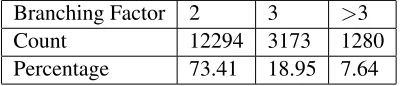
Branching Factor 2 3 >3
Count 12294 3173 1280
Percentage 73.41 18.95 7.64
Table 1: Distribution of Parse Tree Nodes with Dif-ferent Branching Factors Note that nodes with only one child are excluded from the survey as reordering does not apply to such nodes.
[image:6.612.86.289.72.115.2]test set and development set of NIST MT-2002 are merged to form our development set. The training data for both reordering knowledge and translation table is the one for NIST MT-2005. The GIGA-WORD corpus is used for training language model. The Chinese side of all corpora are segmented into words by our implementation of (Gao et al., 2003).
7.2 The Preprocessing Module
As mentioned in section 3, the preprocessing mod-ule for reordering needs a parser of the SL, a word alignment tool, and a Maximum Entropy training tool. We use the Stanford parser (Klein and Man-ning, 2003) with its default Chinese grammar, the GIZA++ (Och and Ney, 2000) alignment package with its default settings, and the ME tool developed by (Zhang, 2004).
Section 5 mentions that our reordering model can apply to nodes of any branching factor. It is inter-esting to know how many branching factors should be included. The distribution of parse tree nodes as shown in table 1 is based on the result of pars-ing the Chinese side of NIST MT-2002 test set by the Stanford parser. It is easily seen that the major-ity of parse tree nodes are binary ones. Nodes with more than 3 children seem to be negligible. The 3-ary nodes occupy a certain proportion of the distri-bution, and their impact on translation performance will be shown in our experiments.
7.3 The decoder
The data needed by our Pharaoh-like decoder are translation table and language model. Our 5-gram language model is trained by the SRI language mod-eling toolkit (Stolcke, 2002). The translation table is obtained as described in (Koehn et al., 2003), i.e. the alignment tool GIZA++ is run over the training data in both translation directions, and the two
align-Test Setting BLEU
B1 standard phrase-based SMT 29.22 B2 (B1) + clause splitting 29.13
Table 2: Experiment Baseline
Test Setting BLEU BLEU
2-ary 2,3-ary
1 rule 29.77 30.31
2 ME (phrase label) 29.93 30.49
3 ME (left,right) 30.10 30.53
4 ME ((3)+head) 30.24 30.71
5 ME ((3)+phrase label) 30.12 30.30
6 ME ((4)+context) 30.24 30.76
Table 3: Tests on Various Reordering Models The 3rd column comprises the BLEU scores obtained by ordering binary nodes only, the 4th column the scores by re-ordering both binary and 3-ary nodes. The features used in the ME models are explained in section 3.
ment matrices are integrated by the GROW-DIAG -FINAL method into one matrix, from which phrase translation probabilities and lexical weights of both directions are obtained.
The most important system parameter is, of course, distortion limit. Pilot experiments using the standard phrase-based model show that the optimal distortion limit is 4, which was therefore selected for all our experiments.
7.4 Experiment Results and Analysis
The baseline of our experiments is the standard phrase-based model, which achieves, as shown by table 2, the BLEU score of 29.22. From the same table we can also see that the clause splitting mech-anism introduced in section 6 does not significantly affect translation performance.
[image:6.612.314.551.139.262.2]Input ddd2005ddd ddddddd ddddddddddddd Reference Hainan province will continue to increase its investment in the public services and
social services infrastructures in 2005
Baseline Hainan Province in 2005 will continue to increase for the public service and social infrastructure investment
Translation with Preprocessing
[image:7.612.106.266.207.267.2]Hainan Province in 2005 will continue to increase investment in public services and social infrastructure
Table 4: Translation Example 1
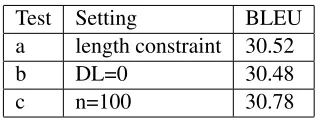
Test Setting BLEU
a length constraint 30.52
b DL=0 30.48
c n=100 30.78
Table 5: Tests on Various Constraints
are added (tests 4 and 6), phrase labels can no longer compete with lexical features. Surprisingly, test 5 shows that the combination of phrase labels and lex-ical features is even worse than using either phrase labels or lexical features only.
Apart from quantitative evaluation, let us con-sider the translation example of test 6 shown in ta-ble 4. To generate the correct translation, a phrase-based decoder should, after translating the word “dd” as “increase”, jump to the last word “d
d(investment)”. This is obviously out of the capa-bility of the baseline model, and our approach can accomplish the desired reordering as expected.
By and large, the experiment results show that no matter what kind of reordering knowledge is used, the preprocessing of syntax-based reordering does greatly improve translation performance, and that the reordering of 3-ary nodes is crucial.
The second set of experiments test the effect of some constraints. The basic setting is the same as that of test 6 in the first experiment set, and reorder-ing is applied to both binary and 3-ary nodes. The results are shown in table 5.
In test (a), the constraint is that the module does not consider any reordering of a node if the yield of this node contains not more than four words. The underlying rationale is that reordering within distortion limit should be left to the distance-based model during decoding, and syntax-based reorder-ing should focus on global reorderreorder-ing only. The
result shows that this hypothesis does not hold. In practice syntax-based reordering also helps lo-cal reordering. Consider the translation example of test (a) shown in table 6. Both the baseline model and our model translate in the same way up to the word “dd” (which is incorrectly translated as “and”). From this point, the proposed preprocess-ing model correctly jump to the last phrase “ddd
dd/discussed”, while the baseline model fail to do so for the best translation. It should be noted, how-ever, that there are only four words between “dd” and the last phrase, and the desired order of decod-ing is within the capability of the baseline system. With the feature of syntax-based global reordering, a phrase-based decoder performs better even with respect to local reordering. It is because syntax-based reordering adds more weight to a hypothesis that moves words across longer distance, which is penalized by the distance-based model.
In test (b) distortion limit is set as 0; i.e. reorder-ing is done merely by syntax-based preprocessreorder-ing. The worse result is not surprising since, after all, preprocessing discards many possibilities and thus reduce the search space of the decoder. Some local reordering model is still needed during decoding.
Finally, test (c) shows that translation perfor-mance does not improve significantly by raising the number of reorderings. This implies that our ap-proach is very efficient in that only a small value of nis capable of capturing the most important global reordering patterns.
8 Conclusion and Future Work
Input dddd,dddddddddddddddddddd
Reference Meanwhile , Yushchenko and his assistants discussed issues concerning the estab-lishment of a new government
Baseline The same time , Yushchenko assistants and a new Government on issues discussed Translation with
Preprocessing
The same time , Yushchenko assistants and held discussions on the issue of a new government
Table 6: Translation Example 2
phrase-based model, is enabled by the tree opera-tions in preprocessing. On the other hand, local re-ordering is preserved and even strengthened in our approach. Experiments show that, for the NIST MT-05 task of Chinese-to-English translation, the pro-posal leads to BLEU improvement of 1.56%.
Despite the encouraging experiment results, it is still not very clear how the syntax-based and distance-based models complement each other in improving word reordering. In future we need to investigate their interaction and identify the contri-bution of each component. Moreover, it is observed that the parse trees returned by a full parser like the Stanford parser contain too many nodes which seem not be involved in desired reorderings. Shal-low parsers should be tried to see if they improve the quality of reordering knowledge.
References
Yaser Al-Onaizan, and Kishore Papineni. 2006. Distor-tion Models for Statistical Machine TranslaDistor-tion. Pro-ceedings for ACL 2006.
Michael Collins, Philipp Koehn, and Ivona Kucerova. 2005. Clause Restructuring for Statistical Machine Translation. Proceedings for ACL 2005.
M.R. Costa-juss`a, and J.A.R. Fonollosa. 2006. Statis-tical Machine Reordering. Proceedings for EMNLP 2006.
Heidi Fox. 2002. Phrase Cohesion and Statistical Ma-chine Translation. Proceedings for EMNLP 2002.
Jianfeng Gao, Mu Li, and Chang-Ning Huang 2003. Improved Source-Channel Models for Chinese Word Segmentation.Proceedings for ACL 2003.
Dan Klein and Christopher D. Manning. 2003. Accurate Unlexicalized Parsing. Proceedings for ACL 2003.
Philipp Koehn, Franz J. Och, and Daniel Marcu. 2003. Statistical Phrase-based Translation. Proceedings for HLT-NAACL 2003.
Philipp Koehn. 2004. Pharaoh: a Beam Search De-coder for Phrase-Based Statistical Machine Transla-tion Models.Proceedings for AMTA 2004.
Philipp Koehn, Amittai Axelrod, Alexandra Birch Mayne, Chris Callison-Burch, Miles Osborne, and David Talbot 2005. Edinburgh System Description for the 2005 IWSLT Speech Translation Evaluation.
Proceedings for IWSLT 2005.
Franz J. Och. 2003. Minimum Error Rate Training in Statistical Machine Translation. Proceedings for ACL 2003.
Franz J. Och, and Hermann Ney. 2000. Improved Statis-tical Alignment Models.Proceedings for ACL 2000.
Kishore Papineni, Salim Roukos, Todd Ward, and Wei-Jing Zhu. 2002. BLEU: a Method for Automatic Eval-uation of Machine Translation. Proceedings for ACL 2002.
Chris Quirk, Arul Menezes, and Colin Cherry. 2005. De-pendency Treelet Translation: Syntactically Informed Phrasal SMT. Proceedings for ACL 2005.
Andreas Stolcke. 2002. SRILM - An Extensible Lan-guage Modeling Toolkit. Proceedings for the Interna-tional Conference on Spoken Language Understand-ing 2002.
Christoph Tillmann. 2004. A Unigram Orientation Model for Statistical Machine Translation. Proceed-ings for ACL 2004.
Fei Xia, and Michael McCord 2004. Improving a Statis-tical MT System with AutomaStatis-tically Learned Rewrite Patterns.Proceedings for COLING 2004.
Kenji Yamada, and Kevin Knight. 2001. A syntax-based statistical translation model. Proceedings for ACL 2001.