Available online throug
ISSN 2229 – 5046
MATRIX-GEOMETRIC METHOD FOR QUEUEING MODEL WITH MULTIPLE VACATION,
N-POLICY, SERVER BREAKDOWN, REPAIR AND INTERRUPTION VACATION
M. RENI SAGAYA RAJ
1, B. CHANDRASEKAR*
21,2
Department of Mathematics, Sacred Heart College(Autonomous),
Tirupattur - 635601, Vellore District, Tamil Nadu, S. India.
(Received On: 15-12-15; Revised & Accepted On: 25-01-16)
ABSTRACT
I
n this paper, we study an matrix-geometric method for queueing model with multiple vacation, N-policy, system breakdown and vacation interruption. Where the system is subject to breakdown while in operation. Service resumes immediately after a repair process, and a vacation starts at the end of each busy period. The server come back to the regular busy period of a service completion without completion the vacation. Such policy is called vacation interruption. Arrivals follows a Poisson process with rate depending upon the system, namely, vacation, service or breakdown state. In terms of matrix-geometric solution method, we obtain the stationary queue length distribution. Towards the end of this paper a numerical example is provided to illustrate how the system characteristic behave as the input parameter change.Key words: Matrix-Geometry methods, Multiple Vacation, min(N,V) - Policy, Server Breakdown, Interruption Vacation.
1. INTRODUCTION
Queues with server vacations have been studied extensively in the past, and have been successfully used in various applied problems. Queueing system with server breakdown are very common in stochastic system, such as computer system, communication system, manufacturing system, Industrial organizations, and so on. In this paper, queueing models with server vacation have been discussed by some researchers due to its wide, Zeng [14] discussed two-phase service queueing system with server breakdown and vacations. Different types of vacation models have been discussed by researchers like Doshi [2] while books by Takagi [10] and Tian and Zhang [12] are dedicated to the topic. Li,Shi and Chao [8] have considered an
M
/
G
/1
queueing system with server breakdowns and bernoulli vacations and have discussed the mean number of customers in the system. Numerical investigation and sensitivity analysis of the reliability and availability measures of a repair system were investigated by Ke and Lin [7], in which the servers were imperfect and applied a multiple vacation policy. Ibe and Isijola [4] discussed multiple vacation queueing systems with differentiated vacations. Alfa and Li [1] investigated the optimum (N,T)-policy for an M/G/1 queue with cost structure where the (N,T)-policy means that the system reactivates as soon as N customers are present or the waiting time of the leading customer reaches a predefined time T. Later, Hur, Kim and Kang [3] studied at M/G/1 system with N-policy and T-policy. In their work, the server takes a vacation of fixed length T when the system becomes empty. After T times units, if the server finds customers waiting in the system, server starts the service. Otherwise, server leaves for another vacation of length T. This continues until the system is not empty. Once the number of customers waiting for service reaches or exceeds N, the server interrupts the vacation and starts providing service immediately. Although the fixed length T of vacation time greatly simplifies analysis. Thus, here a random amount V of vacation time is assumed.In this paper, we extend the model to include vacation interruption by forcing the server to return from a vacation when the number of customers in the system reaches some predefined threshold value N, the server interrupts the vacation and returns to the system to serve customers immediately. This commences new busy period and the server works until the system becomes empty. We call this discipline multiple vacatios with min(N,V)-policy. Vacation queueing system many real life situations, for example,
• A doctor's break(or vacation) can be interrupted by certain hospital emergency situations. • The vacation of an active-duty soldier can be interrupted by some pressing public defense needs.
• It is suited for official in the government sector. If there is any cultural calamity or declaration of election during this time official will be call back to resume their work by interruption their vacations.
Corresponding Author: B. Chandrasekar*
2N-Policy, Server Breakdown, Repair and Interruption Vacation / IJMA- 7(1), Jan.-2016.
© 2016, IJMA. All Rights Reserved 99
Matrix-geometric approach is utilized to develop the computable explicit formula for the probability distributions of the queue length and other system characteristic. Matrix-geometric methods approach is a useful tool for solving the more complex queueing problems of the rapid growth of the state-space introduced by the need to construct the generator matrix. Matrix-geometric method is applied by many researchers to solve various queueing problems in different frameworks. Neuts [9] explained various matrix geometric solutions of stochastic models. Matrix-geometric approach is utilized to develop the computable explicit formula for the probability distributions of the queue length and other system characteristic. Recently, Jain and Jain [5] analyzed a single server working vacation queueing model with multiple type of server breakdowns. They proposed a matrix-geometric method for computing the stationary queue length distribution.
Recently, wang, Chen and Yang [13] studied the
M
/
M
/1
machine repair problem with a working vacation policy, where the server many work with different repair rates rather than completely terminate during a vacation period. Ke [6] suggested the optimal control of anM
/
G
/1
queueing system with server vacations, startup and breakdowns. In this paper we introduced the matrix-geometric method for analyzing the system breakdown with, N-policy and interruption vacation. The server takes a vacation, when the system becomes empty. when the vacation ends, if there are customer in the queue, the server activate. Otherwise, another vacation is taken. The system is subject to breakdown, which occur at a constant rate. The system goes to repair process of random duration and when repair is completed, the server returns to the customer. During vacation, active service, and repair process. Customer arrives according to Poisson process with different rate. Under the assumption that vacation times, service times, and repairs times are follows exponential distribution.This paper is organized as follows. The model is described in section 2. By applying matrix-geometric approach, the stationary probability are obtained in section 3. Steady-state analysis of the model is given section 4. In section 5, we show that the rate matrix R and can be solved using a simple procedure that depends on system parameters. In section 6 some performance indices are established in terms of probability. Numerical results are shown in section 7, and concluding remarks are made in section 8.
2. MODEL FORMULATION
In this paper, we consider an matrix-geometric method for queueing model with multiple vacation, N-policy, breakdown and vacation interruption.
Model Assumptions:
The details assumptions of the system model are described as follows,
We assumed that the customer arrives to Poisson fashion with rate dependent upon the server states. The state dependent arrival rate
λ
of the customer are given as follows:
.
repair
under
and
breakdown
in
is
server
when the
,
,
state
service
in
is
server
when the
,
,
n
on vacatio
is
server
when the
,
=
2
1
λ
λ
λ
λ
v
Service time during a working period follows an exponential distribution with rate
µ
. The state of the service station given as follows:
≤
.
is
length
queue
when the
rate
service
that the
represents
,
,
<
is
length
queue
when the
rate
service
that the
represents
,
=
2 1
N
N
µ
µ
µ
As soon as the system becomes empty, the server begins a vacation of random length
V
at the instant when the queue becomes empty or its breakdown. Upon returning from the vacation, if there exists customers in the queue and immediately start the service. Oterwise, go to for another vacation(multiple vacation). Whenever, the number of customers waiting in the system reaches or exceeds N, the server interrupts the vacation and starts providing service immediately. The vacation random length is V and time follows an exponential distribution with rate v When the server is breakdown, if there is service to the customers. The breakdown times are assumed to be exponential with breakdown rate
α
. After the server is repaired, the server returns to the system and provides untill the system becomes empty. Repair times are exponential distribution with rate
β
. Solution of the models given as follows:
.
repair
under
and
breakdown
in
is
server
that the
represents
2,
,
state
service
active
in
is
server
that the
represents
1,
,
state
n
on vacatio
is
server
that the
represents
0,
=
i
The states for the models are as follows,
•
P
0,i - The state in which there arei
customer in the queue and the server is vacation(
i
≥
0)
. •P
1,i - The state in which there arei
customer in the system during active service(
i
≤
1)
. •P
2,i - The state in which there arei
customer in the system during repair process(
i
≥
1)
.Balance Equation for the Queue Length Distribution:
For mathematical formulation purpose, we define the following steady-state probability,
0,1
=
1 1,1 vP
P
λ
µ
(1)0, 0, 1 1 (
(
λ
v+
v P
)
i=
λ
vP
i−+
µ
P i
1, )
(2)1 1 1,1 0,1 1 1,2 2,1
(
λ µ α
+
+
)
P
=
vP
+
µ
P
+
β
P
(3)1 1 1, 1 1, 1 0, 1 1, 1 2,
(
λ µ α
+
+
)
P
i=
λ
P
i−+
vP
i+
µ
P
i++
β
P
i;
2
≥ ≥
i
N
(4)1 2 1, 1 1, 1 0, 2 1, 1 2,
(
λ µ α
+
+
)
P
N=
λ
P
N−+
vP
N+
µ
P
N++
β
P
N;
i
=
N
(5)1 2 1, 1 1, 1 0, 2 1, 1 2,
(
λ µ α
+
+
)
P
i=
λ
P
i−+
vP
i+
µ
P
i++
β
P
i;
i
≥
N
(6)2 2,1 1,1
(
λ
+
β
)
P
=
α
P
(7)2 1, 2 2, 1
(
λ
+
β
) =
α
P
i+
λ
P
i−;
i
≥
2
(8)3. MATRIX GEOMETRY PROCESSES
The analyze the resulting system of linear equations (1) to (8), a matrix-geometric method approach is used. Follows concept by Neuts [9], in the order to represent the steady-state equations in a matrix form, the transition rate matrix
Q
(the coefficient matrix) of this Markov chain could be partitioned as follows.
0 1 2 0 1 2 0 1 1 0 0=
Q
A
A
(9)Where
[
]
−
2 1 1 0 2 1 1 0 00
0
0
0
0
0
0
0
0
0
0
0
=
,
0
0
=
0],
0
0
[
=
,
=
λ
λ
λ
λ
µ
µ
λ
λ
V VV
C
B
B
,1 1 2 1
2 2
(
)
0
0
0
0
0
0
0
(
)
0
0
0
0
=
,
=
0
0
(
)
0
0
0
0
0
(
)
0
0
0
0
V a a b
V
V
λ
λ
µ α
α
µ
λ
µ α
α
µ
β
λ β
N-Policy, Server Breakdown, Repair and Interruption Vacation / IJMA- 7(1), Jan.-2016.
© 2016, IJMA. All Rights Reserved 101
4. EQUILIBRIUM CONDITION OF THE SYSTEM
Before developing the steady-state solution, the stability of the queueing system should be derived. Let Q be an infinitesimal generator matrix for the queueing system. The Steady-state probability vector exists if and only if
1
1
20
X
A
XA
<
Where
X
=
{
X
0,
X
1,
X
2,
X
3}
is the invariant probability of the matrixA
+
A
1+
A
2=
A
.X
satisfies1
=
1
,
0
=
X
Q
X
Solving the above equation, we have{
0,
1,
2,
3}
=
X
X
X
X
X
+
+
β
α
α
µ
β
α
α
,
,
,
0
=
1V
By substituting X,1,A1 and A2 into equation (1.10), the stability condition becomes as,
+
+
+
<
+
+
+
+
α
µ
β
α
µ
α
µ
β
α
α
α
µ
β
α
α
α
1 2 1 2 1V
V
1We now derive the condition for the system to reach a steady-state.
5. STEADY-STATE PROBABILITY
The steady-state probability vector
X
forQ
is generally partitioned asX
=
{
X
0,
X
1,
X
2,
}
. The equation0
=
Q
X
satisfied by the invariant vectorX
can be rewritten in matrix form:0 0
+
1B
1= 0
X B
X
(10)0 0
+
1 1+
2 2= 0
X C
X A
X A
(11)1 0
+
2 1+
3 2= 0
X A
X A
X A
(12)2 0
+
3 1+
3 2= 0,
i
≤
2
X A
X A
X A
(13)Where 1 represents a column vector with suitable size and each component equal to 1 and
X
1
=
1
is the normalizing equation.6. COMPUTATION OF THE RATE MATRIX
The matrix-geometric technique is a method to solve stationary state probability for vertor state Markov processes. The theory of the matrix geometric solution was developed by Neuts [9]. Furthermore, matrix-geometric methods are applicable to both continuous and discrete time Markov processes. In our model, if we get a matrix
R
such that0
,
=
1
,
=
−1∀
i
≥
⇒
0∀
i
≥
i i
i
i
X
R
X
X
R
X
(14)Where
X
i is the vector state of the Matkov process. Then the solution of the form [15] is called the matrix-geometric solution [9]. The explanation for solving a matrix-geometric system is to state the matrixR
, which is called the rate matrix and which we will discuss below.For some matrix
to be determined, whereX
=
{
X
0,
X
1,
X
2,
}
. Substituting this into the matrix equations yields the following:0 0 0 2 0 0 2
2 2
0 0 0 1 0 2 0 0 1 2
2 2
1 0 2 1 3 2 1 0 1 2
2 2
2 0 3 1 4 2 1 0 1 2
= 0
(
) = 0
= 0
(
) = 0
= 0
(
) = 0
= 0
(
) = 0
+
⇒
+
+
+
⇒
+
+
+
+
⇒
+
+
+
+
⇒
+
+
X B
X R A
X B
R A
X C
X R A
X R A
X A
R A
R A
X A
X R A
X R A
X A
R A
R A
X A
X R A
X R A
X A
R A
R A
Observe the common portion is: 2 2
=
0
1
0
+
+
. We use this common portion to determine
as follows: 1 1 0 2 2)
(
=
−
+
A
−Consequently, could be written in terms of
X
0 asX
i=
X
0R
, where
=
,
,
,
. Once the steady-state probabilityX
0 being obtained, the steady-state solutionX
=
{
X
0,
X
1,
X
2,
}
are then determined.0
X
could be solved by equation (15) with following normalizing equation,1
=
1
)
(
1
1 10
−
−
+
X
I
R
X
(15)7. PERFORMANCE CHARACTERISTIC
The performance characteristic are used to bring out the qualitative behaviour of the queueing model under study. Numerical study has been dealt to find the following measure.
The expression for various performance characteristic of the system are as follows.
The expected number of customer in the system when the server is on vacation.
,0 0 =
=
)
(
ii
i
V
E
∑
X
∞
The expected number of customer in the system when the server is in working state.
,1 0 =
=
)
(
ii
i
W
E
∑
X
∞
The expected number of customer in the system when the server is in breakdown state (under repair).
,2 0 =
=
)
(
ii
i
B
E
∑
X
∞
The expected number of customer in the system is given by
)
(
)
(
)
(
=
)
(
N
E
V
E
W
E
B
E
+
+
8. NUMERICAL RESULTS AND ANALYSIS
In this section we provide the numerical results using (15) matlab software has been used to develop the computer program. Four different figure has been shown. Some of the parameters are kept fixed where as some of the parameters are varied which are shown in following figure.
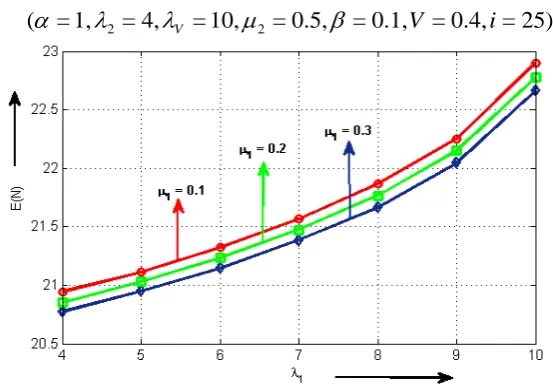
From figure (1) display the correlation between arrival rates
(
λ
1)
active service vs mean queue length byvarying the service rate
µ
1. We can observe that for the same arrival rate, as the service rate goes on increasing the mean queue length goes on decreasing. From figure (2) we can observe that the expected queue length goes on decreasing as we go in the service rate
)
>
(
µ
2µ
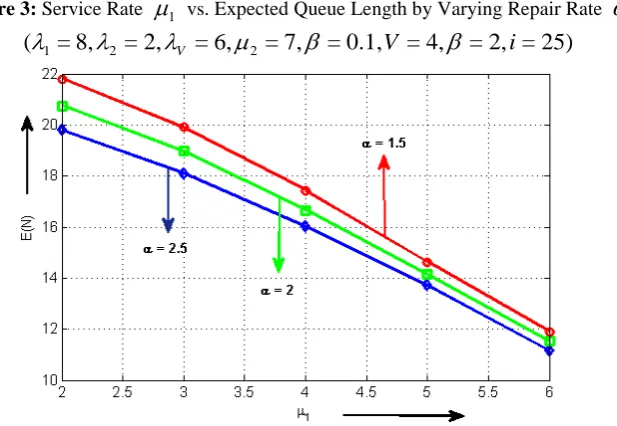
1 . From figure (3) we can observe that the expected queue length increases and decreases respectively as we go on increasing the repair rate.
From figure (4) we can observe that the expected queue length decreases and increases respectively, as we go on increases repair rate.
Figure 1: Arrival Rate During Active Service(
λ
1) vs. Expected Queue Length by Varyingµ
1.25)
=
0.4,
=
0.1,
=
0.5,
=
10,
=
4,
=
1,
=
N-Policy, Server Breakdown, Repair and Interruption Vacation / IJMA- 7(1), Jan.-2016.
© 2016, IJMA. All Rights Reserved 103
Figure 2: Arrival Rate During Active Service(
λ
1) vs. Expected Queue Length by Varyingµ
2 .25)
=
0.4,
=
0.1,
=
0.3,
=
10,
=
4,
=
1,
=
(
α
λ
2λ
Vµ
1β
V
i
Figure 3: Service Rate
µ
1 vs. Expected Queue Length by Varying Repair Rateα
.25)
=
2,
=
4,
=
0.1,
=
7,
=
6,
=
2,
=
8,
=
(
λ
1λ
2λ
Vµ
2β
V
β
i
Figure 4: Service Rate
µ
2 vs. Expected Queue Length by Varying Repair Rateα
.25)
=
2,
=
4,
=
0.1,
=
2,
=
6,
=
2,
=
8,
=
8. CONCLUSION
In this paper, we analyzed an matrix-geometric method for queueing model with multiple vacation, interruption vacation, min(N,V)-policy and server breakdown. Using the matrix-geometric method, the stationary probability distribution and some performance measures are obtained. We also define the vacation interruption, which the server can be interrupted vacation. We present several numerical examples to study the effect of some parameters on the performance measures.
9. REFERENCES
1. Alfa.A.S and Li .W, Optimal (N,T)-policy for M/G/1 system with cost structures. Performance Evaluation, Vol. 42(4), pp. 265-277(2000).
2. Doshi.B.T, Queueing systems with vacation:s A survey. Queueing Syst., vol. 1, no. 1, pp. 29-66(1986). 3. Hur .S, Kim .J and Kang .C, An analysis of the M/G/1 system with N and T policy. Applied Mathematical
Modelling, Vol. 27(8), pp. 665-675(2003).
4. Ibe .O.C and Isijola.O.A, M/M/1 multiple vacation queueing systems with differentiated vacations. Model. Simul. Eng., vol. 2, Art. ID 158247, Jul(2014).
5. Jain .M and Jain .A, Working vacations queueing mdels with multiple types of server breakdowns. Appl.Math.Model., Vol.34.No. 1, pp. 1-33(2010).
6. Ke. C, The optimal control of an M/G/1 queueing system with server vacations, startup and breakdowns. Comput. Int. Eng.44(4), pp. 567-579(2003).
7. Ke .J.C and Lin .C.H, A markov repairable system involving an imperfect service station with multiple vacations. Asia-Pacific Journals of Operation Reserch, 22(4), pp. 555-582(2005).
8. Li .W, Shi .D and Chao .X, Reliability analysis of M/G/1 queueing system with server breakdown and vacations. Journals of Applied Probability, 34, pp. 546-555(1997).
9. Neuts .M.F, Matrix Gometric Solution in Stochastic Models: An Algorithmic Approach, John Hopkins Univrsity Press, Baltimore(1981).
10. Takagi.H, Queueing Analysis: A Foundation of Performance Analysis. Volume 1: Vacation and Priority Systems, Part 1. Amsterdam, The Netherlands: Elsevier(1991).
11. Tian.N and Yue .D, Quasi-birth and death process and the matrix-geometric solution. Beijing: Science Press(2002).
12. Tian.N and Zhang .G, Vacation Queueing Models: Theory and Applications. New York, NY, USA: Springer-Verlag(2006).
13. wang.K.H, Chen.W.L and Yang.D.Y, Optimal management of the machine repair problem with wirking vacation: Newton's method. Journals of Computational and Applied mathematics, 233, pp. 449-458(2003). 14. Zeng.H and Yue .D, Two-Phases service queueing system with server breakdown and vacations. Journals of
Liaoning Technical University(Natural Science), 30(6): pp. 930-934(2011).
Source of support: Nil, Conflict of interest: None Declared