Available online throug
ISSN 2229 – 5046
THE EFFECT OF MHD AND COUPLESTRESS FLUID ON THE PERFORMANCE
CHARACTERISTICS OF WIDE SLIDER BEARING WITH AN EXPONENTIAL
AND SECANT FILM PROFILE –A COMPARATIVE STUDY
Syeda Tasneem Fathima
a*, N. B Naduvinamani
b, C. K Sreekala
c, B. N Hanumagowda
da
Department of Mathematics, Reva University, Bangalore-560064, India.
b
Tumkur University,Tumkur-585106, India.
c
Department of Mathematics,
NitteMeenakshi Institute of Technology, Bangalore-560064, India.
d
Department of Mathematics, Reva University, Bangalore-560064, India.
(Received On: 22-04-16; Revised & Accepted On: 26-05-16)
ABSTRACT
T
he theoretical investigation of comparative study between the performance characteristic of Magnetohydrodynamic wide slider bearing with exponential and secant film profile lubricated with couplestress fluids is made. On the basis of Stokes micro-continuum theory, the modified Reynolds equation is derived and closed form expression for fluid film pressure, load carrying capacity, frictional force and coefficient of friction is obtained. The graphs depicting the build-up between load carrying capacity, frictional force and coefficient of friction is plotted. Computations reveal that, exponential slider has significant load carrying capacity and friction as compared to secant slider. To illustrate the use of present study for engineering application, a design example of slider bearing lubricated with an electrically conducting fluid is also presented.Key Words: Couplestress fluid; Magneto-hydrodynamics; Exponential and Secant shaped slider bearings.
1. INTRODUCTION
In modern machine elements different types of lubricants are selected to meet the specific requirements for bearing operating under severe conditions. In order to enhance the lubricating performance, the non-Newtonian lubricant blended with long chain polymers additives is used. The rheological flow behaviour of Non-Newtonian fluids cannot be described by classical micro-continuum theory. So many micro-continuum theories have been proposed [1-2] and applied in lubrication problems such as continuum model of micro polarfluids [3]. Stokes [4] proposed the simplest micro-continuum theory which permits the presence of couplestresses and body couples. Couplestress fluid model is intended to account for particle size effects.
Slider bearings are often designed to support the axial-component thrust in a rotating shaft. Characteristics of slider bearing lubricated with non-Newtonian couplestress fluid have been studied for slider bearing by Ramanaiah and Sarkar[5]. It is shown that load carrying capacity and frictional force are found to increase but coefficient of friction decreases. Lin. J.R and Yu Ming Lu [6] analysed the steady state performance characteristics of wide parabolic shaped slider bearing with couple stress fluid and found that it has higher load carrying capacity and smaller required flow rate. The effect of couplestress lubricant on pressure and load capacity of wide exponential shaped slider bearing was studied by Mobolaji et al. [7]. He used Galerkin finite element method and found that effect of couple stress enhances load carrying capacity of the bearing. J. R Lin et al., [8] studied the dynamic characteristic of wide exponential film shape slider lubricated with couplestress fluid and investigated that it has higher load carrying capacity and better damping and dynamic characteristics. Mobolaji H. Oladeinde and John [9] has done a comparative study between parabolic and inclined slider bearing lubricated with couplestress fluids and found that parabolic slider is more superior to inclined slider in load carrying capacity. N.B Naduvinamani et al., [10] have studied the hydrodynamic lubrication of rough slider bearing with couplestress fluids. He observed that for all film shapes the negatively skewed surface roughness increases the load carrying capacity, frictional force and decreases the coefficient of friction, while in positively skewed surface roughness the reverse trend is observed.
All the above studies of slider bearing focused on the mechanism lubricated with non-conducting fluids. To avoid unexpected variation with temperature the use of liquid metal lubricant has received extensive interest. Comparing with the conventional non-conducting lubricating oils, liquid metals possesses higher thermal and electrical conductivity. The property of high electrical conductivity implies that hydrodynamic flow can be adjusted by the application of an external magnetic field. This indicates that their use as lubricant is promising. Many authors have investigated the Magnetohydrodynamic performance of slider bearings.
In 1962 Snyder [11] was first to present an analysis of MHD infinite inclined plane slider bearing in the presence of uniform transverse magnetic field. The bearing surfaces are assumed to be electrically conducting. It was observed that a significant increase in load capacity was possible with liquid metal lubricants in the presence of magnetic field. For a given magnetic field load carrying capacity occurs if the bearing surfaces are perfect electrical insulators. Hughes [12] analysed the case of MHD inclined slider bearing under general electrical loading conditions. It was found that significant load increase can be affected by supplying external power. If the Hartmann number is large enough open circuit conditions give rise to greatly increased load capacities. Shukla [13] studied optimum load of MHD slider bearing using film thickness and conductivity functions as bounded control variables. It is shown that if the conductivity of the bearing surface is of step-type function, uniformly applied magnetic field is more advantageous. Hughes [14] analysed the MHD finite step slider bearing in the presence of magnetic field applied both tangentially and transversely to the fluid film. For the transverse field it is found that only a slight increase in pressurization can be affected on open circuit conditions and that short circuit conditions is adverse. Anwar [15] studied the MHD characteristic of inclined slider bearing with arbitrary magnetic field. It is found that a non-uniform applied magnetic field gives higher load capacity as compared with uniform magnetic fields. Lin et al. [16] studied the dynamic stiffness and damping characteristic of one-dimensional slider bearing lubricated with electrically conducting fluid. JR Lin [17] studied the dynamic characteristic of MHD wide slider bearing with exponential profile. He observed that improvement of dynamic characteristics is more pronounced for large Hartmann number and small for minimum film thickness. The combined effect of MHD and couple stress is of more interest. Biradar Kasinath [18] studied the combined effect of MHD and couple stress on composite slider bearing. He analysed that the load carrying capacity and frictional force increases in comparison with non-magnetic case, but the coefficient of friction decreases. Mohammed Nabhani and Mohammed El Khlifi[19]studied the inertial couple stress effect on infinitely wide slider bearing and found that couple effect of fluid inertia forces, MHD and non-Newtonian couple stress provides a significant improvement in slider bearing load carrying capacity. Recently Syeda et al. [20] studied the combined effect of MHD and couple stresses on the characteristics of different finite plates and found that the effects are prominent in case of circular plates as compared to the other plates.
The aim of the current paper is to conduct a comparative study between MHD exponential and secant shaped slider bearing lubricated with conducting couplestress fluids.
2. MATHEMATICAL FORMULATION
The figure 1 represents the physical configuration of a wide MHD slider bearings lubricated with couplestress fluid with exponential and secant film profile. The bearing is of length L. It consists of two surfaces where x-axis is taken along lower plane across its length while the z-axis is taken across the lubricant film. The lower surface of the bearing is moving with a constant velocity U in its own plane while the upper surface is at rest.
The exponential slider film thickness is described as
0exp[ ( / ) ln ]
h=h − x L r , (1)
0 1
0 0
,
d
h
h
r
h
h
+
=
=
where
d
= −
h
1h
0 is difference between inlet and outlet film thicknessThe secant slider film thickness is described as
(
)
{
}
0
1
,
h
=
h sec a
−
x L
(2)( )
1
1 ,
a=sec− δ +
where 1 0
0
.
h
h
h
δ
=
−
A uniform transverse magnetic field B0 is applied perpendicular to the bearing. Assuming that the fluid film is thin and
0,
u
w
x
z
∂
∂
+
=
∂
∂
(3)2 4
2
0 0
2 4 y
,
u
u
p
B u
E B
z
z
x
µ
∂
−
η
∂
−
σ
=
∂
+
σ
∂
∂
∂
(4)0.
p
z
∂
=
∂
(5)and
M
0=
B h
0 0( / )
σ µ
is the Hartmann number,σ
is electrical conductivity andl
=
η µ
/
is the couplestress parameter,µ
is the viscosity coefficient and 𝜂𝜂 is the material constant characterizing couplestress.The relevant no-slip boundary conditions are at the upper surface
z
=
h
22
0,
u
0,
0.
u
w
z
∂
=
=
=
∂
(6)At the lower surface
z
=
0
22
,
u
0,
0.
u U
w
z
∂
=
=
=
∂
(7)where 𝑢𝑢, 𝑣𝑣, 𝑤𝑤 representsthe components of velocity in 𝑥𝑥, 𝑦𝑦, 𝑧𝑧 directions respectively.
If the bearing surfaces are perfect insulators and there is circuit external to the fluid film, then the electric field may be
approximated by requiring the net current flow to be zero.
(
0)
0
0
hy y
E
B u dz
=
+
=
∫
(8)
Solving (4) together with boundary conditions (6), (7) and by condition (8) gives the component of velocity as 2
0
1 2
2
0
2
2
h
p h
U
u
M
x l
ξ
ξ
µ
∂
= −
+
∂
(9) where, 2 2 1 21 2 2
tanh
tanh
2
2
A S
B S
A
Bh
B
Ah
B
l
A
l
ξ
=
−
−
{
2 2}
2 2 2 1 2
1
(A B ) A S B S
ξ
= −−
and
1
(
)
Bh
Bz
B h
z
Sinh
Sinh
Sinh
l
l
l
S
Bh
Sinh
l
−
−
+
=
2(
)
Ah
Az
A h
z
Sinh
Sinh
Sinh
l
l
l
S
Ah
Sinh
l
−
−
+
=
Integrating the continuity equation (2) over the film thickness by the using equation (6), (7) and (9) we get modified one dimensional Reynolds equation in the form
(
)
2 2 2 2
0 2 2 2 0
6
2
6
tanh
tanh
2
2
h h
A
B
l
p
dh
U
A
Bh
B
Ah
x
lM
h
x
dx
B
l
A
l
µ
∂
−
−
∂
=
∂
−
∂
(10)Introducing non-dimensional quantities
1/ 2
* 2
* * 0 * * 1 0
0 0 0
0 0 0
2
,
p h
,
,
,
,
h
h
,
1
x
l
h
x
P
l
h
M
B h
r
L
UL
h
h
h
σ
δ
δ
µ
µ
−
=
=
=
=
=
=
= +
By using non-dimensional quantities equation (10) takes the form
* *
* * 0
*
( , ,
)
6
*,
P
dh
f h l M
x
x
dx
∂
∂
=
where,
(
)
*2 *2 *2 *
* *
0 * 2 *2 * * *2 * * *
0
* * * *
12
(
, ,
)
.
tanh
tanh
h
A
B
l
f h l M
A
B h
B
A h
l M
h
B
l
A
l
−
=
−
−
(12)The ambient boundary conditions
(i) For secant slider bearing is
P
*=
0
a t x
*=
0,1
(ii) For exponential slider bearing
P
*=
0
a t x
*= −
0, 1
Integrating both sides of equation (11) w. r. t. 𝑥𝑥∗ twice The non-dimensional pressure in the film region as
* * * * * * * * 1 * * * * * * 0 0 0 0
1
6
,
(
, ,
)
(
, ,
)
x x x xh
P
dx
C
dx
f
h l M
f
h l M
= =
=
∫
+
∫
(13)
where,
For secant slider
* * 1 * * * * * 0 0 1 1 * * * * 0 0
6
( , ,
)
.
1
( , ,
)
x xh
dx
f
h l M
C
dx
f
h l M
= =
= −
∫
∫
(14)For exponential slider
* * 1 * * * * * 0 0 1 1 * * * * 0 0
6
( , ,
)
.
1
( , ,
)
x xh
dx
f
h l M
C
dx
f
h l M
− = − =
= −
∫
∫
(15)The load per unit width is given by
0 L
w
=
∫
pdx
The dimensionless load carrying capacity W* is
* 1 * * 0 x
W
pdx
==
∫
(16)* *
* *
1 * 1
* * * * *
1
* * * * * *
0 0
0 0 0 0
1
6
(
, ,
)
(
, ,
)
x x x xh
W
dx dx
C
dx dx
f
h l M
f
h l M
= =
=
∫ ∫
+
∫ ∫
(17)
The frictional force on the bearing surface is
( )
00 L
zx z
F
=
∫
τ
=dx
2 2 2
0
2 2 2
0 0
coth
coth
2
(
)
2
2
2
L
lM U
A
Bh
B
Ah
h p
F
dx
h
A
B
B
l
A
l
x
µ
∂
=
−
−
−
−
∂
∫
(18)The non-dimensional frictional force is
1 * *
* 0 * * *
0 *
0
(
, ,
)
2
Fh
h
P
F
G h l M
dx
UL
x
µ
∂
= −
=
+
∂
∫
(19)* 2 *2 * * *2 * *
* * 0
0 *2 *2 * * * *
(
, ,
)
coth
coth
4(
)
where
l M
A
B h
B
A h
G h l M
A
B
B
l
A
l
=
−
1 1 * 1
* * * * * *
0 * * 1 * *
0 0
0 0 0
1
1
(
, ,
)
3
(
, ,
)
2
(
, ,
)
h
F
G h l M
dx
dx
C
dx
h l M
h l M
ξ
ξ
=
+
+
∫
∫
∫
(20)
(
)
* *2 *2 *
* *
0 * 2 *2 * * *2 * * *
0
* * * *
12
(
, ,
)
,
tanh
tanh
h
A
B
l
where
h l M
A
B h
B
A h
l M
h
B
l
A
l
ξ
=
−
−
−
(21)
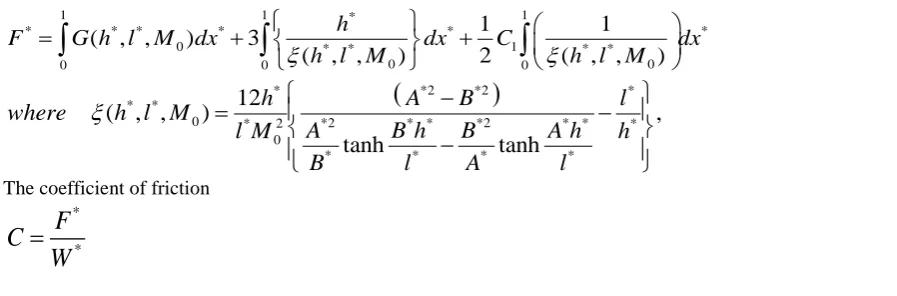
The coefficient of friction
*
*
F
C
W
=
(22)
3. RESULT AND DISCUSSION
The modified Reynolds equations is solved analytically and to study various bearing characteristics such as pressure distribution, load carrying capacity, frictional force, coefficient of friction in the presence of transverse magnetic field, the numerical methods is employed.
3.1 Pressure distribution
The Figure 2 and Figure 3 depicts the variation of non-dimensional pressure
P
* for exponential and secant shaped slider bearing. As the value of couplestress parameter increases in the presence of applied magnetic field, it is observed that pressure in the fluid film increases in both the sliders.3,2 Non-dimensional load carrying capacity:
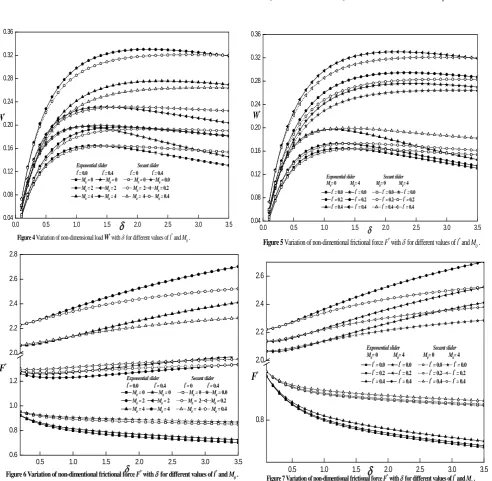
Figure 4 and Figure 5 shows the comparison between non-dimensional load carrying capacity 𝑊𝑊∗for both the sliders. In Figure 4 comparison between Newtonian fluid (l*=0) and couplestress fluid (l*=0.4)is examined. In Figure 5 comparison between non-magnetic (M0 =0) and magnetic (M0 =3) case are examined. The plots with solid line
correspond to exponential slider bearing pressures and the plots corresponding to dotted lines indicate secant shaped slider bearing. The application of magnetic field reduces the velocity of the lubricant. As a result large amount of fluid is collected in film region which results in the pressure rise. It is also observed that increasing the values of couplestress parameter l* increases the build-uppressure in both the film profiles. Hence the load carrying capacity increases for the bearings. It is also observed that the effect of magnetic field increased the build-up pressure in the film region, hence, the load carrying capacity of the bearing has increased. From the graphs and calculations, the load carrying capacity of the slider bearing with exponential profile is found to be more prominent. The load carrying capacities of both the sliders are presented in the table format with 𝛿𝛿 = 1.5in Table-1.
3.3 Non-dimensional frictional force
Figure 6 and 7 represents variations of frictional force 𝐹𝐹∗ against shoulder parameter δ. It is observed that in the presence of applied magnetic field by increasing the value of couplestress parameter frictional force can be increased. The frictional force is more in case of exponential slider than in secant slider.
1.2 The Coefficient of friction
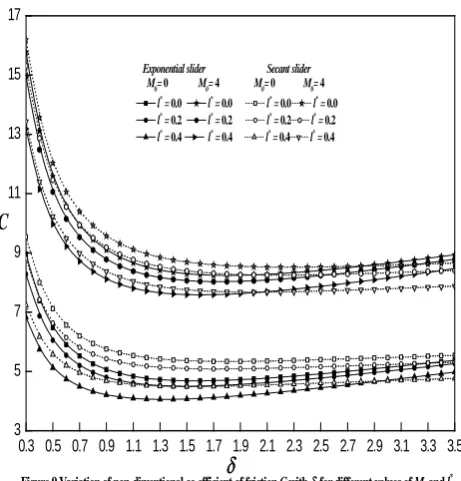
In Figure 8 and 9 the coefficient of friction C is plotted against the shoulder parameter δ. In Figure 8, plot is made showing comparison between Newtonian and couplestress stress fluids for both the sliders. It is observed that in couplestress fluids the coefficient of friction is less in comparison with the Newtonian fluid. It is also observed that exponential slider is having less coefficient of friction than secant slider. Figure 9 represents the comparison between Non-magnetic and magnetic case for both film profiles with increasing value of couplestress parameter and there is decrease in coefficient of friction.
The relative percentage increase in non-dimensional load
R
W*, non-dimensional frictional forceR
F* and coefficient offrictions
C
R is given by
*
*
* * *
* * *
{(
) /
} 100
{(
) /
} 100
{(
) /
} 100
magnetic non magnetic magnetic w
magnetic non magnetic magnetic F
C magnetic non magnetic magnetic
R
W
W
W
R
F
F
F
R
C
C
C
−
−
−
=
−
×
=
−
×
=
−
×
2. CONCLUSION
The comparative study of slider bearing, with exponential and secant film profile lubricated with couplestress fluid in the presence of transverse magnetic field is presented in this paper.
From the results obtained the following conclusions are made.
The effect of magnetic field M0 increases the build-up pressure in both the film profiles.
The couplestress fluids l*contain microstructure additives and are sensitive to applied magnetic field M0. As a
result the enhancement in load carrying capacity is visible. It is interesting to note that, as compared with the secant shaped profile, exponential profile is showing significant load carrying capacity.
The non-dimensional frictional force 𝐹𝐹∗ increases with increasing values of couplestress parameter l*and the effect is prominent in the bearing with exponential profile.
The coefficient of friction C decreases with increasing values of couplestress parameter l* and is less for exponential slider.
The non-dimensional relative load carrying capacity *
W
R
, frictional force *F
R
, coefficient of frictionR
C isalso presented in the form of table corresponding to the shoulder parameter 𝛿𝛿 = 1.5 for both the film profiles.
From Table-2 it is seen that for 𝑙𝑙∗= 0.2, and 𝑀𝑀0= 4 there is significant increase of 73%,199% and 72% in
*
W
R
*F
R
andC
R respectively for exponential slider, where as for secant slider profile we observe an
increase of 36%,135%,72% in
R
W*R
F* andR
C respectively. Hence, it is concluded that exponential sliderprofile is more prominent to the combined effect couplestresses and external magnetic field as compared to secant slider bearings.
It is expected that these results helps design engineers to choose the suitable film profile with suitable parameters of couplestress and magnetic field to enhance the life of the slider bearing. To guide the present study a design example is presented in Table -3.
NOMENCLATURE
B0 applied magnetic field
C coefficient of friction
d
Inlet-outlet film thickness difference(
h
1−
h
0)
F
Frictional force*
F
Non-dimensional frictional force(
= −
Fh
0/
µ
UL
)
h
Film thickness1
h Inlet film thickness
0
h Outlet film thickness
H non-dimensional film thickness
(
h h
/
0)
l
Couplestress parameterL Bearing length
0
M
Hartmann numberp
Pressure in the film region*
P
Non-dimensional pressure,
x y
Rectangular co-ordinates*
x Non-dimensional rectangular coordinates
(
=
x L
/
)
,
u v
Velocity component in film regionw
Load carrying capacity*
W Non-dimensional load carrying capacity
(
=
wh
02/
µ
UL
2)
δ
Non-dimensional inlet-outlet thickness difference(
=
d h
/
0)
η
Material constant characterizing couple stressµ
Viscosity coefficientREFERENCES
1. Ariman T., Turk M.A, and Sylvester N. D. Micro continuum fluid mechanics-a review, International journal of Engineering science ,11(8), (1973), 905.
2. Ariman T., Turk M.A, and Sylvester N.D. Application of micro continuum fluid mechanics, International journal of Engineering science, 12(4), (1974), 273.
3. Khonsari M. and Brewe D E. On the performance of finite journal bearing lubricated with micro polar fluids, Tribology transactions 32(2), 155.
4. Stokes V.K. Couplestresses in fluids, Physics of Fluids, 9(9), (1966), 1709.
5. Ramanaiah G. and Sarkar P. Slider bearing lubricated by fluids with couple-stress, Wear, 52, (1979), 27. 6. LinJ.R and Yu-Ming Lu. Steady-state performance of wide parabolic shaped slider bearings with a couple
stress fluids, Journal of Marine science and Technology, 12, (2004), 239.
7. Mobolaji H., Oladiende and John A,Akpobi. Effect of couple stress lubricant on pressure and load capacity of wide exponentially shaped slider bearing, Proceedings of world congress on engineering and computer science, WCE (2010),2.
8. Lin J.R., Lu R.F. and Hung C.R. Dynamic characteristic of wide exponential film shape slider bearing lubricated with a non-Newtonian couple stress fluids, Journal of Marine science and Technology,14(2), (2006), 93.
9. Mobolaji H Oladeinde and John A Akpobi. A comparative study of load capacity and pressure distribution of infinitely wide parabolic and inclined slider bearing, proceedings on world congress on engineering, WCE, (2010),11.
10. Naduvinamani N.B., Fathima S.T., and HiremathP.S. Hydrodynamic lubrication of rough slider bearings with couple stress fluids, Tribology international, 36(12), (2003), 949.
11. Snyder W.T. The magnetohydrodynamic slider bearing, Journal of Basic Engineering, 84, (1962), 197. 12. Hughes W.F. The magnetohydrodynamic inclined slider bearing with a transverse magnetic field, wear,6,
(1963),315.
13. Shukla J.B. The optimum one-dimensional magnetohydrodynamic slider bearing, Journal of tribology, 92(3), (1970), 530.
14. Hughes W.F. The magnetohydrodynamic finite step slider bearing, Journal of Basic Engineering, 85, (1963), 129.
15. Anwar M.I and Rodkiewicz C.M. Solution for MHD slider bearing with arbitrary magnetic field, ASME J lubrication technology, 94, (1972), 288.
16. Lin J.R., Hung C. R., Hsu, C.H and Lai C. Dynamic stiffness and damping characteristics of one dimensional MHD inclined-plane slider bearing, Proceedings of the institution of Mechanical engineers-part J Journal of engineering tribology, 223, (2009), 211.
17. Lin J.R. and Lu R.F. Dynamic characteristics for magneto-hydrodynamic wide slider bearings with an exponential film profile, Journal of marine science and technology, 18(2), 2010, 268.
18. BiradarKasinath and Hanumagowda B.N. MHD effects on composite slider bearing lubricated with couple-stress fluids, International journal of mathematics trends and technology5, (2014), 27.
19. Nabhani M andKhlifiM El. Inertial MHD couplestress effect on infinitely wide slider bearing, Tribology Transactions, 58(2), 2015,374.
20. Syeda Tasneem Fathima, Naduvinamani N.B., Hanumagowda B.N. and Santhosh Kumar J. Modified Reynolds equation for different types of finite plates with the combined effect of MHD and couplestresses, Tribology Transactions; 58, (2015),660.
-1.0 -0.8 -0.6 -0.4 -0.2 0.0 0.0
0.1 0.2 0.3 0.4 0.5 0.6
Exponential slider
P*
x*
M0 = 0 M0 = 4
l* = 0 l* = 0 l* = 0.2 l* = 0.2 l* = 0.4 l* = 0.4
l* = 0.6 l* = 0.6
Figure 2 Variation of non-dimensional pressure P* with x* for different values of l* and M0with δ = 1.5. 0.0 0.1 0.2 0.3 0.4 0.5 0.6 0.7 0.8 0.9 1.0 0.0
0.1 0.2 0.3 0.4 0.5 0.6
Secant slider
Figure 3 Variation of non-dimensional pressure P* with x* for different values of l* and M0with δ = 1.5. M0 = 0 M0 = 4
l* = 0 l* = 0 l*
= 0.2 l* = 0.2 l* = 0.4 l* = 0.4 l*
= 0.6 l* = 0.6
x* P*
0.0 0.5 1.0 1.5 2.0 2.5 3.0 3.5
0.04 0.08 0.12 0.16 0.20 0.24 0.28 0.32 0.36
W*
δ
Figure 4 Variation of non-dimensional load W*
with δ for different values of l* and M0.
Exponential slider Secant slider l*= 0.0 l*= 0.4 l*= 0 l*= 0.4
M0 = 0 M0 = 0 M0 = 0 M0 = 0.0 M0 = 2 M0 = 2 M0 = 2 M0 = 0.2
M0 = 4 M0 = 4 M0 = 4 M0 = 0.4
0.5 1.0 1.5 2.0 2.5 3.0 3.5 0.6
0.8 1.0 1.2 2.0 2.2 2.4 2.6 2.8
F*
δ
Figure 6 Variation of non-dimentional frictional force F*
with δ for different values of l* and M0. Exponential slider Secant slider l*= 0.0 l*= 0.4 l*= 0 l*= 0.4
M0 = 0 M0 = 0 M0 = 0 M0 = 0.0 M0 = 2 M0 = 2 M0 = 2 M0 = 0.2
M0 = 4 M0 = 4 M0 = 4 M0 = 0.4
0.0 0.5 1.0 1.5 2.0 2.5 3.0 3.5 0.04
0.08 0.12 0.16 0.20 0.24 0.28 0.32 0.36
W*
δ
Figure 5 Variation of non-dimentional frictional force F* with δ for different values of l* and M0.
Exponential slider Secant slider M0= 0 M0= 4 M0= 0 M0= 4
l*
= 0.0 l*
= 0.0 l*
= 0.0 l*
= 0.0 l*
= 0.2 l*
= 0.2 l*
= 0.2 l*
= 0.2 l*
= 0.4 l*
= 0.4 l*
= 0.4 l*
= 0.4
0.5 1.0 1.5 2.0 2.5 3.0 3.5
0.8 2.0 2.2 2.4 2.6
F
*δ
Figure 7 Variation of non-dimentional frictional force F*
with δ for different values of l* and M0.
Exponential slider Secant slider M0= 0 M0= 4 M0= 0 M0= 4
l*
= 0.0 l*
= 0.0 l*
= 0.0 l*
= 0.0 l*
= 0.2 l*
= 0.2 l*
= 0.2 l*
= 0.2 l*
= 0.4 l*
= 0.4 l*
= 0.4 l*
0.5 1.0 1.5 2.0 2.5 3.0 3.5 4
6 8 10 12 14 16
C
δ
Figure 8 Variation of non-dimentional co efficient of friction C with δ for different values of M0 and l *
.
Exponential slider Secant slider l*
= 0.0 l* = 0.4 l*
= 0 l* = 0.4 M0 = 0 M0 = 0 M0 = 0 M0 = 0.0 M0 = 2 M0 = 2 M0 = 2 M0 = 0.2 M0 = 4 M0 = 4 M0 = 4 M0 = 0.4
0.3 0.5 0.7 0.9 1.1 1.3 1.5 1.7 1.9 2.1 2.3 2.5 2.7 2.9 3.1 3.3 3.5 3
5 7 9 11 13 15 17
C
δ
Figure 9 Variation of non-dimentional co efficient of friction C with δ for different values of M0 and l*
.
Exponential slider Secant slider M0= 0 M0= 4 M0= 0 M0= 4
l*
= 0.0 l*
= 0.0 l*
= 0.0 l*
= 0.0 l*
= 0.2 l*
= 0.2 l*
= 0.2 l*
= 0.2 l*
= 0.4 l*
= 0.4 l*
= 0.4 l*
= 0.4
Table-1: Comparison of load carrying capacity for exponential and secant slider bearing
Geometry M0
l*=0.0 l*=0.1 l*=0.2 l*=0.3 l*=0.4
M0=0 0.163993 0.166070 0.171872 0.181074 0.193472
Exponential M0=1 0.172765 0.174990 0.181122 0.190703 0.203485
M0=2 0.196086 0.198916 0.206249 0.217190 0.231340
M0=3 0.228418 0.232487 0.242166 0.255692 0.272425
M0=4 0.265676 0.271737 0.284966 0.302265 0.322709
M0=0 0.164019 0.166472 0.173345 0.184315 0.199231
Secant M0=1 0.171123 0.173702 0.180840 0.192089 0.207264
M0=2 0.190475 0.193582 0.201705 0.213986 0.230121
M0=3 0.218174 0.222387 0.232511 0.246876 0.264956
M0=4 0.199231 0.207264 0.230121 0.264956 0.308875
Table-2: Variation of
R
W*,
R
F andR
C with l* for different values M0 withδ
=
1.5
l* M0
R
WR
FR
CExponential Secant Exponential Secant Exponential Secant
0
2 19.56974 9.802703 62.70537 38.63665 36.07554 26.25997
4 62.00448 34.86018 186.7748 127.9884 77.01653 69.05507
6 111.8292 68.00451 322.6617 233.9711 99.52916 98.78657
2
2 25.76695 9.862531 64.89057 39.33883 31.10785 26.82992
4 73.76717 36.47115 199.1350 135.7939 72.14660 72.77935
6 134.0606 74.32710 356.3963 258.5963 94.99027 105.7021
4
2 41.067 8.813749 69.22713 40.07609 19.96145 28.73006
4 96.78218 33.62550 218.9202 145.4652 62.06716 83.69692
Table-3: Numerical Example of the slider bearings lubricated with an electrically conducting fluid
Physical Parameter Notation Range of values chosen
Steady minimum film thickness
0 m
h
41.00 10
×
−m
Difference between the inlet and outlet film thickness d
(
)
40.5,1.0,1.5, 2.0, 2.5
×
10
−m
Lubricant viscosity
µ
41.55 10
×
−Pa s
.
Electrical conductivity
σ
61.07 10
×
mho m
/
Magnetic field
0
B
20, 0.75,1.5, 2.25, 3, 3.75
Wb m
/
Material Constant characterizing couplestresses
η
(
)
151.25, 5.0,11.25
×
10
−Ns
Source of support: Nil, Conflict of interest: None Declared