723
© 2017 by the Serbian Biological Society How to cite this article: Ganesan G, Velayudhan SS, Solomon Robinson David J. Statistical optimization of medium constituents and conditions for improved antimicrobial compound production by marine Streptomyces sp. JRG-04. Arch Biol Sci. 2017;69(4):723-31.
Statistical optimization of medium constituents and conditions for improved
antimicrobial compound production by marine
Streptomyces
sp. JRG-04
Govindarajan Ganesan*, Satheeja Santhi Velayudhan and Jebakumar Solomon Robinson David
Department of Molecular Microbiology, School of Biotechnology, Madurai Kamaraj University, Madurai 625021, India
*Corresponding author: [email protected]
Received: February 24, 2017; Revised: April 12, 2017; Accepted: May 17, 2017; Published online: June 22; 2017
Abstract: A recently isolated Streptomyces sp. JRG-04 from a mangrove estuary was identified as a producer of a
broad-spectrum antimicrobial compound against various pathogens, including multidrug resistant (MDR) pathogens, with no cytotoxic effect on H9C2 cells. In this study, the concentrations of various nutrient factors and culture conditions were optimized by both classical and statistical methods for an improved titer of the antimicrobial compound production. Among nutrient factors, carbon and nitrogen sources such as maltose and yeast extract stimulated the production of the antimicro-bial compound with the highest titer. The production medium, with a pH 7.5 at 28°C, promoted increased antimicroantimicro-bial compound production. All non-statistically optimized nutrients and environmental conditions were used for subsequent statistical optimization using a Plackett-Burman design (PBD) and response surface methodology (RSM). Maltose, yeast extract and the inorganic salt NH4Cl were found to be significant components for antimicrobial compound production by the PBD method. Interactions between important variables were evaluated using central composite design (CCD) of response surface methodology. The final optimized medium (L-1) contained: 10 g maltose, 2.9 g Na
2HPO4, 2.3 g KH2PO4,
1 g NH4Cl, 0.5 g MgSO4×7H2O, 0.002 g FeSO4, 0.5 g CaCO3, 5.25 g yeast extractand trace elements in 5.0 mL salt solution (0.1 g ZnSO4×7H2O, 0.3 g H3BO3, 0.2 g COCl2×6H2O, 0.03 g MnCl24H2O, 0.03 g Na2MO4×2H2O, 0.02 g NiCl2×6H2O, 0.01 g CuCl2×2H2O). The medium provided an overall 42.8% increase in antibiotic activity when compared to the unoptimized medium, from 140.57±0.80 to 210.33±0.57 U/mL.
Key words: marine Streptomyces; medium optimization; central composite design; response surface methodology
INTRODUCTION
Streptomyces, the largest genus of the phylum Acti-nomycetes, are well-known filamentous bacteria en-dowed with a complex secondary metabolite biosyn-thesizing capability with diverse biological functions [1] Members of this genus are ubiquitous in different habitats, ranging from terrestrial regions, marshy ar-eas, fresh and brackish waters, salty regions, etc. [2-5]. Many recent studies have reported the occurrence of novel Streptomyces species in marine environments rich in diverse chemicals used for the development of therapeutic materials [6]. During characterization of novel marine Streptomyces with a potential for bioac-tive compound production, we recently reported [7] a marine Streptomyces sp. JRG-04, which displayed bio-activity against various disease-causing infectious mi-crobial pathogens, including MDR clinical pathogens,
such as methicillin-resistant Staphylococcus aureus
andvancomycin-resistant enterococci. Although the antimicrobial metabolite exerted a broad-spectrum biological effect against different pathogenic microor-ganisms, it was not toxic to the H9C2 animal cell line. The bioactive metabolite was identified as a polyketide antibiotic compound with structural similarity to aro-matic benzoisochromanequinone [7].
and physiological conditions for specific species. The optimization also provides the best selection choice for the most favorable ingredients of the medium to facilitate product formation [10-13]. Media optimiza-tion by classical approach does not show any significant interactions of selected variables in the medium [14]. In order to overcome this problem, a statistical medium optimization approach such as the Plackett-Burman design (PBD) method and response surface methodol-ogy (RSM) provide a significant effect on antimicrobial compound production. The medium optimization pro-cess that involves both classical and statistical approach-es can provide a substantial improvement in bioactive compound production [5]. The PBD is a widely used statistical method to screen important factors required for increased quantities of product formation. RSM is also used to study the linear, square and interaction effect of ingredients crucial for the production of an-tibacterial compounds [15]. In the present study, the effect of different environmental conditions, such as temperature, pH and nutrient factors, such as carbon and nitrogen sources, was evaluated for its ability to improve the antimicrobial compound capability of
Streptomyces sp. JRG-04. The improved antimicrobial compound was further evaluated by PBD and RSM based on statistical media optimization processes.
MATERIALS AND METHODS
Strain and culture conditions
The bacterial isolate Streptomyces sp. JRG-04 was grown on a modified ISP-4 medium containing per liter: soluble starch, 20 g; NaCl, 0.5 g; KNO3, 1.0 g; K2HPO4, 0.5 g; MgSO4×7H2O, 0.5 g; FeSO4, 0.002 g, agar, 18 g. The initial inoculum was incubated at 30°C for 4 days. The isolate was maintained at 4°C on modified ISP-4 agar plates for further studies. The 16S rRNA gene sequence of the isolate was deposited in the GenBank database under accession number JX486678.
Media and culture condition optimization by a one-factor-at-a-time (OFAT) approach
The effects of pH, temperature, carbon and nitro-gen source on growth and antimicrobial compound produced by the Streptomyces sp. JRG-04 we
exam-ined. To carry out this study, the media components were supplemented with the basal medium contain-ing: 2.9 g Na2HPO4, 2.3 g KH2PO4, 1.0 g NH4Cl, 0.5 g MgSO4×7H2O, 0.002 g FeSO4, 0.5 g CaCO3 and a 5.0-mL trace element salt solution from a stock solution (0.1 g ZnSO4×7H2O, 0.3 g H3BO3, 0.2 g COCl2×6H2O, 0.03 g MnCl2×4H2O,0.03 g Na2MO4×2H2O, 0.02 g NiCl2× 6H2O, 0.01 g CuCl2×2H2O in 1 L water). Non-statistical media optimization was performed according to the OFAT approach in which one factor is changed and other factors are kept constant. For carbon source optimization, different carbon sources (glucose, sucrose, maltose, fructose, starch and glycer-ol) were used independently at the same concentration (1%), supplemented with basal medium. The effect of nitrogen source on the basal medium used for anti-microbial compound production was examined using peptone, tryptone, yeast extract, beef extract and urea. The effectiveness of suitable parameters was assessed based on their antimicrobial activity against the test organism, Staphylococcus aureus. All experiments were performed in triplicate. The outcome of the OFAT method was used for statistical media optimization.
Statistical optimization
were determined using 20 runs with five different levels (-1.682, -1, 0, 1, and 1.682) (Table 2).
The factors were implied according to the follow-ing equation:
dxi = Σ(Xi-X0)
ΔX , i = 1, 2, 3, …, k (1)
where xi was the coded independent factor, Xi was the real independent factor, X0was the value of Xi at the center point and ΔX was the step change value.
Antimicrobial compound production (response variable) was explained by the second-order polyno-mial equation:
Y = β0 + Σ βi xi +Σ βiixi
2 + Σ βijxixj, i = 1, 2, 3, …, k (2)
where Y was the predicted response, β0 was the inter-cept, xi and xj were the coded independent factors, βi was the linear coefficient, βii was the quadratic coef-ficient and βij was the interaction coefficient.
Statistical analysis and method validation
Design Expert version 8.0.2 (STAT-EASE Inc., Minne-apolis, MN, USA) was used to analyze the
experimen-tal model and for regression analysis of the results. The accuracy of the second-order polynomial model was evaluated with coefficient determination (R2). The statistical significance of the above model was deter-mined with p≤0.05. The response graph was drawn using the same software. The classical and statistically optimized media were compared with unoptimized media for biomass and antimicrobial compound pro-duction of Streptomyces sp. JRG-04 using a laboratory-scale batch bioreactor.
Production, extraction and bioassay of antimicrobial compound
For the comparative experimental study, the laborato-ry-scale fermenter (New Brunswick, scientific model number Bioflo/Celligen 1150 from Eppendorf, N.J, USA) with optimized and controlled parameters (pH and temperature) and medium was used for the production of the antimicrobial compound. The an-timicrobial compound was also obtained using un-optimized medium. The 7-day-old culture broth was harvested using a harvesting tube and centrifugation. The cell-free supernatant was collected and acidified to pH 3.0 with 1N HCl [17]. The bioactive compound was extracted twice with an equal volume of chlo-roform and concentrated using a rotational vacuum concentrator, RVC 2-18 CD (CHRIST, Germany). The extracted bioactive compound was examined for anti-microbial activity by disk diffusion [18]. The test or-ganism, S. aureus ATCC 6518 (1×10⁶ CFU/mL), was purchased from American Type Culture Collection (ATCC, Manassas, VA, USA) and used for evaluation of antimicrobial activity.
An equal volume of chloroform-extracted bioac-tive compound was loaded on a sterile disk and air dried. A sterile disk soaked with chloroform served as a control. The dried disks were placed on Mueller-Hinton agar plates containing test organisms. The plates were incubated at 37°C for 24 h. The zone of growth inhibition around the bioactive compound loaded disk was measured using a measuring tool. The size of the zones of inhibition can be considered as a measure of antibiotic titer [19-21]. Antibiotic activ-ity was expressed as units of activactiv-ity per mL of crude substance of the cultures, where 1 U was defined as a 1.0 mm annular clearing around the antibiotic disk.
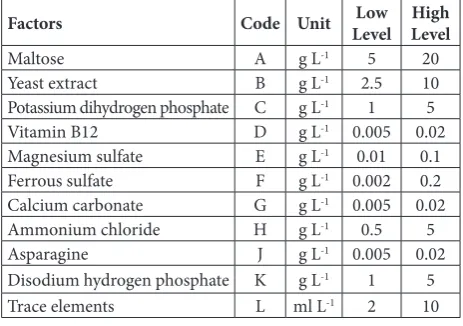
Table 1. Media components for optimization according to the PBD.
Factors Code Unit Low Level High Level
Maltose A g L-1 5 20
Yeast extract B g L-1 2.5 10
Potassium dihydrogen phosphate C g L-1 1 5
Vitamin B12 D g L-1 0.005 0.02
Magnesium sulfate E g L-1 0.01 0.1
Ferrous sulfate F g L-1 0.002 0.2
Calcium carbonate G g L-1 0.005 0.02
Ammonium chloride H g L-1 0.5 5
Asparagine J g L-1 0.005 0.02
Disodium hydrogen phosphate K g L-1 1 5
Trace elements L ml L-1 2 10
Table 2. Levels of factors tested in the central composite design (CCD).
Variables (Factors) Code Unit α + 0 - -α
Maltose X1 g L-1 25 22 10 5 2.5
Yeast extract X2 g L-1 15 12 5 3 1
RESULTS
Effect of pH and temperature on antimicrobial activity
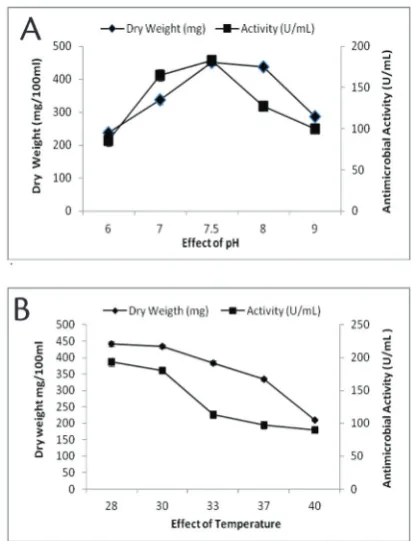
A suitable pH for increasing the biomass and antimi-crobial activity (183 U/mL±5.7) was observed at pH 7.5 (Fig. 1A). Maximum antimicrobial activity was found at neutral pH compared. Optimum growth and a higher level of antimicrobial activity (193 U/ mL±5.7) was observed at 28°C (Fig. 1B).
Effect of carbon and nitrogen source on antimicrobial activity
Among the tested carbon sources, maltose showed maximum antimicrobial activity (170 U/mL±10.00) against S. aureus, followed by lactose (143 U/mL±5.7). Lower antimicrobial activities were observed for other carbon sources (glucose, starch, fructose,and sucrose; Fig. 2A). Examination of the effect of nitrogen showed that yeast extract-supplemented medium provided maximum growth and antimicrobial activity (176 U/ mL±5.77) (Fig. 2B). Other organic nitrogen sources such as tryptone and beef extract exhibited moder-ate antimicrobial activities (126 U/mL±0.57 and 130 U/mL±0.00, respectively). Urea and peptone showed moderate growth and less antibiotic activity compared to other nitrogen sources. Maltose and yeast extract wereselected as the best carbon and nitrogen sources for growth, respectively, and were used for subsequent medium optimization experiments.
Plackett-Burman Design for selection of important components
The PBD was adapted to identify the interaction of the important factors for enhancing the production of the antimicrobial compound by Streptomyces sp. JRG-04. Eleven important ingredients were selected and experiments were carried out with twelve differ-ent combinations (Table 3). Factors A, B and H (A − maltose, B − yeast extract, H − ammonium chloride) influenced the growth and maximum antimicrobial activity and the result is shown in Table 4. The experi-mental results were subjected to regression analysis and analysis of variance (ANOVA). Maltose, yeast ex-tract and ammonium chloride produced statistically
Fig. 1. Effect of pH (A) and temperature (B) on biomass and antimicrobial compound production by Streptomyces sp. JRG-04
Fig. 2. Effect of carbon (A) and nitrogen source (B) on biomass
and antimicrobial compound production by Streptomyces sp.
significant interactions (based on their p values). If the
pvalue is less than 0.05, it indicates significance of the model [22]. According to this model, the p value of factors A, B and H was less than 0.05 when compared to other factors that are statistically significant. The “Pred R-Squared” of 0.9862 is in reasonable agree-ment with the “Adj R-Squared” of 0.9989, and the
“R-Squared” of 0.9999 is in reasonable agreement with the “Adj R-Squared” of 0.9989 for the antimicrobial activity, respectively. The ranking of the media com-ponents is also presented in the Pareto chart based on their coefficient estimates (Fig. 3).
Response surface methodology
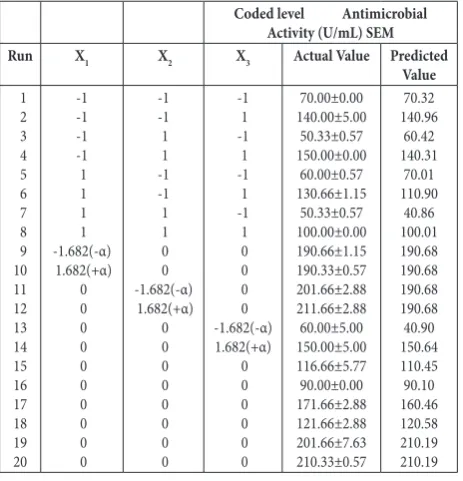
A central composite experimental design of three important components such as maltose, yeast extract and ammonium chloride was used for antimicrobial compound production in the fermentation medium. The design matrix and their responses showed an im-proved antimicrobial compound from PDB-selected factors. The model was then subjected to statistical analysis (p>0.05) to exclude the insignificant factor. A second-order polynomial equation showed impor-tant factors as follows: response antimicrobial activity (U/mL): Y=204.84+32.27 X1 – 12.97X2-11.28 X3+1.17 X1X2-6.25X1X3-3.75 X2X3-40.26 X12-32.13 X
22-25.53 X32, where Yindicated the predicted response of X
1 (maltose), X2 (yeast extract) and X3 (ammonium chlo-ride), respectively.
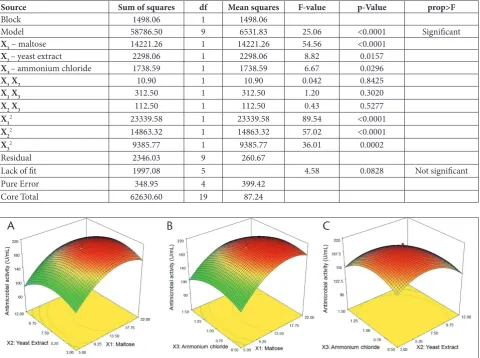
The statistical significance of the model was checked by the F-test and ANOVA of the response (Table 5). In this experimental model, the F-value 25.06 implied that the model is significant. There is
Fig. 3. Pareto chart (PBD) showing the ranking of the medium components on the basis of t value limit: A – maltose, B – yeast extract, H – NH4Cl, L – trace element salt solution, K – Na2HPO4, D – vitamin B12, E – MgSO4×7H2O, F – FeSO4, C – KH2PO4, G – CaCO3, J – asparagine.
Table 3. PBD for 11 factors in 12 combinations (runs) at coded levels with zone of inhibition as response.
Run A B C D E F G H J K L Antimicrobial activity RESPONSE
(U/mL) (SEM)
1 + - + - - - + + + - + 160.00±5.00
2 + + - + - - - + + + - 60.66±4.04
3 - + + - + - - - + + + 110.66±1.15
4 + - + + - + - - - + + 52.00±2.51
5 + + - + + - + - - - + 51.00±1.00
6 + + - + + - + - - - + 50.00±0.00
7 + + + - + + - + - - - 101.66±2.88
8 - + + + - + + - + - - 121.66±2.88
9 - - + + + - + + - + - 170.00±5.0
10 - - - + + + - + + - + 51.66±2.88
11 + - - - + + + - + + - 101.66±2.88
12 - - - - 60.00±0.00
A – maltose (g); B – yeast extract (g); C – KH2PO4 (g); D – vitamin B12
(g); E – MgSO4×7H2O (g); F – FeSO4 (g); G – CaCO3 (g); H – NH4Cl (g);
J – asparagine (g); K – Na2HPO4 (g); L – trace element salt solution (mL).
Table 4. Central composite design with observed and predicted responses.
Coded level Antimicrobial Activity (U/mL) SEM
Run X1 X2 X3 Actual Value Predicted
Value 1 2 3 4 5 6 7 8 9 10 11 12 13 14 15 16 17 18 19 20 -1 -1 -1 -1 1 1 1 1 -1.682(-α) 1.682(+α) 0 0 0 0 0 0 0 0 0 0 -1 -1 1 1 -1 -1 1 1 0 0 -1.682(-α) 1.682(+α) 0 0 0 0 0 0 0 0 -1 1 -1 1 -1 1 -1 1 0 0 0 0 -1.682(-α) 1.682(+α) 0 0 0 0 0 0 70.00±0.00 140.00±5.00 50.33±0.57 150.00±0.00 60.00±0.57 130.66±1.15 50.33±0.57 100.00±0.00 190.66±1.15 190.33±0.57 201.66±2.88 211.66±2.88 60.00±5.00 150.00±5.00 116.66±5.77 90.00±0.00 171.66±2.88 121.66±2.88 201.66±7.63 210.33±0.57 70.32 140.96 60.42 140.31 70.01 110.90 40.86 100.01 190.68 190.68 190.68 190.68 40.90 150.64 110.45 90.10 160.46 120.58 210.19 210.19 X1 – maltose, X2 – yeast extract, X3 – ammonium chloride
only a 0.01% chance that a model F-value could oc-cur due to noise. The predicted R squared of 0.6819 is in reasonable agreement with the adjusted R squared of 0.9232, which indicates that the model is in good agreement with the observed and predicted response.
Fig. 4A-Cshows the 3D response surface curves of the effects of maltose, yeast extract and ammoni-um chloride on the antimicrobial activity. These re-sults show that the highest antimicrobial activity was achieved with maltose, 10.0 g L-1, followed by yeast extract, 5.25 g L-1 and ammonium chloride, 1.0 g L-1. The 3D response surface curves provided the interac-tion between the significant factors and the optimal concentration was identified for further experimental conditions.
Experimental validation
Based on the media optimization, the quadratic model predicted that the higher antimicrobial activity was at 210.33 U/ml±0.57 and overall it represented a 42.8% increase. The optimum concentration of the test fac-tors with coded levels were X1=0, X2=1.682 and X3=0 for maltose 10 g L-1, yeast extract 5.25 g L-1 and am-monium chloride 1.0 g L-1, respectively. To determine the predicted values, the validation experiments were performed in triplicate. Under the optimized medium, the antimicrobial activity was at 210.33 U/ml±0.57, and the predicted value was 210.9 (U/ml). These re-sults indicate that the observed and predicted values were in reasonable agreement with each other.
Table 5. ANOVA of the regression model for the response.
Source Sum of squares df Mean squares F-value p-Value prop>F
Block 1498.06 1 1498.06
Model 58786.50 9 6531.83 25.06 <0.0001 Significant
X1– maltose 14221.26 1 14221.26 54.56 <0.0001
X2 – yeast extract 2298.06 1 2298.06 8.82 0.0157
X3 – ammonium chloride 1738.59 1 1738.59 6.67 0.0296
X1 X2 10.90 1 10.90 0.042 0.8425
X1 X3 312.50 1 312.50 1.20 0.3020
X2 X3 112.50 1 112.50 0.43 0.5277
X12 23339.58 1 23339.58 89.54 <0.0001
X22 14863.32 1 14863.32 57.02 <0.0001
X32 9385.77 1 9385.77 36.01 0.0002
Residual 2346.03 9 260.67
Lack of fit 1997.08 5 4.58 0.0828 Not significant
Pure Error 348.95 4 399.42
Core Total 62630.60 19 87.24
Fig. 4. Three-dimensional response surface curve for antimicrobial compound production by Streptomyces sp. JRG-04. A – interaction of maltose and yeast extract with different concentrations. Ammonium chloride was kept constant at 1 g L-1. B – the interaction of
am-monium chloride and maltose with different concentration. Yeast extract was kept constant at 5.25 g L-1. C – the interaction of ammonium
DISCUSSION
The genera Streptomyces is known to produce diverse secondary metabolites possessing different biological activities, such as antifungal, antibacterial, antitumor and plant growth promoting [1]. Streptomyces sp. JRG-04 was previously reported from sediments taken from the root zone of mangroves at 0.7-10-cm depth from the Karangadu mangrove forest, Tamil Nadu, India. The strain Streptomyces sp. JRG-04 had the ability to in-hibit the growth of many pathogenic microorganisms, including methicillin-resistant Staphylococcus aureus
with a significant level of MIC. The broad-spectrum bioactive property and non-cytotoxicity against normal H9C2 cell lines are due to the aromatic polyketide na-ture of the compound. This feana-ture is an important cri-terion for developing antimicrobials against pathogens [7]. However, its bioactive production potential titer is significantly affected by incubation conditions and components of the unoptimized production medium. The combination of classical and statistical optimiza-tion process provides maximum producoptimiza-tion of sec-ondary metabolites [23]. Here, we developed suitable culture conditions and identified media components for optimal growth and antimicrobial compound pro-duction by the Streptomyces sp. JRG-04 isolate. Similar to this study, production media optimization was also reported for a newly isolated species of Streptomyces
identified to the genus level [24,25].
The pH of the production medium is a crucial factor in defining growth, which in turn significantly influences product formation in secondary metabolite producers [20,26]. Neutral pH has a significant role in the growth of Streptomyces sp. JRG-04 as well as in the resulting bioactive compound production potential. Similar to this report, a study conducted on Strepto-myces sp. KEH23 also yielded optimum antimicrobial substance production at pH 7.5 [27].
Examination of the effect of temperature showed optimum growth and a higher level of antimicrobial activity at 28°C. Extreme temperatures are generally unfavorable for bioactive metabolite production due to the harmful effect imparted on the enzymes in-volved in the biosynthetic pathway [5,28]. Carbon and nitrogen sources play an important role in growth and secondary metabolite production in various indus-trially important microorganisms. The present study
revealed that Streptomyces sp. JRG-04 grown in a me-dium containing maltose as the sole carbon source produced maximum biomass and antimicrobial sub-stance as compared to lactose, which only moderately supported the growth and antimicrobial activity, and other carbon sources. Similar to this study, maltose was reported as the best carbon source for growth and antimicrobial compound production in Streptomyces albidoflavus [29]. Nitrogen assimilation is the key fac-tor in the regulation of antibiotic production in micro-organisms [30]. In this study, yeast extract provided maximum growth and antimicrobial activity against the test organism. These results are in accordance with avilamycin production by S. viridochromogenes
Tu 57-1 [31]. Other organic nitrogen sources provided for a moderate and lower antimicrobial activity.
It is important to identify components of the me-dium used in fermentation processes for antimicrobial compound production. In this study, we adapted the PBD method to select the factor suitable for enhanc-ing the antibiotic production. A Pareto chart can be applied to screen significant factors in the t-value limit [10]. Based on the Pareto chart, the three important components, maltose, yeast extract and ammonium chloride, were selected, and their optimum concentra-tions were further identified by RSM.
Application of RSM shows the experimental re-lationship between the logarithmic values of antimi-crobial compound production and the coded units of the test variables [15]. In general, a regression model having an R squared-value higher than 0.9 was consid-ered as a high correlation [32].The coefficient varia-tion value CV=11.89% indicates that the experimental data were accurate and reliable [16]. The lack of fit of the p-value 0.0869 implied a nonsignificant lack of fit, indicating that the model is reliable. The value of “Prob>F” lower than 0.05 indicated that the model terms are significant [33]. The interaction of maltose (X1), yeast extract (X2) and ammonium chloride (X3) indicated that the model is significant due to the p value <0.0001 in all the cases.
Acknowledgments: The corresponding authorwould like to ac-knowledge his mentor and advisor, the late Professor Dr. S. R. D. Jebakumar. I have profited greatly from his guidance and instruc-tions during my doctoral studies in the School of Biotechnology, Madurai Kamaraj University, Madurai. We also acknowledge the University Grants Commission (UGC), Government of India for the Research Fellowship in Science for Meritorious Students Scheme, and the MKU for providing the University Stipendiary Research Fellowship (USRF).
Conflict of interest disclosure: There is no conflict of interest to declare.
REFERENCES
1. Bibb MJ. Regulation of secondary metabolism in streptomy-cetes. Curr Opin Microbiol. 2005;8(2):208-15.
2. Kuster E. Taxonomy of soil actinomycetes and related organ-isms. In: Gray S, Parkinson T, editors. Ecology of soil bacte-ria. Liverpool: Liverpool University Press; 1968.
3. Hunter JC, Eveleigh DE, Cassalä G. Actinomycetes of a salt marsh. In: Schaal KP, Pulverer G, editors. Actinomycetes Zentralbl Bacteriol Microbial Hyg. Stuttgurt: Fisher-Verlag; 1981. p.195-200.
4. Srinivasan MC, Laxman RS, Deshpande MV. Physiology and nutrition aspects of actinomycetes - An overview. World J Microbiol Biotechnol. 1991;7(2):171-84.
5. Jose PA, Jebakumar SRD. Successive non-statistical and sta-tistical approaches for the improved antibacterial activity of rare actinomycete Nonomuraea sp. JAJ18. BioMed Res Int. 2014;2014:906097.
6. Watve MG, Tichoo R, Jog MM, Bhole BD. How many anti-biotics are produced by the genus Streptomyces. Arch Micro-biol. 2001;176(5):386-90.
7. Gövindarajan G, Santhi VS, Jebakumar SRD. Antimicro-bial potential of phylogenetically unique actinomycete, Streptomyces sp. JRG-04 from marine origin. Biologicals. 2014;42(6):305-11.
8. Tripathi CKM, Praveen V, Singh V, Bihari V. Production of antibacterial and antifungal metabolites Streptomyces viola-ceusniger and media optimization studies for the maximum metabolite production. Med Chem Res. 2004;13(8):790-99. 9. Radhakrishnan M, Gopikrishnan V, Balagurunathan R,
Vanaja K. Effect of critical medium components and cul-ture conditions on antitubercular pigment production from novel Streptomyces sp D25 isolated from Thar desert. J App Pharm Sci. 2015;5(6):15-9.
10. Haaländ PD. Experimental design in biotechnology. New York: Marcel Dekker; 1989.
11. Xiaöbö Z, Haiying W, Linyu H, Yongcheng L, Zhongtao L. Medium optimization of carbon and nitrogen sources for the production of eucalyptene A and xyloketal A from Xyl-aria sp. 2508 using response surface methodology. Process Biochem. 2006;41(2):293-8.
12. Mao X, Shen Y, Yang L, Chen S, Yang Y, Yang J. Optimiz-ing the medium compositions for accumulation of the novel FR-008/ Candicidin derivatives CS101 by a mutant of
Strep-tomyces sp. using statistical experimental methods. Process Biochem. 2007;42(5):878-83.
13. Bundale S, Begde D, Nashikkar N, Kadam T, Upadhyay A. Optimization of Culture Conditions for Production of Bio-active Metabolites by Streptomyces spp. Isolated from Soil Adv Microbiol. 2015; 5(6):441-51.
14. Adinarayana K, Ellaiah P, Sriniväsulu B, Devi RB, Adinara-yana G. Response surface methodological approach to opti-mize the nutritional parameters for neomycin production by Streptomyces marinensis under solid-state fermentation. Process Biochem. 2003;38(11):1565-72.
15. Singh V, Khan M, Khan S, Tripathi CKM. Optimization of actinomycin V production by Streptomyces triostinicus using artificial neural network and genetic algorithm. Appl Micro-biol Biotechnol. 2009;82(2):379-85
16. Box GEP, Hunter WG, Hunter JS. Statistics for experiments. New York: Willey; 1978. p 291-34.
17. Bystrykh LV, Fernandez-Moreno MA, Herrema JK, Mal-partidä F, Hopwoođ DA, Dijkhuizen L. Production of acti-norhodin-related blue pigments by Streptomyces coelicolor A3(2). J Bacteriol. 1996; 178(8):2238-44.
18. Bauer A, Kirby WM, Sherris JC, Turck M. Antibiotic suscep-tibility testing by a standardized single disk method. Am J Clinl Pathol. 1966;45(4):493-96.
19. Maxwell PW, Chen G, Webster JM, Dunphy GB. Stability and activities of antibiotics produced during infection of the insect Galleria mellonella by two isolates of Xenorhabdus nematophilus. Appl Environ Microbiol.1994;60(2):715-21. 20. Wang Y, Fang X, An F, Wang G, Zhang X. Improvement of
antibiotic activity of Xenorhabdus bovienii by medium opti-mization using response surface methodology. Microb Cell Fact. 2011;10:98.
21. Jose PA, Sivakälä KK, Jebakumar SRD. Formulation and statistical optimization of culture medium for improved production of antimicrobial compound by Streptomyces sp. JAJ06. Int J Microbiol.2013;2013:526260.
22. Levin L, Forchiassin F, Viale A. Ligninolytic enzyme pro-duction and dye declorization by Trametestrogii: applica-tion of the Plackett-Burman experimental design to evaluate nutritional requirements. Process Biochem. 2005;40:1381-7. 23. Wang YH, Li YP, Zhang Q, Zhang X. Enhanced antibiotic
activity of Xenorhabdus nematophila by medium optimiza-tion. Bioresour Technol. 2008;99:1708-15.
24. Pathak L, Singh V, Niwas R, Osama K, Khan S, Haque S, Tripathi CK, Mishra BN. Artificial intelligence versus statistical modeling and optimization of cholesterol
oxi-dase production by using Streptomyces sp. PLoS One.
2015;10:e0137268.
25. Rateb ME, Yu Z, Yan Y, Yang D, Huang T, Vodanovic-Jankovic S, Kron MA, Shen B. Medium optimization of Streptomyces sp. 17944 for tirandamycin B production and isolation and structural elucidation of tirandamycins H, I and J. J. Antibiot. 2014;67:127-32.
26. Bhavana M, Talluri VP, Kumar KS, Rajagopal SV. Optimiza-tion of culture condiOptimiza-tions of Streptomyces carpaticus (mtcc-11062) for the production of antimicrobial compound. Int J Pharm Pharm Sci. 2014;6:281-5.
28. Ripa FA, Nikkon F, Zaman S, Khondkar P. Optimal condi-tions for antimicrobial metabolites production from a new Streptomyces sp. RUPA-08PR isolated from Bangladeshi soil. Mycobiol. 2009;37(3):211-4.
29. Narayana KJP, Vijayaläkshmi M. Optimization of antimi-crobial metabolites production by Streptomyces albidoflavus. Res J Pharmacol. 2008;2(1):4-7.
30. Voelker F, Altaba S. Nitrogen source governs the patterns of growth and pristinamycin production in Streptomyces pris-tinaespiralis. Microbiol. 2001;147:2447-59.
31. Chuan-He Z, Fu-Ping L, Ya-Nan H, Juan- Kun Z, Lian-Xiang D. Statistical optimization of medium components
for avilamycin production by Streptomyces viridochromo-genes Tu¨57-1 using response surface methodology. J Ind Microbiol Biotechnol. 2007;34:271-8.
32. Chen XC, Bai JX, Cao JM. Medium optimization for the pro-duction of cyclic adenosine 3’,5’-monophosphate by Micro-bacterium sp. No. 205 using response surface methodology. Biores Technol. 2009;100(2):919-24.