USE OF Z
IG
Bee DEVICE MODULES IN CORROSION
MONITORING
S. Santhana Prabha,
[a]R .Joseph Rathish,
[b]R. Dorothy,
[b]R .M. Joany
[c]and
Susai Rajendran
[d]*Keywords: ZigBee devices; corrosion monitoring; corrosion fatigue; strain in concrete structures; linear polarization resistance sensor
ZigBee-style networks began to be conceived around 1999, when many installers realized that both Wi-Fi and Bluetooth were going to be unsuitable for some industrial applications. In particular, many engineers saw a need for self-organizing ad-hoc digital radio networks. The real need for mesh has been cast in doubt since that, in particular as mesh is largely absent in the market. ZigBee protocols are intended for embedded applications requiring low data rates and low power consumption. The resulting network will use very small amounts of power — individual devices must have a battery life of at least two years to pass ZigBee certification. Typical application areas include: automation, advanced temperature control, safety and security, wireless sensor networks, industrial control-embedded sensing. ZigBee devices find applications in corrosion monitoring also such as corrosion fatigue, strain in concrete structures and linear polarization resistance sensors.
* Corresponding Authors E-Mail: [email protected]
[a] TCS, Chennai, India
[b] PSNA College of Engineering and Technoloy, Dindigul, India
[c] Sathyabama University, Chennai, India.
[d] Corrosion Research Centre, RVS School of Engineering and Technology, Dindigul-624005, India.
Introduction
ZigBee is a specification for a suite of high level communication protocols using small, low-power digital based on an IEEE 802 standard for personal area networks. ZigBee devices are often used in mesh form to transmit data over longer distances, passing data through intermediate devices to reach more distant ones. This allows ZigBee networks to be formed ad-hoc, with no centralized control or high-power transmitter/receiver able to reach all of the devices. Any ZigBee device can be tasked with running the network. ZigBee network can cover a range of 10- 100 metres. The size of a ZigBee device is compared with that of a €1 coin in Figure 1.
Figure 1. A ZigBee module beside a €1 coin.
ZigBee is targeted at applications that require a low data rate, long battery life, and secure networking. ZigBee has a defined rate of 250 kbit s-1, best suited for periodic or
intermittent data or a single signal transmission from a sensor or input device. Applications include wireless light switches, electrical meters with in-home-displays, traffic management systems, and other consumer and industrial
equipment that requires short-range wireless transfer of data at relatively low rates. The technology defined by the ZigBee specification is intended to be simpler and less expensive than other WPANs, such as Bluetooth or Wi-Fi.
The name ZigBee refers to the waggle dance of honey bees after their return to the beehive.
ZigBee protocols are intended for embedded applications requiring low data and low power consumption. The resulting network will use very small amounts of power— individual devices must have a battery life of at least two years to pass ZigBee certification.
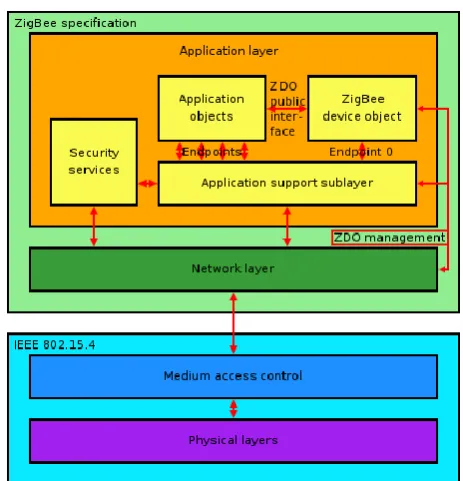
Specification
The specification of a ZigBee device is shown in Figure 2.
ZigBee is a low-cost, low-power, wireless mesh network standard. The low cost allows the technology to be widely deployed in wireless control and monitoring applications. Low power-usage allows longer life with smaller batteries. Mesh networking provides high reliability and more extensive range. ZigBee chip vendors typically sell integrated radios and microcontrollers with between 60 KB and 256 KB flash memory.
ZigBee operates in the industrial, scientific and medical (ISM) radio bands; 868 MHz in Europe, 915 MHz in the USA and Australia and 2.4 GHz in most jurisdictions worldwide. Data transmission rates vary from 20 to 250 kilobits/second.
The ZigBee network layer natively supports both star and tree typical networks, and generic mesh networks. Every network must have one coordinator device, tasked with its creation, the control of its parameters and basic maintenance. Within star networks, the coordinator must be the central node. Both trees and meshes allows the use of ZigBee routers to extend communication at the network level.
Difference between Zigbee and Bluetooth
Zigbee vs Bluetooth
There is a lot in common between Zigbee and Bluetooth, like both operating in the same frequency band of 2.4 GHz and belonging to the same wireless private area network (IEEE 802.15). But even if this is the case, they are not exactly competing technologies. Also, there is a multitude of differences between the two wireless technologies for ‘personal area networks’ both application and technical. Both technologies aim towards a different set of devices and applications and different means of designing for those applications.
The major differences between ZigBee and Bluetooth are summarized below.
1. Zigbee aims at automation whereas Bluetooth aims at connectivity of mobile devices in close proximity.
2. Zigbee uses low data rates, low power consumption on small packet devices while blue tooth uses higher data rates, higher power consumption on large packet devices.
3. Zigbee networks support longer range devices and more in number compared to Bluetooth networks whose range is small, for example between mobile phone and a laptop or desktop or a printer and a PC.
4. Given Zigbee’s almost instant network join times (30 milliseconds) it is more suitable for critical applications while Bluetooth’s longer join time is detrimental (3 seconds).
5. Bluetooth has a protocol stack size of 250 Kilo bytes and 28K bytes for Zigbee.
Uses of ZigBee devices
Recently ZigBee devices have been used in various fields1-21 including wireless communication technologies,1
automation,2 framework for physiological parameters
monitoring,3 networks for vehicular communication,5
electronic devices as thermostats,7 and wireless
technologies for patient monitoring in the operating room and intensive care unit.20 ZigBee devices are used in
corrosion monitoring systems also.
Greenhouse environment wireless monitoring system 22
In the greenhouse environmental monitoring, the wired sensor networks have some problems, for example, complex wiring, inflexible sensor location, cable aging and corrosion and so on. To solve the above problems, ZigBee technology is used to build a wireless sensor network for monitoring temperature, humidity, light intensity, carbon dioxide concentration. And each node is low-power design. Based on the Modbus protocol, RS-485 bus has been built to achieve the communication between a number of greenhouse sensor networks and upper computer (PC). The system has advantages such as flexible sensors placement, low power consumption, easy installation maintenance and expansion, low cost, strong practicability.
Structural Health Monitoring (SHM) system23
Analatom is developing a Structural Health Monitoring (SHM) system which provides both corrosion and strain measurements. This combination of data provides critical assessment of structural health, leading to prediction of failure. The SHM system's sensors can be permanently installed in high value structures, such as buildings, bridges, or aircraft, and are connected to data acquisition nodes where initial processing is performed. From the nodes, processed data is transmitted using a ZigBee/IEEE 802.15.4 compliant low-power, self-organizing, self-healing wireless network to a central PC hub for analysis and interpretation. Analatom's Linear Polarization Resistance (LPR) corrosion sensors have been installed on a mock-up bridge cable at Columbia University as part of a large project on development of a corrosion monitoring system for main cables of suspension bridges. The sensors were placed inside a full-scale mock-up suspension bridge cable located in an environmentally controlled chamber subjected to accelerated corrosion conditions for one year. The LPR sensors recorded corrosion rate measurement at 8 different locations inside the cable showing excellent agreement with temperature measurements.
Structural Health Monitoring by using corrosion degradation AI modeling24
structural health, leading to prediction of failure. The MEMS sensors are permanently installed on a high-valued structure, such as a building, bridge or aircraft, and are connected to a data acquisition node. Data transmission and downloading will use a ZigBee wireless chip, a self-organizing network that has low power requirements. The sensor network provides a low-cost, non-intrusive way to detect failures, or to signal ahead of time that preventative maintenance needs to be undertaken to prevent more expensive replacement in the future. Corrosion Health Monitoring Systems and Prognostics are key elements in assuring the performance and reliability of high value, critical structures. Analatom has developed a multiplexed system that obtains data from a variety of sensors with real-time intelligent algorithms to detect, monitor and predict corrosion rates. Second generation Neural Networks have shown that total state event-shifts within non-linear systems can now be modeled, wherein concurrent, multiple and often interacting sensor signal signatures enhance and amplify this modeling process such that hidden interactions and element dependencies are clarified and understandable. Analatom has developed such a second generation Neural Network architecture whereby multiple and multi-layered element interactions can be evaluated, grouped and monitored. This enhancement now enables CBM monitoring and tracking to reflect local regions of negative impact which arise from multiple and interacting states of degradation.
Wireless sensors for corrosion health management25
Analatom Inc. is developing the Structural Health Monitoring (SHM) system using its Linear Polarization Resistance (LPR) corrosion sensors combined with a Texas Instruments MSP430 microprocessor for lower weight, lower power, higher sensitivity, and lower cost than conventional sensor systems. The system provides both strain and corrosion measurements in a package a few mils thick. This combination of data provides critical assessment of structural health, leading to prediction of failure. The MEMS sensors are permanently installed in a high valued structure, such as a building, bridge or aircraft, and are connected to a data acquisition node. Data transmission and downloading uses a Max Stream ZigBee/IEEE 802.15.4 compliant chip for a wireless, self-organizing network that has low power requirements. The sensor network provides a low-cost, non-intrusive way to detect failures, or to signal ahead of time that preventative maintenance needs to be undertaken to prevent future more expensive replacement. Analatom, Inc. has developed the basic technology for a Portable Maintenance Support Tool (PMST). The device is unique and novel in that it uses a Micro Controller Unit in a handheld device to perform data analysis whilst maintaining a link with a Personal Computer based database for further support. The handheld prototype with a Liquid Crystal Display (LED) touch screen GUI takes readings from a variety of sensors and transfers the data wirelessly to a central PC hub. The handheld unit using the downloaded data from the sensor network can then provide a graphic display and additionally transfer those data to a workstation for further data analysis. Analatom, Inc. builds on its corrosion system platform (sensors, data acquisition unit, data storage) to develop a multiplexed system to obtain data from a variety of sensors, while further developing real time intelligent algorithms to monitor corrosion rates.
Piezoelectric layer (PZT layer) used in the structural health monitoring for aircraft structures 26
The signal of the piezoelectric layer (PZT layer) used in the structural health monitoring for aircraft structures is easily effected by radiation and crosstalk. On the principle of electromagnetic interference, the PZT layer signal is researched and some related coupling parameters are obtained. Based on the research, reasonable parameters to reduce interference were designed and a kind of anti-interference PZT layer is developed. The results of the experiments demonstrate the effectiveness of the anti-interference performance of the designed PZT layer. It can be well used for damage detection. In the same test condition, the magnitude of the crosstalk decreases to 10 percent of the original one and the SNR of fixed frequency interference is improved by 3.16 times when the optimized piezoelectric layer was used.
Detection of fatigue cracks under cyclic loads and corrosive service environments 27
network of distributed miniature piezoelectric sensors/actuators embedded on a thin dielectric carrier film, to query, monitor and evaluate the condition of a structure. The sensor layers are extremely flexible and can be integrated with any type of metal or composite structure. Diagnostic signals obtained from a structure during structural monitoring are processed by a portable diagnostic unit. With appropriate diagnostic software, the signals can be analyzed to ascertain the integrity of the structure being monitored. Details on the system, its integration and examples of detection of fatigue crack and disbond growth and quantification for bonded repairs has been reported.
Accelerated corrosion test predictions using linear polarization resistance sensors with neural networks 28
Coates et al.28 have interpreted accelerated corrosion data
with specific application towards the implementation of a successful Condition Based Maintenance (CBM) program. The objectives of this work are twofold, to investigate the efficacy of specific Linear Polarization Resistance sensors, and to develop a greater understanding of interpretation of accelerated corrosion testing. Linear Polarization Resistance sensors are used to retrieve corrosion data of 1100 Aluminum and 1010 steel using accelerated corrosion tests. The accelerated tests are performed for which the times of exposure are 48 hours and 96 hours. Data from Linear Polarization Resistance sensors is compared with physical observations of metal corrosion. Preliminary tests indicate that the LPR sensor resistance varies appropriately with the corrosion rating and humidity. Quantitative standards are achieved using the ASTM G34 corrosion rating. An Artificial Neural Network (ANN) algorithm is developed in MATLAB to test the consistency and efficacy of the LPR sensors. The Neural Network proposed for this study uses twelve inputs, one hidden layer consisting of 32 neurons, and two outputs; it adapts it weight functions using the back propagation algorithm. The output parameters are the ASTM G34 corrosion rating and material loss rate. The network provides results within 13 % of experimental values for corrosion rate and accurately predicts the corrosion rating. The corrosion rate predicted by LPR data is higher than experimental results as well as the ANN values, however the difference can be accounted for by the inherent assumptions in the electrochemical methods adopted.
Environmental testing of wireless sensor system for structural health monitoring of civil infrastructure 29
Fuchs et al.29 have investigated the environmental testing
of Wireless Intelligent Sensor and Actuator Network (WISAN) currently under development at Clarkson University for the use of long- structural health monitoring of civil infrastructure. The wireless sensor nodes will undergo controlled mechanical vibration and environmental testing in the laboratory. A temperature chamber will be used to perform temperature cycle tests on the sensor nodes. The temperature chamber will also houses a small shaker capable of introducing mechanical loading under the controlled temperature cycle tests. At low temperatures, the resistance of the electronics processing and storage characteristics will be studied. Also, the testing will look at volume expansion and degradation of characteristics due to freezing, degradation of functions and performance, and
mechanical characteristics caused by contraction. At high temperatures, temperature-related changes in sensor nodes due to excessively high temperatures will be investigated. Also studied will be the effects of temperature cycles, including the thermal stresses induced in the nodes and housing and the distortion caused due to expansion and contraction, fatigue, cracks, and changes in electrical characteristics due to mechanical displacement. And finally, mechanical vibration loading will be introduced to the WISAN sensor nodes. Mechanical looseness, fatigue destruction, wire disconnection, damage due to harmonic vibration, defective socket contact, joint wear, destruction due to harmonics, lead breakage, occurrence of noise and abnormal vibration, cracking will be monitored. The eventual goal of the tests is to verify WISAN's performance under anticipated field conditions in which the sensors will be deployed.
Corrosion enhanced capacitive strain gauge 30
Jamshidi et al. have proposed a silicon carbide passivity capacitive strain sensor which continuously and accurately measures strain in corrosive ambient and operates up to 370 °C in air. The analytical model is of low-mechanical noise, high-resolution and high-gain capacitive SiC coated sensor. The gauge is fabricated using silicon-on- insulator and coated with a thin (60 nm) pinhole-free 3C-SiC layer. The integrity of the passivation layer is tested using a hot KOH bath followed by SEM inspection which shows no defects or damage. A localized-heating, high-temperature testing setup has been built using an infra-red lamp to heat the gauge up to 370 °C while maintaining the electronics at significantly reduced temperatures. Experimental results show the strain gauge successfully continues to operate at 370 °C.
High sensitivity oxide based strain gauges and pressure sensors31
Strain gauges and pressure sensors are necessary tools for automotive, aerospace and biomedical monitoring applications. Of the various types of material, which can be used in their fabrication, oxides allow a degree of flexibility in their design. Furthermore, these devices are more rugged and cost effective than semiconductor sensors and have a higher sensitivity than metal-foil gauges. Arshak et al., have developed thin and thick film sensors based on oxides such as V2O5, CeO2, Bi2O3, In2O3, RuO2, TiO2, MgO and Nb2O5.
The devices are evaluated in terms of their sensitivity or gauge factor, linearity, hysteresis and long term stability. Furthermore, different device configurations, planar and sandwich are compared. It is found that the devices presented in this work have sensitivity comparable to that of semiconductor gauges, with good long-term stability. This is particularly true of the sandwich devices. It is observed that oxide based strain gauges may offer an alternative to existing commercial gauges, for example, in applications involving load cells, torque wrenches and limb implants.
Measurement of strain in concrete structure32
gauge. The transponder is powered by the inductive coupling method which eliminates the need for expensive cable runs in the concrete for conventional strain measurement. The measured strain data is digitized and sent back to the PC-controlled reader using Frequency Shift Keying (FSK) technique at two discrete frequencies of 134.2 kHz and 123.2 kHz. A prototype was built using commercial micro power CMOS ICs to verify its functionality. Measurements from the prototype have achieved 100 cm reading range without any trimming on the capacitors in the resonance circuit.
Corrosion fatigue machine 33
Berchem and Hocking have designed a new and simple displacement-controlled high-cycle fatigue and corrosion fatigue machine. The new design allows the simultaneous testing of more than one test specimen. Stress amplitudes and mean stresses can be selected individually; the frequency however is the same for each test specimen.
Conclusion
ZigBee is a low-cost, low-power, wireless mesh network standard. The low cost allows the technology to be widely deployed in wireless control and monitoring applications. Low power-usage allows longer life with smaller batteries. Mesh networking provides high reliability and more extensive range.
ZigBee devices can by used in automation, advanced temperature control, safety and security, wireless sensor networks industrial control, embedded sensing, medical data collection, and corrosion monitoring devices.
Acknowledgement
The authors are thankful to their respective managements.
References
1Kulatunga, N. A., Navaratne, S., Dole, J., Liyanagedera, C.,
Martin, T. 2012 IEEE Innovative Smart Grid Technol. - Asia,
ISGT Asia 2012, Art. no. 6303188, 2012.
2Ahmad, S., Proc. 2011 Int. Conf. Emerging Trends Networks
Comp. Comm., ETNCC2011, Art. no. 5958516, 2011.
3Mahajan, N., Reddy, K .T. V., Proc.Int. Conf. Workshop
Emerging Trends Technol., 2011, ICWET 2011, 2011, 1306.
4Wu, C.-H., Wu, C.-H., Hong, Z.-W., Huang, K.-S. J. Converg.
Inform. Tech., 2011, 6(2), 329.
5Chumkamon, S., Tuvaphanthaphiphat, P., Keeratiwintakorn, P.
ECTI-CON 2010 - The 2010 ECTI Int. Conf. Electr.
Engg./Electronics, Computer, Telecommun. Inform. Technol.,
Art. no. 5491415, 2010, 603.
6Chang, C.-S., Tan, T.-H., Chen, Y.-F., Huang, Y.-F., Lee,
M.-H.,Hsu, J.-C., Chen, H.-C. Lecture Notes Comp. Sci. 6165 LNCS, 2010, 201.
7Starsinic, M. 2010 Long Island Systems, Appl. Technol. Conf.,
LISAT 10, Art. no. 5478336, 2010.
8Li, C., Zhang, J. IFCSTA 2009 Proc. - 2009 Int. Forum Computer
Sci.-Technol. Appl. 1, Art. no. 5385074, 2009, 298.
9Fang, A., Xu, X., Yang, W., Zhang, L., Proc. 2009 Pacific-Asia
Conf. Circuits, Commun. System, PACCS 2009, Art. no.
5232292, 2009, 81.
10Yuce, M. R., Recent Pat. Electr. Engg., 2009, 2(2), 115. 11Taylor, C., Dajani, L. 1st Int. Conf. Pervasive Technol. Related
Assist. Environ., PETRA 2008, Art. no. 43, 2008.
12Bellido Outeiriñio, F. J., Flores Arias, J. M., Real Calvo, R.,
Torres Roldán, M. 2008 1st Conf. IT Revolutions, Art. no. 5075048, 2008.
13Yadav, A., Bhoyar, M., Joshi, C.V., Proc. 2008 Int. Conf.
Wireless Networks, ICWN 2008, 2008, 759.
14Sherman, M., Mody, A. N., Martinez, R., Rodriguez, C., Reddy,
R., IEEE Commun. Mag., 2008, 46(7), 72.
15Yang, W., Li, M., Wang, X. Nongye Gongcheng Xuebao, 2008,
24(5), 297.
16Kawamoto, R., Emori, T., Sakata, S., Yuasa, K., Furuhata,
K., Hara, S. 2007 1st Int. Global Inform. Infrastruct. Symp.,
GIIS 2007 - "Closing the Digital Divide", Art. no. 4404170,
2007, 73.
17Cheng, J. J.-Y., Hung, M.-H.,Chang, J.-W. 2007 IEEE Int. Conf.
Networking, Sensing, Control, ICNSC'07, Art. no. 4239113,
2007, 895.
18Ng, H. S., Sim, M. L., Tan, C. M., Wong, C. C., BT Technol. J.,
2006, 24(2), 130.
19Lopez-Villegas, J. M. Proc. SPIE - Int. Soc. Optic. Engg., 5837
PART I, Art. no. 46, 2005, 404.
20Paksuniemi, M., Sorvoja, H., Alasaarela, E., Myllylä, R., Proc.
Ann. Int. Conf. IEEE Engg. Med. Biol., Vol. 7, Art. no.
1615645, 2005, 5182.
21Arvind, D. K., Wong, K. J. 2004 IEEE, Proc. Int. Symp.
Consumer Electronics - Proceedings, 2004, 219.
22Wang, H., Dong, X.-R., Ma, Y.-Z.,Yang, X.-W., Liu, F.-N. Lect.
Notes Electr. Engg., 132 LNEE, 2011, 1, 579.
23Clements, R., Darr, D., Morse, J., Laskowski, B. C., Betti,
R., Ooi, T. K., Corder, A., Structural Health Monit. 2011: Condition-Based Maintenance Intelligent Struct. – Proc. 8th
Int. Workshop Struct. Health Monit.,2011, 2, 1855.
24Kwan, K., Morse, J., Laskowski, B.C., Proc. 4th Eur. Workshop
Struct. Health Monit., 2008, 551-559.
25Kwan, K., Caldwell, B., Morse, J., O'Day, J., Laskowski. B.
C., Ooi, T.K., Corder, A., Adv. Mater. Res, 2008, 38, 123-131.
26Shi, X.-L., Yuan, S.-F., Qiu, L. Acta. Mater. Sin,2012, 33(5),
457.
27Kumar, A., Roach, D., Beard, S., Qing, X., Hannum, R., Proc.
SPIE – Int. Soc. Optical Engg., 6179, Art. no. 61790M, 2006.
28Coates, C. W., Olanubi, O. O.,Sokoloski, R. M., Singleton, J. D.,
Coll. Techn. Papers - IAA/ASME/ASCE/AHS/ASC Struct.,
Structural Dynamics Mater. Conf., 2004, 5, 3434.
29Fuchs, M.P., Janoyan, K.D.,Sazonov, E.S., Krishnamurthy,
V., Jha, R., Cross, K., Proc. SPIE – Int. Soc. Optical Engg., 6174 I , Art. no. 6 17405, 2006.
30Jamshidi, B., Azevedo, R.G.,Wijesundara, M.B.J., Pisano, A.P.
Proc. IEEE Sensors , Art. no. 4388522, 2007, 804-807.
31Arshak, K., Morris, D., Arshak, A., Korostynska, O., J. Mater.
Sci.: Mater. Electron. , 2006, 17(9), 767.
32Chuah, Y. T., Chan, P.K., Siek, L., Int. Symp., IC Technol.,
Systems Appl., 2001, 9 , 438.
33Berchem, K., Hocking, M. G., Meas. Sci. Technol., Art. no.N05,
2006, 17(10), 60.