Smart Grid Cyber Security
EXECUTIVE SUMMARY
Alstom Grid, Intel, and McAfee have joined their expertise to deliver their view on smart grid cyber security, including:
• What the smart grid is
• The smart grid cyber security landscape • How to protect the smart grid
This initiative highlights challenges in migrating to the modern grid and different approaches to building it while addressing cyber security risks.
Smart Grid Deployment Requires a New End-to-End
Security Approach
What Is the Smart Grid? A Needed Evolution
According to the latest projections of the International Energy Agency, smart grid technologies have become essential to han-dling the radical changes expected in inter-national energy portfolios through 20301:
• World energy demand is expected to increase at an annual rate of 2.2 per-cent, doubling the global energy demand overall.
• Global CO2 emissionsare projected to accelerate even faster than this energy demand, leading to the first critical impact on climate change and exposing the grid to new environmental catastro-phes while increasing societal aware-ness of environmental challenges.
• Intermittent renewable capacitywill continue to evolve, reaching an average of 25 percent capacity by 2050 and leading some grid areas to absorb more intermittent renewable energy than their actual consumption through
specif-The smart grid is an evolution of the electri-cal grid to respond to these challenges. A smart grid is an energy transmission and dis-tribution network enhanced through digital control, monitoring, and telecommunications capabilities. It provides a real-time, two-way flow of energy and information to all stake-holders in the electricity chain, from the gen-eration plant to the commercial, industrial, and residential end user.
This evolution is crucial for integrating both renewable and distributed energy resources and to improve the efficiency and sustainability of the electrical grid and associated services. It will also help in other ways, such as enabling:
• Smart and positive energy infrastructures
• Increased energy density management during peaks
• Real-time pricing to customers
• Integrated mobility services
• New virtual power plants
• Microgrid
Contributors
Yves Aillerie, Intel Corporation
Said Kayal, Alstom Grid
Jean-Pierre Mennella, Alstom Grid
Raj Samani, McAfee
Sylvain Sauty, Intel Corporation
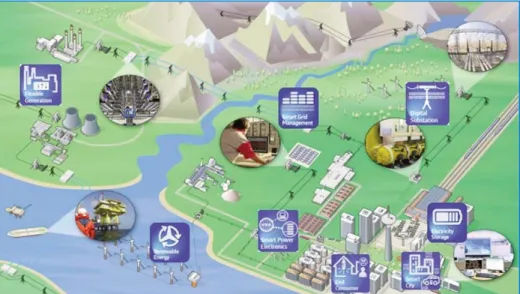
It will also help energy customers to better man-age their electricity consumption and even sell their unused home-produced electricity back to the grid. Figure 1 shows the smart grid ecosystem.
The smart grid is more than an infrastructure for smarter electricity generation, distribution, and consumption. It will have a positive impact on our modern society, with benefits for both indi-viduals and the collective population.
The smart grid phenomenon is something like the Internet phenomenon. It is like an “Internet of watts” that can come from renewable energy sources, energy storage, electrical vehicles, or smart home appliances.
Beyond these connected smart assets, a smart grid is also about ecocitizens, efficiency, green practices, mobility, national welfare, and reliability. Layered Architectures
Energy utilities worldwide see the need for pilot-ing new smart grid systems, laypilot-ing down a new layer of digital equipment on their existing infra-structures to interconnect all assets—from ultra-high-voltage supergrids to ultra-low-voltage micro- and pico-grids—with buildings and homes.
Smart grid technologies bring the opportunity to enhance existing power grid infrastructures (i.e., power lines, electrical substations, network con-trol rooms) by improving real-time assessment of system conditions. New digital equipment and devices can be strategically deployed to comple-ment existing equipcomple-ment. Using a combination of centralized IT and distributed intelligence within critical system control nodes—ranging from ther-mal and renewable plant controls to grid and dis-tribution utility servers to cities, commercial and industrial infrastructures, and homes—a smart grid can bring unprecedented efficiency and sta-bility to the energy system.
Information and communication infrastructures will play an important role in connecting and optimizing the available grid layers.
Figure 2 shows the smart grid's layered architecture.
Figure 1. Smart Grid Ecosystem
Figure 2. The Smart Grid Layered Architecture
Source: Alstom Grid
A significant challenge for these new architec-tures is to offer enough openness to connect historically siloed resources while matching end-user privacy regulations and mitigating new cyber security risks.
The Smart Grid Cyber Security Landscape Cyber Security Standards
A smart grid environment relies heavily on stan-dards, mainly to guarantee interoperability among systems. Standards also play a key role in smart grid cyber security.
Standards to develop smart grid cyber security are available today, although some enhancements and new materials will be required to reflect the evolu-tion of the smart grid, its technologies, and threats. Some will also need to be specifically pro-filed for the smart grid environment.
The challenge is to maintain these standards over time at an appropriate pace. This will require substantial effort, but the benefit of supporting the deployment of smart grid infra-structures that are secure by design will make it worthwhile.
In its report, the CEN-CENELEC-ETSI SG-CG/SGIS working group chose a European electrical grid stability scenario as reference to define security levels (Table 1).2
These security level definitions help create a bridge between electrical grid operations and cyber security. They provide guidance in helping to identify critical areas where security matters most from a global electrical grid stability point of view, starting from pan-European supergrids down to microgrids in city neighborhoods. Fast-Changing Cyber-Threats
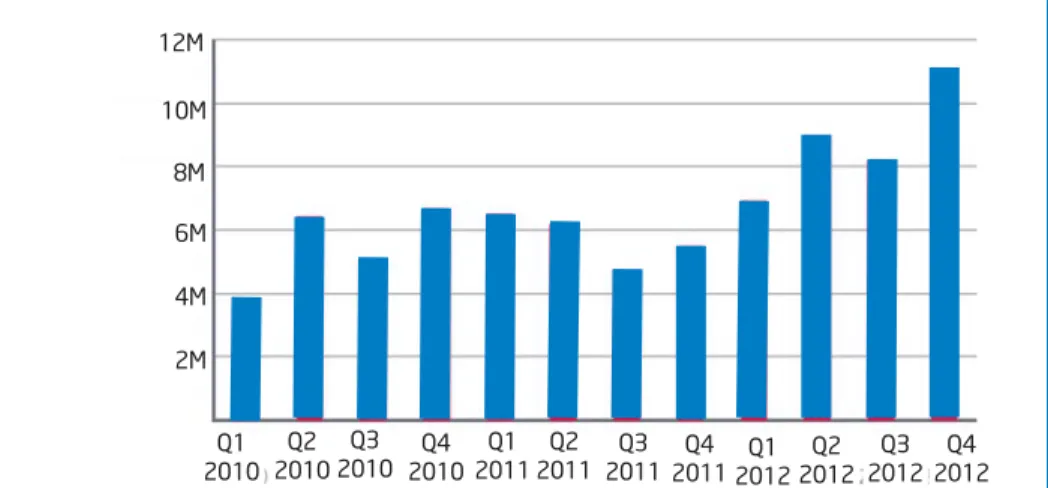
The cyber threat landscape is evolving quickly. The last few years have seen an exponential growth of threats. In its fourth quarter 2012 threats reports executive summary document, McAfee says, “For the year, new malware sample discoveries increased 50 percent with more than 120 million samples now in the McAfee Labs 'zoo.'”3 Figures 3 and 4 show total malware samples in the McAfee
Security Level 5 - Highly Critical 4 - Critical 3 - High 2 - Medium 1 - Low
European Grid Stability Scenario Security Level Examples
• Assets whose disruption could lead to a power loss above 10 GW
• Pan-European incident
• Assets whose disruption could lead to a power loss from above 1 GW to 10 GW
• European/country incident
• Assets whose disruption could lead to a power loss from above 100 MW to 1 GW
• Country/regional incident
• Assets whose disruption could lead to a power loss from 1 MW to 100 MW
• Regional/town incident
• Assets whose disruption could lead to a power loss under 1 MW
• Town/neighborhood incident Table 1. M/490 SG-CG/SGIS Security Levels
Cyber threats are also evolving and becoming highly sophisticated. Advanced persistent threats (APT) are good illustrations of this mutation. Also, attackers are no longer ama-teurs, but highly skilled and organized profes-sionals able to launch complex and coordinat-ed attacks using sophisticatcoordinat-ed tools.
Many types of cyber threats are well known:
• Hackers
• Malware
• Zero days
• Botnets
• Denial of service (DOS)
• Distributed denial of service (DDOS)
These are all terms we have lived with for years.
Information systems have always been tar-geted by cyber attackers. What is relatively
demonstrated in 2010 with Stuxnet, the first discovered malware targeting industrial con-trol systems.5
Electrical grids are valuable and critical targets that need to be protected from cyber threats.
Smart Grid Architecture
Smart grid layers require a system of systems approach with differentiated security needs.
The smart grid includes different domains:
• Power generation
• Transmission
• Distribution
• Distributed energy resources
• Smart cities
• End consumers
It relies on a multitude of stakeholders, each with its own specific role and activity within a
A smart grid architecture is a system of sys-tems: a large and complex system made of smaller and simpler systems distributed and interconnected. Each smaller system has a dif-ferent systemic impact on the global system stability and each must be assessed.
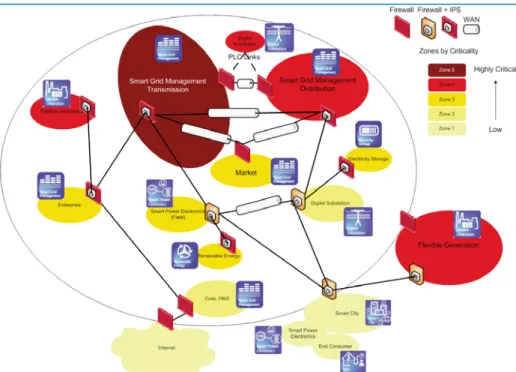
Using the M/490 SG-CG/SGIS security levels (Table 1), Figure 5 shows how this could be transposed into a smart grid architecture.
Each smart grid subsystem and its associated assets require specific security functions and solutions. For example, the solution to secure a substation is not the same as the solution to secure demand response and home energy management systems.
However, this does not mean that subsystems with “lower” criticality should not be secured. The security measures for each level must be sufficient to mitigate the risks. All subsystems would not necessarily need to align to the sub-system having the highest security require-ments to efficiently protect the whole system, since they have their own role to play in the global smart grid ecosystem.
Smart grid stakeholders need to analyze security levels from the perspective of a global risk assessment of each smart grid use case and sub-system considered in the end-to-end architecture. Smart Grid Cyber Security Specificities The European Commission has expressed con-cern about measures to ensure a high common level of network and information security across the Union.6 The U.S. White House has also expressed concern about cyber security and protecting critical infrastructures.7
As a large system of distributed and intercon-nected systems, the smart grid offers an excep-tionally large attack surface. Every asset of the smart grid (i.e., home gateways, smart meters, substations, control room) is a potential target for a cyber attack. An attack over a critical node may jeopardize the grid security and lead a cas-cade effect to a whole system blackout.
Figure 3. Total Malware Samples in the McAfee Labs Database
Figure 4. New Malware Samples 120M 100M 80M 60M 40M 20M 0 Jan 2012 Feb 2012 Mar 2012 Apr 2012 May 2012 Jun 2012 Jul 2012 Aug 2012 Sep 2012 Oct 2012 Nov 2012 Dec 2012 12M 10M 8M 6M 4M 2M Q1 2010 Q2 2010 Q3 2010 Q4 2010 Q1 2011 Q2 2011 Q3 2011 Q4 2011 Q1 2012 Q2 2012 Q3 2012 Q4 2012 Source: McAfee Source: McAfee
Usual cyber security technologies and best practices—such as antivirus, firewalls, intru-sion prevention systems, network security design, defense in depth, and system harden-ing—are necessary to protect the smart grid. However, history showed us they are only part of the solution.
Countering evolved and highly sophisticated threats such as advanced persistent threats (APT) requires advanced cyber security tech-nologies including security information and event management (SIEM) systems, application whitelisting, and security features embedded at the processor level, among others.
The smart grid cyber security challenge is about protecting the ever-growing number of smart grid assets and their communication channels from fast-growing and continuously evolving cyber threats.
Protecting the End-to-End Architecture No Silver Bullet
To maintain the stability of the whole sys-tem, most smart grid subsystems need to keep operating under all circumstances— even if one or more assets is breached or under attack.
Securing the smart grid requires a combina-tion of standard and advanced cyber security technologies.
Security by Design
Since threats are constantly evolving, protection demands advanced cyber security technologies.
By providing comprehensive, real-time threat intelligence, cyber security solutions can pro-tect systems against cyber threats across mul-tiple vectors. Intended to collect information from devices, networks and applications, secu-rity information and event management (SIEM) systems are often focused on security events to identify risks and threats based on analysis of both internal and external data. Such sys-tems are deployed within secure and isolated facilities, or in broadly distributed zones, which is critical for obtaining situational awareness across zones. SIEM systems col-lect and aggregate information from cyber systems and then provide information about risks and threats through an automated process supporting decision-making.
Application whitelisting can complement tradi-tional malware protection technologies like anti-virus and is a valuable alternative when such traditional technologies cannot be deployed. Application whitelisting through a list of authorized files ensures that only allowed files are executed. Non-authorized software (e.g., malware) cannot be executed on systems that have this technology deployed.
Whitelisting technologies are particularly suit-ed for environment where systems ussuit-ed are quite stable.
Finally, Hardware-assisted security makes sys-tems more resilient and helps decrease the time needed to return to normal service in case of incident or attack (Figure 6).
Figure 5. Smart Grid Architecture with Different Security Needs
Figure 6. Hardware-Enhanced Security through Silicon Features (Processor, Chipset)
Source: Alstom Grid
1International Energy Agency, "Technology Roadmap: Smart Grids," http://www.iea.org/publications/freepublications/publication/smartgrids_roadmap.pdf (2011). 2CEN-CENELEC-ETSI Smart Grid Coordination Group, "Smart Grid Information Security," ftp://ftp.cen.eu/EN/EuropeanStandardization/HotTopics/SmartGrids/Security.pdf (November 2012).
3McAFee Labs, "McAfee Threats Report: Fourth Quarter 2012 Executive Summary,” http://www.mcafee.com/us/resources/reports/rp-quarterly-threat-q4-2012-summary.pdf (2013).
4McAFee Labs, "McAfee Threats Report: Fourth Quarter 2012," http://www.mcafee.com/us/resources/reports/rp-quarterly-threat-q4-2012.pdf (2013). 5"Stuxnet," Wikipedia.org, http://en.wikipedia.org/wiki/Stuxnet (May 2013).
6European Union press release, "EU Cyber Security Plan," http://europa.eu/rapid/press-release_IP-13-94_en.htm?locale=en (February 7, 2013).
7White House press release, "Executive Order: Improving Critical Infrastructure Cybersecurity," http://www.whitehouse.gov/the-press-office/2013/02/12/executive-order-improving-critical-infrastructure-cybersecurity (February 12, 2013).
8Sun Tzu, "The Art of War," http://classics.mit.edu/Tzu/artwar.html. Specific secure chipsets allow secure system
remote control and maintenance (operating system, BIOS, application patches) over extra-secure networks. Such platforms can also detect if the system has been physically manipulated by logging any important action that has been performed on it and by detect-ing any change in the hardware components.
Hardware enforced virtualization can isolate execution environments and separate memory access, effectively containing an attack to the limit of a virtual machine. Virtual machines can easily be reloaded from their latest known sta-ble snapshot.
An embedded trusted and secure boot process verifies the platform integrity before mounting the hypervisor and the virtual machines.
Cryptographic chips provide robust and fast encryption features (such as Advanced Encryption Standard [AES]) and random gen-erators that can be used for communication and storage encryption. Cryptographic chips
way with other traditional grid contingencies and expand grid operators’ situational aware-ness through cyber attacks.
Only by understanding the smart grid, its strengths and weaknesses, and the threats it has to face will it be possible to build secure-by-design smart grid end-to-end architectures.
As military strategist Sun Tzu (544 to 496 BC) stated, “If you know the enemy and know yourself, you need not fear the result of a hundred battles. If you know yourself but not the enemy, for every victory gained you will also suffer a defeat. If you know nei-ther the enemy nor yourself, you will suc-cumb in every battle.”8
Cyber security is a growing concern and
a key success factor for smart grid
deployment. Alstom Grid, Intel, and
McAfee have teamed up to move on
smart grid opportunities in a secure and
effective way.
also provide a secure storage for crypto-graphic keys.
To be truly efficient, all these advanced tech-nologies need to be adapted to smart-grid-spe-cific models. These are necessary steps to build inherently secure-by-design smart grid end-to-end architectures.
Conclusion
First experiences on smart grid demonstrations reveal that new architectures develop as com-binations of new use cases and actors, to be expanded on the top of existing grid infra-structures. This requires interconnecting exist-ing subsystems with new ones.
This inherently implies an enlargement of the grid attack surface, and so requires taking new risk mitigation measures. This must be done by taking into consideration the poten-tial impact of an attack to the end-to-end electrical system stability for each use case considered. This requires new approaches to manage cyber contingencies in a consistent
Copyright © 2013 Intel Corporation, McAFee, and ALSTOM. All rights reserved.
Intel and the Intel logo are trademarks of Intel Corporation in the U.S. and/or other countries. *Other names and brands may be claimed as the property of others.
No computer system can provide absolute security under all conditions. Built-in security features available on select Intel® processors may require additional software, hardware, services and/or an Internet connection. Results may vary depending upon configuration. Consult your system manufacturer for more details.For more information, see http://security-center.intel.com/.