PARDA: Proportional Allocation of Resources for Distributed Storage Access
Ajay Gulati
Irfan Ahmad
Carl A. Waldspurger
VMware Inc.
{agulati,irfan,carl}@vmware.com
Abstract
Rapid adoption of virtualization technologies has led to increased utilization of physical resources, which are mul-tiplexed among numerous workloads with varying demands and importance. Virtualization has also accelerated the de-ployment of shared storage systems, which offer many ad-vantages in such environments. Effective resource manage-ment for shared storage systems is challenging, even in re-search systems with complete end-to-end control over all system components. Commercially-available storage arrays typically offer only limited, proprietary support for control-ling service rates, which is insufficient for isolating work-loads sharing the same storage volume or LUN.
To address these issues, we introduce PARDA, a novel software system that enforces proportional-share fairness among distributed hosts accessing a storage array, without assuming any support from the array itself. PARDA uses latency measurements to detect overload, and adjusts issue queue lengths to provide fairness, similar to aspects of flow control in FAST TCP. We present the design and implemen-tation of PARDA in the context of VMware ESX Server, a hypervisor-based virtualization system, and show how it can be used to provide differential quality of service for unmodified virtual machines while maintaining high effi-ciency. We evaluate the effectiveness of our implementa-tion using quantitative experiments, demonstrating that this approach is practical.
1 Introduction
Storage arrays form the backbone of modern data centers by providing consolidated data access to multiple applica-tions simultaneously. Deployments of consolidated storage using Storage Area Network (SAN) or Network-Attached Storage (NAS) hardware are increasing, motivated by easy access to data from anywhere at any time, ease of backup, flexibility in provisioning, and centralized administration. This trend is further fueled by the proliferation of virtualiza-tion technologies, which rely on shared storage to support features such as live migration of workloads across hosts.
A typical virtualized data center consists of multi-ple physical hosts, each running several virtual machines
(VMs). Many VMs may compete for access to one or more logical units (LUNs) on a single storage array. The result-ing contention at the array for resources such as controllers, caches, and disk arms leads to unpredictable IO comple-tion times. Resource management mechanisms and policies are required to enable performance isolation, control service rates, and enforce service-level agreements.
In this paper, we target the problem of providing coarse-grained fairness to VMs, without assuming any support from the storage array itself. We also strive to remain work-conserving, so that the array is utilized efficiently. We fo-cus on proportionate allocation of IO resources as a flexible building block for constructing higher-level policies. This problem is challenging for several reasons, including the need to treat the array as an unmodifiable black box, unpre-dictable array performance, uncertain available bandwidth, and the desire for a scalable decentralized solution.
Many existing approaches [13, 14, 16, 21, 25, 27, 28] al-locate bandwidth among multiple applications running on a single host. In such systems, one centralized scheduler has complete control over all requests to the storage system. Other centralized schemes [19, 30] attempt to control the queue length at the device to provide tight latency bounds. Although centralized schedulers are useful for host-level IO scheduling, in our virtualized environment we need an ap-proach for coordinating IO scheduling across multiple inde-pendent hosts accessing a shared storage array.
More decentralized approaches, such as Triage [18], have been proposed, but still rely on centralized measure-ment and control. A central agent adjusts per-host band-width caps over successive time periods and communicates them to hosts. Throttling hosts using caps can lead to sub-stantial inefficiency by under-utilizing array resources. In addition, host-level changes such as VMs becoming idle need to propagate to the central controller, which may cause a prohibitive increase in communication costs.
We instead map the problem of distributed storage ac-cess from multiple hosts to the problem of flow control in networks. In principle, fairly allocating storage bandwidth with high utilization is analogous to distributed hosts trying to estimate available network bandwidth and consuming it in a fair manner. The network is effectively a black box to the hosts, providing little or no information about its current
state and the number of participants. Starting with this loose analogy, we designed PARDA, a new software system that enforces coarse-grained proportional-share fairness among hosts accessing a storage array, while still maintaining high array utilization.
PARDA uses the IO latency observed by each host as an indicator of load at the array, and uses a control equation to adjust the number of IOs issued per host,i.e., the host window size. We found that variability in IO latency, due to both request characteristics (e.g., degree of sequentiality, reads vs. writes, and IO size) and array internals (e.g., re-quest scheduling, caching and block placement) could be magnified by the independent control loops running at each host, resulting in undesirable divergent behavior.
To handle such variability, we found that using the av-erage latency observed acrossallhosts as an indicator of overall load produced stable results. Although this approach does require communication between hosts, we need only compute a simple average for a single metric, which can be accomplished using a lightweight, decentralized aggre-gation mechanism. PARDA also handles idle VMs and bursty workloads by adapting per-host weights based on long-term idling behavior, and by using a local scheduler at the host to handle short-term bursts. Integrating with a local proportional-share scheduler [10] enables fair end-to-end access to VMs in a distributed environment.
We implemented a complete PARDA prototype in the VMware ESX Server hypervisor [24]. For simplicity, we assume all hosts use the same PARDA protocol to ensure fairness, a reasonable assumption in most virtualized clus-ters. Since hosts run compatible hypervisors, PARDA can be incorporated into the virtualization layer, and remain transparent to the operating systems and applications run-ning within VMs. We show that PARDA can maintain cluster-level latency close to a specified threshold, provide coarse-grained fairness to hosts in proportion to per-host weights, and provide end-to-end storage IO isolation to VMs or applications while handling diverse workloads.
The next section presents our system model and goals in more detail. Section 3 develops the analogy to network flow control, and introduces our core algorithm, along with extensions for handling bursty workloads. Storage-specific challenges that required extensions beyond network flow control are examined in Section 4. Section 5 evaluates our implementation using a variety of quantitative experiments. Related work is discussed in section 6, while conclusions and directions for future work are presented in Section 7.
2 System Model
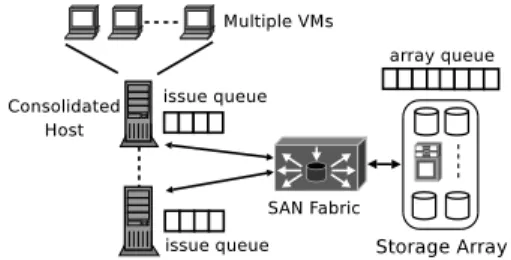
PARDA was designed for distributed systems such as the one shown in Figure 1. Multiple hosts access one or more storage arrays connected over a SAN. Disks in storage
ar-rays are partitioned into RAID groups, which are used to construct LUNs. Each LUN is visible as a storage device to hosts and exports a cluster filesystem for distributed access. A VM disk is represented by a file on one of the shared LUNs, accessible from multiple hosts. This facilitates mi-gration of VMs between hosts, avoiding the need to transfer disk state.
Since each host runs multiple virtual machines, the IO traffic issued by a host is the aggregated traffic of all its VMs that are currently performing IO. Each host maintains a set of pending IOs at the array, represented by anissue queue. This queue represents the IOs scheduled by the host and currently pending at the array; additional requests may be pending at the host, waiting to be issued to the storage array. Issue queues are typically per-LUN and have a fixed maximumissue queue length1(e.g., 64 IOs per LUN).
Figure 1:Storage array accessed by distributed hosts/VMs.
IO requests from multiple hosts compete for shared re-sources at the storage array, such as controllers, cache, in-terconnects, and disks. As a result, workloads running on one host can adversely impact the performance of work-loads on other hosts. To support performance isolation, re-source management mechanisms are required to specify and control service rates under contention.
Resource allocations are specified by numeric shares, which are assigned to VMs that consume IO resources.2A
VM is entitled to consume storage array resources propor-tional to its share allocation, which specifies the relative im-portance of its IO requests compared to other VMs. The IO shares associated with a host is simply the total number of per-VM shares summed across all of its VMs. Proportional-share fairness is defined as providing storage array service to hosts in proportion to their shares.
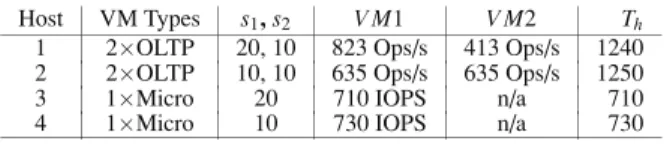
In order to motivate the problem of IO scheduling across multiple hosts, consider a simple example with four hosts running a total of six VMs, all accessing a common shared LUN over a SAN. Hosts 1 and 2 each run two Linux VMs configured with OLTP workloads using Filebench [20]. 1The termsqueue length,queue depth, andqueue sizeare used
inter-changeably in the literature. In this paper, we will also use the termwindow size, which is common in the networking literature.
2Shares are alternatively referred to asweightsin the literature.
Al-though we use the termVMto be concrete, the same proportional-share framework can accommodate other abstractions of resource consumers, such as applications, processes, users, or groups.
Host VM Types s1, s2 V M1 V M2 Th
1 2×OLTP 20, 10 823 Ops/s 413 Ops/s 1240 2 2×OLTP 10, 10 635 Ops/s 635 Ops/s 1250 3 1×Micro 20 710 IOPS n/a 710 4 1×Micro 10 730 IOPS n/a 730
Table 1: Local scheduling does not achieve inter-host fairness.
Four hosts running six VMs without PARDA. Hosts 1 and 2 each run two OLTP VMs, and hosts 3 and 4 each run one micro-benchmark VM issuing 16 KB random reads. Configured shares (si), Filebench operations per second (Ops/s), and IOPS (Th for
hosts) are respected within each host, but not across hosts.
Hosts 3 and 4 each run a Windows Server 2003 VM with Iometer [1], configured to generate 16 KB random reads. Table 1 shows that the VMs are configured with different share values, entitling them to consume different amounts of IO resources. Although a local start-time fair queuing (SFQ) scheduler [16] does provide proportionate fairness within each individual host, per-host local schedulers alone are insufficient to provide isolation and proportionate fair-ness across hosts. For example, note that the aggregate throughput (in IOPS) for hosts 1 and 2 is quite similar, de-spite their different aggregate share allocations. Similarly, the Iometer VMs on hosts 3 and 4 achieve almost equal per-formance, violating their specified 2 : 1 share ratio.
Many units of allocation have been proposed for sharing IO resources, such as Bytes/s, IOPS, and disk service time. Using Bytes/s or IOPS can unfairly penalize workloads with large or sequential IOs, since the cost of servicing an IO depends on its size and location. Service times are difficult to measure for large storage arrays that service hundreds of IOs concurrently.
In our approach, we conceptually partition the array queue among hosts in proportion to their shares. Thus two hosts with equal shares will have equal queue lengths, but may observe different throughput in terms of Bytes/s or IOPS. This is due to differences in per-IO cost and schedul-ing decisions made within the array, which may process requests in the order it deems most efficient to maximize aggregate throughput. Conceptually, this effect is similar to that encountered when time-multiplexing a CPU among various workloads. Although workloads may receive equal time slices, they will retire different numbers of instruc-tions due to differences in cache locality and instruction-level parallelism. The same applies to memory and other resources, where equal hardware-level allocations do not necessarily imply equal application-level progress.
Although we focus on issue queue slots as our primary fairness metric, each queue slot could alternatively repre-sent a fixed-size IO operation (e.g., 16 KB), thereby provid-ing throughput fairness expressed in Bytes/s. However, a key benefit of managing queue length instead of throughput is that it automatically compensates workloads with lower
per-IO costs at the array by allowing them to issue more requests. By considering the actual cost of the work per-formed by the array, overall efficiency remains higher.
Since there is no central server or proxy performing IO scheduling, and no support for fairness in the array, a per-host flow controlmechanism is needed to enforce speci-fied resource allocations. Ideally, this mechanism should achieve the following goals: (1) provide coarse-grained proportional-share fairness among hosts, (2) maintain high utilization, (3) exhibit low overhead in terms of per-host computation and inter-host communication, and (4) control the overall latency observed by the hosts in the cluster.
To meet these goals, the flow control mechanism must determine the maximum number of IOs that a host can keep pending at the array. A naive method, such as using static per-host issue queue lengths proportional to each host’s IO shares, may provide reasonable isolation, but would not be work-conserving, leading to poor utilization in underloaded scenarios. Using larger static issue queues could improve utilization, but would increase latency and degrade fairness in overloaded scenarios.
This tradeoff between fairness and utilization suggests the need for a more dynamic approach, where issue queue lengths are varied based on the current level of contention at the array. In general, queue lengths should be increased under low contention for work conservation, and decreased under high contention for fairness. In an equilibrium state, the queue lengths should converge to different values for each host based on their share allocations, so that hosts achieve proportional fairness in the presence of contention.
3 IO Resource Management
In this section we first present the analogy between flow control in networks and distributed storage access. We then explain our control algorithm for providing host-level fair-ness, and discuss VM-level fairness by combining cluster-level PARDA flow control with local IO scheduling at hosts.
3.1 Analogy to TCP
Our general approach maps the problem of distributed stor-age manstor-agement to flow control in networks. TCP running at a host implements flow control based on two signals from the network: round trip time (RTT) and packet loss proba-bility. RTT is essentially the same as IO request latency observed by the IO scheduler, so this signal can be used without modification.
However, there is no useful analog of network packet loss in storage systems. While networking applications ex-pect dropped packets and handle them using retransmission, typical storage applications do not expect dropped IO re-quests, which are rare enough to be treated as hard failures.
Thus, we use IO latency as our only indicator of con-gestion at the array. To detect concon-gestion, we must be able to distinguish underloaded and overloaded states. This is accomplished by introducing alatency threshold parame-ter, denoted by L. Observed latencies greater than L may trigger a reduction in queue length. FAST TCP, a recently-proposed variant of TCP, uses packet latency in-stead of packet loss probability, because loss probability is difficult to estimate accurately in networks with high bandwidth-delay products [15]. This feature also helps in high-bandwidth SANs, where packet loss is unlikely and TCP-like AIMD (additive increase multiplicative decrease) mechanisms can cause inefficiencies. We use a similar adaptive approach based on average latency to detect con-gestion at the array.
Other networking proposals such as RED [9] are based on early detection of congestion using information from routers, before a packet is lost. In networks, this has the added advantage of avoiding retransmissions. However, most proposed networking techniques that require router support have not been adopted widely, due to overhead and complexity concerns; this is analogous to the limited QoS support in current storage arrays.
3.2 PARDA Control Algorithm
The PARDA algorithm detects overload at the array based on average IO latency measured over a fixed time period, and adjusts the host’s issue queue length (i.e., window size) in response. A separate instance of the PARDA control al-gorithm executes on each host.
There are two main components: latency estimation and window size computation. For latency estimation, each host maintains an exponentially-weighted moving average of IO latency at timet, denoted byL(t), to smooth out short-term variations. The weight given to past values is determined by a smoothing parameterα∈[0,1]. Given a new latency observationl,
L(t) = (1−α)×l + α×L(t−1) (1) The window size computation uses a control mechanism shown to exhibit stable behavior for FAST TCP:
w(t+1) = (1−γ)w(t) + γ � L
L(t)w(t) +β �
(2) Herew(t)denotes the window size at timet,γ∈[0,1]is a smoothing parameter,L is the system-wide latency thresh-old, andβ is a per-host parameter that reflects its IO shares allocation.
Whenever the average latencyL>L, PARDA decreases the window size. When the overload subsides andL<L, PARDA increases the window size. Window size adjust-ments are based on latency measureadjust-ments, which indicate
load at the array, as well as per-hostβvalues, which specify relative host IO share allocations.
To avoid extreme behavior from the control algorithm, w(t)is bounded by[wmin,wmax]. The lower boundwmin pre-vents starvation for hosts with very few IO shares. The up-per boundwmaxavoids very long queues at the array, limit-ing the latency seen by hosts that start issulimit-ing requests after a period of inactivity. A reasonable upper bound can be based on typical queue length values in uncontrolled sys-tems, as well as the array configuration and number of hosts. The latency threshold L corresponds to the response time that is considered acceptable in the system, and the control algorithm tries to maintain the overall cluster-wide latency close to this value. Testing confirmed our expecta-tion that increasing the array queue length beyond a certain value doesn’t lead to increased throughput. Thus,L can be set to a value which is high enough to ensure that a suffi-ciently large number of requests can always be pending at the array. We are also exploring automatic techniques for setting this parameter based on long-term observations of latency and throughput. Administrators may alternatively specifyL explicitly, based on cluster-wide requirements, such as supporting latency-sensitive applications, perhaps at the cost of under-utilizing the array in some cases.
Finally,β is set based on the IO shares associated with the host, proportional to the sum of its per-VM shares. It has been shown theoretically in the context of FAST TCP that the equilibrium window size value for different hosts will be proportional to theirβparameters [15].
We highlight two properties of the control equation, again relying on formal models and proofs from FAST TCP. First, at equilibrium, the throughput of hostiis proportional toβi/qi, whereβiis the per-host allocation parameter, and qiis the queuing delay observed by the host. Second, for a single array with capacityCand latency thresholdL, the window size at equilibrium will be:
wi=βi +βi C L
∑∀jβj (3)
To illustrate the behavior of the control algorithm, we simulated a simple distributed system consisting of a sin-gle array and multiple hosts using Yacsim [17]. Each host runs an instance of the algorithm in a distributed manner, and the array services requests with latency based on an ex-ponential distribution with a mean of 1/C. We conducted a series of experiments with various capacities, workloads, and parameter values.
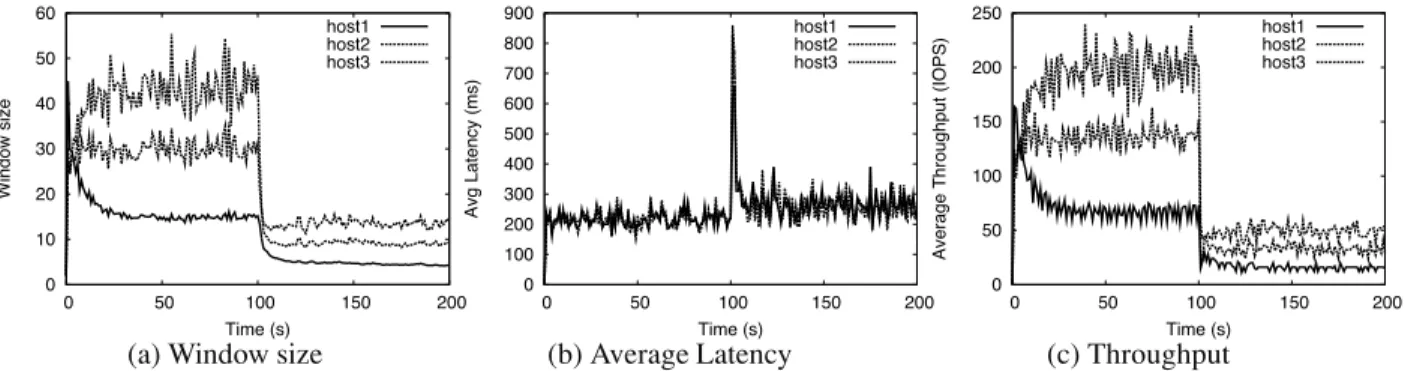
To test the algorithm’s adaptability, we experimented with three hosts using a 1 : 2 : 3 share ratio,L = 200 ms, and an array capacity that changes from 400 req/s to 100 req/s halfway through the experiment. Figure 2 plots the through-put, window size and average latency observed by the hosts for a period of 200 seconds. As expected, the control al-gorithm drives the system to operate close to the desired
0 10 20 30 40 50 60 0 50 100 150 200 Window size Time (s) host1 host2 host3 0 100 200 300 400 500 600 700 800 900 0 50 100 150 200 Avg Latency (ms) Time (s) host1 host2 host3 0 50 100 150 200 250 0 50 100 150 200
Average Throughput (IOPS)
Time (s) host1 host2 host3
(a) Window size (b) Average Latency (c) Throughput
Figure 2:Simulation of three hosts with 1 : 2 : 3 share ratio. Array capacity is reduced from 400 to 100 req/s att= 100 s.
latency thresholdL. We also used the simulator to verify
that asL is varied (100 ms, 200 ms and 300 ms), the
sys-tem latencies operate close toL, and that windows sizes
increase while maintaining their proportional ratio.
3.3 End-to-End Support
PARDA flow control ensures that each host obtains a fair share of storage array capacity proportional to its IO shares. However, our ultimate goal for storage resource manage-ment is to provide control over service rates for the appli-cations running in VMs on each host. We use a fair queu-ing mechanism based on SFQ [10] for our host-level sched-uler. SFQ implements proportional-sharing of the host’s is-sue queue, dividing it among VMs based on their IO shares when there is contention for the host-level queue.
Two key features of the local scheduler are worth noting. First, the scheduler doesn’t strictly partition the host-level queue among VMs based on their shares, allowing them to consume additional slots that are left idle by other VMs which didn’t consume their full allocation. This handles short-term fluctuations in the VM workloads, and provide some statistical multiplexing benefits. Second, the sched-uler doesn’t switch between VMs after every IO, instead scheduling a group of IOs per VM as long as they exhibit some spatial locality (within a few MB). These techniques have been shown to improve overall IO performance [3,13]. Combining a distributed flow control mechanism with a fair local scheduler allows us to provide end-to-end IO al-locations to VMs. However, an interesting alternative is to apply PARDA flow control at the VM level, using per-VM latency measurements to control per-VM window sizes di-rectly, independent of how VMs are mapped to hosts. This approach is appealing, but it also introduces new challenges that we are currently investigating. For example, per-VM allocations may be very small, requiring new techniques to support fractional window sizes, as well as efficient dis-tributed methods to compensate for short-term burstiness.
3.4 Handling Bursts
A well-known characteristic of many IO workloads is a bursty arrival pattern—fluctuating resource demand due to device and application characteristics, access locality, and other factors. A high degree of burstiness makes it difficult to provide low latency and achieve proportionate allocation. In our environment, bursty arrivals generally occur at two distinct time scales: systematic long-term ON-OFF be-havior of VMs, and sudden short-term spikes in IO work-loads. To handle long-term bursts, we modify theβ value for a host based on the utilization of queue slots by its resi-dent VMs. Recall that the host-level parameterβ is propor-tional to the sum of shares of all VMs (ifsi are the shares assigned to VMi, then for hosth,βh=K×∑isi, whereK is a normalization constant).
To adjustβ, we measure the average number of outstand-ing IOs per VM,nk, and each VM’s share of its host window size aswk, expressed as:
wk=∑isks
iw(t) (4)
If (nk < wk), we scale the shares of the VM to be s′
i = nk × sk/wkand use this to calculateβ for the host. Thus if a VM is not fully utilizing its window size, we re-duce theβ value of its host, so other VMs on the same host do not benefit disproportionately due to the under-utilized shares of a colocated idle VM. In general, when one or more VMs become idle, the control mechanism will allow all hosts (and thus all VMs) to proportionally increase their window sizes and exploit the spare capacity.
For short-term fluctuations, we use a burst-aware local scheduler. This scheduler allows VMs to accumulate a bounded number of credits while idle, and then schedule requests in bursts once the VM becomes active. This also improves overall IO efficiency, since requests from a single VM typically exhibit some locality. A number of schedulers support bursty allocations [6, 13, 22]. Our implementation uses SFQ as the local scheduler, but allows a bounded num-ber of IOs to be batched from each VM instead of switching among VMs purely based on their SFQ request tags.
4 Storage-Specific Challenges
Storage devices are stateful and their throughput can be quite variable, making it challenging to apply the latency-based flow control approaches used in networks. Equilib-rium may not be reached if different hosts observe very dif-ferent latencies during overload. Next we discuss three key issues to highlight the differences between storage and net-work service times.
Request Location. It is well known that the latency of a
request can vary from a fraction of a millisecond to tens of milliseconds, based on its location compared to previous re-quests, as well as caching policies at the array. Variability in seek and rotational delays can cause an order of magnitude difference in service times. This makes it difficult to esti-mate the baseline IO latency corresponding to the latency with no queuing delay. Thus a sudden change in average la-tency or in the ratio of current values to the previous average may or may not be a signal for overload. Instead, we look at average latency values in comparison to a latency thresh-oldL to predict congestion. The assumption is that
laten-cies observed during congestion will have a largequeuing delaycomponent, outweighing increases due to workload changes (e.g., sequential to random).
Request Type. Write IOs are often returned to the host
once the block is written in the controller’s NVRAM. Later, they are flushed to disk during the destage process. How-ever, read IOs may need to go to disk more often. Similarly, two requests from a single stream may have widely vary-ing latencies if one hits in the cache and the other misses. In certain RAID systems [5], writes may take four times longer than reads due to parity reads and updates. In gen-eral, IOs from a single stream may have widely-varying re-sponse times, affecting the latency estimate. Fortunately, a moving average over a sufficiently long period can absorb such variations and provide a more consistent estimate.
IO Size. Typical storage IO sizes range from 512 bytes to
256 KB, or even 1 MB for more recent devices. The estima-tor needs to be aware of changing IO size in the workload. This can be done by computing latency per 8 KB instead of latency per IO using a linear model with certain fixed costs. Size variance is less of an issue in networks since most packets are broken into MTU-size chunks (typically 1500 bytes) before transmission.
All of these issues essentially boil down to the problem of estimating highly-variable latency and using it as an in-dicator of array overload. We may need to distinguish be-tween latency changes caused by workload versus those due to the overload at the array. Some of the variation in IO la-tency can be absorbed by long-term averaging, and by con-sidering latency per fixed IO size instead of per IO request. Also, a sufficiently high baseline latency (the desired
oper-ating point for the control algorithm,L) will be insensitive
to workload-based variations in under-utilized cases.
4.1 Distributed Implementation Issues
We initially implemented PARDA in a completely dis-tributed manner, where each host monitored only its own IO latency to calculateL(t) for Equation 2 (referred to as local latency estimation). However, despite the use of av-eraging, we found that latencies observed at different hosts were dependent on block-level placement.
We experimented with four hosts, each running one Win-dows Server 2003 VM configured with a 16 GB data disk created as a contiguous file on the shared LUN. Each VM also has a separate 4 GB system disk. The storage array was an EMC CLARiiON CX3-40 (same hardware setup as in Section 5). Each VM executed a 16 KB random read IO workload. Running without any control algorithm, we no-ticed that the hosts observed average latencies of 40.0, 34.5, 35.0 and 39.5 ms, respectively. Similarly, the throughput observed by the hosts were 780, 910, 920 and 800 IOPS re-spectively. Notice that hosts two and three achieved better IOPS and lower latency, even though all hosts were issuing exactly the same IO pattern.
We verified that this discrepancy is explained by place-ment: the VM disks (files) were created and placed in or-der on the unor-derlying device/LUN, and the middle two vir-tual disks exhibited better performance compared to the two outer disks. We then ran the control algorithm with latency thresholdL = 30 ms and equalβ for all hosts. Figure 3
plots the computed window size, latency and throughput over a period of time. The discrepancy in latencies observed across hosts leads to divergence in the system. When hosts two and three observe latencies smaller thanL, they
in-crease their window size, whereas the other two hosts still see latencies higher thanL, causing further window size
decreases. This undesirable positive feedback loop leads to a persistent performance gap.
To validate that this effect is due to block placement of VM disks and array level scheduling, we repeated the same experiment using a single 60 GB shared disk. This disk file was opened by all VMs using a “multi-writer” mode. Without any control, all hosts observed a through-put of∼790 IOPS and latency of 39 ms. Next we ran with PARDA on the shared disk, again using equalβandL =30
ms. Figure 4 shows that the window sizes of all hosts are reduced, and the cluster-wide latency stays close to 30 ms.
This led us to conclude that, at least for some disk sub-systems, latency observations obtained individually at each host for its IOs are a fragile metric that can lead to diver-gences. To avoid this problem, we instead implemented a robust mechanism that generates a consistent signal for con-tention in the entire cluster, as discussed in the next section.
0 5 10 15 20 25 30 35 0 50 100 150 200 Window Size Time (s) Host 1 Host 2 Host 3 Host 4 0 5 10 15 20 25 30 35 40 45 0 50 100 150 200 Latency (ms) Time (s) Host 1 Host 2 Host 3 Host 4 0 200 400 600 800 1000 20 40 60 80 100 120 140 160 180 200 Throughput (IOPS) Time (s) Host 1 Host 2 Host 3 Host 4
(a) Window Size (b) Latency (ms) (c) Throughput (IOPS)
Figure 3:LocalL(t) Estimation. Separate VM disks cause window size divergence due to block placement and unfair array scheduling.
0 5 10 15 20 25 30 35 0 50 100 150 200 Window Size Time (s) Host 1 Host 2 Host 3 Host 4 0 5 10 15 20 25 30 35 40 45 0 50 100 150 200 Latency (ms) Time (s) Host 1 Host 2 Host 3 Host 4 0 200 400 600 800 1000 20 40 60 80 100 120 140 160 180 200 Throughput (IOPS) Time (s) Host 1 Host 2 Host 3 Host 4
(a) Window Size (b) Latency (ms) (c) Throughput (IOPS)
Figure 4:LocalL(t) Estimation. VMs use same shared disk, stabilizing window sizes and providing more uniform throughput and latency.
4.2 Latency Aggregation
After experimenting with completely decentralized ap-proaches and encountering the divergence problem detailed above, we implemented a more centralized technique to compute cluster-wide latency as a consistent signal. The ag-gregation doesn’t need to be very accurate, but it should be reasonably consistent across hosts. There are many ways to perform this aggregation, including approximations based on statistical sampling. We discuss two different techniques that we implemented for our prototype.
Network-Based Aggregation. Each host uses a UDP
socket to listen for statistics advertised by other hosts. The statistics include the average latency and number of IOs per LUN. Each host either broadcasts its data on a common sub-net, or sends it to every other host individually. This is an instance of the general average- and sum-aggregation prob-lem for which multicast-based solutions also exist [29].
Filesystem-Based Aggregation. Since we are trying to
control access to a shared filesystem volume (LUN), it is convenient to use the same medium to share the latency statistics among the hosts. We implement a shared file per volume, which can be accessed by multiple hosts simulta-neously. Each host owns a single block in the file and peri-odically writes its average latency and number of IOs for the LUN into that block. Each host reads that file periodically using a single large IO and locally computes the cluster-wide average to use for window size estimation.
In our experiments, we have not observed extremely high variance across per-host latency values, although this seems possible if some workloads are served primarily from the storage array’s cache. In any case, we do not anticipate that this would affect PARDA stability or convergence.
5 Experimental Evaluation
In this section, we present the results from a detailed evaluation of PARDA in a real system consisting of up to eight hosts accessing a shared storage array. Each host is a Dell Poweredge 2950 server with 2 Intel Xeon 3.0 GHz dual-core processors, 8 GB of RAM and two Qlogic HBAs connected to an EMC CLARiiON CX3-40 storage array over a Fibre Channel SAN. The storage volume is hosted on a 10-disk RAID-5 disk group on the array.
Each host runs the VMware ESX Server hypervisor [24] with a local instance of the distributed flow control al-gorithm. The aggregation of average latency uses the filesystem-based implementation described in Section 4.2, with a two-second update period. All PARDA experiments used the smoothing parametersα=0.002 andγ=0.8.
Our evaluation consists of experiments that examine five key questions: (1) How does average latency vary with changes in workload? (2) How does average latency vary with load at the array? (3) Can the PARDA algorithm adjust issue queue lengths based on per-host latencies to provide differentiated service? (4) How well can this mechanism
handle bursts and idle hosts? (5) Can we provide end-end IO differentiation using distributed flow control to-gether with a local scheduler at each host?
Our first two experiments determine whether average la-tency can be used as a reliable indicator to detect overload at the storage array, in the presence of widely-varying work-loads. The third explores how effectively our control mod-ule can adjust host queue lengths to provide coarse-grained fairness. The remaining experiments examine how well PARDA can deal with realistic scenarios that include work-load fluctuations and idling, to provide end-to-end fairness to VMs. Throughout this section, we will provide data using a variety of parameter settings to illustrate the adaptability and robustness of our algorithm.
5.1 Latency vs. Workload
4 32 64 128 100 80 60 40 20 0 0 5 10 15 20 25 30 35 40 Size (KB) %RandI/O Size vs. Sequentiality
Latency (ms)
Figure 5:Latency as a function of IO size and sequentiality.
We first consider a single host running one VM execut-ing different workloads, to examine the variation in average latency measured at the host. A Windows Server 2003 VM runningIometer[1] is used to generate each workload, con-figured to keep 8 IOs pending at all times.
We varied three workload parameters: reads – 0 to 100%, IO size – 4, 32, 64, and 128 KB, and sequentiality – 0 to 100%. For each combination, we measured throughput, bandwidth, and the average, min and max latencies.
Over all settings, the minimum latency was observed for the workload consisting of 100% sequential 4 KB reads, while the maximum occurred for 100% random 128 KB writes. Bandwidth varied from 8 MB/s to 177 MB/s. These results show that bandwidth and latency can vary by more than a factor of 20 due solely to workload variation.
Figure 5 plots the average latency (in ms) measured for a VM while varying IO size and degree of sequentiality. Due to space limitations, plots for other parameters have been omitted; additional results and details are available in [11].
There are two main observations: (1) the absolute la-tency value is not very high for any configuration, and (2) latency usually increases with IO size, but the slope is small because transfer time is usually dominated by seek and
0 10 20 30 40 50 60 1 2 3 4 5 Overall B/W (MB/s) Number of Hosts 0 10 20 30 40 50 1 2 3 4 5 Average Latency (ms) Number of Hosts (a) Aggregate Bandwidth (MB/s) (b) Average Latency (ms)
Figure 6: Overall bandwidth and latency observed by multiple
hosts as the number of hosts is increased from 1 to 5.
Workload Phase1 Phase2
Size Read Random Q T L Q T L
16K 70% 60% 32 1160 26 16 640 24
16K 100% 100% 32 880 35 32 1190 27
8K 75% 0% 32 1280 25 16 890 17
8K 90% 100% 32 900 36 32 1240 26
Table 2:Throughput (TIOPS) and latencies (Lms) observed by
four hosts for different workloads and queue lengths (Q).
tational delays. This suggests that array overload can be detected by using a fairly high latency threshold value.
5.2 Latency vs. Queue Length
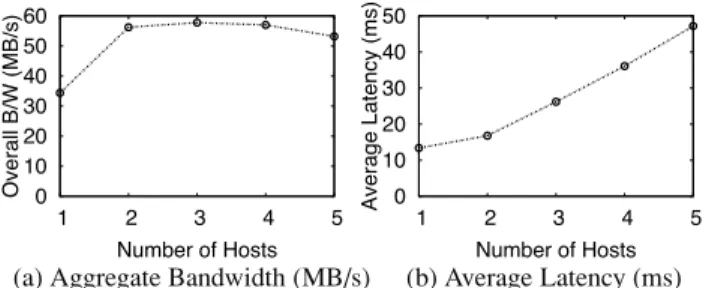
Next we examine how IO latency varies with increases in overall load (queue length) at the array. We experimented with one to five hosts accessing the same array. Each host generates a uniform workload of 16 KB IOs, 67% reads and 70% random, keeping 32 IOs outstanding. Figure 6 shows the aggregate throughput and average latency ob-served in the system, with increasing contention at the array. Throughput peaks at three hosts, but overall latency contin-ues to increase with load. Ideally, we would like to operate at the lowest latency where bandwidth is high, in order to fully utilize the array without excessive queuing delay.
For uniform workloads, we also expect a good correla-tion between queue size and overall throughput. To verify this, we configured seven hosts to access a 400 GB volume on a 5-disk RAID-5 disk group. Each host runs one VM with an 8 GB virtual disk. We report data for a workload of 32 KB IOs with 67% reads, 70% random and 32 IOs pending. Figure 7 presents results for two different static host-level window size settings: (a) 32 for all hosts and (b) 16 for hosts 5, 6 and 7.
We observe that the VMs on the throttled hosts receive approximately half the throughput (∼42 IOPS) compared to other hosts (∼85 IOPS) and their latency (∼780 ms)
is doubled compared to others (∼360 ms). Their reduced
performance is a direct result of throttling, and the increased latency arises from the fact that a VM’s IOs were queued at its host. The device latency measured at the hosts (as op-posed to in the VM, which would include time spent in host queues) is similar for all hosts in both experiments. The
VM 1 VM 2 VM 3 VM 4 VM 5 VM 6 VM 7 0 50 100 150 200 250 300 350 400 450 500 Q = 32 Q = 16 for Hosts 5−7 IOPS VM 1 VM 2 VM 3 VM 4 VM 5 VM 6 VM 7 0 100 200 300 400 500 600 700 800 900 Q = 32 Q = 16 for Hosts 5−7 Latency (ms)
(a) Average IOPS (b) Average latency (ms)
Figure 7:VM bandwidth and latency observed when queue lengthQ=32 for all hosts, and whenQ=16 for some hosts.
overall latency decreases when one or more hosts are throt-tled, since there is less load on the array. For example, in the second experiment, the overall average latency changes
from∼470 ms at each host to∼375 ms at each host when
the window size is 16 for hosts 5, 6, and 7.
We also experimented with four hosts sending different workloads to the array while we varied their queue lengths in two phases. Table 2 reports the workload description and corresponding throughput and latency values observed at the hosts. In phase 1, each host has a queue length of 32 while in phase 2, we lowered the queue length for two of the hosts to 16. This experiment demonstrates two impor-tant properties. First, overall throughput reduces roughly in proportion to queue length. Second, if a host is receiving
higher throughput at some queue lengthQdue to its
work-load being treated preferentially, then even for a smaller queue length Q/2, the host still obtains preferential
treat-ment from the array. This is desirable because overall effi-ciency is improved by giving higher throughput to request streams that are less expensive for the array to process.
5.3 PARDA Control Method
In this section, we evaluate PARDA by examining fair-ness, latency threshold effects, robustness with non-uniform workloads, and adaptation to capacity changes.
5.3.1 Fairness
We experimented with identical workloads accessing 16 GB virtual disks from four hosts with equalβ values. This is similar to the setup that led to divergent behavior in Fig-ure 3. Using our filesystem-based aggregation, PARDA converges as desired, even in the presence of different la-tency values observed by hosts. Table 3 presents results for this workload without any control, and with PARDA using equal shares for each host; plots are omitted due to space constraints. With PARDA, latencies drop, making the over-all average close to the targetL. The aggregate throughput
achieved by all hosts is similar with and without PARDA, exhibiting good work-conserving behavior. This demon-strates that the algorithm works correctly in the simple case of equal shares and uniform workloads.
Uncontrolled PARDAL = 30 ms
Host IOPS Latency (ms) β IOPS Latency (ms)
1 780 41 1 730 34
2 900 34 1 890 29
3 890 35 1 930 29
4 790 40 1 800 33
Aggregate 3360 Avg = 37 3350 Avg = 31
Table 3:Fairness with 16 KB random reads from four hosts.
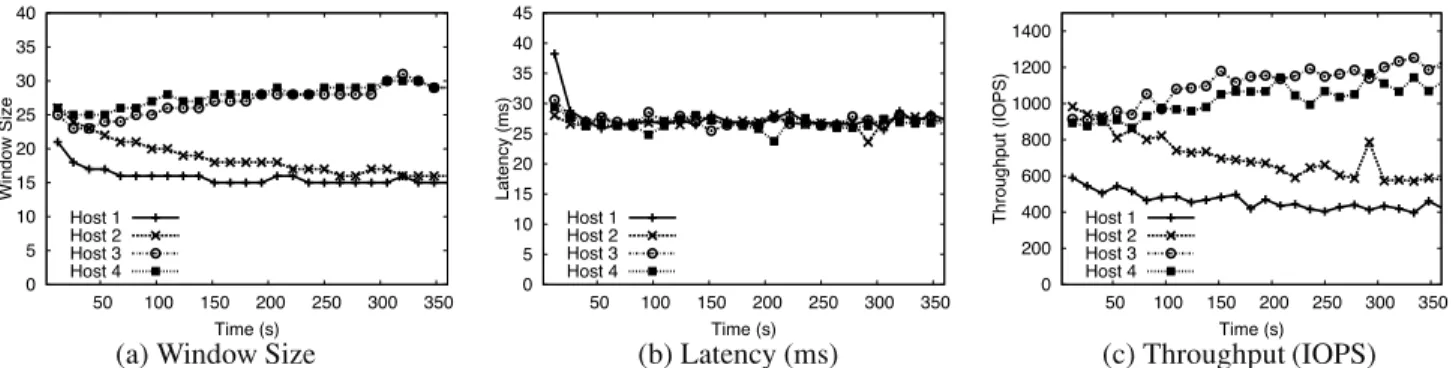
Next, we experimented with a share ratio of 1 : 1 : 2 : 2
for four hosts, setting L = 25 ms, shown in Figure 8.
PARDA converges on windows sizes for hosts 1 and 2 that are roughly half those for hosts 3 and 4, demonstrating good fairness. The algorithm also successfully converges laten-cies toL. Finally, the per-host throughput levels achieved
while running this uniform workload also roughly match the specified share ratio. The remaining differences are due to some hosts obtaining better throughput from the array, even with the same window size. This reflects the true IO costs as seen by the array scheduler; since PARDA operates on window sizes, it maintains high efficiency at the array.
5.3.2 Effect of Latency Threshold
Recall thatL is the desired latency value at which the array
provides high throughput but small queuing delay. Since
PARDA tries to operate close toL, an administrator can
control the overall latencies in a cluster, bounding IO times for latency-sensitive workloads such as OLTP. We investi-gated the effect of the threshold setting by running PARDA with differentL values. Six hosts access the array
concur-rently, each running a VM with a 16 GB disk performing 16 KB random reads with 32 outstanding IOs.
Host IOPS Latency (ms) Host IOPS Latency (ms)
1 525 59 4 560 57
2 570 55 5 430 77
3 570 55 6 500 62
Table 4:Uncontrolled 16 KB random reads from six hosts.
We first examine the throughput and latency observed in the uncontrolled case, presented in Table 4. In Figure 9,
we enable the control algorithm withL = 30 ms and equal
0 5 10 15 20 25 30 35 40 50 100 150 200 250 300 350 Window Size Time (s) Host 1 Host 2 Host 3 Host 4 0 5 10 15 20 25 30 35 40 45 50 100 150 200 250 300 350 Latency (ms) Time (s) Host 1 Host 2 Host 3 Host 4 200 0 400 600 800 1000 1200 1400 50 100 150 200 250 300 350 Throughput (IOPS) Time (s) Host 1 Host 2 Host 3 Host 4
(a) Window Size (b) Latency (ms) (c) Throughput (IOPS)
Figure 8:PARDA Fairness. Four hosts each run a 16 KB random read workload withβvalues of 1 : 1 : 2 : 2. Window sizes allocated by
PARDA are in proportion toβvalues, and latency is close to the specified thresholdL = 25 ms.
0 5 10 15 20 25 30 35 40 50 100 150 200 250 300 350 400 Window Size Time (s) VM1 stops VM2 stops VM3 stops Host 1 Host 2 Host 3 Host 4 Host 5 Host 6 0 10 20 30 40 50 60 50 100 150 200 250 300 350 400 Latency (ms) Time (s) Host 1 Host 2 Host 3 Host 4 Host 5 Host 6 200 0 400 600 800 1000 1200 1400 50 100 150 200 250 300 350 400 Throughput (IOPS) Time (s) VM1 stops VM2 stops VM3 stops Host 1 Host 2 Host 3 Host 4 Host 5 Host 6
(a) Window Size (b) Latency (ms) (c) Throughput (IOPS)
Figure 9:PARDA Adaptation. Six hosts each run a 16 KB random read workload, with equalβvalues andL = 30 ms. VMs are stopped
att= 145 s,t= 220 s andt= 310 s, and window sizes adapt to reflect available capacity.
andt = 310 s. Comparing the results we can see the effect of the control algorithm on performance. Without PARDA, the system achieves a throughput of 3130 IOPS at an aver-age latency of 60 ms. WithL = 30 ms, the system achieves
a throughput of 3150 IOPS, while operating close to the la-tency threshold. Other experiments with different threshold values, such as those shown in Figure 10 (L = 40 ms) and
Figure 12 (L = 25 ms), confirm that PARDA is effective at
maintaining latencies nearL.
These results demonstrate that PARDA is able to con-trol latencies by throttling IO from hosts. Note the different window sizes at which hosts operate for different values of
L. Figure 9(a) also highlights the adaptation of window
sizes, as more capacity becomes available at the array when VMs are turned off at various points in the experiment. The ability to detect capacity changes through changes in la-tency is an important dynamic property of the system.
5.3.3 Non-Uniform Workloads
To test PARDA and its robustness with mixed workloads, we ran very different workload patterns at the same time from our six hosts. Table 5 presents the uncontrolled case.
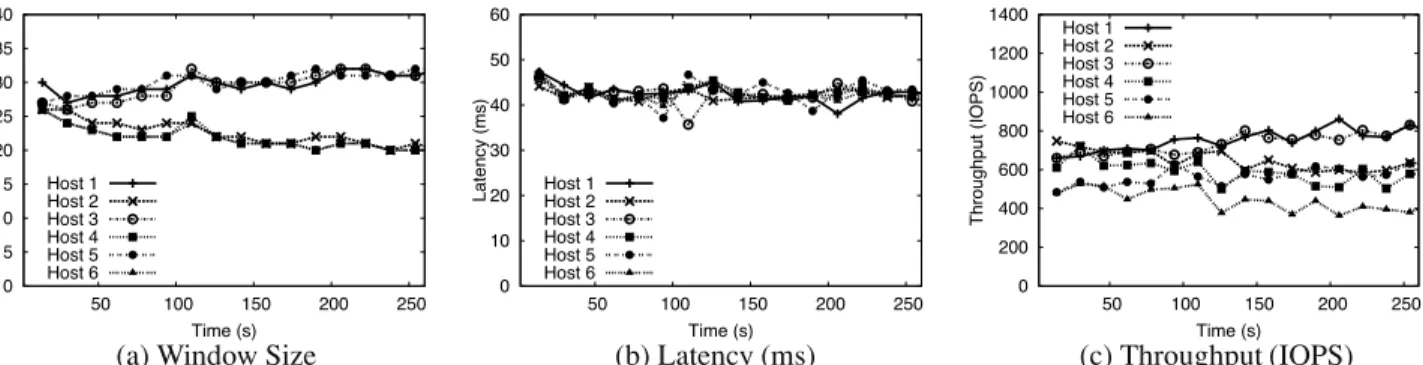
Next, we enable PARDA withL = 40 ms, and assign
shares in a 2 : 1 : 2 : 1 : 2 : 1 ratio for hosts 1 through 6 re-spectively, plotted in Figure 10. Window sizes are differen-tiated between hosts with different shares. Hosts with more
Host Size Read Random IOPS Latency (ms)
1 4K 100% 100% 610 51 2 8K 50% 0% 660 48 3 8K 100% 100% 630 50 4 8K 67% 60% 670 47 5 16K 100% 100% 490 65 6 16K 75% 70% 520 60
Table 5:Uncontrolled access by mixed workloads from six hosts.
shares reach a window size of 32 (the upper bound,wmax) and remain there. Other hosts have window sizes close to 19. The average latency observed by the hosts remains close toL, as shown in Figure 10(b). The throughput observed
by hosts follows roughly the same pattern as window sizes, but is not always proportional because of array scheduling and block placement issues. We saw similar adaptation in window sizes and latency when we repeated this experiment usingL = 30 ms (plots omitted due to space constraints).
5.3.4 Capacity Changes
Storage capacity can change dramatically due to workload changes or array accesses by uncontrolled hosts external to PARDA. We have already demonstrated in Section 5.3.2 that our approach is able to absorb any spare capacity that becomes available. To test the ability of the control algo-rithm to handle decreases in capacity, we conducted an ex-periment starting with the first five hosts from the previous
0 5 10 15 20 25 30 35 40 50 100 150 200 250 Window Size Time (s) Host 1 Host 2 Host 3 Host 4 Host 5 Host 6 0 10 20 30 40 50 60 50 100 150 200 250 Latency (ms) Time (s) Host 1 Host 2 Host 3 Host 4 Host 5 Host 6 200 0 400 600 800 1000 1200 1400 50 100 150 200 250 Throughput (IOPS) Time (s) Host 1 Host 2 Host 3 Host 4 Host 5 Host 6
(a) Window Size (b) Latency (ms) (c) Throughput (IOPS)
Figure 10:Non-Uniform Workloads. PARDA control withL= 40 ms. Six hosts run mixed workloads, withβvalues 2 : 1 : 2 : 1 : 2 : 1.
0 5 10 15 20 25 30 35 40 50 100 150 200 250 300 350 Window Size Time (s) External load at t=230s Host 1 Host 2 Host 3 Host 4 Host 5 0 5 10 15 20 25 30 35 40 45 50 100 150 200 250 300 350 Latency (ms) Time (s) Host 1 Host 2 Host 3 Host 4 Host 5 0 500 1000 1500 2000 50 100 150 200 250 300 350 Throughput (IOPS) Time (s) Host 1 Host 2 Host 3 Host 4 Host 5
(a) Window Size (b) Latency (ms) (c) Throughput (IOPS)
Figure 11:Capacity Fluctuation. Uncontrolled external host added att= 230 s. PARDA-controlled hosts converge to new window sizes.
experiment. At timet= 230 s, we introduce a sixth host that is not under PARDA control. This uncontrolled host runs a Windows Server 2003 VM issuing 16 KB random reads to a 16 GB virtual disk located on the same LUN as the others. WithL = 30 ms and a share ratio of 2 : 2 : 1 : 1 : 1 for
the PARDA-managed hosts, Figure 11 plots the usual met-rics over time. Att = 230 s, the uncontrolled external host starts, thereby reducing available capacity for the five con-trolled hosts. The results indicate that as capacity changes, the hosts under control adjust their window sizes in propor-tion to their shares, and observe latencies close toL.
5.4 End-to-End Control
We now present an end-to-end test where multiple VMs run a mix of realistic workloads with different shares. We use Filebench [20], a well-known IO modeling tool, to gener-ate an OLTP workload similar to TPC-C. We employ four VMs running Filebench, and two generating 16 KB random reads. A pair of Filebench VMs are placed on each of two hosts, whereas the micro-benchmark VMs occupy one host each. This is exactly the same experiment discussed in Sec-tion 2; data for the uncontrolled baseline case is presented in Table 1. Recall that without PARDA, hosts 1 and 2 obtain similar throughput even though the overall sum of their VM shares is different. Table 6 provides setup details and reports data using PARDA control. Results for the OLTP VMs are presented as Filebench operations per second (Ops/s).
Host VM Type s1, s2 βh VM1 VM2 Th
1 2×OLTP 20, 10 6 1266 Ops/s 591 Ops/s 1857 2 2×OLTP 10, 10 4 681 Ops/s 673 Ops/s 1316 3 1×Micro 20 4 740 IOPS n/a 740 4 1×Micro 10 2 400 IOPS n/a 400
Table 6: PARDA end-to-end control for Filebench OLTP and
micro-benchmark VMs issuing 16 KB random reads. Configured shares (si), host weights (βh), Ops/s for Filebench VMs and IOPS
(Thfor hosts) are respected across hosts.L= 25 ms,wmax= 64.
We run PARDA (L = 25 ms) with host weights (βh) set
according to shares of their VMs (βh=6 : 4 : 4 : 2 for hosts 1 to 4). The maximum window sizewmaxis 64 for all hosts. The OLTP VMs on host 1 receive 1266 and 591 Ops/s, matching their 2 : 1 share ratio. Similarly, OLTP VMs on host 2 obtain 681 and 673 Ops/s, close to their 1 : 1 share ratio. Note that the overall Ops/s for hosts 1 and 2 have a 3 : 2 ratio, which is not possible in an uncontrolled scenario. Figure 12 plots the window size, latency and throughput ob-served by the hosts. We note two key properties: (1) win-dow sizes are in proportion to the overallβ values and (2) each VM receives throughput in proportion to its shares. This shows that PARDA provides the strong property of enforcing VM shares, independent of their placement on hosts. The local SFQ scheduler divides host-level capacity across VMs in a fair manner, and together with PARDA, is able to provide effective end-to-end isolation among VMs. We also modified one VM workload during the experiment
0 10 20 30 40 50 60 70 50 100 150 200 250 300 350 Window Size Time (s) OLTP (host 1) stops
OLTP (host 1) starts Host 1 (Beta = 6) Host 2 (Beta = 4) Host 3 (Beta = 4) Host 4 (Beta = 2) 0 5 10 15 20 25 30 35 40 45 50 100 150 200 250 300 350 Latency (ms) Time (s) Host 1 Host 2 Host 3 Host 4 0 500 1000 1500 2000 2500 50 100 150 200 250 300 350 Throughput (IOPS) Time (s) Host 1 Host 2 Host 3 Host 4
(a) Window Size (b) Latency (ms) (c) Throughput (IOPS)
Figure 12:PARDA End-to-End Control. VM IOPS are proportional to shares. Host window sizes are proportional to overallβvalues.
0 1 2 3 4 5 6 7 50 100 150 200 250 300 350 Beta Values Time (s) Host 1 Host 2 Host 3 Host 4
Figure 13:Handling Bursts. One OLTP workload on host 1 stops
att= 140 s and restarts att= 310 s. Theβof host 1 is adjusted and window sizes are recomputed using the newβvalue. to test our burst-handling mechanism, which we discuss in the next section.
5.5 Handling Bursts
Earlier we showed that PARDA maintains high utilization of the array even when some hosts idle, by allowing other hosts to increase their window sizes. However, if one or moreVMsbecome idle, the overallβ of the host must be adjusted, so that backlogged VMs on the same host don’t obtain an unfair share of the current capacity. Our imple-mentation employs the technique described in Section 3.4.
We experimented with dynamically idling one of the OLTP VM workloads running on host 1 from the previous experiment presented in Figure 12. The VM workload is stopped att = 140 s and resumed att = 310 s. Figure 13 shows that the β value for host 1 adapts quickly to the change in the VM workload. Figure 12(a) shows that the window size begins to decrease according to the modified lower value ofβ=4 starting fromt= 140 s. Byt= 300 s, window sizes have converged to a 1 : 2 ratio, in line with ag-gregate host shares. As the OLTP workload becomes active again, the dynamic increase in theβof host 1 causes its win-dow size to grow. This demonstrates that PARDA ensures fairness even in the presence of non-backlogged workloads, a highly-desirable property for shared storage access.
Uncontrolled PARDA HostVM Type OPM Avg Lat Th, Lh βh OPM Avg Lat
1 SQL1 8799 213 615, 20.4 1 6952 273 2 SQL2 8484 221 588, 20.5 4 12356 151
Table 7: Two SQL Server VMs with 1 : 4 share ratio,
run-ning with and without PARDA. Host weights (βh) and OPM
(or-ders/min), IOPS (Thfor hosts) and latencies (Avg Latfor database
operations,Lhfor hosts, in ms).L= 15 ms,wmax= 32.
5.6 Enterprise Workloads
To test PARDA with more realistic enterprise workloads, we experimented with two Windows Server 2003 VMs, each running a Microsoft SQL Server 2005 Enterprise Edi-tion database. Each VM is configured with 4 virtual CPUs, 6.4 GB of RAM, a 10 GB system disk, a 250 GB database disk, and a 50 GB log disk. The database virtual disks are hosted on an 800 GB RAID-0 LUN with 6 disks; log vir-tual disks are placed on a 100 GB RAID-0 LUN with 10 disks. We used the Dell DVD store (DS2) database test suite, which implements a complete online e-commerce ap-plication, to stress the SQL databases [7]. We configured a 15 ms latency threshold, and ran one VM per host, assign-ing shares in a 1 : 4 ratio.
Table 7 reports the parameters and the overall applica-tion performance for the two SQL Server VMs. Without PARDA, both VMs have similar performance in terms of both orders per minute (OPM) and average latency. When running with PARDA, the VM with higher shares obtains roughly twice the OPM throughput and half the average la-tency. The ratio isn’t 1 : 4 because the workloads are not always backlogged, and the VM with higher shares can’t keep its window completely full.
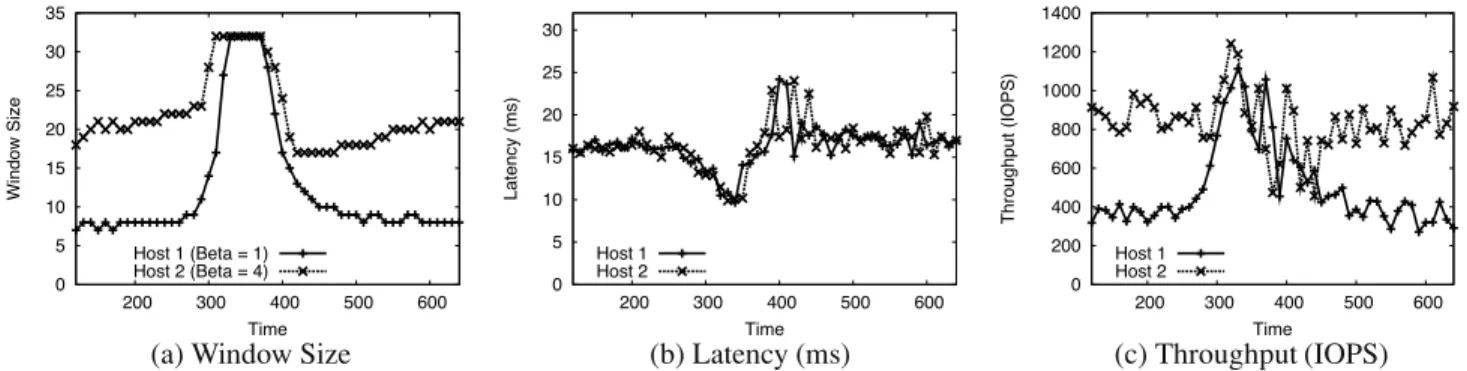
Figure 14 plots the window size, latency and through-put observed by the hosts. As the overall latency decreases, PARDA is able to assign high window sizes to both hosts. When latency increases, the window sizes converge to be approximately proportional to the β values. Figure 15 shows theβ values for the hosts while the workload is run-ning, and highlights the fact that the SQL Server VM on host 2 cannot always maintain enough pending IOs to fill
0 5 10 15 20 25 30 35 200 300 400 500 600 Window Size Time Host 1 (Beta = 1) Host 2 (Beta = 4) 0 5 10 15 20 25 30 200 300 400 500 600 Latency (ms) Time Host 1 Host 2 200 0 400 600 800 1000 1200 1400 200 300 400 500 600 Throughput (IOPS) Time Host 1 Host 2
(a) Window Size (b) Latency (ms) (c) Throughput (IOPS)
Figure 14:Enterprise Workload. Host window sizes and IOPS for SQL Server VMs are proportional to their overallβvalues whenever
the array resources are contended. Betweent=300 s andt=380 s, hosts get larger window sizes since the array is not contended.
0 0.5 1 1.5 2 2.5 3 3.5 4 200 300 400 500 600 Beta Values Time (s) Host 1 Host 2
Figure 15: Dynamicβ Adjustment. β values for hosts running
SQL Server VMs fluctuate as pending IO counts change. its window. This causes the other VM on host 1 to pick up the slack and benefit from increased IO throughput.
6 Related Work
The research literature contains a large body of work re-lated to providing quality of service in both networks and storage systems, stretching over several decades. Numerous algorithms for network QoS have been proposed, including many variants of fair queuing [2, 8, 10]. However, these ap-proaches are suitable only in centralized settings where a single controller manages all requests for resources. Stoica proposed QoS mechanisms based on a stateless core [23], where only edge routers need to maintain per-flow state, but some minimal support is still required from core routers.
In the absence of such mechanisms, TCP has been serv-ing us quite well for both flow control and congestion avoid-ance. Commonly-deployed TCP variants use per-flow in-formation such as estimated round trip time and packet loss at each host to adapt per-flow window sizes to network con-ditions. Other proposed variants [9] require support from routers to provide congestion signals, inhibiting adoption.
FAST-TCP [15] provides a purely latency-based ap-proach to improving TCP’s throughput in high bandwidth-delay product networks. In this paper we adapt some of
the techniques used by TCP and its variants to perform flow control in distributed storage systems. In so doing, we have addressed some of the challenges that make it non-trivial to employ TCP-like solutions for managing storage IO.
Many storage QoS schemes have also been proposed to provide differentiated service to workloads accessing a sin-gle disk or storage array [4, 13, 14, 16, 25, 30]. Unfortu-nately, these techniques are centralized, and generally re-quire full control over all IO. Proportionate bandwidth allo-cation algorithms have also been developed for distributed storage systems [12, 26]. However, these mechanisms were designed for brick-based storage, and require each storage device to run an instance of the scheduling algorithm.
Deployments of virtualized systems typically have no control over storage array firmware, and don’t use a central IO proxy. Most commercial storage arrays offer only lim-ited, proprietary quality-of-service controls, and are treated as black boxes by the virtualization layer. Triage [18] is one control-theoretic approach that has been proposed for managing such systems. Triage periodically observes the utilization of the system and throttles hosts using band-width caps to achieve a specified share of available capacity. This technique may underutilize array resources, and relies on a central controller to gather statistics, compute an on-line system model, and re-assign bandwidth caps to hosts. Host-level changes must be communicated to the controller to handle bursty workloads. In contrast, PARDA only re-quires very light-weight aggregation and per-host measure-ment and control to provide fairness with high utilization.
Friendly VMs [31] propose cooperative fair sharing of CPU and memory in virtualized systems leveraging feedback-control models. Without relying on a centralized controller, each “friendly” VM adapts its own resource con-sumption based on congestion signals, such as the relative progress of its virtual time compared to elapsed real time, using TCP-like AIMD adaptation. PARDA applies similar ideas to distributed storage resource management.
7 Conclusions
In this paper, we studied the problem of providing coarse-grained fairness to multiple hosts sharing a single storage system in a distributed manner. We propose a novel software system, PARDA, which uses average latency as an indicator for array overload and adjusts per-host issue queue lengths in a decentralized manner using flow control.
Our evaluation of PARDA in a hypervisor shows that it is able to provide fair access to the array queue, control over-all latency close to a threshold parameter and provide high throughput in most cases. Moreover, combined with a local scheduler, PARDA is able to provide end-to-end prioritiza-tion of VM IOs, even in presence of variable workloads.
As future work, we are trying to integrate soft limits and reservations to provide a complete IO management frame-work. We would also like to investigate applications of PARDA to other non-storage systems where resource man-agement must be implemented in a distributed fashion.
Acknowledgements
Thanks to Tim Mann, Minwen Ji, Anne Holler, Neeraj Goyal, Narasimha Raghunandana and our shepherd Jiri Schindler for valuable discussions and feedback. Thanks also to Chethan Kumar for help with experimental setup.
References
[1] Iometer. http://www.iometer.org.
[2] BENNETT, J. C. R., AND ZHANG, H. WF2Q: Worst-case fair
weighted fair queueing. InProc. of IEEE INFOCOM ’96(March 1996), pp. 120–128.
[3] BRUNO, J., BRUSTOLONI, J., GABBER, E., OZDEN, B.,ANDSIL
-BERSCHATZ, A. Disk scheduling with quality of service guarantees. InProc. of the IEEE Int’l Conf. on Multimedia Computing and Sys-tems, Volume 2(1999), IEEE Computer Society.
[4] CHAMBLISS, D. D., ALVAREZ, G. A., PANDEY, P., JADAV, D., XU, J., MENON, R.,ANDLEE, T. P. Performance virtualization for large-scale storage systems. InSymposium on Reliable Distributed Systems(October 2003), pp. 109–118.
[5] CHEN, P. M., LEE, E. K., GIBSON, G. A., KATZ, R. H.,AND
PATTERSON, D. A. RAID: High-performance, reliable secondary storage.ACM Computing Surveys 26, 2 (1994).
[6] CRUZ, R. L. Quality of service guarantees in virtual circuit switched
networks.IEEE Journal on Selected Areas in Communications 13, 6 (1995), 1048–1056.
[7] DELL, INC. DVD Store. http://delltechcenter.com/page/DVD+store. [8] DEMERS, A., KESHAV, S.,ANDSHENKER, S. Analysis and simula-tion of a fair queuing algorithm.Journal of Internetworking Research and Experience 1, 1 (September 1990), 3–26.
[9] FLOYD, S.,ANDJACOBSON, V. Random early detection gateways for congestion avoidance. IEEE/ACM Transactions on Networking 1, 4 (1993), 397–413.
[10] GOYAL, P., VIN, H. M.,ANDCHENG, H. Start-time fair queue-ing: a scheduling algorithm for integrated services packet switching networks.IEEE/ACM Transactions on Networking 5, 5 (1997).
[11] GULATI, A.,ANDAHMAD, I. Towards distributed storage resource management using flow control. InProc. of First International Work-shop on Storage and I/O Virtualization, Performance, Energy, Eval-uation and Dependability(2008).
[12] GULATI, A., MERCHANT, A.,AND VARMAN, P. dClock: Dis-tributed QoS in heterogeneous resource environments. InProc. of ACM PODC (short paper)(August 2007).
[13] GULATI, A., MERCHANT, A.,ANDVARMAN, P. pClock: An ar-rival curve based approach for QoS in shared storage systems. In
Proc. of ACM SIGMETRICS(June 2007), pp. 13–24.
[14] HUANG, L., PENG, G.,ANDCHIUEH, T. Multi-dimensional stor-age virtualization. InProc. of ACM SIGMETRICS(June 2004). [15] JIN, C., WEI, D.,ANDLOW, S. FAST TCP: Motivation,
Architec-ture, Algorithms, Performance.Proceedings of IEEE INFOCOM ’04
(March 2004).
[16] JIN, W., CHASE, J. S.,ANDKAUR, J. Interposed proportional shar-ing for a storage service utility. InACM SIGMETRICS(June 2004). [17] JUMP, J. R. Yacsim reference manual. http://www.owlnet.rice.edu/
∼elec428/yacsim/yacsim.man.ps.
[18] KARLSSON, M., KARAMANOLIS, C.,ANDZHU, X. Triage: Per-formance differentiation for storage systems using adaptive control.
ACM Transactions on Storage 1, 4 (2005), 457–480.
[19] LUMB, C., MERCHANT, A.,ANDALVAREZ, G. Fac¸ade: Virtual storage devices with performance guarantees.Proc. of File and Stor-age Technologies (FAST)(March 2003).
[20] MCDOUGALL, R. Filebench: A prototype model based workload for file systems, work in progress. http://solarisinternals.com/si/tools/filebench/filebench nasconf.pdf. [21] POVZNER, A., KALDEWEY, T., BRANDT, S., GOLDING, R.,
WONG, T. M.,ANDMALTZAHN, C. Efficient guaranteed disk re-quest scheduling with Fahrrad.SIGOPS Oper. Syst. Rev. 42, 4 (2008), 13–25.
[22] SARIOWAN, H., CRUZ, R. L.,ANDPOLYZOS, G. C. Scheduling for quality of service guarantees via service curves. InProceedings of the International Conference on Computer Communications and Networks(1995), pp. 512–520.
[23] STOICA, I., SHENKER, S., ANDZHANG, H. Core-stateless fair queueing: A scalable architecture to approximate fair bandwidth al-locations in high speed networks. IEEE/ACM Transactions on Net-working 11, 1 (2003), 33–46.
[24] VMWARE, INC.Introduction to VMware Infrastructure. 2007. http: //www.vmware.com/support/pubs/.
[25] WACHS, M., ABD-EL-MALEK, M., THERESKA, E., AND
GANGER, G. R. Argon: performance insulation for shared stor-age servers. InProc. of File and Storage Technologies (FAST)(Feb 2007).
[26] WANG, Y.,ANDMERCHANT, A. Proportional-share scheduling for distributed storage systems. InProc. of File and Storage Technolo-gies (FAST)(Feb 2007).
[27] WONG, T. M., GOLDING, R. A., LIN, C.,ANDBECKER-SZENDY, R. A. Zygaria: Storage performance as a managed resource. InProc. of Real-Time and Embedded Technology and Applications Sympo-sium(April 2006), pp. 125–34.
[28] WU, J. C.,ANDBRANDT, S. A. The design and implementation of Aqua: an adaptive quality of service aware object-based storage device. InProc. of MSST(May 2006), pp. 209–18.
[29] YALAGANDULA, P. A scalable distributed information management system. InProc. of SIGCOMM(2004), pp. 379–390.
[30] ZHANG, J., SIVASUBRAMANIAM, A., WANG, Q., RISKA, A.,AND
RIEDEL, E. Storage performance virtualization via throughput and latency control. InProc. of MASCOTS(September 2005). [31] ZHANG, Y., BESTAVROS, A., GUIRGUIS, M., MATTA, I.,AND
WEST, R. Friendly virtual machines: leveraging a feedback-control model for application adaptation. InProc. of Intl. Conference on Virtual Execution Environments (VEE)(June 2005).