white paper
CLOUD: THE TOTAL
COST OF OPERATION
BUILDING THE BUSINESS
CASE FOR CHANGE
EXECUTIVE SUMMARY
Cloud computing is now an integral part of the government’s ICT Strategy offering the potential to deliver cost savings as well as agility, increased productivity and efficiency improvements. Public sector organisations are attracted by the potential to reduce costs and are also encouraged by policies such as Cloud First and Digital by Default to consider cloud when faced with new ICT requirements and when legacy infrastructure needs upgrading to meet demand or reaches end of life.
But in the face of increasing austerity, buying organisations need to demonstrate whether cloud really can deliver cost savings. Are the claims based on fact and can they be substantiated? Do they hold true when you compare the cost of meeting a
requirement using a traditional hosted solution to that of meeting the same requirement using the cloud? To accurately design and cost the correct ICT solution, one of the many complexities that buying organisations need to accurately predict or know is the demand that users and citizens will place on the application and exactly how that would vary over time, in order to ensure capacity to meet that predicted demand is in place. If the predicted demand is too high, infrastructure and resources will be under-utilised and investment wasted.
Conversely, if predicted workloads are too low, there will not be enough capacity to meet demand, hence performance and availability may suffer, and users will be frustrated.
Cloud solutions deliver maximum flexibility as resources can be provisioned on-demand to match requirements, and scaled up or down as and when those requirements change. True cloud providers offer consumption-based pricing so buying organisations pay only for what is used.
Taking all costs into account, in our experience, cloud computing will always deliver cost reductions whilst increasing both agility and availability. Other significant business benefits can also be realised by adopting cloud to include quicker and easier procurement, improved quality of service, increased staff productivity and greater security. When these additional soft benefits are considered alongside significant cost savings, the business case for implementing a cloud solution is not just strong but indisputable.
IN THIS WHITE PAPER
Government ICT procurement 3
When are cloud solutions appropriate? 5
Building the business case 8
Can cloud really reduce costs? 10 Assessing the potential cost savings of cloud 23
The soft benefits of cloud 24
But what about security? 26
GOVERNMENT ICT
PROCUREMENT
The government ICT Strategy1 sets out to deliver better public services for less cost, and
acknowledges that ICT can release savings by increasing public sector productivity and efficiency. A key aspect of the Strategy, cloud computing helps to deliver more dynamic and agile ICT solutions, and moves government towards common infrastructure and shared services. Following the ICT Strategy, a number of key programmes and policies were introduced to support the realisation of key objectives:
The G-Cloud programme — introduced to encourage adoption of cloud services by providing an Official Journal of the European Union (OJEU) compliant Framework that buying organisations can use to procure cloud services. The G-Cloud CloudStore is an online catalogue of the services available for purchase where orders can be placed and contracts raised online. The system enables buyers to easily compare and benchmark different options available. The G-Cloud programme aims to achieve annual savings of more than £120m and to account for at least half of all new central government ICT spend by 2015.
The Cloud First policy2— announced in May 2013 by the Cabinet Office to drive wideradoption of cloud computing by the public sector. In practice, Cloud First means that central government organisations should evaluate cloud solutions before they consider any other option. This approach is mandated to central
1
UK Government ICT Strategy:
https://www.gov.uk/government/publications/uk-government-ict-strategy-resources
2
Cloud First policy:
government and strongly recommended to the wider public sector. Departments remain free to choose an alternative to the cloud — but only if they can demonstrate that it offers better value for money.
Digital by Default — the Government Digital Strategy recognises that moving to digitalchannels could save up to £1.8bn a year. As part of the strategy, government departments are redesigning services that handle over 100,000 transactions each year. Between them, HM Revenue & Customs (HMRC), Department for Transport (DFT), Department for Work and Pensions (DWP), Ministry of Justice (MOJ), Department for Business, Innovation and Skills (BIS), Department for Environment, Food and Rural Affairs (Defra) and Home Office handle the majority of central government transactions. Each of these seven departments has agreed to three significant exemplar service
transformations with Cabinet Office. The redesigned services will be implemented by March 2015. In addition, all transactional services offered by all departments that will go live after April 2014 must also meet a new ‘digital by default’ service standard. Many digital
services depend on cloud computing because of the requirement for short procurement and quick deployment times, and its contribution to
Central government buying organisations driven by budget cuts and targets for increased productivity and efficiency alongside a requirement to adhere to the Cloud First policy are therefore considering cloud when they have a new ICT requirement. As these organisations adopt cloud services, they move away from traditional device-centric operating models and towards service-centric cloud options. This will enable them to start to realise the benefits of scalability and the ability to use resources on a subscription or utility basis, paying only for what they consume. This approach underpins the delivery of the substantial long-term cost savings that the ICT Strategy aims to realise.
However in adopting cloud, buying organisations are faced with the challenge of moving from a
procurement model they understand, and working with suppliers and services they know, towards using unfamiliar frameworks and cloud solutions offered by a myriad of cloud suppliers. How do they evaluate a cloud solution to see whether it can offer better value for money?
Every ICT procurement needs a valid business case, and cloud doesn't change that: requirements must be accurately specified and internal approvals obtained. But in order to build a business case, procurement and operational costs need to be understood, evaluated and included. Fundamentally, buying organisations need to understand whether a cloud solution is appropriate and really can deliver cost savings.
WHEN ARE CLOUD
SOLUTIONS APPROPRIATE?
When deciding whether a cloud solution meets the requirements of a specific application, buying organisations need to consider the different demand or workloads the application will generate — see examples below.
A 24x7 application with a spiky traffic
flow
To maintain service levels for a 24x7 application with a spiky traffic flow using an on-premises solution requires provisioning for the maximum peak in workload. However, it can be hard to predict this accurately: too high, and equipment will be under-used for a significant amount of time, as shown by the green shaded areas. Predict workloads too low (shown by the line in blue) and capacity will be insufficient to meet demand, service may become degraded and users (employees or citizens) will be dissatisfied.
With a cloud solution, capacity can be scaled up or down as required to meet traffic peaks, so that service is always available to users.
An application with steadily
increasing traffic
An on-premises solution built to accommodate an application's increasing workflow for up to five years will lead to years of under-utilisation of equipment. Deploying additional equipment each year to meet increased demand is an alternative approach, but involves significant capex and multiple procurements; and requires careful judgement about when to deploy new equipment to maintain service levels. Deploy too soon and expensive equipment will be underutilised. Deploy too late and there will not be capacity to meet demand, service performance may suffer and users will be disappointed.
A cloud solution offers capacity that scales rapidly to match demand plus the buying organisation only ever pays for the capacity used.
An application with a steady traffic
flow
When an application has a steady workload requirement, a buying organisation can order, pay for, install, configure and manage equipment to meet that predicted workflow. Accurately specifying the resources required calls for significant technical knowledge and experience — there is no margin for error. The predicted workload must be accurate in order for the buying organisation to be confident that service levels will be maintained and there is no room to flex if demands change. Predict the workload too high and resources will not be used to capacity, investment will be wasted here when it could have been better utilised elsewhere. Predict too low and there will not be enough resources in place to meet the workload, performance will be affected and users will be frustrated.
A cloud solution, on the other hand, offers flexibility over time. Some cloud providers offer discounts for committed consumption, which could offset any savings that may be associated with utilising existing/legacy infrastructure in favour of implementing a more flexible cloud solution.
An application with defined usage
periods
If an application has defined usage periods, such as working hours only (8x5) or a non-production environment required once a quarter, an in-house or hosted solution must be able to meet demand during usage periods; but will lie idle at all at other times. The buying organisation will need to accurately predict workloads during usage periods and will run the risk of not meeting demand if the workload predicted is too high. Conversely, if the predicted workload is too low, demand will not be met. A cloud solution provides the capacity to meet demand when required; while outside usage periods, the servers can be powered down. Because the buying organisation pays only for what it uses, there are no charges when the servers are off, significantly reducing costs. This type of workload can also be met by using an in-house solution provisioned to meet the mean workload (signified by the blue line) and then ‘bursting’ out to a cloud solution to meet demand above that mean.
Aggregated workflows operating over
a shared infrastructure
Buying organisations can rarely treat individual applications independently. Their ICT infrastructure must serve a wide range of departments and functions all using or providing a variety of
applications and services, each with very different workload patterns. When you combine these workloads, the aggregated usage becomes
extremely unpredictable with spikes in demand and constant fluctuations. Specifying resources to meet aggregated workflows is near impossible.
A cloud solution comes into its own when you consider aggregated workflows. Resources can be available as required to ensure performance is always maintained.
When you combine workloads,
aggregated usage becomes
extremely unpredictable and
specifying in-house resources
particularly challenging. This is when
a cloud solution comes into its own.
BUILDING THE
BUSINESS CASE
Buying organisations with an ICT requirement need to evaluate the different solutions available that will meet their technical requirements, address any legacy constraints and meet data confidentiality requirements.
A key step in this evaluation is identifying all costs associated with each possible solution — in many cases the cost of a cloud solution will need to be compared to the cost of an alternative or more traditional solution, taking into account the
management, support and hosting costs associated with an on-premises or hosted solution as well as upfront capital expenditure.
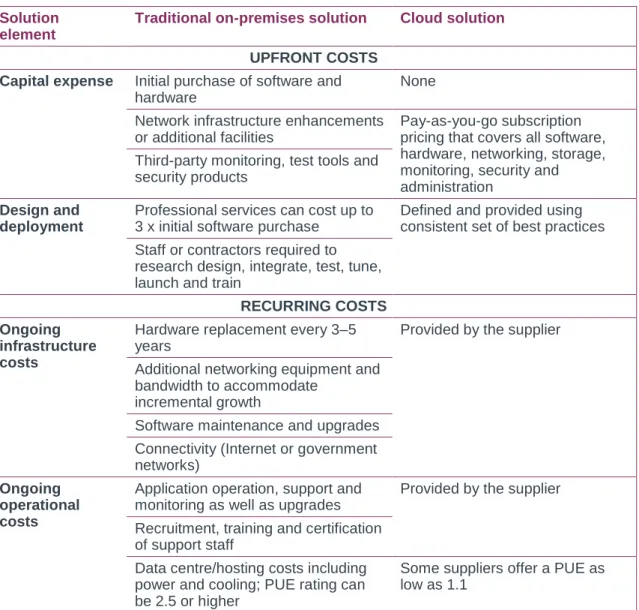
Table 1 outlines the different costs that should be considered and compares how the costs associated with a cloud solution differ to those for a traditional on-premises solution. Considerations range from initial purchase of software and hardware,
professional design services, hardware refresh and software upgrades through to training and
Table 1. Cost considerations
Solution element
Traditional on-premises solution Cloud solution
UPFRONT COSTS Capital expense Initial purchase of software and
hardware
None Network infrastructure enhancements
or additional facilities
Pay-as-you-go subscription pricing that covers all software, hardware, networking, storage, monitoring, security and
administration Third-party monitoring, test tools and
security products Design and
deployment
Professional services can cost up to 3 x initial software purchase
Defined and provided using consistent set of best practices Staff or contractors required to
research design, integrate, test, tune, launch and train
RECURRING COSTS Ongoing
infrastructure costs
Hardware replacement every 3–5 years
Provided by the supplier Additional networking equipment and
bandwidth to accommodate incremental growth
Software maintenance and upgrades Connectivity (Internet or government networks)
Ongoing operational costs
Application operation, support and monitoring as well as upgrades
Provided by the supplier Recruitment, training and certification
of support staff
Data centre/hosting costs including power and cooling; PUE rating can be 2.5 or higher
Some suppliers offer a PUE as low as 1.1
CAN CLOUD REALLY
REDUCE COSTS?
Once an understanding of requirements is clear, a buying organisation can compare the cost of the different solutions available in order to deduce which solution offers lowest cost and best value for money. To analyse whether cloud solutions really can deliver cost savings when compared to a traditional hosted solution, consider three real world requirements for compute resources that have been included in tenders issued by public sector buying organisations in the last six months:
An Impact Level (IL)0 compute platform for Test & Development of new and existing applications
An IL2 compute platform used to host ahigh-traffic web application used by citizens
A IL3 compute platform used to host anEnterprise Application (e.g. SAP or Oracle) Each requirement has been detailed below in terms of utilisation profile and technical specification of the platform. The initial upfront costs, recurring costs over 3 years and hence the total cost of a traditional dedicated solution has been compared to the cost of an equivalent cloud solution available today via the G-Cloud CloudStore3.
3
The cost of each dedicated solution was gained by requesting a commercial quote (including significant volume discounts) from a leading IT distributor in
December 2013. Individual components of each dedicated solution are costed and specified with calculation notes. The cost of each cloud solution was calculated based on prices for Skyscape Compute-as-a-Service as listed in CloudStore for G-Cloud 4.
Full workings and data are available upon request.
All efforts have been made to ensure the cost comparisons are honest and transparent. Scenarios have not been specified to ensure that unfeasibly high costs for a dedicated solution are compared to ridiculously low charges for a cloud solution.
Costs have been considered over a three-year period because this was judged to be the average time a buying organisation might regard the lifespan for new equipment in an environment of fast-paced
technology change and a desire to adopt shorter-term contracts. Costs could have been considered over a longer term, for example five years; however this would incur increasing maintenance charges that would be difficult to quantify.
Recurring costs associated with providing staff to install, manage and maintain an in-house dedicated solution have not been considered. These would vary significantly across different organisations according to the legacy infrastructure in place, current staff resources, whether or not additional staff would need to be recruited and employment terms.
The operational costs associated with the accreditation of an in-house IL2 platform (for the second scenario) or IL3 platform (for the third scenario) have not been considered. These costs would be difficult to estimate and would vary
significantly across different organisations depending on which accreditations they may already have in place for existing infrastructure, their experience of running secure environments and access to any additional resources required to accredit additional platforms.
By not including staff costs or accreditation costs in the cost of providing a dedicated solution, the calculated percentage savings are conservative. In practice, you could expect the actual cost of the dedicated solutions detailed to be more.
Scenario 1: A typical compute
platform used for Test & Development
of new and existing applications
Utilisation profile: As the platform is used on a project basis, it is typically not used every week of every year. Instead, a project might last 6 weeks followed by a 4 week lag until the next project starts. During a project, developers typically only require the platform during office hours.
Environments: Test & Development environments tend to be quite small as there is no requirement for full resilience and scale. However, most Test & Development projects require a number of
simultaneous environments such as sandbox, system test, integration test and user acceptance test. For this scenario, this comes to a total of 22 virtual machines and 1.6TB storage.
Comparison: This scenario compares a cloud platform with a dedicated virtualisation platform — each platform is specified in the table below.
Component Dedicated Cloud
Server Hardware 3 x HP Servers Integral to Compute-as-a-Service Storage Hardware iSCSI Storage array Integral to Compute-as-a-Service Network Hardware HP Network Switch Integral to Compute-as-a-Service OS Licenses Assumes Opensource (Linux) Assumes Opensource (Linux) Virtualisation Licenses VMware vSphere 5 Enterprise Integral to Compute-as-a-Service WAN Bandwidth Share of existing connection 1000GB per month
Scenario 1: cost of dedicated solution
Component Notes Cost calculation Cost
Upfront costs
Server Hardware Physical hardware to run the 22 virtual machines
3 x HP DL360 inc 3 year maintenance
£20,000.00 Storage Hardware Storage for the virtual test &
dev environments
HP MSA 2040 inc 3 year maintenance
£14,000.00 Network Hardware Network switches for the
physical servers and iSCSI storage
HP 2950 Switch £3,000.00
RedHat Enterprise Linux
OS licenses for the 22 virtual machines
3 x RHEL Standard inc 3 year maintenance
£3,700.00 VMware vSphere vSphere and vCenter to
provide a virtualisation platform
VMware vSphere 5 Enterprise and vCenter Standard inc 3 year maintenance £29,000.00 Recurring costs Data Centre Co-location Physical accommodation, power and cooling for the servers and storage during active weeks[1]
1.5KW of equipment load £1.00 per KWh for combined power & accommodation[2]
£632.00
Monitoring and Management
Skyscape assumes existing support teams will monitor and manage this solution – not all organisations will have spare resources to absorb this
£0.00
WAN Skyscape assumes existing connectivity will be used – not all organisations will have spare bandwidth available
£0.00
Totals
Total upfront costs £69,700.00
Total recurring costs over 3 years £22,752.00
Total cost (ex VAT) £92,452.00
[1] Host servers running 24x7 during active weeks (see [2]) as virtual platform must be available on request. Assumes platform would be powered down during inactive weeks so this cost is 58% (30 active weeks/52 weeks) of the equivalent 24x7x365 cost. Note actual cost will be higher as a charge will be incurred for accommodation regardless of whether the servers are active or inactive.
Scenario 1: cost of cloud solution
Component Notes Cost calculation Cost
Upfront costs
None £0.00
Recurring costs
22 x 2CPU/4GB VMs IL0 at Test & Development service level.
Running 8x5 = 100 hours[1] per month
£0.08 per VM per hour x 100 hours[1] x 22 VMs including persistent storage (@£0.35 per GB per month)
£508.26
Additional 500GB Storage
£0.35 per GB per month £175.00 22 x RedHat
Enterprise Linux
Support and Subscription £0.09 per VM per hour x 100 hours[2] x 22 VMs
£198.00 1000GB Internet
Bandwidth
Required for developers to access the IL0 environment
£0.12 per GB per month £120.00
Totals
Total upfront costs £0.00
Total recurring costs over 3 years £36,045.36
Total costs (ex VAT) £36,045.36
[2] 100 hours calculated as follows; 8 hours a day, 5 days a week = 40 hours a week. Assuming projects last 6 weeks, with 4 weeks lag between projects = 5 projects per year = 30 active weeks per year = 1200 active hours per year = 100 active hours per month.
For scenario 1, the comparison shows that when considering total cost of each solution across 3 years, a cloud solution is 61% cheaper than the cost of the dedicated solution.
Scenario 2: A typical high-traffic web
application serving content to the
wider public (citizens)
Utilisation profile: As the platform is used by citizens, it has an unpredictable usage profile with peaks and troughs in terms of demand. The platform must be available 24 x 7 to provide service to the public as required. During high peaks in demand additional servers need to be provisioned to handle the load – this happens once every quarter.
Environments: Due to the nature of the data handled by this application, an IL2 platform is required. As a live production system, the
environment needs to be highly available, so servers are deployed in a N+1 configuration. Some
components of the architecture (e.g. Web Tier) need to scale out to handle increases in workload. In addition to the production system, the solution requires a representative pre-production environment (for volume and load testing) and a Disaster
Recovery (DR) environment.
Comparison: This scenario compares a cloud platform with a dedicated hosted platform — each platform is specified in the table below.
Component Dedicated Cloud
Server Hardware 3 x HP Servers for Web/App VMs in each site 2 x HP Servers for Databases in each site
Integral to Compute-as-a-Service Storage Hardware FC Storage array in each site with dual-path
FC fabric
Integral to Compute-as-a-Service Network Hardware 2 x HP Network Switches in each site Integral to Compute-as-a-Service OS Licenses Windows and SQL licensed via EA Windows and SQL licensed via
SPLA Virtualisation
Licenses
VMware vSphere 5 Enterprise Integral to Compute-as-a-Service WAN Bandwidth 20Mbps for Production, 10Mbps for DR 10000GB per month
Data Centre Co-location
Scenario 2: cost of dedicated solution
Component Notes Cost calculation Cost
Upfront costs
Server Hardware Physical hardware to run the web/app virtual machines and SQL servers 11 x HP DL360 inc 3 year maintenance £80,000.00 Storage Hardware
Storage for the virtual machines and pre-production
environment
2 x HP MSA 2040 inc 3 year maintenance plus 4 x FC Switches
£60,000.00
Network Hardware
Network switches, firewalls and load balancers
4 x HP 2950 Switches, 4 x Cisco ASA 5525 Firewalls, 4 x F5 Load Balances
£95,000.00
Windows and SQL Licenses
EA license for the environment 11 x Windows Datacentre plus SQL Server licenses
£155,000.00 VMware vSphere vSphere and vCenter to provide
a virtualisation platform
vSphere 5 Enterprise and vCenter Standard inc 3 year maintenance
£52,000.00
Accreditation and Assurance
Skyscape assumes existing accredited IL3 environments will be extended to host this solution using internal CLAS resources
£0.00 Recurring costs
Internet Bandwidth
Internet bandwidth at Production and DR sites
20Mbps Production 10Mbps DR
£1,100.00 Data Centre
Co-location
Physical accommodation, power and cooling for the servers and storage
5.0KW of equipment load £1.00 per KWh for combined power and accommodation
£3,650.00
Monitoring and Management
Skyscape assumes existing support teams will monitor and manage this solution – not all organisations will have spare resources to absorb this
£0.00
IL2 PSN WAN Skyscape assumes existing connectivity will be used – not all organisations will have spare bandwidth available
£0.00
Totals
Total upfront costs £442,000.00
Total recurring costs over 3 years £171,000.00
Scenario 2: cost of cloud solution:
Component Notes Cost calculation Cost
Upfront costs
None £0.00
Recurring costs 35 VMs (various sizes)
IL2 at BASIC service level. Running 24x7 = 730 hours per month 5 x Large HM @ £0.90/VM/hr 15 x Medium @ £0.28/VM/hr 10 x Small @ £0.15/VM/hr 5 x Tiny @ £0.13/VM/hr £7,920.50 8 additional VMs four months per year
Additional 8 VMs to handle peak load one month per quarter only 8 x Small @ £0.15/VM/hr including OS license £951.92 [3] Additional 1000GB Storage
£0.35 per GB per month £350.00 Windows and
SQL Licenses
SPLA licenses for Microsoft Windows and SQL 5 x Large HM @ £0.526/VM/hr 15 x Medium @ £0.026/VM/hr 10 x Small @ £0.013/VM/hr 5 x Tiny @ £0.007/VM/hr £2,325.05 10TB Internet Bandwidth
Required for developers to access the IL2 environment
£0.12 per GB per month £1,200.00
Totals
Total upfront costs £0.00
Total recurring costs over 3 years £436,062.84
Total costs (ex VAT) £436,062.84
[3] As these servers are not running all the time, the full cost is only incurred whilst they are active. The servers will be deleted when inactive and re-provisioned when required again to avoid charges for persistent storage.
For scenario 2, the comparison shows that when considering total cost of each solution across 3 years, a cloud solution offers cost savings of 29% versus a dedicated solution.
Scenario 3: A typical compute
platform used to host an Enterprise
Application (e.g. SAP or Oracle)
Utilisation profile: As the platform is used for a production system, it is used throughout the year. However, it is used by internal UK staff so only used between the hours of 6am and 8pm, Monday to Friday. At the end of each month, for eight hours, additional application servers are provisioned to handle the batch processing load.
Environments: Due to the nature of the data handled by these applications, an IL3 platform is required. As it is a production system, the
environment needs to be highly available so servers are deployed in a N+1 configuration. Some
components of the architecture (e.g. Application Tier) need to scale out to handle the batch load. In
addition to the production system, the solution requires a representative pre-production environment (for volume and load testing) and a DR environment. Comparison: This scenario compares a cloud platform with a dedicated virtualisation platform — each platform is specified in the table below.
Component Dedicated Cloud
Server Hardware 2 x HP Servers for Web/App VMs in each site 2 x HP Servers for Databases in each site
Integral to Compute-as-a-Service Storage Hardware FC Storage array in each site with dual-path
FC fabric
Integral to Compute-as-a-Service Network Hardware 2 x HP Network Switches in each site Integral to Compute-as-a-Service OS Licenses Windows and SQL licensed via EA Windows and SQL licensed via
SPLA Virtualisation
Licenses
VMware vSphere 5 Enterprise Integral to Compute-as-a-Service
WAN Bandwidth Uses existing bandwidth 5Mbps PSN per month
DC
Accommodation
Scenario 3: cost of dedicated solution
Component Notes Cost calculation Cost
Upfront costs
Server Hardware Physical hardware to run the web/app virtual machines and SQL servers 8 x HP DL360 inc 3 year maintenance £66,000.00 Storage Hardware
Storage for the virtual machines and databases
2 x HP MSA 2040 inc 3 year maintenance plus 4 x FC Switches
£66,000.00
Network Hardware
Network switches 4 x HP 2950 Switches £5,800.00
Windows and SQL Licenses
EA license for the environment 8 x Windows Datacentre plus SQL Server licenses
£145,000.00 VMware vSphere vSphere and vCenter to provide
a virtualisation platform
vSphere 5 Enterprise and vCenter Standard inc 3 year maintenance
£36,000.00
Accreditation and Assurance
Skyscape assumes existing accredited IL3 environments will be extended to host this solution using internal CLAS resources
£0.00 Recurring costs
Data Centre Co-location
Physical accommodation, power and cooling for the servers and storage
4.5KW of equipment load £1.00 per KWh for combined power and accommodation
£3,285.00
Monitoring and Management
Skyscape assumes existing support teams will monitor and manage this solution – not all organisations will have spare resources to absorb this
£0.00
IL3 PSN WAN Skyscape assumes existing connectivity will be used – not all organisations will have spare bandwidth available
£0.00
Totals
Total upfront costs £318,800.00
Total recurring costs over 3 years £118,260.00
Scenario 3: cost of cloud solution
Component Notes Cost calculation Cost
Upfront costs
None £0.00
Recurring costs 35 VMs (various sizes)
IL3 at STANDARD service level. Running 14x7 = 303 hours per month 5 x Large HM @ £1.60/VM/hr 15 x Medium @ £0.48/VM/hr 10 x Small @ £0.29/VM/hr 5 x Tiny @ £0.21/VM/hr plus persistent storage
£5,861.44
8 additional VMs eight hours per month
Additional 8 VMs to handle peak load eight hours per month
8 x Medium @ £0.506/VM/hr (£0.48 VM plus OS license @ £0.026) plus persistent storage
£210.41
Windows and SQL Licenses
SPLA licenses for Microsoft Windows and SQL 5 x Large HM @ £0.526/VM/hr 15 x Medium @ £0.026/VM/hr 10 x Small @ £0.013/VM/hr 5 x Tiny @ £0.007/VM/hr £966.12 Additional 4500GB Storage
£0.45 per GB per month £2,025.00 5Mbps PSN
Bandwidth
Required for access the IL3 environment
£250 per Mbps per DC per month
£2,500.00
Totals
Total upfront costs £0.00
Total recurring costs over 3 years £416,266.92
For scenario 3, the comparison shows that when considering total cost of each solution across 3 years, a cloud solution still offers a 5% saving over the cost of the dedicated solution. It is worth noting again that in calculating the cost of the dedicated solution specified, the cost of accreditation has not been included. If you consider the day rate for a CESG Listed Adviser Scheme (CLAS) consultant and the costs of an IT Health Check (ITHC) test service plus the fact that most accreditation activity requires a minimum of 10 days, significant accreditation costs can be incurred. Nor have staff costs or additional network bandwidth costs been considered. The average support person can incur a £50,000 cost. Government Secure Network circuits demand high up-front costs and even low bandwidth circuits can cost in the region of £1,000 per month. If these costs had been included, we are confident that the cost saving offered by the cloud solution would be considerably higher than 5%.
ASSESSING THE POTENTIAL
COST SAVINGS OF CLOUD
The scenarios detailed above demonstrate that significant cost reductions can be realised by adopting cloud computing over more traditional dedicated solutions.
Obviously the requirements of individual buying organisations are unlikely to match the scenarios outlined exactly and costs will vary, depending on specific business and technical requirements. In building a business case, buying organisations should ensure they identify all costs associated with individual solutions offered by different suppliers to include any costs related to exiting an existing contract/service, procuring and contracting the new service and then on-boarding and running the new service.
Prices, workloads and running costs should be carefully analysed. Buyers should also check whether any discounts apply.
Unlike the scenarios provided, full operational costs, to include staff and accreditation costs, will need to be considered when costing an in-house solution. Taking all these different elements into account, in our experience of working with the UK public sector, in all situations, cloud computing will deliver cost reductions whilst increasing both agility and availability.
In our experience, cloud computing
will always deliver cost reductions
whilst increasing both agility and
availability.
THE SOFT BENEFITS
OF CLOUD
Although a cost comparison is a fundamental part of any business case for ICT expenditure, a cloud implementation can deliver more than cost savings. As well as transforming ICT from a high-risk capex item to a business enabler, cloud computing offers many other valuable business benefits.
Quicker, easier procurement: throughcompliant frameworks such as G-Cloud, services can be contracted, ordered and set-up in hours or days rather than months. The G-Cloud Framework complies with the OJEU and is regularly refreshed to ensure that the best that the market has to offer is available to the UK public sector.
Adherence to government policies: by implementing a cloud solution buyingorganisations are adhering to initiatives such as Cloud First. The drastically reduced procurement and deployment times offered by cloud services can also support reduced application
development lead times for buying organisations striving to migrate transactional services online in-line with ‘digital by default’ standards.
Improved availability: with cloud there is noneed to set-up a redundant system at a separate disaster recovery location. Additional resources are accessible as required so as workload increases so can your capacity, ensuring that performance doesn’t suffer. Cloud solutions offer significantly less downtime and better application availability. This enables you to meet demand and achieve improved user satisfaction.
Consumption-based commercial models: your exact requirements can be met cost-effectively, such as 8x5 rather than 24x7 availability; and you can cater for unpredictable workloads with no need to over-provision. With usage-based pricing, costs are transparent, giving you the ability to accurately track costs and budget.
High quality of service: with cloud serviceswell-established and some suppliers having gained significant experience of successfully delivering cloud solutions to the UK public sector, industry-leading Service Level Agreements are available, assured by experts in virtualisation and cloud computing.
Reduced riskandincreased agility: cloud solutions from assured providers can quickly and easily flex and adapt as requirements evolve and don’t lock organisations into long-term contracts. Most established cloud service providers do not charge any set-up costs or enforce any minimum contract term.
A business model that encouragesinnovation and thought leadership: Test & Development environments can be set-up in minutes at low cost so ideas can be tested quickly and without significant expenditure.
Increased developer and IT staff productivity: cloud solutions enable faster applicationdevelopment as they can be deployed in minutes, and your cloud provider will be responsible for ongoing maintenance of all facilities, hardware and software. This means your staff can spend less time managing your infrastructure and more time delivering innovative projects that support improvements in efficiency and productivity.
Greater security: there is no requirement to manage extensive and often scattered ordisparate in-house resources; instead the onus is on service providers to meet the high levels of data centre, service and data security required to achieve Pan Government Accreditation (PGA) and to sustain these standards in order to remain accredited.
Greener solutions: cloud solutions offer reduced energy consumption, sustainable procurement and better hardware utilisation. Some cloud providers also have CarbonNeutral® Company status and operate data centres with a low carbon footprint and low PUE rating.BUT WHAT ABOUT
SECURITY?
The public sector’s increasing use of cloud
computing environments presents a number of new security challenges. Technically, there may be little or no difference between public, community and private cloud architecture; but security considerations may be substantially different for services (applications, storage and other resources) that are made available by a service provider for a public audience, and when communication takes place over a non-trusted network.
Generally, public cloud service providers like
Amazon, Google and Microsoft own and operate the infrastructure and offer access only via the Internet. This model and connectivity option can be used for applications with few or no security concerns. However, it is not appropriate when an application manages protectively marked data. In this case, a cloud provider offering alternative connectivity options and accredited cloud services must be used. The required level of management, operation and security of centralised, multi-tenanted cloud systems is the key reason that the G-Cloud programme has adopted a rigorous accreditation process that's designed to provide consuming organisations and their end users — often the general public — with assurance about the security of their data.
Services offered through the G-Cloud Framework are currently designated as being suitable for managing data at one or more Business Impact Levels (ILs). G-Cloud specifies information assurance (IA) requirements in terms of the security accreditation approach for each IL:
IL0 — no impact or claimed assurance
IL1 and IL2 — the minimum level for commercial, commoditised services for the public sector
IL3 — designed, delivered and evidencedaccording to UK Government Standards and Guidance
To achieve accreditation, a cloud service must meet certain standards and criteria for protecting and maintaining the confidentiality, integrity and
availability of the data being managed. Areas such as physical and virtual access, network protection, protective monitoring and due diligence are considered.
Buying organisations considering cloud solutions must accurately assess the IL of the data that will be managed within the cloud. They need to check that the cloud service providers they’re considering buying from offer services that hold Pan Government Accreditation (PGA) to the relevant IL. It's worth noting that very few providers offer cloud services that are accredited at IL3.
In April 2014, a new Government Protective Marking Scheme (GPMS) will come into effect. Whilst the classification of data will change, the UK public sector will still need to process data that needs to be secure and they will look for assurance from
suppliers that their processes and technologies have been externally and independently validated to securely manage, store and process that data. There will still be cloud providers that will be able to provide such assurances but buying organisations will need to be confident that the validation provided is from a trusted source.
ABOUT SKYSCAPE
Skyscape Cloud Services has developed a range of cloud services designed specifically for the UK public sector, to help increase efficiencies, reduce costs, significantly improve procurement times and increase transparency. Our services are easy to adopt, easy
to use and easy to leave to ensure that our
customers remain in complete control, with minimum risk, reassured by the fact Skyscape's services are Pan Government Accredited (PGA) up to IL3. Skyscape’s full offering consists of IaaS, PaaS and SaaS products:
IaaS – seven offerings around Compute and Storage on demand
SaaS – 17 offerings around messaging and document management
PaaS – based upon Cloud FoundryAll of Skyscape’s UK sovereign cloud computing services are hosted across our two highly resilient Tier 3 UK data centres in Farnborough and Corsham. Skyscape services are delivered with leading
technologies from Skyscape Alliance Partners: QinetiQ, VMware, Cisco, EMC and Ark Data Centres. The Cloud Alliance also provides a collaborative resource which drives innovation and technical product development, helping to continually improve Skyscape’s offering to meet the needs of the UK public sector.
Skyscape is focused on providing cloud services in a more agile, secure and cost-effective manner. We strive to deliver solutions that harness technology as a way to facilitate the changes that are needed to streamline processes and reduce costs to support the UK public sector and, ultimately, UK citizens and taxpayers.
CONTACT US FOR A CLOUD COSTING
If you have a specific ICT requirement that you would like us to cost for you now to enable you to compare cloud to alternative solutions available to you, get in touch:
email details to [email protected]Skyscape Cloud Services Limited
A8 Cody Technology Park Ively Road Farnborough Hampshire GU14 0LX +44 (0)1252 303300 [email protected] www.skyscapecloud.com @skyscapecloud
Reasonable efforts have been made to ensure the accuracy of the information contained in this document. No advice given or statements or recommendations made shall in any circumstances constitute or be deemed to constitute a warranty by Skyscape Cloud Services Limited as to the accuracy of such advice, statements or recommendations. Skyscape Cloud Services Limited shall not be liable for any loss, expense, damage or claim howsoever arising out of the advice given or not given or statements made or omitted to be made in connection with this document.
No part of this document may be copied, reproduced, adapted or redistributed in any form or by any means without the express prior written consent of Skyscape Cloud Services Limited.
© Skyscape Cloud Services Limited. All Rights Reserved.