Improving Application Security with Data Flow Assertions
Alexander Yip, Xi Wang, Nickolai Zeldovich, and M. Frans Kaashoek
Massachusetts Institute of Technology – Computer Science and Artificial Intelligence Laboratory
ABSTRACT
RESINis a new language runtime that helps prevent security vulner-abilities, by allowing programmers to specify application-level data flow assertions. RESINprovidespolicy objects, which programmers use to specify assertion code and metadata;data tracking, which allows programmers to associate assertions with application data, and to keep track of assertions as the data flow through the appli-cation; andfilter objects, which programmers use to define data flow boundaries at which assertions are checked. RESIN’s runtime checks data flow assertions by propagating policy objects along with data, as that data moves through the application, and then invoking filter objects when data crosses a data flow boundary, such as when writing data to the network or a file.
Using RESIN, Web application programmers can prevent a range of problems, from SQL injection and cross-site scripting, to inadver-tent password disclosure and missing access control checks. Adding a RESINassertion to an application requires few changes to the existing application code, and an assertion can reuse existing code and data structures. For instance, 23 lines of code detect and prevent three previously-unknown missing access control vulnerabilities in phpBB, a popular Web forum application. Other assertions compris-ing tens of lines of code prevent a range of vulnerabilities in Python and PHP applications. A prototype of RESINincurs a 33% CPU overhead running the HotCRP conference management application.
Categories and Subject Descriptors
D.2.4 [Software Engineering]: Software Verification—Assertion
checkers; D.4.6 [Operating Systems]: Security and Protection
General Terms
Security, Languages, Design
1.
INTRODUCTION
Software developers often have a plan for correct data flow within
their applications. For example, a useru’s password may flow out
of a Web site only via an email to useru’s email address. As another example, user inputs must always flow through a sanitizing function before flowing into a SQL query or HTML, to avoid SQL injection or cross-site scripting vulnerabilities. Unfortunately, today these plans are implemented implicitly: programmers try to insert code inallthe appropriate places to ensure correct flow, but it is easy to
Permission to make digital or hard copies of all or part of this work for personal or classroom use is granted without fee provided that copies are not made or distributed for profit or commercial advantage and that copies bear this notice and the full citation on the first page. To copy otherwise, to republish, to post on servers or to redistribute to lists, requires prior specific permission and/or a fee.
SOSP’09,October 11–14, 2009, Big Sky, Montana, USA. Copyright 2009 ACM 978-1-60558-752-3/09/10 ...$10.00.
miss some, which can lead to exploits. For example, one popular
Web application, phpMyAdmin [38], requires sanitizing user input
in 1,409 places. Not surprisingly, phpMyAdmin has suffered 60 vulnerabilities because some of these calls were forgotten [41].
This paper presents RESIN, a system that allows programmers to make their plan for correct data flow explicit usingdata flow assertions. Programmers can write a data flow assertion in one place to capture the application’s high-level data flow invariant, and RESINchecks the assertion in all relevant places, even places where the programmer might have otherwise forgotten to check.
RESINoperates within a language runtime, such as the Python or PHP interpreter. RESINtracks application data as it flows through
the application, and checks data flow assertions on every executed
path. RESINuses runtime mechanisms because they can capture dynamic properties, like user-defined access control lists, while integration with the language allows programmers to reuse the ap-plication’s existing code in an assertion. RESINis designed to help programmers gain confidence in the correctness of their application, and is not designed to handle malicious code.
A key challenge facing RESINis knowing when to verify a data flow assertion. Consider the assertion that a user’s password can flow only to the user herself. There are many different ways that an adversary might violate this assertion, and extract someone’s password from the system. The adversary might trick the application into emailing the password; the adversary might use a SQL injection attack to query the passwords from the database; or the adversary might fetch the password file from the server using a directory traversal attack. RESINneeds to cover every one of these paths to prevent password disclosure.
A second challenge is to design a generic mechanism that makes it easy to express data flow assertions, including common assertions like cross-site scripting avoidance, as well as application-specific assertions. For example, HotCRP [26], a conference management application, has its own data flow rules relating to password
disclo-sure and reviewer conflicts of interest, among others. Can a single
assertion API allow for succinct assertions for cross-site scripting avoidance as well as HotCRP’s unique data flow rules?
The final challenge is to make data flow assertions coexist with each other and with the application code. A single application may have many different data flow assertions, and it must be easy to add an additional assertion if a new data flow rule arises, without having to change existing assertions. Moreover, applications are often written by many different programmers. One programmer may work on one part of the application and lack understanding of the application’s overall data flow plan. RESINshould be able to enforce data flow assertions without all the programmers being aware of the assertions.
RESINaddresses these challenges using three ideas: policy ob-jects,data tracking, andfilter objects. Programmers explicitly an-notate data, such as strings, with policy objects, which encapsulate the assertion functionality that is specific to that data. Program-mers write policy objects in the same language that the rest of the application is written in, and can reuse existing code and data
struc-Vulnerability Count Percentage SQL injection 1176 20.4% Cross-site scripting 805 14.0% Denial of service 661 11.5% Buffer overflow 550 9.5% Directory traversal 379 6.6% Server-side script injection 287 5.0% Missing access checks 263 4.6% Other vulnerabilities 1647 28.6%
Total 5768 100% Table 1: Top CVE security vulnerabilities of 2008 [41].
tures, which simplifies writing application-specific assertions. The
RESINruntime then tracks these policy objects as the data propa-gates through the application. When the data is about to leave the control of RESIN, such as being sent over the network, RESIN in-vokes filter objects to check the data flow assertions with assistance from the data’s policy objects.
We evaluate RESINin the context of application security by show-ing how these three mechanisms can prevent a wide range of
vul-nerabilities in real Web applications, while requiring programmers
to write only tens of lines of code. One application, the MoinMoin wiki [31], required only 8 lines of code to catch the same access control bugs that required 2,000 lines in Flume [28], although Flume provides stronger guarantees. HotCRP can use RESINto uphold its data flow rules, by adding data flow assertions that control who may read a paper’s reviews, and to whom HotCRP can email a pass-word reminder. Data flow assertions also help prevent a range of other previously-unknown vulnerabilities in Python and PHP Web applications. A prototype RESINruntime for PHP has acceptable performance overhead, amounting to 33% for HotCRP.
The contributions of this work are the idea of an application-level data flow assertion, and a technique for implementing data flow assertions using filter objects, policy objects, and data tracking. Ex-periments with several real applications further show that data flow assertions are concise, effective at preventing many security vulner-abilities, and incrementally deployable in existing applications.
The rest of the paper is organized as follows. The next section discusses the specific goals and motivation for RESIN. Section 3
presents the design of the RESINruntime, and Section 4 describes
our implementation. Section 5 illustrates how RESINprevents a range of security vulnerabilities. Sections 6 and 7 present our evalu-ation of RESIN’s ease of use, effectiveness, and performance. We discuss RESIN’s limitations and future work in Section 8. Section 9 covers related work, and Section 10 concludes.
2.
GOALS AND EXAMPLES
RESIN’s main goal is to help programmers avoid security vul-nerabilities by treating exploits as data flow violations, and then using data flow assertions to detect these violations. This section
explains how faulty data flows cause vulnerabilities, and how data
flow assertions can prevent those vulnerabilities.
SQL Injection and Cross-Site Scripting
SQL injection and cross-site scripting vulnerabilities are common
and can affect almost any Web application. Together, they account
for over a third of all reported security vulnerabilities in 2008, as seen in Table 1. These vulnerabilities result from user input data flowing into a SQL query string or HTML without first flowing through their respective sanitization functions. To avoid these vul-nerabilities today, programmers insert calls to the correct sanitization
function on every single path on which user input can flow to SQL
Vulnerable sites Vulnerability among those surveyed Cross-site scripting 31.5% Information leakage 23.3% Predictable resource location 10.2%
SQL injection 7.9%
Insufficient access control 1.5% HTTP response splitting 0.8% Table 2: Top Web site vulnerabilities of 2007 [48].
or HTML. In practice this is difficult to accomplish because there are many data flow paths to keep track of, and some of them are non-intuitive. For example, in one cross-site scripting vulnerability, phpBB queried a maliciouswhoisserver, and then incorporated the response into HTML without first sanitizing the response. A survey of Web applications [48] summarized in Table 2 illustrates how common these bugs are with cross-site scripting affecting more than 31% of applications, and SQL injection affecting almost 8%.
If there were a tool that could enforce a data flow assertion on an entire application, a programmer could write an assertion to catch these bugs and prevent an adversary from exploiting them. For example, an assertion to prevent SQL injection exploits would verify that:
DATAFLOWASSERTION 1. Any user input data must flow through
a sanitization function before it flows into a SQL query.
RESINaims to be such a tool.
Directory Traversal
Directory traversal is another common vulnerability that accounts for 6.6% of the vulnerabilities in Table 1. In a directory traversal attack, a vulnerable application allows the user to enter a file name, but neglects to limit the directories available to the user. To exploit this vulnerability, an adversary typically inserts the “..” string as part of the file name which allows the adversary to gain unauthorized access to read, or write files in the server’s file system. These ex-ploits can be viewed as faulty data flows. If the adversary reads a file without the proper authorization, the file’s data is incorrectly flowing to the adversary. If the adversary writes to a file without the proper
authorization, the adversary is causing an invalid flow into the file.
Data flow assertions can address directory traversal vulnerabilities by enforcing data flow rules on the use of files. For example, a pro-grammer could encode the following directory traversal assertion to protect against invalid writes:
DATAFLOWASSERTION 2. No data may flow into directoryd
unless the authenticated user has write permission ford.
Server-Side Script Injection
Server-side script injection accounts for 5% of the vulnerabilities reported in Table 1. To exploit these vulnerabilities, an adversary up-loads code to the server and then fools the application into running that code. For instance, many PHP applications load script code for different visual themes at runtime, by having the user specify the file name for their desired theme. An adversary can exploit this by uploading a file with the desired code onto the server (many applica-tions allow uploading images or attachments), and then supplying the name of that file as the theme to load.
Even if the application is careful to not include user-supplied file names, a more subtle problem can occur. If an adversary uploads a file with a.phpextension, the Web server may allow the adversary to directly execute that file’s contents by simply issuing an HTTP
request for that file. Avoiding such problems requires coordination between many parts of the application, and even the Web server, to understand which file extensions are “dangerous”. This attack can be viewed as a faulty data flow and could be addressed by the following data flow assertion:
DATAFLOWASSERTION 3. The interpreter may not interpret any user-supplied code.
Access Control
Insufficient access control can also be viewed as a data flow viola-tion. These vulnerabilities allow an adversary to read data without proper authorization and make up 4.6% of the vulnerabilities re-ported in 2008. For example, a missing access control check in MoinMoin wiki allowed a user to read any wiki page, even if the page’s access control list (ACL) did not permit the user to read that page [46]. Like the previous vulnerabilities, this data leak can be viewed as a data flow violation; the wiki page is flowing to a user
who lacks permission to receive the page. This vulnerability could
be addressed with the data flow assertion:
DATAFLOWASSERTION 4. Wiki pagepmay flow out of the
system only to a user onp’s ACL.
Insufficient access control is particularly challenging to address
because access control rules are often unique to the application. For example, MoinMoin’s ACL rules differ from HotCRP’s access control rules, which ensure that only paper authors and program committee (PC) members may read paper reviews, and that PC mem-bers may not view a paper’s authors if the author list is anonymous.
Ideally, a data flow assertion could take advantage of the code and
data structures that an application already uses to implement its access control checks.
Password Disclosure
Another example of a specific access control vulnerability is a pass-word disclosure vulnerability that was discovered in HotCRP; we use this bug as a running example for the rest of this paper. This bug was a result of two separate features, as follows.
First, a HotCRP user can ask HotCRP to send a password re-minder email to the user’s email address, in case the user forgets the password. HotCRP makes sure to send the email only to the email address of the account holder as stored in the server. The second feature is anemail previewmode, in which the site administrator configures HotCRP to display email messages in the browser, rather than send them via email. In this vulnerability, an adversary asks HotCRP to send a password reminder for another HotCRP user (the
victim) while HotCRP is inemail previewmode. HotCRP will dis-play the content of the password reminder email in the adversary’s
browser, instead of sending the password to that victim’s email address, thus revealing the victim’s password to the adversary.
A data flow assertion could have prevented this vulnerability
because the assertion would have caught the invalid password flow
despite the unexpected combination of the password reminder and
email previewmode. The assertion in this case would have been: DATAFLOWASSERTION 5. Useru’s password may leave the
system only via email tou’s email address, or to the program chair.
2.1
Threat Model
As we have shown, many vulnerabilities in today’s applications
can be thought of as programming errors that allow faulty data flows. Adversaries exploit these faulty data flows to bypass the application’s security plan. RESIN aims to prevent adversaries from exploiting these faulty data flows by allowing programmers to
explicitly specify data flow assertions, which are then checked at runtime in all places in the application.
We expect that programmers would specify data flow assertions to prevent well-known vulnerabilities shown in Table 1, as well as existing application-specific rules, such as HotCRP’s rules for password disclosure or reviewer conflicts of interest. As program-mers write new code, they can use data flow assertions to make sure their data is properly handled in code written by other developers, without having to look at the entire code base. Finally, as new prob-lems are discovered, either by attackers or by programmers auditing the code, data flow assertions can be used to fix an entire class of vulnerabilities, rather than just a specific instance of the bug.
RESINtreats the entire language runtime, and application code, as part of the trusted computing base. RESINassumes the application code is not malicious, and does not prevent an adversary from com-promising the underlying language runtime or the OS. In general, a buffer overflow attack can compromise a language runtime, but buffer overflows are less of an issue for RESINbecause languages like PHP and Python are not susceptible to buffer overflows.
3.
DESIGN
Many of the vulnerabilities described in Section 2 can be ad-dressed with data flow assertions, but the design of such an assertion system requires solutions to a number of challenges. First, the
sys-tem must enforce assertions on the many communication channels
available to the application. Second, the system must provide a convenient API in which programmers can express many different types of data flow assertions. Finally, the system must handle several assertions in a single application gracefully; it should be easy to add
new assertions, and doing so should not disrupt existing assertions.
This section describes how RESINaddresses these design challenges, beginning with an example of how a data flow assertion prevents the HotCRP password disclosure vulnerability described in Section 2.
3.1
Design Overview
To illustrate the high-level design of RESINand what a program-mer must do to implement a data flow assertion, this section de-scribes how a programmer would implement Data Flow Assertion 5, the HotCRP password assertion, in RESIN. This example does not use all of RESIN’s features, but it does show RESIN’s main concepts. Conceptually, the programmer needs to restrict the flow of pass-words. However, passwords are handled by a number of modules in HotCRP, including the authentication code and code that formats and sends email messages. Thus, the programmer must confine
passwords by defining a data flow boundary that surrounds the
en-tire application. Then the programmer allows a password to exit that boundary only if that password is flowing to the owner via email, or to the program chair. Finally, the programmer marks the passwords as sensitive so that the boundary can identify which data contains password information, and writes a small amount of assertion checking code.
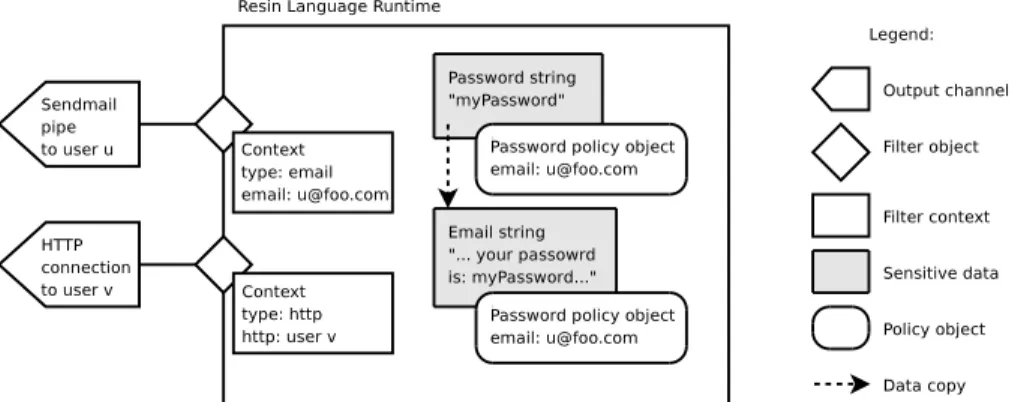
RESIN provides three mechanisms that help the programmer implement such an assertion (see Figure 1):
• Programmers usefilter objectsto define data flow boundaries. A filter object interposes on an input/output channel or a function call interface.
• Programmers explicitly annotate sensitive data withpolicy objects. A policy object can contain code and metadata for checking assertions.
• Programmers rely on RESIN’s runtime to performdata
track-ingto propagate policy objects along with sensitive data when the application copies that data within the system.
Figure 1: Overview of the HotCRP password data flow assertion in RESIN.
class PasswordPolicy extends Policy { private $email;
function __construct($email) { $this->email = $email; }
function export_check($context) { if ($context[’type’] == ’email’ &&
$context[’email’] == $this->email) return; global $Me;
if ($context[’type’] == ’http’ && $Me->privChair) return;
throw new Exception(’unauthorized disclosure’); }
}
policy_add($password, new PasswordPolicy(’[email protected]’));
Figure 2: Simplified PHP code for defining the HotCRP password
policy class and annotating the password data. This policy only allows a password to be disclosed to the user’s own email address or to the program chair.
RESINby default defines a data flow boundary around the lan-guage runtime using filter objects that cover all I/O channels,
in-cluding pipes and sockets. By default, RESINalso annotates some
of these default filter objects withcontextmetadata that describes the specific filter object. For example, RESINannotates each filter object connected to an outgoing email channel with the email’s recipient address. The default set of filters and contexts defining the boundary are appropriate for the HotCRP password assertion, so the programmer need not define them manually.
In order for RESINto track the passwords, the programmer must annotate each password with a policy object, which is a language-level object that contains fields and methods. In this assertion, a user’s password will have a policy object that contains a copy of the user’s email address so that the assertion can determine which email address may receive the password data. When the user first sets their password, the programmer copies the user’s email address from the current session information into the password’s policy object.
The programmer also writes the code that checks the assertion, in a method calledexport_checkwithin the password policy object’s class definition. Figure 2 shows the code the programmer must write
to implement this data flow assertion, including the policy object’s
class definition and the code that annotates a password with a policy object. The policy object also shows how an assertion can benefit from the application’s data structures; this assertion uses an existing
flag,$Me->privChair, to determine whether the current user is the
program chair.
Once a password has the appropriate policy object, RESIN’s data tracking propagates that policy object along with the password data; when the application copies or moves the data within the system, the policy goes along with the password data. For example, after HotCRP composes the email content using the password data, the email content will also have the password policy annotation (as shown in Figure 1).
RESINenforces the assertion by making each filter object call export_checkon the policy object of any data that flows through the filter. The filter object passes its context as an argument to
export_checkto provide details about the specific I/O channel (e.g., the email’s recipient).
This assertion catches HotCRP’s faulty data flow before it can leak a password. When HotCRP tries to send the password data over an HTTP connection, the connection’s filter object invokes theexport_check method on the password’s policy object. The export_checkcode observes that HotCRP is incorrectly trying to send the password over an HTTP connection, and throws an
ex-ception which prevents HotCRP from sending the password to the
adversary. This solution works for all disclosure paths through the code because RESIN’s default boundary controls all output chan-nels; HotCRP cannot reveal the password without traversing a filter object.
This example is just one way to implement the password data flow assertion, and there may be other ways. For example, the programmer could implement the assertion checking code in the filter objects rather than the password’s policy object. However, modifying filter objects is less attractive because the programmer would need to modify every filter object that a password can traverse. Putting the assertion code in the policy object allows the programmer to write the assertion code in one place.
3.2
Filter Objects
A filter object, represented by a diamond in Figure 1, is a generic interposition mechanism that application programmers use to create
data flow boundaries around their applications. An application can
associate a filter object with a function call interface, or an I/O channel such as a file handle, socket, or pipe.
RESINaims to support data flow assertions that are specific to an
application, so in RESIN, a programmer implements a filter object
as a language-level object in the same language as the rest of the application. This allows the programmer to reuse the application’s code and data structures, and allows for better integration with applications.
When an application sends data across a channel guarded by a filter object, RESINinvokes a method in that filter object with the
Function Caller Semantics
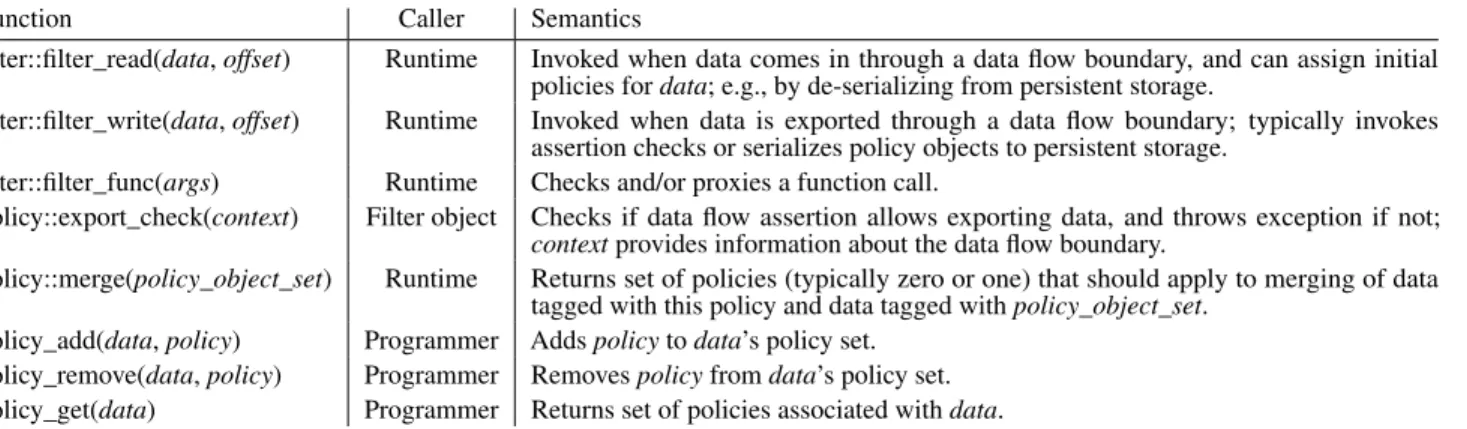
filter::filter_read(data,offset) Runtime Invoked when data comes in through a data flow boundary, and can assign initial policies fordata; e.g., by de-serializing from persistent storage.
filter::filter_write(data,offset) Runtime Invoked when data is exported through a data flow boundary; typically invokes assertion checks or serializes policy objects to persistent storage.
filter::filter_func(args) Runtime Checks and/or proxies a function call.
policy::export_check(context) Filter object Checks if data flow assertion allows exporting data, and throws exception if not;
contextprovides information about the data flow boundary.
policy::merge(policy_object_set) Runtime Returns set of policies (typically zero or one) that should apply to merging of data tagged with this policy and data tagged withpolicy_object_set.
policy_add(data,policy) Programmer Addspolicytodata’s policy set. policy_remove(data,policy) Programmer Removespolicyfromdata’s policy set. policy_get(data) Programmer Returns set of policies associated withdata.
Table 3: The RESINAPI. A::B(args) denotes method B of an object of type A. Not shown is the API used by the programmer to specify and access filter objects for different data flow boundaries.
class DefaultFilter(Filter):
def __init__(self): self.context = {} def filter_write(self, buf):
for p in policy_get(buf): if hasattr(p, ’export_check’):
p.export_check(self.context) return buf
Figure 3: Python code for the default filter for sockets.
data as an argument. If the interposition point is an I/O channel, RESINwill invoke eitherfilter_readorfilter_write; for function calls, RESINwill invokefilter_func(see Table 3).Filter_readand filter_writecan check or alter the in-transit data. Filter_funccan check or alter the function’s arguments and return value.
For example, in an HTTP splitting attack, the adversary inserts an extra CR-LF-CR-LF delimiter into the HTTP output to confuse browsers into thinking there are two HTTP responses. To thwart this type of attack, the application programmer could write a filter object that scans for unexpected CR-LF-CR-LF character sequences, and then attach this filter to the HTTP output channel. As a second example, a function that encrypts data is a natural data flow boundary. A programmer may choose to attach a filter object to the encryption function that removes policy objects for confidentiality assertions such as thePasswordPolicyfrom Section 3.1.
3.2.1
Default Filter Objects
RESINpre-defines default filter objects on all I/O channels into and out of the runtime, including sockets, pipes, files, HTTP out-put, email, SQL, and code import. Since these default filter objects are at the edge of the runtime, data can flow freely within the ap-plication and the default filters will only check assertions before making program output visible to the outside world. This bound-ary should be suitable for many assertions because it surrounds the entire application. The default boundary also helps programmers
avoid accidentally overlooking an I/O channel, which would result
in an incomplete boundary that would not cover all possible flows. The default filter objects check the in-transit data for policies, as shown in Figure 3. If a filter finds a policy that has anexport_check
method, the filter invokes the policy’sexport_checkmethod. As described in Section 3.1,export_checktypically checks the assertion and throws an exception if the flow would violate the assertion.
Since the policy’sexport_check method may need additional information about the filter’s specific I/O channel or function call to check the assertion, RESINattaches context information, in the form of a hash table, to some of the default filters as described
in Section 3.1. RESINalso allows the application to add its own key-value pairs to the context hash table of default filter objects.
The context key-value pairs are likely specific to the I/O channel or function call that the filter guards, and the default filter passes the
context hash table as an argument toexport_check. In the HotCRP
example, the context for a sendmail pipe contains the recipient of the email (as shown in Figure 1).
3.2.2
Importing Code
RESINtreats the interpreter’s execution of script code as another data flow channel, with its own filter object. This allows program-mers to interpose on all code flowing into the interpreter, and ensure that such code came from an approved source. This can prevent server-side script injection attacks, where an adversary tricks the interpreter into executing adversary-provided script code.
3.2.3
Write Access Control
In addition to runtime boundaries, RESINalso permits an applica-tion to place filter objects on persistent files to control write access, because data tracking alone cannot prevent modifications. In partic-ular, RESINallows programmers to specify access control checks for files and directories in a persistent filter object that’s stored in the extended attributes of a specific file or directory. The runtime automatically invokes this persistent filter object when data flows into or out of that file, or modifies that directory (such as creating, deleting, or renaming files). This programmer-specified filter object
can check whether the current user is authorized to access that file
or directory. These persistent filter objects associated with a specific file or directory are separate from the filter objects associated by default with every file’s I/O channel.
3.3
Policy Objects
Like a filter object, a policy object is a language-level object, and can reuse the application’s existing code and data structures. A policy object can contain fields and methods that work in concert with filter objects; policy objects are represented by the rounded rectangles in Figure 1.
To work with default filter objects, a policy object should have anexport_checkmethod as shown in Table 3. As mentioned earlier, default filter objects invokeexport_checkwhen data with a policy passes through a filter, soexport_checkis where programmers imple-ment an assertion check for use with default filters. If the assertion fails,export_checkshould throw an exception so that RESINcan prevent the faulty data flow.
The main distinction between policy objects and filter objects is that a policy object is specific to data, and a filter object is specific
to a channel. A policy object would contain data specific metadata
and code; for example, the HotCRP password policy contains the email address of the password’s account holder. A filter object would contain channel specific metadata; for example, the email filter object contains the recipient’s email address.
Even though RESINallows programmers to write many different filter and policy objects, the interface between all filters and policies remains largely the same, if the application usesexport_check. This limits the complexity of adding or changing filters and policies, because each policy object need not know about all possible filter objects, and each filter object need not know about all possible policy objects (although this does not preclude the programmer from implementing special cases for certain policy-filter pairs).
3.4
Data Tracking
RESINkeeps track of policy objects associated with data. The programmer attaches a policy object to a datum—a primitive data element such as an integer or a character in a string (although it is common to assign the same policy to all characters in a string). The RESINruntime then propagates that policy object along with the data, as the application code moves or copies the data.
To attach a policy object to data, the programmer uses the pol-icy_addfunction listed in Table 3. Since an application may have multiple data flow assertions, a single datum may have multiple policy objects, all contained in the datum’spolicy set.
RESINpropagates policies in a fine grained manner. For example, if an application concatenates the string “foo” (with policyp1), and “bar” (with policyp2), then in the resulting string “foobar”, the first three characters will have only policyp1and the last three characters will have only p2. If the programmer then takes the first three characters of the combined string, the resulting substring “foo” will only have policyp1. Tracking data at the character level minimizes interference between different data flow assertions, whose data may be combined in the same string, and minimizes unintended policy
propagation, when marshalling and un-marshalling data structures.
For example, in the HotCRP password reminder email message, only the characters comprising the user’s password have the password policy object. The rest of the string is not associated with the password policy object, and can potentially be manipulated and sent over the network without worrying about the password policy (assuming there are no other policies).
RESIN tracks explicit data flows such as variable assignment; most of the bugs we encountered, including all the bugs described in Sections 2 and 6, use explicit data flows. However, some data flows are implicit. One example is a control flow channel, such as when a value that has a policy object influences a conditional branch, which then changes the program’s output. Another example of an implicit
flow is through data structure layout; an application can store data
in an array using a particular order. RESINdoes not track this order information, and a programmer cannot attach a policy object to the array’s order. These implicit data flows are sometimes surprising and difficult to understand, and RESINdoes not track them. If the
programmer wants to specify data flow assertions about such data,
the programmer must first make this data explicit, and only then attach a policy to it.
3.4.1
Persistent Policies
RESINonly tracks data flow inside the language runtime, and checks assertions at the runtime boundary, because it cannot control what happens to the data after it leaves the runtime. However, many applications store data persistently in file systems and databases.
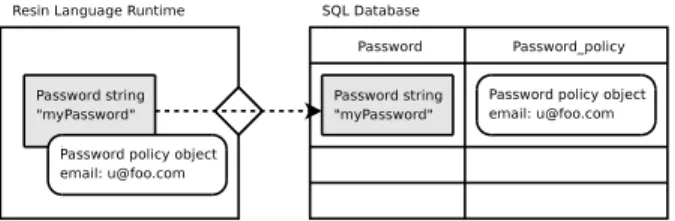
Figure 4: Saving persistent policies to a SQL database for HotCRP passwords. Uses symbols from Figure 1.
For example, HotCRP stores user passwords in a SQL database. It can be inconvenient and error-prone for the programmer to manually save metadata about the password’s policy object when saving it to the database, and then reconstruct the policy object when reading the password later.
To help programmers of such applications, RESINtransparently tracks data flows to and from persistent storage. RESIN’s default filter objects serialize policy objects to persistent files and database storage when data is written out, and de-serializes the policy objects when data is read back into the runtime.
For data going to a file, the file’s default filter object serializes the data’s policy objects into the file’s extended attributes. Whenever the application reads data from the file, the filter reads the serialized policy from the file’s extended attributes, and associates it with the newly-read data. RESINtracks policies for file data at byte-level granularity, as it does for strings.
RESINalso serializes policies for data stored in a SQL database,
as shown in Figure 4. RESINaccomplishes this by attaching a default filter object to the function used to issue SQL queries, and using that filter to rewrite queries and results. For aCREATE TABLEquery, the filter adds an additional policy column to store the serialized policy for each data column. For a query that writes to the database, the filter augments the query to store the serialized policy of each cell’s value into the corresponding policy column. Last, for a query that fetches data, the filter augments the query to fetch the corresponding policy column, and associates each de-serialized policy object with the corresponding data cell in the resulting set of rows.
Storing policies persistently also helps other programs, such as the Web server, to check invariants on file data. For example, if an application accidentally stores passwords in a world-readable file, and an adversary tries to fetch that file via HTTP, a RESIN-aware Web server will invoke the file’s policy objects before transmitting the file, fail theexport_check, and prevent password disclosure.
RESINonly serializes the class name and data fields of a policy object. This allows programmers to change the code for a policy class to evolve its behavior over time. For example, a program-mer could change theexport_checkmethod of HotCRP’s password policy object to disallow disclosure to the program chair without changing the existing persistent policy objects. However, if the application needs to change the fields of a persistent policy, the programmer will need to update the persistent policies, much like database schema migration.
3.4.2
Merging Policies
RESINuses character-level tracking to avoid having to merge policies when individual data elements are propagated verbatim, such as through concatenation or taking a substring. Unfortunately, merging is inevitable in some cases, such as when string characters with different policies are converted to integer values and added up to compute a checksum. In many situations, such low-level data transformation corresponds to a boundary, such as encryption or
hashing, and would be a good fit for an application-specific filter
object. However, relying on the programmer to insert filter objects
in all such places would be error-prone, and RESINprovides a safety net by merging policy objects in the absence of any explicit actions by the programmer.
By default, RESINtakes the union of policy objects of source operands, and attaches them to the resulting datum. Theunion strategy is suitable for some data flow assertions. For example, an assertion that tracks user-supplied inputs by marking them with a UserDatapolicy would like to label the result asUserDataif any source operand was labeled as such. In contrast, theintersection strategy may be applicable to other policies. An assertion that tracks data authenticity by marking data with anAuthenticDatapolicy would like to label the result asAuthenticDataonly if all source operands were labeled that way.
Because different policies may have different notions of a safe merge strategy, RESINallows a policy object to override themerge
method shown in Table 3. When application code merges two data
elements, RESINinvokes themergemethod on each policy of each source operand, passing in the entire policy set of the other operand
as the argument. Themergemethod returns a set of policy objects
that it wants associated with the new datum, or throws an exception if this policy should not be merged. Themergemethod can consult the set of policies associated with the other operand to implement either theunionorintersectionstrategies. The RESINruntime then labels the resulting datum with the union of all policies returned by allmergemethods.
4.
IMPLEMENTATION
We have implemented two RESINprototypes, one in the PHP runtime, and the other in Python. At a high-level, RESINrequires the addition of a pointer, that points to a set of policy objects, to the runtime’s internal representation of a datum. For example, in PHP, the additional pointer resides in thezvalobject for strings and numbers. For strings, each policy object contains a character range for which the policy applies. When copying or moving data from one primitive object to another, the language runtime copies the policy set from the source to the destination, and modifies the character ranges if necessary. When merging individual data elements, the runtime invokes the policies’ merge functions.
The PHP prototype involved 5,944 lines of code. The largest module is the SQL parsing and translation mechanism at about 2,600 lines. The core data structures and related functions make up about 1,100 lines. Most of the remaining 2,200 lines are spent propagating and merging policy objects. Adding propagation to the core PHP language required changes to its virtual machine opcode handlers,
such as variable assignment, addition, and string concatenation. In
addition, PHP implements many of its library functions, such as substrandprintf, in C, which are outside of PHP’s virtual machine and require additional propagation code.
To allow the Web server to check persistent policies for file data, as described in Section 3.4.1, we modified themod_phpApache module to de-serialize and invoke policy objects for all static files it serves. Doing so required modifying 49 lines of code inmod_php.
The Python prototype only involved 681 lines of code; this is fewer than the PHP prototype for two reasons. First, our Python pro-totype does not implement all the RESINfeatures; it lacks character-level data tracking, persistent policy storage in SQL databases, and Apache static file support. Second, Python uses fewer C libraries, so it required little propagation code beyond the opcode handlers.
def process_client(client_sock): req = parse_request(client_sock)
client_sock.__filter.context[’user’] = req.user ... process req ...
class PagePolicy(Policy):
def __init__(self, acl): self.acl = acl def export_check(self, context):
if not self.acl.may(context[’user’], ’read’): raise Exception("insufficient access") class Page:
def update_body(self, text):
text = policy_add(text, PagePolicy(self.getACL())) ... write text to page’s file ...
Figure 5: Python code for a data flow assertion that checks read access control in MoinMoin. Theprocess_clientandupdate_body functions are simplified versions of MoinMoin equivalents.
5.
APPLYING RESIN
RESIN’s main goal is to allow programmers to avoid security vul-nerabilities by specifying data flow assertions. Section 3.1 already showed how a programmer can implement a data flow assertion that prevents password disclosure in HotCRP. This section shows how a
programmer would implement data flow assertions in RESINfor a
number of other vulnerabilities and applications.
The following examples use the syntax described in Table 3. Addi-tionally, these examples usesock.__filterto access a socket’s filter object, and in the Python code,policy_addandpolicy_remove
return a new string with the same contents but a different policy set, because Python strings are immutable.
5.1
Access Control Checks
As mentioned in Section 2, RESINaims to address missing access control checks. To illustrate how a programmer would use RESIN
to verify access control checks, this section provides an example implementation of Data Flow Assertion 4, the assertion that verifies MoinMoin wiki’s read ACL scheme (see Section 2).
The MoinMoin ACL assertion prevents a wiki page from flowing
to a user that’s not on the page’s ACL. One way for a programmer
to implement this assertion in RESINis to:
1. annotate HTTP output channels with context that identifies the user on the other end of the channel;
2. define aPagePolicyobject that contains an ACL;
3. implement anexport_checkmethod inPagePolicythat matches the output channel against thePagePolicy’s ACL;
4. attach aPagePolicyto the data in each wiki page.
Figure 5 shows all the code necessary for this implementation. The
process_clientfunction annotates each HTTP connection’s context with the current user, after parsing the user’s request and creden-tials. PagePolicycontains a copy of the ACL, and implements export_check. Theupdate_bodymethod creates aPagePolicyobject and attaches it to the page’s data before saving the page to the file system. One reason why thePagePolicyis short is that it reuses existing application code to perform the access control check.
This example assertion illustrates the use of persistent policies. Theupdate_bodyfunction associates aPagePolicywith the contents of a page immediately before writing the page to a file. As the page data flows to the file, the default filter object serializes thePagePolicy object, including the access control list, to the file system. When MoinMoin reads this file later, the default filter will de-serialize
thePagePolicyand attach it to the page data in the runtime, so that
class CodeApproval extends Policy { function export_check($context) {} }
function make_file_executable($f) { $code = file_get_contents($f);
policy_add($code, new CodeApproval()); file_put_contents($f, $code);
}
class InterpreterFilter extends Filter { function filter_read($buf) {
foreach (policy_get($buf) as $p) if ($p instanceof CodeApproval)
return $buf;
throw new Exception(’not executable’); }
}
Figure 6: Simplified PHP code for a data flow assertion that catches server-side script injection. In the actual implementation,filter_read verifies that each character in$bufhas theCodeApprovalpolicy.
In this implementation, the update_bodyfunction provides a single place where MoinMoin saves the page to the file system, and a thus a single place to attach thePagePolicy. If, however, MoinMoin had multiple code paths that stored pages in the file system, the programmer could assign the policy to the page contents earlier, perhaps directly to the CGI input variables.
In addition to read access checks, the programmer can also define a data flow assertion that verifies write access checks. MoinMoin’s write ACLs imply the assertion:data may flow into wiki pageponly if the user is onp’s write ACL. MoinMoin stores a wiki page as a directory that contains each version of the page as a separate file. The programmer can implement this assertion by creating a filter class that verifies the write ACL against the current user, and then attaching filter instances to the files and directory that represent a wiki page. The filters restrict the modification of existing versions, and also the creation of new versions based on the page’s ACL.
5.2
Server-Side Script Injection
Another class of vulnerabilities that RESINaims to address is server-side script injection, as described in Section 2, which can be addressed with Data Flow Assertion 3. One way for the programmer to implement this assertion is to:
1. define an emptyCodeApprovalpolicy object;1
2. annotate application code and libraries withCodeApproval policy objects;
3. change the interpreter’s default input filter (see Section 3.2.2) to require aCodeApprovalpolicy on all imported code. This data flow assertion instructs RESINto limit what code the in-terpreter may use. Figure 6 lists the code for implementing this assertion. When installing an application, the developer tags the ap-plication code and system libraries with a persistentCodeApproval policy object usingmake_file_executable. Thefilter_readmethod only allows code with aCodeApprovalpolicy object to pass, ensur-ing that code from an adversary which would lack theCodeApproval policy, will not be executed, whether throughincludestatements,
eval, or direct HTTP requests.
The programmer must override the interpreter’s filter in a global configuration file, to ensure the filter is set before any other code
1
TheCodeApprovalpolicy does not need to take the intersection of policies during merge because RESIN’s character-level data tracking avoids having to merge file data.
executes; PHP’sauto_prepend_fileoption is one way to do this. If, instead, the application set the filter at the beginning of the application’s own code, adversaries could bypass the check if they are able to upload and run their own.phpfiles.
This example illustrates the need for programmer-specified
fil-ter objects in addition to programmer-specified context for default
filters. The default filter callsexport_checkon all the policies that pass through, but the default filter always permits data that has no
policy. The filter in this script injection assertion requires that data
have aCodeApprovalpolicy, and reject data that does not.
5.3
SQL Injection and Cross-Site Scripting
As mentioned in Section 2, the two most popular attack vectors in Web applications today are SQL injection and cross-site scripting. This section presents two different strategies for using RESINto address these vulnerabilities.
To implement the first strategy, the programmer:
1. defines two policy object classes:UntrustedDataand
SQL-Sanitized;
2. annotates untrusted input data with anUntrustedDatapolicy; 3. changes the existing SQL sanitization function to attach a
SQLSanitizedobject to the freshly sanitized data;
4. changes the SQL filter object to check the policy objects on each SQL query. If the query contains any characters that have theUntrustedDatapolicy, but not theSQLSanitizedpolicy, the filter will throw an exception and refuse to forward the query to the database.
Addressing cross-site scripting is similar, except that it uses
HTML-Sanitizedrather thanSQLSanitized. This strategy catches unsani-tized data because the data will lack the correctSQLSanitizedor
HTMLSanitizedpolicy object. The reason for appending SQLSani-tizedandHTMLSanitizedinstead of removingUntrustedDatais to allow the assertion to distinguish between data that may be incorpo-rated into SQL versus HTML since they use different sanitization functions. This strategy ensures that the programmer uses the cor-rect sanitizer (e.g., the programmer did not accidentally use SQL quoting for a string used as part of an HTML document).
The second strategy for preventing SQL injection and cross-site scripting vulnerabilities is to use the sameUntrustedDatapolicy from the previous strategy, but rather than appending a policy like SQLSanitized, the SQL filter inspects the final query and throws an exception if any characters in the query’s structure (keywords, white
space, and identifiers) have theUntrustedDatapolicy. The HTML
filter performs a similar check forUntrustedDataon JavaScript portions of the HTML to catch cross-site scripting errors, similar to a technique used in prior work [34].
A variation on the second strategy is to change the SQL filter’s tokenizer to keep contiguous bytes with theUntrustedDatapolicy
in the same token, and to automatically sanitize the untrusted data
in transit to the SQL database. This will prevent untrusted data from affecting the command structure of the query, and likewise for the HTML tokenizer. These two variations require the addition of either tokenizing or parsing to the filter objects, but they avoid relying on trusted quoting functions.
We have experimented with both of these strategies in RESIN, and find that while the second approach requires more code for the parsers, many applications can reuse the same parsing code.
A SQL injection assertion is complementary to the other asser-tions we describe in this section. For instance, even if an application
has a SQL injection vulnerability, and an adversary manages to
the policy object for each password will still be de-serialized from the database, and will prevent password disclosure.
5.4
Other Attack Vectors
Finally, there are a number of other attack vectors that RESINcan help defend against. For instance, to address the HTTP response splitting attack described in Section 3.2, a developer can use a filter to reject any CR-LF-CR-LF sequences in the HTTP header that came from user input.
As Web applications use more client-side code, they also use more JSON to transport data from the server to the client. Here, much like in SQL injection, an adversary may be able to craft an input string that changes the structure of the JSON’s JavaScript data structure, or worse yet, include client-side code as part of the data structure. Web applications can use RESIN’s data tracking mechanisms to avoid these pitfalls as they would for SQL injection.
5.5
Application Integration
One potential concern when using RESIN is that a data flow assertion can duplicate data flow checks and security checks that already exist in an application. As a concrete example, consider HotCRP, which maintains a list of authors for each paper. If a paper submission is anonymous, HotCRP must not reveal the submission’s list of authors to the PC members. HotCRP already performs this check before adding the author list to the HTML output. Adding a RESINdata flow assertion to verify read access to the author list will make HotCRP perform the access check a second time within the data flow assertion, duplicating the check that already exists.
If a programmer implements an application with RESINin mind, the programmer can use an exception to indicate that the user may not read certain data, thereby avoiding duplicate access checks. For
example, we modified the HotCRP code that displays a paper
sub-mission to always try to display the subsub-mission’s author list. If the
submission is anonymous, the data flow assertion raises an
excep-tion; the display code catches that exception, and then displays the
string “Anonymous” instead of the author list. This avoids dupli-cate checks because the page generation code does not explicitly perform the access control check. However, if the application sends HTML output to the browser during atryblock and then encounters an exception later in thetryblock, the previously released HTML might be invalid because thetryblock did not run to completion.
RESINprovides anoutput bufferingmechanism to assist with this style of code. To use output buffering, the application starts a new
tryblock before running HTML generation code that might throw an exception. At the start of thetryblock, the application notifies the outgoing HTML filter object to start buffering output. If thetry block throws an exception, the correspondingcatchblock notifies the HTML filter to discard the output buffer, and potentially send alternate output in its place (such as “Anonymous” in the example). However, if thetryblock runs to completion, thetryblock notifies the HTML filter to release the data in the output buffer.
Using exceptions, instead of explicit access checks, frees the programmer from needing to know exactly which checks to invoke in every single case, because RESINinvokes the checks. Instead, programmers need to only wrap code that might fail a check with an appropriate exception handler, and specify how to present an exception to the user.
6.
SECURITY EVALUATION
The main criteria for evaluating RESINis whether it is effective at helping a programmer prevent data flow vulnerabilities. To provide a quantitative measure of RESIN’s effectiveness, we focus on three
areas. First, we determine how much work a programmer must do
to implement an existing implicit data flow plan as an explicit data
flow assertion in RESIN. We then evaluate whether each data flow assertion actually prevents typical data flow bugs, both previously-known and previously-unpreviously-known bugs. Finally, we evaluate whether a single high-level assertion can be general enough to cover both common and uncommon data flows that might violate the assertion, by testing assertions against bugs that use surprising data paths.
6.1
Programmer Effort
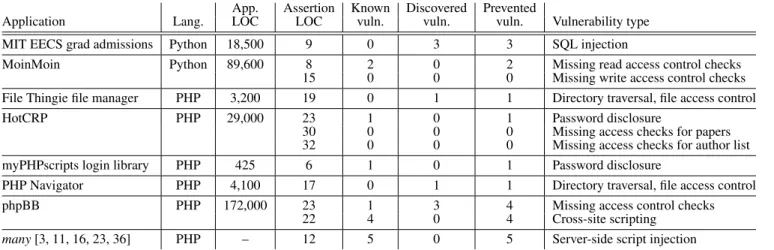
To determine the level of effort required for a programmer to use RESIN, we took a number of existing, off-the-shelf applications and examined some of their implicit security-related data flow plans. We then implemented a RESINdata flow assertion for each of those implicit plans. Table 4 summarizes the results, showing the applica-tions, the number of lines of code in the application, and the number of lines of code in each data flow assertion.
The results in Table 4 show that each data flow assertion requires a small amount of code, on the order of tens of lines of code. The assertion that checks read access to author lists in HotCRP requires the most changes, 32 lines. This is more code than other assertions because our implementation issues database queries and interprets
the results to perform the access check, requiring extra code.
How-ever, many of the other assertions in Table 4 reuse existing code from the application’s existing security plan, and are shorter.
Table 4 also shows that the effort required to implement a data flow assertion does not grow with the size of the application. This
is because implementing an assertion only requires changes where
sensitive data first enters the application, and/or where data exits the system, not on every path data takes through the application; RESIN’s data tracking handles those data paths. For example, the cross-site scripting assertion for phpBB is only 22 lines of code even though phpBB is 172,000 lines of code.
As a point of comparison for programmer effort, consider the MoinMoin access control scheme that appeared in the Flume evalu-ation [28]. MoinMoin uses ACLs to limit who can read and write a wiki page. To implement this scheme under Flume, the program-mer partitions MoinMoin into a number of components, each with different privileges, and then sets up the OS to enforce the access control system using information flow control. Adapting MoinMoin to use Flume requires modifying or writing about 2,000 lines of application code. In contrast, RESINcan check the same MoinMoin access control scheme using two assertions, an eight line assertion for reading, and a 15 line assertion for writing, as shown in
Ta-ble 4. Most importantly, adding these checks with RESINrequires
no structural or design changes to the application.
Although Flume provides assurance against malicious server code and RESIN does not, the RESIN assertions catch the same two vulnerabilities (see Section 6.2) that Flume catches, because they do not involve binary code injection. By focusing on a weaker threat model, RESIN’s lightweight and easy-to-use mechanisms provide
a compelling choice for programmers that want additional security
assurance without much extra effort.
6.2
Preventing Vulnerabilities
To evaluate whether RESIN’s data flow assertions are capable of
preventing vulnerabilities, we checked some of the assertions in Table 4 against known vulnerabilities that the assertion should be able to prevent. The results are shown in Table 4, where the number of previously-known vulnerabilities is greater than zero.
The results in Table 4 show that each RESINassertion does pre-vent the vulnerabilities it aims to prepre-vent. For example, the phpBB access control assertion prevents a known missing access control check listed in the CVE [41], and the HotCRP password
protec-App. Assertion Known Discovered Prevented
Application Lang. LOC LOC vuln. vuln. vuln. Vulnerability type
MIT EECS grad admissions Python 18,500 9 0 3 3 SQL injection
MoinMoin Python 89,600 8 2 0 2 Missing read access control checks
15 0 0 0 Missing write access control checks
File Thingie file manager PHP 3,200 19 0 1 1 Directory traversal, file access control
HotCRP PHP 29,000 23 1 0 1 Password disclosure
30 0 0 0 Missing access checks for papers
32 0 0 0 Missing access checks for author list
myPHPscripts login library PHP 425 6 1 0 1 Password disclosure
PHP Navigator PHP 4,100 17 0 1 1 Directory traversal, file access control
phpBB PHP 172,000 23 1 3 4 Missing access control checks
22 4 0 4 Cross-site scripting
many[3, 11, 16, 23, 36] PHP – 12 5 0 5 Server-side script injection
Table 4: Results from using RESINassertions to prevent previously-known and newly discovered vulnerabilities in several Web applications.
tion assertion shown in Section 3.1 prevents the password disclo-sure vulnerability described in Section 2. The assertion to prevent server-side script injection described in Section 5.2 prevents such vulnerabilities in five different applications [3, 11, 16, 23, 36].
Since we implemented these assertions with knowledge of the previously-known vulnerabilities, it is possible that the assertions are biased to thwart only those vulnerabilities. To address this bias, we tried to find new bugs, as an adversary would, that violate the assertions in Table 4. These results are shown in Table 4 where the number of newly discovered vulnerabilities is greater than zero.
These results show that RESINassertions can prevent vulnerabili-ties, even if the programmer has no knowledge of the specific vulner-abilities when writing the assertion. For example, we implemented a generic data flow assertion to address SQL injection vulnerabilities in MIT’s EECS graduate admissions system. Although the original programmers were careful to avoid most SQL injection vulnerabili-ties, the assertion revealed three previously-unknown SQL injection vulnerabilities in the admission committee’s internal user interface.
As a second example, File Thingie and PHP Navigator are Web based file managers, and both support a feature that limits a user’s
write access to a particular home directory. We implemented this behavior as a write access filter as described in Section 3.2.3. Again, both applications have code in place to check directory accesses, but after a careful examination, we discovered a directory traversal vul-nerability that violates the write access scheme in each application. The data flow assertions catch both of these vulnerabilities.
As a final example, phpBB implements read access controls so that only certain users can read certain forum messages. We imple-mented an assertion to verify this access control scheme. In addition
to preventing a previously-known access control vulnerability, the
assertion also prevents three previously-unknown read access vi-olations that we discovered. These results confirm that data flow assertions in RESINcan thwart vulnerabilities, even if the program-mer does not know they exist. Furthermore, these assertions likely eliminate even more vulnerabilities that we are not aware of.
The three vulnerabilities in phpBB are not in the core phpBB package, but in plugins written by third-party programmers. Large-scale projects like phpBB are a good example of the benefit of explicitly specifying data flow assertions with RESIN. Consider a situation where a new programmer starts working on an existing application like HotCRP or phpBB. There are many implicit rules that programmers must follow in hundreds of places, such as who is responsible for sanitizing what data to prevent SQL injection and
cross-site scripting, and who is supposed to call the access control
function. If a programmer starts writing code before understanding all of these rules, the programmer can easily introduce vulnerabil-ities, and this turned out to be the case in the phpBB plugins we examined. Using RESIN, one programmer can make a data flow rule explicit as an assertion and then RESINwill check that assertion for all the other programmers.
These results also provide examples of a single data flow asser-tion thwarting more than one instance of an entire class of vulner-abilities. For example, the single read access assertion in phpBB thwarts four specific instances of read access vulnerabilities (see Table 4). As another example, a single server-side script injection assertion that works in all PHP applications catches five different previously-known vulnerabilities in the PHP applications we tested (see Table 4). This suggests that when a programmer inevitably finds a security vulnerability and writes a RESINassertion that addresses it, the assertion will prevent the broad class of problems that allow the vulnerability to occur in the first place, rather than only fixing the one specific instance of the problem.
6.3
Generality
To evaluate whether RESIN data flow assertions are general enough to cover the many data flow paths available to an adver-sary, we checked whether the assertions we wrote detect a number of data flow bugs that use surprising data flow channels.
The results indicate that a high-level RESINassertion can detect
and prevent vulnerabilities even if the vulnerability takes advantage of an unanticipated data flow path. For example, a common way for an adversary to exploit a cross-site scripting vulnerability is to enter malicious input through HTML form inputs. However, there was a cross-site scripting vulnerability in phpBB due to a more unusual data path. In this vulnerability, phpBB requests data from awhoisserver and then uses the response without sanitizing it first; an adversary exploits this vulnerability by inserting malicious JavaScript code into awhoisrecord and then requesting thewhois record via phpBB. The RESINassertion that protects against
cross-site scripting in phpBB, listed in Table 4, prevents vulnerabilities at a high-level; the assertion treatsallexternal input as untrusted and makes sure that the external input data flows through a sanitizer before phpBB may use the data in HTML. This assertion is able to prevent both the more common HTML form attack as well as the less commonwhoisstyle attack because the assertion is general enough to cover many possible data flow paths.
A second example is in the read access controls for phpBB’s forum messages. The common place to check for read access is
before displaying the message to a user, but one of the read access vulnerabilities, listed in Table 4, results from a different data flow path. When a user replies to a message, phpBB includes a quotation of the original message in the reply message. In the vulnerable ver-sion, phpBB also allows a user to reply to a message even if the user lacks permission to read the message. To exploit this vulnerability, an adversary, lacking permission to read a message, replies to the message using its message ID, and then reads the content of the original message, quoted in the reply template. The RESIN
asser-tion that checks the read access controls prevents this vulnerability
because the assertion detects data flow from the original message to the adversary’s browser, regardless of the path taken.
A final example comes from the two password disclosure
vulner-abilities shown in Table 4. As described in Section 5, the HotCRP
disclosure results from a logic bug in the email preview and the email reminder features. In contrast, the disclosure in the myPHPscripts login library [33] results from the library storing its users’ pass-words in a plain-text file in the same HTTP-accessible directory that contains the library’s PHP files [35]. To exploit this, an adversary requests the password file with a Web browser. Despite
prevent-ing password disclosure through two different data flow paths, the
assertions for password disclosure in HotCRP and myPHPscripts are very similar (the only difference is that HotCRP allows email reminders and myPHPscripts does not). This shows that a single RESINdata flow assertion can prevent attacks through a wide range of attack vectors and data paths.
7.
PERFORMANCE EVALUATION
Although the main focus of RESINis to improve application secu-rity, application developers may be hesitant to use these techniques if they impose a prohibitive performance overhead. In this section, we show that RESIN’s performance is acceptable. We first mea-sure the overhead of running HotCRP with and without the use of RESIN, and then break down the low-level costs that account for the
overhead using microbenchmarks. The overall result is that a com-plex Web application like HotCRP incurs a 33% CPU overhead for generating a page, which is unlikely to be noticeable by end-users. The following experiments were run on a single core of a 2.3GHz Xeon 5140 server with 4GB of memory running Linux 2.6.22. The
unmodified PHP interpreter is version 5.2.5, the same version that
the RESINPHP interpreter is based on.
7.1
Application Performance
To evaluate the system-level overhead of RESIN, we compare a modified version of HotCRP running in the RESINPHP interpreter against an unmodified version of HotCRP 2.26 running in an un-modified PHP interpreter. We measured the time to generate the Web page for a specific paper in HotCRP, including the paper’s title, abstract, and author list (if not anonymized), as if a PC member requested it through a browser. The measured runtime includes the time taken to parse PHP code, recall the session state, make SQL
queries, and invoke the relevant data flow assertions. In this
exam-ple, RESINinvoked two assertions: one protected the paper title and abstract (and the PC member was allowed to see them), and the other protected the author list (and the PC member was not allowed to see it, due to anonymization). We used the output buffering technique from Section 5.5 to present a consistent interface even when the author list policy raised an exception. The resulting page consisted of 8.5KB of HTML.
The unmodified version of HotCRP generates the page in 66ms (15.2 requests per second) and the RESINversion uses 88ms (11.4 requests per second), averaged over 2000 trials. The performance of this benchmark is CPU limited. Despite our unoptimized RESIN
Unmodified RESIN RESIN
Operation PHP no policy empty policy Assign variable 0.196µs 0.210µs 0.214µs Function call 0.598µs 0.602µs 0.619µs String concat 0.315µs 0.340µs 0.463µs Integer addition 0.224µs 0.247µs 0.384µs File open 5.60µs 7.05µs 18.2µs File read, 1KB 14.0µs 16.6µs 26.7µs File write, 1KB 57.4µs 60.5µs 71.7µs SQL SELECT 134µs 674µs 832µs SQL INSERT 64.8µs 294µs 508µs SQL DELETE 64.7µs 114µs 115µs
Table 5: The average time taken to execute different operations in
an unmodified PHP interpreter, a RESINPHP interpreter without any policy, and a RESINPHP interpreter with an empty policy.
prototype, its performance is likely to be adequate for many real world applications. For example, in the 30 minutes before the SOSP submission deadline in 2007, the HotCRP submission system logged only 390 user actions. Even if there were 10 page requests for each logged action (likely an overestimate), this would only average to 2.2 requests per second and a CPU utilization of 14.3% without RESIN, or 19.1% with RESINon a single core. Adding a second CPU core doubles the throughput.
7.2
Microbenchmarks
To determine the source of RESIN’s overhead, we measured the
time taken by individual operations in an unmodified PHP inter-preter, and a RESINPHP interpreter both without any policy and with an empty policy. The results of these microbenchmarks are shown in Table 5.
For operations that simply propagate policies, such as variable assignments and function calls, RESINincurs a small absolute
over-head of 4-21ns, but percentage wise, this is about a 10% overover-head.
This overhead is due to managing the policy set objects.
The overhead for invoking a filter object’s interposition method
(filter_read,filter_write, andfilter_func) is the same as for a stan-dard function call, except that RESINcalls the interposition method once for every call toreadorwrite. Therefore the application pro-grammer has some control over how much interposition overhead the application will incur. For example, the programmer can control the amount of computation the interposition method performs, and the number of times the application callsreadandwrite.
For operations that track byte-level policies, such as string con-catenation, the overhead without any policy is low (8%), but in-creases when a policy is present (47%). This reflects the cost of propagating byte-level policies for parts of the string at runtime as well as more calls tomallocandfree. A more efficient implementa-tion of byte-level policies could reduce these calls.
Operations that merge policies (such as integer addition, which cannot do byte-level tracking) are similarly inexpensive without a policy (10%), but are more expensive when a policy is applied (71%). This reflects the cost of invoking the programmer-supplied merge function. However, in all the data flow assertions we encountered, we did not need to apply policies to integers, so this might not have a large impact on real applications.
For file open, read, and write, RESINadds potentially noticeable overhead, largely due to the cost of serializing, de-serializing, and invoking policies and filters stored in a file’s extended attributes. Caching file policies in the runtime will likely reduce this overhead. The INSERT operation listed in Table 5 inserts 10 cells, each
into a different column, and the SELECT operation reads 10 cells,
![Table 2: Top Web site vulnerabilities of 2007 [48].](https://thumb-us.123doks.com/thumbv2/123dok_us/8667755.2342860/2.918.114.401.79.229/table-top-web-site-vulnerabilities-of.webp)