Digging into HTTPS: Flow-Based Classification
of Webmail Traffic
Dominik Schatzmann
ETH Zurich [email protected]Wolfgang Mühlbauer
ETH Zurich [email protected]Thrasyvoulos
Spyropoulos
ETH Zurich [email protected]Xenofontas
Dimitropoulos
ETH Zurich [email protected]ABSTRACT
Recently, webmail interfaces, e.g., Horde, Outlook Web Access, and webmail platforms such as GMail, Yahoo!, and Hotmail have seen a tremendous boost in popularity. Given the importance of e-mail for personal and business use alike, and its exposure to im-minent threats, there exists the need for a comprehensive view of the Internet mail system, including webmail traffic.
In this paper we propose a novel,passiveapproach to identify webmail traffic solely based onnetwork-level datain order to ob-tain acomprehensiveview of the mail system. Key to our approach is that we leveragecorrelationsacross protocols and time to intro-duce novel features for HTTPS webmail classification: First, web-mail servers tend to reside close to legacy IMAP and POP web-mail servers, which are easy to identify. Second, the usage of webmail services results in distinct patterns on sessions’ duration and on the diurnal/weekly traffic usage profile. Third, traffic flows to webmail platforms exhibit inherent periodicities since AJAX-based clients periodically check for new messages. We use these features to build a simple classifier and detect webmail traffic on real-world NetFlow traces from a medium-sized backbone network.
We believe that the major contribution of this paper – exploring a set of new features that could classify applications that run over HTTPS ports solely based on NetFlow data – will stimulate more general advance in the field of traffic classification.
Categories and Subject Descriptors
C.2.3 [Computer-Communication Networks]: Network Opera-tions
General Terms
Measurement, AlgorithmsKeywords
Traffic classification, HTTPS traffic, webmail, flow-level data
Permission to make digital or hard copies of all or part of this work for personal or classroom use is granted without fee provided that copies are not made or distributed for profit or commercial advantage and that copies bear this notice and the full citation on the first page. To copy otherwise, to republish, to post on servers or to redistribute to lists, requires prior specific permission and/or a fee.
IMC’10,November 1–3, 2010, Melbourne, Australia. Copyright 2010 ACM 978-1-4503-0057-5/10/11 ...$10.00.
1.
INTRODUCTION
Speculations that web browsers could gradually supplant tradi-tional operating systems as the default platform for user applica-tions [21] go back to the first browser war in the mid 90’s. Accord-ing to recent reports [6] many Internet users prefer to access their e-mail via a web-based (webmail) interface such as Horde [11], Outlook Web Access (OWA) [25], or a webmail platform as pro-vided by GMail, Yahoo!, or Hotmail. Similar trends also hold for many other applications, such as video, VoIP, and instant messag-ing, presently making browsers more than ever before the new op-erating system.
This trend however is detrimental for the field of Internet traffic classification, which over the past years has seen a plethora of pro-posals [16]. Evidently,port-basedapproaches are insufficient since many of today’s applications use port 80 or HTTPS port 443 [23]. Signature-basedsolutions [5,9,14,23,30], which generally assume packet-level traces, fail if payload encryption is used, raise privacy or legal issues, and may not scale well enough to obtain a network-wide characterization of traffic. Even with hard to obtain, unen-crypted full-packet traces, it is very difficult to identify the applica-tions in use [8]. Statistics-based(e.g., [1, 2, 7, 19, 20, 22, 27]) and host-behavior-based[13–15] techniques avoid payload inspection. The former rely mainly on flow-level features such as flow duration, number and size of packets per flow and classify traffic flows. In our extensive experiments, we have found that flow-based features are not sufficient to classify individual HTTPS flows as webmail or not. Finally, host-based approaches (e.g., BLINC [14]) attempt to classify a host directly based on its communication pattern, and are the closest in spirit to our approach. Yet, to our best knowledge, host-based approaches have not been applied before to HTTP(S) traffic classification.
As a first step towards deciphering HTTP(S) traffic, we, in this work, address the challenging problem of extracting HTTPS-based webmail traffic from coarse-grained NetFlow data. Given its im-portance for personal and business use, and its exposure to immi-nent threats [3, 12], there exists a need for a comprehensive view of the Internet mail system [10, 26, 28], including webmail traf-fic. Measuring webmail traffic can enhance our understanding of shifting usage trends and mail traffic evolution. Surprisingly, we find that more than66%of all HTTPS flows observed at the border routers of the SWITCH backbone network [31] are related to web-mail. With GMail having recently enabled HTTPS by default (and other platforms expected to follow), this number will only increase in the future.
The most important contribution in this work is the introduc-tion and evaluaintroduc-tion of three novel features for identifying HTTPS
mail traffic. Key to our approach is that we leveragecorrelations across protocols and time: (i) The Internet mail system is an inter-play of multiple protocols (SMTP, IMAP, POP, webmail). We find that webmail servers tend to reside in the vicinity of legacy SMTP, IMAP, and POP servers, which can be identified easily and reli-ably [17] using port numbers, thus providing significant hints for detecting webmail servers. (ii) Moreover, clients of a mail server share certain characteristics (e.g., usage patterns) irrespective of the used mail delivery protocol, i.e., IMAP, POP, or webmail. (iii) Fi-nally, webmail traffic exhibits pronounced periodic patterns due to application timers (and more generally AJAX-based technologies). This paper shows that these features can be harvested solely from coarse-grained NetFlow data to classify webmail traffic.
To get a first impression of the ability of the above features to un-cover webmail traffic, we train a simple classifier based on a (man-ually) pre-labeled set of hosts. Although finding the best possible classifier is beyond the scope of this paper, our simple classifier already exhibits93.2%accuracy and79.2%precision in detecting
HTTPS servers within SWITCH, which is remarkable given that we rely solely on NetFlow data. Moreover, our work shows that we can also effectively detect webmail traffic (e.g., GMail) towards mail serversoutsidethe SWITCH network, for which only a small sample of their total traffic is visible.
As a final note, we expect our methodology to stimulate advance in the field of traffic classification in general. For example, for our third feature we distinguish between “machine-generated” and “user-invoked” traffic based on network-level data, which is a very general method that can be used for several different types of de-tection problems.
The rest of this paper is structured as follows. Section 2 ex-plains our data set we have used. Section 3 introduces and discusses features to discriminate mail-related traffic from other web traffic. Then, Section 4 describes how we construct a classifier based on the features we identify and presents our first results. Finally, we give an overview of related work in Section 5 and conclude in Sec-tion 6.
2.
DATA SETS AND GROUND TRUTH
Throughout this paper we will rely on NetFlow traces coming from SWITCH [31], a medium-sized ISP. SWITCH is a backbone operator connecting approximately 30 Swiss universities, govern-ment institutions, and research labs. For our studies we have col-lected a trace in March 2010 that spans 11 days and contains un-sampled flows summarizing all traffic crossing the borders of SWITCH. This results in50to140million NetFlow records per hour, with ap-proximately3%being HTTPS. Over the 11 days, we observe more than1billion HTTPS records.Instead of analyzing individual flows, we mainly consider ses-sions. Our flow collectors break up long-lived flows into smaller fragments. Therefore, we merge flows sharing the same 5-tuple (source address and port, destination address and port, transport protocol identifier) if traffic exchange does not stay silent for more than900s. Moreover, we group merged flows with the same IP addresses into a session if they are not more than1,800s apart in
time. These values have been determined empirically, and found to work well in the past.
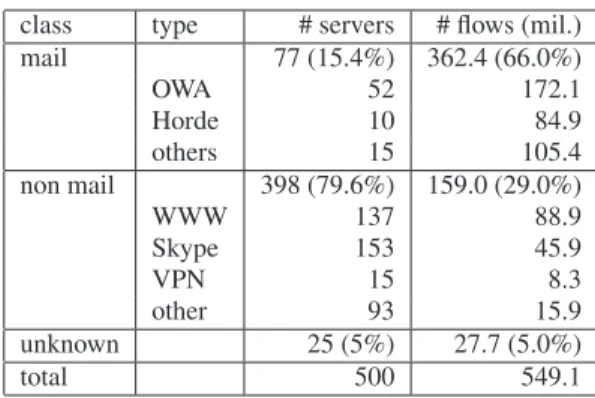
To train a classifier and to verify the accuracy of our classifica-tion in Secclassifica-tion 4 we need a labelled data set. To this end, we first extract from a 1-hour trace recorded on Monday noon 2010-03-15 the500most popular internal HTTPS hosts/sockets (top500) in terms of unique IP addresses they communicate with. Then, we manually access each of the500obtained IP addresses with a web browser and determine the host type (e.g., Horde, OWA). In cases
class type # servers # flows (mil.)
mail 77 (15.4%) 362.4 (66.0%) OWA 52 172.1 Horde 10 84.9 others 15 105.4 non mail 398 (79.6%) 159.0 (29.0%) WWW 137 88.9 Skype 153 45.9 VPN 15 8.3 other 93 15.9 unknown 25 (5%) 27.7 (5.0%) total 500 549.1
Table 1:top500data set
where this does not work (e.g., Skype), we usenmap. Table 1 summarizes the results of this time-consuming task.
The fact that66%of the observed HTTPS flows are related to Outlook Web Access, Horde, or other webmail interfaces (e.g., CommuniGate, SquirrelMail) is surprising and emphasizes the high popularity of webmail. Although the numbers may vary, we believe that our finding also holds for networks other than SWITCH. After all, e-mail is an omnipresent service in today’s Internet. While we cannot label5%of thetop500hosts, we further differentiate398
non-mail data sources into WWW content (e.g., e-shops, e-learning platforms), Skype, VPN services, etc.
3.
FEATURES
We are now ready to discuss the features we propose for discrim-inating between mail related web traffic and other HTTPS traffic.
As mentioned earlier, classifying individual flows relying on flow-level statistics alone (e.g., packets and bytes per flow) does not work well. For example, cross-checking the distribution of num-ber of bytes per flow does not reveal any significant differences between webmail and other HTTPS traffic flows.
An important challenge for feature extraction is to overcome the inherent heterogeneity of webmail traffic caused by the high num-ber of different webmail implementations.
The features we present in the following are based on two main observations: first, the network-wide view provided by our flow-based data set allows to leverage correlations across hosts and pro-tocols; second, periodic patterns due to regular timeouts are visible in flow data and provide useful application fingerprints.
To this end, this section sketches three approaches for distin-guishing webmail from other HTTPS traffic. The key ideas are as follows: (i) classical mail services (POP, IMAP, SMTP) are fre-quently in the vicinity of webmail services (see Section 3.1), (ii) the client base of legacy mail services and the clients of its associated webmail service share common behavior in terms of user activity (Section 3.2), and (iii) traffic generated by AJAX-based webmail clients shows a pronounced periodicity that we can leverage to tract webmail traffic (Section 3.3). The following subsections ex-plain these methods in detail, discuss their efficiency, and describe how to obtain features that can be used as input for a classifier.1
All three feature categories that we present in the following are broad in the sense that the key ideas are not limited to webmail clas-sification. We believe that our features can be more generally ap-plied towards demultiplexing HTTP(S) traffic into individual
appli-1
We stress here that simplicity and interpretability, rather than opti-mality, have been our guiding principles in translating our observa-tions into (scalar) features, used for our preliminary classification results.
0 0.1 0.2 0.3 0.4 0.5 0.6 0.7 0.8 0.9 1 0 200 400 600 800 1000 CDF IP distance webmail non mail
Figure 1: Distance to closest known legacy mail server.
cations. For example, inferring periodicity of sessions could trans-late into a powerful tool for distinguishing between “user-invoked” and “machine-generated” (e.g., AJAX) traffic and for extracting flow-level signatures associated with different applications. Also, studying the mix of well-known services within a subnet may pro-vide hints for the existence of other unknown services in the same subnet. Finally, although we will focus on HTTPS traffic when in-troducing our features (motivated also by the earlier observations about webmail traffic), we stress that the techniques we describe are applicable to both HTTP and HTTPS flow traces.
3.1
Service proximity
The Internet mail system relies on the interplay of multiple ser-vices or protocols, including SMTP, IMAP, POP, and webmail. We have observed that if there exists a POP, IMAP, or SMTP server within a certain domain or subnet, there is a high chance to find a webmail server in the same subnet. This is often due to network planning reasons. Since legacy mail delivery traffic and respective servers can be easily and reliably identified using port-based clas-sification [17], we can use their existence to infer webmail servers in the vicinity.
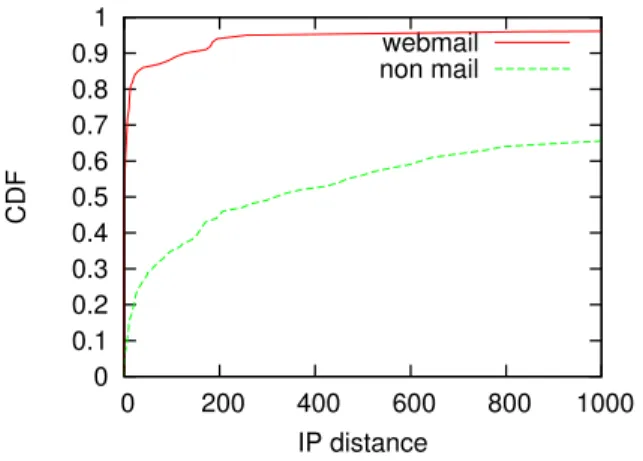
To verify our assumption of server proximity, we detect all mail servers in the SWITCH network relying on port numbers. Overall, we find300SMTP,140IMAP/S, and176POP/S servers. More-over, we use ourtop500data set, see Section 2. For every HTTPS server we compute the IP address distance, which is simply the in-teger difference between two IP addresses towards the closest mail server. Our assumption is that legacy mail servers are closer to webmail than other HTTPS servers. Figure 1 shows the observed distance for webmail and non-mail HTTPS servers (e.g. WWW, VPN, Skype) found among thetop500servers.
We observe that almost60%of the webmail servers have a dis-tance very close to the minimum, i.e., smaller than 10 IP addresses, while only5%of the non-mail servers are in this range. Moreover, more than90%of the webmail servers have a distance smaller than 200 IP addresses. These numbers indicate that webmail servers are substantially more likely than non-mail servers to be in the neigh-borhood of a legacy mail server.
3.2
Client base behavior
While Section 3.1 studies direct correlations between servers (i.e., how close they are), here we propose to analyze the entire client base of a server. We have found pronounced patterns for the following two properties: (i) the daily and weekly access patterns
0 0.2 0.4 0.6 0.8 1 0 0.2 0.4 0.6 0.8 1 CDF correlation coefficient webmail non mail
Figure 2: Correlation between activity profiles of web (mail or non-mail) servers and their closest legacy mail server.
of HTTPS servers (Section 3.2.1), and (ii) the duration of client connections (Section 3.2.2).
3.2.1
Daily and weekly profile
It is well-known that Internet traffic as a whole has diurnal and weekly patterns. Different applications may also have their own specific access patterns. For example, people access their e-mail frequently and often in a scheduled way, i.e., first thing in the morn-ing, whereas they access other web applications, such as online banking or Skype, in a substantially different way. More impor-tantly, we expect client activity to be more balanced during the day for servers that have a worldwide user base (e.g., a web page) than for webmail servers with a local user base. For example, everyone can access the website of ETH Zurich, but only a limited group of people can use the webmail platform of ETH Zurich.
To quantify these differences, we use the activity profile of known IMAP and POP servers as a reference point and evaluate how it compares with the activity profile of unknown web servers in their vicinity. Our expectation is that IMAP and POP diurnal and weekly patterns will be more similar to webmail than to non-mail server patterns. In line with the observations of Section 3.1, we compare an unknown server to the closest legacy mail server in the same sub-net. If there is no such server, we compare to the highest-volume legacy mail server in the same autonomous system.
Specifically, to compare two activity profiles, we partition a given time interval (in our case one week) into bins of one hour and count for every hour the number of client sessions that access the two servers. This way we derive two vectors of equal length that de-scribe the profile of the servers. To measure statistical dependence between the profiles, we compute the Spearman’s rank correlation coefficient [24] of the two vectors. The Spearman’s coefficient has two useful properties. First, it is a rank correlation measure and therefore it effectively normalizes the two vectors. Second, it cap-tures (non)-linear correlations between the two profiles, i.e., if the activity intensity of two profiles increases/decreases together. If two profiles are strongly correlated then the coefficient tends to1. The resulting value is used as input to our classifier (Section 4).
To demonstrate the efficiency of this feature, Figure 2 plots the distribution of Spearman’s correlation coefficient when comparing the activity profiles of alltop500HTTPS services with the pro-file of the closest mail server. For more than90%of the webmail servers the correlation coefficient is higher than0.6while this
0 0.1 0.2 0.3 0.4 0.5 0.6 0.7 0.8 0.9 1 0 50 100 150 200 CDF duration [s] webmail non mail
Figure 3: Median of session duration.
3.2.2
Session duration
A second characteristic of user behavior is how long clients nor-mally use a service. We speculate that webmail users generally take some time to read and answer their e-mails and may even keep the browser window open to wait for incoming messages. Hence, ac-cess duration for a webmail service should be higher, on average, than the one for a normal webpage. To capture the access duration of a service we consider sessions as described in Section 2. By defining session duration as the time between the start of the first session flow and the start of the last session flow, we ignore poten-tial TCP timeouts. Since we are interested intypicaluser behavior, we use the median across all session duration samples for a given server.
Figure 3 displays the distribution of the median duration for our top500servers. Again, we find significant differences between the client behavior of a webmail server and other non-mail servers. While the median session duration of a webmail service is shorter than25s for only some20%of the webmail servers, almost90%of non-mail servers experience such short median access times. Al-though there exist some non-mail servers with long session du-rations (these are mainly VPN servers), the overall differences in access duration are sufficiently pronounced to use this as another feature for classifying webmail traffic.
3.3
Periodicity
The activity profiles of Section 3.2.1 capture fluctuations in client activity over long time periods such as one week. We now inves-tigate the existence of higher frequency time patterns. The advent of AJAX-based technologies, which heavily rely on asynchronous interactions between clients and servers, has led to an increase in exchanged messages. Many of today’s webmail solutions check pe-riodically (e.g., every 5 minutes) for incoming messages and update the browser window if necessary. This is in line with the experience provided by mail programs such as Outlook or Thunderbird. Our idea is to leverage such periodicity that we expect to be visible in our flow-based data in order to classify e-mail related web traffic.
UsingWiresharkand Firebugwe analyze the communi-cation triggered by different webmail implementations. We find evidence of distinct periodicity in the sense that even during idle times a synchronization message is sent at regular time intervals. This also results in a new observed flow between client and server at the same time intervals. Nevertheless, capturing this periodicity requires some signal processing.
0 0.05 0.1 0.15 0.2 0 100 200 300 400 500 600 700 800 900 1000 Lag [s] Skype 0 0.05 0.1 0.15 0.2 WWW 0 0.05 0.1 0.15 0.2 HORDE 0 0.05 0.1 0.15 0.2 OWA
Figure 4: Autocorrelation of flow inter-arrival times.
We observe that webmail sessions are composed of noisy user-invoked traffic, resulting from activities such as sending e-mails or browsing folders, and evident machine-generated periodic traffic. To recover the periodicity buried in the signal, we start by filtering out all short sessions, since they are not useful for identifying peri-odic behaviors that repeat infrequently, e.g., every 5 minutes. For a server under study, we keep all sessions and respective flows with a duration higher than1,800s, which corresponds to six 5-minute
intervals. We then split each session into time bins of1s and count the number of flows that start within a bin. This is repeated for every client of the server under study. Then, we compute the au-tocorrelation function and average the auau-tocorrelation signals over the entire client base of a particular server, in order to smooth the signal and obtain a server-level behavior.
The plots in Figure 4 display the results for four different types of servers from ourtop500class. Evidently, webmail applica-tions show pronounced peaks at regular intervals, i.e., OWA at60s and Horde at300s, while web and Skype traffic does not show this pattern. Note that we observe similar periodic patterns for other webmail applications such as GMail or Yahoo!.
Although it is trivial to assess periodicity visually based on auto-correlation signals, we still need to introduce a simple metric that quantifies periodicity and can be used by a classifier. To this end, we consider the energies of different frequencies in the autocorrela-tion funcautocorrela-tion. By cutting off small time lags (e.g., below 200s) and high time lags (e.g., above 400s), we mitigate the impact of noise. Then, we compare the maximum and median signal levels that we observe within this time interval. High ratios are a strong indicator for periodicity, i.e., for the existence of a webmail server.
We believe that the basic idea behind our approach could in gen-eral be used to distinguish between user- and machine-initiated traf-fic. Hence, a spectrum of other applications as well is likely to have a characteristic fingerprint related to flow timing (in fact, our pre-liminary results already hint to such a direction).
4.
EVALUATION
The results of the preceding Section 3 are promising in the sense that it is apparently possible to discriminate between e-mail related web traffic and other HTTPS traffic leveraging correlations across protocols and time. In this section we explain how to build a classi-fier using our proposed features and present first results. Our main concern is not maximum accuracy. Rather we seek to demonstrate the general feasibility and the potential of our approach in a proof of concept study.
The general approach is as follows: We use the Support Vector Machine (SVM) library provided by [4]. For classification we rely on the four features presented in the preceding Section 3, namely service proximity, activity profiles, session duration, and periodic-ity. These features are used to discriminate between the two classes mail and non-mail. To estimate classification accuracy, we rely on 5-fold cross-validation: we partition the set of hosts into five com-plementary subsets of equal size. Four subsets are used as training data, the remaining subset serves as validation data. We repeat this process five times such that each of the five subsets is used exactly once as validation data.
Based on thetop500data set, see Table 1, we classify webmail hosts that are inside the SWITCH network.
Number of true HTTPS mail servers non mail servers
classified as mail 61 16
classified as non mail 16 382
accuracy (mean) 93.2% (±3)
Table 2: Classification of internal HTTPS servers.
As shown in Table 2, our classification realizes a remarkably high mean accuracy of93.2%(with standard deviation3.0) across
the five runs of our 5-fold cross-validation. In addition, the pre-cision for the mail class is also reasonably good at79.2%relying
solely on flow data and can be further improved by optimizing the classifier. By manually scrutinizing the results of the classification, we find our classifier can effectively discriminate between web-mail and Skype nodes mainly due to the service proximity feature of Section 3.1 and also between webmail and authentication ser-vices mainly due to the session duration feature of Section 3.2.2. However, it is challenging to distinguish between VPN and web-mail servers, which is the main reason for false negatives when classifying webmail hosts.
Popular webmail platforms such as GMail, Yahoo!, or Hotmail do not maintain servers within the SWITCH network and, there-fore, have been ignored in our discussion and analysis so far. Fi-nally, we briefly illustrate that applying our approach to uncover arbitrary webmail applications is equally feasible, irrespective of whether hosts are internal or external.
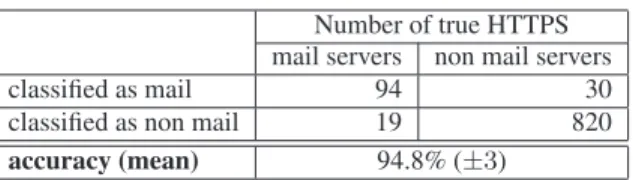
To this end, we extract additional data from our trace collected in March 2010. Following the methodology outlined in Section 2, we select 500 popularexternalHTTPS hosts/sockets. Manually la-beling this data set reveals32GMail servers2. For452additional HTTPS servers we established that they provide other non-mail ser-vices such as online banking, update, Facebook login servers, etc.
We now merge the original top500data set and the labeled external hosts creating a new data set with 1000 HTTPS servers. Based on our proposed features we build a classifier and again ap-ply 5-fold cross-validation.
2Recall that GMail recently switched to HTTPS.
Number of true HTTPS mail servers non mail servers
classified as mail 94 30
classified as non mail 19 820
accuracy (mean) 94.8% (±3)
Table 3: Classification of internal and external HTTPS servers.
Table 3 shows that we are able to classify internal and external HTTPS servers with overall accuracy of94.8%±3and precision
of75.8%for the mail class. Although these results are preliminary,
it appears possible to detect mail servers outside the SWITCH net-work using the same features, even though only a small sample of the total traffic of these servers is visible in our network. More-over, our case study on GMail suggests that the techniques pro-posed in this paper are not limited to specific applications (e.g., Outlook Web Access, Horde).
5.
RELATED WORK
Though extensive research has focused on traffic classification3, only a comparably tiny portion has studied methods for dissect-ing WWW traffic. Schneideret al. [29] extracted traffic to four popular Ajax-based sites from full packet traces and characterized differences between Ajax and HTTP traffic. Liet al. used man-ually constructed payload signatures to classify HTTP traffic into 14 applications and discussed trends from the early analysis [18] of two datasets collected three years apart. Compared to previous studies, our work focuses on extracting mail traffic from WWW traces and operates onflows, solving a substantially more challeng-ing problem than previous HTTP classification studies, which used full packet traces (e.g., [8]).
Some research has recently focused on the traffic characteristics of mail. Notably, Ramachandranet al. [26] characterized a number of network properties of spammers and emphasized that spammers can alter the content of spam to evade filters, whereas they cannot easily change their network-level footprint. This work suggested the plausibility of network-based spam filtering and was followed by the SNARE system [10], which uses a small number of simple traffic features to block spammers with reasonable accuracy.
Finally, compared to host-based classification, the novelty of our method can be mostly traced to the addition of the following two “dimensions”: (i) we introduce a timing dimension, as this con-tains valuable information about user- and machine- behaviors; (ii) while earlier host-based approaches [14] attempt to identify a com-moncommunication pattern (graph) shared by all hosts of this ap-plication, we try to correlate the unknown host behavior toknown hosts running a different, butrelatedapplication; as a result, hosts with different patterns could be validly identified under one class.
6.
CONCLUSION
In this paper, we have presented a number of flow-level tech-niques that can be used to separate webmail traffic from other HTTPS traffic. The novelty of our approach goes into two main directions: (i) we leverage correlations across (related) protocols (e.g. IMAP, POP, SMTP, and webmail) and among hosts sharing a similar client base, and (ii) we identify and exploit timing characteristics of web-mail applications. Based on these, we have introduced novel fea-tures, investigated their efficiency on a large flow data set, and used them to produce preliminary classification results on internal and
external HTTPS servers. This is the first work to show that it is possible to uncover HTTPS webmail applications solely based on flow-level data with approximately 93.2% accuracy and 79.2% pre-cision.
While the main focus of this paper has been the presented novel features, in future work, we intend to optimize our classifier and if needed to further extend our set of features (along the two direc-tions discussed) to improve the precision of our classification. In the same direction, we would also like to test the effect of sampling on our techniques, as we believe that most of the features presented are likely immune to sampling. Furthermore, we believe that our features are of broader interest for traffic classification, and could be used, for example, to facilitate demultiplexing of HTTP(S) traf-fic in general. Finally, having a reliable method to extract webmail traffic, we intend to perform an extensive characterization of the long-term evolution of mail-related traffic including usage trends and traffic mix between classical delivery and web-mail protocols.
Acknowledgments
We are grateful to SWITCH for providing their traffic traces and to the anonymous reviewers for their helpful comments. Also, we want to thank Bernhard Tellenbach, Martin Burkhart and Brian Trammell for their contributions. Special thanks to Simon Leinen for assisting with flow collection and processing. Finally, we are grateful to our shepherd Mark Allman. Part of this work has been funded by the EC Marie Curie IRG project 46528.
7.
REFERENCES
[1] T. Auld, A. Moore, and S. Gull. Bayesian Neural Networks for Internet Traffic Classification.IEEE Transactions on Neural Networks, 2007.
[2] L. Bernaille, R. Teixeira, and K. Salamatian. Early application identification. InProc. of ACM CoNEXT, 2006. [3] Trojan Now Uses Hotmail, Gmail as Spam Hosts.
http://news.bitdefender.com/NW544-en-n-\ -Trojan-Now-Uses-Hotmail-as-Spam-Hosts. html, 2007.
[4] C. Chang and C. Lin.LIBSVM: a Library for Support Vector Machines, 2001.
www.csie.ntu.edu.tw/~cjlin/libsvm. [5] T. Choi, C. Kim, S. Yoon, J. Park, B. Lee, H. Kim, and
H. Chung. Content-Aware Internet Application Traffic Measurement and Analysis. InProc. of IEEE/IFIP NOMS, 2005.
[6] Email client popularity.http://www.
campaignmonitor.com/stats/email-clients. [7] M. Crotti, M. Dusi, F. Gringoli, and L. Salgarelli. Traffic
Classification Through Simple Statistical Fingerprinting. ACM SIGCOMM CCR, 2007.
[8] H. Dreger, A. Feldmann, M. Mai, V. Paxson, and R. Sommer. Dynamic Application-Layer Protocol Analysis for Network Intrusion Detection. InProc. of USENIX Security
Symposium, 2006.
[9] P. Haffner, S. Sen, O. Spatscheck, and D. Wang. Acas: Automated Construction of Application Signatures. InProc. of SIGCOMM MineNet Workshop, 2005.
[10] S. Hao, N. Feamster, A. Gray, N. Syed, and S. Krasser. Detecting Spammers with SNARE: Spatio-Temporal Network-level Automatic Reputation Engine. InProc. of USENIX Security Symposium, 2009.
[11] The Horde Project.www.horde.org.
[12] Scammers Exploit Public Lists of Hijacked Hotmail Passwords.http://www.computerworld.com/s/ article/9139092/Scammers_exploit_public_ lists_of_hijacked_Hotmail_passwords, 2007. [13] M. Iliofotou, P. Pappu, M. Faloutsos, M. Mitzenmacher, and
G. Varghese. Network Monitoring Using Traffic Dispersion Graphs. InProc. of ACM IMC, 2007.
[14] T. Karagiannis, K. Papagiannaki, and M. Faloutsos. BLINC: Multilevel Traffic Classification in the Dark. InProc. of ACM SIGCOMM, 2005.
[15] T. Karagiannis, K. Papagiannaki, N. Taft, and M. Faloutsos. Profiling the End Host. InProc. of PAM, 2007.
[16] H. Kim, K. Claffy, M. Fomenkov, D. Barman, M. Faloutsos, and K. Lee. Internet Traffic Classification Demystified: Myths, Caveats, and the Best Practices. InProc. of ACM CoNEXT, 2008.
[17] H. Kim, M. Fomenkov, K. Claffy, N. Brownlee, D. Barman, and M. Faloutsos. Comparison of Internet Traffic
Classification Tools. InProc. of IMRG workshop on application classification and identification report, 2009. [18] W. Li, A. W. Moore, and M. Canini. Classifying HTTP
Traffic in the New Age. InACM SIGCOMM, Poster Session, 2008.
[19] Z. Li, R. Yuan, and X. Guan. Accurate Classification of the Internet Traffic Based on the SVM Method. InProc. of IEEE International Conference on Communications (ICC), 2007. [20] A. McGregor, M. Hall, P. Lorier, and J. Brunskill. Flow
Clustering Using Maching Learning Techniques. InProc. of PAM, 2004.
[21] The Middleware Threats.
http://biz.yahoo.com/msft/p7.html.
[22] A. Moore and D. Zuev. Internet Traffic Classification Using Bayesian Analysis Techniques. InProc. of ACM
SIGMETRICS, 2005.
[23] A. W. Moore and P. Konstantina. Toward the Accurate Identification of Network Applications. InProc. of PAM, 2005.
[24] J. Myers and A. Well.Research Design and Statistical Analysis (2nd edition). Routledge, 2002.
[25] Microsoft Outlook Web Access.www.microsoft.com/ exchange/code/OWA/index.html.
[26] A. Ramachandran and N. Feamster. Understanding the Network-Level Behavior of Spammers. InProc. of ACM SIGCOMM, 2006.
[27] M. Roughan, S. Sen, O. Spatschek, and N. Duffield. Class-of-Service Mapping for QoS: a Statistical
Signature-Based Approach to IP Traffic Classification. In Proc. of ACM IMC, 2004.
[28] D. Schatzmann, M. Burkhart, and T. Spyropoulos. Inferring Spammers in the Network Core. InProc. of PAM, 2009. [29] F. Schneider, S. Agarwal, T. Alpcan, and A. Feldmann. The
New Web: Characterizing AJAX Traffic. InProc. of PAM, 2008.
[30] S. Sen, O. Spatscheck, and D. Wang. Accurate, Scalable In-Network Identification of P2P Traffic Using Application Signatures. InProc. of WWW, 2004.
[31] The Swiss Education and Research Network (SWITCH). http://www.switch.ch.